An all-electric version of one of the world’s best-known small utility airplanes hummed through its first flight today at Moses Lake in central Washington state.
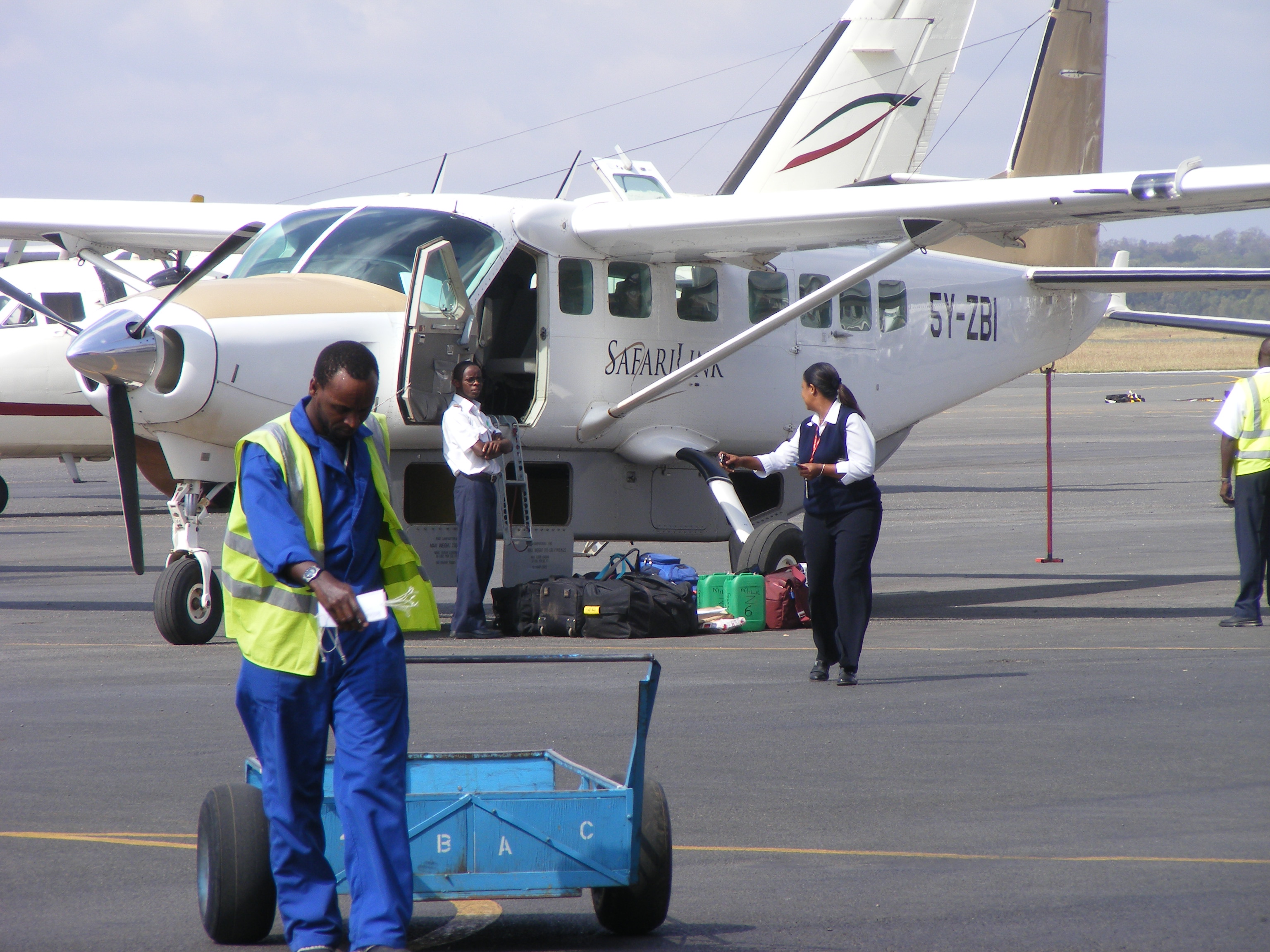
This is a picture of another Cessna Caravan, that I took, as I boarded it in Kenya for a flight to the Maasai Mara.
It must surely, be an ideal aircraft to convert to electric power.
This is a video of the first flight on YouTube.
The guy behind the project;Roei Ganzarski has just given a very optimistic interview on BBC Breakfast.
He emphasised the various environmental and financial advantages of the aircraft and if you can catch it on the iPlayer, it outlines a possible future for aviation.
I can see electric Cessna Caravans flying around the UK within the next couple of years.
Designing And Building An Electric Aircraft
Three of the designs for commercial electric aircraft under development are conversions of existing designs.
This must make certification of the aircraft simpler, as you’ve just replaced one type of engine with a battery and electric motor of similar size.
The difficult parts of the design; the aerodynamics and structure are probably almost unchanged.
As MagniX are involved in the first two of these projects, I would suspect that they have come up with an electric motor, that fits what is needed for aviation very well.
But then electric motor design is changing, probably driven by the needs of electric transport from bicycles through cars and vans to buses, planes, ships, trains and trucks.
It should also be noted, that the Beaver, Caravan and Islander are all simple aircraft, with a long history of successful operation and a vast knowledge base amongst pilots, engineers and operators of how to use these aircraft safely and in a financially viable way.
Will we see other aircraft conversions from to electric power in the next few years?
I would certainly be happy to fly in one at any time, unlike some aircraft I could mention.
This paragraph from the article details how the maker of the electric motor;magniX is involved in electric flight.
The Grand Caravan is to be the largest, but not the first commercial aircraft magniX has converted to fly with 100 percent electric power. Roei Ganzarski, CEO of magniX, wrote in an email exchange that the de Havilland DHC–2 Beaver first flown in December continues its test flight program in Canada. Harbour Air, a short-haul air carrier with a fleet of seaplanes, is working with magniX to convert its fleet to all-electric power, and the same 750-hp electric motor that will power the upcoming Grand Caravan flight has been performing well in test flights over British Columbia.
Ganzarski is quoted as saying he is pleased with results to date.
The aircraft is lined up to make its first flight on May 28th, which hopefully will be shown on the Internet.
My flight in Kenya was only about half-an-hour and despite the Caravan having a range of nearly 2,000 kilometres, I suspect that many flights in the aircraft are of similar duration.
A Quick Battery Size Estimate
750 hp is 560 kW.
So a half-hour flight on full power will use 280 kWh plus whatever is needed for aircraft systems like avionics, heating and air conditioning.
The Eviation Alice electric aircraft seats nine passengers and has a 900 kWh battery according to Wikipedia.
I would suspect a 900 kWh battery should allow the Electric Caravan to do two half-hour trips.
The Future Of Electric Aviation
It is interesting to note, that four of the projects in designing and building a viable electric aircraft are in this nine-seater segment.
Eviation Alice, which is a new radical aircraft with three magniX electric motors.
The DHC-2 Beaver prototype first flew on the day I was born, so it can’t be all bad.
A detailed insight into the reasons and the economics of converting an existing fleet of aircraft are given in a sub-section called Development in the Wikipedia entry for Project Fresson.
Scottish Airline Loganair appears to be the launch airline and will use the plane for their short flights around Orkney.
Several companies are involved in the development.
First flight is aimed for 2021.
Conversion kits could be available in 2022-2023.
It is hoped that operators would get a return on their money for the kit in 2-3 years.
Once they get the design right, there is talk of a nineteen-seat electric airliner.
I can see hundreds of converted electric Caravans and Islanders flying short routes by 2030.
Today, zero-emission flight is closer to reality than ever. Electric and hybrid-electric propulsion is rapidly revolutionising mobility technologies across industries, from automotive to marine. And the aviation industry is no exception. Airbus is committed to developing, building and testing electric and hybrid-electric future technology that will enable the aviation industry to significantly reduce the CO2 emissions of commercial aircraft.
A read of the whole section is recommended.
A lot of technology will need to be improved even to get say a 60-seat airliner, with a 500 mile range.
Design-changing efficient aerodynamics.
Lightweight, strong structures.
Efficient zero-carbon propulsion systems.
Batteries with a much higher energy capacity per kilogram of battery weight.
It’s a tough ask, but I believe it is possible!
We might even see some very unusual ideas. And some proven ones.
Catapults
Naval fighters are usually literally thrown into the air from aircraft carriers using aircraft catapults, which traditionally were steam-powered. Gliders are often towed into the air using a rope.
So could something similar be used to accelerate the aircraft to flying speed?
Taxiing And Take-Off Using A Tug
All taxiing would use a battery-electric or hybrid-hydrogen-electric tug to minimise use of energy from the plane’s batteries.
Could the tug be combined with charging and a vehicle to handle the catapult launch?
A fully-charged tug would meet incoming aircraft and tow them to the terminal.
The aircraft would use the tug for power, if it was low.
At the terminal, the tug and aircraft would be charged, during passenger unloading and loading.
On the taxi to the runway, all power would be provided by the tug.
The catapult system, would attach to the tug on take-off.
Once take-off speed was achieved, the aircraft would disconnect and climb away under its own power.
All the power for acceleration to take-off speed would be provided on the ground and the aircraft wouldn’t have to carry it.
Energy Calculations For An Airbus 220-100
The smallest Airbus aircraft is the A220-100, which has the following specification.
Passengers – 135
Maximum Take-Off Weight – 63.1 tonnes
Cruise speed – 871 kph
Take-off speed – 220 kph (estimated)
Ceiling – 41,000 ft.
Note that the design cruise speed of the nine-seat electric Eviation Alice is 482 kph at 10,000 ft.
As the kinetic energy is proportional to the square of the speed, I would expect that a small electric airliner would have a cruise speed slower than current airliners.
I would expect that Alice’s cruise at 482 kph and 10,000 ft., could have been chosen to get a decent range for the maximum size of battery.
The aircraft will also have to be given potential energy in the climb.
I would expect a small electric airliner would fly a lot lower.
A 135-seat electric airliner, which is the same weight as an Airbus 220-100 and cruising at 482 kph and 10,000 feet would need the following energy to establish itself in the cruise.
Kinetic energy – 157 kWh
Potential energy – 524 kWh
Take-off energy at 220 kph – 32.7 kWh
Which gives a total of 681 kWh.
It should be noted that both the kinetic and potential energies are proportional to the maximum take-off weight. Assuming that take-off weight would be proportional to the number of passengers, rough estimates for the battery size needed.
25 – 126 kWh
50 – 252 kWh
75 – 378 kWh
As Wikipedia says the smaller nine-seater Eviation Alice has a 900 kWh battery, I feel that at least a fifty passenger electric airliner is possible.
Very Efficient Aerodynamics
One of the biggest losses of energy will be due to less-than-perfect aerodynamics, with vortices, eddies and skin friction wasting precious energy.
Look at the pictures on the Internet of the Eviation Alice and you’ll see a strange aircraft.
A very pointed nose.
Two propellers at the wing-tips.
A third propeller at the tail.
I suspect, all the propellers are placed to get the most out of the power.
When Alice is cruising, her energy consumption will be minimal, so that the maximum range for a given battery size can be obtained.
Any electric airliner will draw on all the aerodynamic tricks in the book.
Efficient Flight Profiles
The longest flight, that I ever did in my Cessna 340A was from Southend to Naples.
Before take-off at Southend, the fuel bowser followed me to the end of the runway to give me a last-second top-up.
I travelled across France on a beautifully-clear day and the accommodating Lyon ATC allowed me to fly at 19,500 feet all the way to French Coast at Nice.
The French then decided that, as I was happy at that height, they would hand me over to the Italians without a change of level.
So I flew down the Italian coast past Genoa and Rome at 180 knots, with spectacular views all the way.
The Italians, then used radar to vector me on to final approach at Naples.
I reckon, I had flown nearly a thousand miles in if I remember correctly about six hours.
But it was a very efficient flight profile to get the range.
I took the maximum about of fuel, I could carry.
I climbed as fast as possible to an efficient cruising level.
I cruised at an efficient speed.
I used very little fuel on the descent and landing into Naples.
I certainly was pleased, that I had about another hour’s fuel left, when I arrived in Naples.
Electric aircraft will probably always fly efficient profiles, to get the maximum range. But they will all be calculated by the plane’s computer system.
Most Aircraft Are Heaviest At Take-Off
This is because they burn fuel in the engines, as they fly along.
But a full battery weighs the same as an empty one, so the electric aircraft will have the same flying characteristics in all stages of the flight.
This could have design and operational advantages.
Hybrid Propulsion
Some electric aircraft designs are hybrid, with both battery and turboprop power.
It still cuts carbon emissions and may give better performance.
Fuel created from biomass can also be used.
Conclusion
I expect to fly in an Aubus battery-electric short-haul plane between London and Geneva by 2030.
But I’m certain, I’ll fly before that in an electric aircraft.
St. Mary’s Airport on the main island of the same name in the Scilly Isles used to be considered a good test of airmanship.
When, I flew my Cessna 340A into the airport in the early 1990s, the runway was very hump-backed and it was a case of coming in slow, landing, cutting power and slamming on the brakes, so you didn’t run away downhill.
I remember having a telephone briefing before, I took off for the Airport and landed safely.
But there was a wrecked plane after the end of the runway.
Returning from the Airport was tricky. Maximum power was applied and you, accelerated up the hill on full power and along a short piece of flat runway on the hump. Eventually, I lifted the plane over the end of the runway and over the adjacent cliff. I maintained level, but once clear I deliberately lost altitude and this added the safety of flying speed. I then flew on at about two hundred feet or so above the sea, before turning to the East for home.
According to Wikipedia, a new runway was built in 1991, so hopefully aircraft like Islanders and Twin Otters can get into the islands with increased ease and safety.
The Future Air Service To The Scillies
Last night there was a discussion on Radio 5 about Flybe and other flights in the South West of England.
A text message to the program, said that the helicopter service to the islands was to be increased and it would be the sole way to get by air to the islands
Wikipedia says that the current air service run by Isles of Scilly Skybus, will be only flying nineteen-seater turboprop Twin Otters after March 2014..
Project Fresson
Project Fresson is a project to create an electric version of the Britten-Norman Islander by Cranfield University, with backing from the manufacturer, Rolls-Royce and some specialist suppliers.
The power could be electric or hybrid electric.
Rolls-Royce seem to be aiming for a low or zero-carbon power plant for a nineteen-seater airliner.
First flight is planned for 2022.
Sixty minute endurance with a thirty minute reserve is planned.
The aim is to design a kit that can be retrofitted to the up to seven hundred Islanders all over the world.
This could be an interesting project to watch, as Loganair needs an aircraft like this for its Scottish island services.
Conclusion
I very much feel that by 2030, one way or another, the airport on St. Mary’s will be hosting an electric passenger service.
This article on the BBC is entitled Flybe Boss ‘Focused’ On Turning Airline Around.
This was the start of the BBC article.
Flybe boss Mark Anderson has told staff that he and the management team remain “focused” on turning the airline round.
Mr Anderson’s comments came in an email to staff following reports that the airline is in crisis talks in an attempt to put together a rescue deal.
According to Sky News, Flybe, which has already been bailed out once, has been struggling to secure fresh finance.
So will the airline survive?
A Wake Up To Money Discussion
At 0530 this morning, the BBC Radio 5 Live program discussed Flybe with Lord Adonis, who is a former New Labour Transport Minister giving his fourpennyworth.
The following suggestions and observations were made.
Air Passenger Duty Be Scrapped For Domestic Flights
This has been suggested and it is thought it would give Flybe several tens of millions of pounds of aid.
The feeling was that it wouldn’t be illegal under EU law and it looks like it could be the solution.
But it would apply to all domestic flights within the UK and I can’t see BA, Ryanair and easyJet accepting, this to be available only to Flybe.
It would also cost the Government a lot of tax and why should I as a non-flyer inside the UK have to pick up the tab in other ways?
Certain Flights Could Be Directly Subsidised
To get to some parts of the UK, flying is necessary and under EU rules, essential flights can be subsidised directly.
The programme mentioned that Newquay flights are subsidised and those to Derry could be.
Other Airlines Would Take Over Profitable Routes
This is the law of the jungle and it has always been so.
A Radical Solution
Consider these facts.
Flybe’s Routes Tend To Be Shorter
As examples, Flybe flies.
Aberdeen to Belfast–City, Birmingham, Cardiff, Durham/Teesside, Humberside, London–Heathrow, Manchester, Newcastle upon Tyne and Wick
Birmingham to Aberdeen, Amsterdam, Belfast–City, Düsseldorf, Edinburgh, Glasgow, Guernsey, Inverness, Isle of Man, Jersey, Knock, Paris–Charles de Gaulle and Stuttgart
Exeter to Amsterdam, Belfast–City, Dublin, Edinburgh, Glasgow, Guernsey, Jersey, London–City, Manchester, Newcastle upon Tyne and Paris–Charles de Gaulle.
London City, to Amsterdam, Belfast–City, Edinburgh, Exeter and Jersey.
Manchester to Aberdeen, Amsterdam, Belfast–City, Düsseldorf, Edinburgh, Exeter, Hanover, Isle of Man, Jersey, Knock, Luxembourg, Lyon, Newquay, Paris–Charles de Gaulle, Southampton and Stuttgart.
Most if not all of these flights are under 500 miles.
Flybe Flies A Lot Of Smaller Aircraft
The backbone of their fleet is the Dash 8 Q 400, of which they currently have 54 in service, making Flybe one of the largest operators of the type.
They are powered by two turboprop engines.
They seat 78 passengers.
They have a cruise speed of 400 mph.
They have a range of 1,200 miles.
They can fly into city centre airports like London City and Belfast City.
In my view, they are an ideal aircraft for their shorter routes, with shorter runways and stricter noise restrictions.
Flybe Makes A Lot Of Places Accessible
Boris said this morning on the BBC, that we need regional connectivity and Flybe is part of the solution.
Northern Ireland would fare badly if Flybe ceased to exist, until alternative airlines provided the flights.
London And Edinburgh Is A Rail Journey
Over the last few years, more and more of my friends travel by rail on this route rather than flying.
Why?
Trains are now virtually every half hour.
Trains go between city centres.
Prices are generally comparable.
The trains and service has improved.
One friend takes her dog.
The journey time is getting closer to four hours.
In the next couple of years, there will be more services and journeys will be faster.
But go beyond four hours and train travel is not so attractive, so there will always be a need for regional flights to the North of Scotland, the South and South-West of England and other places where trains are not convenient.
Noise, Pollution and Carbon Emissions
These are aviation’s three main environmental problems and although Flybe’s core fleet is mainly turboprop, they are still not totally environmentally friendly, although they are better than the smaller jets, of which Flybe use a few.
CrossCountry Trains
Several of Flybe’s routes are mirrored by some of the services of CrossCountry Trains.
CrossCountry uses exclusively diesel trains and these will surely be replaced by bi-mode or hydrogen-powered hybrid trains to take advantage of the electrification, where it exists.
A revitalised CrossCountry could take advantage of Flybe’s troubles to increase revenue.
Eviation Alice And Other Electric Aircraft
Eviation Alice and other electric aircraft are on the way.
Within ten years, there will be an electric aircraft that meets this specification.
All-electric operation
At least twenty passengers
A range of 500 miles
A half-hour turnround for an hour’s flight.
Low noise.
No pollution or carbon emission.
Eviation Alice will show the way with a first flight this year.
Note that their first customer is Cape Air, who are a very successful feeder airline in New England.
I am confident of my prediction because the maths and physics, say it is possible.
I also feel that the might of Airbus is the one to watch!
They have much to lose at the small end of their market.
They are very strong in aerodynamics and lightweight structures.
easyJet are reportedly behind the project.
It should also be remembered, that their rival Boeing has too much on their plate.
The Short Term Solution
The short term solution must be to keep Flybe functioning, as the economic damage to far-flung regions will be far greater than the cost of keeping the airline flying.
But it must be done legally and within the rules, as the large profitable carriers have access to some of the world’s best lawyers.
I can see the following happening.
A reduction in Air Passenger Duty for domestic air travel.
Government subsidies for essential routes like those to and from the North of Scotland, Northern Ireland and remoter parts of England and Wales.
BA, Ryanair and easyJet using their lawyers to get equal treatment.
The Long Term Solution
The long term solution will undoubtedly depend on electric aircraft, when they meet the following criteria.
Sufficient range and passenger capacity.
Sufficient support infrastructure at airports.
Full certification
Overcoming the scepticism of the general public.
I feel that the first electric aircraft will be about nine-ten seats and they will build up from there and that thirty seat aircraft will be flying in ten years.
They will start on thin routes, where the number of passengers are low.
The government could encourage the fast adoption of electric aircraft, by abolishing all Air Passenger Duty for electric flights.
What would that do for an airline’s marketing and the environment?
Conclusion
Electric aircraft will be one of the factors , that will ensure the survival of regional airlines like Flybe.
The Times today has an article which is entitled Cost-Cutting And Crew Shortages Will Force Pilots To Fly Solo.
The title says it all and it may well happen.
Although, the pilots and their unions will resist it.
I remember in the 1980s, Air UK, used to fly Embraer Bandeirante aircraft between Norwich and Stavanger with just a single fully qualified pilot.
However, the flight attendant was a qualified private pilot, who had sufficient training to take over, if the pilot were to be incapacitated for some reason.
I fairly sure that nothing ever went seriously wrong.
The article in The Times doesn’t mention electric aircraft, but I got to thinking, they will have collateral effects on aviation.
A Proposed Electric Aircraft
The nearest aircraft to a recognisable airliner so far proposed is the Wright Electric Jet.
This description of the aircraft is from Wikipedia.
The aircraft is to run on batteries and handle flights of under 300 miles. It will feature high aspect-ratio wings for energy efficient flight, distributed electric propulsion and swappable battery packs with advanced cell chemistry.
The aircraft was being developed with easyJet, who now seem to be talking to Airbus.
I find the talking to Airbus significant.
The aerospace giant have long experience with aerodynamics, composite structures and advanced flight controls and avionics to build a strong lightweight airliner.
They have a significant share of the small airliner market.
They have a worldwide support organisation.
The only thing that electric airliners lack, is an efficient electric propulsion system. But they are on friendly terms with companies like Rolls-Toyce, who are developing suitable products.
The Wikipedia entry for Wright Electric says that they are aiming to develop an electric airliner with these characteristics.
Single aisle
120 seats
Fifty percent less noise
Ten percent lower costs.
I would suspect, that Airbus are working towards a similar set of objectives.
Note,
The aircraft will have long narrow wings with a high aspect-ratio.
I wouldn’t be surprised to see a long fuselage with four abreast seating.
The airliner would have to fit existing jetways, taxiways and stands at airports.
I don’t think that the design of the aircraft is too challenging, but battery charging and the engines will be more so.
The Collateral Effects
Electric airlines will have various effects on flying, airports and the environment.
Low Noise Could Allow More Airports To Be Served
This probably goes without saving.
Alternative Airport Design
But I also wonder, if it could lead to some innovative one-runway designs of airports, that were used solely by electric aircraft.
There would be short taxiways to save energy.
The terminal might be half-way along the runway.
There would be a source of zero-carbon energy nearby.
The airport could be near a city or town centre, perhaps served by a tram system to cut carbon emissions.
I also wonder whether an airport only served by electric planes would attract passengers.
More Airports Would Mean More Routes
Again this probably goes without saying.
More Routes Would Mean More People Flying
But this would not be at the expense of extra carbon emissions for the actual flying.
More Routes Would Mean More Pilots
So perhaps the predictions and fears of the article in The Times are well founded?
Efficient Battery Charging Would Be Needed
Wright Electric have said that they will swap full batteries for the empty ones in the plane, which I assume would be checked and charged at a convenient location.
The fastest way to recharge a battery is to connect it to some form of low-impedance energy storage like batteries or supercapacitors.
So I wouldn’t be surprised to see airports, that had electric routes had adequate and sophisticated electrical storage, which would be charged using renewable sources like hydro, solar, wave and wind,
The storage could even be built underneath the apron or aircraft stand.
Aircraft Would Drive Battery Technology To New Levels Of Efficiency
Aircraft will need lightweight efficient batteries.
This will mean that some of the world’s best battery technologists will receive the funds and the backing to create new and more efficient batteries.
As battery technology gets more efficient and more affordable, this will mean that other applications like zero-carbon heavy trucks, railway locomotives and energy storage of renewable power, will become more affordable as well.
Conclusion
We may have the ultimate contradiction.
More flying, more routes, less noise and no extra carbon emissions.
US aviation regulators allowed Boeing’s 737 Max aircraft to continue flying despite knowing there was a risk of further crashes.
Analysis after the first crash last year predicted there could be up to 15 disasters over the lifetime of the aircraft without design changes.
Despite this, the Federal Aviation Administration did not ground the Max until a second crash five months later.
The FAA chief said it was a mistake.
I would class it as a very big mistake.
When are Boeing going to come to the conclusion, that they can’t stretch the fifty-year-old design of the Boeing 737 and they need a new modern design?
What this blog will eventually be about I do not know.
But it will be about how I’m coping with the loss of my wife and son to cancer in recent years and how I manage with being a coeliac and recovering from a stroke. It will be about travel, sport, engineering, food, art, computers, large projects and London, that are some of the passions that fill my life.
And hopefully, it will get rid of the lonely times, from which I still suffer.
 The Anonymous Widower