The French Get Touchy About Language
The French can get very touchy, when English encroaches on territory, they think is reserved for French.
But this row, reported here on the BBC is totally of their own making, Here’s the introduction.
The French parliament is debating a new road map for French universities, which includes the proposal of allowing courses to be taught in English. For some, this amounts to a betrayal of the national language and, more specifically, of a particular way at looking at the world – for others it’s just accepting the inevitable.
The English-speaking world has nothing to do with it.
My French is such, that I can get by as a tourist. I also successfully used the language, when I was at ICI, as it was quicker to read scientific reports from the Belgian company, Solvay, in French, rather than wait for a translation.
On the other hand, when I was in Montreal, a few years ago, I was totally baffled, as Canadian French, is more different to French, than American is to English.
When we developed Artemis, we sold in quite a few European countries, but didn’t bother with French, as we thought they would be touchy, wanting everything in their own language.
In the late 1970s, Metier had installed an Artemis system, at Chrysler in Coventry. For various reasons, it hadn’t been upgraded, as much as it should. Soon after Peugeot-Citroen took over Chrysler in 1979, someone in Peugeot-Citroen decided to do a company wide survey of the various project management systems in use in the group. on one visit they went to Coventry and because they were impressed with what they saw, they came straight down the M1 to see us in our offices in Hayes.
Peugeot-Citroen then decided to buy a system for Paris. We told them it was only in English, but they said not to matter, as all their engineers knew the language. They did ask us to get some proper sales flyers in French.
The rest as they say is history, in that Peugeot-Citroen introduced Artemis to a lot of their friends.
Another story I remember, which illustrates the French and their language, happened a few years later. In the 1980s, I owned a company that made hand-tools. One tool, was exported to France and the United States. Our American agent asked if we could produce an English/French version for Canada. But a straight combination of what we already had was unacceptable and we had to get a special French Canadian translation at great expense. Eventually, the Canadians excepted it.
A couple of years afterwards, we had an urgent order from France, but unfortunately we were out of French leaflets. So we faxed over the French Canadian one to ask if that would be acceptable. The response was, that it will do, but that the French would have a bit of a laugh about the language.
Make of that, what you will!
I should say, that I once travelled to the States with a secretary from the New Zealand embassy in Ottawa. She told me, that some Canadians got very upset, if she sent them a letter with some American English spelling.
Not Very Correct French
French Railways or SNCF has just introduced a budget low-cost TGV service . They’ve called it Ouigo, which I assumed is pronounced “we go”.
I thought the French had laws against the language of the dreaded rosbifs!
But it is a concept that might just have enough to succeed.
Would I use it?
Probably not, as it seems to be tied into French mobile phones and post codes. But I had read that the web site was only in French, but it’s now also in English. So I suspect that in a few months, it’ll be as easy to use as easyJet or Ryanair.
I shall certainly try it on one of my trips back from somewhere in Southern Europe.
Food At Last
It was a short walk from the Gare de Paris Est station to the Gare du Nord and the 11:07 Eurostar for London.
I made it easily and an hour or so later, I was having lunch.
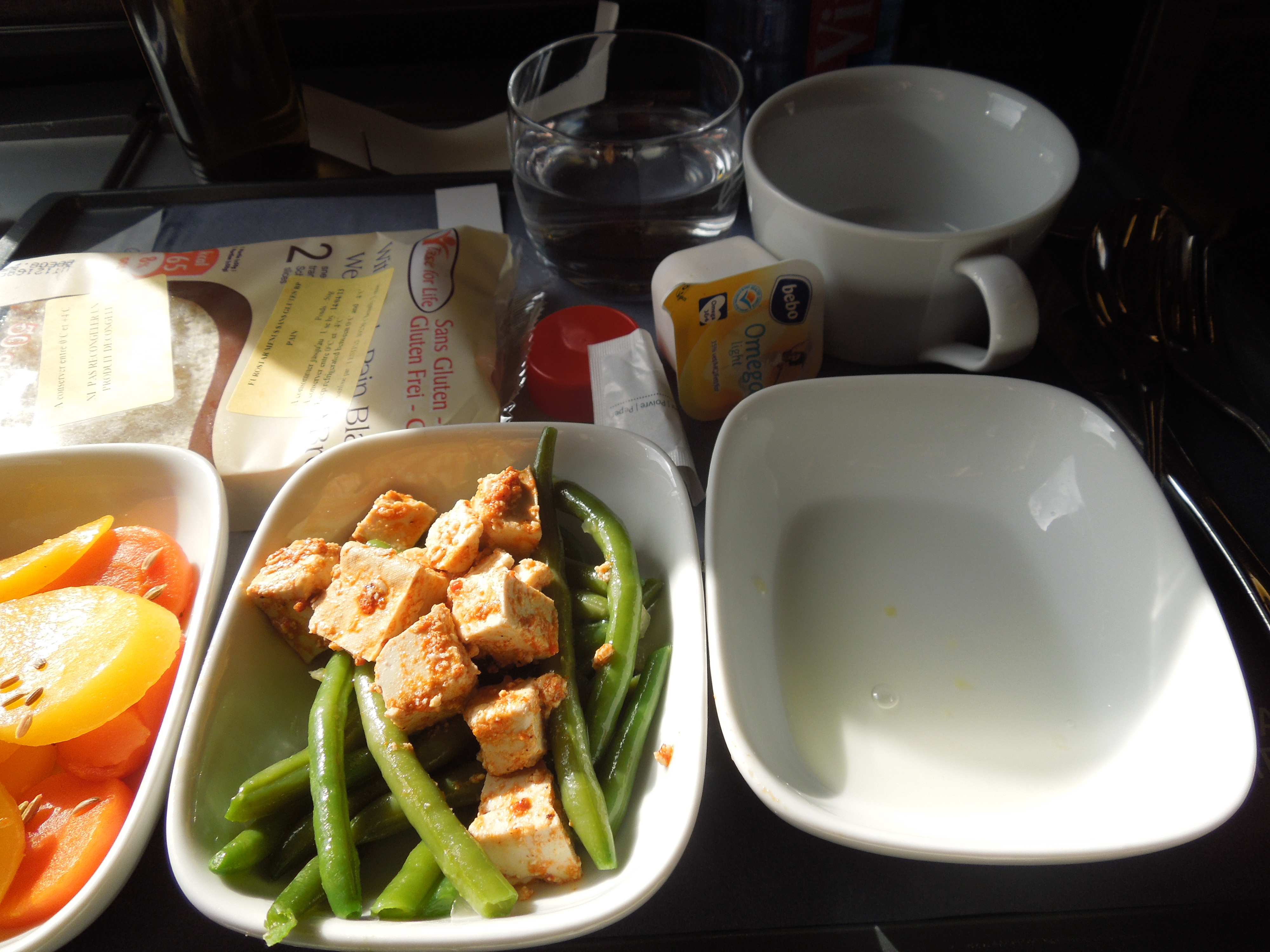
Food At Last
It was actually tofu, which I’ve never had before. But it was good to have a meal I could trust. The tea was very good too.
What I always think, is why if Eurostar can do gluten free food so well, why can’t other train companies?
The Sleeper From Munich To Paris
It takes over ten hours, but as I wanted to be back in London in time to get to Ipswich for the Hull game on Saturday, it was the only way I could do it.
I had booked the sleeper on Deutsche Bahn’s excellent web site at bahn.de. I had a self-printed paper ticket, that worked well. These are some of the pictures I took on the journey.







We arrived in Paris on time at 09:30. I had slept reasonably well.
Passing Naval Battles
We were continually passing the locations of famous naval battles. Mostly, where the British gave the French or in later times, the Germans a good kicking.
As we passed through the Bay of Biscay, we passed Quiberon Bay, St. Nazaire and Aix Roads, although we were well offshore.
And then after Corunna, we passed Cape Finisterre, where two battles were fought in 1747 and one in 1805.
Later of course we passed Trafalgar and actually went into Cadiz, where Drake famously singed the King of Spain’s beard.
The Language Rules In Quebec
There is a big row going on in Quebec about the use of the proper language in an Italian restaurant. It’s here in the Guardian. This paragraph shows the pedantic nature of the language police.
After a five-month investigation into an anonymous complaint, Massimo Lecas received a letter from the board telling him that his establishment, Buonanotte, had broken the law by including the words “pasta” on the menu and “bottiglia”, the Italian word for bottle, instead of the French word bouteille.
It sounds like several Italian restaurants, I have been to in the UK, the Netherlands or France.
I have only been to Quebec once and wouldn’t go again.
I don’t speak French well, but I can read it pretty well, as I’ve spent a couple of summers in the South of France and have also read some of the James Bond books in French.
But I found the French in Montreal very difficult and I never worked out how to use the public transport, as there is no English translation. It was almost like going to Wales and finding everything in Welsh. Even Paris, which last time I looked at the map was in France, is a city, where instructions for public transport are in multiple languages and in that respect it is much better than London.
But the main reason, I won’t go, is that I found on that trip it was difficult to stay gluten-free. In fact, I got glutened for the only time in recent years. It was mainly because the good restaurant I ate in, had probably used oven-chips, which are coated in wheat to make them crisp.
Some years ago, I used to own a hand tool company. We sold in numerous countries including the United States and France, and then had an enquiry from a distributor in Canada. They would take the product, but the product leaflet would have to be in perfect Canadian French. French just wouldn’t do! So at some expense we got a French Canadian translation and the product was duly launched in Canada.
Some time later, we had an urgent order from France and sadly we were out of French leaflets, so we told them, we did have the French Canadian version in stock. So we faxed one to France and the French said that the leaflet was rather quaint and a good laugh, but that it would do to fulfil the urgent order.
There’s no doubt that French Canadians are much more bothered about their language than the French.
Perhaps though some Canadians are also a bit touchy about English spelling. I once flew to the States sitting next to a secretary at the New Zealand High Commission in Toronto. She had to be very careful she didn’t use American spelling, when writing to some English-speaking Canadians, as otherwise they’d return it with corrections.
The Phone Problems Of The Channel Tunnel
Years ago, I met the guy, who had project managed the installation of the telephone system on the Channel Tunnel. It wasn’t as simple as you’d have thought. I remember one problem he outlined in particular.
Say you are an engineer, customs officer or whatever, employed by the Tunnel and because you are French, you live in France, but your major place of work is on the British side. You want to make a phone call to your wife, husband or partner, to say that because of a problem, you’ll be late home for supper. Obviously, the same problem would apply to British employees working in France.
So is your call home a local call, which it would be if you lived and worked in the same country or an international call, which of course would be at a higher rate.
The solution was to make for telephonic purposes, the Channel Tunnel, its own country.
The guy who managed the installation was British, but he had a French-speaking mother, so BT probably made a good choice, as to who managed the installation of a rather complicated project.
The White Cliffs Of Dover Have Moved To France
According to this article in the Metro, if you use your mobile phone on top of the White Cliffs of Dover, you may get charged as if you’re in France.
Landlord of the Coastguard pub and restaurant on the beach Nigel Wydymus, 53, said: ‘We are a little telecommunications enclave of France here.
‘It did not cause a huge amount of trouble for a few years with mobile phones because you got a message saying welcome to France but since smartphones have come in it’s more of a problem.
No-one has checked, but I wonder if you’re on the French side under the cliffs there, you might find the British signal is your phones preferred choice.
i do remember, when I would fly back in my Cessna from France, I was quite surprised at how far beyond the French coast, I could pick up a UK signal. Not that I made a call, as I probably needed two hands to fly the plane, but some of my passengers did. And of course that was well before smart phones.
And We Think We’ve Got Nimbys!
This article on the BBC’s web site shows that nimbys get everywhere, even in Italy. But it is a fascinating article about a rail tunnel between Italy and France. Christian Fraser, the author, puts this case in favour of the tunnel.
The pro-tunnellers employ a mixture of hyperbole and hard-nosed economic home truths as they argue for the project. The Atlantic will reach out to the Urals via this new link, they cry. Freight trains will zoom to and fro, boosting the shambling economies of southern Europe. Of greater interest to British tourists – skiers like me – is that the journey time from London to Milan will be cut to just six hours.
With those against as follow.
The naysayers insist that the tunnel will be an ugly, expensive white elephant. They point out that the existing trans-Alpine road and rail routes seem to cope very nicely, thank you. They claim that projections of traffic were drawn up 20 years ago and are hopelessly out-of-date. And they are worried about potentially dangerous minerals that are buried underneath the mountains being released into the air and water.
Hand on heart, even the keenest of protesters would struggle to claim the Susa Valley was an area of outstanding beauty. A narrow pass, it is already crammed with the clutter of human development – a motorway stalks across the valley floor on gigantic stilts, elevated above railway lines, quarries and factories.
But he also describes the action taking place.
In Italy, they have lobbied tenaciously – and at times violently – in their fight against the rail link between Lyon and Turin. Some 400 people were injured in clashes with the police last year when the tunnel site was first fenced off.
I know that area reasonably well, as I’ve driven through it and flown over it in a light aircraft several times. It is one of those areas, where if asked to dig a tunnel, your first action would be to ask if there was an easier route.
I don’t know the economics of this rail route, but I suspect that in the future some route will be completed to allow passengers to take the train from London and Paris to Rome or Milan.
 The Anonymous Widower