Who Nicked Me Titfer?
I took this picture of the statue of the Duke of Wellington.

Who Nicked Me Titfer?
Someone has stolen the road cone, he usually wears as a hat!
There’s a report about this on Scotland Now!
From Glasgow Green To George Square
I then walked from the very crowded Glasgow Green via Glasgow Cross to George Square and eventually Queen Street station to meet my friend.

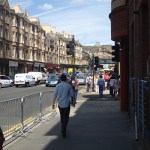

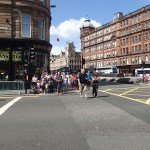
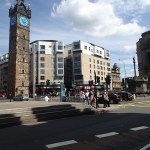

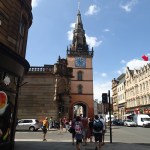


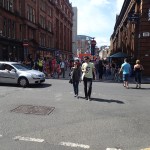
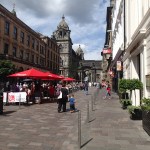


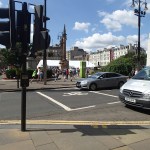


Note how the railway viaduct threads its way through the city.
Walking Along The Clyde
Is there any other river that is commonly used as a person’s name? I’ve never heard of anybody called Mississippi, Amazon, Nile or Rhine. Not even a child of a celebrity!
I walked along the river to Glasgow Green from Central station.


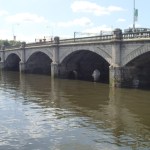

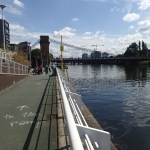



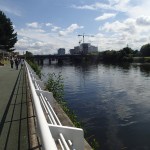

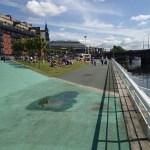
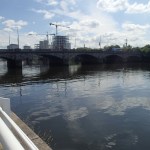

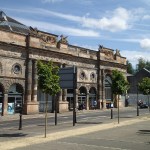





As with many cities, it has a varied collection of bridges.
It was also extraordinarily sunny. A couple of people were sunbathing by the river. Later in the day, I saw a young lady walking around the city centre wearing a mini skirt, high-heeled sandals and a small bikini top. The weather was just that good!
Note the pictures of the derelict Ladies Waiting Room. There’a a lot more about it here in a blog called Lost Womyn’s Space.
I was also impressed by the City Union Bridge and St. Enoch Viaduct, which could in future be part of Glasgow Crossrail.
Glasgow Gets Money For Infrastructure
After the announcement yesterday about investment in the rail route to Penzance, a story broke later yesterday about a large amount of money for infrastructure and City Deal status for Glasgow. Read about it here on the BBC. One major piece of infrastructure included is the Glasgow Airport Rail Link.
So what is a City Deal?
Under the section on Wikipedia for Local Enterprise Partnership, there is a small section on City Deals and several large cities like Liverpool, Leeds, Manchester and Sheffield have got them. Only Manchester seems to have a meaningful entry in Wikipedia.
Type “City Deal UK” into Google and you get all sorts of irrelevant rubbish like transfer deals involving football clubs with City in the name and Groupon.
It stikes me that whoever thought of the name City Deal dropped an enormous clanger.
I did eventually find a government web site, well down the page in Google.
the obvious URL; citydeal.co.uk, is owned by Groupon.
Never trust a politician to get the details and small print right.
Does Glasgow Need Its Own Rail Hub?
I’ve just been talking to a friend north of the border and he had not heard of the Northern Hub, which finally is getting the treatment and publicity it deserves.
He was unaware of a scheme in Glasgow called Crossrail Glasgow to link the two main stations and make journeys across the city a lot easier.
Reading about it here on Wikipedia, I can’t understand, why it wasn’t implemented before the Commonwealth Games this year.
Crossrail Glasgow and the Northern Hub, are just two of a whole series of projects to improve transport in our major provincial cities, like the Greater Bristol Metro, the extensions to both the Birmingham and Nottingham trams and the reopening of several important commuter railways.
Could it be that the decision on this rail project would have been taken in Edinburgh?
The Tripe Talked About Building Warships In The UK
I have been listening and watching the debate about BAE ‘s decision to end warship building at Portsmouth and move this all to Glasgow.
Much of the argument has been based on emotional facts like Portsmouth has been building warships since the Mary Rose and political considerations of keeping Scotland happy. Little has got anything to do with having a Royal Navy that is fit for purpose.
This article on the BBC, gives a pretty good assessment of the political story. This section is the heart of the article.
So was this a sweetener to Scotland, to stave off a Yes vote? The Defence Secretary Philip Hammond was asked repeatedly in the Commons to say whether the Scottish poll had influenced his choice.
He made, broadly, three replies to the variety of ways in which he was posed that question. Firstly, he stressed that the decision to locate warship building solely in Glasgow was taken by BAE, with endorsement from the Ministry of Defence. It was, thereby, primarily an industrial rather than a political choice.
Secondly, he stressed the importance of cost. His entire statement was predicated upon the drive to contain rising costs in the aircraft carrier contract. The identification of a sole location was also, he suggested, driven by cost efficiency.
But, thirdly, he made a point with regard to the forthcoming orders for Type 26 ships. Mr Hammond’s core point in respect of the carriers was that a blunder had been made (by the predecessor government) in placing the contracts for these vessels before design was completed.
He would not repeat that error, he said, with the Type 26 contract. It would not be placed before design was “mature”. That would be at the end of 2014. He noted, twice, that would be after the Scottish referendum in September of that year.
So BAE, had to make a decision, before they know what orders are coming. They are a supposedly commercial organisation, so they will do what they see is best for the company. Given that costs are higher in Portsmouth than Glasgow for most things, I suspect that there was only two solutions; persuade the Government to buy lots of warships that we don’t need or close Portsmouth.
In the arguments I heard, no-one seemed to bring up the Falkland Islands. When Argentina invaded, as regards warships we were ill-prepared and had to scramble hard to get a task force together. But the rest as they say is history!
The one thing we can say with certainty, is that if we need to use the Navy in anger again, we’ll have the wrong ships, and they’ll be in the wrong place.
It was always thus!
I would suspect that the Navy goes through some of the most bizarre scenarios, and works out how they will handle them and that there will be a lot of improvisation in there.
Look at the operational history of HMS Ocean and you’ll find a lot of it, is in response to events. If you read the Wikipedia entry for HMS Ocean, you’ll find this gem.
While Swan Hunter viewed the ships as entirely military, “VSEL thought the design was basically a merchant ship with military hardware bolted on.” VSEL’s decision to sub-contract the build phase took advantage of lower overheads at a civilian yard as well as efficiency drives by its parent, Kværner. The cut-price build to commercial standards means that Ocean has a projected operational life of just 20 years, significantly less than that of other warships.
VSEL and Swan Hunter were completing for the work. But there was some serious innovation in the construction of this, in my view, successful warship. It’s certainly got us out of trouble a few times.
Innovation has been lacking over the years in the design of warships, which partly explains, why we and probably every other Navy has the wrong ships for a serious crisis.
One thing that should be thrown in, is if warship building is so important and BAE are so good at it, why aren’t we exporting ships to other friendly nations?
So are we subsidising warship building and BAE to an unsustainable high level?
Glasgow Central Station
Glasgow Central is a large impressive station, that has been refurbished quite recently.









The station has a large well-lit waiting/meeting area in front of the platforms, which is a bit like having Kings Cross Square under the station roof!
Too many stations don’t have enough space for waiting and meeting, but Glasgow Central is not one of them.
Walking Around Glasgow City Centre
I had an hour or so before I needed to get to Glasgow Central station, so as it was fine, I walked around looking at the buildings.
Glasgow is easy to navigate, as it has lots of wayfinding liths, just like London.

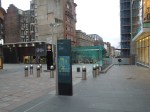




As you can see, some are megaliths and have a lot more than just a simple map and a few words.
Without doubt liths are the way to go.
This was illustrated, when I came across a group of students and a local, who were discussing in detail, the direction the students needed to go.
In my view, Glasgow’s liths may only have one problem, except for the misplaced Tourist Office.
And that is on Friday, with all the rain, they didn’t stand out, as the colours were too subtle. Perhaps, that is why London’s liths have yellow tops.
 The Anonymous Widower