Gluten And Heart Disease
Type “Gluten And Heart Disease” into Dr. Google and you find two major peer-reviewed studies.
This study is entitled Effects Of A Gluten-Reduced Or Gluten-Free Diet For The Primary Prevention Of Cardiovascular Disease.
These are the authors’ conclusions.
Very low-certainty evidence suggested that it is unclear whether gluten intake is associated with all-cause mortality. Our findings also indicate that low-certainty evidence may show little or no association between gluten intake and cardiovascular mortality and non-fatal myocardial infarction.
There would appear to be no strong link, between gluten and heart disease.
This British study is entitled Long Term Gluten Consumption In Adults Without Celiac Disease And Risk Of Coronary Heart Disease: Prospective Cohort Study.
These were the authors’ conclusions.
In these two large, prospective cohorts, the consumption of foods containing gluten was not significantly associated with risk of coronary heart disease. Although people with and without celiac disease may avoid gluten owing to a symptomatic response to this dietary protein, these findings do not support the promotion of a gluten restricted diet with a goal of reducing coronary heart disease risk. In addition, the avoidance of dietary gluten may result in a low intake of whole grains, which are associated with cardiovascular benefits. The promotion of gluten-free diets for the purpose of coronary heart disease prevention among asymptomatic people without celiac disease should not be recommended.
As before there would appear to be no strong link between gluten and heart disease.
To me, this is the most important sentence.
In addition, the avoidance of dietary gluten may result in a low intake of whole grains, which are associated with cardiovascular benefits.
So can we do something about it?
Enter The First Great Ethiopian Marathon Runner
I used to run a bit (badly) at school and my three heroes were Chris Brasher, Bruce Tulloh and Abebe Bikula.
The Ethiopian; Abebe Bikula was a double Olympic marathon champion.
- In 1960, he won in Rome, running barefoot.
- In 1964, he won in Tokyo, a few days after leaving hospital after having his appendix removed.
Both wins were in world record time.
Since 1964, three Olympic men’s marathons have been won by Ethiopians.
Ethiopian women have also won two gold and one bronze medals since the women’s marathon was inaugurated in 1984.
And then there’s the Kenyans, who’ve won a hatful of marathon medals.
Their competence is generally put down to living at altitude and I wouldn’t disagree with that.
My Experience Of Kenya
Soon after C died, I went on holiday to Kenya.
In one part of the holiday, I was riding horses in the Masai Mara and in the other I was glamping.
The second part was upmarket and one evening the chef approached me to find out more about my gluten-free diet. At breakfast next day, he presented me with a couple of rolls made from a local flour, which was probably something like millet or perhaps, teff from Ethiopia.
I had no adverse reaction. and he said, I could eat like a true African, as Western flour had no place in the local diet.
Conclusion
If we are worried about the lack of whole grains in gluten-free food, then perhaps we should add gluten-free whole grains from East Africa.
As a manager in a Marks and Spencer store, told me that they used Ethiopian flour in their gluten-free breads, I suspect this is already happening.
Fabrice Muamba Shows How To Come Back
Fabrice Muamba has made a remarkable recovery from his collapse on the pitch at White Hart Lane, where his heart stopped for 78 minutes.
He’s now going to appear on Strictly Come Dancing at Christmas.
I suspect now that Fabrice will be unlikely t0 die from any form of heart disease, as his doctors will watch him like a hawk and give him the best of care.
Coeliac Disease And Atrial Fibrillation
I’ve got both and according to this study, if you have coeliac disease, you’re more likely to have atrial fibrillation.
Which I’ve got and is generally considered by my doctors to be the cause of my strokes
This is another problem to add to a long list of those caused by coeliac disease.
Defibrillators on Buses
If you search for defibrillators on buses, you will find that some companies do have them on buses and train staff to use them.
So perhaps where you have a two-man bus, like the New Bus for London, they should be carried and staff should be trained. Note that some of the newer buses have got bigger, so I suspect there might be a space to store a defibrillator.
Own Up! Which Of You Is Responsible?
I am now taking four extra drugs.
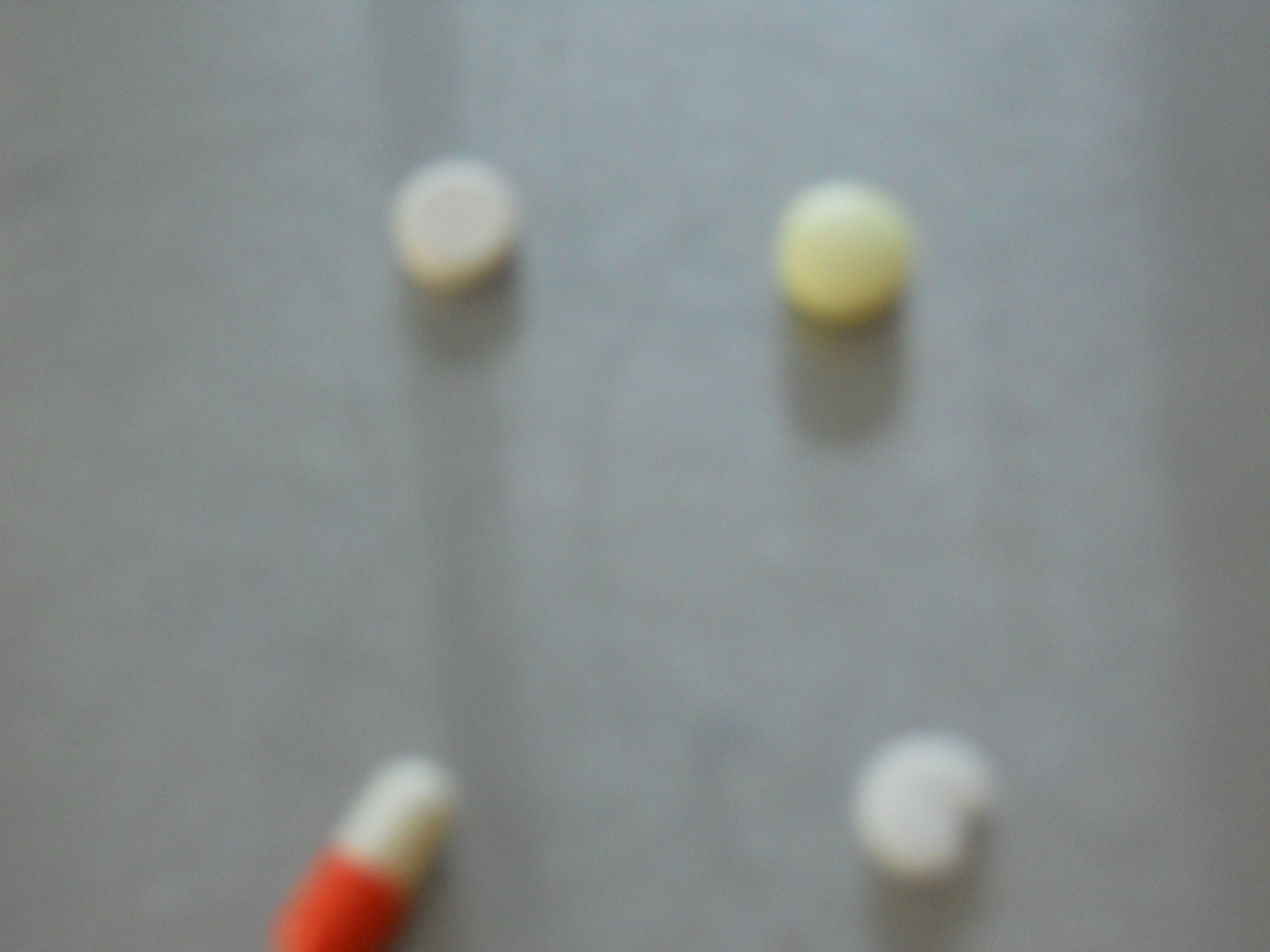
My Four Extra Pills
But my diarrhoea has all but stopped! So which one has caused that? Clockwise from the top left, they are furosemide, spironolactone, Cardicor and Ramipril.
But still I’m glad to get rid of it after two years. Does it show what a chancy business taking drugs is?
A Couple of Days in Hospital
Some will know that on Wednesday I collapsed, called an ambulance and ended up in University College Hospital. I thought at first I was having another stroke, but whilst lying on the floor, I felt that this wasn’t the case. The paramedics couldn’t get in, but luckily the builder opposite, who I talk to most days, had a ladder and came through the open window.
I called the ambulance, as my left hand was twitching after doing a lot of typing. These days, I use my left hand for shift and control and I think all the movement had irritated my humerus. And no! It’s not funny. In the end I got frightened, and it got me very worried, so that is why I dialled 999. I sat on the chair and when trying to stand up, my left leg gave way so I just laid on the floor, until I was rescued.
The trip to hospital was quick and they were examining me within a few minutes.
They ended up admitting me and I was in a First Floor single room in the tower, looking out over the Euston Road.
I was fully checked out and they found there were problems with my heart, which I did know about to a certain extent. But I got a very good diagnosis for free. when I was having the echnocardiogram, it felt like I was back in Hong Kong, as the operator of the machine and his student, were both Chinese.
I left on Friday with a whole new load of drugs.
So all in all was very positive.
Lessons From the Patrice Muamba Incident
Note that I’m calling it an incident, as hopefully after today’s hopefully promising news, things may get a lot better.
One of the reasons, I can call it an incident, may turn out to be the fact, that according to the Evening Standard a cardiologist was in the East Stand at White Hart Lane and he knew what was happening to poor Patrice, so he just told the Stewards, that he was going onto the pitch and did it! He also persuaded the paramedics to take Patrice to the London Chest Hospital, where they had the facilities to deal with such a serious heart attack. He even accompanied the footballer in the ambulance. Isn’t that what we think, we should expect from a doctor?
Someone, who was a friend of a friend, wasn’t so lucky. He had a heart attack in the stand at a football match and the paramedics were unable to revive him. Perhaps, with help from a cardiologist, they might have succeeded. But my friend did say that he was well into his seventies and had already had one major heart attack and would have probably preferred to go out, watching his team.
So what are the chances of the right doctor being at the ground.
About ten years ago, I was in the circle of the theatre at Cambridge with C, when a rather worried usher asked if there was a doctor in the house. Whether there was a conference on, but out of about a hundred or so, she got at least ten doctors to come forward. I don’t know what happened afterwards, but hopefully they managed between them.
But White Hart Lane has a capacity of 50,000 or so and that greatly increases the odds of the right doctor being available. And as the incident happened in front of him that helped too.
I am not saying Patrice was lucky, as to go through what he has is terrible, but can we increase the chances of getting the right sort of assistance in public events and even spaces.
For instance, the cardiologist was a season ticket holder and because of modern electronic ticketing, they could have found out he was at the game. So you can envisage systems, where doctors with particular specialities are texted, if something serious happens. I can remember the day when Luc Nillis broke his leg at Portman Road, as it was in front of me. Would his treatment have been better, if they’d managed to find an orthopaedic consultant or two in the crowd of 20,000? They may have done, but I don’t know!
It does strike me that this could be an application for a smart phone!
Vinny Jones Shows He’s All Heart
Vinny Jones has got involved in publicity for the British Heart Foundation. The details and a video are here.
It should be remembered that his wife, Tanya, has had a heart transplant and I think he’s done work for the BHF before.
I actually think the whole concept of the video is rather good, as it’s very simply put together and you remember his message.
Do We Have Too Many Heart Transplant Centres?
Doctors at Newcastle’s Freeman Hospital have questioned whether we have too many heart tranplant centres in the UK.
Apparently, the number of transplants is down, but the number of potential donors is up.
My cardiologist performs transplants and other radical heart surgery. We have chatted about technology in appointments, so could it be that the reason the number of transplants is down, is bcause surgeons are learning more tricks to keep us alive and in many cases we are doing our bit with less smoking and drinking and taking the right exercise and eating better.
Closing a heart transplant centre will be a difficult political decision, but as in many things these days, technology may be a better alternative, that takes good care nearer to the many.
I suffer from atrial fbrulation, caused in part by a dodgy heart valve. My mother-in-law had the same problem and had a valve replacement, which wasn’t a trivial operation in the 1970s.
My cardiologist’s prognosis to me was that if I keep getting the Warfarin right, I won’t have another stroke and pehaps in te years he might do something to fix the valve.
The way things are going with technology, I might suspect that when that valve is fixed, it might well be a trivial procedure.
So perhaps there’s a bit more life in this London mongrel yet? Here’s hoping!
A Better Way to Measure Blood Pressure
I do hope so, as the current method seems to cause all sorts of problems when healthcare staff measure mine using the traditional cuff, whether it’s connected to a high tech machine or a manual device.
In Hong Kong, they were very worried about my blood pressure and they were always measuring it. Sometimes they changed from the new to old devices.
My previous doctor too, often got a different result to her nurse and another doctor, said I suffered from a classic case of white-coat hypertension.
So a new blood pressure device developed at the University of Leicester is to be welcomed. Especially, as it can measure the blood pressure closer to the heart or the brain.
It also looks to me that after fully researching and sorting the medical principles, instrument engineers have applied modern electronic technology to the problem.
We shall be seeing more devices like this to monitor many bodily parameters in the future.
 The Anonymous Widower