Travelling Between Heathrow Airport And Staines Station
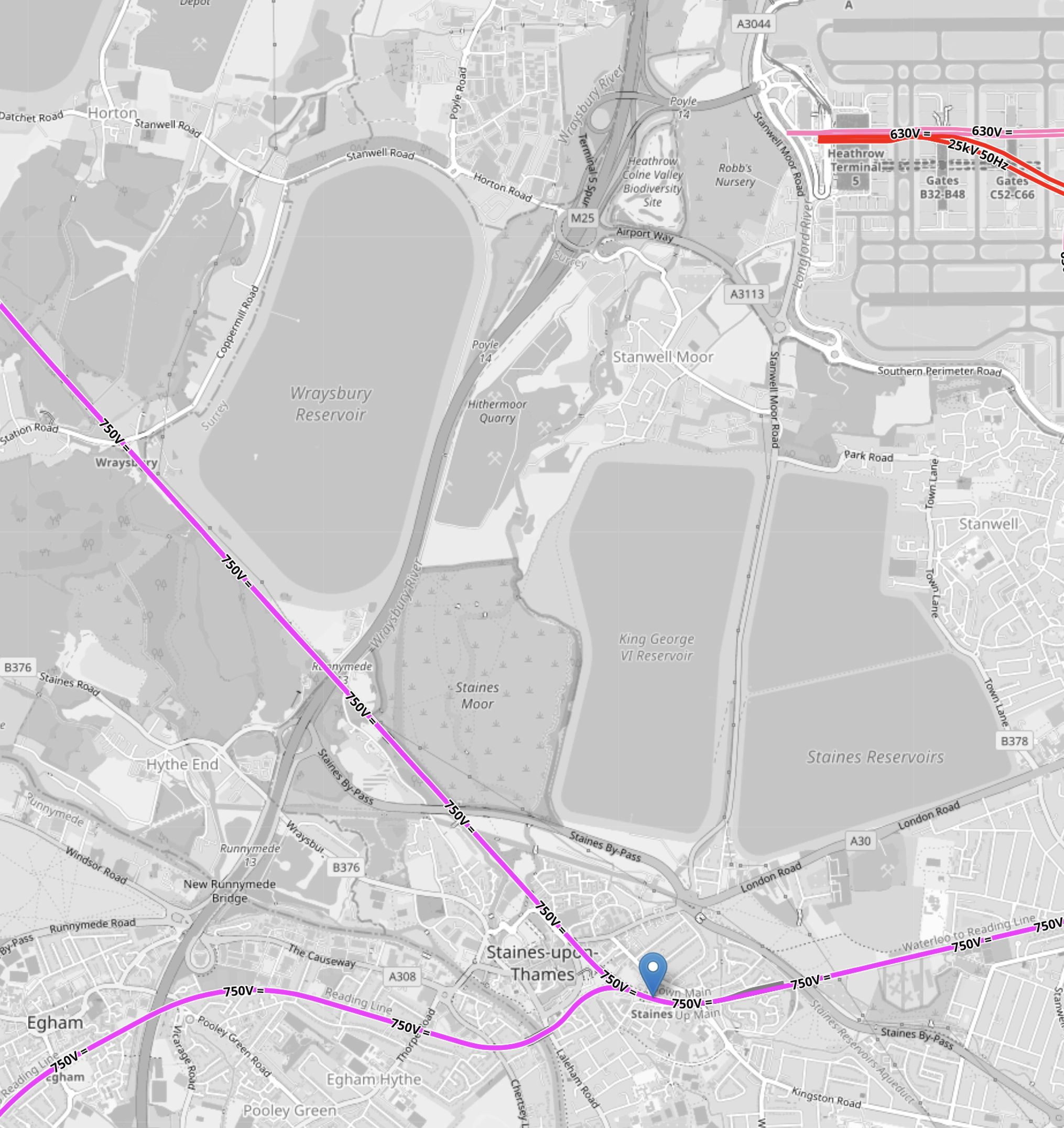
Staines Station and Heathrow Airport are not far apart, as this OpenRailwayMap shows.
Note.
- The mauve lines in the bottom half of the map are South West Trains services out of Waterloo.
- Waterloo via Feltham, Twickenham and Richmond to name but three stations , is to the East.
- Reading is to the South-West
- Windsor is to the North-West.
- The blue arrow indicates Staines station.
- Heathrow Terminal 5 is in the North-East corner of the map.
- The pink tracks are the Piccadilly Lines
- The red tracks are for the Elizabeth Line and Heathrow Express.
- This OpenRailwayMap shows Terminal 5 to a larger scale.

Note.
- The pink tracks are the Piccadilly Line.
- The red tracks are for the Elizabeth Line and Heathrow Express.
- In front of the red tracks is what looks like a circular walkway or emergency exit, with a rectangular block to its West.
- The rectangular block is the lift tower to get from the railway station to the Departures and Arrivals floors of Terminal 5.
I asked Google AI if it would it be possible in the future to extend the Elizabeth Line to the West out of the Western end of Terminal 5 and received this reply.
Extending the Elizabeth line west from Terminal 5 is technically possible and has been proposed, notably as part of a potential westward rail link to Staines or to support airport expansion, but it is not currently funded. Terminal 5 was designed with future expansion in mind, potentially allowing a connection to Staines to create a “southern rail link” for better connections.
Perhaps there are two tunnels under the lift shafts?
How many trains per hour (tph) terminate in those two platforms?
- 4 tph – Heathrow Express
- 2 tph – Elizabeth Line to Shenfield.
Note.
- Only six trains in two platforms is easily managed.
- Because, Heathrow Express services appear to use both platforms, when I visited yesterday, the system seems to confuse passengers.
- The services surely need to be evened up, so that there are four tph of each service, with each service having a dedicated platform.
- But terminating eight trains in two platforms could be troublesome.
- Platforms are numbered 1 to 6 from the South.
- Platforms 1 and 2 have not been built yet.
Although four tph for Heathrow Express in one platform, should be easy with digital signalling, as you see it every day in London, it may be difficult on two platforms, at the same time.
In Is More Capacity Between Heathrow Airport And Central London, Needed On The Elizabeth Line?, I said this.
Currently, the Elizabeth line provides up to 12 trains per hour (including Elizabeth line and Heathrow Express) on the relief lines, making it nearly at capacity.
Note.
- When I use the Elizabeth Line, I deliberately avoid trains going to and from Heathrow, unless I’m going that way, as they are too crowded with passengers and their oversized cases.
- High Speed Two, the West London Orbital Railway and the North London Line will bring passengers for Heathrow Airport to Old Oak Common station.
- Surely, as Heathrow Airport gets bigger and increases its passenger numbers. the Elizabeth Line will need to be increased in capacity.
I believe Elizabeth Line capacity needs to be increased soon.
The only feasible plan I’ve seen is Heathrow Southern Railways plan, which included.
- Construction of a bay platform 0 at Staines alongside the Staines to Windsor line.
- A step-free bridge across the tracks.
- Construction of a single-track railway with 25 KVAC overhead electrification and a passing looop, between the new platform 0 at Staines and Platform 3 at Heathrow Terminal 5 station.
- Run four trains per hour in both directions between Heathrow Terminal 5 and Staines stations.
- This plan would would add two trains per hour through the Central Tunnel.
Various Journeys Would Be As Follows
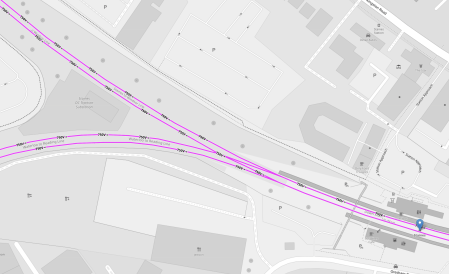
This OpenRailwayMap shows Staines junction and the positions of the three platforms.
Note.
- The Windsor Line goes North-West.
- The Reading Line goes West.
- The Waterloo Line Goes East.
- Platform 1 is on the North side of the tracks.
- Platform 2 is on the South side of the tracks.
- The bay platform, which I’ve numbered 0, will be on the North side of the tracks towards Windsor.
- I suspect the step-free bridge will be over the tracks and replace the current rickety structure.
- The bridge would be a short walk from all three platforms.
Interchanges would be as follows.
- Windsor to Heathrow – Walk between Platforms 1 and 0.
- Reading to Heathrow – Walk between Platforms 1 and 0.
- Heathrow to Windsor – Cross the bridge between Platforms 0 and 2.
- Heathrow to Reading – Cross the bridge between Platforms 0 and 2.
- Waterloo to Heathrow – Cross the bridge between Platforms 2 and 0.
- Heathrow to Waterloo – Walk between Platforms 0 and 1.
Note.
- All trains to or from Heathrow use Platform 0.
- All trains to Waterloo use Platform 1.
- All trains going away from Waterloo use Platform 2.
- Reading and Heathrow gain a step-free route at 2 tph.
- All interchanges at Staines station would be step-free.
- A train like London Crosslink, which used to go between Feltham and Woking, would use Platform 1 going towards Feltham and Platform 2 going towards Woking.
Staines station would gain step-free access to all Heathrow terminals, all Elizabeth Line and High Speed Two stations.
Could Anglia Railways’ London Crosslink Be Recreated As Part Of The London Overground?
I like the idea of the London Crosslink service, that ran for a few years between East Anglia and Hampshire via the North London Line and Staines.
My arguments for its restoration are described in Could Anglia Railways’ London Crosslink Be Recreated As Part Of The London Overground?
At various times in my life, it would have been very useful.
Today, as I live about fifteen minutes from Highbury and Islington station, I could use London Crosslink for the following reasons.
- Visiting friends and family in Hampshire.
- Going to Heathrow Airport, especially Terminal 5.
- Visiting friends in East Anglia.
- Going to football at Ipswich.
- Exploring new parts of England.
- I would wait at home and time my departure to catch a booked train at a fully step-free station.
Conclusions
Extending the Elizabeth Line to Staines gives these advantages.
- Staff at Heathrow, who live in the Staines area get easy access to the airport.
- Buses and coaches between Heathrow and the local area may be reviewed.
- Less cars will be used to get to and from the airport.
- Reading and Heathrow gain a step-free route at 2 tph.
- A lot of stations would gain a step-free route to all terminals at Heathrow, and all Elizabeth Line and High Speed Two stations.
There may well be other advantages.
Heathrow Rail Link Project Could Be ‘Reopened’
The title of this post, is the same as that of this article on the BBC.
This is the sub-heading.
Network Rail has said plans for a rail link between the Great Western mainline and Heathrow Airport could still move forward if funding is found in the future.
These three paragraphs give the current status of the scheme.
The Local Democracy Reporting Service recently reported that the project had been put on hold.
It began in 2012 and involved proposals for a 4 mile (6.5km) rail link to allow train services from Reading and Slough in Berkshire to reach Heathrow using a tunnel.
The £900m scheme would allow people living to the west of Heathrow to travel direct to the airport, instead of having to go into London.
These are some other facts and my thoughts.
The All-Party Parliamentary Group (APPG) For The Western Rail Link To Heathrow
According to the BBC article, this has now been established and this is said.
Labour MP for Slough, Tanmanjeet Singh Dhesi, held a debate in parliament on the western rail link in April and established the All-Party Parliamentary Group (APPG) for the Western Rail Link to Heathrow, to make sure it “remains on the government’s agenda”.
He said the project had been “beset by delays and funding challenges” but still had “wide cross-party and local support”.
Parliamentary backing is surely a good thing.
The Current Scheme
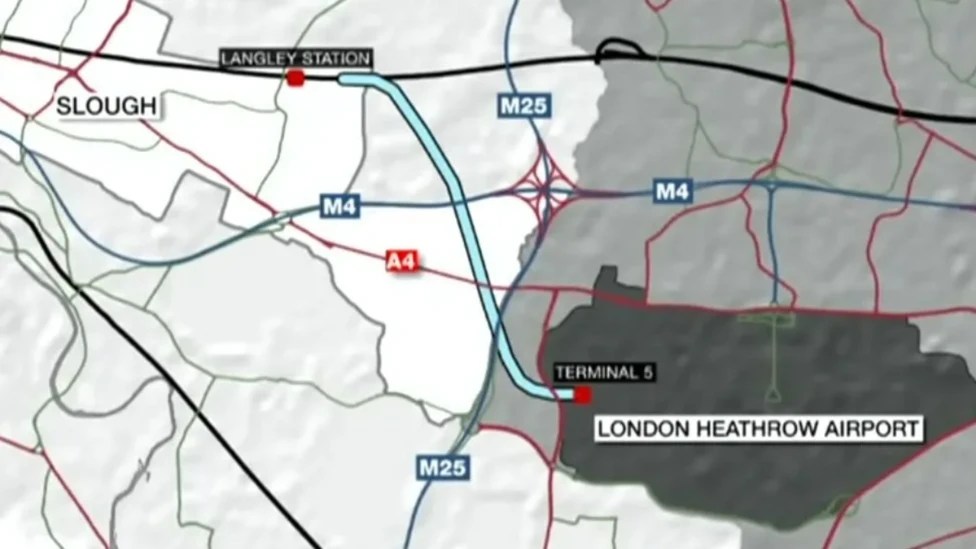
The BBC article shows this map with a rail link connecting the Great Western Main Line to Terminal 5 railway station.
Note.
- The rail link starts from East of Langley station.
- Terminal 5 station can take full-length Elizabeth Line trains.
- Main line trains from Bristol, Cardiff and Wales and the West should be able to access Heathrow.
But I suspect, that there would be extensive changes to Heathrow’s railways to access the other terminals. This would explain the near billion pound cost of the link.
I also suspect that it would take about eight to ten years to build and from what I havc heard, the rail link is urgently needed.
RailAir
RailAir is the current way of travelling between Reading station and Heathrow Airport.
This is the first paragraph of RailAir’s Wikipedia entry.
RailAir describes a number of airport bus and coach services designed to connect the National Rail network to airports in the United Kingdom. Services are currently concentrated on Heathrow Airport, with one other from Luton Airport. RailAir services are operated as public transport services by or on behalf of train operators, where the whole journey is paid for as a through-ticket which combines the railway and bus journey, although journeys can be made using the bus only. As such, many are operated where the train and bus operator are owned by the same company.
Could RailAir be updated to be a more frequent and integrated service?
CoacH2
This page on the Advanced Propulsion Centre UK web site is entitled CoacH2 – Next Generation Hydrogen Fuel-Cell Coach Powertrain Demonstrator.
This is the sub-heading.
Accelerating the development of zero-emission hydrogen fuel-cell electric coaches, with a full on-vehicle technology demonstrator.
These are the first two paragraphs.
Coaches are an integral part of the public transport network, with over 30,000 diesel coaches operating across the UK and Ireland. Due to the specific demands of coach operation (motorway driving, long-range, high passenger and luggage loading capacity) decarbonisation options for this sector are extremely limited with hydrogen fuel-cell technology considered the most viable choice. This project will tackle this difficult to decarbonise sector by developing, testing and validating an innovative hydrogen fuel-cell powertrain suitable for coach applications.
Delivered by a Northern Irish consortium spanning OEM, coach operator and academia, CoacH2 will accelerate the development of zero-emission, fuel-cell electric coaches, with a full on-vehicle technology demonstrator to be manufactured and showcased at Cenex Expo 2024.
As I indicated in British Buses For British Bottoms, Wrightbus build a good well-built, smooth-riding and comfortable bus, so now they can add hydrogen-powered coaches to the product range.
This press release on the Wrightbus web site is entitled Wrightbus Coach Demonstrator Unveiled At Cenex Expo, gives more information on CoacH2.
- The demonstrator has a power of 300 Kw.
- It has a range of 1,000 km. on one refueling.
- An internet search reveals a launch date of 2026 for the hydrogen-powered coach.
I wonder, if RailAir changed their coaches to these new Wrightbus hydrogen-powered coaches, they would transform travel to airports all over the UK.
If the hydrogen-powered coaches are of the same quality of their hydrogen-powered siblings, they will be a quality product with good road-holding, sufficient performance and superb passenger comfort.
RailAir could be the ideal, initial application.
Conclusion
A proper rail link to Heathrow from Reading is needed, but it will take at least ten years to build and cost a billion pounds.
However the RailAir links to Heathrow from Reading and Woking can be improved by using high-performance Wrightbus hydrogen-powered coaches.
 The Anonymous Widower