Does Sheffield Need A Super High Speed Line To London?
I ask this question because HS2 was put forward in the days, when brute force and high speed was the only way to get fast journey times.
In this article on the BBC, which is entitled HS2 South Yorkshire route change threatens new estate, the following is stated.
- 120 mins – Fastest existing Sheffield to London service
- 79 mins – Fastest Sheffield to London service via HS2
I have not seen any details as to how fast conventional trains could do Sheffield to London, but we do have some useful figures from the Great Eastern Main Line, which I wrote about in Could Class 387 Trains Do Norwich In Ninety And Ipswich In Sixty? I came to the conclusion that a 200 kph Aventra with modest track improvements could reduce the current 120 minutes to ninety.
Compare the Great Eastern Main Line (GEML) with the Midland Main Line (MML)
The GEML is about 180 km long and fully electrified, with only two tracks except South of Shenfield and a 160 kph line speed.
The MML is about 250 km long and not electrified past Bedford, with generally more than two tracks and quite a bit of 200 kph running.
The MML has a lot of potential for improvement.
- In several places there is space to add extra tracks and improve junctions.
- A fully-developed Erewash Valley Line, could possibly be used as a higher-speed diversion, avoiding the line through the Derwent Valley, which is a World Heritage Site.
- The MML is currently being electrified.
- Modern electric trains with regenerative braking would speed stops on the MML.
- Some of the stations on the MML, could be rebuilt to speed trains through.
- This is just the sort of line for which the Digital Railway could have a large positive affect.
I feel that after the line is fully electrified and upgraded between London and Sheffield, that there could be a big improvement in journey times.
I do wonder if the revised plan for HS2 to serve Sheffield, , has come about because engineers have been able to devise a plan to improve the MML, that has created enough capacity from Clay Cross to Sheffield, to allow HS2 to share.
In HS2 Does The Right Thing In Sheffield, I postulated that if the MML from Clay Cross, where it bis joined by HS2 to Sheffield, were to be built to HS2 standards, when it was electrified, then this would have benefits for both lines.
- HS2 trains could approach Sheffield, using the sort of speed profile, they’d use into other stations.
- 200+ kph trains on the MML would knock a few minutes off schedules.
- Any extra tracks would probably fit on railway land.
- Chesterfield station could be rebuilt to accept HS2 trains.
There would be a large saving in costs, as only two tracks would be built. They would also be built when the MML is electrified.
We might not see trains on the classic route between London and Sheffield do the trip in the 79 minutes of HS2, but they would certainly be some minutes quicker than the two hours of today.
HS2 Does The Right Thing At Sheffield
In HS2 Does The Right Thing At Leeds, I put my case for HS2 stations to be in City Centres, so that when passengers arrived, they could use all the current and often well-developed local trains and trams to get to their ultimate destination.
I said this.
I don’t like the concept of most of the HS2 stations.
Euston, isn’t too bad, as the HS2 platforms are alongside those for the main station and I suspect that when and if I see it in reality, I will be able to arrive in the station on perhaps a London Midland train from Bletchley or Tring and just walk across to the HS2 platforms.
At some of our better interchange stations like Reading, to change trains, you go up escalators to a wide overbridge and then walk across to the escalator for the platform of your departing train. The design also allows seats and cafes in a totally non-claustrophobic environment. I have a feeling that the new London Bridge will raise the bar of this type of station even higher!
To my mind the designs for HS2 station at Birmingham is absolute rubbish and truly terrible. Birmingham is developing a local train, tram and bus network centred on New Street station, so instead of HS2 arriving into this hub, it arrives at a separate station some distance away and many passengers will have to get a tram to connect to their ongoing service.
After seeing the light at Leeds and proposed something much more sensible, HS2 has now done a similar thing at Sheffield.
This article on the BBC explains it all.
- HS2 will now serve the main Sheffield station.
- HS2 will now pass to the East of Rotherham.
- HS2 will reach Sheffield on classic lines from a junction near Clay Cross and via Chesterfield.
- Sheffield City Council say the new route will create 6,500 more jobs in Sheffield.
- The old route might have created congestion around Meadowhall.
This map shows the new and the old routes.

HS2 Through South Yorkshire
The yellow route is the old one and the blue one is the new one.
Note how the on the map it says “Link to Sheffield Midland on Existing Railway”
I have followed this route on Google Maps and with the exception of perhaps Chesterfield station, there would appear to be space to get four tracks from the junction at Clay Cross to Sheffield station. There also appears to be few houses close to the line, which seems to be in a wooded corridor between industrial premises.
Good planning says that this line should be upgraded and Chesterfield station should be remodelled, when the Midland Main Line (MML) is electrified.
Is this one of the reasons, that HS2 has chosen this route and moved the station from Meadowhall to Sheffield?
Clay Cross to Sheffield is about twenty miles and if two tracks were rebuilt or added to the MML, to HS2 standards, it would have the following benefits.
- HS2 trains could approach Sheffield, using the sort of speed profile, they’d use into other stations.
- 200 kph trains on the MML would knock a few minutes off schedules.
- Any extra tracks would probably fit on railway land.
- Chesterfield station could be rebuilt to accept HS2 trains.
There would be a large saving in costs, as only two tracks would be built. They would also be built when the MML is electrified.
Unfortunately, this change of route will cause problems as the BBC article explains.
It’s a pity they didn’t lay down a few objectives at the start of the detailed design of HS2.
One of which would have been, that HS2 should access existing well-developed stations if possible.
A South London Metro
Some of my recent posts including.
- An Improved South London Line Is Proposed
- A New Station For Battersea
- The Lines At Battersea Power Station On the Way Into Victoria
- A Tunnel Under Brixton
Are leading me to the conclusion that it would be possible to create a South London Metro, that worked under similar principles to the East London Line.
The East London Line
If anybody doesn’t believe that the East London Line is one of the best creations on the world’s railways in recent years, then they should go and read something else now.
Consider.
- There is a core section between Dalston Junction and Surrey Quays stations, where sixteen trains per hour (tph) shuttle passengers under the river in modern trains.
- In Increased Frequencies On The East London Line, I indicated that TfL are planning to increase this frequency to 20 tph.
- At the Northern end four dedicated platforms at two different termini; Dalston Junction and Highbury and Islington give passengers choices of onward routes.
- At the Southern end, there are four separate termini; Clapham Junction, Crystal Palace, New Cross and West Croydon.
- Three of the southern termini have excellent onward connections and if the Tramlink is sorted at West Croydon, then that would be improved.
- The line has excellent connections to the Victoria and Jubilee Lines of the Underground and other rail lines.
It has been a marvellous success.
The North London Line
The North London Line is not as radical in its design as the East London Line, as it effectively just a a simple line across North London, that carries up to eight trains per hour and a lot of freight.
It has been successful, but not as successful as the East London Line.
The Future Of The Overground In North And East London
The success of removing, third-rate trains on the North and East London Lines is now being repeated on the Gospel Oak to Barking Line, where two-car diesel trains are being replaced with four-car electric ones.
But this is only the start, as other plans are being put together in North London.
- Will electrification be completed in North London by wiring the Dudding Hill Line?
- New stations like Brent Cross Thameslink, Old Oak Common and Angel Road are being created to support development.
- In the Walthamstow area, new curves will improve services on the Chingford Branch.
- Chiltern Railways have plans for a Chiltern Metro to West Ruislip station.
- The Metropolitan Line is being extended to Watford Junction.
- Thameslink will integrate and expand the suburban services out of Kings Cross and St. Pancras.
But to use the well-known phase – “You ain’t seen nothing yet!”
South London In The Slow Lane
South London is very second-rate compared to the North with respect to railways.
My mother always told me to never go South of the River, as I’d get lost.
Look at the historic radial routes out of East, North and West London termini like Euston, Fenchurch Street, Kings Cross, Liverpool Street, Marylebone, Paddington and St. Pancras and the lines have a simple structure that the average child of ten could understand. The Underground also follows a simple structure.
But if you look at trains South of the River, there is not even any logic as to which terminus you use to get your train, with the exception perhaps of Waterloo. Only South London’s crazy rules would mean that going to East Kent would be from the most western Southern terminus at Victoria.
It is mainly down to the fact that much of the rail network South of the River were developed by companies, whose idea of co-operation was stopping the other companies from expanding.
My mother was so very right!
There are problems galore of inadequate infrastructure.
- Some stations are in desperate need of more platforms.
- Lines often cross each other in flat junctions, which severely limit capacity.
- Many of the lines have heavy peak-hour use from commuters and infrequent services in the off-peak.
- Any electrification is non-standard third-rail.
- The main lines don’t have enough capacity.
- Commuters are also often very vocal opponents of even the smallest change.
Even new lines like the Channel Tunnel Rail Link at Ebbsfleet International and Crossrail at Abbey Wood are only partly integrated into the existing network and don’t share a station.
The engineers are doing their best with innovative schemes like the Bermondsey Dive-Under, but the railways in South London need a whole new philosophy to meet the challenges of the twenty-first century.
North London may have a long list of projects in the pipeline, but after the upgrading of Thameslink and the Northern Line Extension to Battersea, South London’s future plan is very thin.
In some ways Crossrail 2 sums up the South. North London will be affected by this line’s construction, but all of the protests are from Chelsea, which can probably be ignored, and South London.
The Centre For London Proposals
In the June 2016 Edition of Modern Railways, there was an article entitled Turning South London Orange, which is a radical set of proposals from an organisation called the Centre for London, with the aim of improving rail services in South London.
This is a summary of their proposals, as they affect the lines across South London from Victoria to Peckham Rye, Herne Hill and Surrey Quays.
- A tunnel should be built from Battersea to South of Herne Hill under Brixton to remove fast services from Victoria to Kent from the area.
- The four-track South London Line should be reconfigured so that London Overground services use the Northern rather than the Southern pair of tracks.
- A new station is built at Battersea linking the Northern Line Extension to the South London Line.
One of the consequences of this, is that it would be possible to create three modern step-free stations at Wandsworth Road, Clapham High Street and Brixton, with the latter two connected to the Northern and Victoria Lines of the Underground using escalators and/or lifts.
A South London Metro
So what would a South London Metro look like?
I will assume the following.
- The fast line tunnel under Brixton is built.
- The South London Line is reconfigured to put the London Overground service on the Northern pair of tracks.
- A new interchange station is built at Battersea.
In the next few sections, I will look at the various parts of the South London Metro.
The Brixton Tunnel
Although not actually part of the South London Metro, the Brixton Tunnel must be built before the Metro can be created, as it removes all the fast Chatham Main Line services between Victoria and Kent, from the lines across South London.
Trains will use a tunnel between Battersea and South of Herne Hill.
So what Southeastern Mainline services, that serve Victoria could use the tunnel?
- 1 tph to Ramsgate via Chatham with a first stop at Bromley South.
- 1 tph to Dover via Chatham with a first stop at Bromley South.
- 1 tph to Dover via Chatham with a first stop at Orpington and a second at Bromley South.
- 1 tph to Canterbury West via Maidstone East with a first stop at Bromley South.
- 1 tph to Ashford International via Maidstone East with a first stop at Bromley South.
There are another nine trains per day running in the peak.
The question has to be asked, if extra services can be provided through a fast tunnel, as the current number of trains might even be within the capacity of a single-track tunnel.
But I suspect that for redundancy and safety reasons that the five-kilometre tunnel would probably be built as double track or a twin-bore tunnel.
At present non-stop services take sixteen minutes between Victoria and Bromley South stations, which is a distance of 20.4 kilometres, which gives a start-to-stop average speed of about 75 kph. At that speed the trains would take around four minutes to pass through the tunnel. So even if the Class 375 trains, that generally work the line went through at full speed of 160 kph, not much would be saved on the journey.
But given the transit time through the tunnel of four minutes or less and the generally low number of trains through the tunnel, I suspect that a single-track tunnel is under serious consideration.
But I would future-proof the line by providing a double-track tunnel.
As Bombardier have said, that the Class 375 trains could be retro-fitted with on-board energy storage, I suspect too that the tunnel could even be left without electrification, as an electrically-dead tunnel must be safer in the unlikely event of a train needing to be evacuated. Evacuation will probably be through the side doors of the trains onto a walkway, as is proposed for Crossrail.
I think that the developments in infrastructure creation and the powering of trains in the last few years could enable a very radical and affordable approach to building this tunnel.
I think there’s a chance we’ll see this five kilometre tunnel bored as a single bore, with either one or two tracks, but no electrification.
Remember that the Severn Tunnel, which is the longest main line rail tunnel in the UK and was built by the Victorians, is seven kilometres long.
London’s latest tunnel which is the Lee Tunnel for sewage is just under seven kilometres long, seven metres in diameter and at a depth of over seventy-five metres under East London. It is probably big enough for a third-rail electrified double-track railway. According to Wikipedia, the Lee Tunnel cost an estimated £635 million.
As we’re moving towards a Golden Age of Tunnelling, I think we’ll be seeing more tunnels proposed.
The Core Section
I would define the core section of the South London Metro as between Wandsworth Road and Peckham Rye stations, so it would also include the following intermediate stations.
- Clapham High Street
- Brixton
- Denmark Hill
If fast services from Victoria to Kent are in a tunnel under Brixton and Herne Hill, the Centre for London Report says that it would be possible for London Overground services to use the Northern pair of tracks rather than the Southern ones. Freight, empty stock movements and other non-stopping services would continue to use the Southern tracks.
At present there are just four tph each way on the Overground along the current line, but as the East London Line core is currently handling sixteen tph, I would think it possible, subject to some reorganisation of the tracks at the two ends of the core section, that all Metro and Overground services could share the Northern tracks and platforms.
Similar sharing has been done successfully between New Cross Gate and Norwood Junction on the Overground, since the East London Line was extended to West Croydon in 2010. On that existing route, the fast trains have their own separate tracks out of the way, just as under the Centre for London proposals, fast trains between Victoria and Kent will be separated in a tunnel under Brixton.
As to the ultimate capacity of the core section, who knows? Figures of 24 tph have been quoted as possible for the East London Line, but twenty through the core will do well for several years.
I suspect that as the only trains on the Northern pair of tracks through South London will be slow Overground/Metro trains, that any routing problems could be solved by simple flat junctions, of which there are many already.
So how would this affect the stations on the core section?
- Wandsworth Road would have two new Northern platforms. As the lines split for Victoria and Clapham Junction just after the station, would each pair of lines and platforms be for appropriate destinations?
- Clapham High Street would have two new Northern platforms for Metro/Overground services. As the Northern platforms are closer to Clapham North station, it might be sensible to create an escalator connection between the two stations and not generally use the Southern platforms.
- East Brixton is a station, that has been discussed for rebuilding.
- Brixton would have reopened Northern platforms for Metro/Overground services. Services via Herne Hill would still use the current platforms and as no trains on the high-level lines over the station would stop, providing step-free access between the Victoria Line and Metro/Overground services would be much easier.
- Many believe that Loughborough Junction station should be connected to the Overground. If Metro/Overground services are moved to the Northern tracks as they go over Loughborough Junction station, I believe that step-free connection between new Metro/Overground platforms and Loughborough Junction is now possible.
- Denmark Hill station would need some reorganisation, but it is already step-free.
- Peckham Rye station would need some reorganisation and it is on the list of being made step-free.
The list of projects to create a core section of the South London Metro would include.
- Build the Brixton Tunnel
- Add the extra platforms and station infrastructure at Wandsworth Road station.
- Add the extra platforms and station infrastructure at Clapham High Street station.
- Create an escalator/lift connection between Clapham High Street and the Northern Line at Clapham North station.
- Reopen the Northern platforms at Brixton station.
- Create an escalator/lift connection between the low-level platforms at Brixton with the Victoria Line.
- Add two high-level platforms at Loughborough Junction station on the Metro/Overground lines.
- Make Loughbrough Junction station fully step-free.
- Make various changes to the tracks, so that all required routes are possible.
There would obviously be other small projects, but I can’t see anything major except for the building of the Brixton Tunnel, that would be needed to create a sixteen train-per-hour route from Victoria across South London.
All projects and that includes the Brixton Tunnel could be carried out without large disruption of the existing train services, which in my view is a tribute to the Centre for London proposals.
I think that without any further major infrastructure after the Brixton Tunnel has been built, and some other smaller projects that are already being planned, the core section of the South London Metro could be a run of step-free stations interchanging with the Northern and Victoria Lines, Thameslink and other services out of Victoria and London Bridge.
Reversal Stations
I also wonder if any of the core stations could be created with an island platform, so that passengers can reverse direction without going up and down stairs. This can already be done at Queens Road Peckham station if say you are on a Dalston Junction to Clapham Junction train and want to go to South Bermondsey or London Bridge.
Never underestimate passengers’ ability to duck and dive!
Connectivity just encourages passengers to take more outrageous, faster and convenient routes.
The Western Termini
At present there are two western termini for the services along the South London Line; Victoria and Clapham Junction and Victoria.
There is probably not enough platforms, if it is desired to run sixteen tph or more through the core, as is done on the East London Line.
Clapham Junction As A Western Terminus
At present 4 tph run to Clapham Junction and as I wrote in Increased Frequencies On The East London Line, this will be increased to 6 tph in 2019.
I suspect that despite the rather unusual platform arrangements at Clapham Junction, which I call The Clapham Kiss, that 6 tph can be handled at the station.
So I think it will be very much Carry On Clapham!
Victoria As A Western Terminus
At present, the following services serve Victoria along the South London Line.
- 4 tph to Orpington, which turn off at Brixton.
- 2 tph to Dartford via Bexleyheath, which turn off at Peckham Rye.
Combined with the 6 tph from Clapham Junction, between Wandsworth Road and Brixton, there are 12 tph.
Given that Victoria is crowded and needs more platforms, would it be possible to handle the South London Metro from a dedicated platform or pair of platforms in Victoria?
Assigned platforms at Dalston Junction certainly helps passengers, as you know where your train to the various destinations will call.
- Through Platform 1 for Highbury and Islington
- Bay Platform 2 for New Cross
- Bay Platform 3 for Clapham Junction
- Through Platform 4 for Crystal Palace and West Croydon
This is certainly what is happening today as I write.
I think it would be a great advantage if you went to a particular platform or pair of platforms to pick up the South London Metro.
This mini sub-station concept is used at.
- Cheshunt for the Lea Valley Lines
- Clapham Junction for the East London Line.
- Crystal Palace for the East London Line.
- Liverpool Street for the Lea Valley Lines.
- Richmond for the North London Line.
- Stratford for the North London Line.
Usually, you just look for the orange!
Battersea As A Western Terminus
Given that Victoria is crowded and probably needs more platforms, an alternative terminus is probably needed.
Just as when Dalston Junction was rebuilt for the East London Line, two bay platforms were incorporated, could the same thing be done at the new Battersea station?
Certainly, the system works well at Dalston Junction, so why wouldn’t a similar arrangement work at Batttersea?
- Passengers needing to get to Victoria on a train terminating at Battersea would just walk across the platform and wait a couple of minutes for the train to Victoria.
- Passengers from Victoria on a train going to a wrong destination would only have to go to Wandsworth Road to get a train to any destination, including those served from Clapham Junction.
It is a system, where to do any journey you either do it direct, or with a single same-platform change.
Old Oak Common As A Western Terminus
Because of the capacity problems and the unusual layout at Clapham Junction station, it might also be possible to use somewhere on the West London Line as a Western terminus.
Old Oak Common station with its connections to the West Coast Main Line, HS2, Crossrail and the North London Line would be an obvious choice.
The Eastern Termini
At present services from Victoria and Clapham Junction, go although the South London Line to the following destinations.
- Dalston Junction – 4 tph from Clapham Junction – 6 tph from 2019
- Dartford – 2 tph from Victoria via Bexleyheath
- Orpington – 4 tph from Victoria
Even with Dartford services raised to 4 tph, that is probably still below the capacity of the core section of the line.
Dalston Junction As An Eastern Terminus
I would assume that the current Dalston Junction to Clapham Junction service will continue.
Currently there are 4 tph, but this will go to 6 tph in 2019 as I wrote about in Increased Frequencies On The East London Line.
As TfL’s predictions in the document I found for 2016 and 2017 have already happened, I would think the 6 tph is likely, if the new Class 710 trains are delivered to boost the fleet.
With the increase in service frequency, London Overground Syndrome means that the passengers using the service will increase.
Dartford As An Eastern Terminus
At present, 2 tph go between Victoria and Dartford via Bexleyheath.
But is Dartford, the best terminal in the area for the South London Metro?
Consider.
- A Crossrail extension to Gravesend has been safeguarded, which goes through Dartford.
- Crossrail surely should connect directly to HS2.
- If Crossrail served Dartford, some of the other services would be simplified.
- Dartford will probably come under TfL control.
I wouldn’t be surprised to see 4 tph service along a South London Metro to a Dartford station, where Crossrail calls to give a direct link to HS2 at Ebbsfleet International.
London Bridge As An Eastern Terminus
As London Bridge station used to be linked along the South London Line to Victoria, this important station must be added.
Especially, as there were a lot of passengers, who objected to losing the direct service along the South London Line between London Bridge and Victoria.
On the East London Line, there is a short 4 tph service between Dalston Junction and New Cross which is used as a short direct service through the core, perhaps to boost train frequencies there.
So could a service with a similar frequency be run on the South London Line between Victoria and London Bridge? It could call at.
- South Bermondsey
- Queen’s Road Peckham
- Peckham Rye
- Denmark Hill
- Loughborough Junction
- Brixton
- Clapham High Street
- Wandsworth Road
- Battersea
It would have step-free connections to the Northern and Victoria Lines and Thameslink, if the appropriate stations were upgraded.
Orpington As An Eastern Terminus
I think that Orpington has the greatest potential as a terminal.
This map from carto.metro.free.fr shows the route from Kent House station via Beckenham Junction and Bromley South to Orpington.
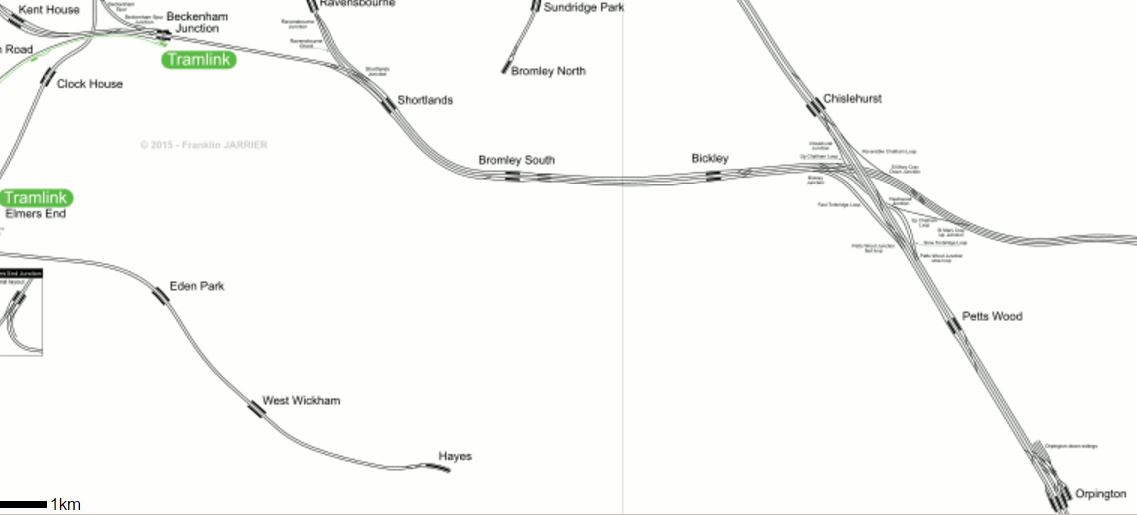
From Kent House Via BromleySouth To Orpington
It has very good connectivity.
- Beckenham Junction connects to the Tramlink.
- Bromley South connects to Thameslink, the Chatham Main Line and the Maidstone East Line.
- Orpington connects to the South Eastern Main Line and the Hastings Line.
Because of all this connectivity, Bromley and Orpington might be able to provide enough passengers for more than four trains per hour going to Victoria and/or Battersea.
Remember there will still be the five fast trains per hour through the Brixton Tunnel in addition to the stopping ones of the Metro.
Bellingham As An Eastern Terminus
When the Overground took over the line, there was some discussion about a service between Victoria and Bellingham.
So could Bellingham station be a terminus?
This Google Map shows the area around Bellingham station.
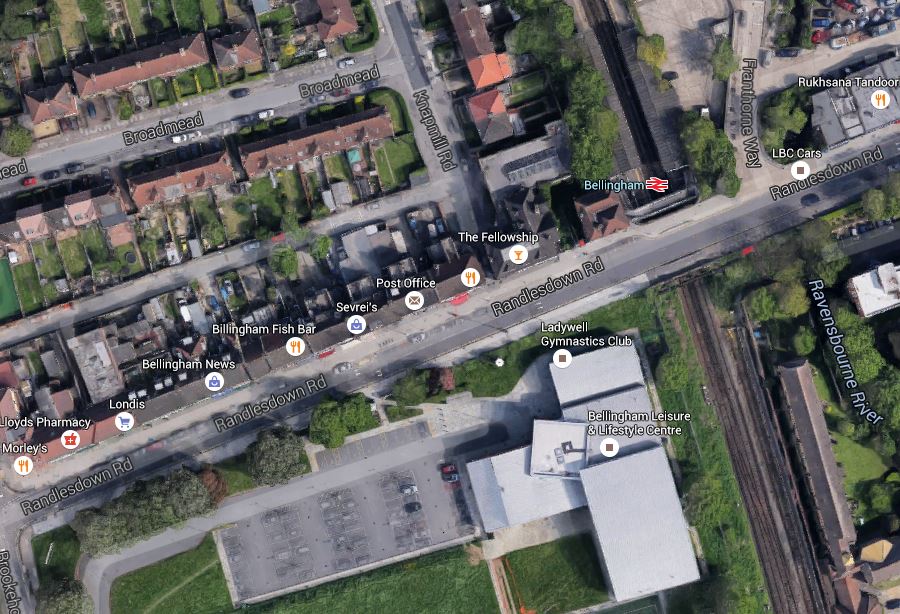
Bellingham Station
There doesn’t seem to be much of importance in the area, except the leisure centre.
In addition.
- The station doesn’t seem to have a suitable bay platform, but there may be space to build one.
- The station would provide a link to Thameslink.
- It only handles a couple of trains an hour most of the day, so perhaps the terminating of trains was to be slipped in the large gaps.
Perhaps it was all to stimulate development in the area.
An HS1 to HS2 Link
If Old Oak Common is chosen as a Western Terminus with a 4 tph service down the West London Line and the core route of the South London Metro, what would be a suitable terminal in the East?
Given what I said about Dartford as an Eastern terminus, surely a four tph service across South London linking HS1 and HS2 must enter into the route planners’ thinking.
As Crossrail does the business linking HS1 and HS2 for North and Central London, a South London Metro could be configured to do a similar job for a whole swath of South and West London.
A Brockley Interchange
The Centre for London report proposes a new pair of platforms on the South London Line between Nunhead and Lewisham stations, providing interchange with the existing Brockley station.
I gave my views on Brockley station in A Report On The Bakerloo Line Extension, which I now repeat in an edited form.
This Google Map shows Brockley station.
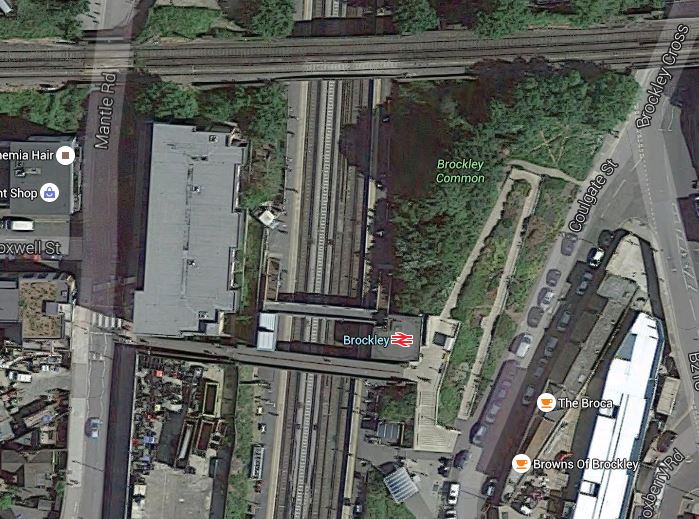
The Bexleyheath Line between Nunhead and Lewisham stations crosses the East London Line and Brockley station at a high level.
I wrote A Four-Poster Station about connecting these two lines.
It would appear that Transport for London have advanced this project from one word in their 2050 Infrastructure Plan to a proposal.
If the South London Metro included the services to Dartford via Bexleyheath, then this interchange at Brockley station might make some passengers journeys a lot easier.
A Penge Interchange
The Centre for London report proposes an interchange between Penge East station on the Chatham Main Line with Penge West station on the East London Line.
This Google Map shows the lines and the two Penge stations.
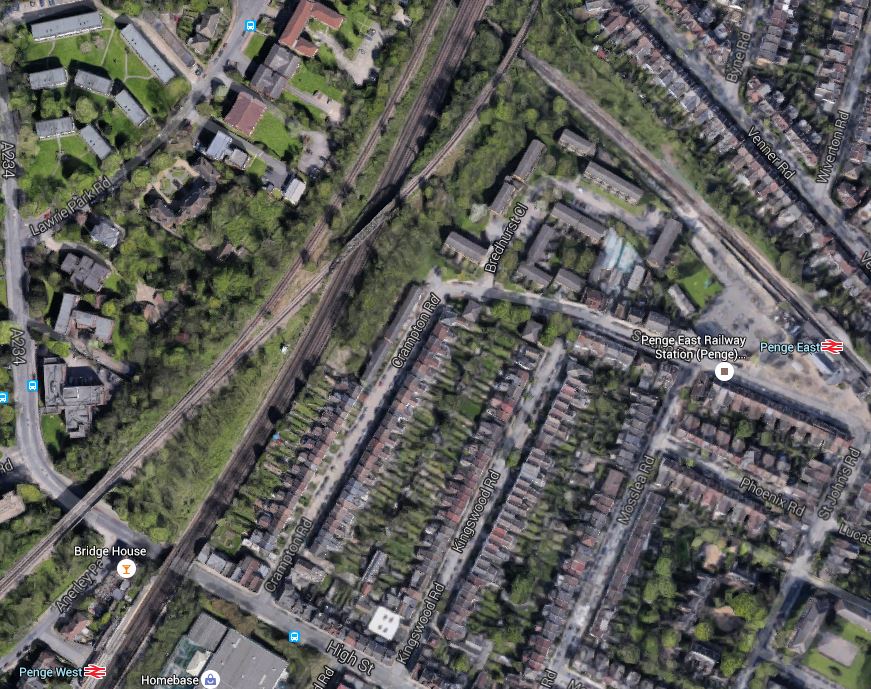
Penge Stations
The report suggests that it would be possible to reduce the walking distance between the two stations from 650 to 400 metres and there might be potential to move Penge West station to the North of the High Street.
As the walking appears substantially to be flat, I wonder if a section of travelator would be possible!
I recently walked from East to West station and took these pictures.



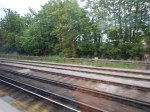
One of the station staff said that they need step-ladders to access the Crystal Palace line, that runs over the top.
The walk incidentally took me fifteen minutes, so if it decreases from 650 to 400 metres, by moving the station North of the High Street that should reduce the time to under ten minutes.
Will a travelator be added.
As with the extra platforms at Brockley station, this interchange has the potential to ease some passengers journeys.
My Proposed Schedule
I will give my view of the trains on a South London Metro.
- 6 tph between Dalston Junction and Clapham Junction.
- 4 tph between Dartford and Old Oak Common.
- 4 tph between Victoria/Battersea and London Bridge
- 6 tph between Victoria/Battersea and Orpington
This gives a total of 20 tph, which would be the same as the East London Line will be in 2019.
The Rolling Stock
Due to platform restrictions on the East London Line, I would envisage that the trains between Dalston Junction and Clapham Junction will probably still be the same five-car Class 378 trains.
The trains on the other destinations can probably be anything suitable and would include Class 375, Class 377 or even some new Class 710 trains.
But as there is no platform restrictions to the other destinations, the trains could probably be any desired formation between four and twelve cars.
Any new platforms would of course be built to accept twelve-car trains.
Getting To Heathrow
At the present time, getting to Heathrow can be a bit of a problem from some places in South London.
But after Crossrail and Old Oak Common station are opened, it would just be a matter of getting one of a 4 tph South London Metro train to Old Oak Common and changing for Crossrail.
It may of course be easier to use one of the other possible routes to Crossrail.
- Take the Northern Line to Tottenham Court Road from Battersea or Clapham North.
- Take Thameslink to Tottenham Court Road.
- Go via Whitechapel.
We’ll all develop our favourite routes.
Getting To Gatwick
At the present time, Thameslink haven’t published their full route yet, but anybody on the South London Metro should be able to do one of the following.
- Go to Clapham Junction and get a direct train.
- Go to Victoria and get Gatwick Express.
- Go to London Bridge and get Thameslink.
Unfortunately, it looks like I might lose my option of going to New Cross Gate and getting a direct train.
Conclusion
A South London Metro running 16 tph or more between Wandsworth Road and Peckham Rye stations, with multiple termini at either end, must be a feasible and affordable possibility, if the following is done.
- The Brixton Tunnel is built to give fast Victoria to Kent services a by-pass.
- The Overground/Metro services are moved to the Northern pair of tracks on the South London Line.
- Various station and track improvements are carried out.
It looks to me, that this project could transform South London and improve the lot of people like me, who live on the East London Line.
Expanding Manchester Piccadilly Station
This announcement on the Government web site is entitled Put HS3 at the heart of a High Speed North – Adonis.
This is an extract.
Recommendation six: Proposals for the redevelopment of Manchester Piccadilly station should be prepared jointly by TfN, Transport for Greater Manchester, Manchester City Council, Network Rail, DfT and HS2 Ltd.
These organisations should work to together to deliver:
a) Detailed plans for the new east-west platforms 15/16 to facilitate delivery early in Control Period 6 and unlock the development potential of the Mayfield site;
b) A masterplan for the longer-term development of Manchester Piccadilly station as a whole, incorporating capacity for HS2 services and options for the delivery and timing of platform capacity for HS3; and
c) Proposals for funding and financing the station redevelopment, including for private sector and local contributions.
I know Manchester Piccadilly station well and it has multiple space problems. These pictures illustrate some of the problems on the North side of the station.

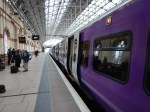


You have lots of short trains and long platforms, which means the following.
- Passengers have to walk long distances.
- There is confusion of which train to take with more than one in the platform.
- It must be a nightmare for train operators and their staff.
Surely some reorganisation could improve this mess, that was probably designed by Topsy.
On the South side of the station, there are two of the most crowded platforms in the UK. Platforms 13/14 need a serious sorting out.
Currently, services from Platform 13 seem to go to the following.
- Huddersfield
- Leeds
- Manchester Airport
- Norwich
- Scarborough
- Sheffield
- York
And from Platform 14 to the following.
- Blackpool
- Edinburgh
- Liverpool
- Southport
Most of the services seem to be provided by TransPennine Express and I think it is true to say, that when and if the Ordsall Chord is opened, there will be a sorting out of services on these two platforms.
But I do feel that the solution is Network Rail’s preferred one of adding platforms 15/16. They can’t be built soon enough, to ease the overcrowding.
This Google Map shows the layout of Manchester Piccadilly station.

Manchester Piccadilly Station
The current Platforms 13/14 are along the bottom of the station, connected to the main station by the two small bridges. I would assume that the two new platforms will go on the south side of 13/14.
Wikipedia gives more details of developments related to the Northern Hub and HS2.
It is going to be a tight fit to get all the lines and platforms into the area.
The more I look at the station, the more I tend to think that the Picc-Vic Tunnel might have been a good solution.
It makes me wonder if it would be more efficient for HS2 and HS3 to share a route through Manchester from the Airport to Victoria and on to Huddersfield and Leeds. It would need to be mainly in tunnel and could go right under the city with underground stations. I wrote about it in Rethinking HS2 And HS3.
Surely, if two high speed lines are to go through Manchester, they should share a route?
I have also received this image from a reader; Ben.
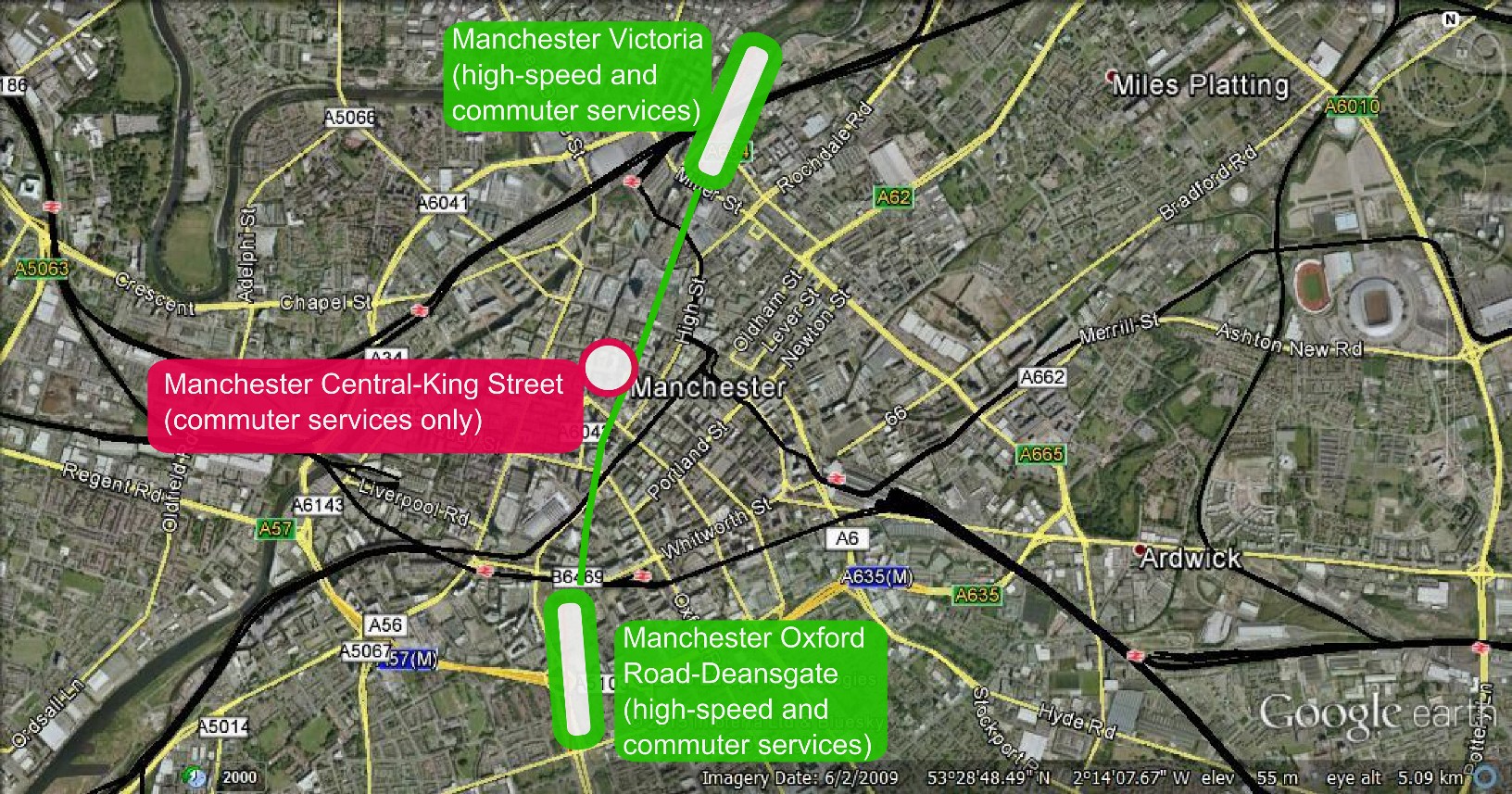
An Alternative Cross-Manchester Tunnel
Ben’s plan illustrates some advantages of a cross-city tunnel, which probably include.
- Less demolition at stations served by HS2.
- HS2 and HS3 could probably share platforms.
- Release of platforms at Piccadilly.
- A station in the centre of the city.
- Better links to the trams and local train services
- Ability to continue in tunnel towards Huddersfield and Leeds.
Remember that we’ve improved our tunnelling capability by a large amount in recent years.
Crossrail in London has also developed station designs and layouts, that could be used in Manchester.
- Massive double-ended stations to effectively serve two separate locations.
- Lines and station layouts to ease and encourage same platform interchange.
- Moving walkways and inclined lifts, where necessary to ease passenger movement.
- Island platforms to ease interchange between directions and branches, as at Whitechapel.
So could the most passenger friendly station, just called Manchester, be built under the city?
I don’t think that the current plans for Piccadilly, which are just so much conservative dross will be realised, as someone will come up with something much better. But then recommendation six encourages that!
Is HS2 At Risk Of Derailing?
There is an article in The Telegraph entitled HS2 at risk of derailing at top speeds, report finds.
I have read the article and the report by Professor Woodward at Heriot-Watt University is obviously, based on sound mathematics and enginering principles.
We have a problem with HS2, which is not unlike the problem with the new Hinckley Point nuclear power station.
There is a big need for extra capacity, but it will cost an awful lot of money.
In both projects too, there is a lot of opposition.
Professor Woodward’s research has one serious consequence, even if the high design speed of the line doesn’t make the trains derail.
It is that if you reduce the speed of the line, the economic case for HS2 is shot to pieces.
If you decide that there could be a safety problem with the embankments, you have to strengthen them and that ruins the economic case too.
If we look at Hinckley Point C nuclear power station, not building it, is not as serious as not building HS2.
We have several other ways to generate power and also lots of ways to save it. Also, the widely quoted strike price of £92.50/MWh would make a lot of other much cheaper schemes like tidal power viable.
But this doesn’t solve the problem of creating more capacity on the rail lines between north and south for both passengers and freight.
HS2 doesn’t carry freight, but hopefully, it will free up paths on traditional routes to the north, that could be used by freight trains.
If you think we don’t, travel between Euston and Glasgow on Virgin Trains and look at the passenger loading.
At present, Network Rail are carrying out various schemes to squeeze more capacity out of the current lines and it is hoped that in the short term, this will help.
But in some ways all it will do is create more demand for travel on the routes.
So at some time we’re going to have to build a new line, which will allow faster speeds than the current lines.
If you look at Phase 1 to the West Midlands, this will have the following effects.
- Extra capacity between London and the West Midlands.
- Journey times of around fifty minutes.
- Making Birmingham Airport, a viable one for those living in North London.
- Paths released for freight on the West Coast Main Line.
- Reorganisation of traditional services on the West Coast Main Line to serve more places.
In Phase 1, there would probably be no more than half-a-dozen trains in both directions on the southern section of HS2, south of Birmingham International station.
On the other hand, when Phase 2 to Manchester and Leeds opens there will be upwards of twenty trains per hour both wayson the same southern section.
I can understand, why those in the Chilterns are getting angry.
So to the protesters, Professor Woodward’s research could be manna from heaven.
For some time, my view has been that we need new tracks between London and the North via Birmingham, as even if all existing lines were upgraded, there wouldn’t be enough capacity.
I think we’re going to need some radical thinking.
For instance, suppose you made Birmingham International a hub, where the lines from the North met a line to London and one into Birmingham city centre.
This might help in the design of HS2 to the north of Birmingham, but that is not the area, where there is major opposition to the line. That is between Birmingham International and London, where land is limited and wherever you build it, you’ll annoy someone.
I suspect, a lot of people working on the project, sometimes feel like going and working elsewhere.
But whatever we do with HS2, we must improve the traditional routes.
- Electrify the Midland Main Line to Derby. Nottingham and Sheffield,
- Electrify the Chiltern Main Line to Birmingham.
- Electrify the routes across the Pennines from Preston and Liverpool to Hull, Leeds and Newcastle via Manchester.
- Sort out the Digswell Visduct on the East Coast Main Line.
- Improve speeds to as high as possible on all routes to the North.
The only trouble, is that the more we improve traditional routes, the more people will travel by train and the need for HS2 will become more urgent.
Does London Need To Get A Grip On Rail Connectivity?
This article in the Standard has a title of Old Oak Common regeneration scheme ‘risks being London’s worst cock-up in 50 years’. This is the first three paragraphs.
Boris Johnson’s flagship regeneration scheme at Old Oak Common is in danger of turning into London’s “worst cock-up in 50 years”, a leading government adviser warned today.
Urban planner Sir Terry Farrell said the £10 billion development, the biggest in Britain, is heading for disaster because of the rush to finish Crossrail.
He blamed politicians for ducking key decisions and said the Mayor was partly responsible for a shortsighted “pass the parcel” approach. Sir Terry said: “If a tenth of the energy he put into the Boris island airport idea had gone into Old Oak Common I feel sure it would have happened without a problem.”
Old Oak Common is going to be a major development of 25,000 homes and 55,000 jobs created over the next fifteen years. A major transport hub will be created at Old Oak Common station will be created, linking some or all of the following lines together.
- Bakerloo Line
- Central Line
- Crossrail
- Dudding Hill Line
- Great Western Main Line
- HS2
- North London Line
- Watford DC Line
- West Coast Main Line
- West London Line
This map shows the plans for Option C of TRfL’s Old Oak Common proposals.
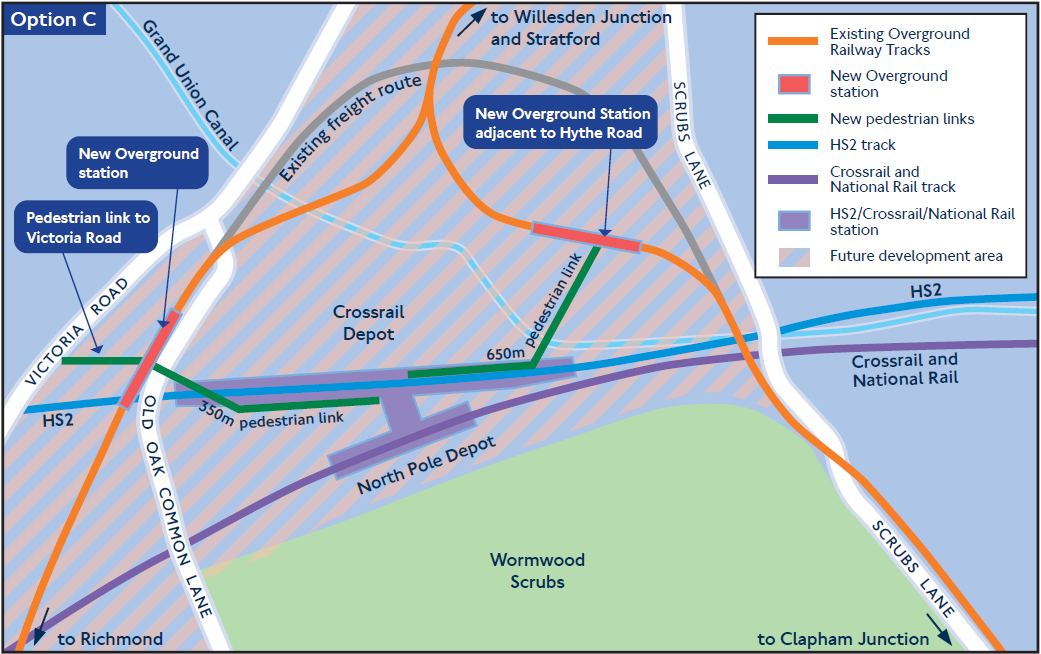
Option C Proposal At Old Oak Common
I wrote about this option in Should An Overground Station Be Built At Hythe Road?
Terry Farrell has said that there is no space between the rail lines to put the piling to support the homes, offices and other developments that will built over the top.
I also believe that the walking routes between the various stations will be far to long and tortuous.
The developers, Transport for London and the rail companies involved all seem to be planning their own parts in isolation.
It seems to echo what I documented in Searching For What Is Going To Happen On The East London Line After The Thameslink Programme Opens, where I was trying to find out how Thameslink will improve my journeys from Dalston Junction using the East London Line.
My correspondence on that issue, would seem to indicate that Thameslink and Transport for London don’t talk to each other and calmly go their own ways.
Someone needs to get a grip on all these big projects at a high level.
Small-Scale Connectivity To Crossrail
I live about twenty-five minutes from my nearest Crossrail station at Moorgate on a 141 bus and as I walked around today, I just wondered what will be the best way to access London’s new East-West rail line when it opens in a few years time.
So what do I mean by small-scale connectivity?
I think it is best defined as any method that isn’t more than perhaps ten stations on heavy rail, light rail, the Underground or trams.
And of course, you might substitute Thameslink for Crossrail! Or if you don’t live in London, it could be your major cross-city line.
So in my case, the following would be small-scale connectivity to Crossrail.
- Walking
- Cycling
- Car
- Taxi
- Bus
I do have a heavy rail link to Crossrail in the form of the East London Line between Dalston Junction and Whitechapel, so that will be included as it is only a short stretch of line of four stations.
These are the methods available to me in Dalston.
Walking
For good connectivity, the walking routes around a station should be properly mapped and signposted on a physical wayfinding system, like Legible London used all over the capital.
I also think it is essential that a common format is used, along a line.
So this probably means that London will decide how walking maps and signposts at Crossrail stations in Essex and Berkshire will look.
Will that be acceptable to towns and cities, that have called in consultants to design their ideal wayfinding system?
One problem with wayfinding systems, is that in some places the locals who know the city or area well, say they don’t need the system and think it a waste of money.
You also have the problem in areas with more than one local authority, that each go their own way, rather than agree on a common system.
Remember too, that London is so large, that the average resident finds themselves regularly in an area of the city they don’t know. So Londoners on the whole are very pro-Legible London.
I feel that we need to impose the same wayfinding system all over the UK.
Cycling
Just as there should be good walking routes to a station, the cycling routes should be obvious and well-signposted.
And if bikes are provided for hire at the station, the payment system must be compatible with London’s.
Perhaps we need a nationwide bike hire system?
Car
Many people will want to drive to their local Crossrail station and park their car before they get the train.
i have a feeling that when Crossrail opens, the biggest complaint will be the lack of car parking at stations.
Taxi
For about the last three months, I’ve been suffering badly from plantar fasciitis and because of the limited mobility, it gives me at times, I now feel very strongly that every Crossrail station, should have a proper black taxi rank.
Recently Transport for London have announced that one of my local stations; Highbury and Islington, is going to have a taxi rank. I have yet to find a taxi driver who is against the idea and I believe this could be a winner for both passengers and black cab drivers.
Bus
Every London rail and tube station is a bus hub with its own spider map, which details all of the buses and their routes from the area. This is my lovcal bus spider map for Dalston.
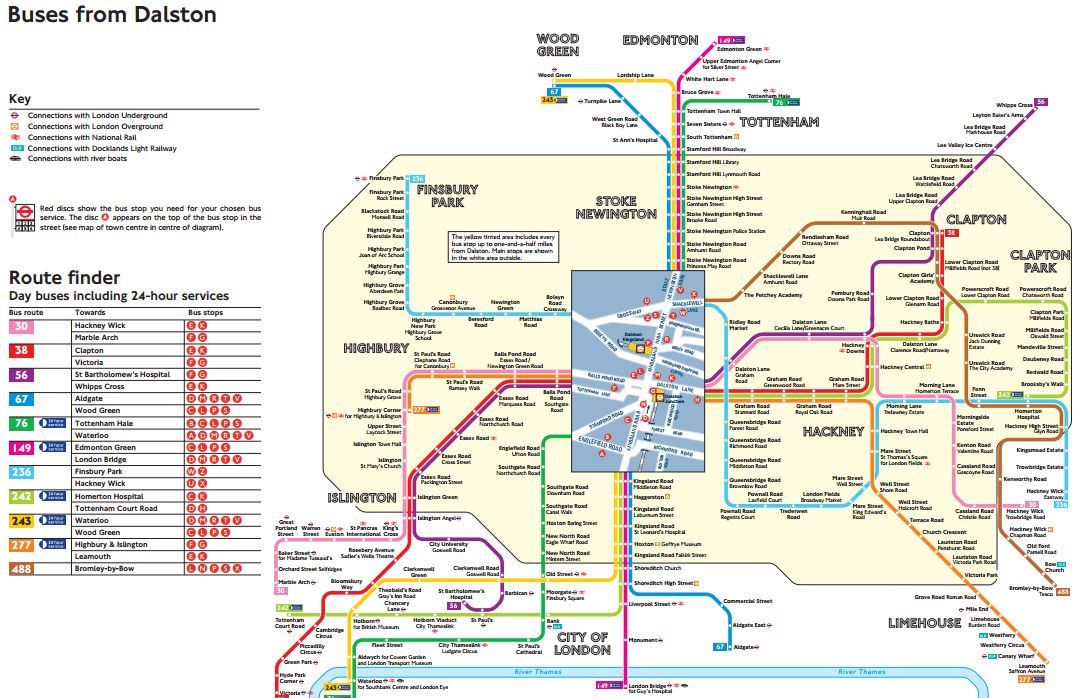
Dalston Bus Spider Map
Venture outside of London and in many places, bus mapping is often missing or very bad to give it the benefit of the doubt.
As with walking maps, local authorities outside of London with a Crossrail station, will have to adopt London’s system.
Other Rail Lines
Crossrail does connect to quite a number of heavy rail, Underground and Overground Lines.
- Bakerloo Line
- Central Line
- Circle Line
- District Line
- East London Line
- Great Eastern Main Line
- Great Western Main Line
- HS1 – After extension to Gravesend
- HS2 – After Old Oak Common
- Jubilee Line
- Metropolitan Line
- North Kent Line
- Northern Line
- Northern City Line
- North London Line
- Thameslink
- West Anglia Main Line
- West Coast Main Line – After extension to West Coast Main Line
- West London Line
I have included links to extensions to Gravesend and the West Coast Main Line and Old Oak Common in this list.
Small Branch Lines
But it also connects with several smaller branch lines or perhaps in the future, some tram and light rail lines.
- Abbey Line – After extension to West Coast Main Line
- Brentford Branch Line
- Croxley Rail Link – After extension to West Coast Main Line
- Greenford Branch Line
- Henley Branch Line
- Marlow Branch Line
- New North Main Line
- Reading to Basingstoke Line
- Romford to Upminster Line
- Shenfield to Southend Line
- Slough to Windsor and Eton Line
- Staines and West Drayton Railway
- Waterloo to Reading Line
I believe that Local Authorities will develop these smaller lines and create others to maximise their benefit from Crossrail,
A Metro In The East
The two lines that I think have the most likely chance of being developed, are the Romford to Upminster and Shenfield to Southend Lines.
- The main line rail company; c2c, is very ambitious.
- In the next couple of decades, South East Essex will be an important economic growth area.
- Better links are needed to Southend Airport and the London Gateway.
- There is substantial development of jobs, housing and leisure opportunities in the areas the lines serve.
- Give the people of Essex an opportunity and they embrace it fully.
I wouldn’t be surprised to see a substantial metro network created in the area, based on Billericay, Shenfield, Southend and Thurrock.
A Metro In The West
If a metro network can be successfully developed at the eastern end of Crossrail, is there the potential of creating something similar at the western end?
Consider.
- Heathrow dominates thinking in West London and feels that everybody should jump to its tune.
- Heathrow should wake up to the fact that it will never get a third runway, as London’s electorate will always vote to block this.
- There will always be a Heathrow, but in time, it will cease to dominate the air travel market in the UK, as it does now!
- Heathrow has very limited rail connections to Basingstoke, Reading and the West.
- If you look at the list of small branch lines, several are clustered around the western end of Crossrail, with its two hub stations of Slough and Reading.
A metro in the west could be developed based on hubs at Basingstoke, Heathrow, Slough and Reading. The Windsor Link Railway is surely thinking along those lines.
A Metro In The South East
Of all the stations on Crossrail, Abbey Wood is one of the most disappointing.
As a terminus for Crossrail, that connects to the North Kent Line and to services to South East London and the Dartford area, four platforms doesn’t seem enough, when you compare the station to the other terminals of Reading and Shenfield.
Transport for London have proposed that the Gospel Oak to Barking Line could cross the river to serve Abbey Wood and if this should happen, there must be opportunities to create another metro system based on Abbey Wood.
A Metro In The North
There are proposals to extend Crossrail to Milton Keynes from Old Oak Common.
This would surely, bring in the possibility of a network of local lines based on Watford.
- The Abbey Line is one of those difficult-to-run lines, that needs substantial improvement.
- The Croxley Rail Link could be expanded to serve Amersham.
- Local services on the West Coast Main Line and the Watford DC Line are very crowded.
This will only be developed once Crossrail serves Watford.
Conclusion
Crossrail in 2030, will be an entirely different line to that being created today.
Capturing The Benefits Of HS2 On Existing Lines
This is the title of a report written in 2011 by Greengauge 21.
This is how the report starts.
When High Speed Two (HS2) is complete, the longer distance, non-stopping trains on the West Coast Main Line (WCML) will in the main transfer to the new, quicker, route, freeing up valuable capacity. However, until now plans for services on the WCML once HS2 is open have been broad brush assumptions made for the purposes of completeness in the economic appraisal. This report looks ahead in more detail to consider what services should operate on the existing rail network once HS2 is open. The aim is to help kick start the development of this wider strategy in which the benefits of HS2 are maximised, not just for those using the new line, but for travellers on the existing railway. The effective re-use of the capacity released by HS2 is a key project benefit. It will allow new local and regional passenger and new freight trains to operate: services that are and will continue to be prevented by network capacity constraints.
It is well worth reading the full document, even though it was written in 2011,, as I think it explains how HS2 could benefit those other than those, who want to get quickly between London and Birmingham.
Places With Better Services To And From London
The report singles out three areas, that could benefit from a freed-up West Coast Main Line between London and Birmingham.
It says that the following places.
- Walsall
- Shropshire
- Mid and North East Wales.
Could all gain new direct services to and from London.
Feeders To The West Coast Main Line
The report talks about how three new or improved lines and schemes will act as feeders to the services on a West Coast Main Line, that will have more capacity for semi-fast services, connecting London with Birmingham, Liverpool, Manchester and Scotland.
- The Croxley Rail Link will link Watford to a wide area of Hertfordshire and Buckinghamshire.
- The East-West Rail Link intersecting the WCML at Milton Keynes would improve services from a lot of the South Midlands and East Anglia.
- Improvements between Leamington and Nuneaton (Nuckle) would improve connections for Warwickshire.
These three schemes are now progressing and will be fully working by the time HS2 opens in 2026.
Chiltern Electrification
The three feeder schemes mentioned above all contain two ambitious words Chiltern Railways.
Consider the following.
- The Croxley Rail Link could and probably will be extended to Amersham via Rickmansworth.
- TheEast West Rail Link will deliver a Chiltern service from Marylebone to Milton Keynes via Aylesbury.
- The Greengauge 21 report talks of a Marylebone to Coventry service via Leamington and Kenilworth.
- Oxford to Milton Keynes will be electrified.
- Chiltern use some rather elderly but excellent diesel trains.
- Coventry, Milton Keynes and Watford are already electrified.
I can’t believe that there is not more talk about electrifying the Chiltern Railways network.
I don’t think that Chiltern Railways would need full electrification, if they were to use IPEMU technology in conjunction with some limited electrification.
- The Snow Hill Lines in Birmingham, perhaps as far south as Leamington.
- The southern section of the Chiltern Main Line, perhaps between Marylebone and High Wycombe.
Electrification is a future aspiration of Chiltern Railways and it could give a second 125 mph line between London and Birmingham.
This would mean that a much increased number of towns would have a high speed connection to both major cities and many places in between and North of Birmingham.
I think that enabling electric trains to use the Chiltern Main Line and the Snow Hill Lines, should be given a high priority.
How Not To Handle An Environmental Issue In A Large Project
On my holiday in Poland, I met someone, who lives on the route of HS2.
They told me that a million tons of tunnel spoil will be dumped on farmland in the Chilterns.
I was rather surprised to say the least, as having followed major projects for the best part of forty years, I know that project managers, engineers, architects and construction companies, don’t want hassle from what are collectively termed Nimbys, so they do their utmost to design projects, so that disruption and damage to the environment is minimised.
Crossrail had its problems early on, as Mayfair didn’t want the rsailway or the disruption of ten years of construction. So they devised a strategy based on openness and archaeology, which sold the project to Londoners, as something more than a railway. They have also been very helpful in giving access to the general public in events like Open House.
So I typed “HS2 tunnel spoil” into Google and found this article in the Bucks Free Press, which is entitled HS2 tunnel spoil to be dumped in Chilterns AONB. This is an extract from the article.
The announcement was made by HS2 Ltd’s Country South Area Manager Neil Cowie at a community forum in Little Kingshill on Tuesday.
He said it would be placed within a ‘sizeable area’ within two or three miles of the planned tunnel portal at Mantles Wood near Amersham – but he added HS2 Ltd did not want the location to be made public yet.
Mr Cowie said: “Rather than taking it longer distance along highways, we’ve taken some additional land alongside the route which we will landscape.
“When it’s finished it will be properly landscaped and will look very nice.”
I’m no diplomat, but it does seem a rather poor statement, which probably came out of a forum, where things were not up to scratch.
I’ve been to several Transport for London foums about projects like Camden Town station, Crossrail 2 and Hackney station and at each one, there has been an architect, engineer or project planner, who understands in detail what is proposed.
A later statement in the article says this.
In a later statement, HS2 Ltd said: “We will not being be depositing spoil/excavated materials from tunnelling in the AONB – it will be excavated materials from the cuttings going through the AONB. All tunnelling excavated materials from that part of the line will be taken out via the Colne Valley construction site.”
When dealing with any sensitive project from a children’s playground upwards, you must get your facts right! Once errors are in the local culture, they can only be eradicated with great difficulty and tremendous expense.
With respect to HS2, my project management and engineering instincts lead me to the conclusion, that HS2 will probably come up with an innovative and non-disruptive way to remove the tunnel spoil from the area.
If they don’t, then they don’t deserve to be building the line.
Puzzled Over Streatham Common Station
Transport for London’s proposal for the Bakerloo Line Extension comes with a very nice map of the various projects that will be carried out to improve rail services in South London.
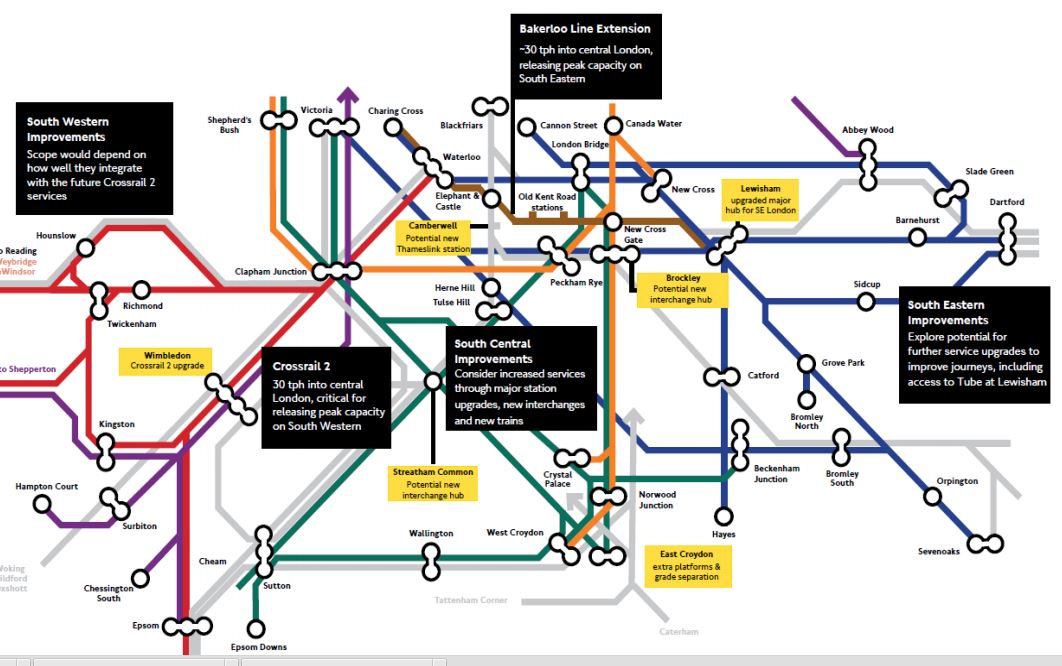
Rail Improvements South Of The Thames
It is all good stuff and most is easily explained.
The black boxes are about more general and larger projects, whereas the yellow boxes are comments about specific stations.
The projects; large and small, fit together like a jigsaw. And not a particularly difficult one to understand!
Of the larger projects, the simple extension of the Bakerloo Line to Lewisham station via two new stations and New Cross Gate station is a masterstroke.
- It provides a thirty trains per hour rail link through the Old Kent Road Opportunity Area.
- It gives all those living on the East London Line, as I do, a much needed connection to the Bakerloo Line.
- Coupled with an upgraded Lewisham station, it gives South East London access to the Underground.
- The project can be opened without an expensive set of new trains.
- New Cross Gate and Lewisham stations have space for construction.
- The extension can be built with minimal closure of the Bakerloo Line.
- The project is almost a repeat of the Northern Line Extension.
- No-one’s current train service will be discontinued.
- There is no replacing heavy rail with smaller Underground trains.
- If in the future, the line needs to be extended, this will be no problem, if Lewisham station is designed correctely.
The only negative, is that the plan doesn’t provide a much-needed rail link in Camberwell.
But Transport for London have done there research and have concluded that reopening the disused Camberwell station on Thameslink could be a worthwhile alternative.
The TfL report gives this concise summary.
A new station at Camberwell would be a significantly lower cost option to a Tube extension, whilst serving the same catchment area. Investigations show significant journey time improvements could accrue to Camberwell passengers and that operationally there may be scope to integrate re-opening of the station into the launch of the completed Thameslink programme.
We will therefore undertake further planning work with Network Rail and the London Borough of Southwark to assess the proposal.
It is a second masterstroke.
Camberwell station will probably get a similar service to Loughborough Junction station. I’m not sure what it will be, but something like four eight-car trains an hour both ways. In around fifteen minutes, passengers could be at.
- Balham for the Northern Line and Crossrail 2
- Elephant and Castle for the Bakerloo and Northern Lines
- Blackfriars for the Circle and District Lines
- Farringdon for Crossrail and the Metropolitan Line.
- Kings Cross St Pancras for main line services and the Victoria Line.
Camberwell station could easily be double-ended, with entrances on both sides of Camberwell New Road.
Camberwell would get at least a high-capacity four trains per hour service to virtually everywhere, with just a single change.
And this could be delivered by 2020, if they get the turbo-charged engineering skates out.
On the South London map, there are some other stations mentioned.
- Brockley – Potential new interchange hub
- East Croydon – Extra platforms & grade separation
- Lewisham – Upgraded major hub for SE London
- Streatham Common – Potential new interchange hub
- Wimbledon – Crossrail 2 upgrade
All of these station upgrades are understandable, with the exception of Streatham Common station.
I can only believe that Transport for London have a cunning plan for this station and the tangle of lines to its North.
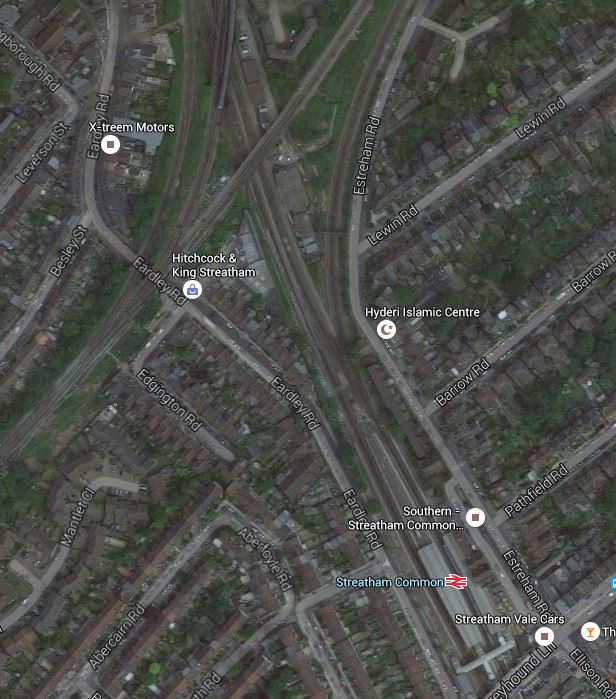
Streatham Common Station And The Tangle Of Lines
So what would an interchange hub be like?
In the simplest design, two platforms would be built across the lines through Streatham Common station alongside the Sutton Loop Line. They would be connected to extended platforms from the existing station, by stairs and lifts.
I think there would be space to build some bay platforms into the station, so that Streatham Common station could be used as a terminus.
This schematic of the rail lines is from carto.metro.free.fr
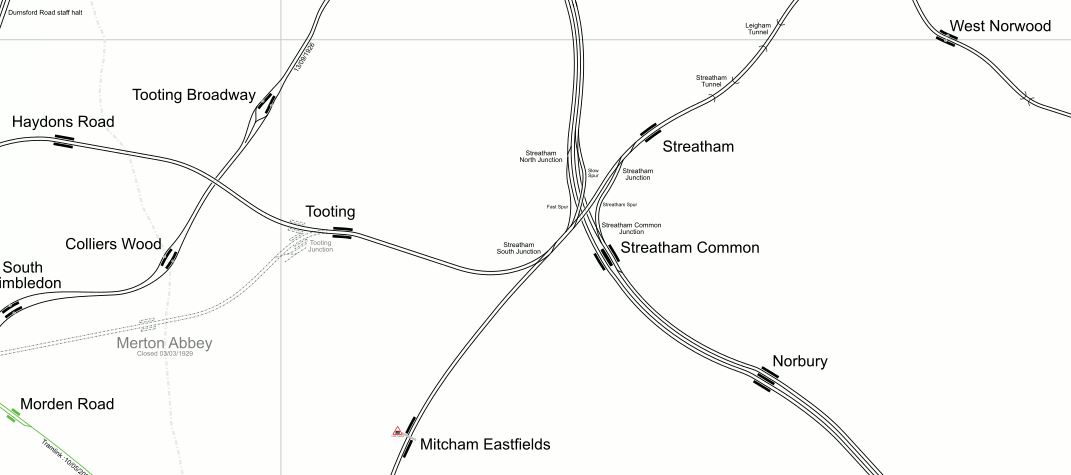
Lines At Streatham
Note how there are very few rail lines, south of Streatham towards Mitcham Eastfields station. Wikpedia says this about the station.
The station is located at Eastfields Road level crossing, in an area previously poorly served by public transport. The nearest station was Mitcham Junction, which along with Mitcham tram stop, was over 1 mile (1.6 km) from the district.
I wrote about the station in Mitcham Eastfields Station.
The lines that currently go or could go through the Dtreatham stations are set out in the following sections.
The Sutton Loop Line Of Thameslink
Streatham station is the last station on Thameslink before the Sutton Loop starts and finishes. Stations on the Sutton Loop include.
- Tooting
- Haydons Road
- Wimbledon
- Wimbledon Chase
- South Merton
- Morden South
- St. Helier
- Sutton Common
- West Sutton
- Sutton
- Carshalton
- Hackbridge
- Mitcham Junction
- Mitcham Eastfields
The fourteen stations have the following service.
- Currently, there are two trains per hour in each direction on the loop.
- Only Mitchan Junction and Wimbledon have connecions to Tramlink.
- I think Streatham to Streatham takes about forty-five minutes of travelling time.
- These trains eventually terminate and come back at St. Albans or Luton in the Peak.
- When the ongoing Thameslink Programme is finished, there will be two eight-car Class 700 trains in each direction every hour.
When the Thameslink Programme was planned, Network Rail intended to terminate these services at Blackfriars.
Residents and their politicians objected! Wikipedia says this.
Network Rail had planned to terminate Sutton Loop Thameslink trains at Blackfriars station, rather than have them continue through central London as at present. This upset many residents in South London and their local politicians, who saw it as a reduction in services rather than an improvement. In response to pressure, government has ordered Network Rail to reverse the decision.
I think this illustrates a certain sensitivity about train services in the area. Do they think that other places like Balham, Croydon and Wimbledon, get all the goodies?
So we have four trains an hour through the core section of Thameslink going on the Sutton Loop.
Although, this shouldn’t affect the services on the loop, could this cause problems for passengers on the trains through Wimbledon and Sutton, as long-distance trains are being used for short local journeys.
For example, you might have mothers with buggies taking babies and children to nurseries and schools, mixed up with commuters, who want to go north of the Thames.
A simple solution would be to have more trains going round the loop, so that instead of just two trains per hour each way, there were perhaps four or even more.
But where would they come from?
They could come a long way from somewhere like Orpington or Cannon Street, which would mean finding paths all over South East London and perhaps beyond.
Or perhaps they could just do the loop and start and finish at either Streatham or an expanded Streatham Common.
As Streatham is just a two platform station, with little space to expand, a bay platform in Streatham Common might be one solution.
Possible Reason for an expanded Streatham Common station – The station could be the terminus of a two train per hour local service around the Sutton Loop.
The Brighton Main Line
The Brighton Main Line goes from Victoria to East Croydon with fast trains generally only stopping at Clapham Junction station en route. However services pass through several important stations like Balham and Streatham Common without stopping.
Could there be advantages in stopping some of these services at an upgraded Streatham Common?
I don’t know under normal circumstances, but there may be good operational reasons for services to be able to call at Streatham Common station.
Possible Reason for an expanded Streatham Common station – The station could be a valuable interchange between Brighton Main Line and other services.
Tramlink
Although Tramlink doesn’t go anywhere near Streatham at present, it does have a main route, south of the area.
There is also a distinct lack of rail services in the area between Streatham and Mitcham, which led to the building of Micham Eastfields station.
In Wikipedia, it says that extensions to the Tramlink have been proposed North and South of Croydon. This is said about North of Croydon.
To the north of Croydon, it is proposed to use a highway alignment based on London Road. To the south of Thornton Heath Pond, the use of a shared carriageway is a possibility. North of this point the road becomes the A23 again, but there are likely to be some opportunities for trambaan type segregation to Norbury and between Norbury and Streatham, although Norbury is a pinch point. The proposal is to terminate the line at Streatham railway station, providing an interchange to the extended East London Line
Possible Reason for an expanded Streatham Common station – The station could be a destination for Tramlink.
Tram-Trains
In areas of Germany, where there are both trains and trams, the Germans are getting very enthusiastic about tram-trains which can run on both networks.
If tram-trains, were to be used on a possible Tramlink Extension to Streatham, they could join the railway at a convenient station, like Norbury or Streatham Common and become trains to go round the Sutton Loop.
Possible Reason for an expanded Streatham Common station – Tram-trains on Tramlink.
The East London Line
I use the East London Line a lot and it has the problem of success.
Trains have grown from three to five cars and some recent trips from Denmark Hill to Dalston Junction have shown, that at times standing is common.
Increased frequencies in 2018/2019, will ease the problems, but would another terminus in South London be a good idea for the East London Line?
The capacity of the core section of the East London Line is twenty-four trains per hour, so even from 2018/2019, there are four more paths available.
So could we see some services going to Streatham Common station perhaps via Peckham Rye, Tulse Hill and Streatham?
A factor that might apply here, is can Platform 1 at Clapham Junction cope with enough trains from Dalston Junction?
Possible Reason for an expanded Streatham Common station – A terminus for a branch of the East London Line.
The West London Line
Southern’s hourly service between South Croydon and Milton Keynes calls at Streatham Common station.
London Overground has a service of around four trains per hour on the West London Line between Clapham Junction and Willesden Junction, which Southern’s service augments for part of the route.
But there are problems with the West London Line.
- There are some extended service intervals at times.
- The Southern service doesn’t call at Willesden Junction.
- West London Line services call at different platforms at Clapham Junction.
- As with the East London Line, could platform space at Clapham Junction be a problem for the West London Line of the Overground
Unlike the East London Line, the West London Line is not a turn-up-and-go service.
So could there be advantages to use Streatham Common station, as a southern terminus for services through the West London Line?
Possible Reason for an expanded Streatham Common station – A terminus for the West London Line.
HS2
When HS2 opens in 2026, getting to Euston station will not be easy, as it is unlikely that Crossrail 2 will have been started, let alone up and running.
Passengers will need to get to a Northern or Victoria Line station and have a deep and possibly tedious journey across Central London.
Thameslink will be of use to some, but there will be a walk or a short-but-difficult tube journey between St. Pancras and Euston.
But HS2 will stop at Old Oak Common station on the North London Line. If the West London and East London Lines were to be extended to Streatham Common station, either could be a good alternative route to HS2 and the West Coast Main Line.
I estimate that Streatham Common to Old Oak Common will take thirty three minutes, compared to Morden to Euston on the Northern Line, which can take forty-one minutes.
Possible Reason for an expanded Streatham Common station – The station could be an important hub, collecting passengers for HS2 and the West Coast Main Line
Crossrail 2
Crossrail 2 is not planned to call at Streatham Common station, although it might go underneath in its route from Balham to Wimbledon.
Even so, I suspect that an expanded Streatham Common station will be to the advantage of Crossrail 2.
As I said earlier the station can help improve services on the Sutton Loop, which would have effects.
- Bring more passengers to Wimbledon for Crossrail 2.
- If extra stations were added to the Sutton Loop, these could help solve the Tooting Broadway/Balham wars.
- Could a new station be built at St. George’s Hospital, between Tooting and Haydons Road stations?
But the biggest benefit would be that Streatham Common station, would be an alternative hub, for those wanting to avoid Wimbledon during the building of Crossrail 2.
Possible Reason for an expanded Streatham Common station – Crossrail 2
East Croydon
When East Croydon station is being extended or the grade separation at Windmill Bridge Junction is being built, surely a well-connected interchange at Streatham Common, could be an asset towards helping to maintain a service.
Even under normal circumstances with a decent tram and train connection to Croydon, Streatham Common station may take the pressure off public transport in Croydon.
Possible Reason for an expanded Streatham Common station – Alternative routes for Croydon
Conclusions
Build a Streatham Common interchange hub!
It is just a pity that Crossrail 2 can’t have a station at Streatham Common.
Is the Streatham Common interchange hub, a third masterstroke?
 The Anonymous Widower