Are Rail Passengers Enthusiastic About High Speed Rail?
I ask this question, as in some ways it is a continuation of a conversation I had with a fellow First Class passenger, whilst we were waiting for our Manchester train on Saturday in the Lounge at Euston.
He asked if I’d ever flown to Manchester from London. I said no and he said he wouldn’t either, as the trains were good enough. So we were two satisfied Virgin riders.
But we were both travelling on a Saturday and I bought my ticket some weeks ago on-line.
So what if I needed to go urgently to see someone tomorrow, how much would it cost?
Looking on the Virgin web site this morning, I can get a ticket to Manchester from Euston for £67.50, if I leave on the 10:00. The cheapest flight available on British Airways in the morning is £211. But there is one big difference, with Virgin the ticket is a First Class Advance, which includes an unlimited baggage allowance and free drinks and snacks. I’d also get a third off the £67.50 as I have a Senior Railcard.
The conversation was typical of many, I’ve had with savvy passengers on British trains, not always in First Class. Moans include the overcrowding and the quality of on train snacks and drinks. But with most passengers going a distance, there is generally no problems with the price. Obviously, passengers would like to get there quicker, but in the UK in recent years, I’ve never heard anybody complain about the length of the journey, on trips to and from Glasgow, Edinburgh, Cornwall and Wales.
You might get the odd comment, about looking forward to a slight speed-up, but no-one has ever mentioned that they can’t wait for a High Speed train to whisk them to say Edinburgh at 200 mph.
I think that passengers choose a train that meets certain criteria. It must be convenient and comfortable, at a keen price and so long as it is fast enough no-one seems to care. I remember, once being told by a one of First Great Western’s Customer Service Agents, that one of the common question they get asked is “Is the train going to be an InterCity125?”
I must admit, that one of the reasons, I travel on Chiltern to Birmingham, is that the trains are comfortable and spacious, Mark 3 coaches, rather than the cramped Pendelinos. My only problem, is that Euston is easier for me to get to, than Marylebone.
So you pays your money and takes your choice.
Obviously, we’d all like to get there a few minutes sooner and to illustrate this, at Bolton, I had a long chat with a fellow Ipswich fan, who like me was looking forward to the implementation of the Norwich in Ninety improvements.
When HS2 is built to Birmingham, I do wonder if I’ll use it! A lot will depend on the trains, being comfortable and spacious, and I’m not going to pay a silly price to save a few minutes. I’d also be more likely to use the line, if I could just hop on the Overground at one of the Dalston stations and then change across the platforms at say Old Oak Common.
Convenience is everything! Especially, when there is a comfortable, affordable alternative! Which there will be!
If you look at the only high speed link we have, that to Paris and Brussels, through the Channel Tunnel, it obviously meets a lot of passengers’ criteria. But it did take some time to get popular, as I believe it will with HS2.
The interesting thing, will be how successful, the new electrified line to Bristol and South Wales, is in attracting passengers, after it opens hopefully in 2017. There will be new Class 800/801 trains, but I have my doubts, they will be liked as much by passengers as the forty-year-old InterCity125s.
The Great Western Main Line, like the West and East Coast Main Lines, will be a genuine 200 kph plus line, that because of signalling developments will be able to run faster than current services.
All three lines by the end of this decade will share some characteristics.
1. Fast, frequent services in modern trains at speeds up to 140 mph.
2. Services will stop at a convenient intermediate stations, like Crewe, Doncaster, Swindon, Newport and many others.
3. If the current trend continues its upward curve, on-board service will be better.
4. All classes will have free on-board wi-fi.
These services will set a very high bar for services on HS2 to achieve.
The more, I read about HS2, the more I’m convinced that it is needed more on capacity grounds than anything else. And especially, the capacity the line will release for freight! It will certainly find it difficult to offer some of the reasons we use the trains we do today.
So to answer my original question, I think the current answer is no. But in a few years time, there may be a different answer. Unless of course all of the negative publicity about HS2 convinces a government, that it is not worth the trouble.
An Advantage Of Eurostar’s New Trains
I’ve stood on the unwelcoming platforms at Stratford International station waiting to catch a fast train to Kent, as Eurostar’s trains thunder by on their way to Europe.
The current Class 373 trains are not the quietest, to say the least.
This morning, Nicola Shaw, the boss of HS1, said on BBC Breakfast, that the new e320 or Class 374 trains are a lot quieter.
So at least twenty years of development has brought another advantage, to those living along the route.
Hopefully, the trains for HS2 will be even quieter.
Crossrail, HS2 And The Overground Seem To Be Coming Together At Old Oak Common
There has been a report in the Standard, which talks about how Crossrail, HS2 and the Overground could come together at Old Oak Common, which is an area of London ripe for redevelopment.
The report shows this map.
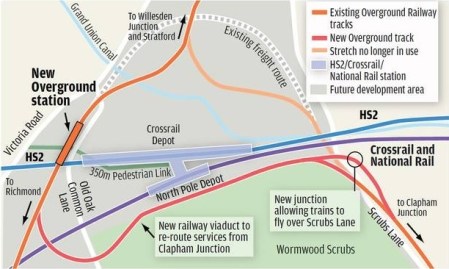
Rail Lines At Old Oak Common
The map is informative and it shows how the West London Line might split from the North London Line at the new Old Oak Common station, rather than at Willesden Junction.
The map though doesn’t show the Dudding Hill Line which joins the North London Line in this area, possibly just south of the new station.
To show the space available in the are, look at this Google Map shoeing the wider area around the proposed station.
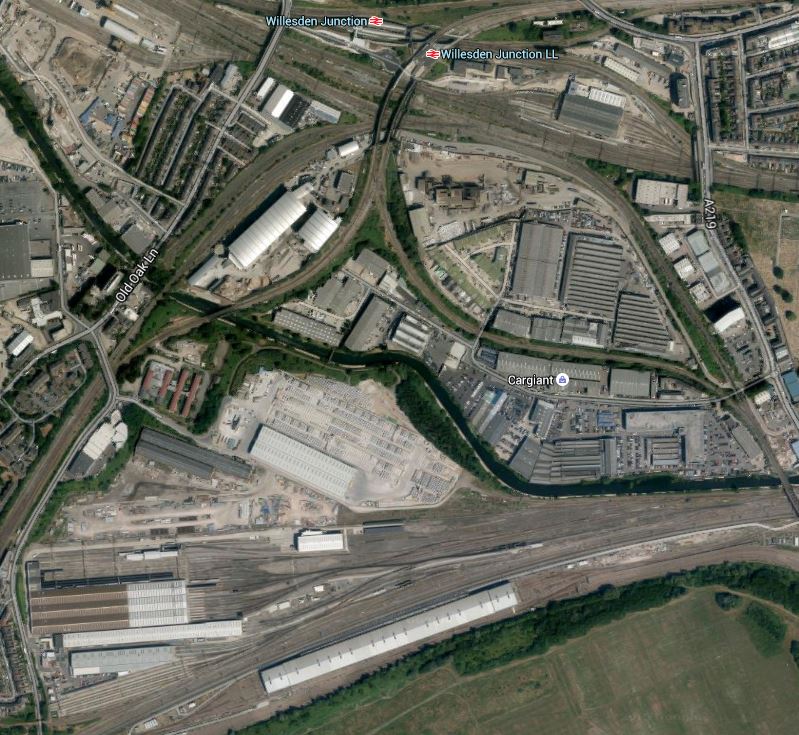
Old Oak Common Area – Downloaded 7th July 2015
There are rail lines everywhere. This second image shows the Southern part of the previous one, along the Great Western Main Line and Crossrail.
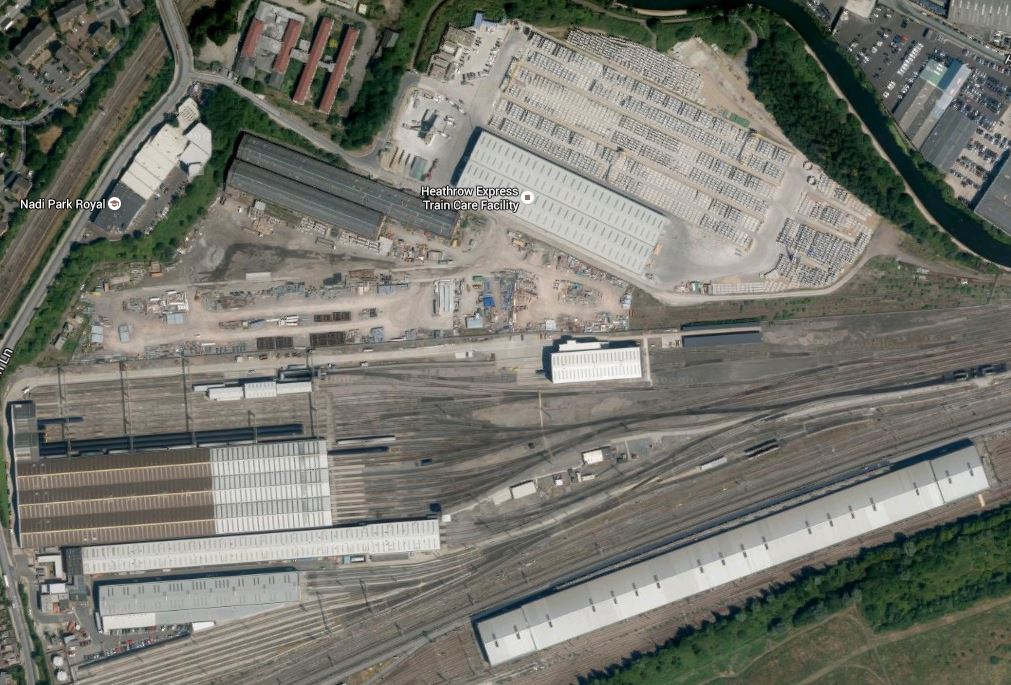
Old Oak Common Detail – Downloaded 7th July 2015
Working upwards from the bottom (South) on this map, you see the following.
1. The long building is the North Pole depot to be used by the new Hitachi Class 800/801 trains, which will be delivered over the next few years.
2. The Great Western Main Line and the future Crossrail tracks.
3. Depots for Heathrow Express and other trains.
4. I think that the large building surrounded by a large amount of grey blobs is the factory that manufactured the tunnel linings for Crossrail.
5. The Grand Union Canal encircles the site.
So could the imaginative minds of the planners at Transport for London have decided to bring the North London Line, an Extended Gospel Oak to Barking Line, Crossrail and HS2 together at the proposed new large development at Old Oak Common? With a little bit more clever design, they might even be able to tie the Central Line into the mix.
I’m all for this personally, as North East London, where I live, will be given a simple route to get to Heathrow and Reading, by just taking the North London Line or the GOBlin to Old Oak Common for Crossrail.
A Vision Of Old Oak Common In The Future
Transport for London’s Transport Plan for 2050 is particularly forceful about what will happen at Old Oak Common.
A key aim beyond this is to integrate Old Oak Common as a Canary Wharf of the future, with around 90,000 jobs and 19,000 homes
They also have a detailed map, showing lines reaching out in all directions, from the junction of Crossrail, HS2 and the Overground. In addition to the links through the Goblin Extension, I’ve traced earlier, there are a possible extension of the West London Line to Balham and a service northwards on the Midland Main Line to somewhere like St. Albans.
So London is getting another hub to complement Stratford and Canary Wharf in the East and Clapham Junction in the South.
Musings On Freight And The New Thames Tunnel On The Goblin Extension
It may seem strange that freight has such a large affect on the Gospel Oak and Barking Line, which is essentially a passenger railway across North London.
But at the Barking end of the line there could be very good connections to London Gateway and the other end has good connections to the main routes to the north. So a container unloaded at the port, which is destined for say the large distribution centre at Daventry, could go on a train up the Goblin to the West Coast Main Line. Other large distribution centres are planned or being constructed, like the one at Radlett, so we will see more trains from the London Gateway taking this route as the port gets larger.
In a few years time, the line will be carrying a lot of freight trains, many of which will be hauled through at night. At least the line is being electrified, so the noisy thuds of the dreadful Class 66 locomotives will hopefully be replaced by smooth electric power.
If a new Thames Tunnel is built between Barking and Thamesmead, this will be a game changer, if it is a tunnel that is capable of taking the biggest freight trains. It should probably be built to the loading gauge of the Channel Tunnel, so allowing any train capable of using the Channel Tunnel to be able to use the new link.
London Gateway is one of the few ports capable of handling the new breed of ultra large container ships. Obviously, this will generate more freight train traffic for the UK out of London Gateway, but will some of these containers be destined for Europe? At present there is a route to get them onto HS1 for the Channel Tunnel, but a new Thames Tunnel might give opportunities for these trains to go along the North Bank of the Thames and then through the tunnel to pick up the North Kent Line for HS1. The advantage is that it avoids sending trains through the crowded North London rail system. Obviously freight going from Europe to London Gateway for onward shipping, could be routed in the reverse direction.
Increasingly, over the last few years there has been a significant stirring of the practice of sending freight trains through the Channel Tunnel. Car components and perishable fruit, are just two of the cargoes seeing an increase.
We will see a large increase in future with exports such as complete cars going both ways on special trains. Although, it’s a common site in Europe, large trains of new vehicles are rarely seen here.
All of these flows will probably be best routed through the new Thames Tunnel and over the upgraded Goblin.
We shouldn’t forget that the main reason for a rail tunnel between Barking Riverside to Thamesmead is to vitalise the housing developments in the east of London, as I outlined in A Divided City.
But could the Goblin Extension be used for extra passenger trains given that it would link HS2 at Old Oak Common to HS1 at Ebbsfleet via the North Kent Line.
During the day there probably aren’t enough paths for an intensive service from the North via HS2 to link with HS1. And anyway, is the demand there for direct trains between say Paris and Manchester or Cologne and Leeds?
But it would allow overnight sleeper services, which might be a better proposition.
On the other hand to run a regular service from Old Oak Common to Ebbsfleet might be worthwhile, especially if it stopped regularly in between, at say Abbey Wood, Barking, Walthamstow and West Hampstead.
The Fifteen Billion Pound Railway
I’ve just watched the latest episode of the BBC documentary on Crossrail call the Fifteen Billion Pound Railway.
Part of this episode told a history of tunneling through the last fifty years, through old film and the eyes of one of the tunnellers, who’s been digging for fifty years, starting with manual methods on the Victoria line.
It is fascinating to see how techniques have improved even over the last couple of decades.
Just as with North Sea Oil exploration, where projects got easier, as cranes got bigger, it looks like tunnelling will get easier, as tunnel boring machines get bigger, more powerful and better designed.
So when they build Crossrail 2 will it be a quick and more financially efficient project? Having spoken to some of the planners of the project on Friday at Dalston Library, I suspect it will be. Especially, as they are cutting out one of the Hackney stations to save a billion and moving one terminus from Alexandra Park to New Southgate stations.
The lessons learned on Crossrail will also effect HS2, where I suspect we’l see even more tunnels, in the final design.
Do We Need Double-Deck Trains In The UK?
You regularly see articles like this one in the Guardian extolling the virtues of double-deck trains. Here’s an extract.
Consultants have drawn up blueprints for double-deckers up to 400 metres long, carrying more than 1,000 passengers, on the network. Supporters of high speed rail say tackling the limited capacity offered by existing lines is crucial.
Greening told the Sunday Times she was excited by the idea of “continental-style double-decker trains that immediately give you more seats and more space”. The trains could have glass viewing ceilings and meeting areas.
Have any of these advocates of double-deck trains ever travelled on one?
They may work on the Continent, but UK railways are different to the rest of the Continent and probably the rest of the world, in that we’re increasingly going for walk-in step-free access to our trains, whereas everybody else has low platforms and several steps up into the train, as I pointed out in this article. In the article I quoted from the specification issued by Crossrail for their Class 345 trains.
Wide through gangways between carriages, and ample space in the passenger saloons and around the doors, will reduce passenger congestion while allowing room for those with heavy luggage or pushchairs.
From what I have read here on First Capital Connect’s web site, the Class 700 might be very similar.
If you’ve ever tried to get in and out of a French, German or Italian express train in a hurry, you will realise that they’re designed to different principles. And they are a total nightmare with a heavy case, in a wheelchair or pushing a buggy. And I’m generally tslking about single-deck trains.
You must also consider the Health and Safety aspects of double-deck trains. If the British public felt they were dangerous and didn’t like the climbing up and down, they would get angry and Disgusted from Tunbridge Wells would get his computer out.
But the biggest problem of double-deck trains is that they need infrastructure clearance everywhere they might go. So if say you might want to run say one of the trains to an important event off its usual haunts, you would have to make sure that line was cleared to accept it.
With normal height trains, like the Class 800, they are designed as go-anywhere trains, that can accept the far corners of the network.
You could argue that the double-deck trains would only stay on high speed or high-density commuter lines, but then for reasons of efficiency trains they must also be able to run on other lines.
Double-deck trains are one of these ideas that look good to politicians, but create more problems than they solve.
A Beginner’s Guide On Opposing HS2
I found this here on Rail News.
Read it and enjoy.
As I’m a simple man, who prefers words of one syllable, my views on HS2 are as follows.
1. The best way to increase the capacity of our motorways is to move as much freight as possible off the roads onto the railways. As there are a limited number of freight paths on the East and West Coast Main Lines, one way to increase capacity would be to create a new high speed railway that is used by the high speed passenger trains from London to the Midlands, North and Scotland. Passenger trains would take HS2, thus releasing capacity on older lines for freight.
2. It is well known that speed attracts more passengers. At the moment there’s a lot of speculation about Norwich in Ninety. Every route from London has a time, that would attract passengers. Perhaps, it should be Birmingham in an hour, Cardiff and Manchester in two and Edinburgh in four. Speed will attract people to use the trains, hopefully freeing up the roads.
3. A lot of our older stations like Euston and Manchester Piccadilly need rebuilding, or are on cramped sites like Birmingham, Leeds and Newcastle, so building HS2 with a few well-connected and spacious stations may well make a better railway for every passenger. The network’s Victorian designers didn’t envisage the number and size of trains we are using today, let alone those that we will, in a few years time.
4. HS2 is making us think. In the past couple of months, George Osborne has laid out a plan for HS3 across the north of England from Liverpool and Manchester to Hull. The government has now announced that the existing line will be electrified as a priority. Would a politician have ever thought of this without HS2?
5. I also believe that HS2 should be freight enabled, so that at night, when the line won’t be busy, freight trains can be sneaked up and down the country. Network Rail are experimenting with using Euston in the middle of the night, as a distribution point for retail goods, so could we see that in cities like Birmingham, Leeds, Liverpool and Manchester?
6. I also think that HS2 could be the solution to how we get freight from London Gateway up to the North, if we built a tunnelled link from HS2 to HS1, This would also allow direct passenger and freight services between most of the UK and the Continent. Surely, it would be a better way to distribute Jaguars, Land-Rovers, Toyotas and Nissans all over the Continent and perhaps even further. That is just one example of probably many on how rail freight could be used.
7. I have my doubts about direct passenger services between say Manchester and Berlin, as for a journey of that length, the easyRyans of this would will always be a lot quicker and probably cheaper.
8. A properly linked up high speed rail system, connected to most parts of the country, will open up all sorts of possibilities.
9. Suppose the North Wales Coast line between Holyhead and Crewe was electrified and made into a full-size faster line, would this ease the problem of transporting freight and passengers to and from Ireland? At the present time it take nearly four hours to get to Holyhead from London, so with something like a Class 800 train, under three hours should be possible, even without the sections of HS2 north of Birmingham.
10. South Wales isn’t a problem from London and the South East, as by the end of this decade, Brunel’s Great Western will be making his ghost jump for joy, as trains speed along an electrified railway to Cardiff and South Wales as trains speed along at 225 kph. The line which, I’ve called HSW will probably change the way we think about high speed rail.
11. The main problem of South Wales is getting to Birmingham and the North. But this will probably be solved in the short term by the use of Class 800 running via Gloucester.
12. The Class 800 will have big part to play with HS2, as it will be used as a route extender, as I said in point 9, where it could be used to Holyhead.
HS2 Must Be Right As The C of E Opposes It
This report in the Telegraph and praying that HS2 will be halted. Here’s the first paragraph.
The Church of England has announced its opposition to HS2 – saying the high speed rail line will desecrate graves and shatter peace
This to me proves HS2 must be a good thing as the C of E’s idea of progress seems very much to go in a backwards direction.
The Ugly Duckling Is Coming To The Aid Of HS2
I’ve called the Overground an ugly ducking that is turning in to a swan before and today, it would appear that it is getting the chance to help out the troubled and unloved HS2. A study has been announced on the Global Rail News website entitled Overground Station For Old Oak Common. Here’s the start of the report.
WSP has been appointed to begin the next stage of planning for a new London Overground station at Old Oak Common.
The consultant is to carry out a Grip 3 study of three options with the hope of establishing the best solution to connect Overground services with the proposed HS2 and Crossrail interchange.
An interchange station at Old Oak Common would certainly make it easier for the good burghers of Hackney and other forgotten areas to access HS2 and Heathrow Airport.
But surely compared to the billions being spent on Crossrail and HS2, a simple interchange station, with links to the Overground, would just be small change. Wikipedia says this.
Proposals being considered by Transport for London include a scheme to realign the routes of the West London and North London line around the Old Oak Common site to create a new London Overground interchange station. The proposal envisages diverting the NLL Richmond route to curve around the eastern side of Old Oak Common, and re-routing the WLL to branch west south of the Mitre Bridge before curving north along a short section of the Dudding Hill Line to join the West Coast Main Line. New platforms serving both the NLL and WLL would be built on the southern side of Old Oak Common, adjacent to Wormwood Scrubs. Alternative versions of this scheme also consider cheaper options such as terminating the WLL at Old Oak Common or two separate London Overground stations.
But perhaps the great and the good don’t want to allow the various plebs and hoi polloi better transport links. They may have also noted that a new station would give better access to Wormwood Scrubs Prison for visitors and escapees.
If Old Oak Common is created as a major interchange, then surely the Gospel Oak to Barking services of the Overground, should be extended at least to the new station. And what about the Dudding Hill line, that passes through the area. Could it finally have found a use except for the odd freight train?
All of this says to me that an Overground station at Old Oak Common is a no-brainer, but then politicians don’t do no-brainers.
 The Anonymous Widower