Are Network Rail Losing The IPEMU Argument?
Network Rail’s preferred term for a train, that uses batteries as a range extender or to increase train efficiency, is an Independently Powered Electric Multiple Unit or for short an IPEMU!
The latest mention of the trains is this article in the Hastings Observer, which is entitled Hybrid trains alternative to electrifying 1066 country railway.
The article mentions hybrid trains and battery trains and gives a good description of the train.
Network Rail’s senior strategic planner in the south east Paul Best explained how they are proposing an ‘incremental approach’ to electrifying the railway between Ashford and Bexhill.
He said they can increase speed limits in certain places but also look into using hybrid trains with a battery so they can be used on the normal track and electric line from St Pancras to Ashford, which would reduce journey times.
But the term IPEMU is never mentioned.
When I rode the prototype, I wrote about it in Is The Battery Electric Multiple Unit (BEMU) A Big Innovation In Train Design? I said this.
A Hybrid Train
In some ways to consider this train a battery electric multiple unit is wrong, as its nearest cousin is probably the hybrid bus, such as the New Routemaster in London. In the bus the battery is charged by a small diesel engine and final drive is all-electric.
In the rest of this article, I will continue to use BEMU, but hybrid electric multiple unit or HEMU might be better. It could be argued that the general public associate hybrid with something good, so there may be sensible public relations reasons for calling the trains HEMUs.
No matter what Network Rail says, I think they’ll be called hybrid trains by the media and passengers.
Long Live The Hybrid Train…
Electrification Of The Felixstowe Branch And Other Lines In East Anglia
I’m using the Felixstowe branch as an example, as I used to live near Felixstowe station and I know the area well. I’ll make these assumptions.
- In this rail forum, the cost of electrification was given in 2010 as £100,000 per single track kilometre.
- The passenger line from Ipswich to Felixstowe is about 16 miles with only 6 miles being double-track. So that is effectively 22 miles or 35.4 kilometres of track.
- The Port of Felixstowe is exclusively served by diesel locomotives of various noisy and environmentally-non-friendly types, although sometimes these are changed for an electric Class 90 locomotive at Ipswich. So we can probably leave the Port out of the calculations, especially as they don’t seem to keen on electrification.
- Of the four stations on the line a couple would need to have lengthened platforms for a four-car train.
- The passenger service is roughly hourly and can be run by a single train.
- As the line has a W10 loading gauge, all of the bridges would probably be big enough to accept overhead electrification.
So we get a very rough electrification cost that will be £3.5million at 2010 prices to enable electric trains to go to Felixstowe station. You would have to add any platform costs.
At present the service is run by one inadequate single car Class 153 train.
This train pulls into a bay platform without electrification at Ipswich, which is certainly long enough to take one four car Class 387 train and could probably be lengthened to take an eight-car or two separate trains.
It would probably be necessary to electrify enough of the platform and the route to the branch , so that an IPEMU could be fully charged before it left Ipswich station for Felixstowe. As all of this electrification would be linked to the current electrification on the Great Eastern Main Line, it wouldn’t be an unaffordable cost.
I don’t know the cost of leasing a four-car Class 387 train, but I have read here that forty-five Class 710 Aventra trains, will cost £260million or about six million each. This cost is probably inclusive of servicing, financing and other costs.
This calculation is obviously only very rough, but it does show the advantages of electrifying a branch line using IPEMUs rather than traditional electrification.
- If the line has sufficient gauge clearance for the IPEMU, there are no bridge reconstruction or track lowering costs.
- Only sufficient electrification to charge the train is needed.
- Where the branch is linked to an electrified main line, connection costs of the minimal electrification are minimised.
- Platforms will need to be lengthened as necessary.
From this rudimentary analysis, it would appear that the cost of electrifying a branch line is roughly the same as the capital cost of a new IPEMU.
Looking at the two approaches for the Felixstowe branch for passenger trains only, we get something like.
- Traditional electrification would cost about £3.5million plus the cost of the train, which would probably be an old EMU ready for the scrapyard at a million or so.
- A new IPEMU would cost £6million and there would probably be a cost of under a million to upgrade the line.
But the IPEMU approach would give you other advantages.
- The train company would be running a modern train only a few years old at most.
- New trains attract passengers.
- The train could also run on main lines to create new routes and services.
The only losers in the IPEMU approach are the construction companies, putting up the wires and rebuilding bridges.
Passengers, train companies, local residents and the environment would all gain.
I’ll also look at some of the other branch lines in East Anglia.
The Gainsborough Line
The Gainsborough Line from Marks Tey to Sudbury is just over nineteen kilometres long, so it could easily be within the capability of an IPEMU, which charged on the main line at Marks Tey station.
This line shows the advantages of the IPEMU approach.
- The line goes over the Chappel Viaduct, which is Grade II Listed and one of the largest brick structures in England. Overhead wires could be a problem with both the engineers installing them and the heritage lobby.
- This branch could be extended towards Cambridge and surely to extend a branch without electrification would be easier.
- Passenger numbers might show that some trains should perhaps go to or from Colchester and/or Ipswich. IPEMUs are fast enough to mix it on the main line, with its 100 mph speed.
- The stations on this line are very basic and an IPEMU wouldn’t require any lectrification works.
But the reason, I’d use IPEMUs on this branch, is that a higher capacity line with trains to Marks Tey and perhaps Colchester, would probably take traffic off the congested roads to Sudbury.
The East Suffolk Line
It is my belief that the East Suffolk Line from Ipswich to Lowestoft ,will be electrified using IPEMUs.
- The new franchise has stated that the operator will run direct services between Liverpool Street and Lowestoft. Will the operator want to run this using diesel trains?
- A chord is possibly to be built at Reedham to allow direct Lowestoft to Yarmouth trains.
IPEMUs are not necessary as diesel trains could be used, but four car trains would create much needed capacity between Yarmouth, Lowestoft and Ipswich.
The line is fifty miles or just under eighty kilometres long, so charging would be needed at Lowestoft and/or Yarmouth.
I think the Reedham Chord is integral to Network Rail’s plans for the line and the related Whery Lines, as it is only mentioned in this document on their web site, which is entitled Improving Connectivity.
An Ipswich-Manningtree-Colchester Metro
I think that due to the flexibility of the IPEMU and its ability to run on the main line, could lead to something like an Ipswich-Manningtree-Colchester Metro.
There would certainly be advantages in terms of train and platform utilisation, if branch lines were able to run services in a back-to-back manner passing along the main line.
There could be a core route on the main line perhaps serving.
- Marks Tey
- Colchester
- Ardleigh -possible reopening
- Manningtree
- Bentley – possible reopening
- Ipswich
Services would start and finish on the various branch lines.
- Sudbury on the Gainsborough Line
- Harwich on the Mayflower Line
- Colchester Town
- Clacton-on-Sea and Walton-on-the-Naze on the Sunshine Coast Line.
- Felixstowe on the Felixstowe Branch.
Obviously, if such a system were to be created, the design would depend on how passengers used the system and where new developments happen.
The Wherry Lines
The Wherry Lines reach east from Norwich to Lowestoft and Yarmouth. None of the lines are very long, but they suffer from a shortage of suitable rolling stock and especially trains that could go between London and Yarmouth in the summer.
IPEMUs would solve the rolling stock problem and could serve these routes.
- Liverpool Street to Yarmouth via Ipswich and Norwich
- Liverpool Street to Yarmouth via Cambridge, Cambridge North, Ely and Norwich
- Norwich to Yarmouth and back to Norwich
- Norwich to Lowestoft and back to Norwich
- Norwich to Lowestoft via Yarmouth and Reedham and back to Norwich.
Services could also link to the East Suffolk Line for Ipswich to give a second route between Ipswich and Norwich.
The Bittern Line
The Bittern Line reaches North from Norwich to Cromer and Sheringham and like the other Norfolk branch lines at thirty miles it is well within the range of an IPEMU.
Rackheath Eco-Town lies close to Salhouse station and plans for the town envisage a new station and a frequent service to Norwich.
There has been talk of tram-trains, but IPEMUs could also be used.
I think the biggest problem at the moment is getting the town built.
The Main Lines Without Electrification
The following lines are not electrified.
- The Breckland Line between Cambridge and Norwich.
- The Ely to Peterborough Line
- The Ipswich to Ely Line
All of these lines could have electrified services provided by IPEMUs.
The Network Rail document; Improving Connectivity, also mentions changes at Newmarket.
Currently, there are two services between Ipswich and the West.
- Cambridge to Ipswich
- Ipswich to Ely and Peterborough
They provide a rather uneven hourly service across Suffolk.
Network Rail are proposing an island platform at Newmarket. The Cambridge to Ipswich service will be as now, but it will have cross-platform interchange with a new Newmarket to Peterborough via Ely service at the updated station.
This will mean that there will be an increased frequency on the line and passengers from Ipswich wanting to go West will be able to get any train and change if necessary at Newmarket.
Could the platform used by the Newmarket to Peterborough service at Newmarket have facilities to charge IPEMUs?
I wrote about an update Newmarket station and other topics in Better East-West Train Services Across Suffolk.
New Stations
In this analysis Cambridge North station, which serves the Cambridge Science Park, keeps cropping up. According to Wikipedia, this is the proposed service pattern.
5tph to Cambridge, with 2tph continuing to London King’s Cross; 1tph continuing to London Liverpool Street and 1tph continuing to Stansted Airport. 4tph to Ely, with 1tph continuing to King’s Lynn, 1tph continuing to Birmingham New Street and 1tph continuing to Norwich.
It may be all right if you’re going to Cambridge, London or Norwich, but what about those who want to go to Bury St. Edmunds or Ipswich.
Is this just another manifestation of the prejudice, that Suffolk is full of yokels and idiots?
Look at the rail maps of East Anglia and there are disused stations and places that appear to need one all over the four eastern counties.
I think just as Yorkshire and Devon have developed a penchant for building new stations, I think we’ll see a few built in the area.
Remember that IPEMUs with their regenerative braking and large doors are stop-start specials, that can call at a station, discharge and load passengers, and be on their way, much quicker than the current diesel multiple units.
Long Distance Services
There are still two services starting and finishing in East Anglia, that travel across the country.
- Norwich to Liverpool
- Birmingham to Stansted Airport
Both could be run using IPEMUs.
I do wonder if it would be better to improve services between Cambridge, Cambridge North, Ely, Ipswich, Norwich, Peterborough and Stansted Airport and link up with these cross-country services at Cambridge, Ely and Peterborough.
When the new franchise is awarded in June 2016, thins will probably be clearer.
Conclusion
Remember that Abellio Greater Anglia were very much part of the testing and demonstration of the IPEMU technology last year, so I suspect that they would like to rid the franchise of diesel trains, as most in East Anglia aren’t the best.
The requirements for the new franchise include.
Improve the quality of trains running on East Anglia’s network, providing a modern service with state of the art trains – extra points will be awarded to bidders who include plans to trial new technologies in rolling stock.
Abellio’s and other studies have probably shown, that electrification of passenger trains in East Anglia can be completed using IPEMUs.
So be prepared to see a new franchise awarded, that promises to eliminate diesel trains from East Anglia.
I think this analysis also shows how when in an area, there is a fair amount of electrification, IPEMUs can successfully fill in all the missing links.
Other areas where IPEMUs could do the same thing now or after the current electrification programs are completed include.
- Birmingham
- Bristol
- Glasgow
- Merseyside and the North West
- Newcastle and Middlesborough
- South Wales
- Sussex
I already feel, that one new line; the Barking Riverside Extension of the Gospel Oak to Barking Line has been designed without electrification.
Scotland To Keep Class 170 Trains
This article on Global Rail News, which is entitled Scotland promises bumper timetable from 2018, says this.
ScotRail will introduce 200 additional services to its timetable from 2018 after extending its lease on 13 Class 170 diesel multiple units.
Additional funding from the Scottish government will allow ScotRail to retain 39 Class 170 carriages beyond 2018.
The deal, which was announced yesterday (March 15), represents 20,000 extra seats daily.
It’s all a bit of a surprise to me, in that I had assumed that the Class 170 trains, that will be released by brand-new Class 385 trains would be moved elsewhere.
So it could be that Scotland’s gain is a loss in England and Wales?
But there could be another reason, why there has been no adverse comment from the rest of the UK!
New trains could be coming to lines that desperately need replacements for elderly diesel multiple units.
Already we’ve had the order for CAF Civity trains, but this non-transfer tells me something else could be on the cards.
- Another order for new trains.
- The predicted Class 387 IPEMUs will finally appear.
It will be interesting to see what happens.
Adonis Promises Milk And Honey In The Future, But The North Needs Unblocking Now!
I don’t have much time for Lord Adonis, as I always think that unelected politicians who change sides are a bit like the Vicar of Bray.
And lets face it, he was part of Tony Blair’s gang of idiots, who felt that licking Dubya’s arse and making war in Afghanistan and Iraq was more important than creating proper transport links across the north.
But they were only following the lead set by Harold Wilson, when he cancelled the Picc-Vic Tunnel. Wikipedia says this about how the need for the tunnel has been and is being fulfilled.
In 1992, the Metrolink system opened and linked both stations via tram, negating the requirement for a direct rail connection to an extent. In 2011, the Ordsall Chord was announced; it is an overground railway scheme designed to directly link Manchester Piccadilly and Manchester Victoria in a comparable fashion to Picc-Vic.
Wouldn’t it have been better to dig the tunnel in the first place?
I heard Lord Haskins and Chris Hyomes from Railfuture on Wake Up To Money this morning and they were aggressive in demanding that something happen sooner rather than later.
After my last trip to Huddersfield and writing Welcome To Huddersfield, I can say, that the Class 185 trains are a sick joke inflicted on the North by Tony Blair as Prime Minister and Gordon Brown as Chancellor. The trains are both too short and to few in number.
And then we have Lord Adonis saying on BBC Breakfast, that the line needs to be electrified as soon as possible.
So how long will the misery of the TransPennine routes continue before the line is electrified? 2022 is mentioned!
In my view there are four solutions for acceptable trains across the Pennines.
- Introduce the first bi-mode Class 800 trains on the route.
- Introduce the first bi-mode Class 800 trains on the East Coast to release InterCity 125s for the route.
- Introduce some locomotive-hauled stock.
- Create Class 387 trains with an IPEMU capability, so they could use energy storage to bridge the electrification gaps.
One of these must be implemented before the end of this year.
The first two options are impossible, as the Class 800 trains won’t be ready for passenger service until 2017.
I also think that Option 3 would be unacceptable to passengers, but is probably impossible, as there are no modern diesel locomotives available and probably very few coaches in good condition.
So we’re left with the Class 387 IPEMUs.
- They are modern four car electric trains, with everything passengers expect. Only wi-fi is missing.
- The IPEMU technology was successfully demonstrated in early 2015 using a Class 379 train.
- I rode the demonstrator and was impressed for what that is worth!
- Bombardier have won awards for the technology.
- There are well upwards of twenty four-car trains available or being built, that could be modified.
- There are rumours that IPEMUs could be used on the Great Western.
- They can work in eight or twelve car trains, where platforms allow.
- They can travel for over fifty miles on battery power, after charging on electrified track. So Leeds to Manchester is no problem!
- Liverpool to Newcastle and Edinburgh via Leeds could be served by 110 mph electric trains.
Would a Northern Powerhouse built on battery trains be acceptable to politicians?
In my view, it will have to be, as Derby-built Bombardier Class 387 trains with an IPEMU capability are all we’ve got.
I shall be listening to George Osborne tomorrow!
Will London Overground Fit On-board Energy Storage To Class 378 Trains?
This may seem to be a ridiculous idea, as why would the Class 378 trains on the London Overground need the ability to use battery power?
But I have just read this article in Rail Technology Magazine entitled Bombardier enters key analysis phase of IPEMU and it is a detailed article on everything Bombardier are doing to convert the prototype IPEMU into a real train, that can be sold to demanding customers.
- Four different types of battery are being evaluated in Mannheim.
- A simulated five-year test is being performed.
- Bombardier are taking a serious look at the branch-line market.
- Bombardier are evaluating the retrofit market with particular reference to the Class 387 and Class 378 trains.
This is all very sound stuff and in some ways it makes a change to fully-develop the product before launch rather than expect train operators and passengers to find the problems.
One thing that is surprising, is that Class 378 trains are being looked at for the retrofit of on-board energy storage. Marc Phillips of Bombardier is quoted as saying this in the article.
All Electrostars to some degree can be retrofitted with batteries. We are talking the newer generation EMU as well as the older generation. So, the 387s and 378s are the ones where we have re-gen braking where we can top-up the batteries and use the braking energy to charge the batteries. That gives us the best cost-benefit over operational life.
So it would seem that the Class 378 trains of the London Overground are candidates for fitting with batteries. As the trains handle their routes with ease and there doesn’t appear to be any lines without electrification, where anybody has speculated they might run, the only reason to fit them with batteries would be to capture and reuse all that braking energy.
It is an interesting proposition where the decision to fit batteries will depend totally on the accountants.
Obviously, there will be a cost to fit batteries, but as they wouldn’t need to propel the train for large distances, where there is no electrification, the specification could be quite relaxed.
- The capacity would have to be sufficient to hold the maximum braking energy of a full train.
- The battery technology would have to be able to handle the demanding stop/start regime of London Overground services.
- The system must be easy to fit to the existing trains.
- The battery capacity should probably be sufficient to move a stalled train into the nearest station.
A worst case scenario for moving a stalled train, would be hauling a train out of the Thames Tunnel after a failure of the power to the third-rail.
I have a feeling that traditional battery storage is not the best way to handle this application, as it is one that could be met by a larger version of the KERS system used in Formula One. KERS has already been applied successfully to buses, and I wrote about that in Could IPEMU Trains Use KERS?
You can do a simple calculation, which gives the kinetic energy of a hundred and sixty tonnes Class 378 moving at twenty metres per second, which is about two thirds of maximum speed and probably a typical service speed. The kinetic energy of such a train is 3.2 Mega Joules or 0.89 kWh. As an aside, I pay 10.73p for each kWh.
If a train has regenerative braking as Class 378 trains do, this energy can be returned through the overhead wires or third rail and used by other trains on the rail network, if the lines are setup to receive the energy. But it relies on another train being able to pick up the electricity and there are inevitable loses in the complicated transfer of the electricity.
On the other hand, if the train has on-board energy storage, it can store the energy and use it when it starts again at the station. This is a more efficient process.
It should also be noted that over the last year, all fifty-seven four car Class 378 trains have been upgraded to five cars. Does the fifth car have the wiring to incorporate an energy storage device? I would be surprised if it didn’t and that the train software is now capable of being upgraded to incorporate on-board energy storage.
I have no idea how much electricity would be saved by regenerative braking on the London Overground, but various applications of regenerative braking technology talk of electricity savings of between ten and twenty percent.
I think it is only a matter of time before the technology is proven to be sufficiently reliable and the numbers add up correctly for the Class 378 trains to be fitted with on-board energy storage.
Defining The GOBlin Extension To Barking Riverside
Transport for London have published the results of their consultation on proposals to extend the for Gospel Oak to Barking Line (GOBlin) from Barking station to Barking Riverside.
To see the full report visit tfl.gov.uk/barking-riverside.
The main points are summarised in the next few sections.
Class 710 Trains
After the electrification of the GOBlin, services will be run using Class 710 trains, which although the line will be fully-electrified using overhead 25kVAC, will be the dual-voltage variant able to run on 750 VDC.
I would assume that this is so that the trains can go past Gospel Oak station to access parts of the North London Line and West London Line that have third-rail electrification and are shared with both London Underground and Southern Electric trains.
Bombardier have also told me, that all Aventra trains are wired so that an on-board energy storage capability can be installed.
When I rode the prototype for this IPEMU technology in public service between Manningtree and Harwich, it felt exactly like a standard Class 379 train and one of Bombardier’s engineers told me the battery range was upwards of fifty miles with a similar performance to the standard train.
In the remainder of this post, I will use Aventra IPEMU (Independently Powered Electric Multiple Unit) to indicate an Aventra Class 710 train with an on-board energy storage capability.
Because prospective routes for Aventra like the East London Line and Merseyrail run in longish tunnels, I would think it very likely that Aventras will be certified for tunnels like the Thames Tunnel or those under Liverpool.
Transport for London have certainly ordered a train, that doesn’t limit development of new routes linked to the GOBlin.
Lines At Barking Station
This map from carto.metro.free.fr shows the rail lines around Barking station.
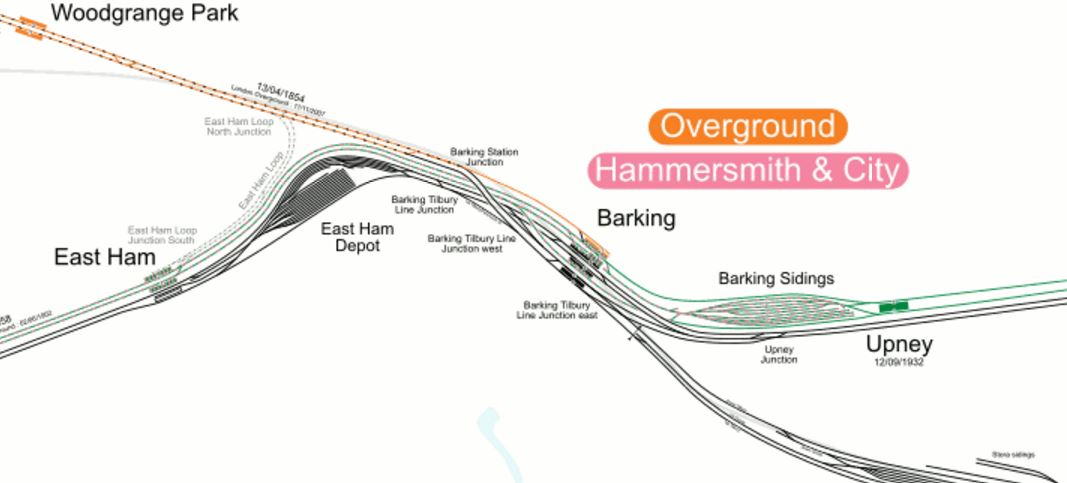
Lines At Barking
The lines radiating from the station are as follows, taking them in a clockwise direction from the South West.
- District and Metropolitan Line services of the London Underground and c2c services to Fenchurch Street pass through East Ham station.
- GOBlin services to the West, freight trains crossing London and the occasional c2c service to Liverpool Street pass through Woodgrange Park station.
- District Line services to Upminster and the East and c2c services via Basildon take the lines through Upney station.
- c2c services via Rainham, freight trains crossing London and the proposed Barking Riverside service take the lines going vaguely to the South East.
Three platforms will be used at Barking station for GOBlin services, which come into the station from Woodgrange Park in the West and from Barking Riverside in the South East.
- Platform 1 which is the current terminus of the GOBlin will be retained and would remain available to Overground trains at Barking Station to aid service recovery during periods of disruption.
- Platform 7 which is currently used by eastbound c2c trains via Rainham, will also be used by GOBlin trains going to Barking Riverside.
- Platform 8 which is currently used by c2c trains from Rainham to Fenchurch Street, will also be used by GOBlin trains coming from Barking Riverside.
As can be seen on the map, there is a double-track flyover to connect Platforms 7 and 8, which are the two southernmost platforms to the GOBlin to the west.
The only platform and its associated connecting lines that doesn’t have any electrification is platform 1.
Changing Trains At Barking Station
The GOBlin services and c2c services via Rainham will share the island platform 7 and 8 at Barking, which could mean some easier step-free journeys for some passengers.
Plans exist for redevelopment at Barking station and I wonder if architects and planners can come up with a better layout for the station, that will become increasingly important as an interchange. Especially as the station is shared by three ambitious operators; London Overground, London Underground and c2c. All these operators have expansion and/or improvement plans for services through Barking.
Electrification of Platform 1 At Barking Station
No electrification work has happened on this platform until now and the platform could be electrified in the normal manner.
However, it may be more affordable to fit all the Class 710 trains with an IPEMU capability and run them in and out of the platform using the on-board energy storage.
The platform could also be electrified using London Underground’s system to create another bay platform for the District and Metropolitan Lines, if that was to be needed. This would not stop the platform being used by the dual-voltage Class 710 trains,
Obviously, the route planners and the accountants will decide.
Renwick Road Station
This map shows the layout of the extension.

Barking Riverside Extension
Note now the new line curves away south after passing under Renwick Road. This Google Map shows the area.
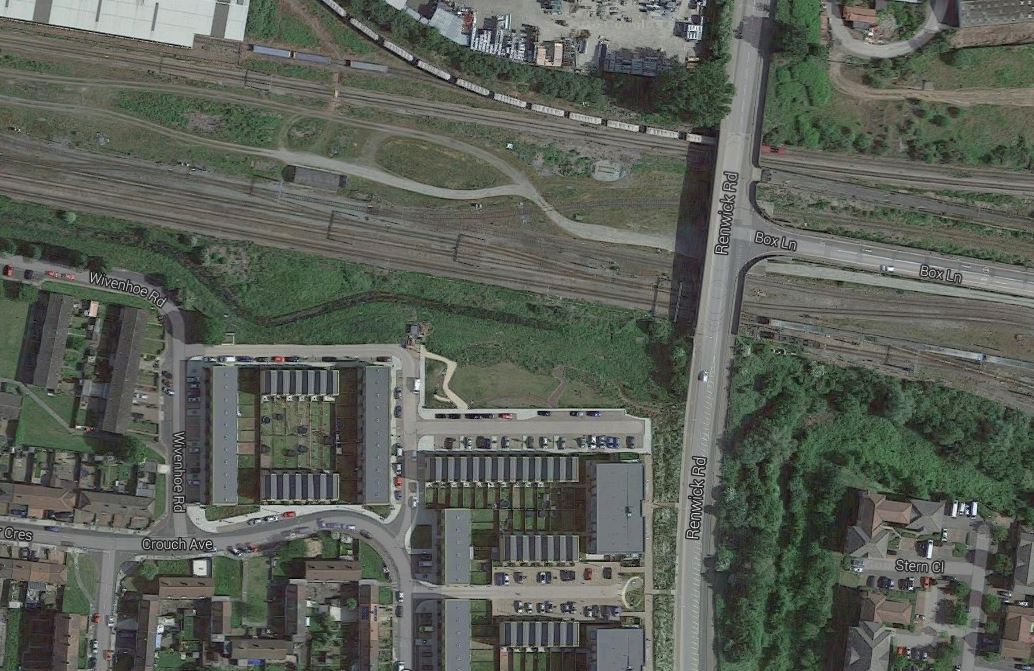
Renwick Road Area
One recommendation of the consultation is to install passive provision for a new station at Renwick Road, which eventually would make the extension a two-station branch.
The station is proposed to be a simple island platform design and TfL’s maps show it on the Western side of Renwick Road. There would appear to be plenty of space.
Barking To Renwick Road
On creating the required two lines between Barking and Renwick Road, the report doesn’t indicate, it’s anything other than a simple construction project.
Renwick Road to Barking Riverside
The line is proposed to curve off and over the rail lines and roads on a double-track viaduct, which is shown in blue on TfL’s map. The TfL report says this.
After passing under Renwick Road, the alignment would climb on a viaduct curving south towards Barking Riverside, crossing the Freight Terminal, westbound Tilbury lines and Choats Road. The viaduct would then descend to pass under the existing high voltage power line south of Choats Road, before again rising and continuing towards a station at Barking Riverside.
So it looks that the viaduct goes all the way to Barking Riverside station.
Barking Riverside Station
The proposed layout of the station is described in the TfL report.
The station would be designed to fit the look and feel expected of stations on the London Overground network, and would include the provision of step free access from street to platform and platform to train. Other features of the station would include: a ground floor ticket hall, CCTV, help points, customer information systems and secure cycle parking.
The platform level would be on the upper floor as an extension of the viaduct structure. The station ticket hall would provide direct access to Renwick Road and the separation between the railway infrastructure and ground floor ticket hall would allow additional uses to be made of the space, such as: cash machines, cafe and retail opportunities. The station design would include cladding for weather protection, including a canopy to part of the platform to allow sheltered access to trains.
So it would appear the trains are on the upper floor above the station facilities, shops and cafes.
I think this is to ensure that once the trains have passed over the Tilbury Line to Rainham and the freight tunnel, they run fairly level into Barking Riverside station. It could also mean that if the line is extended to Abbey Wood station under the Thames, the track layout to achieve this is not too complicated.
This Google Map shows the location of the station in Barking Riverside.
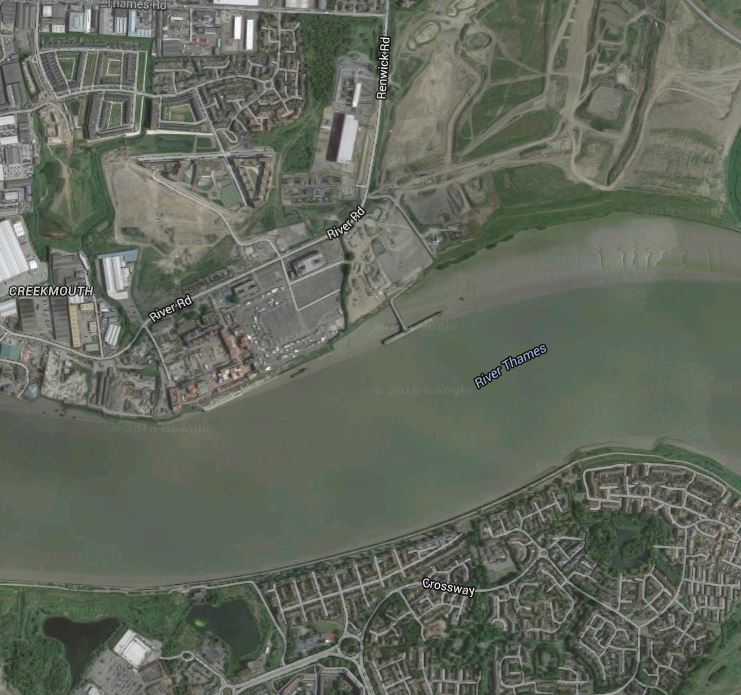
Barking Riverside Station And The Thames
Note.
- TfL’s map shows the station is alongside Renwick Road, where it joins River Road.
- It is perhaps a couple of hundred metres from the river.
- The housing area of Thamesmead is opposite.
- Trains could take a straight route to a possible Thames tunnel.
I think it all shows that the design of the station has been thought over long and hard.
Electrification Of The Barking Riverside Extension
The total length of the extension from Barking to Barking Riverside is 4 km., with just 1.5 km. of new line.
As with Platform 1 at Barking station, the Class 710 trains give the option of not-electrifying all or part of the extension.
Consider.
- The performance of an Aventra IPEMU running on on-board energy storage, that had been charged before Renwick Road is such, that I believe it could easily handle the extension with a full train of passengers.
- The viaduct can be built with provision for future electrification.
- As mentioned in the TfL report, the line has to be carefully profiled to avoid existing power lines. An extension without electrification, would give extra clearance.
- The Barking Riverside station design is simplified, if it is not electrified.
- The area has overhead wires everywhere and a stylish viaduct without overhead wiring could have a less negative visual impact.
- Are IPEMU trains running using on-board energy storage quieter than those using overhead wires?
But not electrifying the line from Renwick Road to Barking Riverside would reduce the complication and cost of the extension.
Intriguingly, the full TfL report only mentions overhead wires once, talking consistently about four car electric trains and a fully-electrified line.
Nothing in the TfL report precludes the use of Aventra IPEMUs to Barking Riverside and whether this route is chosen will depend on design and environmental issues, and the accountants.
Under The Thames To Thamesmead And Abbey Wood
It is planned to incorporate passive provision, so that the line can be continued in a tunnel under the River Thames.
Barking Riverside station appears to have been designed with several features to aid this continuation.
- Trains could pass through the station on their way to or from the tunnel.
- The route from the station to the tunnel would probably not need any sharp curves.
- Barking, Barking Riverside and Renwick Road stations would probably be sufficient to handle passengers on the north side of the river.
- There appears to be nothing of any importance between the Barking Riverside station site and the Thames, so it should be easy to safeguard a route.
- Barking Riverside station is elevated, so this potential energy could help to propel a train under the river.
- A crude estimate says that from Barking Riverside station to the other side of the river is about two kilometres.
The engineers involved in the Barking Riverside extension have certainly made provision to extend the railway under the Thames.
This Google Map shows Thamesmead and the Thames.

Under The River
Note River Road and Barking Riverside on the north bank of the river, Abbey Wood station with Crossrail and the North Kent Line in the South and Crossness to the East.
I don’t know the Thamesmead area well at all, and from these maps, I can’t work out whether a surface railway could be run to Abbey Wood station from the southern tunnel entrance.
However, a tunnel all the way with intermediate stops would surely be possible.
- As London Underground have thought about extending the Jubilee Line to Thamesmead, I suspect that the area would be amenable to the right type of tunnel boring machine.
- The tunnel could be bored under the A2041 if a direct route were to be chosen.
- A trip from Barking to Abbey Wood and back is probably about twenty kilometres.
- Aventra IPEMUs could handle the route with ease.
- If Aventra IPEMUs used on-board energy storage in the tunnels, the tunnels could be built without electrification.
I believe that there is an affordable innovative solution to extending the Barking Riverside extension under the Thames.
I do question if an extension to Abbey Wood will be needed, as when Crossrail opens, it will be possible to travel from Barking to Abbey Wood with a single change at Whitechapel from the District/Metropolitan Lines to Crossrail.
Conclusion
As it should be, I think it is a well-thought plan.
As to whether the Class 710 trains will use a possible IPEMU capability, nothing is stated, but I believe the proposed design could be very IPEMU-friendly and using IPEMUs would be advantageous on cost, noise and visual grounds.
Their only downside is that they could get derided as battery trains.
I also have the feeling that if the extension does use the IPEMU capability of the trains, the extension will become a model for other extensions and branch lines all over the UK.
Electrification Delays On The Great Western Railway Must Be Serious
This article in Rail Magazine is entitled GWR and DfT discuss ‘revised plan’ after electrification delays and it talks about what is to be done to get a decent passenger service running on the Great Western Railway, despite all of the delays to the electrification program.
If you want to know more of the problem this article on the BBC web site from July 2015 is an excellent summary.
- The under-performance of the High Output Plant System, a factory train made up of 23 vehicles, has, according to rail observers, made a big contribution to Network Rail falling at least a year behind schedule.
- The whole electrification project for the Great Western line was really based on the High Output train because of the amount of work it could do so much more quickly,
- Engineering insiders told the BBC that a newly designed wiring system did not match the specification of the holes the Hops train was designed to dig and that a new design of pile-tubes hammered into the ground to house the thousands of electrification masts – went in too deep after ground surveys were missed.
- Even where the Hops train has managed to dig holes, it has damaged existing signalling cables.
- Network Rail is short on experienced engineers and experienced operators – people who know how to run a railway.
- It was decided by the Department for Transport that the new trains will be 26m long per vehicle and our railways are built for 23m long,
I don’t think I’ve ever seen such a badly-designed and executed project in my long years on the dark fringes of project management.
So now it is sucking engineers and resources out of every other electrification project in the UK!
For instance, on my local electrification of the Gospel Oak to Barking Line, nothing much seems to have happened for the last few weeks.
I had to have a quiet chuckle, when I read this last paragraph in the Rail Magazine article.
GWR has tested short-formation High Speed Trains, and these could potentially be used on longer-distance services currently operated by multiple units, such as Cardiff-Portsmouth and Exeter-Penzance. They could also be used on some of the longer branch lines in the South West, such as Par-Newquay and Exeter-Barnstaple, although neither GWR nor the DfT would confirm this. A potential additional order for bi-mode AT300 hybrid trains could also be under consideration.
Terry Miller’s wonderful stop-gap design of the 1970s; the High Speed Train, is coming to the rescue again.
But then very serious problems, need the most serious of solutions!
I’m not running Network Rail and I’m not the Transport Minister, but in my view, it is now time to think extremely radically.
- Electrify as far as possible from London and run Class 387 trains or dependable-but-ugly Class 319 trains where you can.
- Run services to Bedwyn, Newbury, Oxford and the various branches East of Didcot using IPEMU variants of Class 387 trains.
- Replace as many HSTs on the East Coast Main Line as possible with new Class 800/801 trains and deploy Miller’s Masterpieces to the Great Western.
- Build new Class 800 electro diesel trains, instead of Class 801 electric trains and use them on the routes of TransPennine and Hull Trains.
We have been lucky with our train purchases and development.
- Class 800 and Class 801 are identical except for the diesel engines.
- Class 700 trains are being delivered to release Thameslink’s Class 387 and Class 319 trains.
- There are fifty or so Class 387 trains, that could be converted into IPEMUs, which would have a sixty mile range on batteries.
- Bombardier could probably build a few more Class 387 trains, alongside the Aventras.
I think that many places will get different and probably better and bigger trains, but not everyone will get the expected new electric trains.
Improving The Hastings Line
In The Lewes Horeseshoe, I discussed how an idea from Railfuture might be used to improve services between London and the South Coast.
I came to the conclusion, that if various improvements were carried out, including the running of trains with Class 395 performance from Ashford to Brighton along the East Coastway Line, that this would present an opportunity to close and rebuild the Hastings Line.
The Hastings Line is only thirty-two miles long from the South Eastern Main Line to Hastings, but there are deficiencies in the tunnels, which led to four of the eight tunnels being made single-track, when the line was electrified in 1986.
Surely, the fact that the line is constantly switching from double to single track, is one of the reasons, that the line only has a pathetic one semi-fast and one stopping train per hour between London and Hastings.
But things have moved on since 1986!
Network Rail must have learned a lot of tricks with tunnels. In particular, all the lessons learned in the re-boring of Farnworth Tunnel will be invaluable.
The length of the line is also such, that services could be run using IPEMU trains, charging the on-board storage on the South Eastern Main Line and between Battle and Hastings stations.
Would running some parts of the Hastings Line without power, mean that it could be simplified by the partial removal of electrification?
I estimate that around twenty-five miles would be without electrification, which would be an easy gap to bridge for an IPEMU.
Would this simplification in the various single-track tunnels, coupled with modern tunnelling techniques, allow Network Rail to create a fully double-tracked route from the South Eastern Main Line along the full length of the Hastings Line to Hastings?
If four trains per hour could be run between London and Hastings, that would be a tremendous improvement. At the London end of the route, the Thameslink Programme should create extra capacity for trains into Charing Cross station.
In addition, it would appear that the line is already capable of handling ten-car trains. Could this be stretched to twelve?
I am certain, that in the light of developments in the last few years, that Network Rail are looking at ways of increasing the capacity on the Hastings Line.
They’re also probably looking to do other engineering work, as there was a major landslip on the line a couple of years ago.
But in truth nothing can be done, until alternative routes are provided via Ashford and/or Brighton, as the tunnel work would probably mean that the Hastings Line would need to be closed, whilst some of the work is performed.
Unless a sensible alternative is provided, I’m sure Disgusted of Tunbridge Wells will be penning another letter to the Telegraph.
The IPEMU And The Windsor Link Railway
The IPEMU or to use its full name, an Independently Powered Electric Multiple Unit, is a form of Electric Multiple Unit, which has on-board electricity storage, so that it has a limited range on lines without electrification.
Bombardier have shown it is a serious concept, by allowing the general public to ride their prototype in passenger service between Manningtree and Harwich during six weeks in early 2015.

An Outwardly Normal Class 379 Train
Note the following about IPEMU trains.
- IPEMUs look and ride like the standard train to passengers, with everything passengers expect.
- On electrified lines, IPEMUs run and accelerate like the standard train.
- IPEMUs can run for up to fifty miles using electricity stored in the on-board energy storage.
- The on-board energy storage is charged when the train is running on electrified lines.
- The train can run on any line without electrification, where a modern diesel multiple unit of the same length or longer can run.
- IPEMUs use regenerative braking, so all energy generated from braking is stored and used to restart the train.
- IPEMUs can be 25 kVAC overhead, 750 VDC third-rail or dual-voltage.
- The on-board energy storage can be batteries, super-capacitors or Formula One-style KERS.
There were rumours in the September 2015 Edition of Modern Railways, that Great Western Railway was going to convert some of their Class 387 trains to IPEMU operation.
How would IPEMUs help in the creation of the Windsor Link Railway?
Click here for a map of the Windsor Link Railway!
I think it is sensible to assume that all trains running on the Windsor Link Railway could have an IPEMU capability and the ability to take power from both third-rail and overhead electrification.
In Phase 1, using IPEMUs would mean.
- Trains from London would run using the existing third-rail electrification and would fully charge the energy storage before Windsor.
- The linking tunnel would not have any electrification and would thus be safer.
- The linking tunnel would only need to be wide and high enough for safe operation of the trains.
- The linking tunnel could be single-track with a passing loop/island platform station, as the proposed maximum frequency is four trains per hour in each direction.
- The Slough to Windsor Line would not be electrified, so would be visually unchanged, with no ugly overhead wires.
- Trains would run through Windsor and on to Slough using the on-board energy storage.
Less than ten miles of a trip from London to Slough via Windsor and back, would be run on batteries.
In Phase 2, using IPEMUs would mean.
- No new lines would need to be electrified.
- The tunnels would not be electrified and just large enough for safe operation.
- Bridges would not need to support overhead electrification gantries.
- Trains would run betwen the main lines and Heathrow Airport using the on-board energy storage.
Only a few miles of each trip would be run on batteries.
 The Anonymous Widower