Walking To The Tate Liverpool
After visiting St. George’s Hall, I walked down to the Tate Liverpool, having lunch at Carluccio’s on the way. I took these pictures on the way.

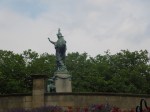
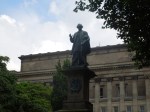
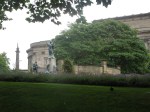

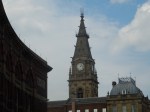


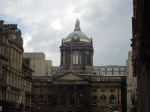
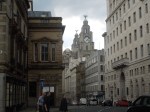
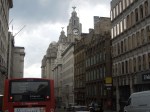
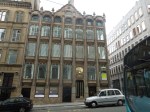
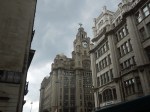

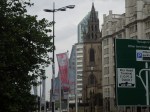
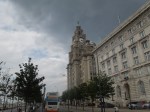
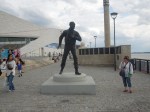
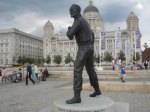
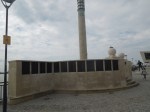

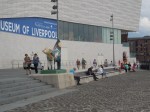
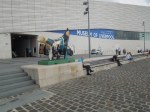

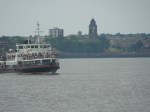
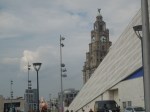



They show how much public art and the number of clocks there are in the city.
I think it is true to say that you could spend a couple of days looking at all the public art in Liverpool.
Tom Murphy
Tom Murphy‘s work is all over Liverpool. but at the present time there is an exhibition in St. George’s Hall.





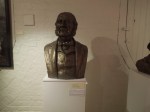
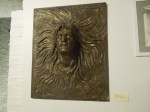
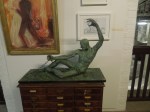
What surprised me was the range of subjects in his sculpture and paintings, including surprisingly to me, Margaret Thatcher and Diana, Princess of Wales.
Funnily enough, when I arrived in Liverpool, I had had to explain who the people were in his twin statues entitled “Chance Meeting” of Ken Dodd and Bessie Braddock, to some puzzled Chinese tourists.
Liverpool incidentally has more public works of art, than any other location except Westminster. There is a list here and Tom Murphy has done twelve of them. He is certainly very prolific!
Inside St. George’s Hall
I’ve been inside St. George’s Hall before, but never with the floor revealed.

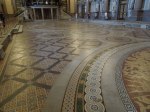

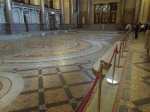

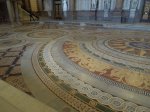
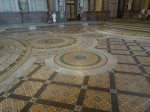

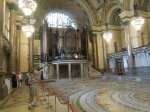
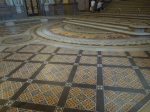



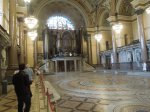

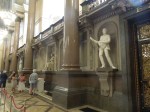
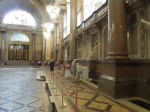
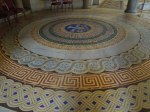
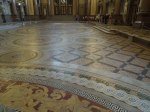


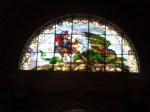





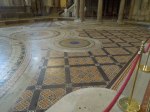
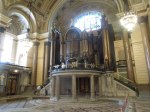
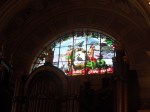
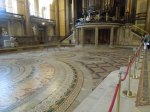
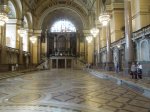
I had thought that someone I knew at University had seen the floor in the 1960s, when I was there. A guide confirmed that it had been revealed in 1965! So my recollection might have been correct.
But whatever, it truly is a must-see building, and it is sad, that it is only open until the 18th of August.
Note the statue of Sir Paul McCartney by Tom Murphy.
One strange thing, is that there has been no television report on BBC Breakfast. Surely, something as noteworthy as this, deserves a small report, whilst the floor is revealed. There is a report on the BBC website from when it was last revealed in January 2012.
If You Need To Know The Time Ask A Liver Bird
If you walk out of the station and cross the road to St. George’s Hall, you will see the massive clock on the landward side of the Liver Building.
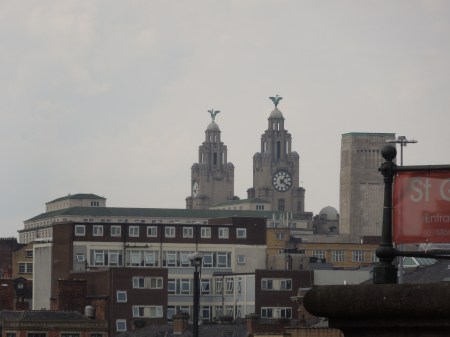
If You Need To Know The Time Ask A Liver Bird
The Liver Building clocks are visible from a large part of the city centre and is there another city, from where a clock can be seen from so many places? The clock faces are after all, larger than those on Big Ben.
A Station With Twin Clocks
Is Liverpool Lime Street station, one of the few where you are greeted two large clocks?
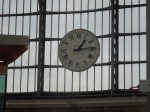
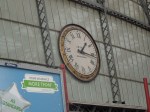
But then Liverpool loves its big clocks and seems to have more than most cities.
I went to the Second City today, to see two unique exhibitions; the revealing of the floor in St. George’s Hall and the Marc Chagall exhibition at the Tate Liverpool.
A Great Victorian Masterpiece Gets Exposed
St. George’s Hall in Liverpool is one of the UK’s greatest buildings. In 1969 the architectural historian Nikolaus Pevsner expressed his opinion that it is one of the finest neo-Grecian buildings in the world.
Until the 18th of August, it is a must-visit building, as they are exposing the magnificent Minton floor. It’s reported here on the BBC.
The BBC Gets The Pronunciation Wrong
According to the BBC Six O’Clock News, Gateacre School has been closed because of the heat. The story is here on the Liverpool Daily Post site.
But the BBC pronounced Gateacre wrong, by effectively making the mistake of treating it as two words; gate and acre.
I made the very same mistake, when I first went to the city.
Ten Big Mistakes
This piece on the BBC web site lists ten of the greatest mistakes of all time. They do have one from the Liverpool Echo.
The Liverpool Echo, in a rare error, once described Violet, the mother of the Kray twins, as “Mrs Violent Kray”.
I disagree with the statement it was a rare error. Fritz Spiegl, wrote a whole book on the subject of errors in Liverpool’s evening paper.
One I actually saw, was when they referred to the 1697 Arab-Israeli War.
Knowing the city well, as I do, I was always a bit suspicious that some of mistakes in the paper were not as accidental, as many would believe!
Are Virgin Trains Going To Go Faster?
With trains, it has always been known, that the faster you go, the more passengers you attract.
So when you get a headline of Virgin mulls 135 mph working in Modern Railways, you suspect that they are working on faster trains.
After all the Class 390 Pendolinos are capable of 140 mph, but are limited to 125 mph in service.
At present, most trains to both Liverpool and Manchester take about eight minutes over two hours from Euston, but one train a day does it in two hours. So to lose that eight minutes and get all trains on the headline-grabbing two hours, would mean an average speed increase of 6.25%. If the average journey speed bears a direct relationship to the train’s maximum speed, then by increasing the current maxium from 125 mph to 135 mph is a rise of 8.0%.
So is this where the conservative figure of 135 mph came from? It is just enough to get all London to Liverpool and Manchester trains just under that magic two hours, that will give a sensible return for the cost of the extra speed and the track and signalling improvements?
Applying the same rules to the Glasgow time of four hours and thirty minutes, could give a speed reduction to four hours and ten minutes.
So on a rough and ready cakculation, Virgin’s op speed of 135 mph, could bring a great improvement to the West Coast Main Line. Remember that the rebuild of the line in the early 2000s was intended to deliver a London Manchester time of an hour and forty five minutes.
The Water We Drink
The BBC has done a blind tasting test of the tap water from various parts of the United Kingdom.
I don’t drink much water directly, although I do drink a lot of it in cups of tea all day.
I was brought up in London and I suspect that the water I drink now in Hackney is vaguely similar to that I had sixty years ago in Enfield. It’s probably exactly the same to that we had in the Barbican, as that area is only a kiolmetre or so away and I can see the flats from the corner of my road.
I certainly will drink it again, if there is nothing else, which is something I hardly ever did, whilst living away from London.
Except for the four years or so, that I lived in Liverpool, I’ve always lived in hard water areas. In fact, at one time, I lived in Melbourn near Cambridge, which in the 1970s reputedly had the hardest water in England. It also had quite a few sets of twins and the doctor thought there was a connection.
It’s funny, though but a few months ago after a couple of days in Liverpool, the tastes and smells around my mouth were quite different. It was almost if they were much fresher. But that could have been the Liverpudlian sea air.
Incidentally, one of the waters they tasted was from Woodbridge in Suffolk, where C and I lived for twenty or so years. The water didn’t come out well in the taste test! But I do remember C, who was an obsessive water drinker, saying she didn’t like the water, when we moved to Newmarket. She used to drink masses of bottled water, although usually insisted on tap water in a restaurant.
 The Anonymous Widower