SSE And Gilkes Energy Submit Plans For Pumped Hydro Storage Project
The title of this post, is the same of this article in Solar Power Portal.
This is the sub-heading.
SSE Renewables and Gilkes energy have submitted a planning consent application to Scottish Ministers for a proposed Pumped Storage Hydro (PSH) project.
These two paragraphs add more detail.
The Fearna PSH project is proposed as a 50:50 joint venture project between SSE and Gilkes Energy, with Gilkes Energy leading the development under a developer services agreement with SSE Renewables. The scheme will have an installed capacity of 1.8GW and a stored capacity of up to 36GWh, providing 20 hours of storage. If approved, the project would be the largest pumped hydro scheme in the UK.
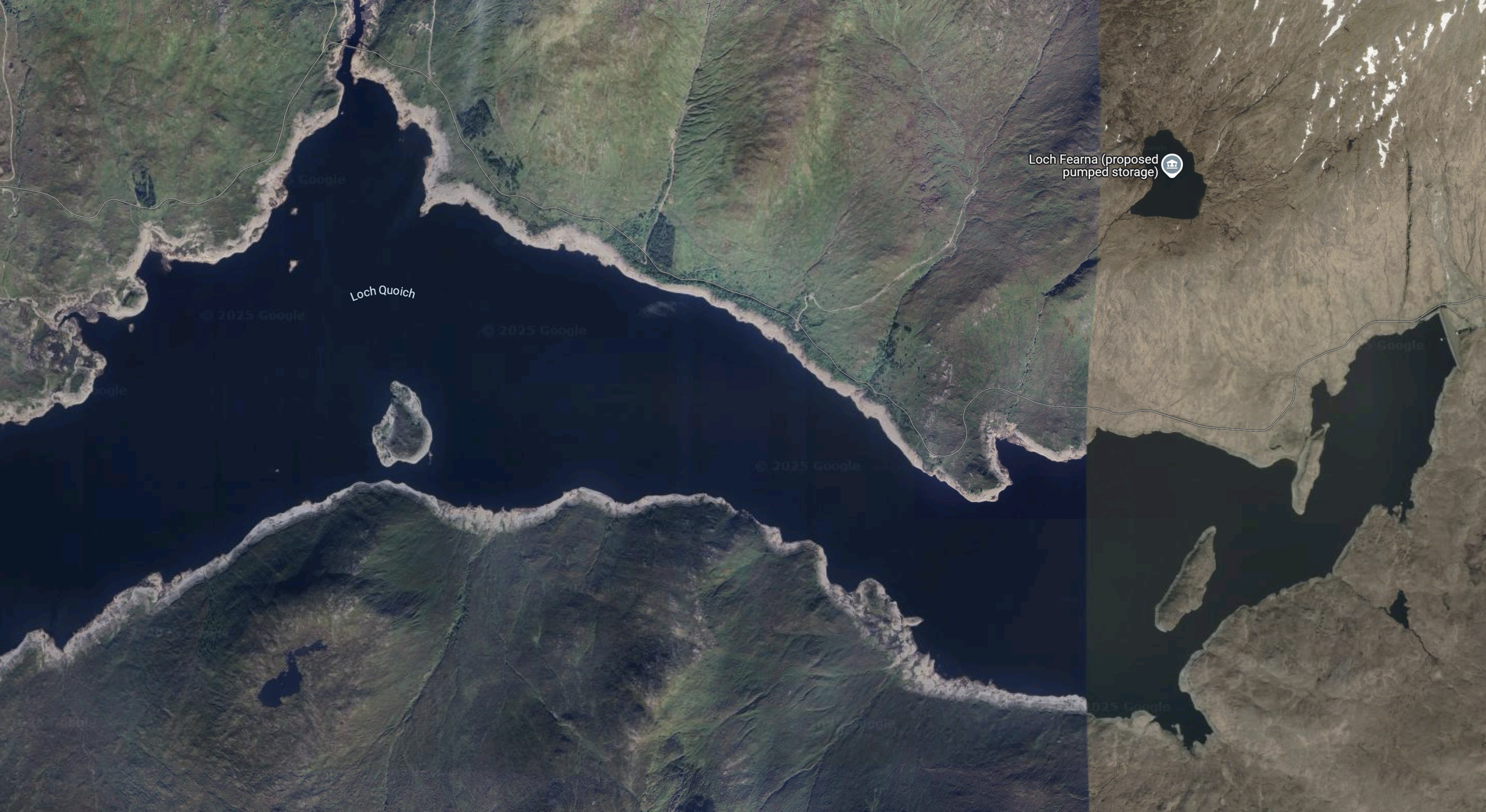
The proposed site is located around 25km from Invergarry in the Scottish Highlands and adjoins SSE Renewables’ existing Loch Quoich reservoir, which forms part of the Great Glen hydro scheme. The development will include the construction of tunnels and a new power station that will connect the existing Loch Quoich reservoir to an upper reservoir at Loch Fearna.
This Google Map shows the location of Invergarry and Loch Quoich.

Note.
Loch Quoich is the dolphin-shaped loch at the West of the image.
Invergarry is indicated by the red dot at the East of the image.
This second Google Map shows the location of Loch Fearna to the North-East of Loch Quoich.
These are my thoughts.
It Will Be A Large Scheme
With an installed capacity of 1.8GW and a stored capacity of up to 36GWh, providing 20 hours of storage, this is not a small scheme.
Wikipedia’s Description Of Loch Quoich
This is the first two paragraphs of the Wikipedia entry for Loch Quoich.
Loch Quoich (Scottish Gaelic: Loch Chuaich) is a loch and reservoir situated west of Loch Garry approximately 40 km northwest of Fort William, Lochaber, Scotland. The name means “loch of the quaich”. In 1896, it was listed as six miles long and three-quarters of a mile in width, belonging to Mrs. Ellice of Glenquoich, within the parish of Kilmonivaig.
Both lochs form part of the Glen Garry hydroelectricity project commissioned by the North of Scotland Hydro-Electric Board in the 1950s.
So is the Loch Fearna scheme, a massive repurposing of the existing Glen Garry hydroelectricity project?
I wrote about this before in Repurposing The Great Glen Hydro-Electric Scheme?
This map from the SSE Renewables web site shows the layout of the dams and power stations between Loch Quoich and Invergarry..
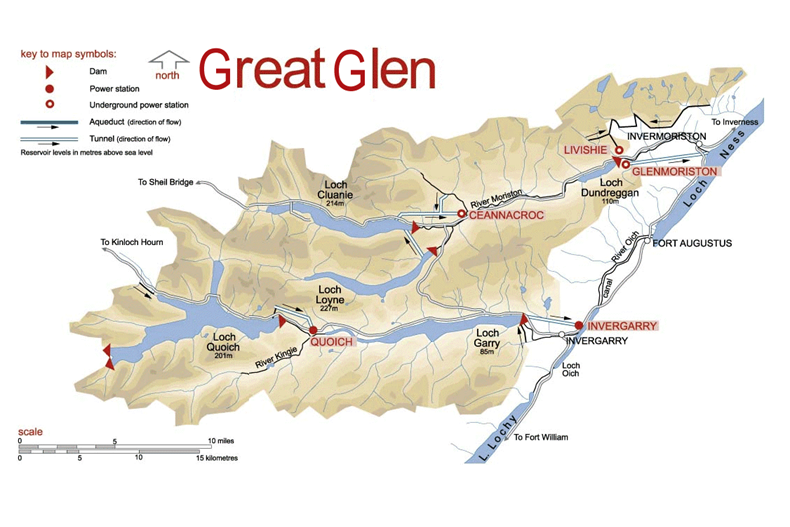
The sizes of the power stations in the scheme are as follows.
- Ceannacroc – 20 MW
- Livishie – 15 MW
- Glenmoriston- 37 MW
- Quoich – 18 MW
- Invergarry – 20 MW
- Mucomir – 1.7 MW
This gives a total power of 112.7 MW.
112.7 MW to 1.8 GW (1800 MW) is a colossal increase in power.
It should be noted that 1.8 GW is half the power of Hinckley Point C nuclear power station.
Pumped Storage Hydro In The Highlands – Is Anywhere Still Off Limits?
The title of this post, is the same as that of this article on UK Climbing.
This is the sub-heading.
Are the enormous Earba and Fearna hydro projects merely the thin end of an ever bigger wedge? Thanks to a relaxed developer-friendly planning regime, is anywhere in Highland Scotland now safe from energy projects designed to feed an insatiable demand down south? In pursuit of clean power, do we risk permitting huge and irreparable harm across our remaining wild habitats and scenic land? And if so, what (and who) is it all really in aid of? It’s not too late to shed light on the murky world of Highland mega-energy, says Jane Meek, but time is running out for our mountain heritage.
These are the first three paragraphs.
In case you haven’t heard, Earba is the codename for a massive pumped storage hydro scheme to be hosted by Ardverikie Estate of Monarch of the Glen fame on behalf of Gilkes Energy, a Lakes-based engineering firm hitherto better known as a developer of small-scale run-of-river hydro schemes on Scottish burns and rivers. Some of these may be familiar to you: they include Pattack on Ardverikie Estate, Ben Glas on Glen Falloch Estate near Crianlarich, and Neaty Burn in Glen Strathfarrar, to name just three.
Gilkes Energy has now moved up into the big league of pumped storage hydro (PSH). Visit their homepage to admire a brief slide show of projects past, present and in planning. It’s glossy professional stuff, just what you’d expect from the self-styled “leading independent developer” of conventional hydro and PSH in the UK.
The aerial shots are particularly fine but… hang on a minute… isn’t that Loch a’ Bhealaich Leamhain down there, gleaming like a pearl in the high pass between Munros Beinn a’ Chlachair and Mullach Coire an Iubhair (Geal Charn as was)? And … oh dear, isn’t that Loch Fearna, the glittering shelf lochan below Spidean Mialach, immortalised in countless photographs by walkers crossing the col between Spidean and neighbouring Gleouraich? From the slopes above Fearna, the views across Loch Quoich to Gairich and beyond are simply stunning. After watching the slide show, you may feel simply stunned.
The author of the article makes a statement and asks a question.
It’s industrialisation on a vast scale. Are these truly the right schemes in the right places?
The author may have a point, but environmentalists will argue that saving the planet is more important and that pumped storage hydroelectricity is one of the technologies, that will help us do that!
SSE And Gilkes Energy Announce Joint Plans To Progress Loch Fearna Pumped Storage Hydro Project
The title of this post, is the same as that of this press release from SSE Renewables.
These five paragraphs from the press release outline the scheme.
SSE has announced plans to progress a new pumped storage hydropower scheme at Loch Fearna in Scotland’s Great Glen, in a 50:50 development joint venture with a consortium led by Gilkes Energy.
The proposed co-development is located at the western end of Glengarry around 25km west of Invergarry and adjoins SSE Renewables’ existing Loch Quoich reservoir in the Great Glen hydro scheme.
SSE Renewables already operates the largest fleet of hydro-electric power and pumped storage hydro assets in Scotland. It is now progressing development plans for new pumped storage hydropower projects in the Highlands to complement its existing fleet and deliver the large-scale, long-duration electricity storage (LDES) needed as part of Britain’s future energy mix.
The Fearna Pumped Storage Hydro (PSH) project envisages the development of tunnels and a new power station connecting SSE Renewables’ existing reservoir at Loch Quoich with an upper reservoir at Loch Fearna.
Under the terms of the joint venture being announced today, Gilkes Energy will lead the project’s development under a development services agreement with SSE Renewables.
I wrote about the Great Glen hydro scheme in Repurposing The Great Glen Hydro-Electric Scheme, where I included this map, from the SSE Renewables web site shows the layout of the dams and power stations.
The sizes of the power stations in the scheme are as follows.
- Ceannacroc – 20 MW
- Livishie – 15 MW
- Glenmoriston- 37 MW
- Quoich – 18 MW
- Invergarry – 20 MW
- Mucomir – 1.7 MW
This gives a total power of 112.7 MW.
This five paragraph from the press release details the size of the scheme.
It is envisaged the proposed development would be up to 1.8GW in generating capacity and capable of producing around 37GWh of stored energy capacity. The project has already secured a grid connection offer totalling 1,795MW.
The 1.8 GW/37 GWh Fearna pumped hydro scheme will dwarf the Great Glen hydro scheme.
it is now seventy years since some of these hydro-electric systems were built in Scotland.
As an engineer, I wouldn’t be surprised to a see a fair amount of updating in the Highlands to upgrade Scotland’s hydro-electricity.
Price Framework Paves Way For Vast Electricity Storage Scheme
The title of this post, is the same as that of this article on The Times.
This is the sub-heading.
SSE welcomes step forward in plans to build the £1.5bn Coire Glas hydroelectric project
These two paragraphs outline the article.
Ministers have provisionally agreed to a power pricing framework that could pave the way for more pumped storage hydroelectricity projects in Britain, including a gigantic £1.5 billion scheme from SSE that is starting to take shape in the Scottish Highlands.
The Department for Energy Security and Net Zero said it intended to develop a “cap and floor” pricing mechanism that would advance the Coire Glas storage project being developed by SSE, the energy company, and could unlock further pumped storage power stations.
Coire Glas will be one of the largest renewable power projects ever built in the UK.
- It will have a power output of 1.5 GW, which is comparable with some of the large wind farms in the North Sea or four gas-fired power station or Rolls-Royce SMRs.
- It will be able to store 30 GWh of electricity and provide 1.5 GW for twenty hours.
- Coire Glas has a web site.
- Coire Glas will more than double pumped storage hydroelectric capacity in the UK.
Bath County Pumped Storage Station in Virginia, US claims to be the world’s largest battery, but Coire Glas will be able to store more electricity.
You wait decades for one of these monsters to come along in the UK and SSE also have another on the way.
- Loch Sloy hydroelectric power station is the largest conventional hydroelectric power station in the UK.
- It has an output of 152 MW.
- It opened in 1950 and was largely built by German and Italian prisoners-of-war.
SSE plan to convert Loch Sloy power station into a pumped storage hydroelectric power station.
- It will be able to store 25 GWh of electricity.
- Loch Sloy will be the upper lake.
- Loch Lomond will be the lower lake.
- The existing dam, upper lake, pipes and powerhouse will be retained.
- The developments have a web page.
The project is aimed at a commissioning date of 2028.
This paragraph explains how the ‘cap and floor’ mechanism works.
In the scheme, operators would be guaranteed a minimum level of revenue, while consumers would be protected by a price ceiling, above which surplus revenue would be returned to them.
And these two paragraphs give SSE’s reaction.
Finlay McCutcheon, 46, director of onshore Europe at SSE, said the pricing framework was welcome news. He said that a deal for Coire Glas was needed by the end of this year to secure a firm investment decision by early 2026. Planning for the project started in 2007.
“Given the time taken to reach this point, much work is now needed to ensure an effective mechanism is finalised and put in place as early as possible to enable Coire Glas to take final investment decisions and move into construction,” he said.
I believe that the negotiations between the Government and SSE will lead to a monster on Loch Lochy and another one on Loch Lomond.
Conclusion
There are also these pumped storage hydroelectric schemes under development.
- Balliemeanoch Pumped Hydro – 1.5 GW/45 GWh
- Balmacaan Pumped Hydro – 600 MW/15-20 GWh
- Corrievarkie Pumped Hydro – 1.5 GW/14.5 GWh
- Fearna Pumped Hydro – 1.8 GW/37 GWh
- Glenmuckloch Pumped Hydro – 400 MW/1.6 GWh
- Loch Earba Pumped Storage Hydro – 900MW/33 GWh
- Loch Kemp Pumped Storage Hydro – 300MW/9 GWh
- Loch Na Cargeach/Red John Pumped Storage Hydro – 450 MW/2.8 GWh
These total up to 7.4 GW/100+ GWh.
This page on the Strathclyde University web site, gives these GWh figures for the possible amounts of pumped-storage that can be added to existing schemes.
- Errochty – 16
- Glasgarnock – 23
- Luichart – 38
- Clunie – 40
- Fannich – 70
- Rannoch – 41
- Fasnakyle – 78
- Tummel – 38
- Ben Lawers – 12
- Nant – 48
- Invermoriston – 22
- Invergarry – 41
- Quoich – 27
- Sloy – 20
That is a total of 514 GWh.
Scotland will be the Saudi Arabia of energy storage.
Scotland’s 25 GWh Energy Storage Arriving By Stealth
In SSE Unveils Redevelopment Plans For Sloy Hydro-Electric Power Station, I introduced SSE Renewable’s plan to convert the UK’s largest hydro-electric power station into a pumped storage hydroelectric station, that can store 25 GWh of electricity and generate 152.5 MW of electricity.
After a public consultation in July, which unfortunately, I was unable to get to, SSE have now published a comprehensive document, which details their plans.
These are some points from the document.
- There will be no increase in the generating capacity of 152.5 MW, which is about half the size of a gas-fired power station.
- SSE designed a similar scheme for Sloy in 2009.
- Pumped storage systems need a lot of water. The Loch Sloy scheme has Loch Lomond.
- The development of pumped storage at Sloy would only require construction work to be carried out in the grounds of the existing power station.
- No permanent new works would be required at Sloy Dam or outside of the existing station boundary.
- A new above ground structure would be required which would contain a main hall with vehicular access, laydown areas, an overhead travelling crane, electrical switchgear and control systems.
- A new underground pump hall would be required to house two pumps. This would link to the intake structure and would be approximately 20m below the existing ground level.
- The existing tailrace to Loch Lomond, will be used to bring water to the pumps.
- Construction could start in 2025, with completion in 2027.
This redevelopment is a much less complex construction project, than building the original power station in the 1950s.
It also looks like the construction will not cause much disruption in the local area.
Hence my view, that this storage is arriving by stealth and won’t be noticed by those passing the power station.
After reading this SSE document, I wonder how many similar 1950s hydroelectric power stations have been upgraded to pumped storage stations in the last few years.
Also, if their Sloy scheme is successful, will SSE be looking for other hydroelectric power stations to convert to pumped storage?
This article on renews.biz is entitled Vattenfall Plans To Build 730MW Of Swedish Hydro Power, where this is a paragraph.
Vattenfall is also conducting a pilot study to investigate reinstating the Juktan power station on the Storjuktan lake adjacent to the Umeälven river in Västerbotten, to a pumped storage plant with a capacity of up to 380MW.
Note.
- Juktan power station was built as a pumped storage station and converted to a standard one.
- It has a web page.
- As the paragraph says it could be converted back!
So other companies and countries are thinking the same way!
Strathclyde University’s Prediction
This page on the Strathclyde University web site, gives these figures in GWh for the possible amounts of pumped storage that can be added to existing schemes.
- Errochty – 16
- Glasgarnock – 23
- Luichart – 38
- Clunie – 40
- Fannich – 70
- Rannoch – 41
- Fasnakyle – 78
- Tummel – 38
- Ben Lawers – 12
- Nant – 48
- Invermoriston – 22
- Invergarry – 41
- Quoich – 27
- Sloy – 20
That is a total of 514 GWh.
These figures must give SSE food for thought.
These new schemes are also being planned.
- Balliemeanoch – 1.5GW/45 GWh
- Coire Glas – 1.5 GW/30 GWh
- Corrievarkie – 600 MW/14.5 GWh
- Fearna – 1.8 GW/37 GWh
- Loch Earba – 900 MW/33 GWh
- Loch Kemp – 300 MW/9 GWh
- Loch Na Cathrach/Red John – 450 MW/2.8 GWh
These could bring the potential pumped storage in Scotland to 685.3 GWh.
 The Anonymous Widower