The Flexibility Of Public Transport In East London
After my tea, I had to get home. To get from Pudding Mill station to where I live halfway between Highbury and Islington, and Dalston Junction stations, there are many possibilities.
So I resorted to the Monte Carlo method and took the first train that arrived. It was going to Stratford. I could have walked through the station to the overground, but noticed that despite it almost being the rush hour, the Central line trains towards Central London were fairly empty.
So I took the first one, intending to go to Bank, to take the `141 bus to my house. But at Mile End station, where the Central and sub-surface lines have a cross platform interchange, I decided to get a Metropolitan line train to Moorgate to pick up the bus there. I waited just a minute before I was on my way.
In the end, I went just two stops to Whitechapel station, where I used the quick interchange to get an Overground train to Dalston Junction, where I caught one of innumerable 38 buses down the Balls Pond Road.
I may have used five different modes of transport, but I had a seat all the way and never waited more than a minute anywhere.
Incidentally, CrossRail will change all this, as the simplest route, would be to take CrossRail to Moorgate and then get the 141 bus. Let’s hope they get the bus connection right.
London Underground Stations To Avoid
Londoners all have the Underground stations they don’t use. Here’s a few of my list.
Green Park – I was talking with a friend last night about my experience here yesterday and she also said she doesn’t use the station either, although she has to when she goes to the Royal Academy. I don’t as I will use a 38 bus from the stop just around the corner from my house. Outside of the rush hour, it’s almost as quick and I have to get a bus to Highbury and Islington station to get the Underground anyway.
Kings Cross St Pancras – It may be fully step-free, but it’s another station with endless subterranean passageways and I still get caught out by going to the wrong end of the platform, when getting off a train. If you want to exit, it’s better to go to the Euston Road exits, as that way it’s generally a short walk and an escalator. Following the recommended route puts you in the endless passageways. But again, I have the luxury of a 30 bus direct to the station. When they finish the plaza in front of the station, bus access will get much better, so this station, should improve overall later this year.
On the other hand changing between the deep lines isn’t too bad, which can’t be said for Green Park.
London Bridge – This is another station, designed by an architect with shares in a shoe company. I would never change Underground trains here and avoid getting on them as well. It used to be much easier, when the 141 bus ran from the new bus station. It doesn’t at the moment, as after they’d built it, the sewer collapsed, but in a few weeks it will be different.
Victoria – This is another on the list at present, but probably only until the station and the Underground interchange has been rebuilt in a few years.
Bank – This is another station that I avoid at weekends to change onto the DLR, but it is much better during the week. It’s also improved over the last few ears, with several extra escalators. It will also get better in the future, as I believe it’s getting some more lifts.
Camden Town – It’s just so busy with all the markets and the tourists they attract. It had been slated for rebuilding completely, but nothing is on the cards at the moment. I either use a bus or the Overground to Camden Road station to get there.
I’ve already had a couple of suggestions from a friend.
Mile End – I know this one well and used to use it a lot, when my son lived round the corner. My friend suggests you should avoid it because it is a suicide hot-spot and because of it’s depressing decor. But I’ve always found it a good way to get onto the District or Metropolitan lines from the Central or vice-versa. It also has a very useful black cab rank outside the station, which is rare on the Underground.
Edgware Road – This is the subsurface station, which can be a nightmare as it is the gap in the Circle line. I’ve waited there in the past for a lot more than several minutes to turn the corner to the south. I was talking to station staff at Kings Cross and the new Circle line layout generates a lot of queries, especially from those, who are visiting London after several years.
You will notice, that I often do a split journey using a bus at one end. I also know the bus stops pretty well, so for example, if I was returning home from say Paddington on the Metropolitan line, I’d go to Moorgate station and get a 141 bus from there, as the stop is by the station. In a similar way, say if I was going to Wembley, I’d take a 56 bus to Barbican station and get the Metropolitan from there.
I do hope that Crossrail doesn’t muck up the bus connections too much. After all, it would be easy to go to Heathrow, by getting a 141 bus to Moorgate and then getting Crossrail direct to the airport.
You will also notice that two of the stations I avoid are on the Jubilee line. I don’t think, it was the best designed of the Underground lines and we are paying the price that shoddy design. Spectacular some of the stations like Canary Wharf , Westminster and North Greenwich might be, but couldn’t a proportion of the money been better spent at the interchanges like Green Park, London Bridge and Bond Street.
Westminster always amazes me, as I walk through its subterranean structures. But then it is in effect the foundation of Portcullis House; that grandiose monument to Parliamentary excess.
Step Free In Name, But Not Spirit!
Transport for London is rather proud of the work it has done at Green Park station, judging by this page on their web site. Here’s a key section.
The £48m project to provide step-free facilities at Green Park Tube station has been completed ahead of schedule and under budget by Tube Lines and London Underground.
Passengers with restricted mobility, as well as people with heavy luggage or buggies, are now able to use the new lifts at Green Park Tube station to access the Piccadilly, Victoria and Jubilee line platforms.
Other work includes new flooring, ceiling, lighting, tiling and signage in the ticket hall plus new entrances and lift lobbies.
In common with I suspect many others, I rarely if ever use the station as an interchange, as to get from one line to another means a long walk underground.
I do use it though, if I want to come home from the western reaches of the Piccadilly line, as the stop for my local 38 bus is just outside the station and at most times of the day, the upstairs of these buses isn’t full. I’d far rather use an uncrowded bus, than play sardines on the Underground.
So today, as I was coming home, I decided to check out the step-free access at this important station. I arrived on the Jubilee line and wanted to use the lift to get to the surface. I found the lift easily enough on a cross tunnel between the two Jubilee line platforms. I didn’t wait long and the lift whisked me and an elderly couple up to the next level.
To get to the exit, you have to walk miles to the lifts that connect you to the booking hall. So the design fault, that I always hated about this station, is still there. My fellow passengers at this point gave up, as the lady was walking with a single crutch and returned to the Jubilee line platforms.
I walked on and eventually arrived in the newly redecorated booking hall, after coming up two levels. I mentioned to station staff, that this couple were a bit lost and one said he’d check them out on the CCTV. So at least the staff know about the problems down below.
I crossed to the north side of Piccadilly and then walked up the steps to get my 38 bus. The lift is on the south side, which is only useful if I want to catch a bus to the west, which would be unlikely in my case, because of where I live.
It may have all cost £48million, but I do think, the money for the lifts could have been better spent. Perhaps even elsewhere!
Holloway And Caledonian Road Stations
In some ways these two stations are a pair, but not in their step-free access.
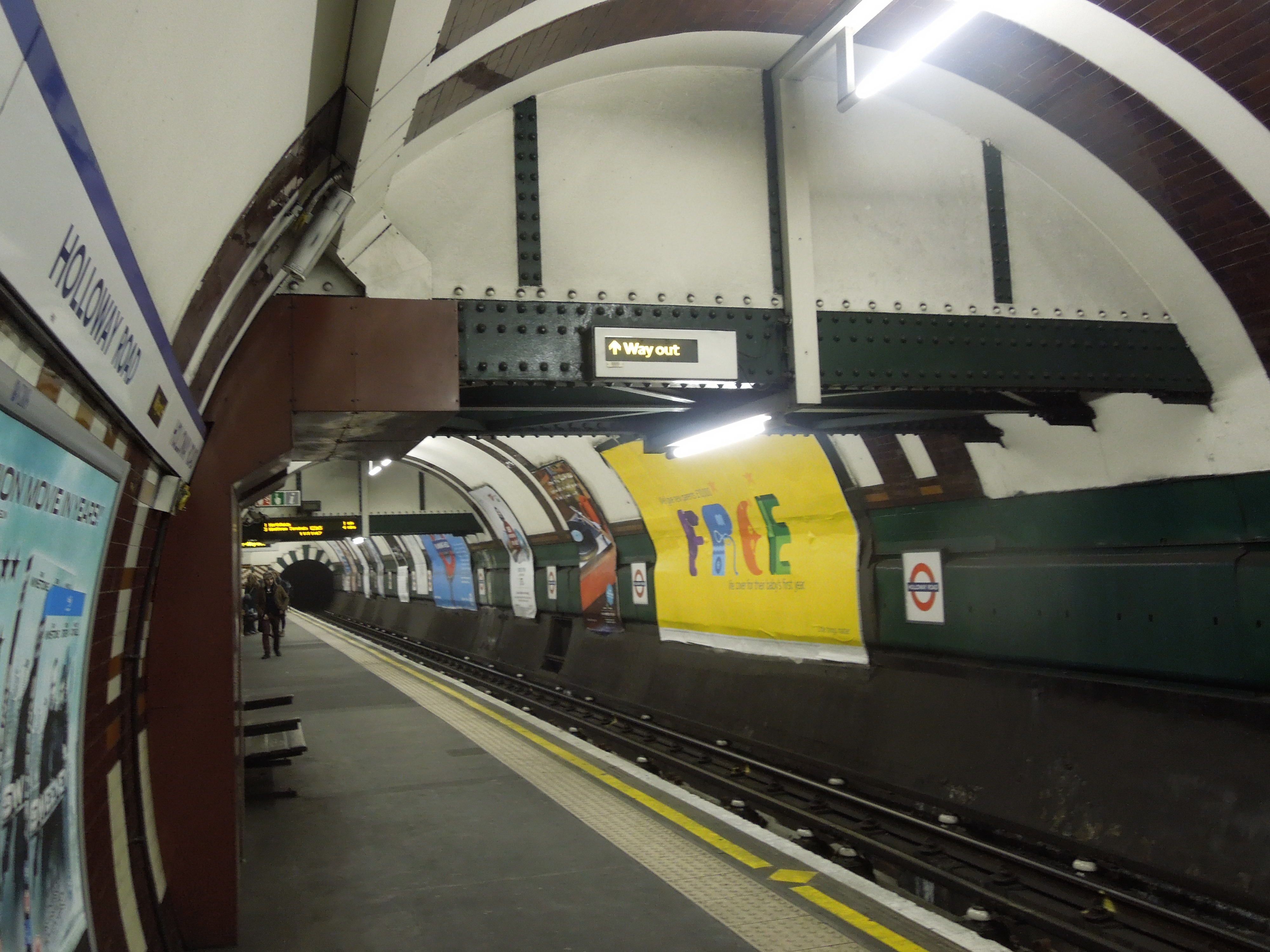
Holloway Road is a classic two lift station, where you descend to just above the tracks and walk down to the platforms. But there is more to this station than meets the eye. Just look at this picture.
Holloway Road Station
It shows two passenger bridges over the westbound platform. according to Wikipedia, the station was built with two lift shafts and experiments were tried out with a spiral escalator. Perhaps the second one was for this device. The tiles certainly show a second entrance to the platforms. That spiral escalator would have been something if it worked.
If Transport for London could find a solution for step-free access here, they could probably solve the problems at other stations, like Covent Garden and Russell Square.
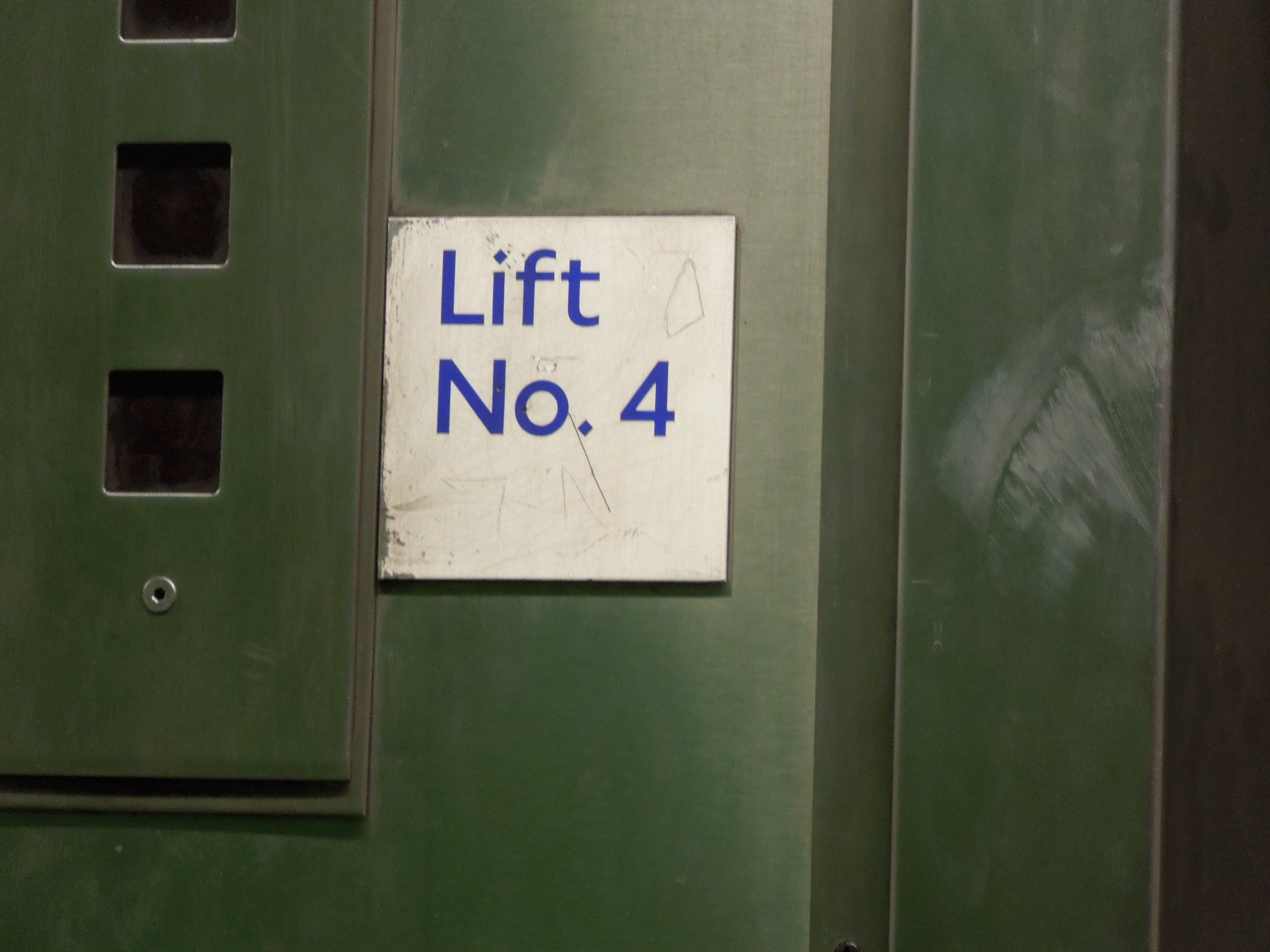
Caledonian Road shows what might have been. The lifts go down to platform level and you step outside, turn left or right and you’re on the platform. Perhaps they made a mistake somewhere and dug the lift shafts too far. But they did create a truly step-free station. But this is curious.
Where Are Lifts 1 and 2?
I found lifts 3 and 4, but where are 1 and 2?
Going Back To My Childhood
Well, not really! But this afternoon, I did go back to the northern reaches of the Piccadilly line. The aim was to look at the escalator layout of the stations to see how difficult they would be to upgrade to step-free access, possibly using inclined lifts, as I outlined here.
I joined the line at Manor House station, but didn’t go all the way to Cockfosters, as the last two stations, don’t have escalators. Starting from the end of the line, here’s what I found.
Cockfosters – This station could probably be made step-free by fitting conventional lifts into the structure to access the tunnel under Cockfosters Road. Once in the tunnel, the station is then step-free to the platforms.
Oakwood – Looking at the ends of the various Underground lines, the end station is more often than not step-free. But in the case of the northern end of the Piccadilly line, Oakwood was made step-free rather than Cockfosters.
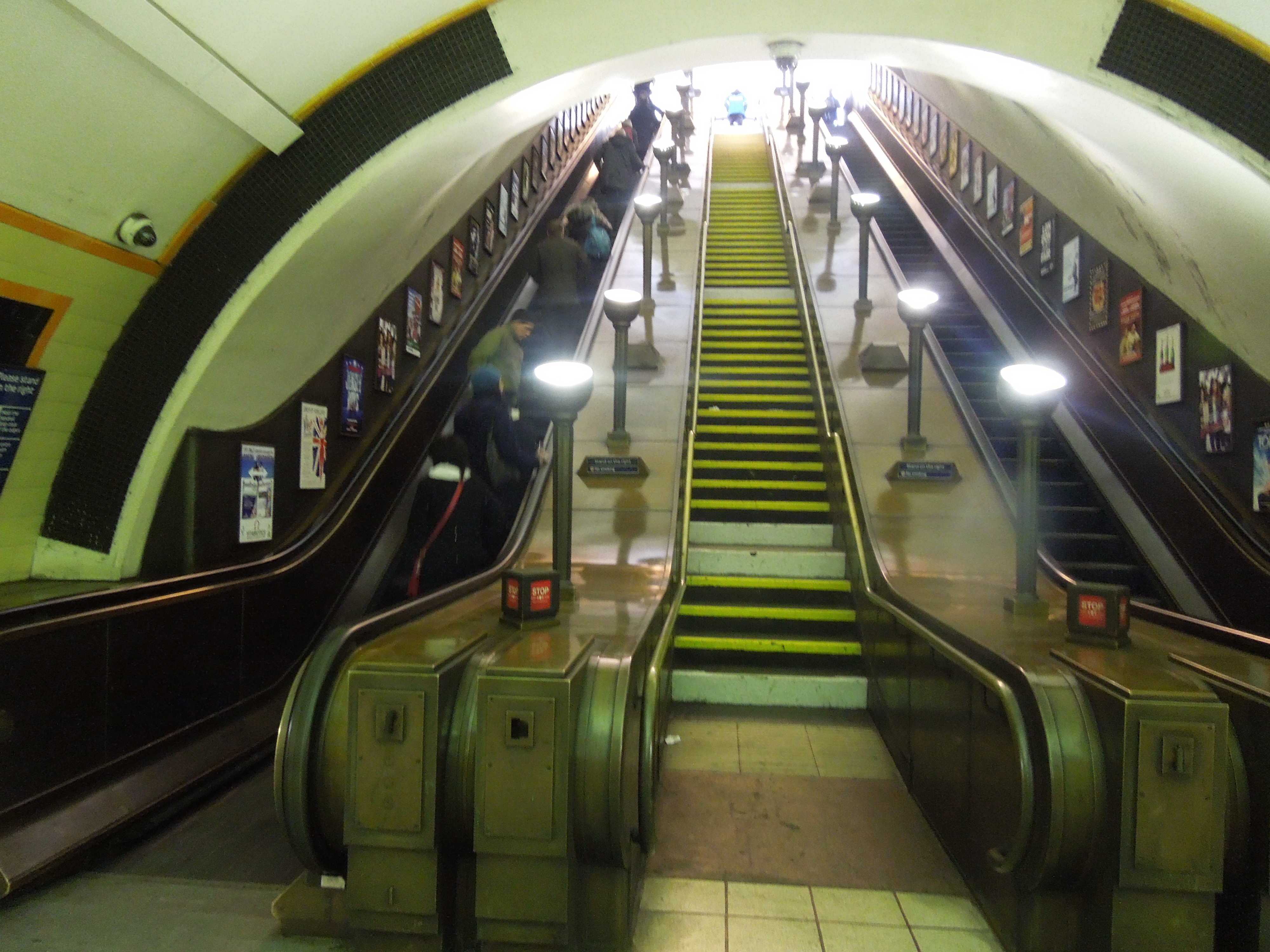
Southgate – When I mused about fitting an inclined lift at this station in this post, I said it would be a challenging design problem. Southgate is one of the architectural jewels of the line and this picture shows why.
Escalators and Uplighters At Southgate Station
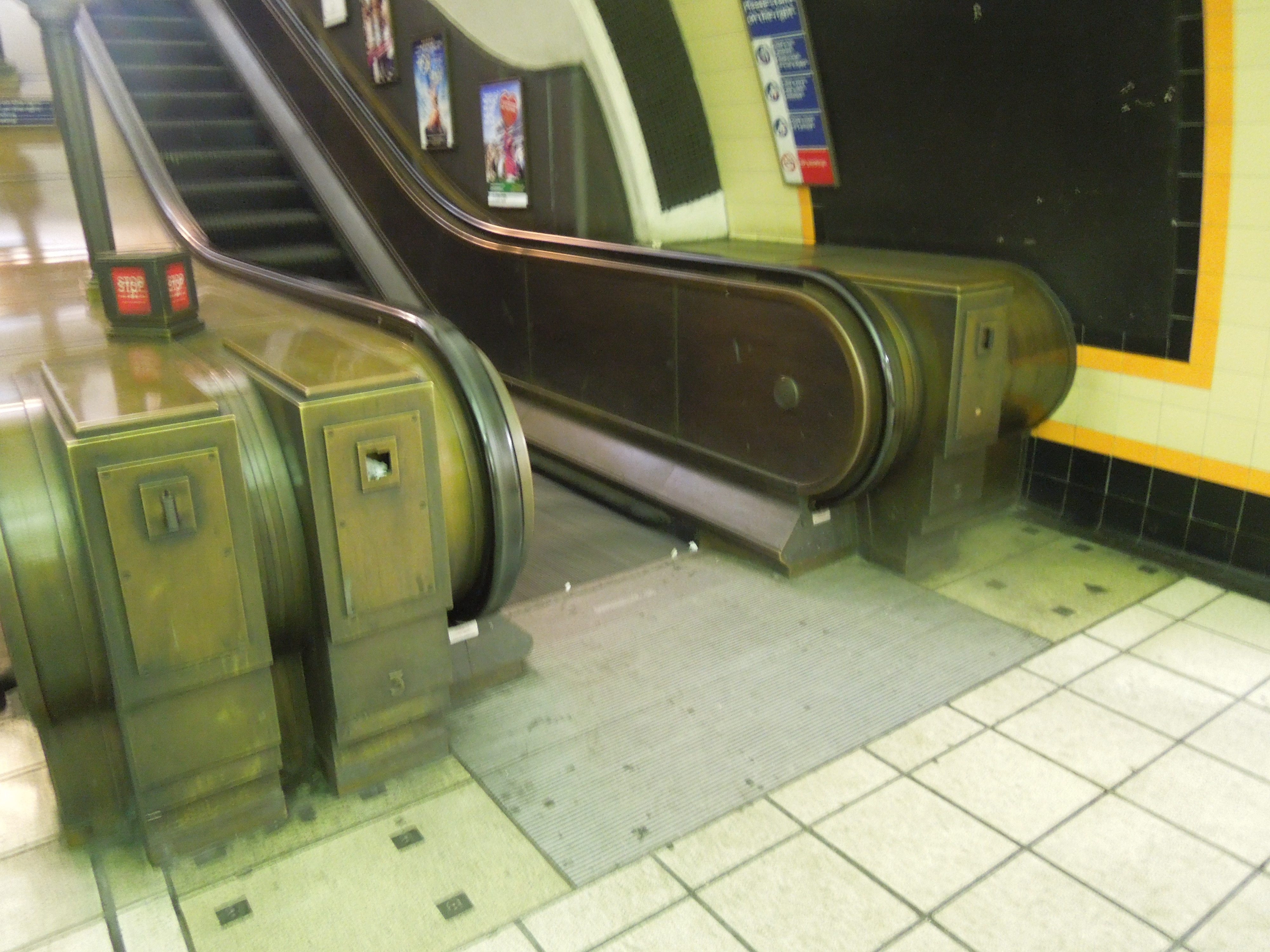
It is a gem of 1930s design and architecture with all that bronze, even if the yellow paint on the stairs in the middle for health and safety reasons, is out of place. The station may not have the original wooden escalators, but someone had the sense to fit modern treads in the old casing, rather than a complete modern escalator.
Escalator At Southgate Station
This station could take an inclined lift in the central space, but it would have to be done with enormous sympathy using similar materials to the original Charles Holden design.
There would be two other problems with an inclined lift.
As the station is now, it could easily be converted into an Underground station of several decades ago for making a film, as it was for The End of The Affair. I remember it was strange seeing a film, that had been shot in a place I knew so well.
The heritage lobby would have a field day trying to stop the installation. After all the station has won awards for its restoration over the last few years and it is a Grade II* Listed Building.
But all that adds to making it the sort of challenge, that a good designer would relish.
Arnos Grove – This is a surface station and could be made step-free with the addition of lifts in the same manner used on several stations on the Undergound and Overground network.
Bounds Green – Like Southgate, this station is a two escalator and one staircase station, where the staircase could be replaced with an inclined lift. But it doesn’t have the heritage problems of Southgate, as the station has modern escalators.
Wood Green – This is a three escalator station and step-free access would probably have to be installed, by digging a traditional lift shaft. I say shaft, as I suspect because the running tunnels are fairly wide apart, there is probably somewhere to slot in a shaft that served both platforms by descending into the platform level lobby or a cross tunnel, as was done at Tottenham Hale station.
Turnpike Lane – The problems here are similar to Wood Green, as it is another three escalator station, where a traditional lift would have to be sunk from the booking office to the platform levels. But another problem is that some form of lift would be needed to descend to the booking office level, which is below ground.
Manor House – This is very similar in layout to Turnpike Lane, but it would need lifts at seven exits to the surface to be fully step-free.
Finsbury Park – This is almost a low-level station with steps up to a pedestrian tunnel. Conventional lifts could probably be added without too much difficulty. There is a lot of development going on at this station and it will be interesting to see if the step-free access improves. The last time I visited access wasn’t good.
I think that the difficulty of making some of these stations completely step-free, shows how much our attitudes to those with difficulties getting about has changed since the stations were built in the 1930s. Charles Holden’s stations either had escalators or a short flight of steps, like Cockfosters or Arnos Grove. Compare the equipment at these stations with those on the Jubilee line extension, where all stations are fully step-free. But to be fair to Charles Holden, the Victoria line built thirty years after the Piccadilly line even now has only three step-free stations, Tottenham Hale, Green Park and Brixton stations. The Victoria line station, that I use the most; Highbury and Islington is a maze of tunnels and little short of a complete rebuild will improve matters.
Having looked at Southgate and Bounds Green, I think that an inclined lift could be a excellent idea at these two stations. You wouldn’t rip out the central escalator at Wood Green, Turnpike Lane and Manor House, as it was put in because the number of passengers needed it. But at least these three stations have larger platform tunnels, which must help the installation of a conventional lift.
However, putting in an inclined lift would not only make it easier for those in wheelchairs, with babies in buggies or heavy cases, but it would add to the station’s capacity. One point about an inclined lift, is parties where some need the lift and others don’t, can effectively travel up and down together at the same time, with those who can walk on the adjoining escalator. So the size of an inclined lift, may actually be smaller for the same capacity. It would probably also go up and down almost continuously.
A Design Challenge
It is absolutely essential that the London Underground increases the number of stations that have step-free access.
Southgate station is a station I know well, as I used it many times to go to and from my school. It is one of those stations with three escalator slots, as this picture shows.
The middle one was just an emergency staircase, but this could be converted into an inclined lift, as is proposed at Greenford.
But as Southgate is a Grade II* Listed building, it would have to be installed with a high degree of sensitivity, which would be the design challenge.
But solve it at Southgate and you could solve it on any of the number of stations, that have two escalators and a staircase.
Meandering Through The Snow
Today, I wanted to do two things.
First, I was going to Broadway Market to track down an old friend of C’s, who I knew had a relative with a shop there.
And then I was intending to go to a restaurant called Pappagone in Stroud Green Road to have lunch with an old friend.
I intended to get to Broadway Market by taking a 236 bus direct from Newington Green, just up the road from my house. As you an see, it was snowy, but the conditions weren’t too difficult.
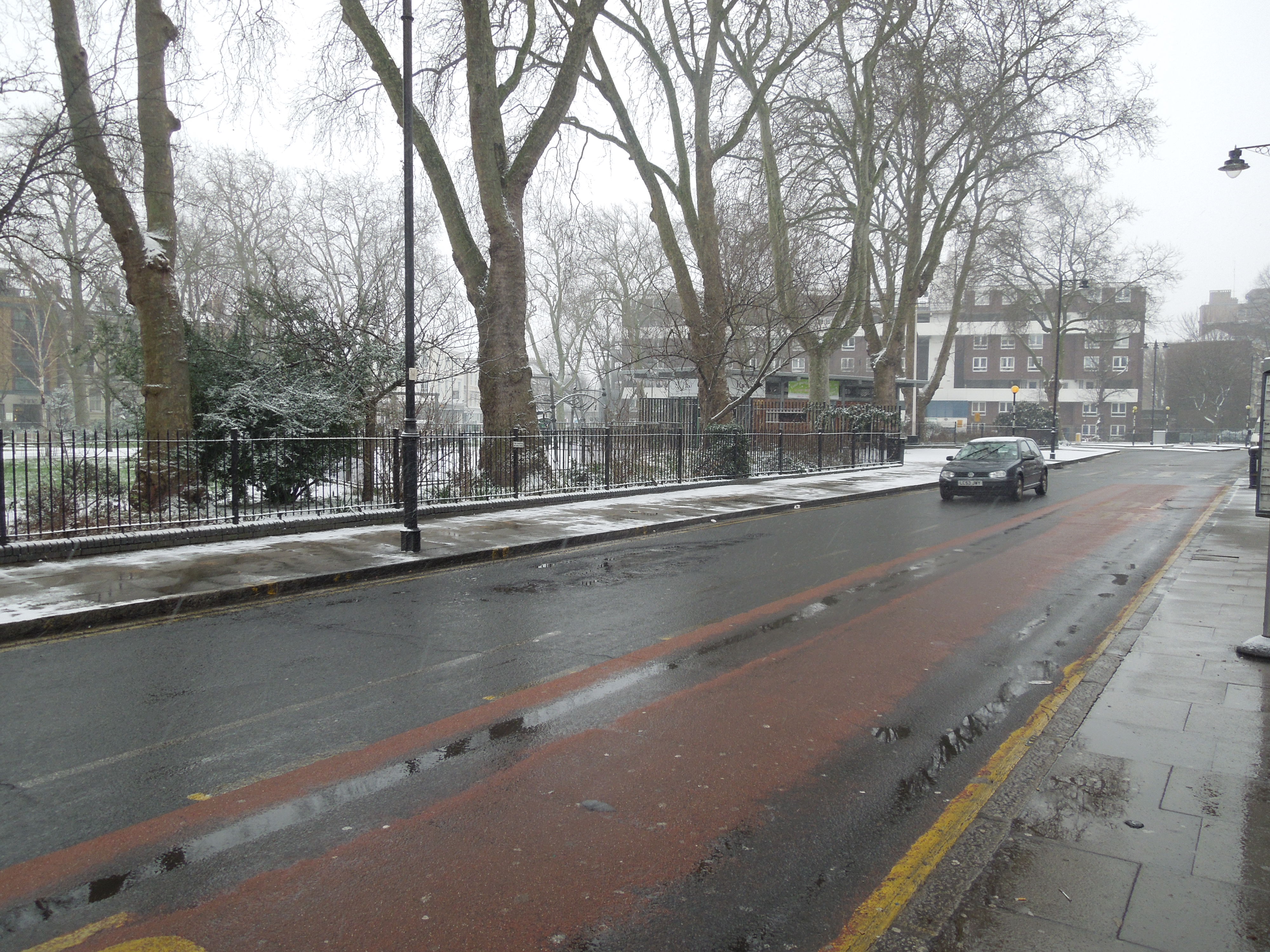
Newington Green In The Snow
The 236 is rather an untypical London bus, as it more like a country bus, that meanders around various communities as it goes on its way. It was full and comfortable an d got me safely to Broadway Market, although it probably took longer than normal due to the weather.
I didn’t find C’s friend, but I met a man who knew her and gave him my card before returning to the bus to take it all the way to its terminus at Finsbury Park station. but the stop was closed due to roadworks and I couldn’t get to the next one, before the 236 bus arrived. Then a 394 bus arrived going the other way and I decided it was better to take this to Angel station. I didn’t get that far, as the roads were slightly blocked and I then swapped to a 271 to take me to Highbury and Islington station, which would enable me to take one stop to Finsbury Park station. From there I intended to walk up Stroud Green Road
If it all sounds complicated, you have to remember that South Hackney is mainly densely packed buildings, with few main roads. Hence the meandering routes of the buses.
It might have been better, if the Chelsea Hackney line had been built after the Jubilee line as was originally planned. But not that much better, as there is no direct Underground connection between Angel and Highbury and Islington stations.
At Finsbury Park station my troubles weren’t over, as there was no staff about to tell me how to get out in Stroud Green Road and the sign had been obscured by a notice board. I also had the disadvantage, in that although I’ve changed trains at the station many times, I’ve never emerged above ground there. Eventually, i found my way and walked up the road to Pappagone.
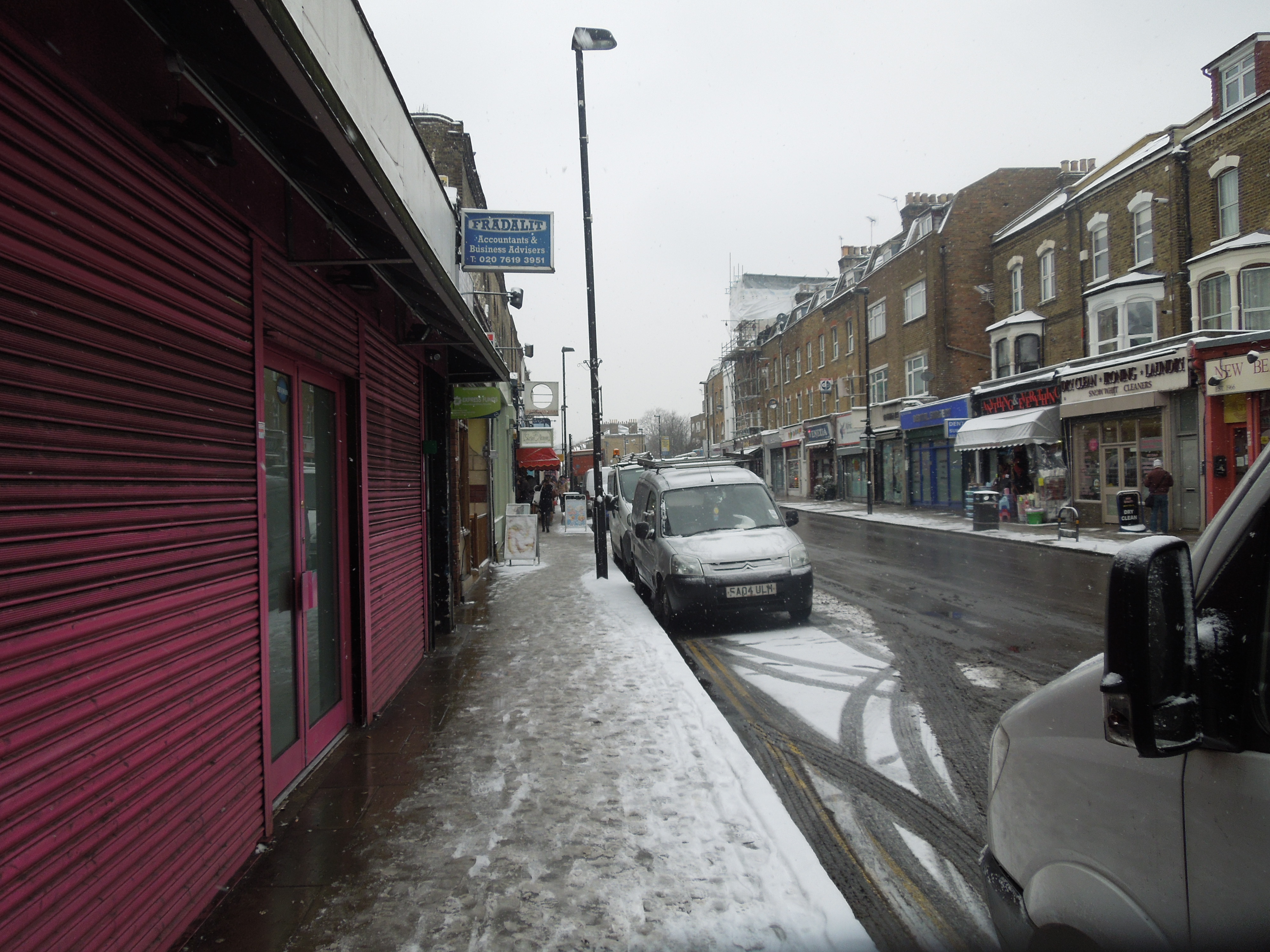
Up Stroud Green Road In The Snow
The weather wasn’t too bad, but I could have taken a bus up the hill if I’d needed to.
I had some very good gluten-free pasta at the restaurant and after a couple of hours or so, we took the 210 bus to Archway, where she went home and I took the Underground.
A quick change at Angel station onto a 38 bus and I was on the last leg home.
This trip illustrates how London or in fact any other city with a decent public transport system generally copes well with snow, as you can change your plans according to circumstances.
I always remember as a child, that the buses then, didn’t perform as well as the modern ones, which have most of the weight over the driving wheels and better tyres to boot. I saw a couple of New Buses for London and they seemed to be coping well, but strangely they had more snow on the roof, despite it being more curvy than the older buses. Perhaps the roof is better insulated!
Step-Free Access To The Underground
Coming back from Kings Cross station tonight, I took the indirect route using the Circle line to Moorgate station and then getting a 141 bus from just outside the station to just round the corner from my house.
The reason was that I had a heavy parcel of bedding, I’d bought in John Lewis and my normal change to the bus home at either Angel or Highbury and Islington stations would have meant crossing a major road.
Although I’m not in any way disabled, sometimes I do find that my left hand is a bit gammy and it is better to take an easier route, with escalators, lifts or right-handed staircases. For this reason, I know a lot of the best routes to get around London.
As I went through the gate at Kings Cross, the staff were chatting about step-free access and how difficult it will be to put in at some stations. I said that I think we’ll be finding some innovative engineering solutions used in some stations.
I know that inclined lifts are going to be used on Crossrail, but when I got home I found that at Greenford station, London Underground is going to get its first inclined lift. There’s more here on the Crossrail web site.
I think we’ll see a lot more of these, especially at stations, where there are three escalator positions, but the middle one has never been installed to save money.
The great advantage of inclined lifts is that in these stations, they can be installed without any digging or disruption to the station during the installation process.
I also think that buses have a large part to play in step free access.
As I said, I often plot my routes around London to avoid difficult stations or interchanges. For instance, I don’t change at Green Park station, as although it has lifts and is step free, you can walk miles between trains. Kings Cross too, is a bit of an Underground maze. Often though, the best route is to go to an easier station and then get a bus.
But not all stations have easy access from the trains to the buses and vice-versa like London Bridge, Euston and Victoria.
It may improve the lot of passengers and especially those who are disabled to improve the bus/Tube interface, as it will mean that some difficult stations can be bypassed.
I want lots more step free access to stations, but lets see if we can have innovative and more affordable solutions, that allow more stations to be given the full treatment.
The Two-Minute Rule On The Jubilee Line
This poster illustrates the two minute rule superbly.
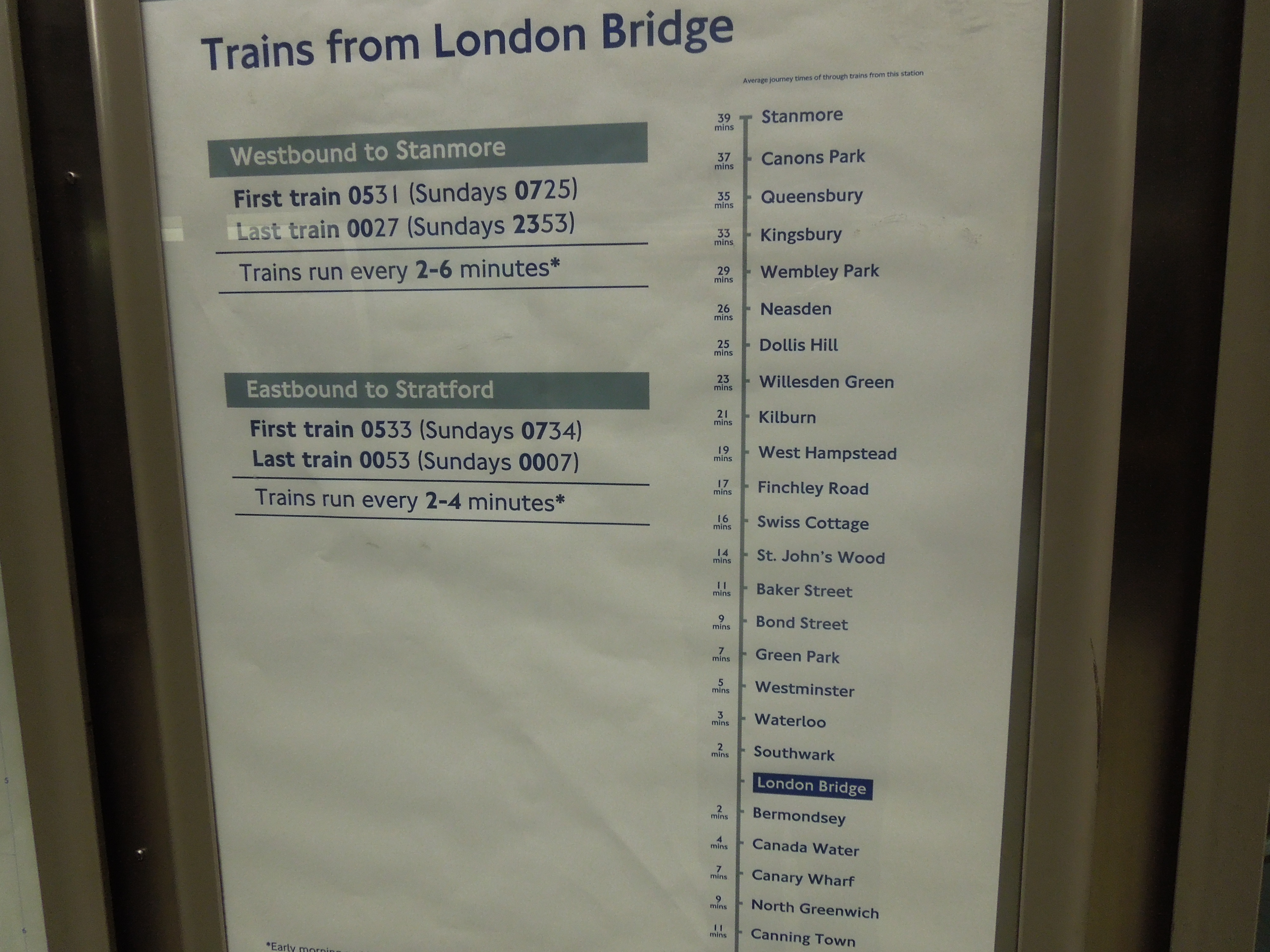
The Two-Minute Rule On The Jubilee Line
Stanmore station takes 39 minutes from London Bridge station and that is nineteen stations, which is roughly two minutes a station.
I wonder when these time diagrams were introduced.
I Like This Advert
The London Underground has more many decades been famed for its posters, graphics and art.
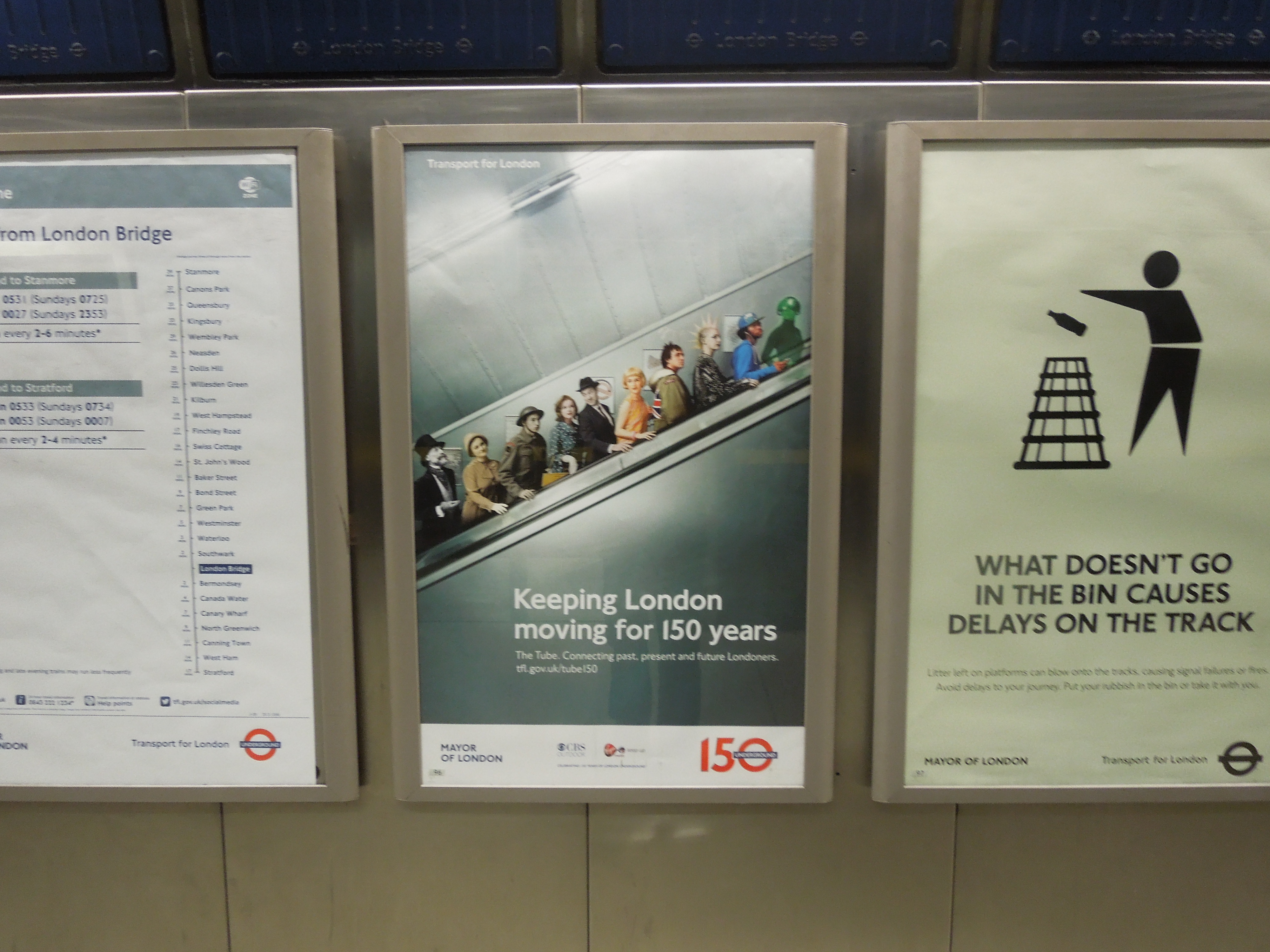
I Like This Advert
Their own adverts are usual better than companies and organisations that pay for them. I do feel too that some shouldn’t be allowed to advertise.

I Don’t Like This Advert
I don’t think any religious or quasi-religious adverts should be allowed, with the possible exception of charities that do good work, like the Salvation Army or Christian Aid. But Scientology should definitely not be allowed.
Apparently, they are having a media blitz according to this article in Wired magazine. Here’s the first paragraph.
The Church of Scientology is in the midst of a multi-million dollar media campaign that includes running ads on news sites, satellite dish networks, 37 cable stations, and even Wired.com — a blitz that seems to have not so much won new friends or influenced people as stir up more animosity towards the group many consider nothing more than a greedy cult.
I was pleased to read this, as the last bit is my view of this scientifically-incorrect movement.
I certainly won’t be watching a Tom Cruise film. In fact, I don’t think I ever have. Nicole Kidman is another matter though!
 The Anonymous Widower