Bethnal Green Tube Station
I had to go to East London today and took time out at Bethnal Green station.
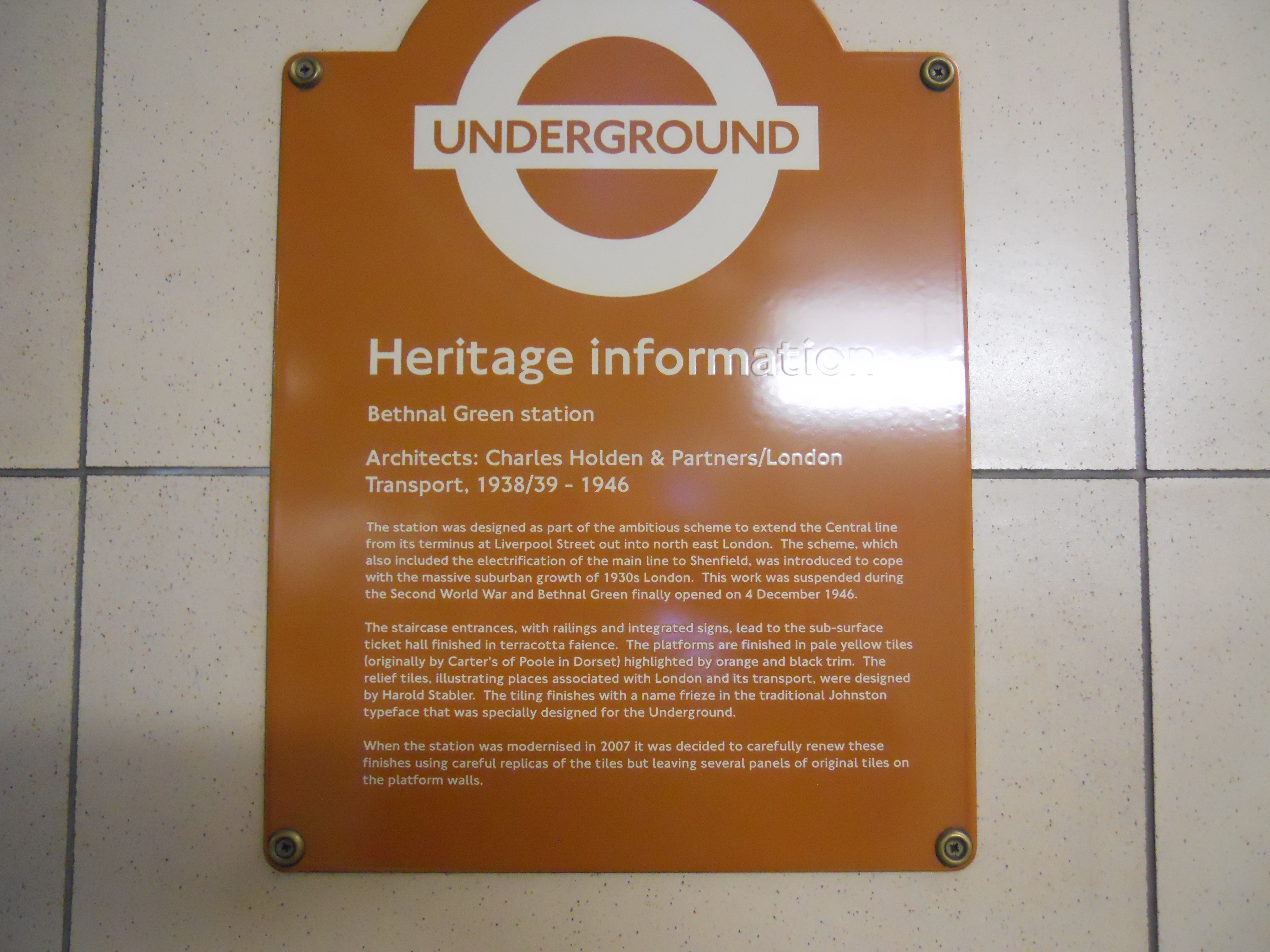
Heritage Plaque at Bethnal Green Station
This plaque is the first I’ve seen in a London Underground station and gives details of the architecture.
We need a lot more.
I’d been to the station before, when my late son and his family lived nearby and knew a little about the wartime disaster at the station.
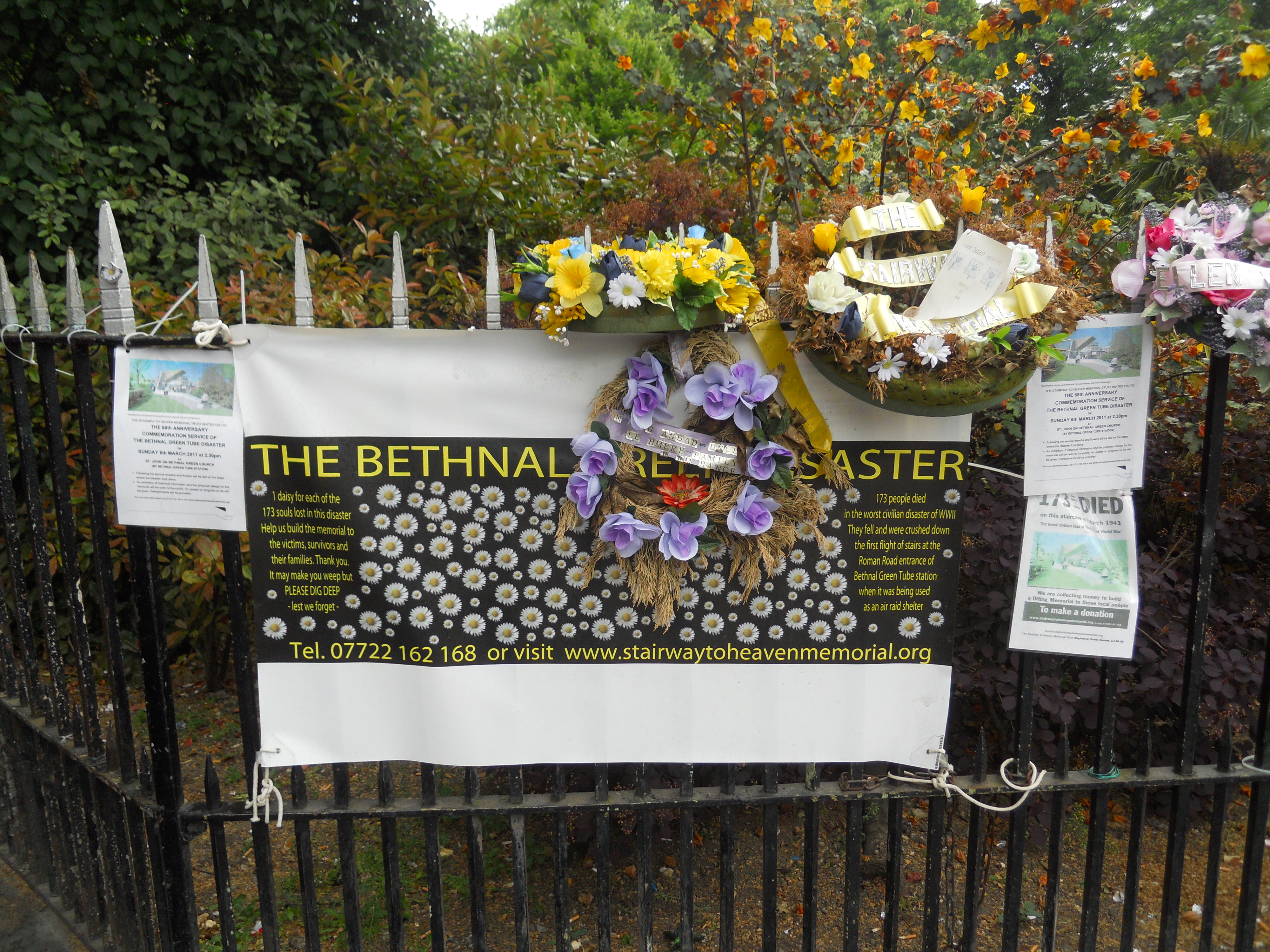
Memorial Banner and Flowers to the Bethnal Green Disaster
173 people died not from enemy action, but from a rush down the stairs to get into the station. A memorial has been designed and given planning permission. For more details of the disaster and the memorial see here.
I hope this memorial to the worst disaster on the London Underground goes ahead.
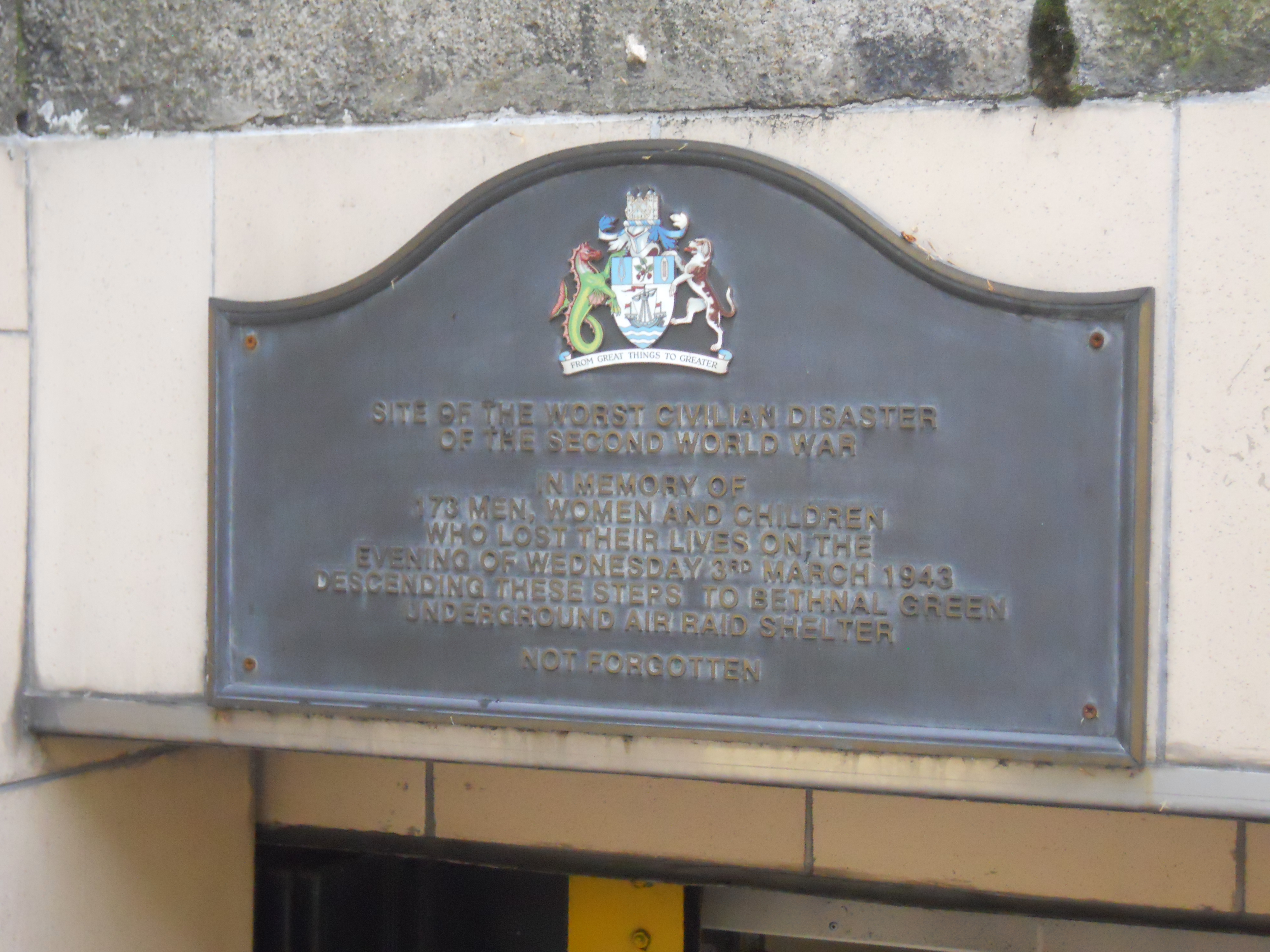
Memorial Plaque to the Bethnal Green Disaster
At least there is a plaque outlining the disaster.
The Ridiculous Tube Strikes
The RMT is calling a series of strikes on the Tube over the next few weeks. If ever there was a ridiculous set of strikes it is these.
The facts are a bit cloudy but it would appear that two drivers have been sacked. Transport for London says one thing and the RMT says another. Apparently, the cases of the two men are going before an Employment Tribunal.
So surely, all parties should cool off until the results of that!
The interesting things to read are the comments on the various news items on the BBC, The Times and other serious media. I have searched extensively, and can’t find any comment in favour of the drivers actions. As several thousand of them voted for the strikes, surely one or two could put a few words together to explain why they are striking.
In my view this strike and some of the others that have proceeded it is not about the issues, but is a result of the fact that the RMT has seen the writing on the wall of the future and doesn’t like it.
At present on the Victoria and Jubilee lines, the drivers effectively close the doors when everything is clear and start the train in the station and then it proceeds automatically until the next one. The Victoria line has had this method of operation since 1967. So surely, all lines will be updated to work this way in the next few years.
So in effect drivers will not drive the train anymore, but will effectively be train captains managing the train and its passengers. Obviously in an emergency, they would have an important role to play.
But because of the automation it is only one small step to drive the trains remotely. Even if this doesn’t happen, as costs in public services come under pressure, automation will mean that drivers can work safer and in a less stressful environment.
So as they are well-paid would many feel they don’t need the Union!
In other words, this strike may be more about Union survival, than any individual grievance.
It was the same in the printing industry, where in the 1960s and 1970s, the unions put vast numbers of companies out of business because of their attitude and refusal to accept new technology. My father was a printer at the time and his business was ruined because new technology made his business easy to bring in house. The unions only had one place of power and that was newspapers. So we had days without papers and all sorts of Spanish practices. The Times even shut for a year to reform its working practices.
Hopefully we won’t see anything as drastic as that, but Transport for London must stand up to the bullying tactics of the RMT. They in turn, should behave like a responsible union.
Both parties should also wait for the Employment Tribunal.
It is the least Londoners could ask for.
The Future Worldwide Public Transport Ticketing is Almost Here
I read last month, that Transport for London would be aiming to introduce ticketing using contactless bank cards before the Olympics next year. They would work instead of or alongside the Oyster card.
So after some of the comments with regard to public transport in the Aston Martin post, I thought I’d look up the progress.
I myself have a Freedom Pass, so you might ask why I would need to pay in other way. I usually keep it in the back pocket of my trousers, so I have forgotten it a couple of times, when I’ve changed in the middle of the day. I also keep an emergency Oyster card in my wallet, in case I lose the Freedom Pass or I meet someone from outside London, who doesn’t have an Oyster.
So how is it all progressing? Read about it here.
This is an extract.
Hany Fam, President of MasterCard UK & Ireland, said: ‘We’ve been working closely with TfL since 2006 to make this shared vision a reality and recently announced a deal for the exclusive branding of TfL’s Oyster card wallet for 2011.
‘MasterCard was the first to introduce contactless bankcard payments on UK public transport in 2009 and we’re delighted that from 2012 consumers with a PayPass card issued anywhere in the world can use it to access London’s transport system.
‘We believe that London’s leadership will pave the way for adoption of contactless payments in other major cities across the world.’
What is this worldwide universal ticketing, going to do for worldwide tourism?
So perhaps the banks, helped by lots of clever engineers and computer programmers are going to do something worthwhile for a change.
You might ask what’s in it for them?
These contactless transactions are much cheaper to process than one with a pin. I suspect too that as your bank card will be able to buy your travel, your paper and your lunch, you’ll only carry one card much of the time and hence theft and the associated fraud will be a lot less.
No Shredders in the City
My rather-too-cheap shredder failed a week ago and you’d think being close to the City of London, it would not be difficult to get a new and better one!
Wrong!
After a couple of abortive trips to the nearest PC World and Maplins, where they were out of stock, I decided to take the bull by the horns and go to Staples at Tottenham Hale.
In the end I chose one that just fitted in my large Tesco bag-for-life.
It also fitted the steps of the escalators on the Underground well and I could place it under the seat on one of the new Victoria line trains, so getting it back home wasn’t the hassle I thought it would be.
But why are there no shredders in the City?
The Athens Metro
The Athens Metro is fairly modern, as a lot of it was built for the 2004 Olympics. But beware, if you’re visiting the city in the next few months, that a large section of the original line 1 is being rebuilt. No-one seemed to know, when it would be fully reopened.
It is an efficient, if very busy system and you can buy a 24-hour ticket for just 4 euros.
I liked these seats I saw on one of the stations.

Seats on the Athens Metro
Quirky and easy to see. But I don’t know what Health and Safety would say as they appear not to be fixed down.
They also indicate which way the escalators are going. London Underground please note!
The 7th July 2005 Memorial Plaque at Russell Square Station
This plaque is in the foyer of Russell Square Station
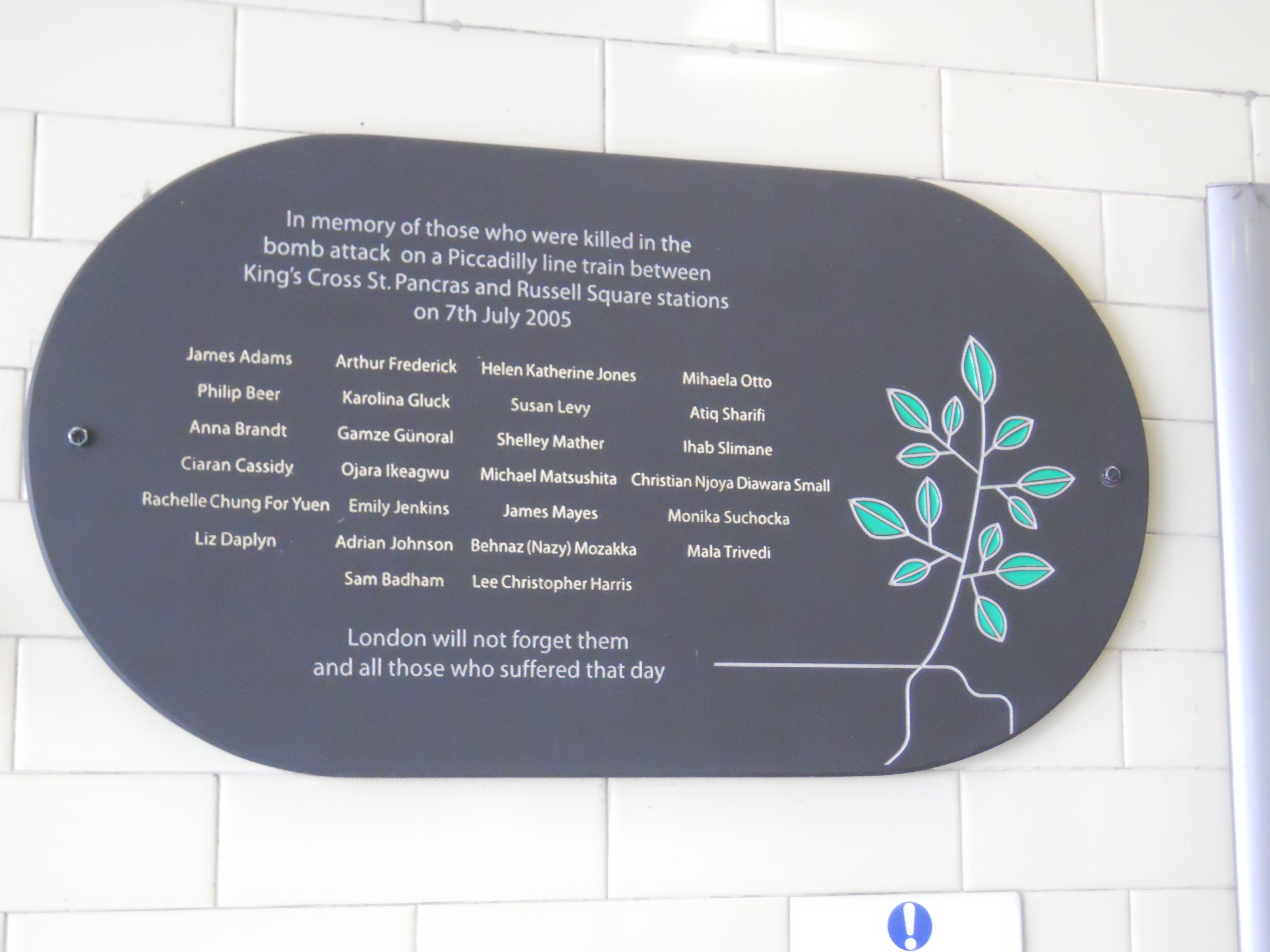
Meomorial Plaque at Russell Square Station
It sets exactly the right tone.
The Sunday Night Chaos at London Bridge
I’ve come back from London Bridge several times lately. Usually, I just catch a 141 bus from the station forecourt direct to close to my house.
But on Sunday night, it’s all different and the bus station on the forecourt is closed, so I have to walk across London Bridge to get the bus from a temporary stop on the other side of the bridge.
It is not a pleasant walk. But I’ve not had any serious problems.
Next time though, I’ll take the Northern Line a few stops towards home and then get a bus from Bank, Moorgate or Old Street.
It’s a pity that weekend connections are not good at New Cross for the East London Line to get me to Dalston Junction.
Thoughts on Rail Ticketing
Modern Railways this month provokes a lot of thoughts with reasoned articles on the financing of the UK’s rail system and developments in ticketing.
- Ian Walmsley argues in an article called Rail’s Big Chance, that the rising oil price is the biggest opportunity for rail since the steam engine.
- An unsigned article describes how ticketing technology is developing, especially with regard to using bank and credit cards instead of cards like the popular Oyster on the London Underground.
- Chris Stokes goes surfing on the Internet for tickets and says that the companies could do better.
In my view rail is missing a few things and there needs to be a holistic approach to fulfil the objectives for the rail companies and passengers alike.
- The rail companies will want to tempt as many passengers as they can from their cars and keep them.
- The rail companies will definitely want the best cash-flow possible. In one sense this means having trains as full as possible at all times of the week and day. But it also probably means using innovative ways to sell tickets.
- Passengers will want the best value and trains at times to suit their needs. They will also want easy-to-use ticketing systems.
With respect to the first objective, they may be attracting new passengers, but are they trying their hardest to keep them?
Many of these new passengers will be business ones travelling on expenses. These passengers have traditionally been encouraged by loyalty schemes from Green Shield Stamps in the 1960s to Air Miles and airline loyalty schemes now. Their companies pay the travel expenses, but they get the rewards. I know people who live in East Anglia and when they go to Scotland drive to a London Airport to fly with their favourite airline to collect the points, when perhaps driving to Peterborough and taking the train will be quicker and cheaper. The points are more important to them, than their company’s money.
There should be a nationwide rail and possibly tram and bus too, loyalty scheme. Perhaps it should be linked to a credit card, that also doubles as your Railcard, so it will work in London as your Oystercard and in Manchester, Sheffield and Birmingham on the trams. And of course everywhere on the buses!
I know I’d have one like a shot, as it would mean only carrying one card instead of three; credit card, Freedom Pass and Railcard. It would also make accounting for your expenses a lot easier, if you needed to account for everything.
So this move would benefit both rail companies and passengers.
A lot of passengers don’t like the hassle of buying a ticket. Turn up at a station as I did recently at Weybridge at eleven at night and if you are unfamiliar with the line, or if there is no-one around, you may struggle to buy a ticket, when it should be a welcoming experience. Touch-in and touch-out systems like Oyster or Freedom Pass should be the norm all over the country and this will happen almost universally when bank and credit cards can be used.
I also like the idea of bulk buying of tickets in advance. I live in London and have a season ticket at Portman Road to see Ipswich Town. I usually travel First Class these days and on Saturday I always use the same trains and tickets. Since my Freedom Pass arrived, it’s a Second Class Off-Peak Return from Harold Wood to Ipswich and an Upgrade to First Class for the whole journey. I usually buy them from the ticket office, as this cheapest fare is probably a bit complicated for me to buy from a machine. So why can’t I buy these tickets in batches of ten or so and then validate them before I get on the train? I would save time, even if I didn’t get a discount and the rail company would save expenses in the booking office. They’d also have my money in advance and f Town had a bad season, they might even find I didn’t use all the tickets. After all when we buy stamps, we buy them in books of 12 or so and rarely as singles. So why not rail tickets?
Years ago, I ran a company in Ipswich and we sometimes had to send people to London for the day. Inevitably we’d give people a cash advance for the ticket, but it would have been so much easier to give them a ticket, that they validated before travelling.
Bulk buying in advance would benefit a large number of passengers from commuters, who only did a journey perhaps three times a week, to businesses, who needed to send staff at short notice to clients in say London.
The rail industry now has the technology to do all sorts of things for the benefit of both rail companies and passengers alike.
From the Match Factory to Eastfield
Today, as I went to the football in Ipswich, I took a video as the train passed the site for the London Olympics in 2012.
The video starts as the train passes the old Bryant and May match factory and continues until the new Westfield shopping centre at Stratford. It opens in September 2011 and will inevitably be called Eastfield.
The red-bricked former match factory is now flats and a few houses and is called the Bow Quarter. It is famous for the match girls’ strike in 1888, which was part of the suffragette movement and one of the defining moments in trade union history. A musical, The Matchgirls, was written and produced about the strike in the 1960s. The musical was written by Bill Owen, who later appeared as Compo for many years in Last of the Summer Wine.
The Olympic Stadium is now substantially complete or at least on time for its full opening later this year.
The red tower after the stadium is the ArcelorMittal Orbit.
The Aquatics Centre is next.
The recently completed London Velopark is to the back of the Olympic Park and is not really visible.
The video ends at the new Eastfield Shopping Centre, which opens in September. The owners as you can see are still calling it Westfield.
But of course it will be part of that new Olympic sport; shopping, based on the new Underground line; the Shopping line, which must be the new name for the Central line. You start at Eastfield, after arriving by train and perhaps even from Paris, Brussels and Amsterdam on Eurostar, before travelling to Oxford and Bond Streets and then taking the line onto Westfield at White City.
Note that the video was shot from left side of the train in First Class. My thanks go to the driver, who specially slowed the train, so I could get a better video and to the ticket collector, who didn’t interrupt me to check my tickets. If you listen carefully, you can here his voice on the video.
It would be nice to repeat this on a clear day from the DVT on the front of the train. It would hopefully be as spectacular as the video, I took from the High Speed Train on the way to Inverness.
The Central Express Line
Getting to and from QPR yesterday was simple. I took a 21/141 bus to Bank and then got the Central Line to White City.
The journey back was particularly quick and the average station time was under two minutes.
So why is it quicker than other lines?
The trains were the first on the Underground to have wide outside plug doors and this gives more space inside and makes entry and exit easier. But also these trains are fully-automatic, with an advanced breaking system, that cuts time on stopping from full speed.
In other words, by good attention to detail, you can speed things up a little bit in several ways.
 The Anonymous Widower