Jumping The Electrification Gap Between Leeds And Manchester
The Battery High Speed Train
An Aventra uses a modern version of the same bogies that are used in the Class 222 trains, which are capable of 200 kph. As the Class 387 train, which is a version of the Electrostar, can travel at 110 mph, I wouldn’t rule out that the more modern Aventra could run at 200 kph or 125 mph. Obviously, this speed would probably only be attainable in places on the East Coast Main Line.
Example times between York and Newcastle include.
- East Coast InterCity 225 – 56 minutes
- East Coast InterCity 125 – 62 minutes
- Transpennine Class 185 – 67 minutes
So if the performance on the line of an Aventra IPEMU was the same as an InterCity 225, then this would knock eleven minutes of the trip to Newcastle
Acceleration on batteries would be the problem, not maintaining a high speed. that had been built up whilst running under the wires.
When jumping the gap in the electrification between Leeds and Manchester, as the train will have been running from either Liverpool or York, I would suspect that it would set out over the Pennines with a full load of electricity.
Manchester To Leeds Electrification Gap
The Manchester to Leeds electrification has now been paused and it is likely that it will not be completed in the next ten years.
The line has its problems as the three-car Class 185 trains, that work the line, are totally inadequate for the route.
There are two major routes between Leeds and Manchester.
- The Huddersfield Line via Dewsbury, Huddersfield and Stalybridge.
- The Calder Valley Line via Bradford Interchange, Halifax, Hebden Bridge, Todmorden and Rochdale.
The shortest distance by rail between Manchester and Leeds is just 43 miles. When I saw this, I didn’t believe it, but it’s all in this article in the Guardian.
So this means that if you want to run an electric train between Liverpool and Manchester to Leeds, York and Newcastle, the Aventra IPEMU would bridge the gap with ease.
The demonstration version of the Aventra IPEMU was a modified Class 379 Train and had a range of sixty miles on batteries.
So even this modified Stansted Express would have been able to bridge the gap on both routes with ease.
A fully engineered production Aventra IPEMU would be unlikely to have a shorter range on batteries.
So Aventra IPEMUs create a fully-electrified TransPennine route from Preston, Liverpool and Manchester in the West to Leeds, York and Newcsastle in the East.
Destinations In The West
These are all current Western destinations for Transpennine Express.
- Barrow – On an unelectrified branch line from an electrified Carnforth.
- Blackpool North – On an unelectrified branch line from an electrified Preston.
- Liverpool – On a direct line from Manchester that is completely electrified
- Liverpool via Warrington – On a direct line from Manchester that is partially electrified.
- Manchester Airport – Electrified from Manchester
- Windermere – On an unelectrified branch line from an electrified Oxenholme.
All could be served by using Aventra IPEMUs.
I suspect it would also be possible to serve Chester.
I’m not sure how Aventra IPEMUs would affect slower services like York to Blackpool North across the Pennines, but I suspect they would be faster than the current diesel multiple units.
With the franchises being reallocated, I suspect that it will be done in such a way, that the trains across the Pennines give a much better service.
Destinations In The East
These are all current Eastern destinations for Transpennine Express.
Cleethorpes – Probably too far, but the Class 185 trains could run the service as they do now!
Hull – Hull is perhaps fifty miles East of the East Coast Main Line and I believe that a solution can be found to do this on an out-and-back basis.
Middlesbrough – This is a few miles from Darlington
Newcastle – Electrified all the way from Leeds
Scarborough – The York to Scarborough Line is forty two miles long and I believe that a solution can be found to do this on an out-and-back basis.
Whether Aventra IPEMUs can do the return trip from the East Coast Main Line on an out-and-back basis to Hull and Scarborough, depends very much on how the range of the trains work out, when the production trains are delivered. I suspect Bombardier know and have either calculated it or proven it on a test rig, but obviously they are keeping it quiet and sticking with the sixty miles total range obtained with the Demonstrator.
If they can’t make it, I suspect that they can provide some form of charging at the Eastern termini.
I do suspect that because of the reorganisation of the two franchises we may see some extra destinations in the East.
Times Across The Pennines
At present times on the major routes are.
Liverpool to Newcastle – 3 hours
Liverpool to Hull – 2 hours 30 minutes with a change at Leeds
As I indicated earlier there is eleven minutes to take off the Newcastle journey and the change at Leeds probably wastes ten minutes on the Hull trip.
Other factors would have an effect.
- The time spent on a stop by the Aventra IPEMU will be less than that of the current Class 185 trains.
- If diesel multiple units on the two TransPennine routes can also be replaced with Aventra IPEMUs, then these trains would be less likely to slow the fastest expresses.
- The Aventra IPEMUs are faster than the current trains.
- Network Rail will probably be able to do some small amount of trackwork to speed trains up in places.
I have no idea what the eventual TransPennine time will be, but it will be a few minutes less than today’s times.
Manchester’s Metroshuttle
Manchester has a network of three free Metroshuttle buses that you can use in the City Centre.
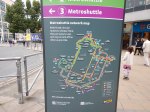

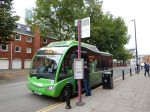
My big complaint about the system is the limited hours. Surely, in a busy City Centre a bus service like this should go on later than 19:00.
I also feel that the stops away from Piccadilly station could be better designed with more information and local maps.
Manchester’s Ticketing In Disarray
According to this article on Global Rail News, Manchester’s plans for smart ticketing have gone down the pan.
Could the failure of this system be caused, by not using the same successful system as London?
After all the minimum requirements of any smart electronic ticketing must include :-
- A Smart card like Oyster
- The ability to use contactless bank cards from all over the world.
- The ability to use ApplePay and the future AndroidPay.
London isn’t quite there yet, but when AndroidPay arrives and they can accept any contactless bank card, they will have set the global standard, to which all transport ticketing systems must aspire.
Any city or region, that doesn’t have a system that matches London, will lose out on the independent visitors.
The biggest benefits of contactless ticketing on buses, trams and trains are.
- Cash money and its associated costs and problems are taken out of the system.
- Attacks on staff are reduced.
- Boarding is quicker, so services are faster.
- Ridership increases.
- I have a feeling that by analysing the enormous amounts of joirney data generated, prediction of where new and improved services should go is very much better.
- The book is open on fare evasion, but I think it has dropped.
So come on Manchester, join the twenty-first century!
Northern Electrics Increase Services
Today the Class 319 trains started running services from Liverpool Lime Street to Manchester Victoria and Wigan North Western.
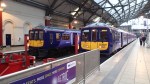
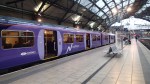
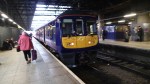

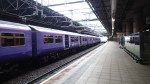
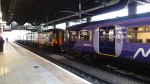
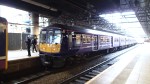
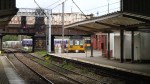
I took the pictures when I rode the 07:20 train from Liverpool to Manchester and some later when I returned to Manchester.
When I was travelling to Preston on the Sunday from Liverpool, my Class 156 train on the slow line between Wigan North Western and Preston was passed on the fast line by a Class 319 doing about a hundred. I estimated it was going fast as a couple of minutes later a Class 390 Pendolino roared past.
So it got me thinking, as to why some of the Wigan North Western services from Liverpool don’t go to Preston, as the tracked are electrified.
Then today, a student in Burnley asked me the same question, because as he said, it would make travelling from Burnley and Blackburn to Liverpool a lot easier.
There’s probably a very good reason, why they don’t!
I also asked a driver how they liked the Class 319s. He replied by saying they were waiting for more services to start out of Manchester.
He also said they were a bit bouncy on Chat Moss, where Network Rail had had trouble putiing up the overhead wires.
I have a feeling, that as Northern Rail get a few more Class 319 trains, they may do a bit of reorganisation of services around Preston.
Suppose :-
1. All Northern Rail trains between Liverpool Lime Street and Preston were to be run via Wigan North Western to a frequency of at least twice an hour by Class 319 trains. This might release some Class 156 trains.
2. The Blackburn service via Accrington, Burnley and Todmorden is extended to Preston and possibly to Blackpool North to connect with the Liverpool trains.
3. The Colne to Blackpool South service would also connect.
4. As more lines get electrified, the services would be optimised.
There’s also probably a good reason, why during the closure of the Farmsworth Tunnel, that the service via Todmorden isn’t extended past Blackburn to Preston. It could probably be something as simple as that when they planned the closure, the Todmorden Curve didn’t exist.
Where Is The Todmorden Curve When You Need It?
In my view, one of the biggest sins in good project management is to do jobs in the incorrect sequence.
In recent months, two important projects have been scheduled in the north of Lancashire.
Todmorden Curve
The Todmoden Curve is a short stretch of railway that will improve train services between Burnley and Blackburn to Manchester Victoria, by way of Todmorden and Rochdale.
The first train ran in May 2014 and from May 16th this year, there will be a full service.
Farnworth Tunnel
The Farnworth Tunnel has to be enlarged for electrification and it means that for the next few months, the direct route from Preston to Manchester will be very much reduced in capacity.
Work on this will start soon and the new reduced service kicked in today.
My Journey Today
At Preston on Friday, I asked if there would be a normal Blackburn Manchester service by the Ribble Valley Line. I was told yes and on reading the handouts from Virgin, there was no mention of any diversions or altered services.
But when I arrived at Blackburn station, I was told there was a bus to Salford Crescent, from where I could get a train to Manchester Piccadilly.
The bus took nearly ninety minutes and then I had to wait another twenty to get a train to Manchester Victoria, from where I got a tram to Piccadilly. There I got a train to Euston, which although it did go by a roundabout route because of engineering works, brought me safely to London.
It would have been so much easier to get from Blackburn to Manchester if the services by the Todmorden Curve were started before the partial closure of the Farnworth route.
The fact that the curve wasn’t opened before work on the tunnel started was a disgrace and it unnecessarily inconvenienced lots of passengers.
Manchester Now! Is Glasgow Next?
Look at most large English, Scottish and Welsh cities and there is usually at least one line through the city so that trains can pass from one side of the city to the other. Look at these examples.
1. London is upgrading the main North-South Thameslink route and building another East-West one.
2. Birmingham, Cardiff, Edinburgh, Leeds, Newcastle, Nottingham, Reading and Sheffield all have lines that fan out on either side.
3. Liverpool Lime Street is effectively a terminus on the coast, but a North-South line in the city connects stations in the North with others in the South.
When lines connect across a city, this means you don’t have so many terminal platforms in the centre of that city. As an example look at Brighton and Bedford, which have been connected for decades by Thameslink through London. There are several Central London stations where the train calls, so passengers have a lot of journey options. But there are no terminal platforms in Central London used by Thameslink.
Only two major cities don’t have a connection like this.
1. Manchester has two unconnected stations; Piccadilly and Victoria, with the former generally dealing with Southern services and Victoria dealing with the North and East.
2. Glasgow is the same with Queen Street dealing with the North and East and Central dealing with the South and West.
But with the announcement today of the final go-ahead for the Ordsall Curve in Manchester, as reported in this piece on the BBC, Manchester is finally getting the cross-city link it should have got with the building of the Picc-Vic tunnel. This plan was abandoned in 1977.
Will Crossrail Glasgow be announced before the election? I doubt it, as Alex Salmond would label it an English bribe.
But it is desperately needed!
Electrification In The North And East Anglia
There has been two major announcements about electrification of railways in recent weeks.
In this article on the BBC, they lay out the twelve lines in the north that have been prioritised for electrification in the report of the North of England Electrification Task Force. They are in all parts of the North.
- Calder Valley
- Liverpool to Manchester via Warrington Central
- Southport/Kirkby to Salford Crescent
- Chester to Stockport
- Northallerton to Middlesbrough
- Leeds to York via Harrogate
- Selby to Hull
- Sheffield Meadowhall to Leeds via Barnsley/Castleford
- Bolton to Clitheroe
- Sheffield to Doncaster/Wakefield Westgate
- Hazel Grove to Buxton
- Warrington to Chester
If the project goes ahead soon after completion of the current electrification project in the North West, it will take another large step towards creating a modern electrified railway in the north.
Joining the electrification together on a map, shows that after it is all completed there will effectively be two major east-west routes that are fully electrified.
The Huddersfield Line will allow electric trains to run from Liverpool to Hull, York and Newcastle, via Manchester, Huddersfield, Leeds and Doncaster, with a choice of two routes between Liverpool and Manchester. After all the work is completed there will be six fast trains an hour between Leeds and Manchester.
I was surprised that one of my favourite rail lines, the Calder Valley Line was also prioritised for electrification along with all its branches. But according to their correct methodology the line scored highest of all lines considered in the report. It is very much a scenic line and I recently took it from Leeds to Manchester, as it wound its way over the Pennines and through towns, like Bradford, Halifax, Hebden Bridge and Rochdale. Electrification will speed the journey and add capacity to the route. It will be a good home for more of those refurbished Class 319 trains and will link Preston, Blackpool and Manchester in the east with Leeds in the east. But perhaps more importantly, it will bring faster electric trains to all those towns dotted across the Pennines. Only knowing the area from occasional football matches in places like Burnley, Blackburn and Barnsley, I would not try to quantify the economic benefits. But I have a feeling that those who made the predictions would have erred on the low side!
The other lines prioritised for electrification fall into two distinct groups.
The Western or Lancashire/Cheshire group is a set of extensions to the current North West Electrification radiating out of the Northern Hub and includes Liverpool to Manchester via Warrington Central, Southport/Kirkby to Salford Crescent, Chester to Stockport, Bolton to Clitheroe, Hazel Grove to Buxton and Warrington to Chester. It virtually leaves only a few smaller lines to be electrified in the area.
The Eastern group is generally a set of extensions off the East Coast Main Line or the soon-to-be electrified Midland Main Line and includes Northallerton to Middlesbrough, Leeds to York via Harrogate, Selby to Hull, Sheffield Meadowhall to Leeds via Barnsley/Castleford and Sheffield to Doncaster/Wakefield Westgate. As with the Western group, it leaves very few important lines that are not electrified.
Looking at all this electrification, I think it has all been very well-thought through and the Task Force has chosen well. If you look at the Tier Two and Three lines that will follow these twelve Tier One schemes, it certainly seems to have been touched by the hand of a good project manager, who has arranged the schemes so that the teams can efficiently do one after another.
There was also a report in Modern Railways entitled Felixstowe Wires Study, which contained the following.
Network Rail is to conduct a study into the possibility of wiring the busy cross-country freight route from the port to Birmingham, with the results feeding into its Initial Industry Plan for Control Period 6 (2019 to 2024), due to be announced in September 2016.
The Modern Railways report also talks about looking into the eastern end of the East West Rail Link, a new station at Addenbrookes and the possible reopening of the March to Wisbech branch.
Both the North of England and the East Anglian reports seem to be the sort of comprehensive and intelligently-written reports, that have been severely lacking in the last few decades from UK rail companies. The work being proposed seems to be lacking in any political vanity, but geared very much to commuting, leisure, freight and bringing investment and infrastructure to places that need it.
I can’t help feeling though that if you look at all of the electrification schemes proposed for the North, there is a very strong focus on leisure.
For instance, increased frequency, capacity and comfort on the Calder Valley Line, will help those commuting into Leeds and Manchester, but the line will also carry a large amount of all sorts of leisure traffic like walkers, shoppers and families just taking a scenic train ride. As a lady said to me, when I travelled from Leeds to Manchester last week, the train is so much easier than the M62.
This leisure focus continued with adding the Barrow to Carnforth, Settle to Carlisle, the Carlisle to Newcastle, York to Scarborough, Hull to Scarborough, Cumbrian Coast Line and a few others into the program. I never thought I’d ever see some of these lines ever mentioned with the e-word.
Quite frankly all of this electrification should have been planned and implemented years ago, so it’s very much a case of better late than never. The big irony, is that some of the British Rail built, nearly thirty-years-old, Class 319 trains, will be returning to the county of their creation to move tourists and business passengers all over Yorkshire and the rest of the North.
It looks to me, that if you’re interested in a job with a future, then they’ll be plenty of work in railway electrification for quite a few years.
Or you could open a quality B & B near to a picturesque station in the North!
The Scenic Route From Leeds To Manchester
As I had plenty of time to travel across the Pennines to get from Leeds to Manchester Victoria, I took the scenic route on the Calder Valley Line.




The line is slower than a direct train to Piccadilly, taking probably twenty minutes longer, but I sat in a comfortable Class 156 train across the table from several friendly;y passengers, watching the countryside go by.
By coincidence today this article on Modern Railways web site, entitled Calder Valley Tops Wires Wishlist was published.
It says that full electrification of the line is the top priority after the current electrification is completed.
After all, they’ve got to create some high-quality electric railways on which to run all those shiny refurbished Class 319 trains. Thirty years old they may be, but they have the heart and soul of someone at least ten years younger. And there are a battalion of eight-six of the trains, should the powers-that-be send them all to the North to dispatch a lot of Pacers to menial duties or the scrapyard.
The electrification will mean that four-car electric trains will be able to run from Leeds via Halifax, Hebden Bridge and the Todmorden Curve all the way to Manchester Victoria, Liverpool and Blackpool.
Greater Manchester To Control Local Health Budget
\This report on the BBC entitled Greater Manchester Councils ‘to control £6bn NHS budget’, is surely the way for healthcare to go in the UK, as I suspect that health needs in various parts of the country can be very different.
Manchester is getting increasingly like London with an elected mayor responsible for various issues. Some of these issues are related, like the provision of good public transport to and from hospitals, so it is only right that they are dealt with locally. I am lucky in that my three local hospitals; the Royal London, Homerton and University College are all an easy bus ride or train journey away, but what proportion of the UK population, need to get a car or taxi to their local hospital?
Electrification Of Manchester To Preston Via Bolton
My trip to Bolton today, beautifully illustrated that the Manchester to Preston line needs to be electrified and the Ordsall Chord needs to be built. This chord would allow trains to serve both Manchester Piccadilly and Victoria stations as they pass through the city.
Trains do run directly between Piccadilly and Horwich Parkway, but going to the match, I did want to take some pictures in Manchester, so I walked to Victoria and got the train from there. Hopefully, when the scheme is fully implemented, all of the stations served by the line will get better connections at Piccadilly to and from the South.
Wikipedia says this about services between Horwich Parkway and Manchester
Northern Rail: there is a half-hourly service Monday to Saturdays northbound to Preston, with hourly extensions to Blackpool North and southbound to Bolton, with trains running alternately to Manchester Piccadilly or Manchester Victoria. An hourly service continues onwards to Stockport and Hazel Grove.
Trans-Pennine Express: one train per hour calls in each direction throughout the day, northbound to Blackpool North and southbound to Manchester Airport.
I think after the Ordsall Chord is built, it is reasonable to assume that a good proportion of the services will call at both Manchester stations. Certainly, it has been stated that Manchester Airport services will do this.
The train I got to the match from Victoria was one of Northern Rail’s better elderly diesel units, but coming back I was in one of TransPennine’s modern Class 185 trains.
After electrification of the line, I suspect there’ll be a bit of a reallocation of routes between the two train companies and most services on the line will be run by refurbished Class 319 trains. These are four carriages to a trainset and they can also be run in eight and twelve coach formations, so they can run services based on the newly-electrified lines in a very flexible manner, suited to the traffic.
I personally think that the train service between Manchester and Blackpool is totally inadequate at just a couple of rather pedestrian trains per hour.
As electrification is likely to bring a raising of speed limits and a larger pool of bigger and much better rolling stock, I would think that in a few years time, the Manchester-Blackpool service will bear no relation to the terrible one it is today.
At present it is not just the Manchester-Liverpool and Manchester-Preston-Routes that are being electrified. In their description of the electrification in this report, Network Rail show this map.
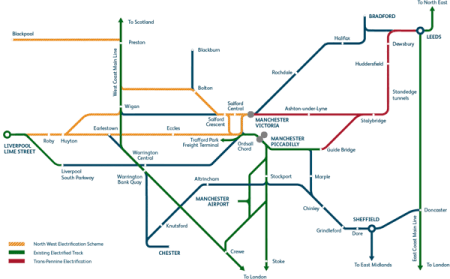
Northern Electrification Map
Note how Wigan-Liverpool via Huyton, Manchester Victoria-Leeds via Huddersfield and Guide Bridge-Stalybridge are also shown as going to be electrified. As is the Windermere Branch Line, which is not shown on this map. All are costed and funded, but there have been a few engineering problems, meaning that the Manchester to Liverpool services didn’t start when they should have done. The problems are reported in the Liverpool Echo.
Network Rail has admitted the long-awaited launch of electric train services between Lime Street and Manchester Victoria and Manchester Airport will now be postponed until next year, possibly as late as February.
The serious delay has been blamed on “unexpected ground conditions and technical issues” encountered while installing the overhead catenary wires on the 184-year-old former Liverpool & Manchester Railway mainline, said Network Rail.
This will only be the start of the revolution.
As there are 86 Class 319 trainsets, that are to be split between the North and the Great Western Main Line, I’m sure that enough sets can be found to run a good service between the following destinations, when the current electrification plans are complete.
- Liverpool-Blackpool
- Liverpool-Lancaster, Carlisle and Scotland
- Liverpool-Leeds/Newcastle via Manchester Victoria
- Manchester-Blackpool
- Preston-Windermere
Services from Liverpool, that go North up the West Coast Main Line, don’t run at present, except to Preston and Blackpool. But if the lines are all electric, subject to the paths being found, I think that one of the operators will run direct services between Liverpool and Glasgow. Failing that Liverpool to Blackpool services will probably be timed to connect with services to both Scotland and the South at Preston. Or perhaps some of the First TransPennine services between Scotland and Manchester , could divide and connect at Preston. But whatever happens travel between Liverpool and Scotland will be a lot easier.
Once electrification gets to Leeds, this will enable services from Manchester and Liverpool to go all the way to Newcastle, opening up more possibilities for new services.
I don’t believe that this will be the end of the development of electric services in the North.
The Class 319 trains currently ply between Bedford and Brighton, which by road is about 120 miles. So they should be capable of serving the slightly shorter distance between Liverpool and Hull. It would seem they are capable of travelling across the North of England reliably. As they are 100 mph electric trains, they certainly wouldn’t be slower on the route than the current Class 185 trains and probably only slightly slower than the new Class 350 trains, that First TransPennine use on Manchester-Scotland services.
In a few months time, electric services between Liverpool and Manchester will commence, probably followed about two years later by electric services from Liverpool and Manchester to Preston and Blackpool.
If the North like their refurbished trains running on electrified lines, it will be hard to resist the pressure to put in more electrification.
If Network Rail can get its act together on electrification, I think that by 2022, the number of electrified lines in the North will be greater than currently planned.
The route from Manchester to Sheffield by the Hope Valley Line will probably be a priority, as when the Midland Main Line from Sheffield to Doncaster, Nottingham and London is electrified in 2020, it will open up all sorts of routes like Liverpool and Manchester to Nottingham and the East Midlands.
If Hull to Leeds and Doncaster is electrified, then this opens up the possibility of electric Liverpool and Manchester to Hull services via Leeds. The BBC has this report about ministers backing the electrification.
The government has backed plans to electrify the Hull to Selby rail line.
Transport Secretary Patrick McLoughlin said he was making £2.5m available to take the project to the next stage
First Hull Trains is planning to spend £94m electrifying 70 miles (112km) of track to improve connections with the wider rail network.
Work is already under way to electrify the line from Manchester to Leeds, York and Selby and is due to be completed by December 2018.
This one will happen, as First Hull Trains wouldn’t spend £94million of their own money, if they didn’t think they’d make a decent return. They are probably trying to get their hands on some of the InterCity225s that will be made redundant by the new Class 800/801 trains.
It is almost if a hundred miles per hour railway across the country is fighting its way to birth by stealth, aided by some refurbished over twenty-years old British Rail rolling stock.
An interesting aside is what will happen to the thirty one InterCity225s. I have heard a rumour that some will be cascaded to the Greater Anglia Main Line to run London to Ipswich and Norwich services currently run by Class 90 locomotives hauling Mark 3 coaches.
I haven’t travelled in an InterCity225 for some months, but the last time I did on a short trip to Peterborough, they did not appear to my untrained eye to be scrapyard fodder yet.
As they are genuine 200 kph high speed trains, could we see them providing fast services from Liverpool to Newcastle and Hull in under two hours? Politicians and comedians may well have poked fun at British Rail for years, but now that we have a UK cash flow shortage, who are stepping up to the plate to help out our impoverished railways? A whole series of British Rail trains like the InterCity 225s and Class 319. No-one should forget the refurbished Class 315, Class 317 and InterCity125s, which will fill other gaps in the bad planning of our railways in theThatcher, Blair and Brown decades.
The only problem with the InterCity225s, is that they may be too long for some of the stations across the Pennines. But solving that is in the grand scheme of things a relatively minor problem for good engineers, architects and construction teams. Also, as they get replaced will some end up on the West Coast Main Line providing direct services to Blackpool?
Once the basic spine across the country is complete and running high-capacity services fast electric services between Blackpool, Liverpool and Manchester, in the West and Leeds, Hull and Newcastle in the East, two things will happen.
Politicians will press Network Rail to create a genuine high speed railway or HS3, across the country, as they love high profile projects, by which they will be remembered.
But more importantly, all of those connecting lines across the North will be prime candidates foe electrification, so they can be home to some more Class 319s.
HS3 will eventually be created, but only when the new electrified service is in need of more capacity.
I think that the electrification in the North is an unstoppable series of projects, that will only finish, when all lines are electrified.
Talking to people on the trains to Bolton yesterday, I don’t think the passengers know how their lives will change, when what is certainly going to be implemented happens.
One very extensive traveller, I met on the train between Manchester Victoria and Horwich Parkway, didn’t realise that the new electric trains in a couple of years would be larger units that the current diesels. He also had travelled on Thameslink to his daughter in South London and actually thought the current trains on that route were pretty good. He hadn’t realised that these would be running after a basic refurbishment all around Manchester.
And then on the trip back to Piccadilly, I met two young ladies, who were coming all the way from Eskdale to see the Who in Manchester. They didn’t kow that the branch to Windermere is going to be upgraded and said that it would have made their journey today a lot easier.
The rail industry in the North needs to spread the word. I have a feeling that the Class 319s, when they start operating in a few months between Liverpool and Manchester will start the process.
 The Anonymous Widower