Audacious’ Contract To Revive Nancy – Contrexéville Route
The title of this post, is the same as that of this article on Railway Gazette.
These first two paragraphs give more details of the project.
The 89 km route from Nancy to Contrexéville, much of which has been closed to passenger and freight traffic since 2016, is to reopen in December 2027. This follows the award by the Grand Est regional council on May 24 of a contract to a private-sector consortium formed of Transdev SA, NGE Concessions and Caisse des Dépôts et Consignations.
The ‘audacious’ 22-year concession deal is worth €721m and covers both rehabilitation of the line at a cost of €150m plus management of the infrastructure and operations. Following detailed studies, work on the ground is expected to start in April 2025.
This OpenRailwayMap shows the route.

Note.
- Nancy is at the top of the map in the middle.
- Contrexéville is in the South-West corner of the map.
- Vuttel is shown by the blue arrow.
- The distance between Nancy and Contrexéville is 89 kilometres.
- It appears to be a double-track railway.
As the picture in the Railway Gazette article shows, the route needs to be refurbished.
These are my thoughts.
The Route Will Be Operated By An Augmented Form Of Open Access
- An augmented form of open access will seem to be used to run services.
- The infrastructure will be donated to the regional government.
- Upwards of a dozen round trips per day will be run.
Nothing is said about the traction to be used!
Modernised, it could be an interesting route for tourism.
Will It Provide A New Route Between Metz and Dijon?
Consider.
Metz with TGV connections, is not far to the North of Nancy.
Dijon with TGV connections, is not far to the South of Contrexéville.
These connections could be invaluable for tourism and development of the area.
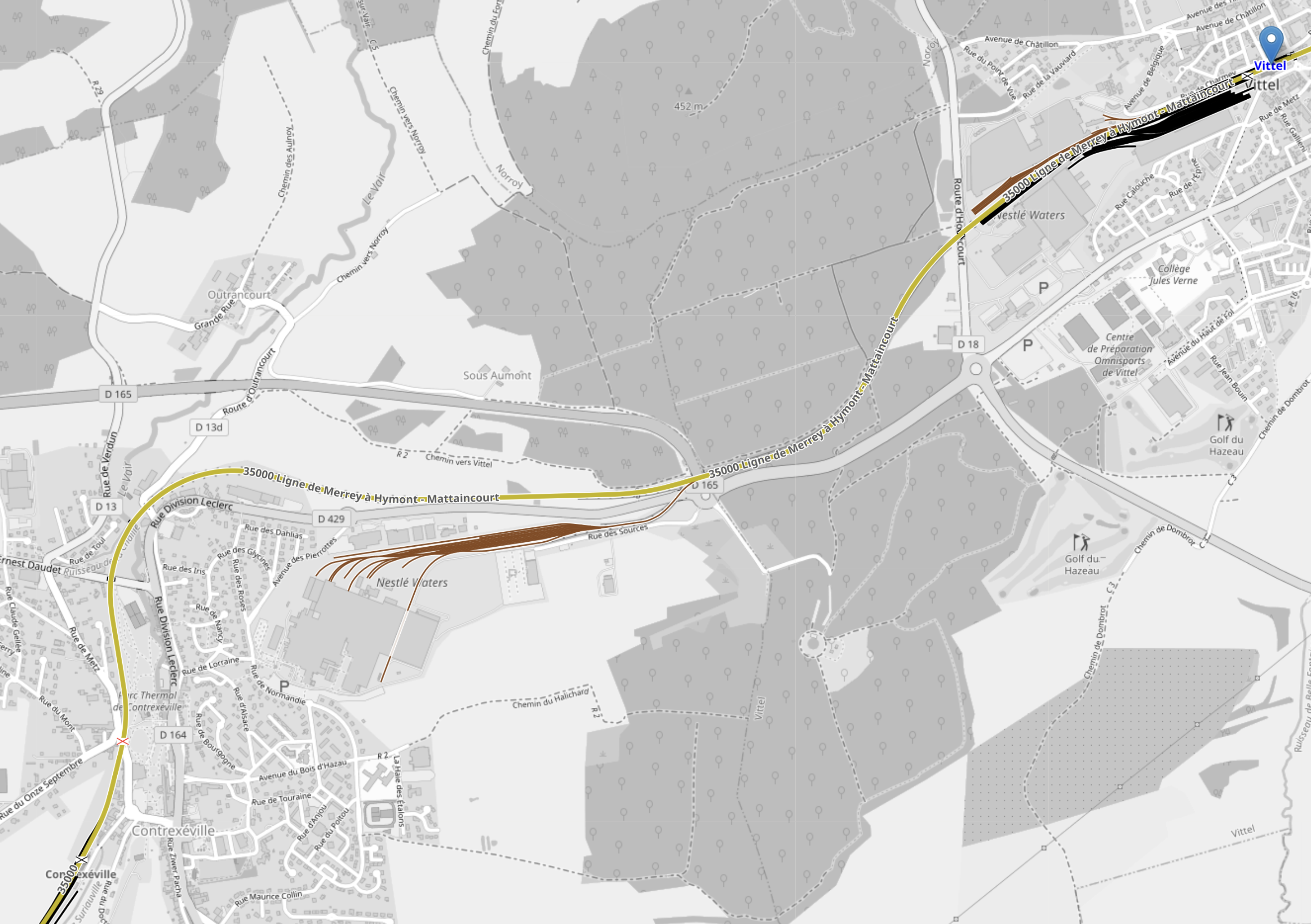
This map shows the South-Western section of the route between Contrexéville and Vittel.
Note.
- Vittel is marked by the blue arrow in the North-East corner of the map.
- Contrexéville is in the South-West corner of the map.
- In the middle of the map are sidings, which are marked Nestlé Waters.
- There appear to be sidings at Contrexéville and Vittel
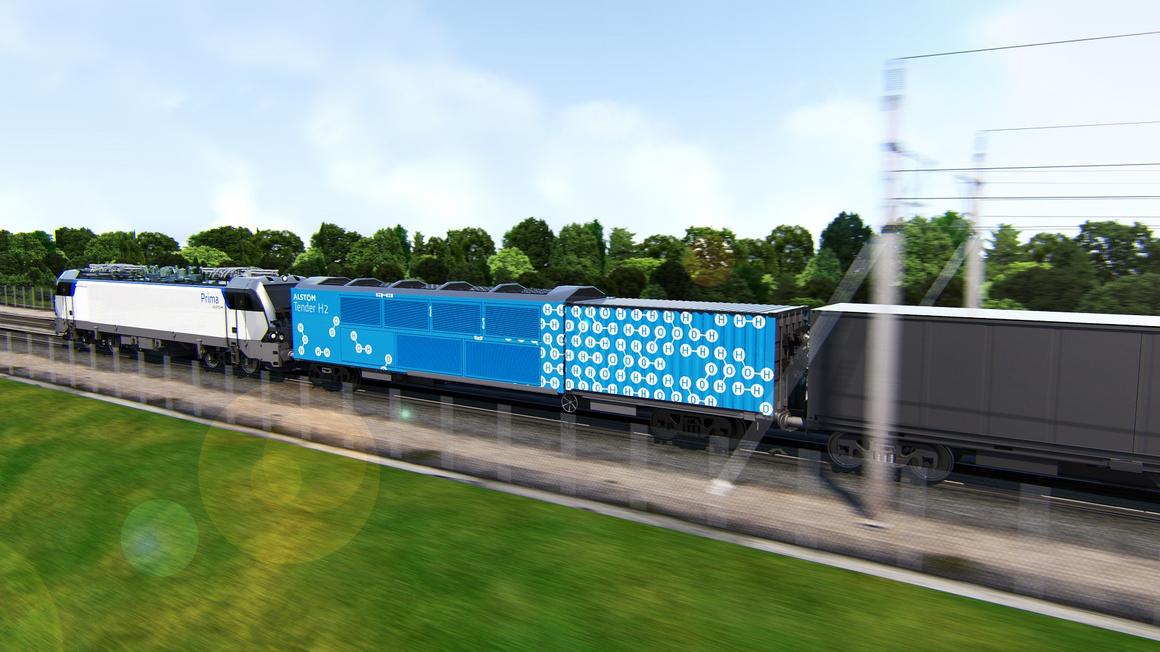
In From 2025, Nestlé Waters France Will Use The First Hydrogen-Powered Freight Train Through An Innovative Solution Developed by Alstom and ENGIE, I talk about how Nestlé will move water from the Vosges, using hydrogen-hybrid locomotives pulling freight trains.
This is a visualisation of the train.
This is said in the original Alstom press release.
From 2025, this freight train powered by electricity from the rail network and from hydrogen in non-electrified sectors will aim to progressively ensure the transport of VITTEL® natural mineral water between the factory located in the Vosges and its various distribution centers in France (i.e Vittel/Arles 600 kms and Vittel/Montreuil-Bellay 760 kms). The dual-mode solution will be composed by a generator wagon incorporating a high-power fuel cell system powered by renewable hydrogen and a line-electric locomotive, all connected by an electrical power cable. The generating wagon will be able to supply the locomotive with electricity in the without the need for any catenary.
It does appear, that within a year or to, freight trains from between Contrexéville and Vittel will be hauled by hydrogen-hybrid locomotives.
- Trains to and from Montreuil-Bellay could go via Nancy or Contrexéville.
- Trains to and from Arles could go via Contrexéville.
I suspect at present all trains have to go via Contrexéville.
If the Nancy and Contrexéville route were to be rebuilt and could take the water trains, this would open up routes to the Channel Ports and Belgium, Luxembourg, Northern France, Northern Germany and The Netherlands.
- Hydrogen trains would certainly advertise the zero-carbon nature of the transport.
- It has to be remembered that a couple of years ago, Highland Spring opened a rail distribution facility in Scotland, with the aim of moving 40 % of their water by rail.
I wonder if Nestlé are building a zero-carbon rail network for the delivery of their bottled waters.
What Traction Would Be Used For Passenger Trains?
Consider.
- The distance between Nancy and Contrexéville is 89 km or 55 miles.
- This distance, is within the range for battery-electric and hydrogen-powered trains.
- There is reason to believe that Nestlé’s water trains will be hydrogen-powered.
I suspect either battery-electric and hydrogen-powered trains could be used.
Nestlé And Tesco Launch Double-Stacked Rail Freight Trial
The title of this post, is the same as that of this article on Logistics Manager.
This is the sub-heading.
Nestlé UK and Ireland has successfully completed its first delivery to supermarket chain Tesco using a ‘first-of-its-kind’ rail container, as part of a new rail freight trial.
These are the first three paragraphs.
The container features a roof-raising mechanism allowing products to be “double-stacked from floor to ceiling operating at full capacity before the roof is lowered for transit”. The appeal of this is its capability to store potentially twice as much freight in one journey, reducing costs and emissions.
This is part of Nestlé’s plans to increase freight capacity on trains as a means of reducing the negative impact that the company’s logistics operations have on the environment. It is hoped that the trial will allow the process to be refined over time, providing further opportunities for Nestlé to expand the volume of goods that can be transported via rail in a single shipment.
This focus is integral to Nestlé’s strategy to reduce its reliance on the consumption of diesel in its road transport network. According to a 2021 report from the Rail Delivery Group, rail freight produces, on average, 76% fewer emissions than road transport. This, it claims, equates to a reduction of around 1.4 million tonnes of CO₂ nationally each year.
Note.
- This article would appear to be a follow-on to Nestlé Unveils New Double-Stacking Rail Logistics Plan To Reduce Carbon Footprint, which I wrote in June 2022.
- In From 2025, Nestlé Waters France Will Use The First Hydrogen-Powered Freight Train Through An Innovative Solution Developed by Alstom and ENGIE, I talk about how Nestlé are experimenting with hydrogen-powered locomotives.
Nestlé certainly seem to be working on reducing the carbon dioxide produced by their logistic operations.
Kit Kat Cereal Proves Failure On Sugar, Say Charities
The title of this post, is the same as that of this article on The Times.
This is the sub-heading.
Nestlé promotes ‘nutritious’ product that is a quarter sugar
And this is the caption for the picture.
With 24.7g of sugar per 100g, a bowl of Kit Kat cereal accounts for a third of a seven-year-old’s suggested intake
This is the first two paragraphs.
The launch of a Kit Kat breakfast cereal shows the government strategy of relying on food companies to help fight obesity has failed, campaigners have claimed.
Charities such as the British Heart Foundation have accused Nestlé of “irresponsible” promotion of a product which is a quarter sugar, arguing that it makes the case for state intervention to make food healthier.
After this start, I thought I’d better check the ingredients on the product page on Nestlé’s web site!
Under a heading of Our Carefully Selected Ingredients, this is said.
Whole grain WHEAT (31.4%), maize semolina, sugar, dextrose, palm oil, WHEAT flour, cocoa powder* (5.4%), glucose syrup, WHEAT starch, skimmed MILK powder, calcium carbonate, BARLEY malt extract, fat-reduced cocoa powder*, flavourings, cocoa butter*, salt, cocoa mass*, emulsifier: lecithin, whey powder (MILK), MILK fat, antioxidant: tocopherols, iron, vitamin B3, B5, B6, B2, B9.
May contain NUTS.
*Rainforest Alliance Certified. Find out more at ra.org.
This product on their own admission contains over thirty per cent wheat.
Now let’s add a very large dollop of peer-reviewed science.
Coeliac Disease: Can We Avert The Impending Epidemic In India? is the title as that of this peer-reviewed paper on the Indian Journal Of Research Medicine.
This is an extract.
The time of first exposure to wheat influences the development of celiac disease. In countries such as Finland, Estonia, and Denmark, characterized by low gluten consumption in infancy, celiac disease prevalence is much lower than in Sweden where gluten consumption is high in infancy. A natural experiment occurred in Sweden about two decades ago when national recommendations were made to introduce wheat into the diet after cessation of breast feeding at six months. This change was coupled with increased wheat gluten consumption through infant feeds. Together these measures resulted in a two-fold increase in incidence of celiac disease in Sweden, which was attributed to introduction of wheat into the diet after cessation of breast feeding.
In 1996 this recommendation was changed to introduce gluten in gradually increasing amounts while the infant was still being breast fed. This led to a dramatic decrease in celiac disease incidence.
Should we be following the route of these Scandinavian countries and eat wheat sensibly and reduce the amount we give our children or should we follow what Nestlé’s marketeers want us to do?
As a coeliac, who is allergic to the gluten in wheat, I wouldn’t touch this product with a spoon certified by my cardiologist.
The author also says this about wheat.
The other dimension to this problem is that not all wheat is alike when it comes to inducing celiac disease. The ancient or diploid wheats (e.g. Triticum monococcum) are poorly antigenic, while the modern hexaploid wheats (e.g. Triticum aestivum) have highly antigenic glutens, more capable of inducing celiac disease. India, for centuries, grew diploid and later tetraploid wheat which is less antigenic, while hexaploid wheat used in making bread is recently introduced. Thus a change back to older varieties of wheat may have public health consequences. Public health authorities may well want to examine both these avenues, i.e. infant feeding recommendations and wheat varieties cultivated in the country, for opportunities to avert the epidemic of celiac disease which is impending in our country.
The author may be talking about India, but as he says modern wheats have highly antigenic glutens and will cause an epidemic of coeliac disease.
I may not have had any medical training, but I spent a miserable first fifty years of my life as an undiagnosed coeliac.
Conclusion
KitKat Cereal should be labelled that it may cause coeliac disease.
From 2025, Nestlé Waters France Will Use The First Hydrogen-Powered Freight Train Through An Innovative Solution Developed by Alstom and ENGIE
The title of this post, is the same as that of this press release from Alstom.
These are the main points of the press release.
-
Nestlé Waters will be the first company in Europe to benefit from the hydrogen fuel cell solution developed by Alstom and ENGIE, for rail freight.
-
The purpose is to operate the first hydrogen-powered freight train from the Vosges plant, thanks to a hydrogen generator wagon system developed by Alstom and supplied with renewable hydrogen by ENGIE, from 2025.
-
Ultimately, this project should enable Nestlé Waters to reduce emissions by 10,000 tons of CO2 equivalent per year.
-
This new collaboration is in line with the actions Nestlé Waters has been carried out for several years to decarbonize its supply chain.
In this Alstom visualisation that accompanies the press release, an Alstom Prima locomotive can be seen pulling a tender full of hydrogen, that generates electricity.
It would appear to be a very simple concept.
- The electric locomotive uses electrification where it is available.
- On lines without electrification, hydrogen is used to generate electricity.
- The locomotive and the tender are connected by a cable.
- I suspect for longer distances, larger generators with a larger hydrogen capacity can be developed.
- It would appear that typical SNCF Prima locomotives have at least 4 MW of power, so the generator must be at least this size.
I could see this concept being used with a 4 MW Class 90 electric locomotive.
Nestlé Unveils New Double-Stacking Rail Logistics Plan To Reduce Carbon Footprint
The title of this post, is the same as that of this press release from Nestlé.
These paragraphs explain the concept.
Nestlé UK & Ireland has unveiled plans to increase freight capacity on trains to allow the double-stacking of products, an important step towards reducing its carbon footprint.
The new curtain-sided rail container with a raising roof, designed to transport double-stacked palletised products by rail, was displayed at the Multimodal Exhibition in Birmingham this week.
The design of the container overcomes an important barrier as the height of road trailers differs from rail containers due to the height constraints of the rail network, meaning transport by rail had not been a winning option for Nestlé until now.
Utilising a hydraulic raising roof mechanism, the unit allows the business to double-stack its food and drink products. The roof is then lowered to just above the height of the stock, making it compliant with the height requirements of rail transport, while being able to get more products on board.
It is currently under test between the Midlands and London.
The press release also mentions, that it could be used to deliver to Tesco, who are extensive users of rail freight and have been for some years.
 The Anonymous Widower