Mingyang Building Fish Farm-Equipped Offshore Wind Jacket Foundation
The title of this post, is the same as that of this article on offshoreWIND.biz.
This is the sub-heading.
Chinese wind turbine manufacturer Mingyang Smart Energy revealed on 17 April that it started the construction of a jacket foundation that also features a net cage system for fish farming, which will be installed at the Mingyang Qingzhou 4 offshore wind farm in the South China Sea later this year.
The picture in the article, looks like something out of Baldrick’s book of cunning plans.
This paragraph gives more details.
The jacket is typhoon-resistant and the aquaculture system, which will raise up to 150,000 fish in 5,000 cubic metres of water, will have remote functions such as automated feeding, monitoring, detection, and collection, according to Mingyang.
Mingyang also state that the Qingzhou 4 offshore wind farm will also produce hydrogen.
Does that mean that in the next phase of the development, they’ll be putting a fish and chip shop on top?
The Netherlands Chooses Site For World’s Largest Offshore Wind-to-Hydrogen Project
The title of this post, is the same as that of this article on offshoreWIND.biz.
This is the sub-heading.
The Dutch government has designated an area for what will become the world’s largest offshore hydrogen production project. That area is Ten noorden van de Waddeneilanden (the North of the Wadden Islands), identified earlier for offshore wind development and deemed most suitable for providing 500 MW of electrolysis capacity and for the transport of hydrogen to land.
This Google Map shows the Wadden Islands.
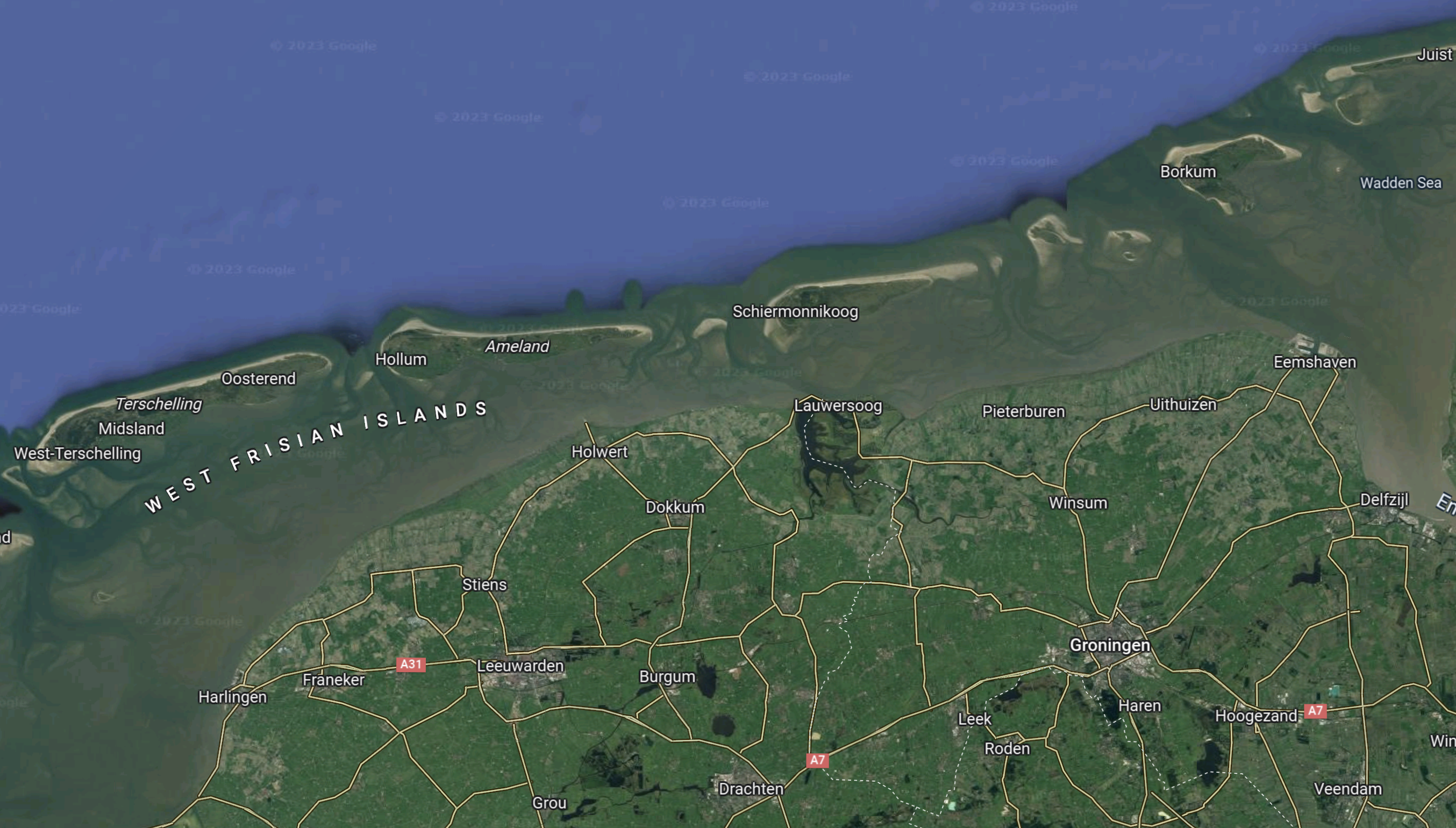
Note.
- Groningen is in the South-East corner of the map.
- I wrote about Eemshaven, which is to the North-East of Groningen in The Train Station At The Northern End Of The Netherlands.
- The Wadden or Frisian Islands are along the coast.
The Wadden Islands of the Netherlands, Germany and Denmark are a World Heritage Site.
In Can The UK Have A Capacity To Create Five GW Of Green Hydrogen?, I said the following.
Ryze Hydrogen are building the Herne Bay electrolyser.
- It will consume 23 MW of solar and wind power.
- It will produce ten tonnes of hydrogen per day.
The electrolyser will consume 552 MWh to produce ten tonnes of hydrogen, so creating one tonne of hydrogen needs 55.2 MWh of electricity.
If the Dutch build a 500 MW electrolyser it will produce 217 tonnes of hydrogen per day.
The Dutch Plan For Hydrogen
This 500 MW electrolyser fits well with the The Dutch Plan For Hydrogen.
Lhyfe And Centrica To Develop Offshore Renewable Green Hydrogen In The UK
The title of his post is the same as that of this news item from Centrica.
These are the bullet points.
- Memorandum of Understanding will pave the way for green hydrogen pilot production site at sea
- Energy firms explore large scale partnership in drive to net zero
- Aim for UK to become a global leader in the hydrogen sector
This is the third paragraph, that outlines the objectives of the project.
The pilot will aim to combine Lhyfe’s expertise on green hydrogen production and Centrica’s experience of gas storage and infrastructure to ensure that the hydrogen produced can be safely stored and utilised in the UK. The end result would be proof that an end-to-end hydrogen production, storage, and distribution system is possible in the country.
I have a couple of thoughts.
Offshore Production Of Hydrogen
I remember from the 1960s, when I told friends and my mother, that I worked in a hydrogen factory, some of them asked if it was dangerous.
The Hindenburg and the R 101 had a lot to answer for even forty years later.
But does that fear of hydrogen still exist? If it does, surely building hydrogen electrolysers offshore could be a way of reducing that fear?
There are also other reasons to produce hydrogen offshore.
- The latest electrolysers will work with sea water, which means the water doesn’t need to be desalinated first.
- The hydrogen can be brought ashore and stored using redundant gas infrastructure.
- Using redundant gas infrastructure may be a more affordable way of bringing energy onshore.
- A severe hydrogen leak may be much less dangerous 50 km. offshore. It will quickly disperse and rise into the atmosphere.
The accountants will probably decide.
Do Centrica Have Big Ambitions For Hydrogen?
This is said about Centrica in the news item.
- Centrica is a leading international services and solutions company with ambitious plans across the business to reach net zero by 2045. Centrica have identified hydrogen as playing an essential part in company and UK targets to achieve net zero.
- Centrica Storage are a 100% owned subsidiary of Centrica and own and operate the Rough gas field storage facility, located off the coast of Humberside.
- Centrica has a long-term ambition to turn Rough into the world’s largest hydrogen storage facility in Europe.
Centrica appear to have big ambitions for hydrogen.
Dutch Take Aim At Lower Green Hydrogen Costs By Combining Offshore Wind And Floating Solar
The title of this post, is the same as that of this article on offshoreWIND.biz.
This is the sub-heading.
A consortium of Dutch companies has launched a government-backed project to explore the synergies between offshore wind, offshore solar and hydrogen production at sea for improved sustainability of North Sea renewable energy projects.
T thought about calling this post, The Dutch Go For The Full Monty, but there is no mention of wave or tidal power.
These two paragraphs outline the project.
The four-year project, dubbed Solar Enhanced North Sea Energy Hub (SENSE-HUB), is expected to accelerate the rollout of offshore solar into offshore renewable energy systems.
Let by TNO, short for Netherlands Organization for Applied Scientific Research, the project will address the integration of various energy system modules for the Dutch North Sea by understanding and removing the implementation barriers for future SENSE-HUBs from a technical, economical, ecological, legal and societal perspective.
I wouldn’t be surprised to see more integrated systems like this in the waters around our coasts.
I also believe that the ultimate offshore energy production system will also use wave and tidal power to generate electricity and have inbuilt energy storage.
 The Anonymous Widower