Oxford Now Wants Silent Track
Network Rail must rue the day they agreed to extend the Chiltern Line to Oxford, as the locals have done everything they can to tell Network Rail, that they don’t want the new railway. I wrote about it in July 2015, in Network Rail’s Problems In Oxford.
This article in the Oxford Mail was published yesterday. This title is.
City council bosses to force Network Rail to install Silent Track on another stretch of North Oxford railway.
Which is a good precis of the article.
So what is silent track?
This article on Railway Technology is entitled Tata Steel’s SilentTrack to reduce noise levels at London Blackfriars station.
It gives a sensible explanation.
I know something about noise and vibration and feel very strongly that we should do what we can to minimise noise, where it causes problems.
Noise from a railway comes from several sources.
- The track
- Diesel locomotives and multiple units.
- Pantographs on electric locomotives and multiple units.
- Freight wagons.
All contribute to a various degree.
In my view, the worst noise comes from diesel locomotives like the noisy and smelly Class 66 locomotives and there is not much point on spending millions on silent track and then allowing these to run through sensitive areas.
The sooner lines like this one through North Oxford are electrified the better.
Slow Progress On Electrification To Oxford
A few piles have started to appear on the line between Didcot and Oxford.


But a guy on the station, said Oxford won’t be electrified soon.
Report from Sir Peter Hendy to the Secretary of State for Transport on the Replanning of Network Rail’s Investment Programme
This report is crucial to a lot of reconstruction work continuing on railways in parts of the UK.
I’ve put the link, so I can find the report easily.
Here’s a taster of what the report contains.
This extract is entitled Case study – Aristotle Lane, Oxford and talks about the problems of closing a private level crossing in Oxford.
Network Rail planned to install a replacement footbridge over the Oxford to Banbury Line north of Oxford Station and close an adjacent private level crossing for safety reasons. People walking from a nearby car park, across some allotments to the other side of the tracks, used the level crossing. The new bridge will have a link to the allotments removing the need for people to cross the tracks.
The level crossing is not a public right of way and the rights to use it are owned by Oxford City Council. As part of the East West Rail (phase 1) improvement scheme, Chiltern Railways made an application in 2009 to close the level crossing as part of a wider project to upgrade the railway line.
Objections from allotment holders at the Public Inquiry meant that the approval was not granted. This meant that Network Rail needed to pursue a separate planning application in order to complete the work and deliver Marylebone to Oxford services.
Efforts to close the crossing and deliver the scheme continued. Meetings were held in 2012 between Network Rail, ORR and the Council to find a solution. Finally, in 2014 the principle to close this one level crossing was granted, but with the conditions that Network Rail had to fund and construct better access to the allotments, arrange a land swap so the local school could be expanded and to fund and build a new car park. All of these require further, and separate, planning permissions.
A planning application was submitted in May 2014 and approved a year later after three separate planning committee presentations. Construction of the bridge is now planned to start in January 2016 with completion in September 2016. The level crossing will then be closed seven years after the first application.
Kafka is certainly alive and well and living in Oxford.
For more information on this fiasco/farce/cock-up/vexacious litigation/waste of money (delete as appropriate!) read this article in the Oxford Mail, entitled Network Rail changes its plan for new Aristotle Lane bridge after protests.
Some of the comments are priceless.
I am very much of the opinion that all level crossings should be shut on safety grounds. If there are serious objections, then surely the railway should be closed until an agreed solution is negotiated.
Oxford Or Oxford Parkway Station?
I ask this question, as the new Oxford Parkway station opens on the twenty-sixth of this month.
I have just looked at the times and it would appear that the half-hourly services between Marylebone and Oxford Parkway, will take about an hour.
The current service between Paddington and Oxford station isn’t a consistent service, with some services taking forty minutes and other direct services taking an hour longer.
So for the next few months, until Chiltern Railways hopefully arrive in Oxford station in Sprint 2016, it’ll very much be a question of personal convenience and preference.
From Oxford To Birmingham
As there wasn’t much of interest to photograph in Oxford, I grabbed myself some gluten-free sandwiches and a drink in Marks and Spencer at the station and took a train to my next destination, Birmingham New Street.
I’ve never done that trip before on the Cross Country Route via Banbury and it was an easy journey of about an hour.
I missed photographing all of the work near Harbury, which is reported here on the BBC. It was a major landslip that closed the railway for some weeks.
As we approached Birmingham, the train seemed to take a circuitous route into Birmingham and at one point, the train passed behind Birmingham City’s football ground.



We were on the Camp Hill Line, which is being proposed for passenger services, according to Wikipedia.
At least such a project would probably be appreciated in Birmingham.
Network Rail’s Problems In Oxford
Oxford is going to be a big rail hub with over the next few years the following projects being completed or at least underway.
1. Chiltern Railways from Oxford Parkway to Oxford station. Services to Oxford Parkway station will start on October 26th 2015, with services to Oxford city centre starting in spring 2016. I’ll believe the last part of that, when a Chiltern Railways train takes me to Oxford. When I visited in March 2015, little seemed to be happening at Oxford station in preparation for the arrival of this service.
2. Oxford station to be substantially upgraded with more platforms and possibly two island platforms for through trains. Again in March 2015, little seemed to be happening.
3. Chiltern Railways from Oxford station to the Science Park on the Cowley branch.
4. Electrification between Didcot and Oxford.
5. The creation of the East-West Rail Link
But according to the August 2015 of Modern Railways, they are having severe problems in the area North of the station, which I explored in a walk in March 2015. This is said.
On top of that, there is a hint of exasperation with the local authorities about the glacial pace of the planning process: it took two and a half years to get approval for a pedestrian crossing to replace a footbridge for Chiltern’s mew line to the city centre, because allotment holders used to wheeling barrows of compost across the line were complaining about the new up-and-down route they would have to take over the bridge. New railway staff accomodation in Oxford is mired in similar planning mud.
Cambridge have upgraded their railways in recent years, and although they have had delays on the new Cambridge North station, there doesn’t seem to have been the same planning mud.
The question has to be asked if the good burghers of Oxford would prefer that money was spent on improving transport infrastructure in more welcoming places. The writer obviously feels strongly as he goes on to say this.
While not wishing to stand in the way of democracy , Network Rail is pointing out that there is a window of opportunity for modernising the route to Oxford that could be lost unless local authorities embrace it wholeheatedly. With NR’s spending plans under pressure, there is a danger that Oxford will be put in the “too difficult” pigeonhole and the caravan will move on. Then it would really be back to the 1970s, with changing at Didcot becoming the best option to reach Paddington at some times of day.
I had a friend who lived in Oxford and he used to say that the Council liked to keep cars out of the City. Perhaps, it is more fundamental than that, and the Council would prefer to keep everybody out of the city, so they can continue to lead their cloistered lives, untroubled by the Twentieth Century, let alone the twenty-first.
Do the same people, who blame Network Rail for their well-documented problems, like these at Oxford and those at Manchester, fully support the improvements in the first place or do they really want money to be spent on their own pet projects?
We certainly need a planning system that allows people to air their views and protest, but also one that takes more account of the good of the majority after all contra-arguments have been rejected.
Oxford Station And Chiltern Trains
In a couple of years Chiltern Trains will go between London Marylebone and Oxford stations around the Bicester Chord. Wikipedia says this about how Oxford station will be expanded to accept the extra services.
The scheme also includes two new platforms at Oxford station, to be built on the site of the disused parcels depot. The new platforms would initially be five carriages in length, but provision will be made for them to be extended southwards to eight carriages.
These pictures show the Parcels Office.

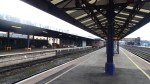

I would suspect that any southward extension would use the car park.The Parcels Office is clearly shown in this Google Earth image of the station.

Oxford Station
Note the two coach train in Platform 3, by the Parcels Office, with the white flat roof on the northern end of the station.
Oxford Takes A Leaf Out Of Cambridge’s Book
When I visited all of the 92 football clubs in England, Oxford was one of the most difficult to get to. I said this.
Oxford, must surely be one of the most difficult stadia to get to from the town centre, even if you have a car. And if you do, you have to actually drive along the by-pass where there are queues of traffic. Of all the taxis I have taken to get to and from grounds, Oxford was by far the most expensive.
But from 2020, it’ll all be different.
According to the BBC, Chiltern Trains are opening up the Cowley branch to passenger trains, which will stop at the Science and Business Parks. Some reports say this will also handle the football ground.
But it is good to see Oxford following Cambridge and having a station at the Spence Park.
Oxford Isn’t All It’s Cracked Up To Be
I had to smile at this article.
At least she decided to follow in C’s footsteps and go to UCL to read law.
I’ve always believed that you shouldn’t go to a university, that is in a place, that is very similar to where you were brought up, as it doesn’t widen your mind.
By Train to Oxford
When I went to Oxford on Saturday, I could have driven. But I parked at Blackhorse Road station on the Victoria Line and then took the tube to Paddington changing at Oxford Circus, as it is only a short walk between the platforms. From Paddington it was just an hour by train direct to Oxford.
The journey worked out well and I didn’t wait long in either direction and there were no delays. Taking the train also allowed me to do some shopping in Oxford Street and have coffee with an old friend on the way back.
Going it was just a typical Networker multiple-unit, but coming back it was a proper High-Speed Train.

High Speed Train at Paddington
The High Speed Train or HST was a stop-gap design that has been in service for over thirty years and it is still one of the fastest, if not the fastest, diesel train in the world. Like good wine they are getting better with age! Not bad for something designed in eighteen months.
What is not generally known about the HST is the name of the designer; Terry Miller. At least East Midlands Trains have now put his name on a power car of one of his outstanding trains.
They will soldier on for at least another decade until they are replaced by electric units. But will these be as reliable? And good?
Whilst at Paddington, I took this picture of Brunel’s roof.

The Roof at Paddington Station
It needs a proper St.Pancras treatment!
 The Anonymous Widower