Don’t Use the Cash Machines at Wetherby Services
To a coeliac, motorway services are distinctly unfriendly places with lots of overpriced poisonous-to-them food.
There is a couple of exceptions and those are the ones with say a Waitrose or an M&S Simply Food, where you can buy a salad, that you know you can trust.
We stopped at Wetherby Services on the A1 and I bought a tuna and bean salad from the M&S there, together with some bananas and some lemonade.
I also needed some cash, but as all the cash machines would be charging me to withdraw some of my own money, I declined. I mentioned this to the lady in M&S and she said she never used them for that reason.
In the end, I got my money out at Tesco in Redcar, where they don’t charge. But it did mean taking an obstacle course through their litter-strewn car park, with cars all going against the direction signs!
If Network Rail can put up signs in Liverpool Street station, that all cash machines in the station don’t charge, then isn’t it about time, that Service Areas stopped ripping off motorists!
Completing the A11
If the A47 Acle Straight is a problem in East Norfolk, then the much delayed Elveden bypass is a problem at the south west corner of the conty.
Local MPs are trying to get the project moving again, but I’m not hopeful, they’ll have any affect.
Just as at the Acle Straight, there is a rail alternative for those travelling between Cambridge and Norwich, but it needs more capacity and a more frequent service. At least though Cambridge is to get extra platforms, which may help.
But the rail route can’t take the freight for Norfolk, that comes off the A14 and the M11!
The Infamous Acle Straight
When I went to Great Yarmouth, the train travelled alongside the A47 or Acle Straight for a few miles close to the town.
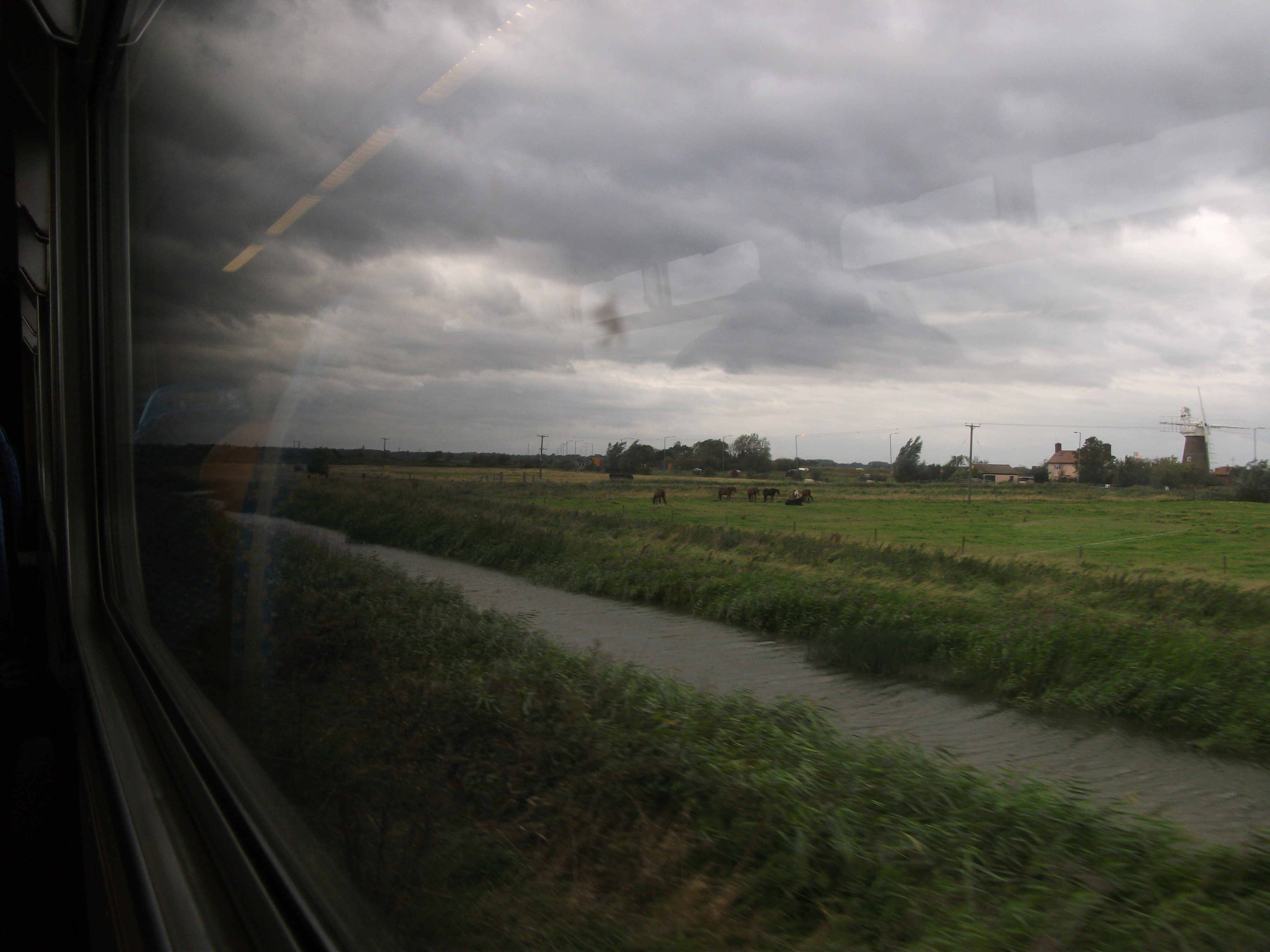
The Acle Straight from the Train
I have written about this road before, as it is very dangerous. You can just see a few vehicles on the road, by the windmill.
But it would appear that nothing will be done to improve transport links to Great Yarmouth!
Perhaps an alternative to improving the road, would be to increase capacity on the railway line. In common with much of the services in East Anglia, trains are typically inadequate two-coach diesel multiple units, running on a mainly single-track line. The station at Great Yarmouth could also do with a substantial upgrade.
But then Great Yarmouth station is very typical to those around East Anglia. As an example, Bury St. Edmunds station is a total dump and completely out of keeping with the town. Only Norwich has a station, which is fit for purpose.
But then here in East Anglia, we know how to live on the scraps that the Treasury dishes out!
I had that Black Stig in My Kitchen!
The original Black Stig, Perry McCarthy, once came to see me about a business venture, I was involved with. He was a likeable guy, talked a lot of sense and I regret slightly that we didn’t meet again. I wish him well in whatever he is doing now.
I can still see him standing in my kitchen by the fridge and every time I get milk out with someone else standing in the same place, I have a little smile.
Plants Have More Rights Than People
In my post on the Isle of Wight, Yarmouth etc., I mentioned the notoriously bad road into Great Yarmouth called the Acle Straight. Remember that Yarmouth is an important port, where the oil and gas and offshore wind farm industries are concerned, so if you were say the boss of an important player in the industry, getting stuck in traffic before going to see the town as a possible supply base , would show how important, the Government think creating jobs in the town is and illustrates the level of support you’ll get.
So I looked up Acle Straight on the Highways Agency web site, to see the progress being made to upgrade this choked and extremely dangerous road.
All they are doing is doing a study to see if they can move the dykes back from the main road to try to improve safety.
Note this paragraph about the purpose of the study.
The trial will cover the relocation of sections of dyke over a distance of about one kilometre along the A47 Acle Straight and is to be used to determine whether species will relocate to dykes constructed further away from the existing carriageway edges. If proven successful the trial dyke relocation may lead to relocation of the roadside dykes and improve the safety for road users. The trial dykes will be regularly monitored over a minimum period of two years.
So there you have it, plants are move important than those who live in Yarmouth, who need a better job or even one at all!
An Alternative to Toll Roads
A report today, says that toll roads are not the answer to Britain’s crowded roads.
But is an alternative here already?
The A14 is one of the UK’s most crowded roads. A lot of the traffic is trucks carrying containers to and from the docks in the Haven Ports (Felixstowe, Harwich and Ipswich).
Over the next two years, Network Rail are upgrading the railway from Felixstowe to the East and West Coast Main Lines, so that large amounts of this traffic can go by rail. Network Rail are also upgrading the rail network to Southampton and other places to put the heavy freight where it belongs and the traffic figures are now showing that rail is carrying more freight traffic of this type than a few years ago.
The problem is that rail needs depots to transfer the containers for the final collection or delivery and planning permission for these is often difficult to get, due to local opposition from those same people, who will benefit from less freight traffic on the roads.
We may not have space in this country for a new motorway, but there is often space to fit in another rail track or two alongside an existing line.
The Isle of Wight, Great Yarmouth, Hastings and Morecambe
I am going to Portsmouth to see Ipswich on the 11th of this month to see Ipswich play. I thought that I might take the ferry and see the Isle of wight. but after reading Bronwen Maddox’s article in The Times today, I don’t think I’ll bother.
She says that the Isle is rather run down and virtually cut off from the rest of the UK, just like the other towns in the heading of this post. All places share higher unemployment than the rest of the country and have a run-down feel.
She says that the solution to the Isle of Wight’s problem is a bridge, just as all the other towns could do with transport connections to the rest of the UK to attract industry, jobs and tourists. I know the route to Yarmouth well and is it not only sib-standard, but very dangerous. upgrade it or perhaps the railway that runs alongside it and you might improve one of the worse unemployment blackspots in Southern England. I also drove to Hastings once. Never again!
These are the infrastructure projects that we must start. I even suspect that some might even be financed by the reduction in benefits, when the jobs are created.
Boxing Clever
Boxing Clever is the title of two articles in September’s edition of Modern Railways magazine. They detail the works being done to upgrade the major freight lines of Felixstowe to Nuneaton and Southampton to Birmingham, so that they can take the larger 9 ft 6 in high containers (boxes) from the ports to and from industrial centres. In times of austerity and climate change, it is interesting to see how these projects which will cut out hundreds of thousands of lorry journeys are being carried out and managed using some very innovative solutions. So much so,m that it appears that the second project might be £10m under its £70.7m budget.
It is an example of very good project management and shows how by spending money wisely to remove freight bottle-necks is to the good of us all. You could argue for instance that Felixstowe to Nuneaton enhancement might be the equivalent of adding extra capacity to the A14, which is a road, that really can’t be widened too easily, as the Orwell bridge was only built for two lanes each way.
I particularly liked the way that the 1847 Southampton Tunnel was made larger. Rather than use the traditional approach and closing the tunnel for two to three months, as they did when they upgraded Ipswich Tunnel, they did it a track at a time closing for only three weekends and over Christmas 2009, saving a year on the project.
It is my belief that we can save a lot of money on infrastructure projects, like roads, railways, hospitals ands schools by thinking things through with a great deal more innovation, enterprise and by borrowing good and proven ideas and methods from other countries and industries.
Speed Cameras
Here in Suffolk, we don’t have too many speed cameras, but the ones we do have tend to be pretty obvious, so if you get caught, you deserve it.
However we do have Haughley Bends on the A14, which was a notorious accident black-spot near Ipswich with four cameras They have now been removed. There have been few if any accidents since, as a short stretch of dual-carriageway has bypassed the black-spot.
Most cameras are in places with other problems. So is it better to solve the problem, by a new road, a better junction or clear signs, rather than stick a plaster called a speed camera over the problem? The trouble is that a speed camera is a cheap solution.
A guest on Radio 5, said he was in the speed management profession or something similar. So perhaps the sensible replacement of speed cameras, a la Haughley would put him out of business and he could get a real job.
I also think that there should be an Internet-based reporting system for bad driving. Persistent offenders would be warned to behave by letter. People who have used my software, Daisy, to analyse bad driving, have found correlations between bad driving and lack of insurance, tax and MOT.
I should say that I am an impartial observer at present, as I’ve had a stroke. But it won’t me stop travelling by train and bus and writing about it.
Dangerous Roads in the UK
This is an interesting report with some solid conclusions.
It also said.
Improved junctions and markings, along with resurfacing with high friction, anti-skid treatments, saw the number of serious accidents fell from 27 between 2003 and 2005 to seven in the following three years.
IT all goes to show we should analyse problems and then take the right actions, rather than just make a simple knee-jerk decision.
 The Anonymous Widower