Brian Cox on Libel Reform
Brian Cox, the particle physicist or celebrity scientist, depending on your view has a piece published in today’s Evening Standard about libel law reform in the UK.
It is a well-written piece that deserves to be read. As does Libel Law Reform’s web site.
Codebreaker At The Science Museum
This morning, I went to see the exhibition about Alan Turing called Codebreaker at the Science Museum.
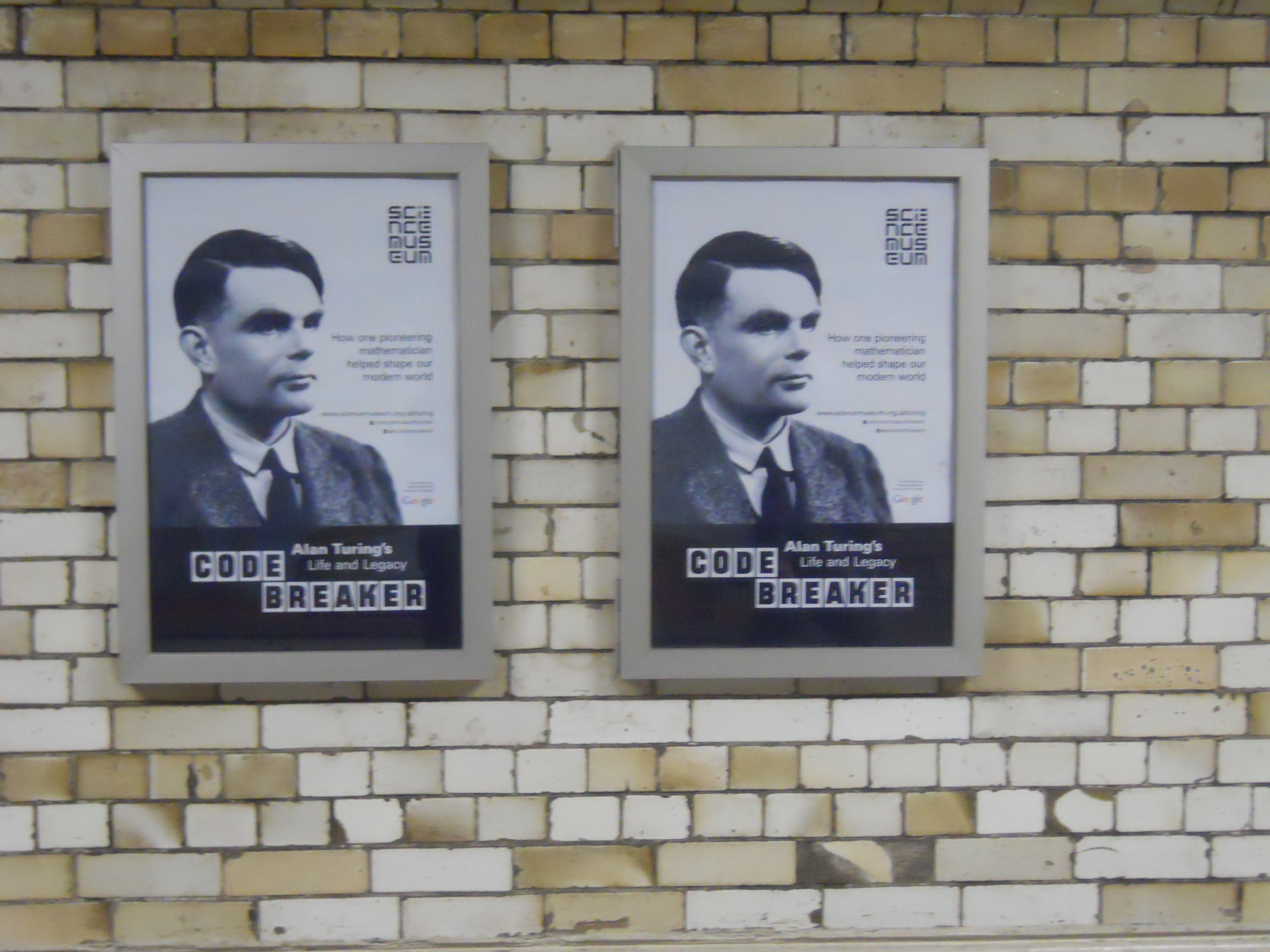
Posters for Codebreaker
it is actually only a small exhibition, but with good quality and some unusual exhibits, including a differential analyser built out of Meccano.
There was also some exhibits and documents on Turing’s personal life, including the Coroner’s report on his suicide.
The exhibition says that his mother thought his death may not have been suicide and in his Wikipedia entry, this is said.
Turing’s mother argued strenuously that the ingestion was accidental, caused by her son’s careless storage of laboratory chemicals. Biographer Andrew Hodges suggests that Turing may have killed himself in an ambiguous way quite deliberately, to give his mother some plausible deniability. Hodges and David Leavitt have suggested that Turing was re-enacting a scene from the 1937 film Snow White, his favourite fairy tale, both noting that (in Leavitt’s words) he took “an especially keen pleasure in the scene where the Wicked Queen immerses her apple in the poisonous brew.”
If you look at others like Turing, such as Newton, you find characters very much on the edge. I used to work with a programmer, who always sang and made strange noises as he coded. He argued that programming was such a logical business, you had to do something mad to balance the mind. Turing wasn’t a programmer in the sense we think now, but he was someone steeped in logic and I suspect the same applied to him.
Sadly, in today’s world, Turing would probably be treasured in much the way Stephen Hawking is.
At least now, hopefully his sexuality would not have been the problem it was in the 1960s.
Turing Remembered
The BBC has an excellent article about Alan Turing on its web site. Interestingly, the article is by Vint Cerf, a guy I saw lecture at the University of Hertfordshire a few years ago. They also share a birthday of June 23rd.
The article has been published because next year, the Science Museum will be mounting an exhibition on Turing. That should be well worth a visit.
The Dominions Stick Together
In some ways it’s one of the best pieces of news for Africa in a long time, but the decision of the SKA organisation to site their new radio telescope in remote parts of Australia, South Africa and New Zealand, is to be welcomed. The details are here on the BBC’s web site.
Milton Nkosi from the BBC says this about the project.
This decision will help to change the perception that Africa is a dark continent full of death and destruction and where little scientific research is carried out.
The telescope will deliver thousands of jobs and will showcase South Africa’s rich history in astronomy.
The SKA will have 3,000 antennas across a vast semi-desert part of South Africa known as the Karoo. The site is already home to seven massive Gregorian dish antennas that form part of the Karoo Array Telescope, or Kat7.
The only thing history tells us about it, is that the project will get bigger. And it will be joined by other large instruments.
BBC Ignores the Science and the History
Perhaps it’s symtomatic of our age, where people forget or ignore the science and history behind everything.
I watched the start of the torch relay at Land’s End on the BBC.
They didn’t mention that the miner’s lamp used to transport and safeguard the flame is a development of the Davy lamp. The original lamp was designed by Humpry Davy from Penzance. That was close to Land’s End, last time I looked.
Political Correctness Runs Amok
Not my words but a headline in the Daily Mail for this article. It’s all about New York City banning the use of a list of fifty words in tests. One was dinosaur because it might upset creationists.
Who cares upsetting them, as they are a ragbag collection of religious idiots who deny the truth and logic of science.
Read David Attenborough on the subject of creationism here.
To the Geological Society of London for a Lecture
When I went to the exhibition on Soviet Architecture, I saw this lecture being advertised on a poster outside the Geological Society of London. So I applied for tickets and yestersay I was able to see James Jackson of Cambridge University, lecture on Earthquakes and Tsunamis in the Modern World. It was fascinating and I learned a lot. I think a video of the lecture will be uploaded at some time.
Years ago, as a sixteen-year-old schoolboy, I went to see Patrick Moore give a lecture on whether there was a link between earthquakes and the moon, next door at the British Astronomical Association.
We do go round in circles.
It’s All James Bond’s Fault
According to this article on the BBC’s web site, the general distrust of nuclear power is all down to James Bond. Here’s the first two paragraphs.
The evil villains in James Bond movies are being blamed for casting a long-lasting shadow over the image of nuclear power, says the president of the Royal Society of Chemistry.
Prof David Phillips says that Dr No, with his personal nuclear reactor, helped to create a “remorselessly grim” reputation for atomic energy.
I won’t argue with the President of the Royal Society of CHemistry, but I will add a little story of my own.
In the 1960s, I worked on NMR spectroscopy or to give it its full name nuclear magnetic resonance spectroscopy. The technique is summed up as.
Nuclear magnetic resonance spectroscopy, most commonly known as NMR spectroscopy, is a research technique that exploits the magnetic properties of certain atomic nuclei to determine physical and chemical properties of atoms or the molecules in which they are contained. It relies on the phenomenon of nuclear magnetic resonance and can provide detailed information about the structure, dynamics, reaction state, and chemical environment of molecules.
One of the guys I worked with at the time, Eddie Clayton, predicted that the technique would be used instead of X-rays in the future. We didn’t think he was right, but now of course nuclear magnetic resonance imaging is commonplace, with most hospitals having a scanner.
However because of peoples’ fears of anything nuclear, the nuclear has been dropped and it is referred to as MRi.
David Hockney is Awarded the Order of Merit
The Order of Merit is a unique order in that it is a personal gift of the sovereign. It has just been awarded to David Hockney.
I first came aware of Hockney when he won the John Moores Painting Prize at the Walker Art Gallery in Liverpool, in 1967 and can remember seeing his painting, Peter Getting out of Nick’s Pool, at the time with C. I also have seen the major collection of his works at Saltaire.
Reading the list of those who have been awarded the Order of Merit is to read a list of some of our greatest scientists, artists and composers with a few politicians thrown in. Although, I think it is true to say, that these days there are more of the thinkers than the politicians, than there was fifty years or so. At present there are only two British politicians on the list and both are women; Margaret Thatcher and Betty Boothroyd. There are however two long serving Commonwealth Prime Ministers; one Canadian and one Australian. Decades ago, there would have been many from the military, but now there is only the respected military historian; Sir Michael Howard.
I think on the whole it is a good list and if you look at those who hold the honour today, no-one stands out as universally condemned by all.
There are some interesting connections and some would think anomalies.
For instance the only churchman is the Anglican Primate of Ireland, Lord Eames. Although Cardinal Hume was a member.
Dorothy Hodgkin was also a member, as is her pupil, Margaret Thatcher. I think it is true to say, that their politics were very different. I wonder if they ever met, when Thatcher was Prime Minister! This web page provides a glimpse of their relationship.
Margaret Thatcher worked as a fourth year student on X-ray crystallography in Dorothy Hodgkin’s laboratory. Despite later political differences they always held a great affection for one another.
According to this page on the BBC, they did meet whilst Thatcher was Prime Minister to discuss world peace.
Hidden Heroes At The Science Museum
I went to see Hidden Heroes at the Science Museum yesterday. It was quite an interesting little exhibition documenting the stories behind a selection of everyday objects.
As you would expect most of the items shown, had been invented or designed in the major industrial countries like the UK, the United States, Germany, France and Sweden.
But what was surprising was that only one had been designed or invented by a woman. and that was the coffee filter, which was invented by a German housewife called Melitta Bentz. Could it be that she was fed up with her family’s comments on her bad coffee?
In some ways it’s strange, but one of Britain’s most successful and well-known female engineers of the mid-twentieth century, Tilly Shilling, made her name in the field of getting liquids to flow properly. She designed a device, which meant that the Merlin engines in Spitfires and Hurricanes could perform negative-G manoeuvres and thus not be shot down by German fighters.
 The Anonymous Widower