Repurposing The Sloy/Awe Hydro Scheme
The Sloy/Awe hydro-electric scheme was built in the 1930s and 1950s, by the North of Scotland Hydroelectric Board.
- The scheme is now owned by SSE Renewables and has a page on their web site.
- There are ten individual power stations; Sloy, Sron Mor, Clachan, Allt-na-Lairige, Nant, Inverawe, Inverawe, Loch Gair, Striven and Lussa.
- There are four dams; Sloy, Allt-na-Lairige and two dams at Shira.
- Cruachan used to be part of this scheme, but is now owned by Drax.
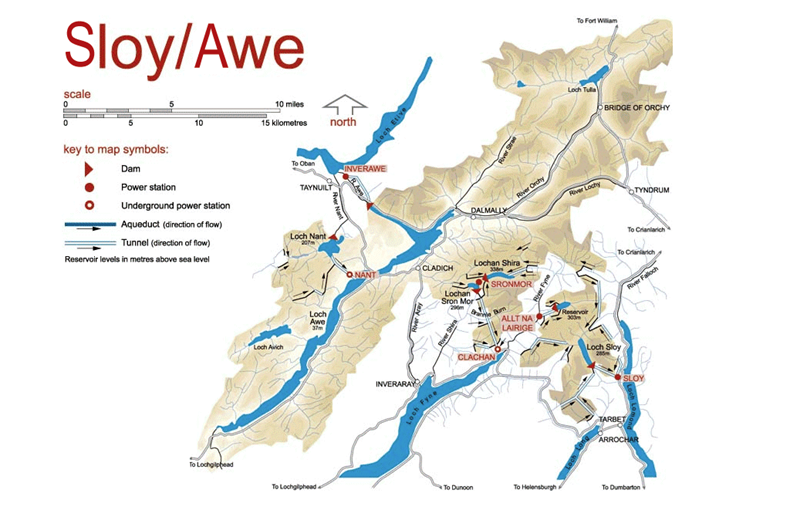
This map from the SSE Renewables web site shows the layout of the dams and power stations.
The sizes of the power stations in the scheme are as follows.
- Sloy – 152.5 MW
- Sron Mor – 5 MW
- Clachan – 40 MW
- Allt-na-Lairige – 6 MW
- Nant – 15 MW
- Inverawe – 25 MW
- Kilmelford – 2 MW
- Loch Gair – 6 MW
- Striven – 8 MW
- Lussa – 2.4 MW
This gives a total power of 261.9 MW.
It should be noted that Cruachan power station is also in this area and in Drax’s Plans For Cruachan, I talked about expanding the station from a 440 MW/7.1 GWh pumped-storage station to one of 1040 MW/7.1 GWh.
Scotland would appear to have 1.3 GW of hydro-electric power between Loch Awe and Loch Lomond.
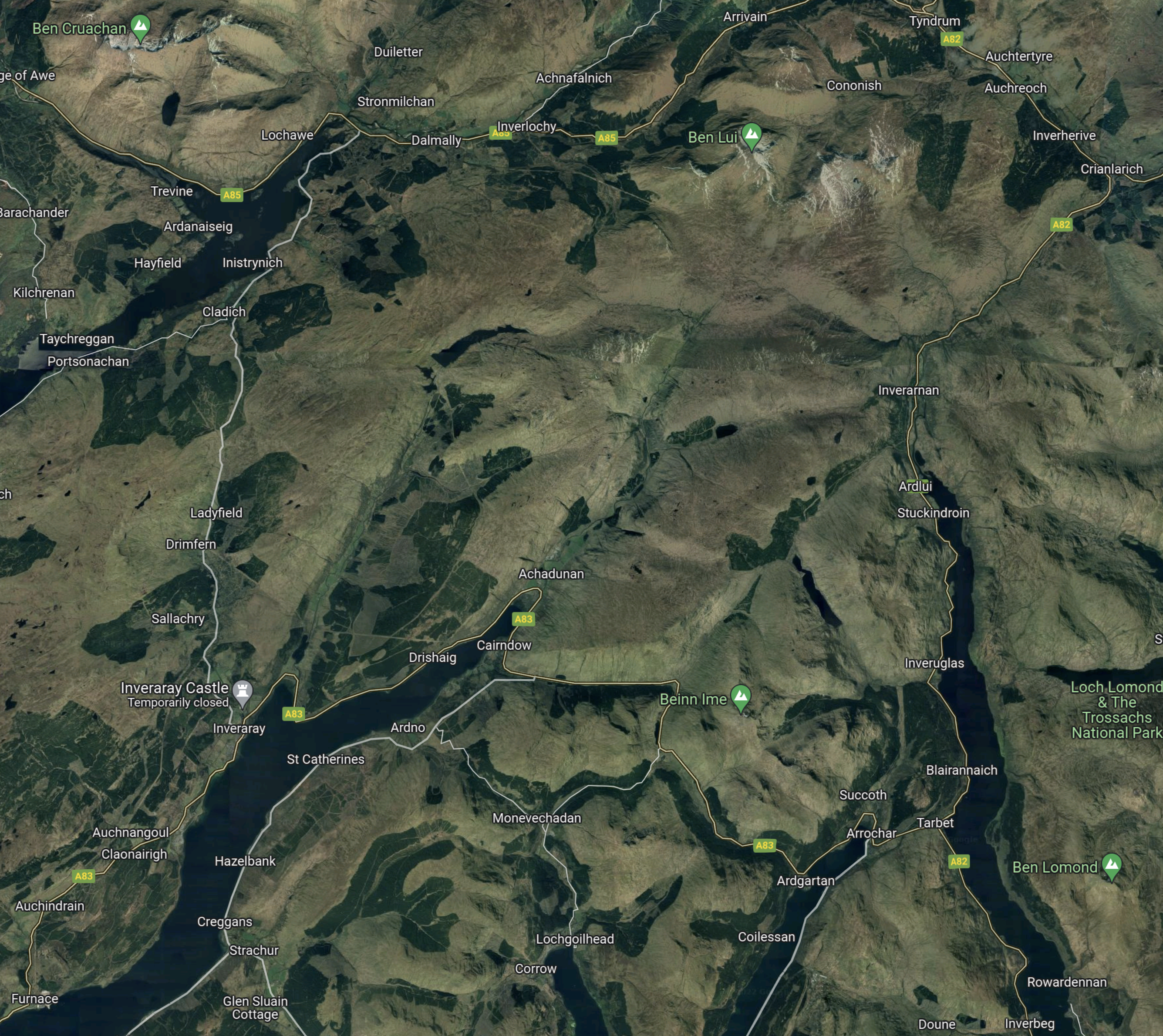
This Google Map shows the same area as the SSE Renewables Map.
Note.
- Loch Awe, which is the sixth biggest freshwater loch in Scotland, is in the North-East corner.
- Loch Fyne, which is the longest sea loch in Scotland, is in the South-West corner.
- Loch Lomond, which is the second biggest freshwater loch in Scotland, is in the South-East corner.
- Loch Long reaches up from the South to the West of Loch Lomond.
These are four big lochs.
Strathclyde University And Pumped Storage Power For Scotland
This page on the Strathclyde University gives a list of the pumped storage potential for Scottish hydrogen-electric dams and power stations.
These figures are given for the dams and lochs in the Sloy/Awe scheme.
- Sloy – 20 GWh
- Nant – 48 GWh
It would appear that based on research from Strathclyde University, that the Sloy/Awe scheme could support over 60 GWh of pumped storage.
Water Flows In The Sloy/Awe Scheme
Looking at the SSE Renewables map of the Sloy/Awe scheme, water flows appear to be as follows.
- Loch Awe to Loch Etive via Inverawe power station.
- Cruachan reservoir to Loch Awe via Cruachan power station.
- Loch Nant to Loch Awe via Nant power station.
- Loch Nant to Loch Etive via Inverawe power station.
- Lochan Shira to Lochan Sron Mor via Sron Mor power station.
- Lochan Sron Mor to Loch Fyne via Clachan power station.
- Allt-na-Lairige reservoir to Loch Fyne via Allt-na-Lairige power station.
- Loch Sloy to Loch Lomond via Sloy power station.
All the water eventually flows into the sea to the West from Loch Etive and Loch Fyne.
Refurbishing And Repurposing The Sloy/Awe Scheme
Perhaps as the power stations are now over fifty years old, one simple way to increase the generating capacity of the Sloy/Awe scheme, might be to selectively replace the turbines, with modern turbines, that can generate electricity more efficiently.
I suspect that SSE Renewables have an ongoing program of improvements and replacements for all of their hydro-electric stations in Scotland. Some turbines at Sloy power station have already been replaced with larger ones.
Adding Pumped Storage To The Sloy/Awe Scheme
Strathclyde University picked out two places where pumped storage could be added; Sloy and Nant.
I discussed Sloy power station in A Lower-Cost Pumped Hydro Storage System and came to these conclusions.
- For £40 million, 14 GWh of pumped storage can be created at Sloy.
- But it could be bigger than 14 GWh, as this page on the Strathclyde University web site, says 20.4 GWh is possible.
- This would surely, be a project that could be first in the queue, once the environmental problems are solved.
20 GWh or even 14 GWh of pumped storage would be nice to have reasonably quickly.
As I said, this must be a high priority project.
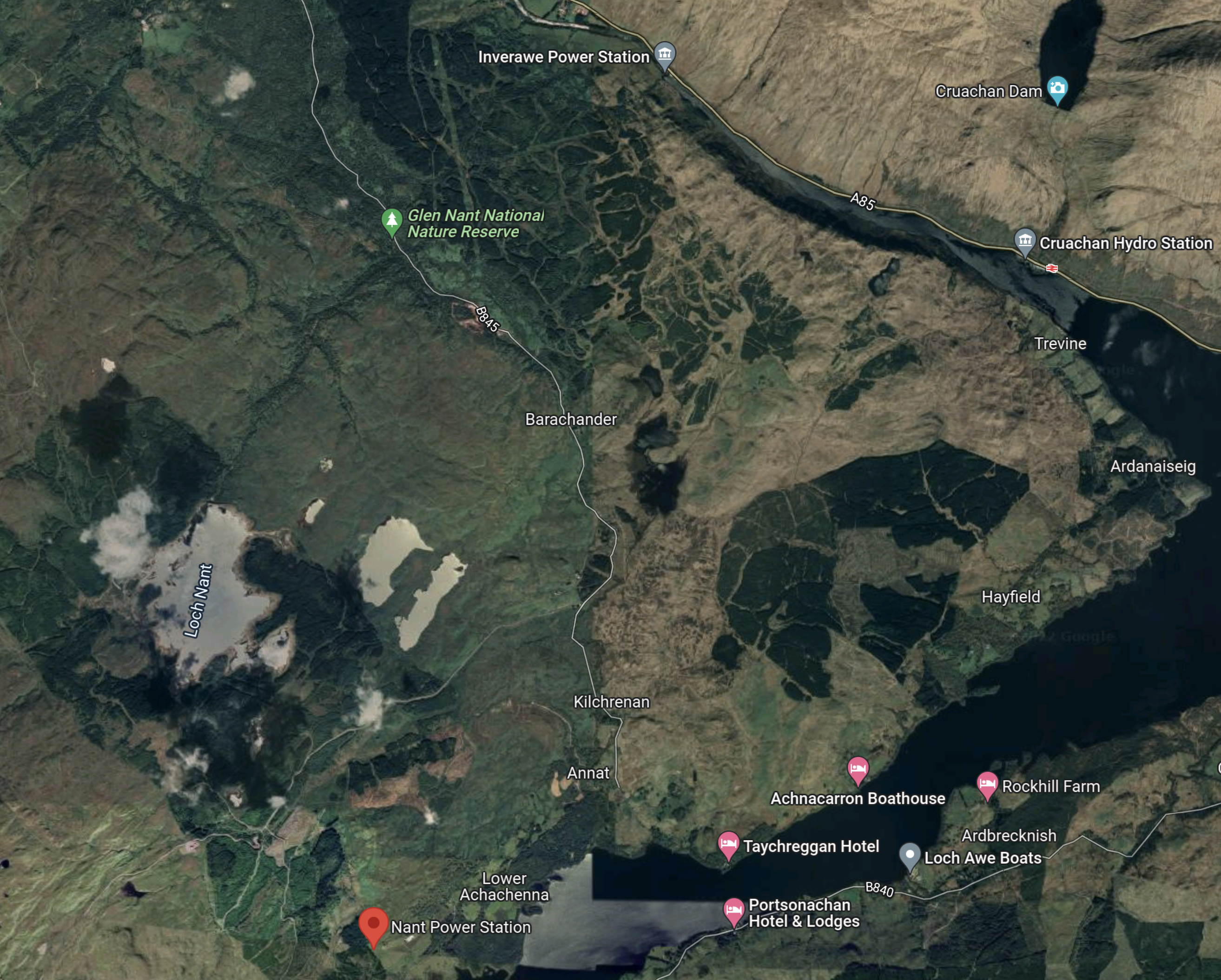
The other project is at Loch Nant.
Note.
- Loch Nant is in the Western side of the map.
- Nant power station is marked by the red arrow.
- The loch to the South of the power station is Loch Awe.
- It appears that water can also go from Loch Nant to Inverawe power station to the North-East of the loch.
- Inverawe power station is on Loch Awe, which curves round Loch Nant.
- The 440MW/7.1 GWh Cruachan pumped-storage power station is on the other side of Loch Awe in the North East corner of the map, with the Cruachan dam and reservoir above.
Strathclyde University says that 48 MWh of pumped-storage could be possible at Loch Nant.
- Comparing the size of Cruchan reservoir at 7.1 GWh and the larger Loch Nant, gives me hope that Loch Nant could hold upwards of 20-30 GWh.
- From pictures on this page at Subterranea Britannica, it appears Nant power station has only a single 15 MW turbo-generator.
- Inverawe power station is a 25 MW power station with a single turbo-generator.
I suspect that pump-turbines could be installed to fill Loch Nant from Loch Awe, just as was done at Foyers, where a 300 MW pumped storage power station was created.
Conclusion
There would appear to be up to two schemes, that could each add around 20 GWh of pumped storage.
One advantage is that the waters of Loch Awe and Loch Lomond can be used for the lower reservoir.
Shin Hydro Power Scheme
The Shin hydro-electric scheme was built in the 1930s and 1950s, by the North of Scotland Hydroelectric Board.
- The scheme is now owned by SSE Renewables and has a page on their web site.
- There are three individual power stations; Casseley, Lairg and Shin.
- There are two dams
This map from the SSE Renewables web site shows the layout of the dams and power stations.
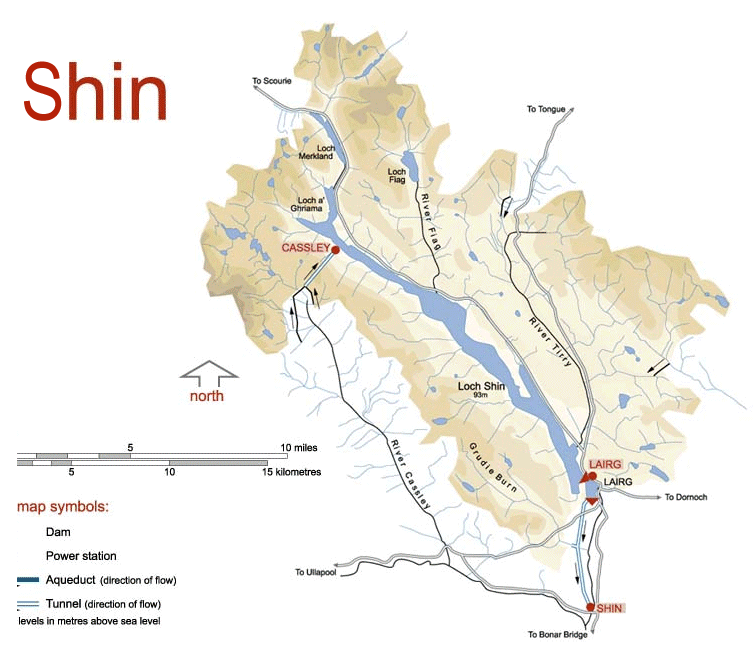
The sizes of the power stations in the scheme are as follows.
- Casseley – 10 MW
- Lairg – 3.5 MW
- Shin – 18.6 MW
This gives a total power of 32.1 MW.
This Google Map shows the same area as the SSE Renewables Map.
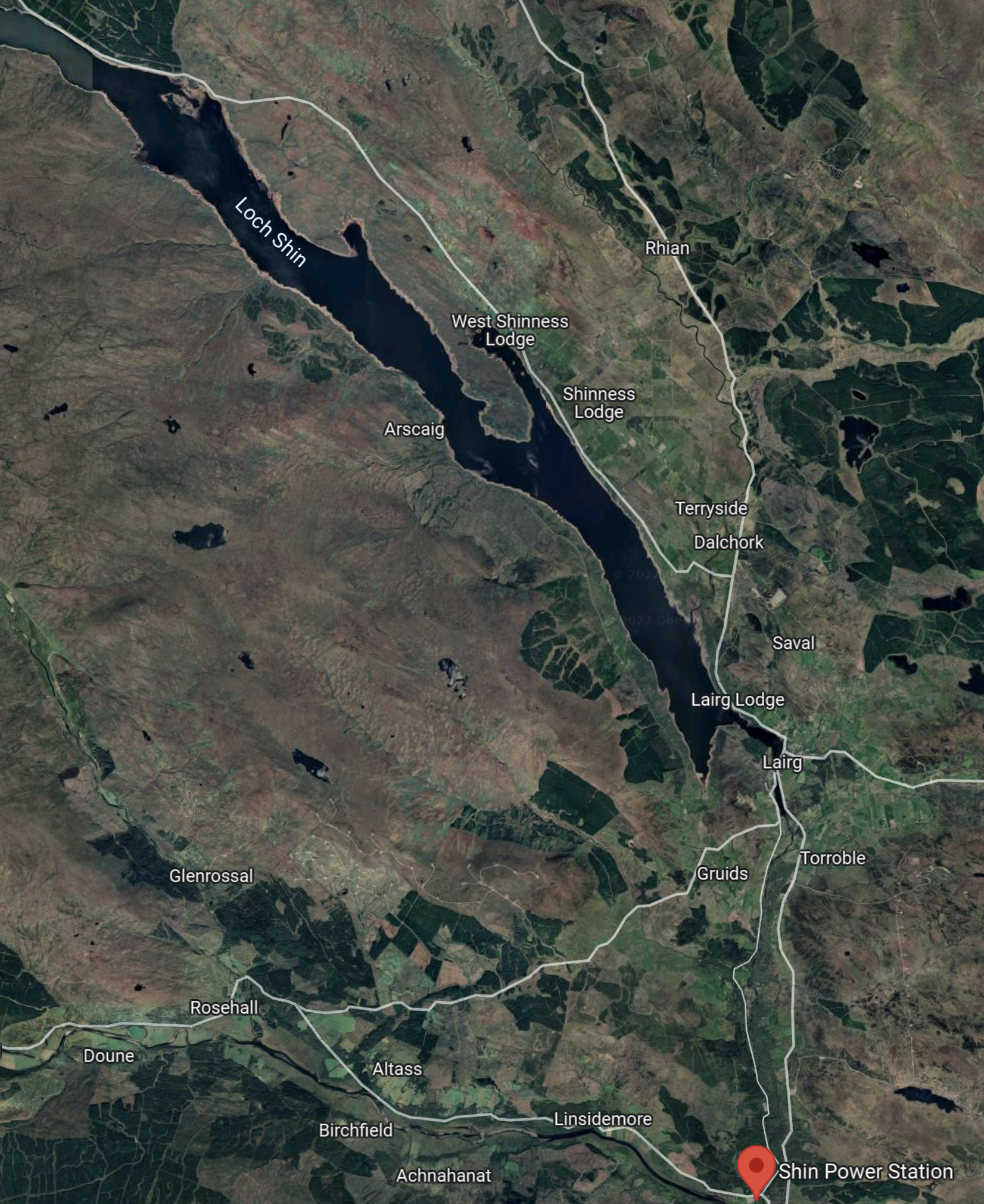
Note.
- Shin power station is in the South-West corner of the map.
- Loch Shin is the large area of water in the top half of the map.
- The village of Lairg is at the South end of Loch Shin.
This Google Map sows Shin power station in detail.
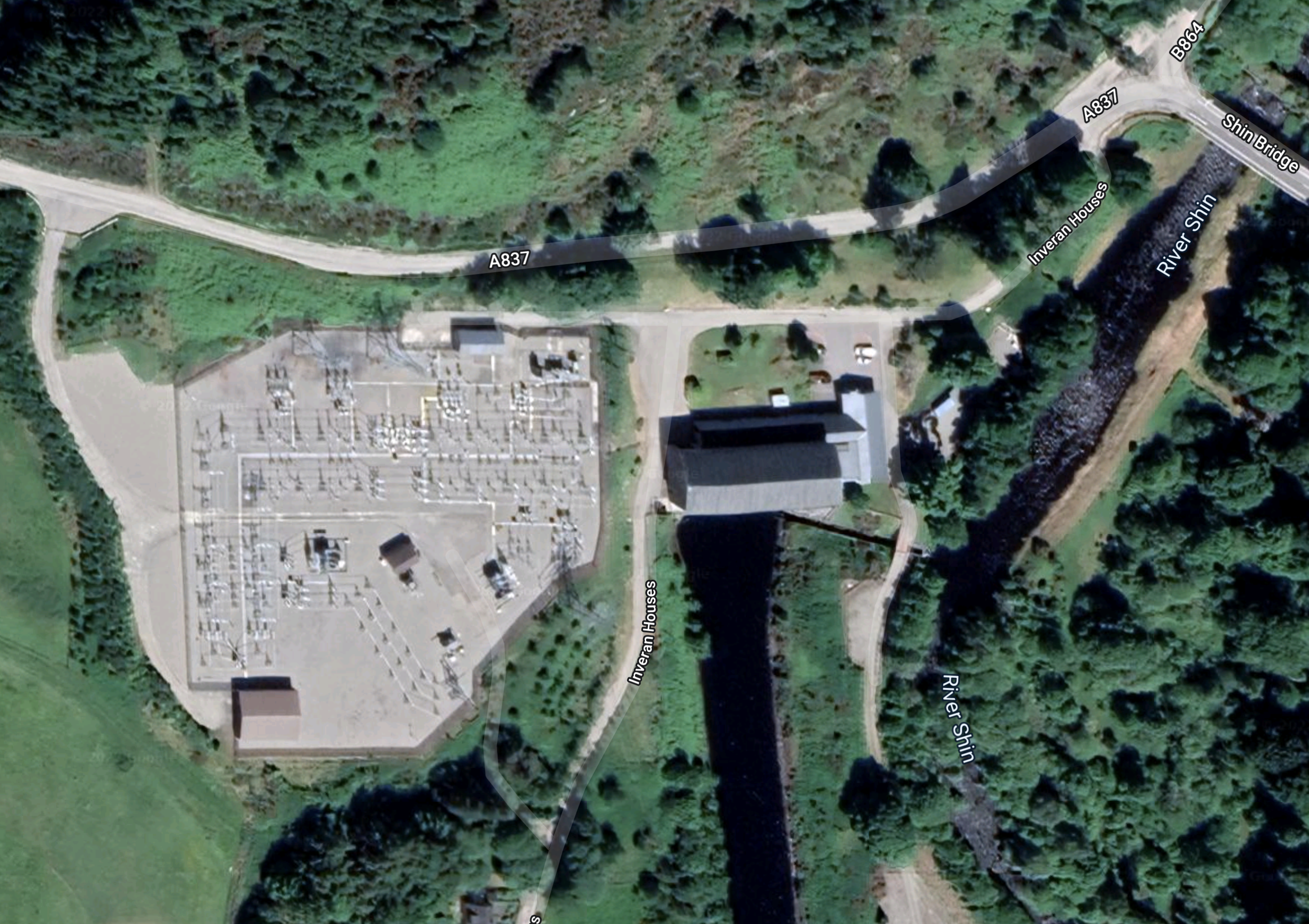
Note.
There is a large substation on the left side of the map.
Shin power station is the building straddling the water to the right of the substation.
I have found this informative press release on the SSE web site, which is entitled £5 m Investment In Shin Hydro Station.
These are a couple of paragraphs.
John McDonald, Hydro Manager for SSE said: “This is the first major overhaul of Shin Hydro Station in its 55-year history – a true testament to the reliability and longevity of hydro-electric power.
“There are few other industries that could claim to be making the same product with the same machines and same specifications as they were in the 1950s. This overhaul will mean that Shin will be producing clean, green electricity for decades to come.”
Surely, that is an argument for more hydro schemes.
This Google Map shows Lairg.
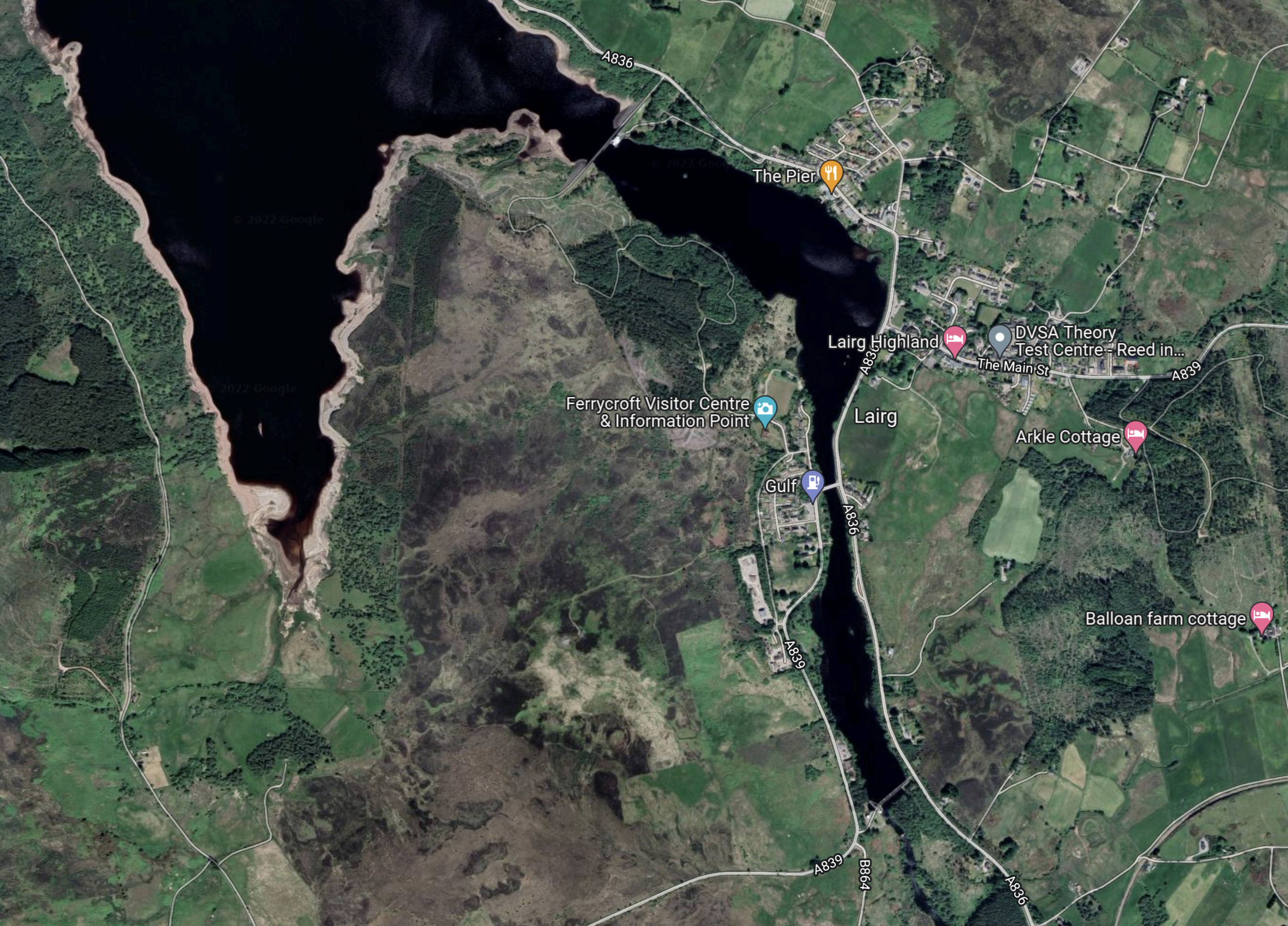
Note that there are two dams and a bridge across Loch Shin/River Shin.
This Google Map shows dam at the Southern end of the Loch.
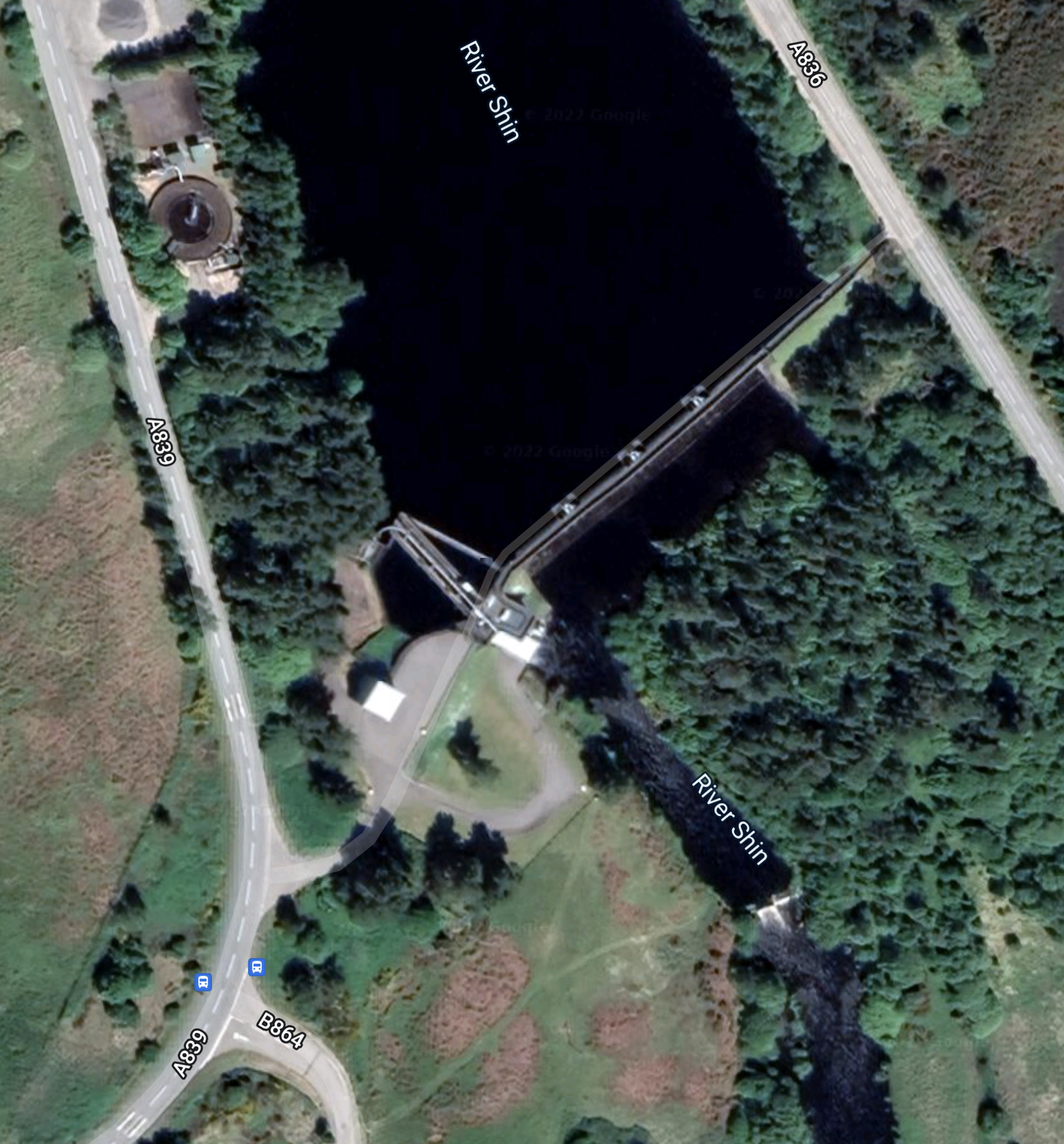
This Google Map shows Lairg dam and power station at the Northern end of the village.
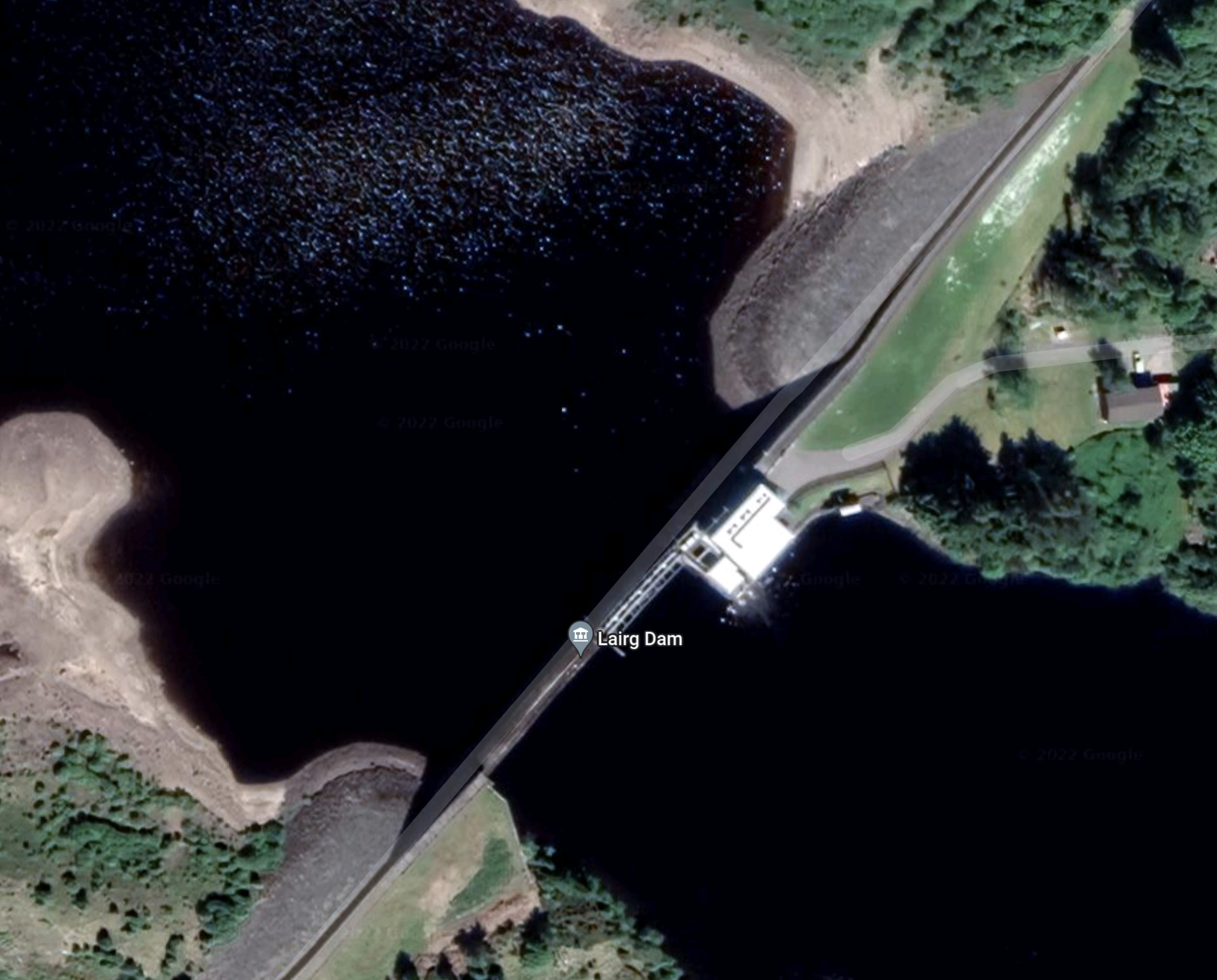
It would appear to be a much simpler scheme, than others I have examined.
Conclusion
I would be very surprised if any pumped storage were to be added to this scheme.
The Coire Glas Pumped Storage Scheme
The Coire Glas pumped storage scheme, which is being developed by SSE Renewables will be the first large scale pumped storage scheme to be developed in the UK for more than 30 years.
- It would have a power output of 1.5 GW.
- Compared to Dinorwig (Electric Mountain) in Wales at 9.1 GWh and Cruachan in Scotland at 7.1 GWh, it will be a giant.
- Planning permission has been obtained.
The Coire Glas project has a web site.
This is the introductory paragraph.
Coire Glas is a hydro pumped storage scheme with a potential capacity of up to 1500MW. Coire Glas is an excellent pumped storage site with a large lower reservoir (Loch Lochy) and a significant elevation of more than 500m between the lower and the new upper reservoir site over a relatively short distance.
There is also an explanatory video.
This map was clipped from this SSE planning document.
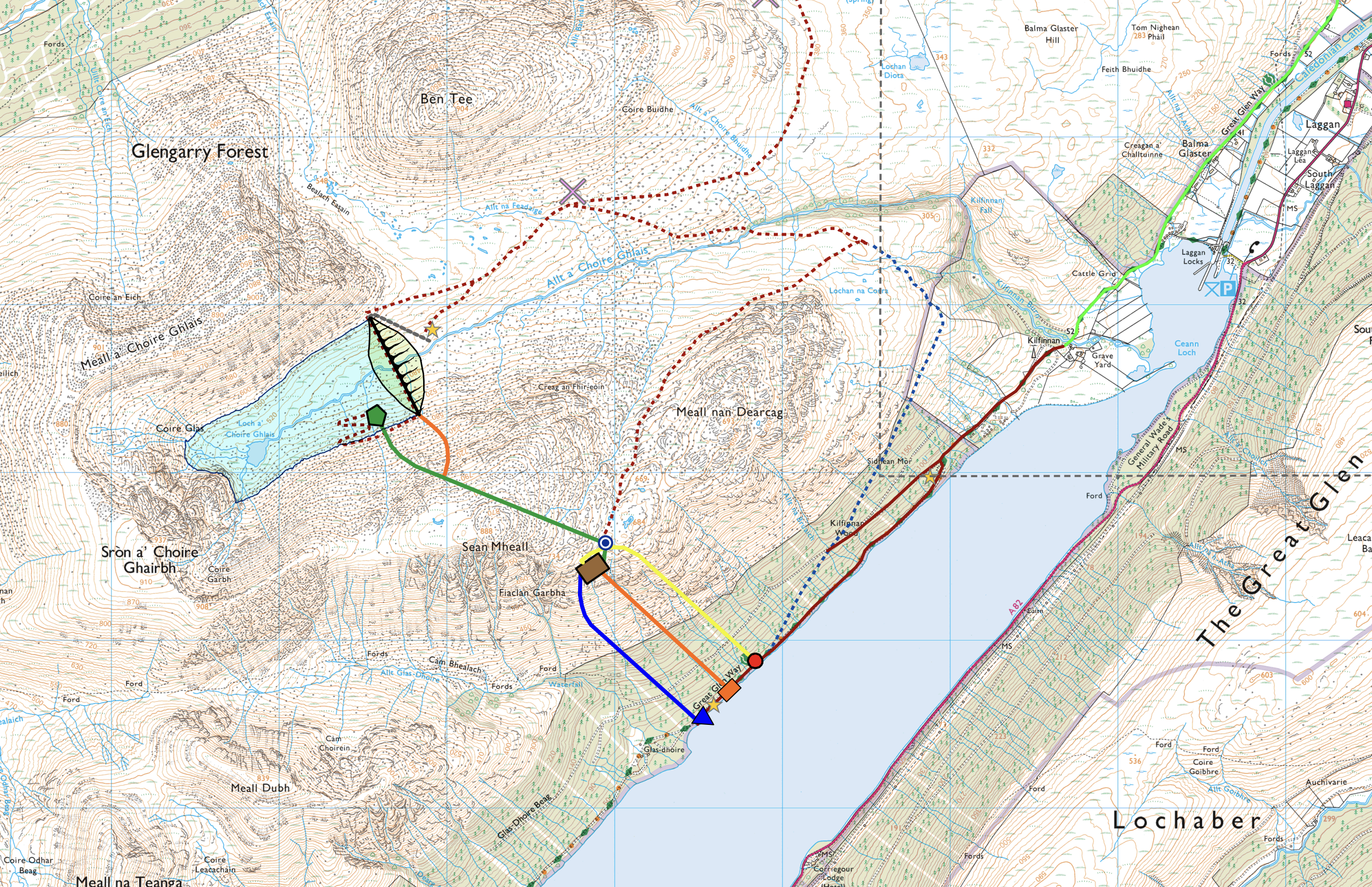
Note.
- Loch Lochy in the Great Glen will be the lower reservoir.
- Loch Lochy is a freshwater loch, that is up to seventy metres deep.
- The top reservoir is formed by building a dam across the stream, that runs into the Northern end of Loch Lochy.
- The green line leading from the pentagon in the lake behind the dam towards Loch Lochy is the headrace tunnel.
- It leads to the brown rectangle, which is the underground power station.
- The blue line leading from the power station, where water is discharged into the loch.
- The two orange lines are access tunnels.
- The yellow line is the emergency access tunnel.
It is a standard layout for a pumped storage power station.
- To store electricity, water is pumped from Loch Lochy and stored in the new lake.
- To generate electricity, water runs down the headrace tunnel, through the turbines and then down the tailrace into Loch Lochy.
- The power station would have a number of pump/turbines, that can do both tasks.
In addition, any water from rain or snow melt, that runs into the top lake gives low-cost extra electricity.
This layout of the dam and the upper lake was clipped from this SSE planning document.
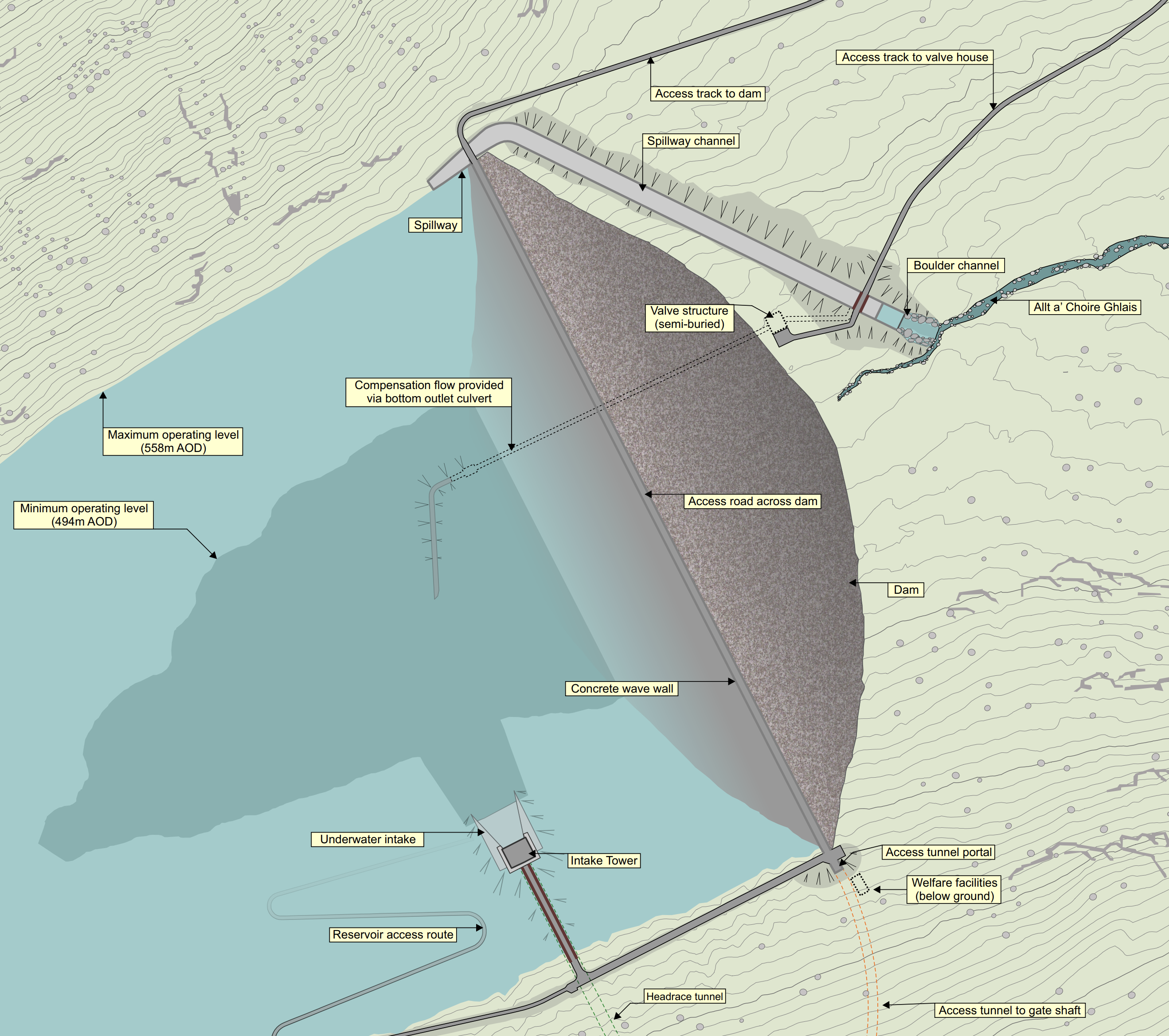
It would be an impressive structure.
Could this pumped storage scheme give the UK energy security?
Repurposing The Tummel Hydro-Electric Scheme
The Tummel hydro-electric scheme was built in the 1930s and 1950s, by the North of Scotland Hydroelectric Board.
- The scheme is now owned by SSE Renewables and has a page on their web site.
- There are nine individual power stations; Gaur, Cuaich, Loch Ericht, Rannoch, Tummel, Errochty, Trinafour, Clunie and Pitlochry.
- There are four dams; Gaur, Errochty, Clunie and Pitlochry.
This map from the SSE Renewables web site shows the layout of the dams and power stations.
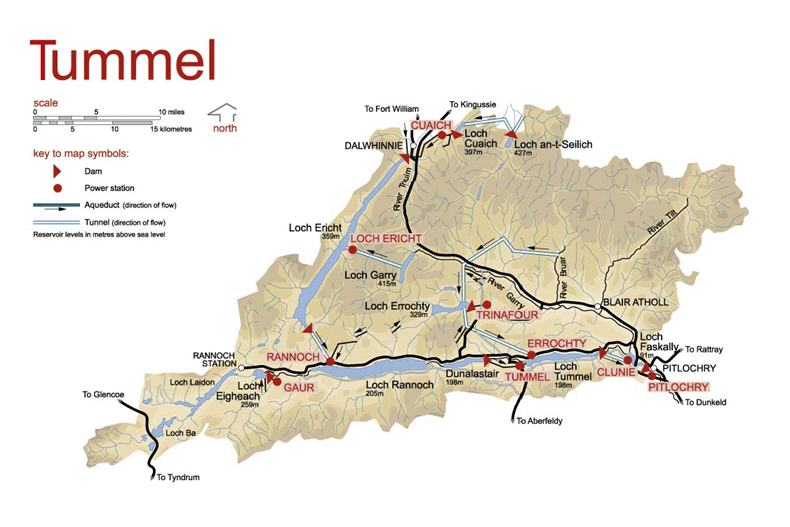
This description of the scheme is from Wikipedia.
The Tummel hydro-electric power scheme is an interconnected network of dams, power stations, aqueducts and electric power transmission in the Grampian Mountains of Scotland. Roughly bounded by Dalwhinnie in the north, Rannoch Moor in the west and Pitlochry in the east it comprises a water catchment area of around 1,800 square kilometres (690 sq mi)[1] and primary water storage at Loch Ericht, Loch Errochty, Loch Rannoch and Loch Tummel, in Perth and Kinross. Water, depending on where it originates and the path it takes, may pass through as many as five of the schemes nine power stations as it progresses from north-west to south-east. The scheme was constructed in the 1940s and 50s incorporating some earlier sites.
Note.
- There are no underground power stations.
- The scheme is what is known as a run-of-the-river hydroelectric scheme.
The sizes of the power stations in the scheme are as follows.
- Gaur – 75 MW
- Cuaich – 2.5 MW
- Loch Ericht- 2.2 MW
- Rannoch – 44 MW
- Tummel – 34 MW
- Errochty – 75 MW
- Trinafour – 0.5 MW
- Clunie – 61 MW
- Pitlochry – 15 MW
This gives a total power of 309.2 MW.
This Google Map shows the same area as the SSE Renewables Map.
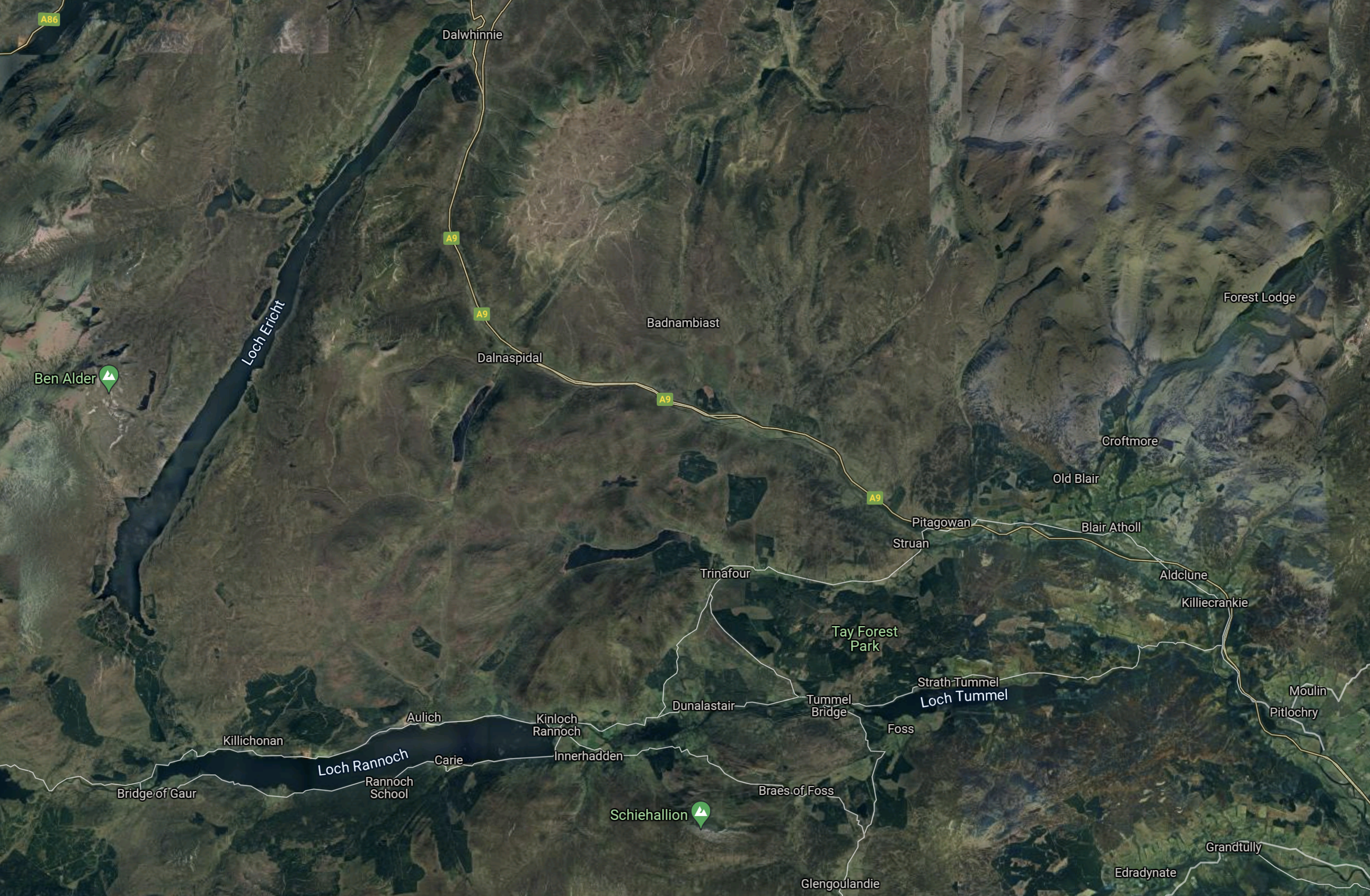
Note.
- Dalwhinnie is at the North of the map.
- Gaur is in the South-West corner of the map.
- Pitlochry is in the South-East corner of the map.
There are no underground power stations.
Strathclyde University And Pumped Storage Power For Scotland
This page on the Strathclyde University gives a list of the pumped storage potential for Scottish hydrogen-electric dams and power stations.
These figures are given for the dams and lochs in the Tummel scheme.
- Errochty – 16 GWh
- Clunie – 40 GWh
- Rannoch – 41 GWh
- Tummel – 38 GWh
It would appear that based on research from Strathclyde University, that the Tummel scheme could support over 120 GWh of pumped storage.
Water Flows In The Tummel Scheme
Looking at the SSE Renewables map of the Tummel scheme and reading this section in the Wikipedia entry for the Tummel scheme, which is entitled Water Route, water flows appear to be as follows.
- Loch an t-Seilich to Loch Cuaich
- Loch Cuaich to Loch Ericht via Cuaich power station and the Cuaich aqueduct
- Loch Garry to Loch Ericht via Ericht power station.
- Loch Ericht to Loch Rannoch
- Loch Eigheach to Loch Rannoch via Gaur power station
- Loch Rannoch to Dunalastair Water via Kinloch Rannoch weir
- Dunalistair Water to Loch Tummel via Tummel power station
- River Bruar and River Garry to Loch Errochty
- Loch Errochty to Loch Tummel via Errochty power station
- Loch Errochty to Trinafour power station
- Loch Tummel to Loch Faskally via Clunie power station
- Loch Faskally to Pitlochy power station
Note.
Water from Loch an t-Seilich can take various routes to Clunie and Pitlochry power stations.
Water from Loch Eigheach goes through Loch Rannoch, Dunalistair Water and Loch Tummel to Clunie and Pitlochry power stations.
It seems a complicated scheme but it does have a capacity of 307 MW, which compares with 389 MW of Bankside power station.
Refurbishing And Repurposing The Tummel Scheme
Perhaps as the power stations are now over fifty years old, one simple way to increase the generating capacity of the Affric/Beauly scheme might be to selectively replace the turbines, with modern turbines, that can generate electricity more efficiently.
I suspect that SSE Renewables have an ongoing program of improvements and replacements for all of their hydro-electric stations in Scotland. Some turbines at Sloy power station have already been replaced with larger ones.
In The Affric/Beauly Hydro-Electric Scheme, I wrote about the control system needs of that scheme, which I felt could be fairly challenging.
I suspect the control of the Tummel scheme is equally challenging.
Adding Pumped Storage To The Tummel Scheme
I’ll look at each possibility in turn.
Loch Errochty
Strathclyde University estimated that 16 GWh of pumped storage could be added to Loch Errochty.
This Google Map shows the Eastern end of Loch Errochty.
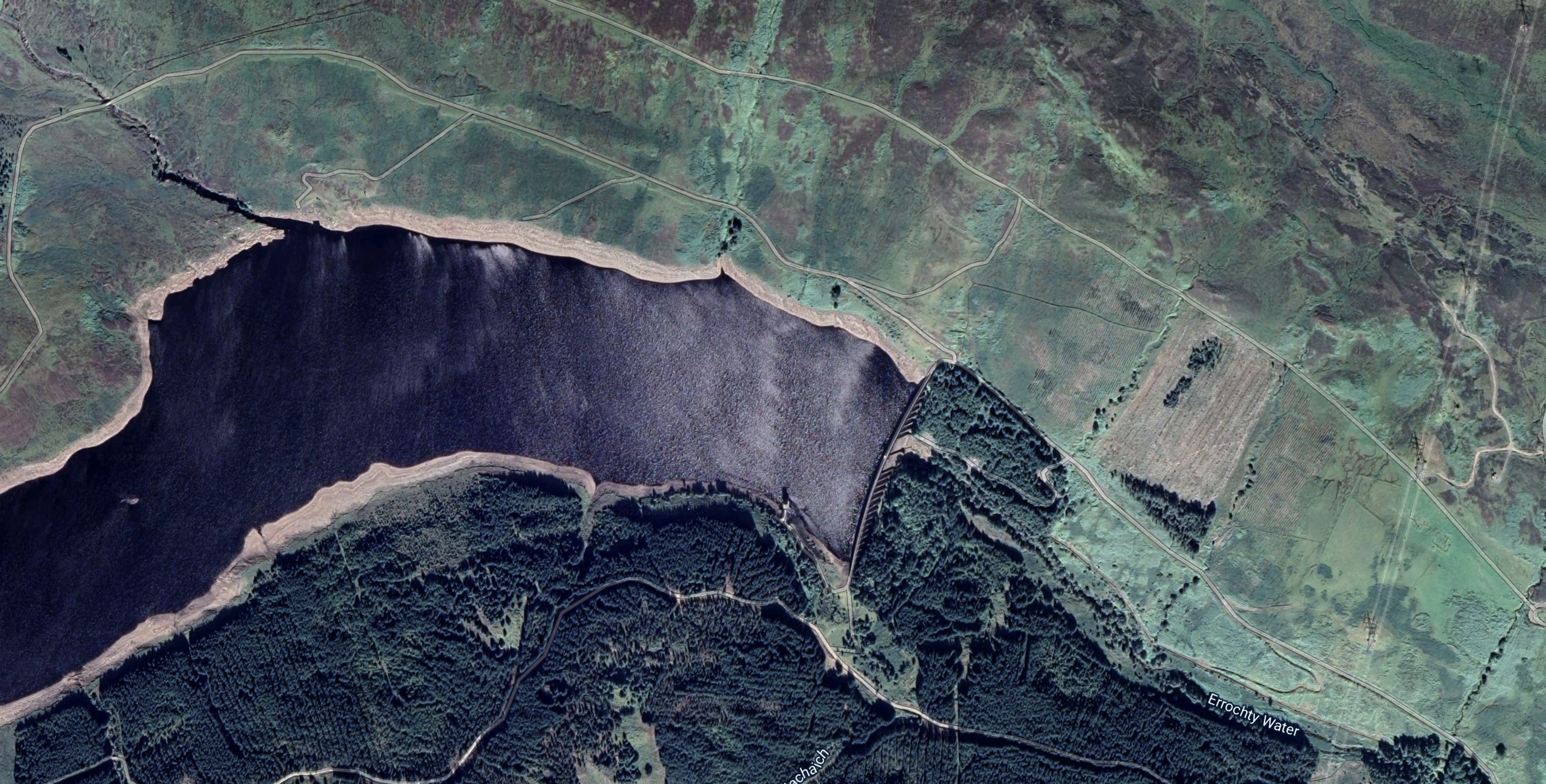
Note the dam at the Eastern end of the loch.
- The dam is 354 metres long by 49 metres high.
- The dam was built in 1957 and the lake is man-made.
- The loch stands at 330 metres above sea level.
- Water flows from the loch to the Errochty power station at the Western end of Loch Tummel, through a ten kilometre long tunnel.
This Google Map shows Errochty power station and Loch Tummel.
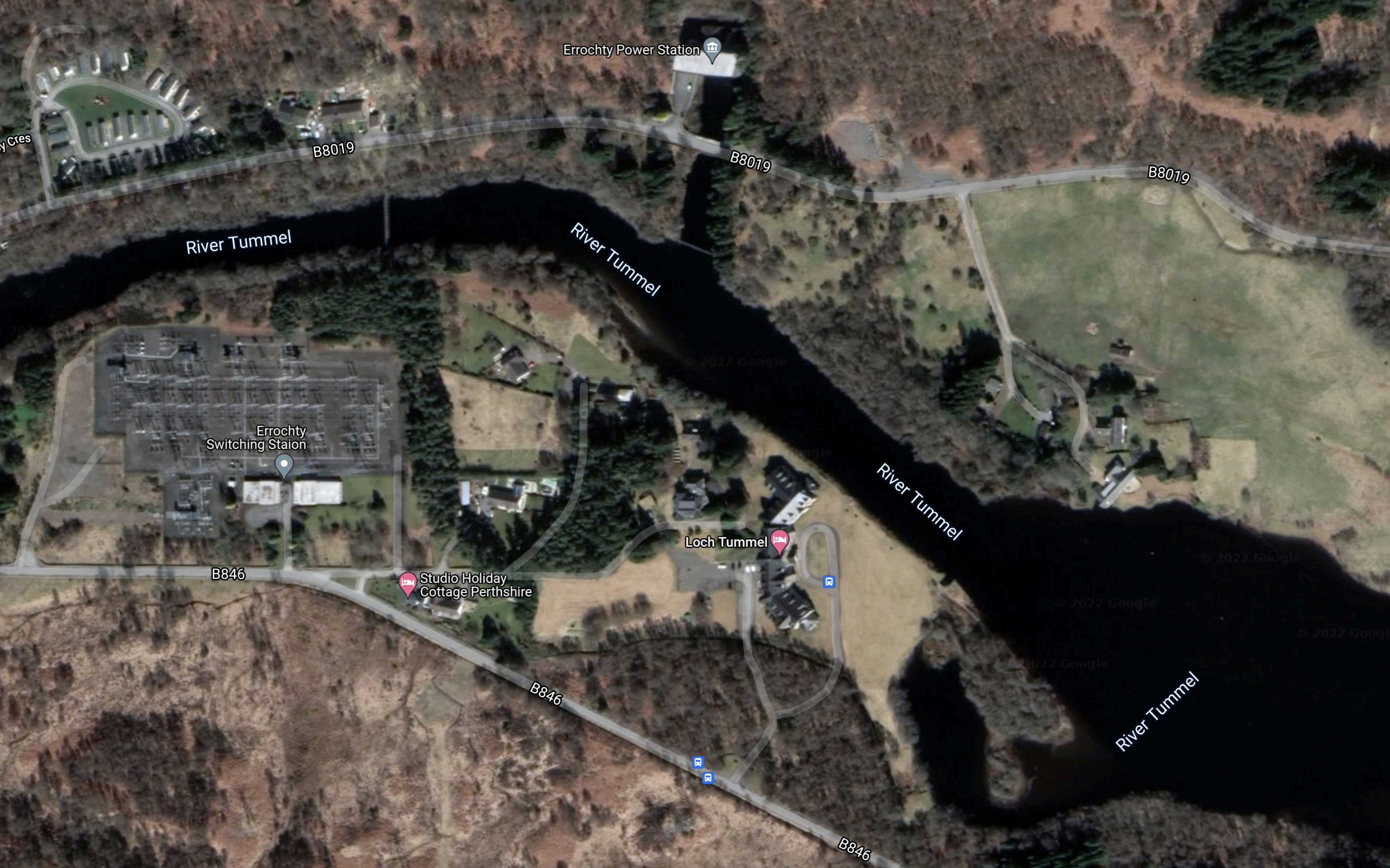
Note.
- Errochty power station is at the top of the map in the middle on the channel connecting it to the River Tummel.
- Errochty power station has two turbines and a maximum output of 75 MW.
- There is what appears to be a large switching station at the Western side of the map.
I obviously don’t know for sure, but I suspect this could be an easier scheme to convert, if the current turbines could be replaced with pump/turbines.
There is a section with the title; Water Supply To The Loch in the Wikipedia entry for Loch Errochty, where this is said.
Loch Errochty’s main feeder streams are the Allt Sléibh and the Allt Ruighe nan Saorach which both rise in the high ground to the west of the head of the loch. Other small streams flow directly off the 892-metre-high (2,927 ft) mountain of Beinn a’ Chuallaich which stands just to the south. Supplementary water is diverted into the loch from the east by the Errochty catchwater, a system of tunnels and surface pipelines at a height of approximately 380 metres which redirects water from five small tributary streams of the River Garry, and the Garry itself. The catchwater then goes through a tunnel in the hill which separates the Garry and Errochty valleys to join the loch. This method of re-directing water allows it to be used more often to generate electricity. Some of the water within the Tummel scheme passes through five of the power stations and thus generates electricity five times.
That strikes me as being very sophisticated for the 1950s and if the engineering and tunnels are up to a high standard, it might be that conversion of this power station to a 75 MW power station with 16 GWh pumped storage is a distinct possibility.
It might even be possible to increase the generating capacity of the power station.
Clunie
Strathclyde University estimated that 40 GWh of pumped storage could be added above Clunie power station.
This Google Map shows the River Tummel between Clunie and Pitlochry power stations.
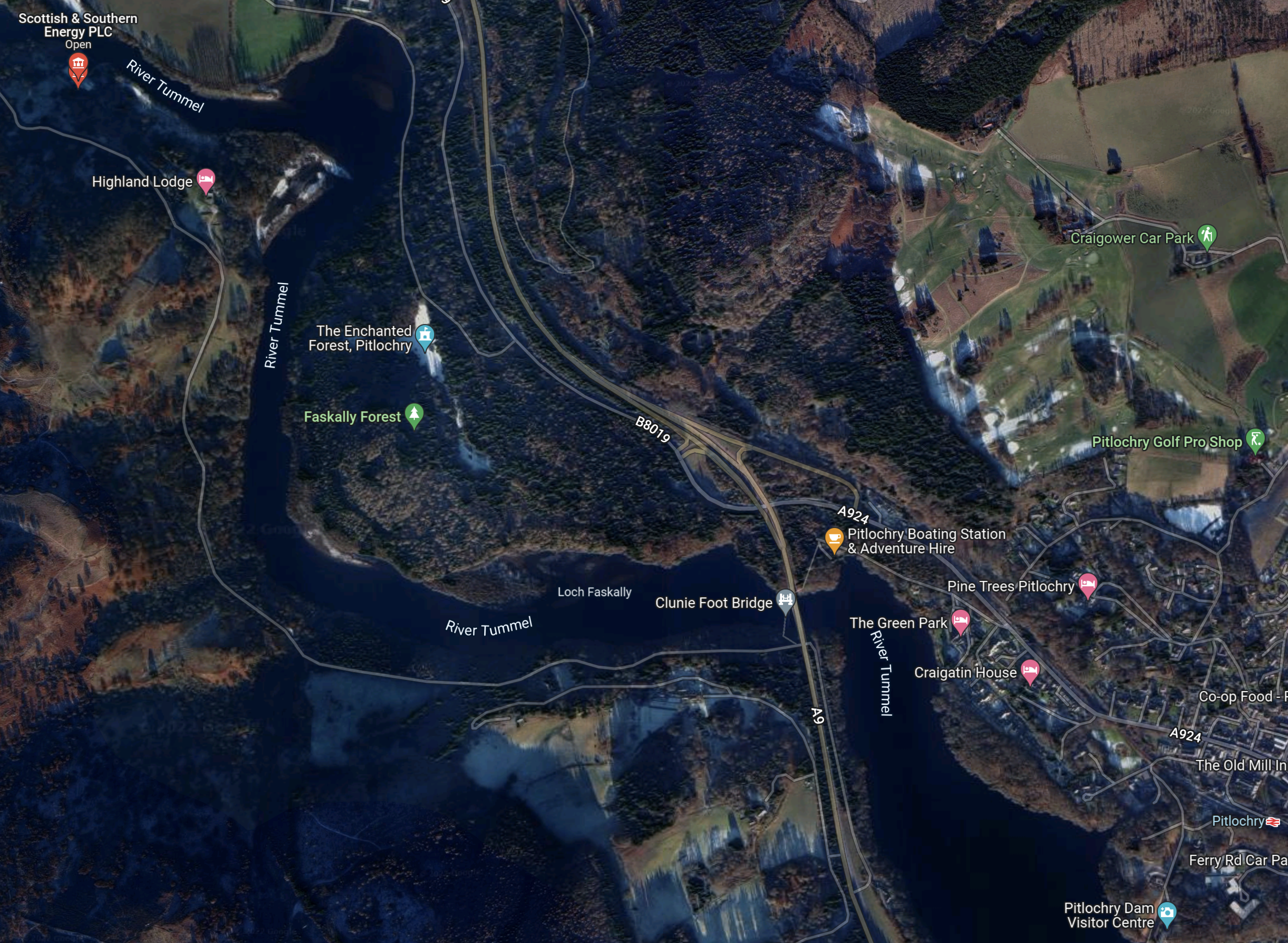
Note.
- Clunie dam and power station is marked by a red arrow labelled Scottish and Southern Energy in the North-West corner of the map.
- Pitlochry Dam and power station are in the South-East corner of the map.
- River Tummel and Loch Faskally link the two dams.
There is a large volume of water between the two dams.
In a pump-back hydro-electric water is pumped back from the lake below the dam into the reservoir above the dam. Such a system was added to the Grand Coulee Dam in the United States to increase its generating and storage capacity.
This Google Map shows how the water to the West of Clunie dam and power station stretches to the other end of Loch Tummel.
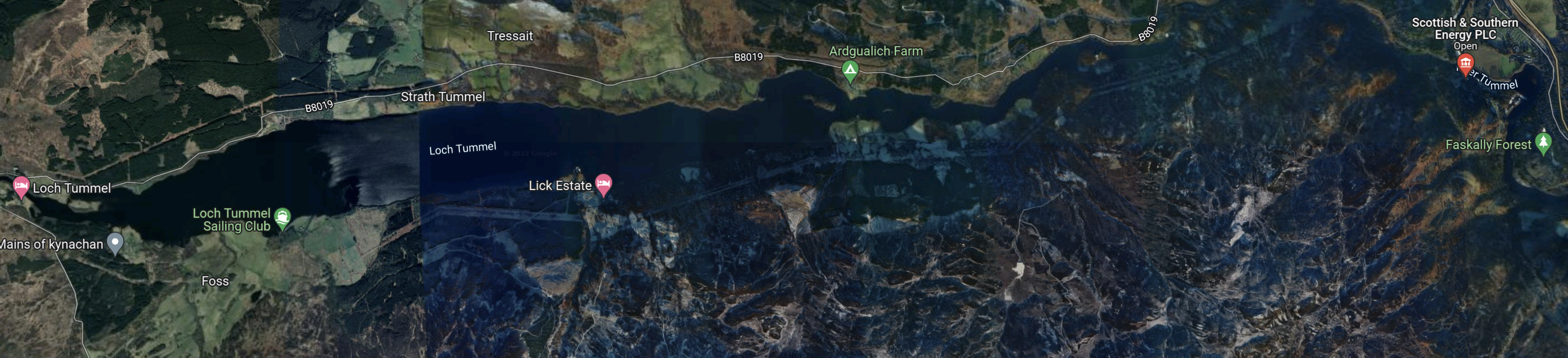
As there would be large volumes on both sides of the dam, I am fairly sure, that a pump-back system could be employed at Clunie power station.
Whether 40 GWh of storage could be added, would be one for the designers of the rebuilt dam and power station?
Tummel
Strathclyde University estimated that 38 GWh of pumped storage could be added above Tummel power station.
This Google Map shows the Eastern end of Loch Rannoch, Dunalastair Water, the River Tummel and Tummel power station.
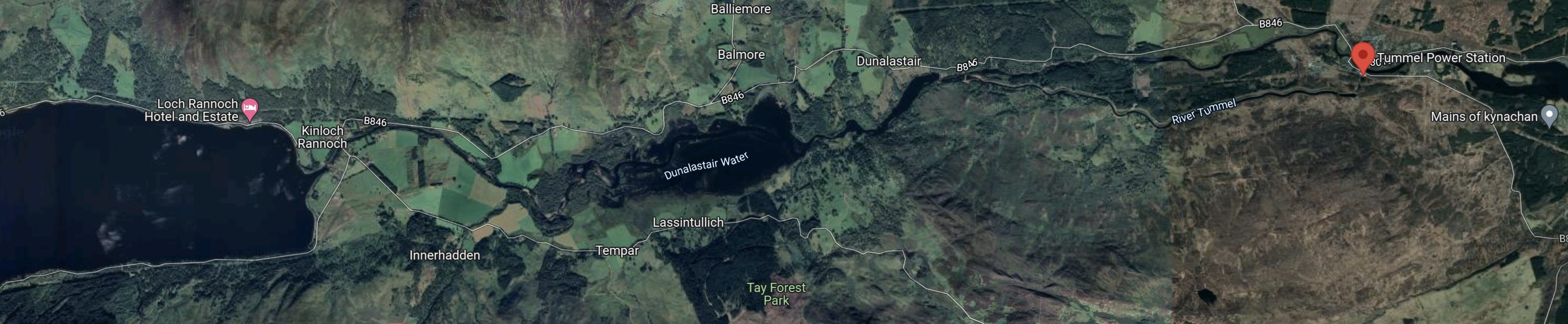
Note.
- Loch Rannoch is at the Western end of the map.
- Dunalastair Water is the smaller lake in the middle.
- Tummel power station is indicated by the red arrow at the East of the map.
This Google Map shows Tummel power station.
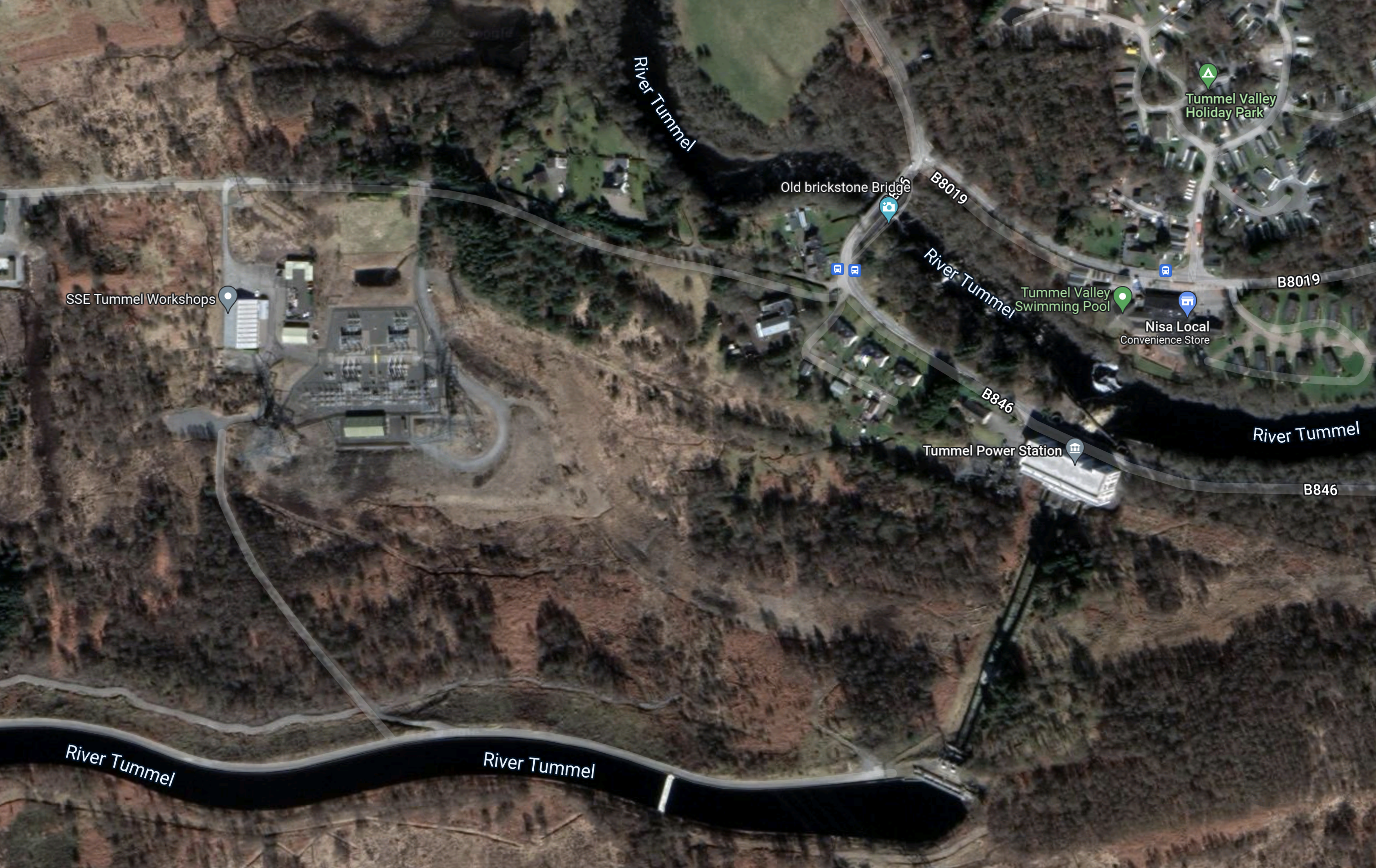
Note.
There appears to be two branches of the River Tummel.
- At the bottom of the map, it appears to be in an aqueduct and above the power station.
- Running across the top-right corner of the map, the second branch appears to be a low-level branch of the river.
- The height difference will mean that power station works well and generates its full 34 MW.
As with Clunie power station, I am sure there is scope for Tummel power station to pump water from Loch Tummel to Dunalastair water, when there is a surplus of wind-generated electricity.
But could space be found above Tummel power station to store enough water to create a massive 38 GWh pumped-storage power station?
Rannoch
This description of Lord Rannoch is from Wikipedia.
It is over 15 kilometres (9.3 mi) long in a west–east direction with an average width of about 1.2 kilometres (0.75 mi), and is deepest at its eastern end, reaching a depth of 130 metres (440 ft).
The loch could hold almost a half a billion tonnes of water.
This Google Map shows Loch Rannoch and Loch Ericht
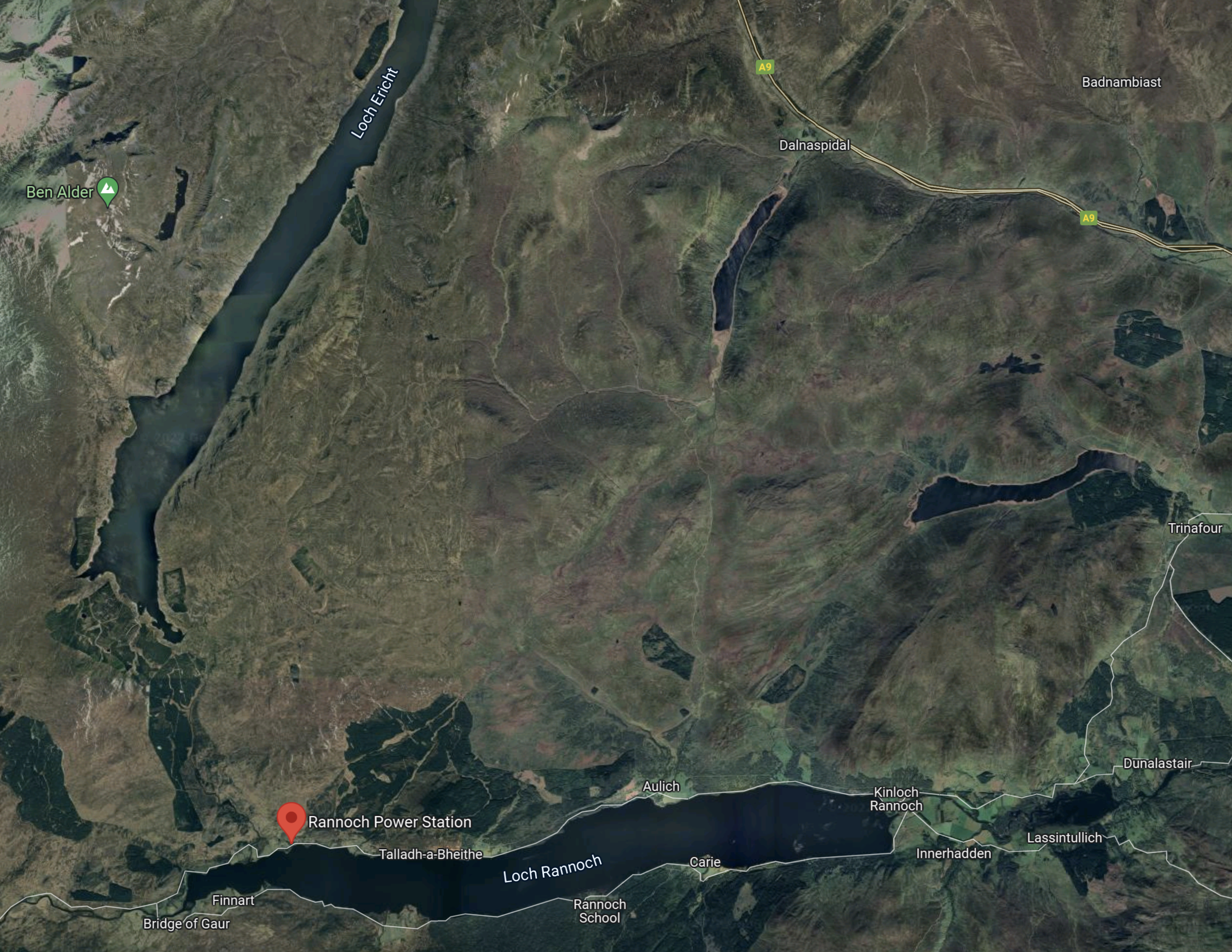
Note.
- Loch Rannoch is along the bottom of the map with Loch Dunalastair to the right.
- Loch Rannoch has an altitude of 205 metres.
- Rannoch power station is indicated by the red arrow.
- Rannoch power station was built in 1930 and the history of the power station is told in this page on the SSE web site, which is entitled A Real Gem In Hydro History.
- Loch Ericht runs to the North from above the power station.
- Loch Ericht has an altitude of 350 metres.
This Google Map shows Rannoch power station to a larger scale.
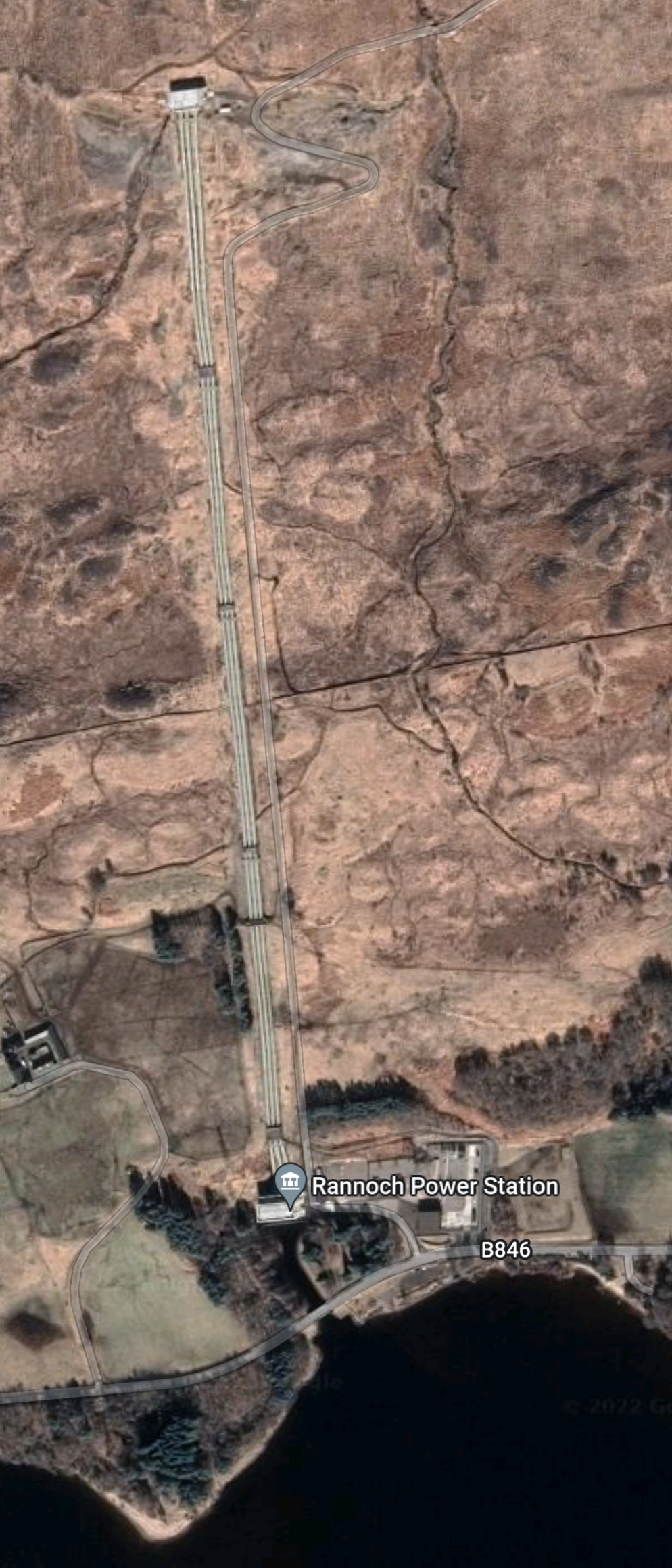
Rannoch power station is on the shore of Loch Rannoch and is described in this section in Wikipedia. This is said.
Rannoch Power Station, on the northern shore of the loch, is part of the Tummel hydro-electric power scheme, which is operated by SSE. The power station has a vertical head of 156 m (512 ft) and a total generating capacity of 44 MW, and uses water fed by pipeline and tunnel from Loch Ericht which is discharged into Loch Rannoch.
There are four pipes running down the hill from Loch Ericht, which deliver water to the power station.
The layout of Rannoch power station seems very similar to Sloy power station, which I described in A Lower-Cost Pumped Hydro Storage System.
- Both power stations sit on a large deep loch.
- Both have pipes to supply water going up the hill and then in a tunnel to a large loch over a hundred metres above the lower reservoir.
- Rannoch power station is a 44 MW power station built in 1930.
- Sloy power station is a 152.5 MW power station built in 1950.
SSE have been examining if a pumped-storage station could be added to Sloy power station.
Given the similarity of the layouts of the two stations, it could be that if it is possible to add pump storage to Sloy, that this could also be done at Rannoch.
Could 41 GWh be stored above Rannoch power station? I won’t say it is not possible.
Conclusion
Research at Strathclyde University gives these figures for possible storage capacity for these dams and lochs in the Tummel scheme.
- Errochty – 16 GWh
- Clunie – 40 GWh
- Rannoch – 41 GWh
- Tummel – 38 GWh
Adding these up gives a total of 135 GWh of stored energy for the Tummel scheme.
But that assumes every power station and dam is expanded to fit Strathclyde’s research.
SSE Renewables are currently calling for tenders for Coire Glas, as I wrote about in SSE Renewables Launches 1.5GW Coire Glas Construction Tender.
This was my conclusion in that post.
It looks to me, that it’s almost certain that Scotland will get a 1.5GW/30 GWh pumped-storage system at Coire Glas.
Coire Glas could supply slightly more power than Sizewell B nuclear power station for twenty hours.
Now that’s what I call backup!
But in the Tummel scheme, there could be three places, where a 30 GWh pumped-storage scheme could be developed and one where a 16 GWh scheme could be developed.
I would expect that a conservative figure of between 40-60 GWh of pumped-storage capacity could be added to the Tummel scheme.
Repurposing The Great Glen Hydro-Electric Scheme
The Great Glen hydro-electric scheme was built in the 1950s and early 1960s, by the North of Scotland Hydroelectric Board.
- The scheme is now owned by SSE Renewables and has a page on their web site.
- There are six individual power stations; Ceannacroc, Livishie, Glenmoriston, Quoich, Invergarry and Mucomir.
- There are five dams; Cluanie, Loyne, Dundreggan, Quoich and Invergarry.
This map from the SSE Renewables web site shows the layout of the dams and power stations.
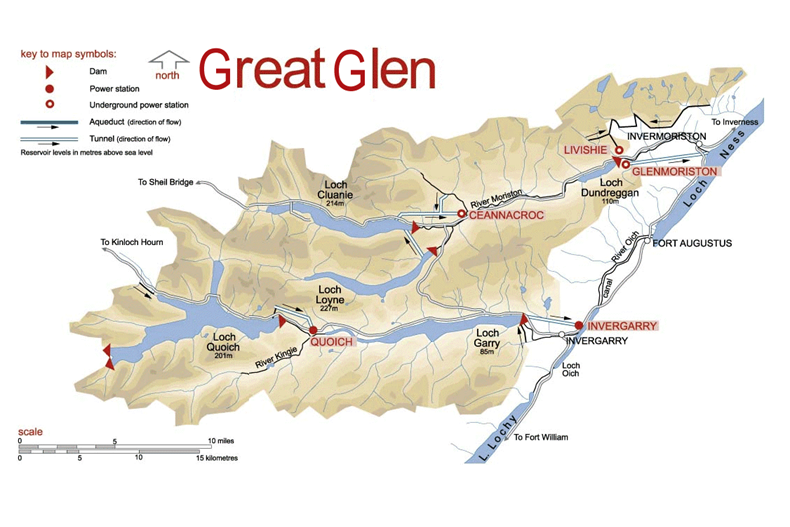
The sizes of the power stations in the scheme are as follows.
- Ceannacroc – 20 MW
- Livishie – 15 MW
- Glenmoriston- 37 MW
- Quoich – 18 MW
- Invergarry – 20 MW
- Mucomir – 1.7 MW
This gives a total power of 112.7 MW.
This Google Map shows the same area as the SSE Renewables Map.
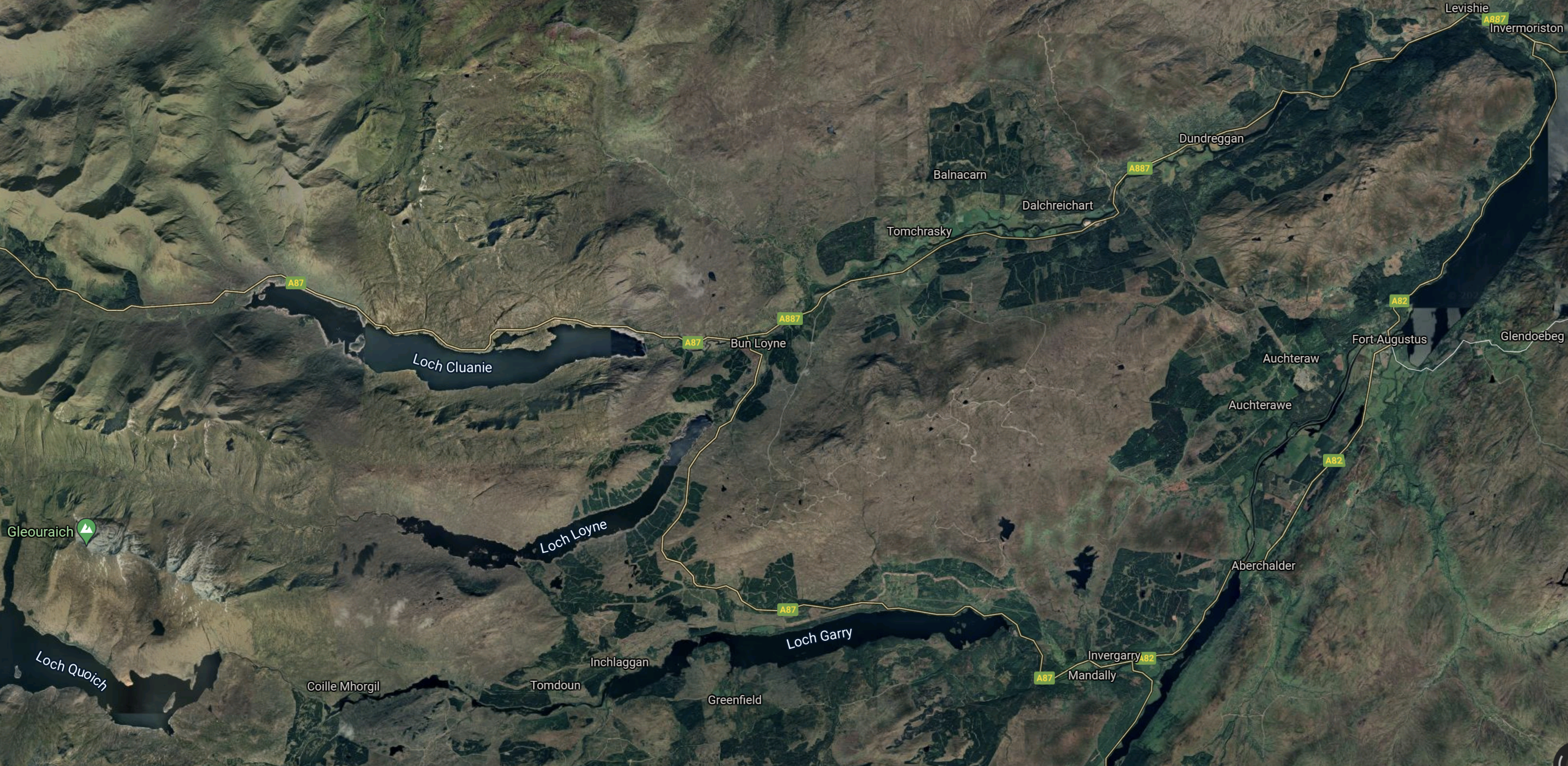
Note.
- Loch Quoich is in the South-West corner.
- To the East of Loch Quoich is Loch Garry and to the North-East is Loch Loyne.
- Loch Cluanie is to the North.
- Invermoriston is in the North-East corner.
The scheme also includes three underground power stations and several miles of tunnels.
Strathclyde University And Pumped Storage Power For Scotland
This page on the Strathclyde University gives a list of the pumped storage potential for Scottish hydrogen-electric dams and power stations.
These figures are given for the dams and lochs in the Great Glen scheme.
- Invergarry – 22 GWh
- Glenmoriston- 41 GWh
- Quoich – 27 GWh
It would appear that based on research from Strathclyde University, that the Great Glen scheme could support up to 90 GWh of pumped storage.
Water Flows In The Great Glen Scheme
Looking at the SSE Renewables map of the Great Glen scheme, water flows appear to be as follows.
- Loch Quoich to Loch Garry via Quoich power station.
- Loch Garry to Loch Oich via Invergarry power station.
- Loch Loyne to Loch Dundreggan via River Moriston.
- Loch Cluanie to Loch Dundreggan via Ceannacroc power station and River Moriston.
- Loch Dundreggan to Loch Ness via Glenmoriston power station.
All the water eventually flows into the sea at Inverness.
Refurbishing And Repurposing The Great Glen Scheme
Perhaps as the power stations are now over fifty years old, one simple way to increase the generating capacity of the Great Glen scheme, might be to selectively replace the turbines, with modern turbines, that can generate electricity more efficiently.
I suspect that SSE Renewables have an ongoing program of improvements and replacements for all of their hydro-electric stations in Scotland. Some turbines at Sloy power station have already been replaced with larger ones.
Adding Pumped Storage To The Great Glen Scheme
I would assume that the water to pump uphill at night or when there is a surplus of electricity will come from Loch Oich or Loch Ness.
Some power stations like Glenmoriston and Invergarry might be updated to both generate electricity or pump water up hill, as is required.
Conclusion
There would appear to be up to three schemes, that could each add around 30 GWh of pumped storage.
One advantage is that the waters of Loch Ness can be used for the lower reservoir.
Repurposing The Affric/Beauly Hydro-Electric Scheme
The Affric/Beauly hydro-electric scheme was built in the 1950s and early 1960s, by the North of Scotland Hydroelectric Board.
- The scheme is now owned by SSE Renewables and has a page on their web site.
- There are six individual power stations; Mullardoch, Fasnakyle, Deanie, Culligran, Aigas and Kilmorack.
- There are seven dams; Mullardoch, Benevean, Monar, Loichel, Beannacharan, Aigas and Kilmorack.
This map from the SSE Renewables web site shows the layout of the dams and power stations.
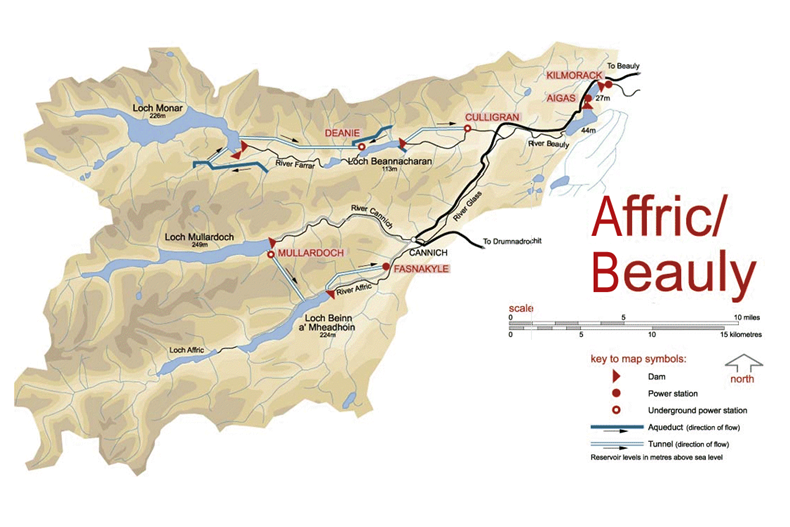
This description of the scheme is from Wikipedia.
The Affric / Beauly hydro-electric power scheme for the generation of hydro-electric power is located in the western Highlands of Scotland. It is based around Glen Strathfarrar, Glen Cannich and Glen Affric, and Strathglass further downstream.
The scheme was developed by the North of Scotland Hydro-Electric Board, with plans being approved in 1947.
The largest dam of the scheme is at Loch Mullardoch, at the head of Glen Cannich. From there, a tunnel takes water to Loch Beinn a’ Mheadhoinn (Loch Benevean) in Glen Affric, via a small underground power station near Mullardoch dam. Loch Benevean is also dammed, with a tunnel taking water to the main power station of Fasnakyle, near Cannich.
To the north in Glen Strathfarrar, Loch Monar is dammed, and a 9 km tunnel carries water to an underground power station at Deanie. Further down the glen, the River Farrar is dammed just below Loch Beannacharan, with a tunnel to take water to Culligran power station (also underground).
The River Farrar joins with the River Glass near Struy to form the River Beauly. Downstream on the River Beauly, dams and power stations have been built in gorges at Aigas and Kilmorack.
As the rivers in this scheme are important for Atlantic salmon, flow in the rivers is kept above agreed levels. The dams at Kilmorack, Aigas and Beannacharn contain Borland fish lifts to allow salmon to pass.
Note
- Culligran, Deanie and Mullardoch power stations are underground.
- Loch Beannacharan is the English name for Loch Beinn a’ Mheadhoin.
- The salmon impose a constraint on water levels.
The sizes of the power stations in the scheme are as follows.
- Mullardoch – 2.4 MW
- Fasnakyle – 69 MW
- Deanie – 38 MW
- Culligran – 19 MW
- Aigas – 20 MW
- Kilmorack – 20 MW
This gives a total power of 168.4 MW.
This Google Map shows the Western area of the SSE Renewables Map.
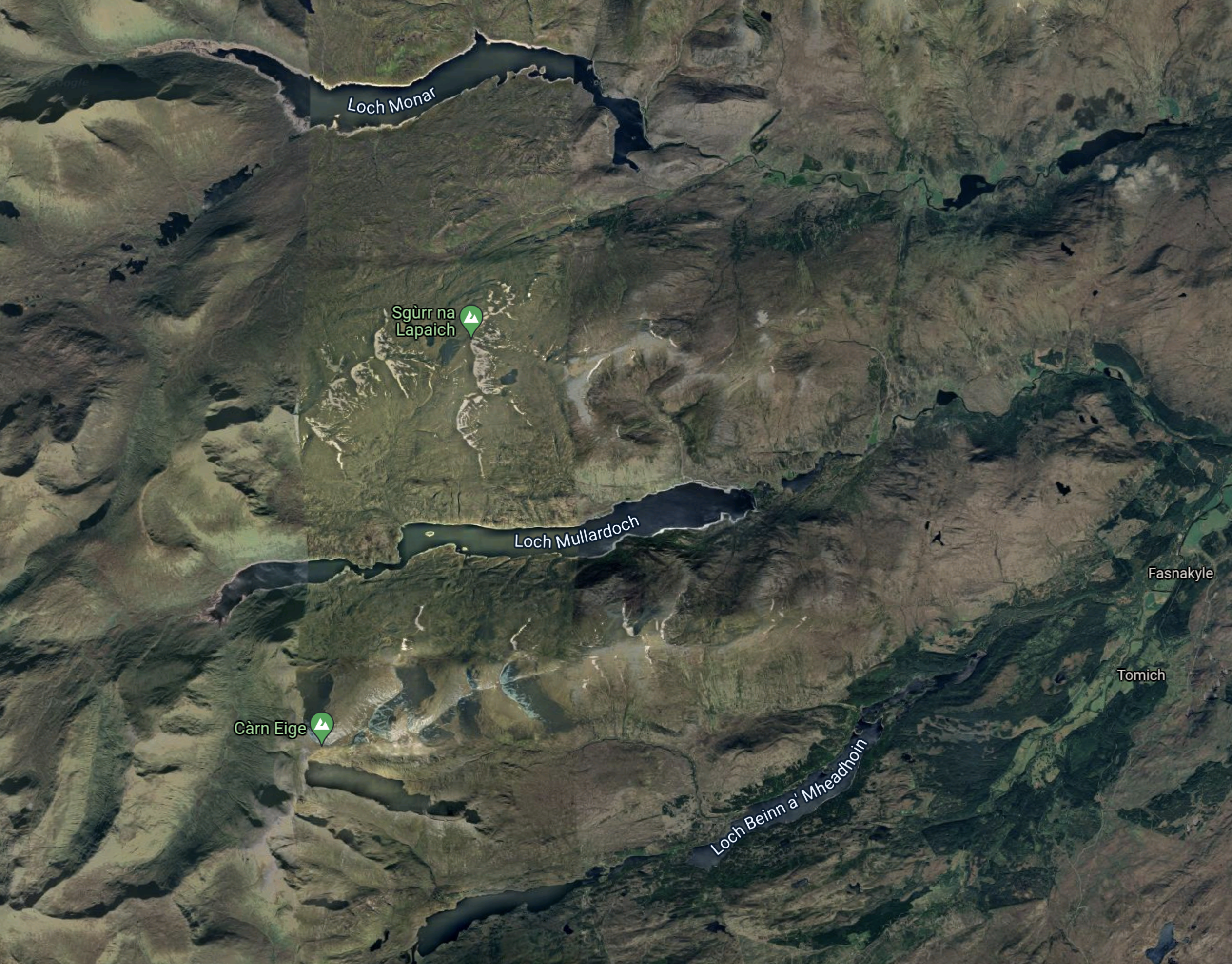
Note.
- The three lochs; Monar, Mullardoch and Beinn a’ Mheadhoin can be picked out on both maps.
- Fasnakyle, where the largest of the hydro-electric power stations in the Affric/Beauly scheme, is at the Eastern edge of the map about half-way up.
- The area doesn’t seem to have a large population.
This Google Map shows the location of Fasnakyle power station in more detail.
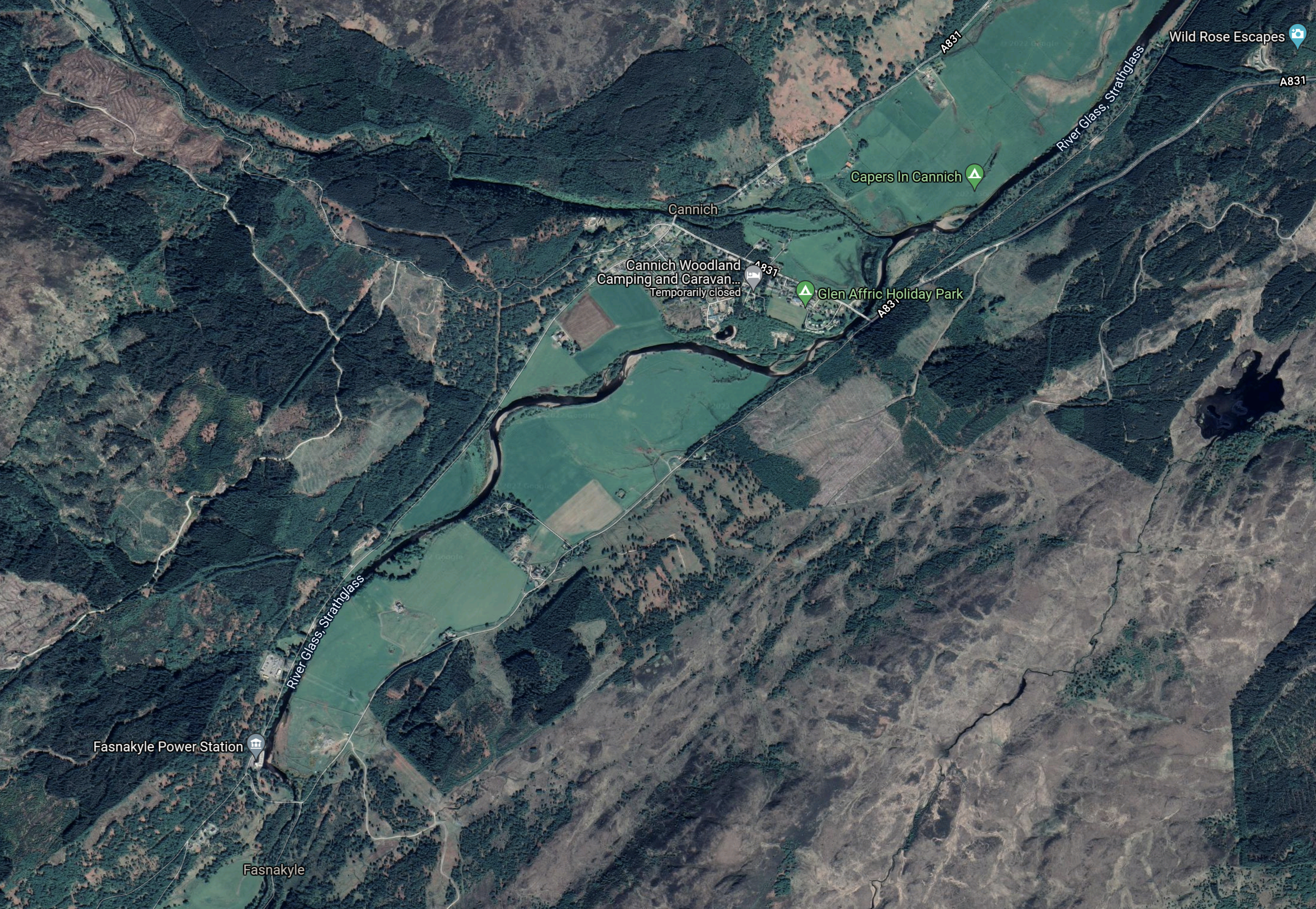
Note.
- Fasnakyle power station is in the South-West corner of the map. marked by a grey flag.
- It appears that all of the water that goes through the power station flows into the River Glass, Strathglass, which meanders its way towards Inverness on the bottom of what appears to be a broad valley.
This Google Map shows the next section of the river.
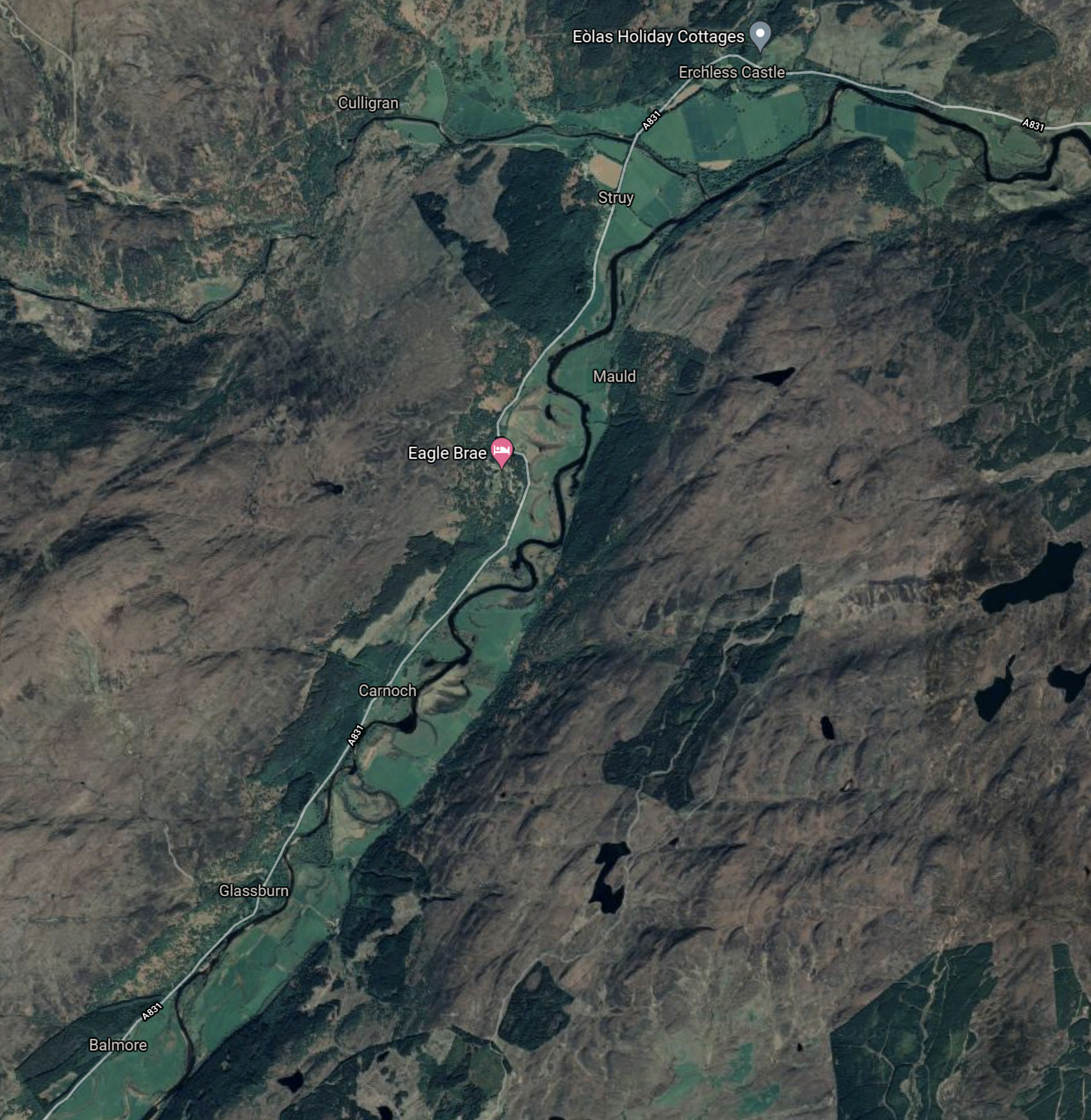
The River Glass, Strathglass joins the River Farrar near the top of the map an becomes the River Beauly.
This Google Map the River Beauly to Kilmorack.
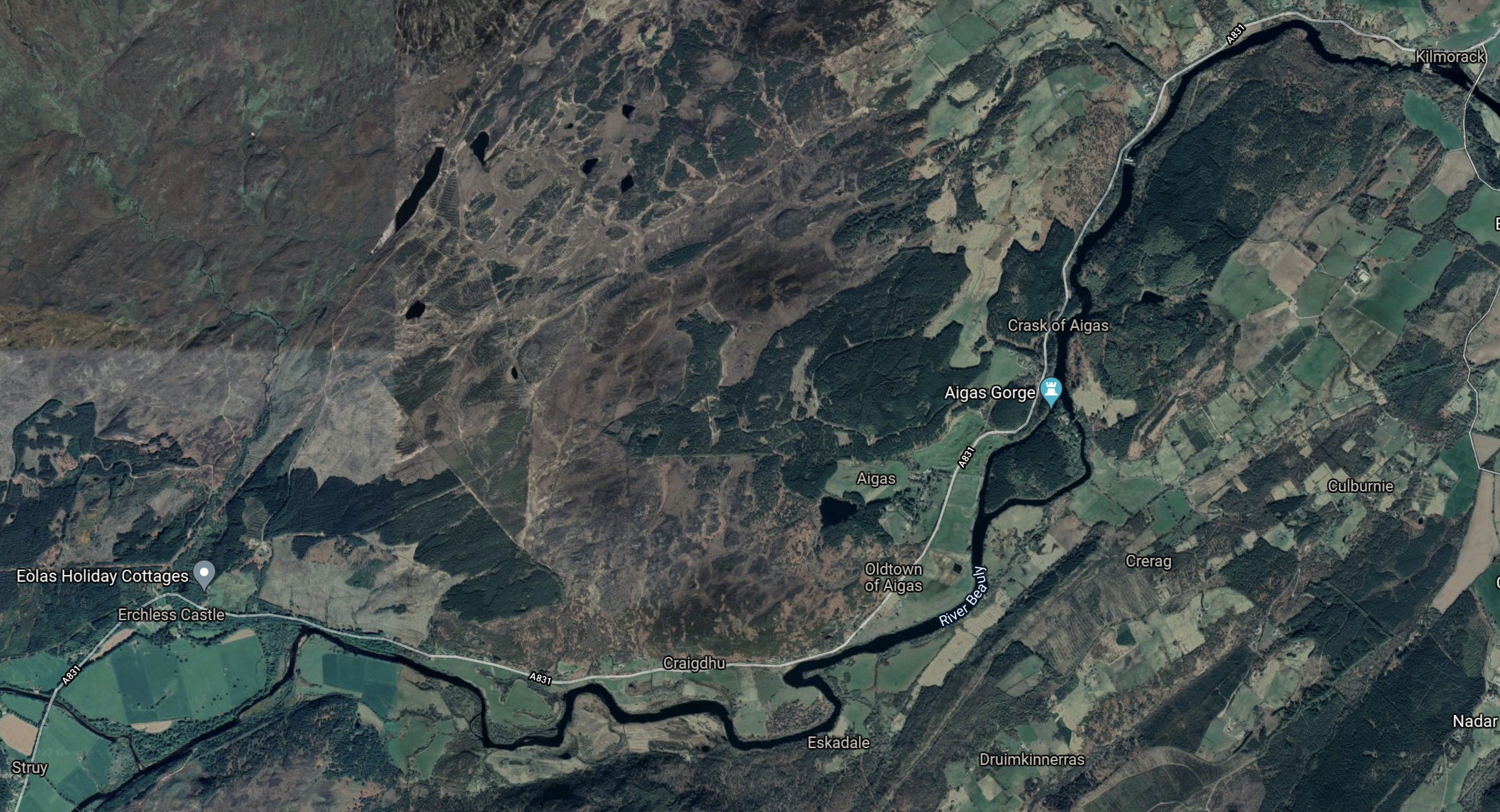
Wikipedia says this about this section of the River Beauly.
The river is part of the Affric-Beauly hydro-electric power scheme, with dams and power stations at Aigas and Kilmorack. Both have 20MW generators and include fish ladders to allow salmon to pass, the Aigas fish ladder is open to visitors in the summer.
This last Google Map shows the Beauly Firth.
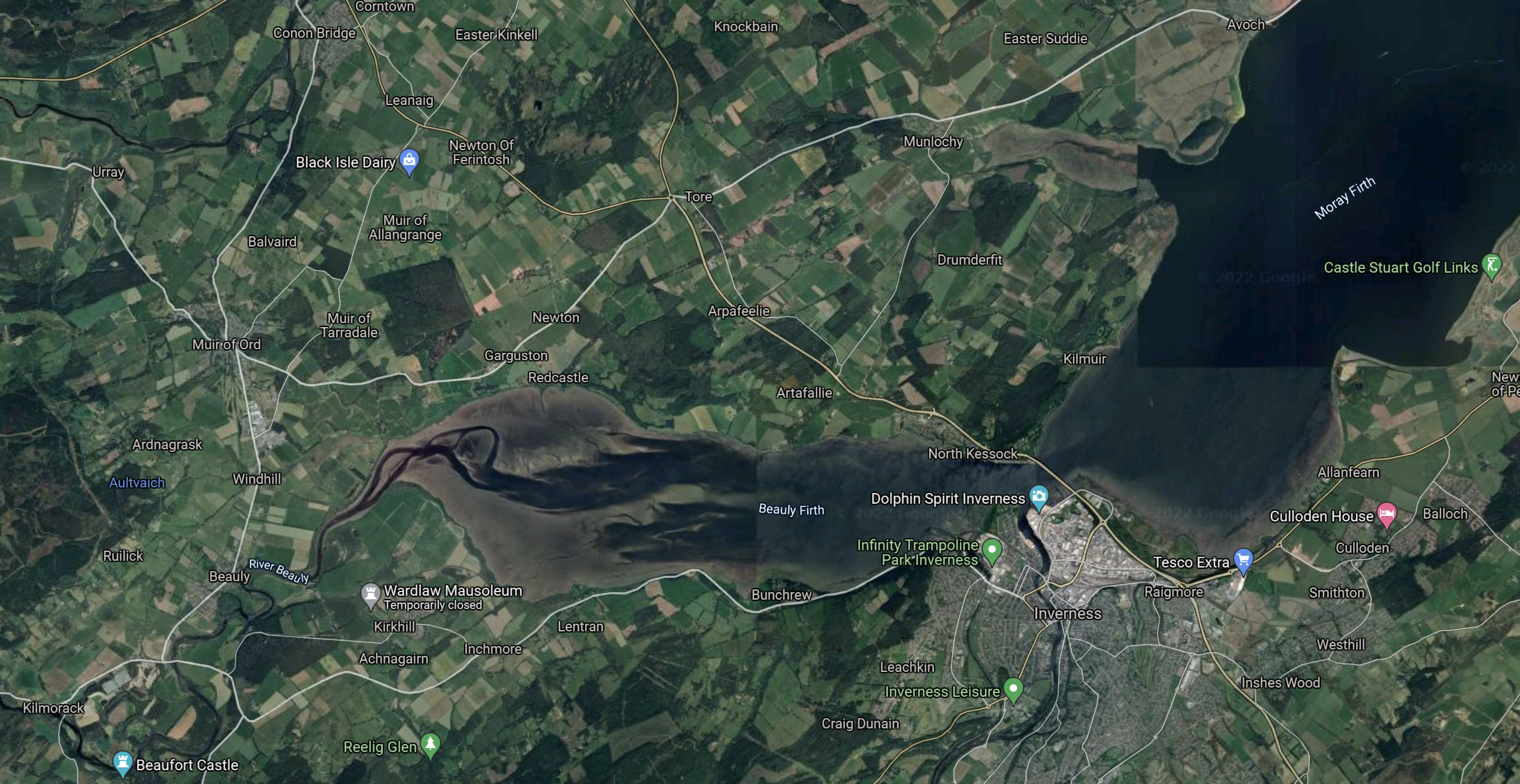
Note.
- Kilmorack is in the South-West corner of the map.
- The River Beauly flows into the Beauly Firth and ultimately out to see in the Moray Firth.
- The water flows past Inverness to the North.
It does strike me, that a lot of the water collected in the dams to the West of Fasnakyle, flows out to sea.
Strathclyde University And Pumped Storage Power For Scotland
This page on the Strathclyde University gives a list of the pumped storage potential for Scottish hydrogen-electric dams and power stations.
A figure is given for only one dam or power station in the Affric/Beauly scheme.
- Fasnakyle – 78 GWh
That would be a lot of pumped storage.
Water Flows In The Affric/Beauly Scheme
Looking at the SSE Renewables map of the Conon scheme, water flows appear to be as follows.
- Loch Monar to Loch Beannacharan via Deanie power station
- Loch Beannacharan to River Beauly via Culligran power station
- Lochs Mullardoch and Beinn a’ Mheadhoin both supply water to the Fasnakyle power station
- Fasnakyle power station to River Beauly via the River Glass, Strathglass.
- River Beauly to Beauly Firth via Aigas and Kilmorack power stations.
Note.
- Water from Loch Moray goes via Deanie , Culligran, Aigas and Kilmorack power stations on its journey to the sea.
- Water from Loch Mullardoch goes via Mullardoch , Fasnakyle, Aigas and Kilmorack power stations on its journey to the sea.
- Water from Loch Beinn a’ Mheadhoin goes via Fasnakyle, Aigas and Kilmorack power stations on its journey to the sea.
Fasnakyle, Aigas and Kilmorack power stations must work very hard.
Refurbishing And Repurposing The Affric/Beauly Scheme
Perhaps as the power stations are now over fifty years old, one simple way to increase the generating capacity of the Affric/Beauly scheme might be to selectively replace the turbines, with modern turbines, that can generate electricity more efficiently.
I suspect that SSE Renewables have an ongoing program of improvements and replacements for all of their hydro-electric stations in Scotland. Some turbines at Sloy power station have already been replaced with larger ones.
I also suspect that the whole scheme has a very sophisticated control system.
Consider.
- There is a need to control water levels to agreed minimum levels for the Atlantic salmon.
- Hydro-electric power stations have the ability to get to full power quickly, to cover sudden demands for more electricity.
- Electricity only needs to be generated if it can be used.
- Water might be held in Lochs Mullardoch and Beinn a’ Mheadhoin, as a reserve, as it goes through three or four power stations when it is released.
Over the years, SSE Renewables will have developed very sophisticated control philosophies.
Adding Pumped Storage To The Affric/Beauly Scheme
To do this a source of fresh-water must be pumped into Loch Mullardoch or Beinn a’ Mheadhoin, when there is a surplus of electricity.
It looks from Google Maps, that the river system between Fasnakyle and Aigas power stations has been effectively turned into a canal.
- I wonder, if it is deep enough to contain enough water to act as the lower level reservoir of a pumped-storage system.
- The higher level reservoir would be Loch Mullardoch.
- There would be a height difference of 200 metres.
- Calculations show around 1850 cubic metres of water would need to be pumped into Loch Mullardoch to store one MWh.
So long as enough water is left for the salmon, I suspect that if a way of pumping water from the River Glass to Loch Mullardoch, that an amount of pumped-storage can be added.
Conclusion
There would appear to be only one scheme, but if it was built it could add over 50 GWh of pumped storage.
Repurposing The Conon Hydro-Electric Scheme
The Conon hydro-electric scheme was built in the 1950s, by the North of Scotland Hydroelectric Board.
- The scheme is now owned by SSE Renewables and has a page on their web site.
- There are six individual power stations; Achanalt, Grudie Bridge, Mossford, Luichart, Orrin and Torr Achilty.
- There are six dams; Glascarnoch, Vaich, Luichart, Meig, Torr Achilty and Orrin.
This map from the SSE Renewables web site shows the layout of the dams and power stations.
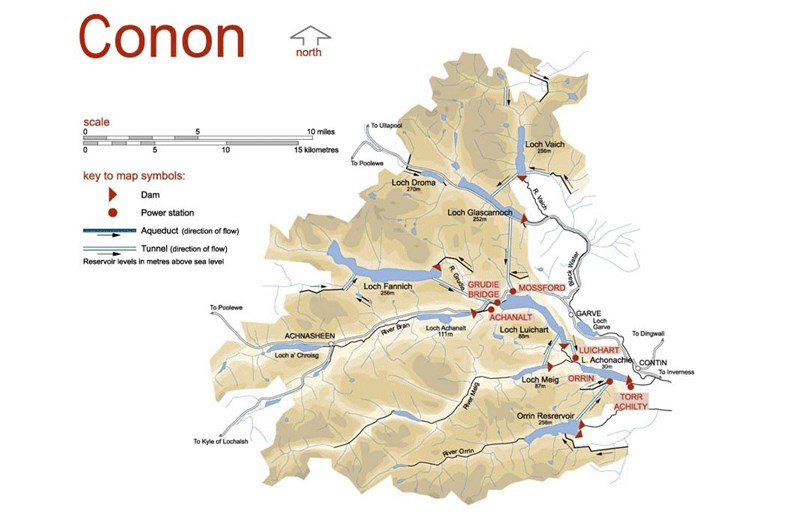
The sizes of the power stations in the scheme are as follows.
- Achanalt – 3 MW
- Grudie Bridge – 18.6 MW
- Mossford – 18.6 MW
- Luichart – 34 MW
- Orrin – 18 MW
- Torr Achilty – 15 MW
This gives a total power of 107.2 MW.
This Google Map shows the same area as the SSE Renewables Map.
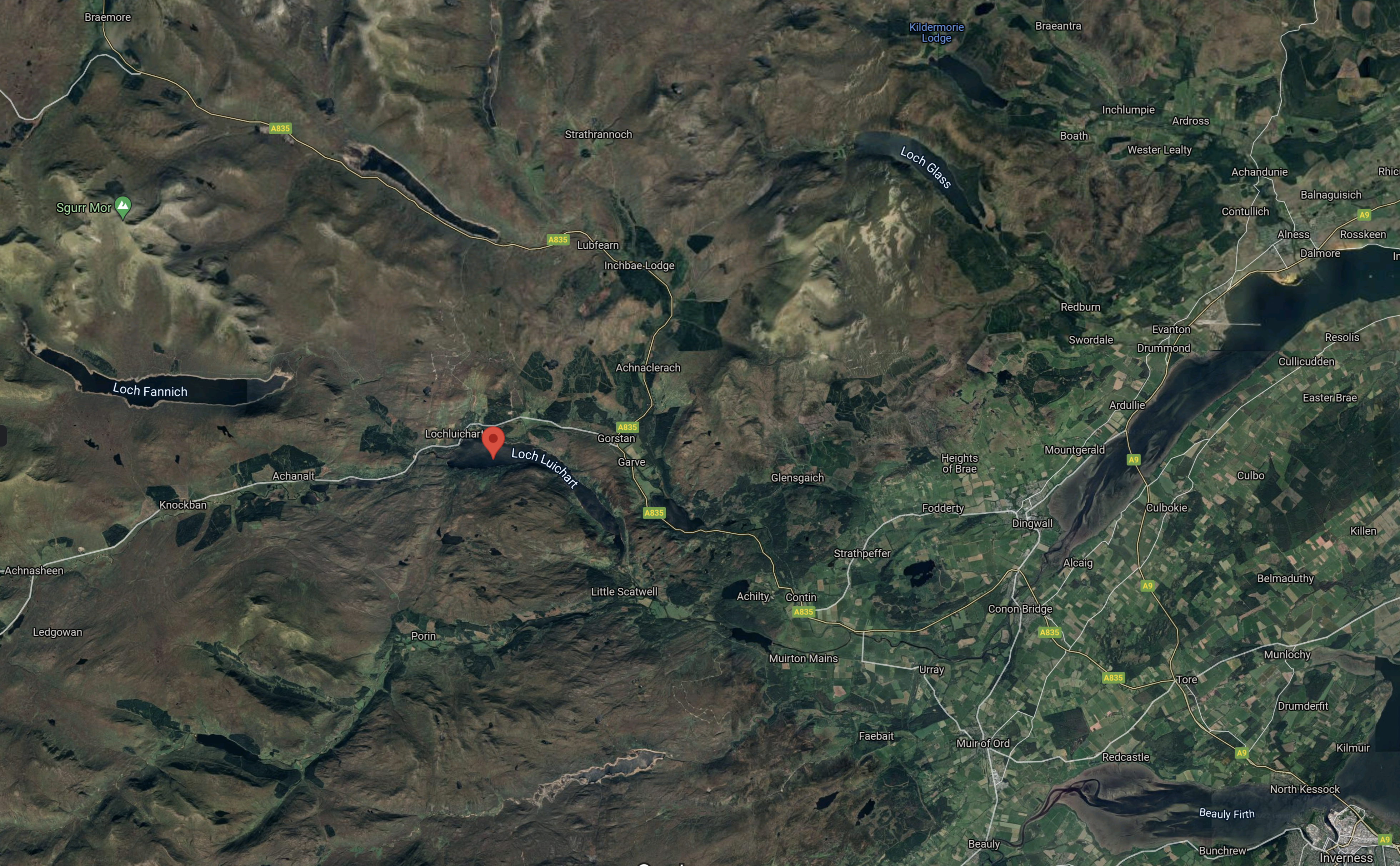
Note.
- Inverness is in the South-East corner of the map.
- The red arrow indicates the Western end of Loch Luichart.
- Loch Fannich is the large loch to the West of Loch Luichart.
- Loch Glascarnoch is the East-West loch to the North of Loch Luichart
- Loch Vaich is the North-South loch to the North of Loch Glascarnoch.
Is Inverness a City substantially powered by renewables?
Strathclyde University And Pumped Storage Power For Scotland
This page on the Strathclyde University gives a list of the pumped storage potential for Scottish hydrogen-electric dams and power stations.
These figures are given for the dams and lochs in the Conon scheme.
- Glascarnoch – 23 GWh
- Luichart – 38 GWh
- Fannich – 70 GWh
It would appear that based on research from Strathclyde University, that the Conon scheme could support up to 131 GWh of pumped storage.
This Google Map shows the three lochs and Loch Vaich.
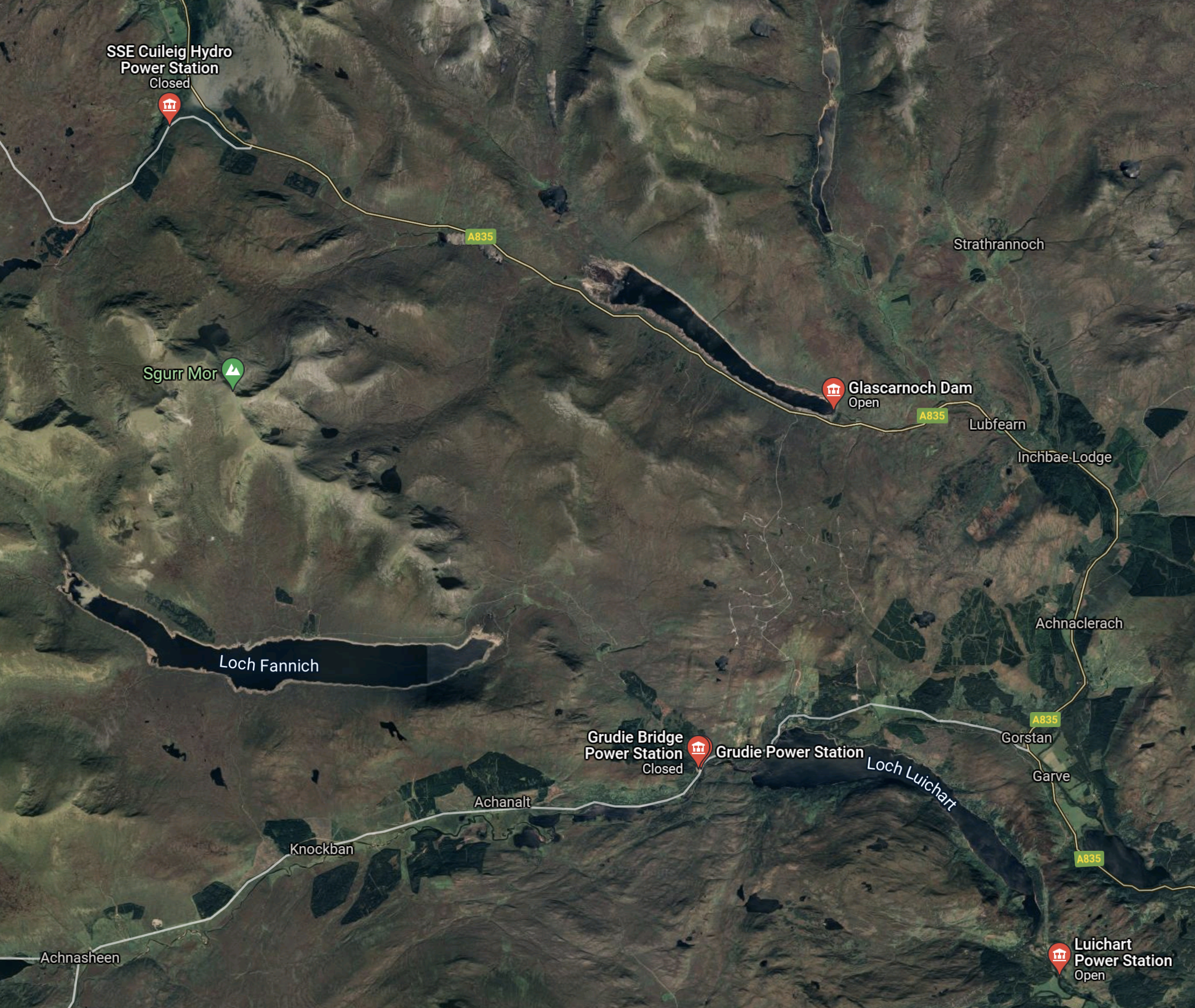
Note.
- Lochs Fannich and Luichart are named.
- Loch Glascarnoch is the East-West loch to the North of Loch Luichart
- Loch Vaich is the North-South loch to the North of Loch Glascarnoch.
- The locations of several power stations are shown.
- Cuileig is a 3.2 MW power station built in 2002.
This Google Map shows Loch Fannich.
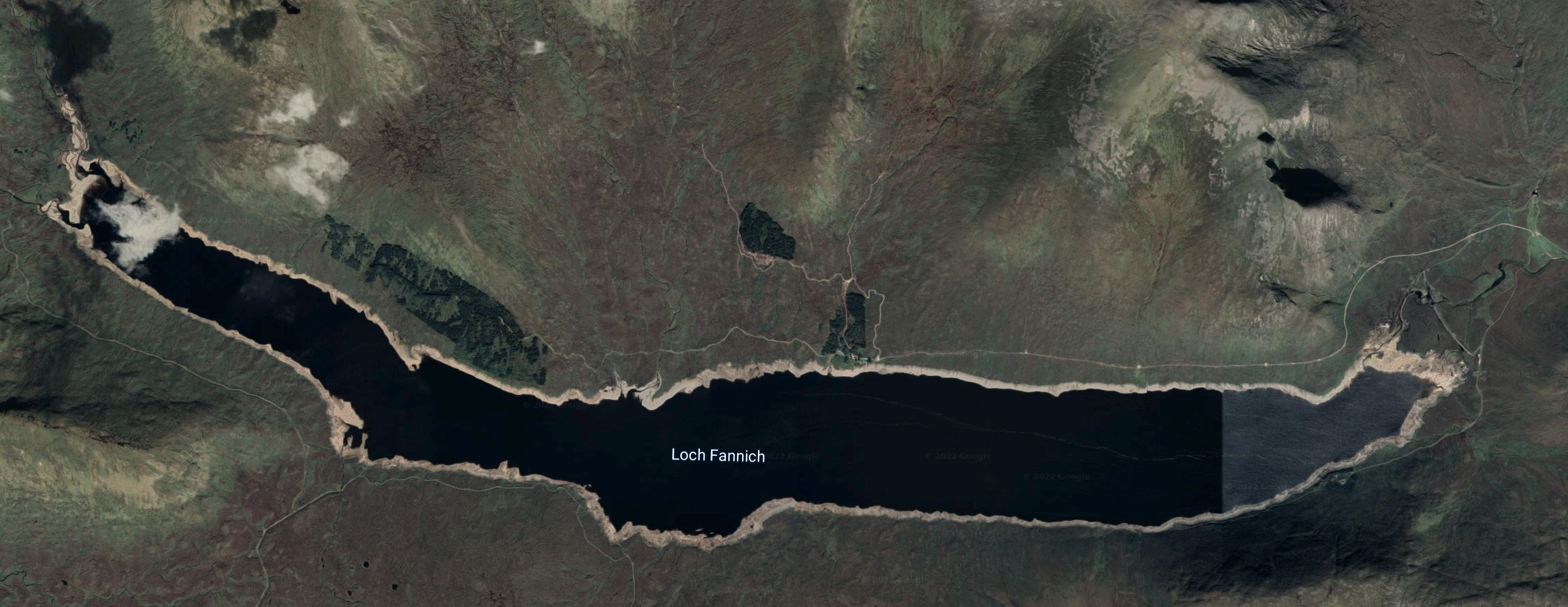
Wikipedia says this about the loch.
Loch Fannich was dammed and its water level raised as part of the Conon Hydro-Electric Power Scheme, built by the North of Scotland Hydro-Electric Board between 1946 and 1961. An underground water tunnel leading from Loch Fannich to the Grudie Bridge Power Station required blasting out a final mass of rock beneath the loch, a procedure which was referred to popularly as “Operation Bathplug”.
The dam appears to be at the Eastern end of the loch, as this Google Map shows.
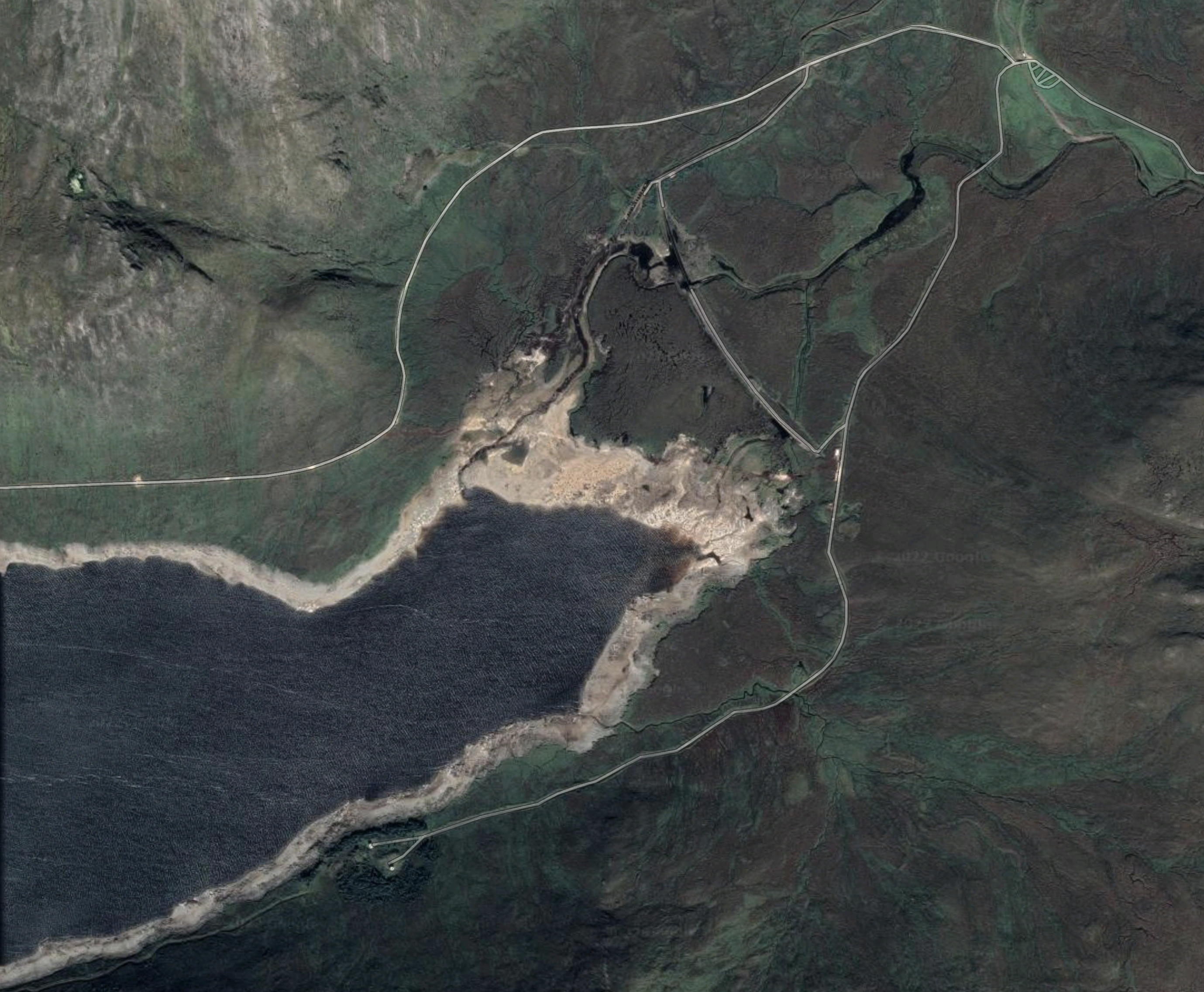
I wouldn’t be surprised to find that to obtain the potential 70 GWh of storage, that the dam will need to be raised.
This Google Map shows Loch Glascarnoch.
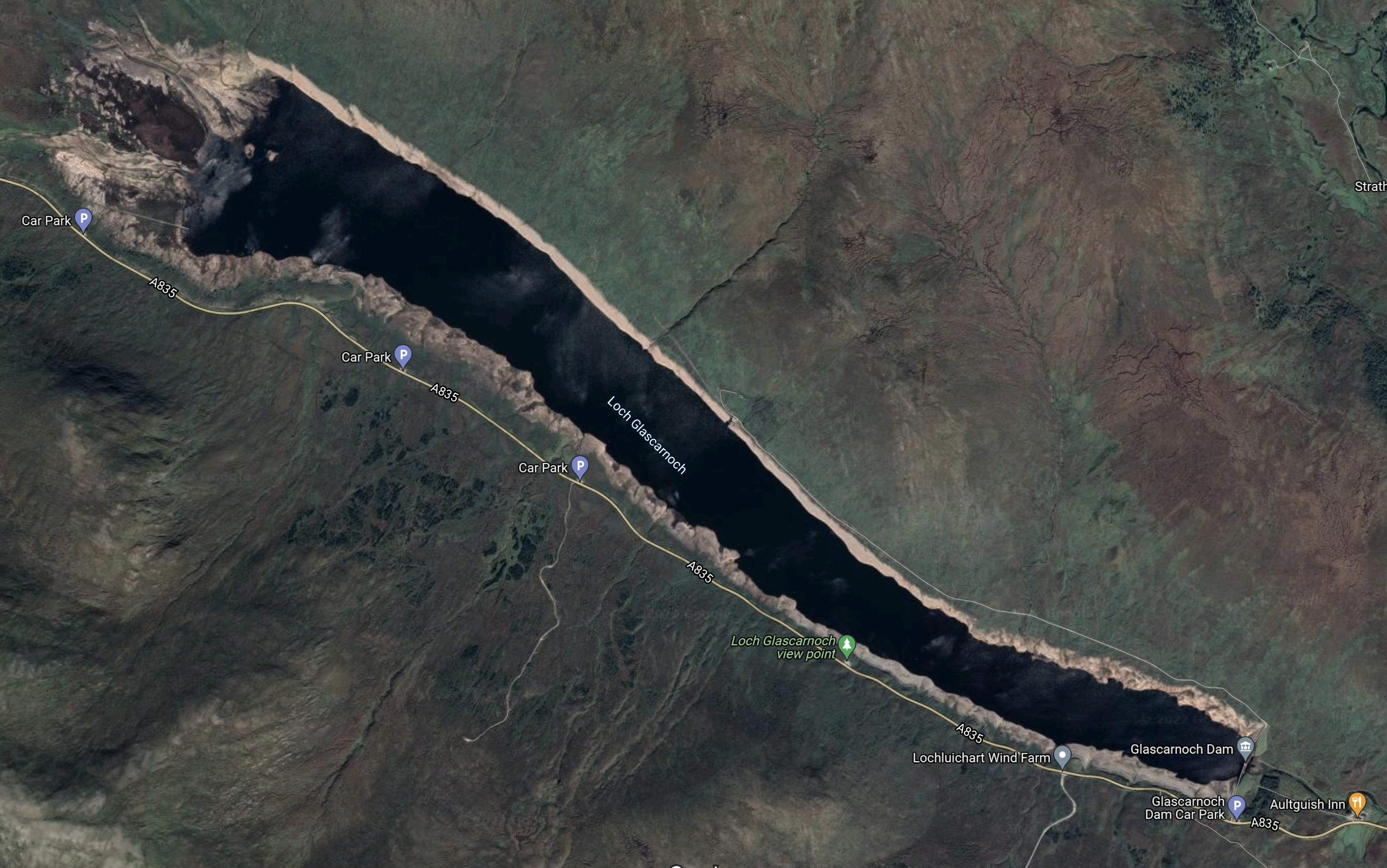
Loch Glascarnoch may be more difficult to expand, as a road runs along the Southern side of the loch.
This Google Map shows Loch Luichart
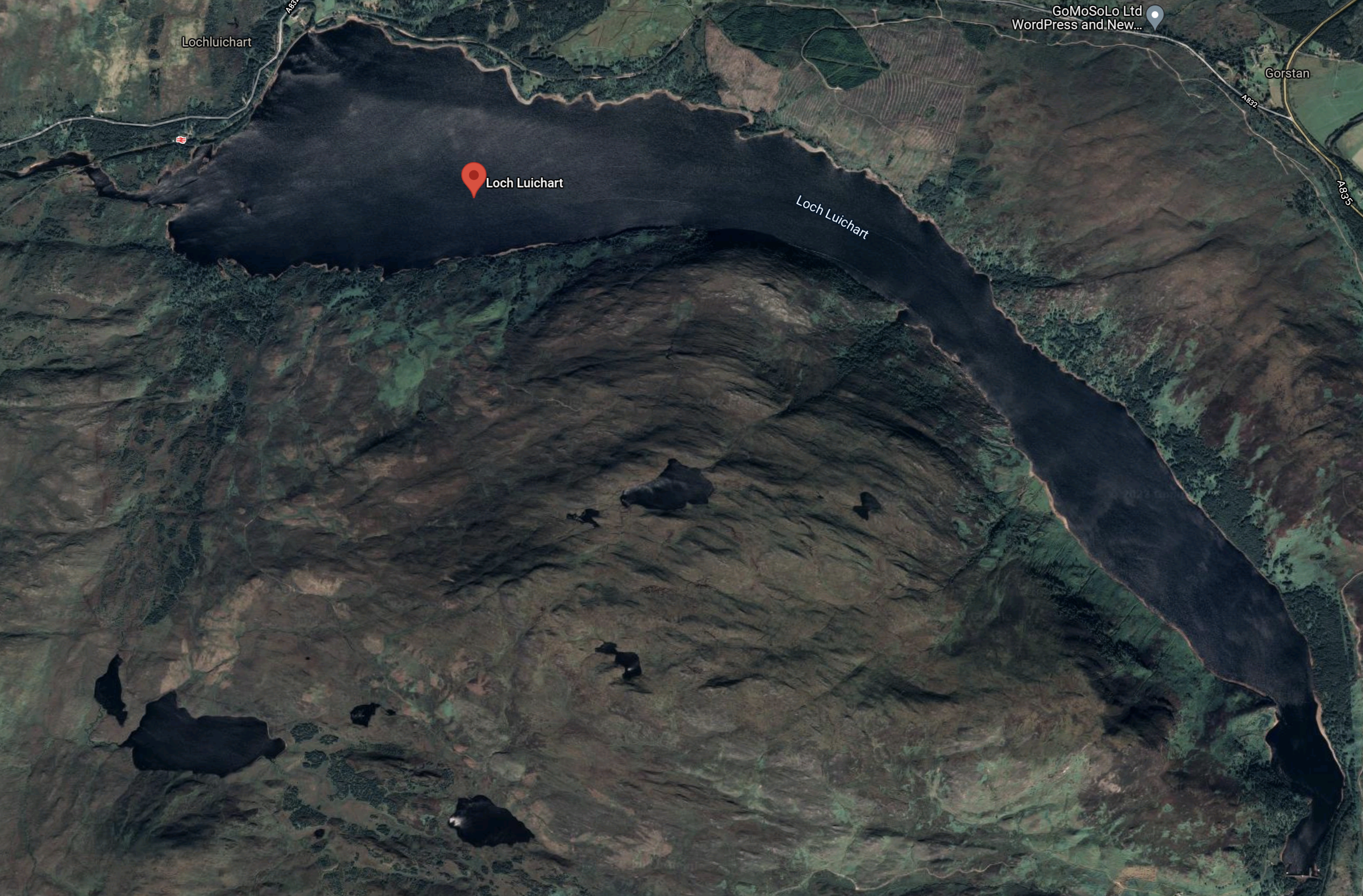
Lock Luichart may have possibilities as it is wide and could be deep.
But it will all be about the shape of the loch and the mathematics of the water.
Water Flows In The Conon Scheme
Looking at the SSE Renewables map of the Conon scheme, water flows appear to be as follows.
- Loch Vaich to Loch Glascornoch
- Loch Droma to Loch Glascornoch
- Loch Glascornoch to Loch Luichart via Mossford power station
- Loch Fannich to Loch Luichart via Grudie Bridge power station
- Loch Achanalt to Loch Luichart via Anchanalt power station
- Loch Meig to Loch Luichart
- Loch Luichart to Loch Achonachie via Luichart power station
- Orrin Reservoir to Loch Achonachie via Orrin power station
- Loch Achonachie to River Conon and eventually the Cromarty Firth via Torr Achilty power station
Note that all the power stations date from the 1950s.
Repurposing The Conon Scheme
Perhaps as the power stations are now over sixty years old, one simpler way to both increase the generating capacity of the Conon scheme and add a degree of pumped storage might be to selectively replace the turbines, with modern pump/turbines, that can both generate electricity and pump the water back up into the mountains.
It should also be noted that Loch Vaich, Loch Glascornoch, Loch Fannich and the Orrin Reservoir are all about 250 metres above sea level, with the others as follows.
- Loch Achanalt – 111 metres
- Loch Luichart – 56 metres
- Loch Meig – 87 metres
- Loch Achonachie – 30 metres
Loch Droma is the highest loch at 270 metres.
These height differences could create opportunities to put in extra tunnels and power or pumping stations between the various levels.
As water pumped to a greater height has a higher potential energy, perhaps it would be an idea to give Loch Droma, which is the highest loch, a bigger role.
Conclusion
I believe these improvements are possible.
- Adding a pumped storage facility to the Conon hydro-electric scheme, with a capacity of upwards of 30-40 GWh.
- Increasing the generating capacity by replacing the elderly turbines.
- Improving control of the scheme, by replacing 1950s control systems.
It may even be possible to substantially improve the performance of the scheme without any expensive rock tunnelling.
A Possible Balmacaan Pumped Storage System
This article on Power Technology is entitled SSE Proposes Loch Ness Hydro Power Plant.
These are the first three paragraphs.
Scottish and Southern Energy (SSE) has begun consultations to develop a 600MW hydro electric power plant on the shores of Loch Ness in Scotland.
SSE proposes to build a pumped storage scheme on the Balmacaan Estate between Invermoriston and Drumnadrochit.
The plan also includes construction of a dam and a new reservoir at Loch nam Breac Dearga, north-east of Invermoriston, according to Inverness-courier.co.uk.
This Google Map shows the location of Loch nam Breac Darga.
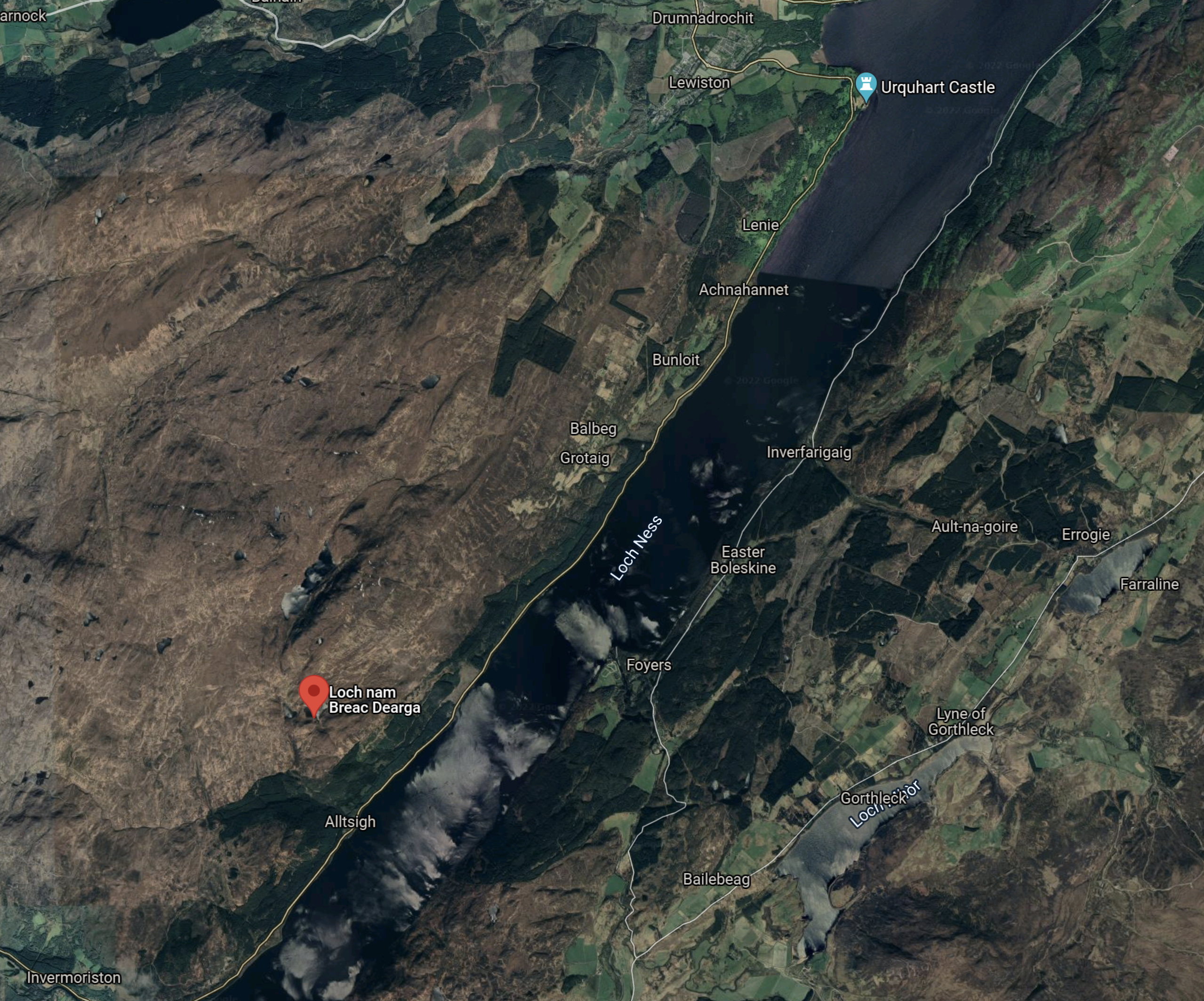
Note.
- Loch Ness runs diagonally across the map.
- Invermoriston is in the South-West corner of the map.
- Loch nam Breac Darga is marked by the red arrow and is 452 metres above sea level.
- Drumnadrochit is at the North of the map, just to the West of Urquhart Castle.
- The Foyers Pumped Hydro scheme, which I wrote about in The Development Of The Foyers Pumped Storage Scheme is on the opposite bank of Loch Ness from Loch nam Breac Darga.
This could be Scotland’s largest hydro-electric plant.
I can’t find a value for the amount of energy that can be stored, but I suspect it could be in the order of 15-20 GWh.
The stories about this project seem to be thin on the ground, so could it be that this project has been placed on the back burner by SSE.
Onshore And Offshore Wind Energy Capacity Predicted To Increase By 230% By 2030
The title of this post, is the same as that of this article on insider.
The report was commissioned by Scottish Renewables to assess the effects on the supply chain in Scotland.
But it does show that Scotland is on the way to be able to supply a lot of its electricity from wind farms, which would be backed up by some of another of pumped storage schemes under development.
A Lower-Cost Pumped Hydro Storage System
Whilst writing some of the posts recently about pumped storage I came across the Loch Sloy Hydro-Electric Scheme.
This is the introductory sentence in Wikipedia.
The Sloy/Awe Hydro-Electric Scheme is a hydro-electric facility situated between Loch Sloy and Inveruglas on the west bank of Loch Lomond in Scotland.
This page on the Greenage web site gives comprehensive details of the power station and is well worth a read.
This Google Map shows the Lochs Sloy and Lomond.
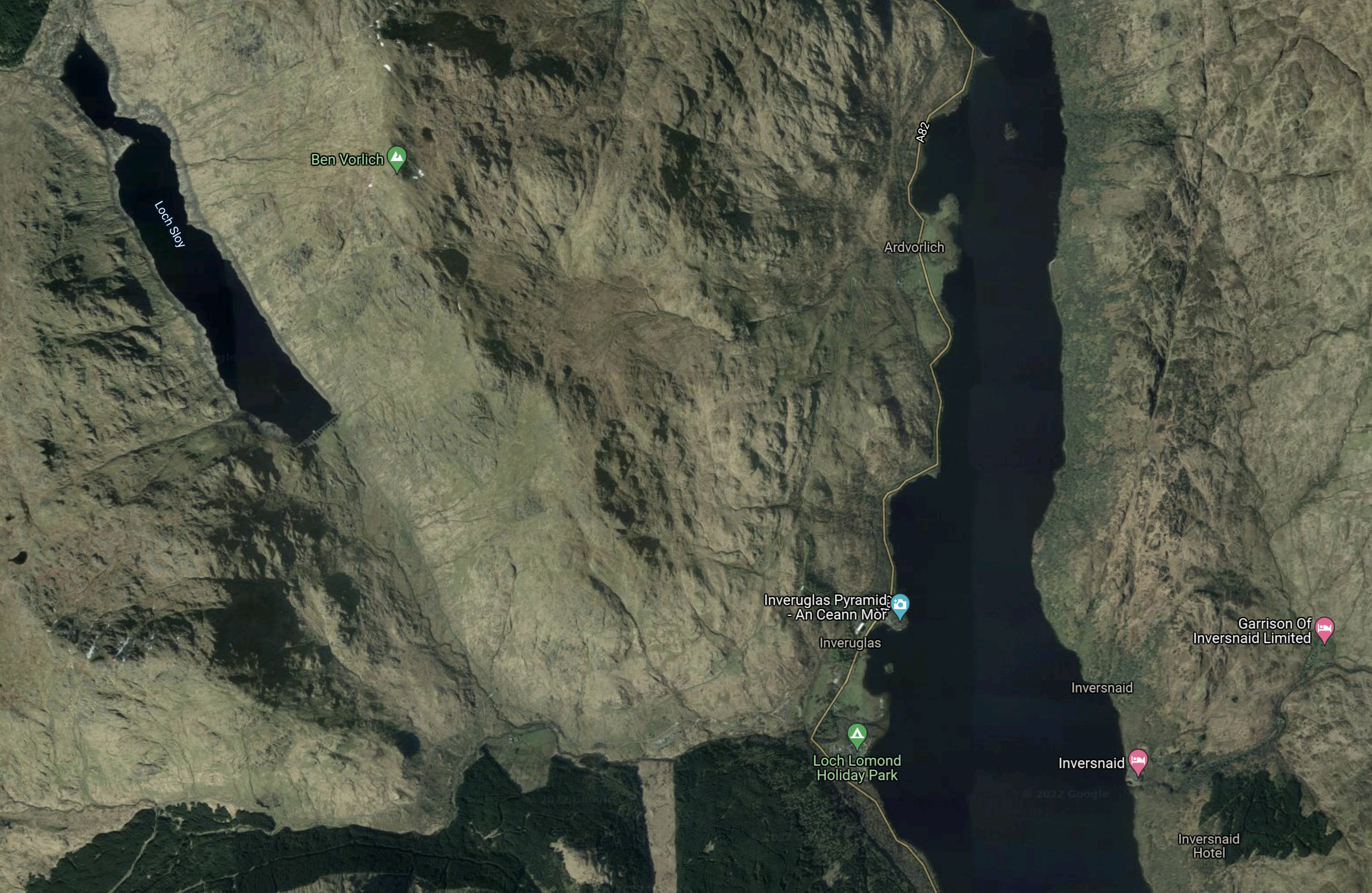
Note.
- Loch Sloy is in the North-West corner of the map.
- The page on Greenage says that Loch Sloy can store 14 GWh of electricity
- Loch Lomond is the body of water towards the Eastern side of the map.
- Inverglas is on the West bank of Loch Lomond to the North of the Loch Lomond Holiday Park, which is indicated by the green arrow with a tent.
This second Google Map shows the power station and Inverglas.
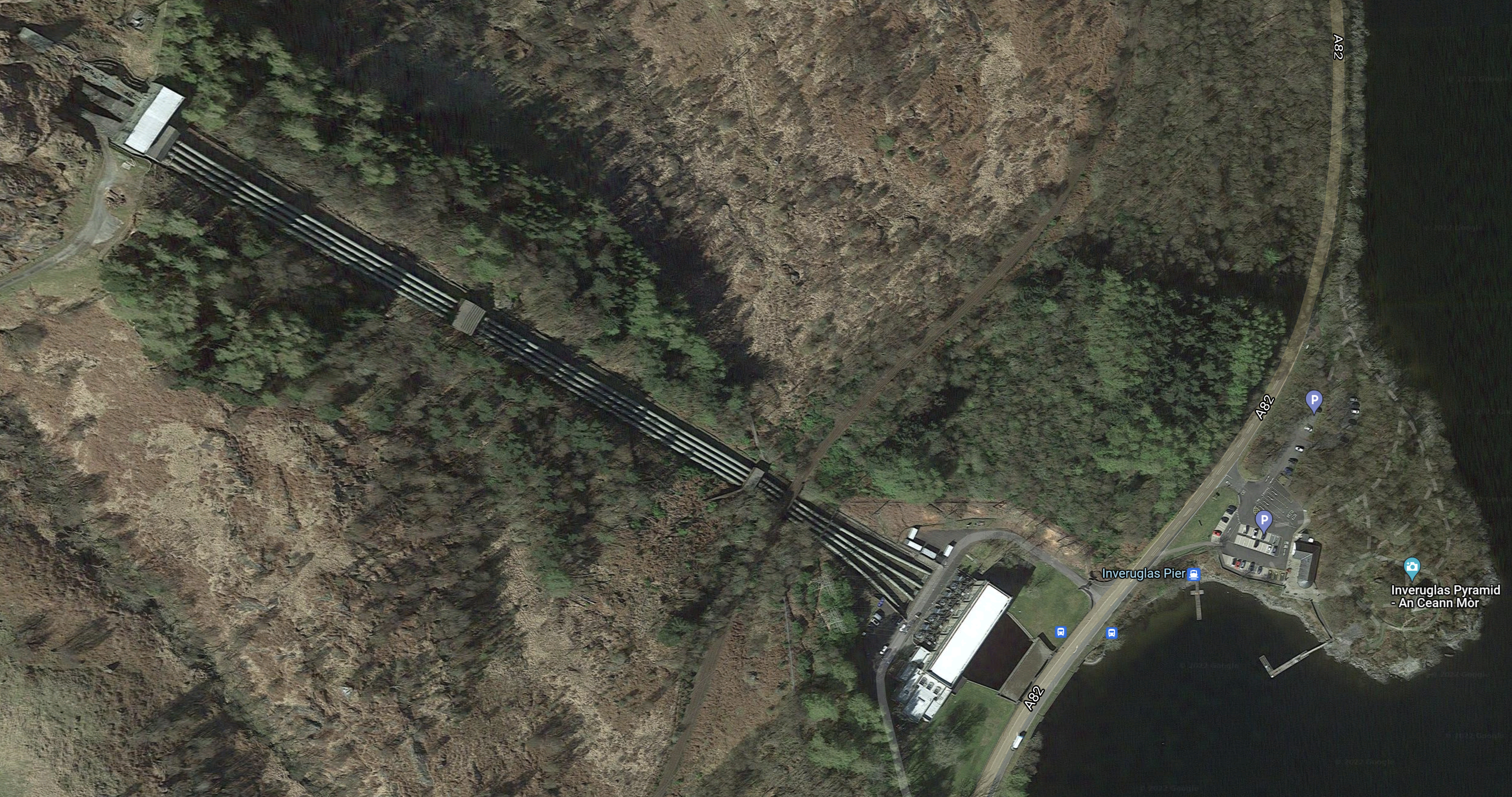
Note.
- It is a classic layout for a hydro-electric power station.
- In the North West corner of the map is the valve house, which is connected to Loch Sloy by a three kilometre tunnel.
- The valve house controls the water flows to the power station by Loch Lomond.
- There are four two-metre pipes running down the hill, one for each of the four turbines.
- According to the page on Greenage, the power station has three 40 MW turbines and one 32 MW turbine, which gives a total output of 152 MW.
- The water discharges into Loch Lomond after doing its work in the power station.
Loch Sloy is the largest conventional hydroelectric power plant in the UK.
Extending The Loch Sloy Hydro-Electric Scheme
This page on Hydro Review, which is dated the 10th of November 2010, is entitled SSE Gets Government Consent For Sloy Pumped-Storage Hydropower Project.
These are the first paragraph.
SSE Generation Ltd., the wholly owned generation business of Scottish and Southern Energy, has received consent from the Scottish Government to develop a 60-MW pumped-storage hydro project at its existing Sloy hydropower station at Loch Lomond, SSE reported.
Note.
- Two 30 MW pumps will be added to the power station to pump water up the hill from Loch Lomond to Loch Sloy.
- According to the page on Greenage, if the two pumps worked together for six hours, they would transfer 432,000 m3 of water. Note that a cubic metre of water weighs a tonne.
- Water would be transferred, when there was a surplus of energy being generated over the demand.
It would appear to be a simple scheme, as it is just adding two pumps to pump the water up the hill.
- As pumps rather than pump/turbines as at Foyers are used, there is no corresponding increase in generating capacity.
- Water also appears to be pumped up to the valve house in the existing pipes.
- Loch Sloy and Loch Lomond would not need major works to enable the scheme..
The page on Greenage gives the cost at just £40 million.
Originally, the project was supposed to have started in 2012, but as there are environmental problems with the fish, the work has not started.
These problems are detailed on the page on Greenage.
Conclusion
For £40 million, 14 GWh of pumped storage can be created at Sloy.
- But it could be bigger than 14 GWh, as this page on the Strathclyde University web site, says 20.4 GWh is possible.
- This would surely, be a project that could be first in the queue, once the environmental problems are solved.
20 GWh of pumped storage would be nice to have reasonably quickly.
 The Anonymous Widower