Is The Levenmouth Rail Link Going To Be Scotland’s Next New Railway?
I ask this question as this article in Global Rail News was asking the same question, with a title of Levenmouth – Scotland’s next railway?.
According to the article, the figures look good, for the reopening of the Levenouth Rail Link, with a Benefit Cost Ration of 1.3, which compares well with the figure of 0.96 for the successful Borders Railway.
This is also said in the Wikipedia entry for the Fife Circle Line under Future Services.
A Leven rail link would provide better services to support major industrial sites at Fife Energy Park, Methil Docks, the Low Carbon Park (under construction), Diageo, the businesses along the Leven Valley (including Donaldsons) and major retailers in Leven located close to the line (Sainsbury, B&Q, Argos, etc.). Levenmouth is an area of high deprivation and Fife Council estimates that an hourly train link (using the Fife Circle services)to Edinburgh would increase job vacancies by 500% since commuting for work would become possible.
There is one big difference between the Borders Railway and the Levenmouth Rail Link.
On a journey to Scotland’s capital from Leven, the travellers have to cross the large water.barrier of the Firth of Forth.
Is The Firth Of Forth A Psychological Barrier?
Does the Forth act as both a psychological batter, as well as a physical barrier to travel?
I don’t know for sure, but I hear the same sort of comments from my friends in Edinburgh about Fife, as North Londoners make about South London and probably South Londoners make about the North.
The much larger Thameslink project may get all the publicity and criticism, but London’s most modern cross-river link just keeps on giving.
The East London Line And The Levenmouth Rail Link
You might argue, what has the East London Line got to do with the Levenmouth Rail Link?
I believe that because of the geography of the two areas, with a major waterway between two centres of population, that the massive underestimation of passenger numbers, that occurred in East London could also happen across the Forth.
Luckily, that just as Marc Brunel provided a high-quality crossing under the Thames, the Victorians did this for the Firth of Forth.
Although, it could be argued that the Scottish crossing is more iconic and you get a better view.
As an aside, if the Forth Bridge, which opened in 1890 is a UNESCO World Heritage Site, surely Marc Brunel’s much older Thames Tunnel, should be similarly acknowledged.
Local Rail Services Across The Firth Of Forth
At present the local services across the bridge are four trains per hour on the Fife Circle Line.
That is not a high capacity service, given the line is not electrified.
If the Levenmouth Rail Link were to be rebuilt, it would connect to the Fife Circle and surely, it would mean that more trains could be timetabled to and from Edinburgh, via the new station at Edinburgh Gateway, which gives access to Edinburgh’s trams, the Airport and services to Glasgow and the West of Scotland.
Would those along the Levenmouth Rail Link respond to a new railway, as those who live in Hackney did to the East London Line?
I would be very surprised if they didn’t!
Rebuilding The Levenmouth Rail Link
The Levenmouth Rail Link is a classic branch line, with not much complication. Published plans show the following.
- It would be about five miles long.
- It would branch off the main Edinburgh to Aberdeen Line to the North-East of Glenrothes with Thornton station.
- It would terminate at Leven station.
- A branch would serve the large Diageo distillery.
This Google Map shows the junction with the main line.

Glenrothes with Thornton station is in the South-West corner of the map on the Fife Circle Line.
- Trains go West from the station to Edinburgh on the Fife Circle Line via Cowdenbeath and Dunfermline.
- There is a triangular junction to the East of the station.
- Trains go South from this junction to Edinburgh via Kirkcaldy.
- Trains go North from this junction to Perth, Dundee and Aberdeen.
To the North of this junction, the line splits, with trains for Leven, branching off to the East.
This map from Wikipedia shows the stations on the Fife Circle Line
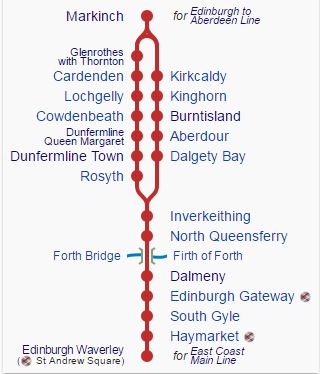
Note that the junction where the Fife Circle Line splits South of Markinch station, is the one shown in the Google Map.
Electrification
The Fife Circle and the Edinburgh to Aberdeen Line are not electrified and there are no scheduled plans to do so, other than the aspiration of having more lines with electric services.
But various factors will effect the types of trains between Edinburgh and Perth, Dundee and Aberdeen.
- Distances are not hundreds of miles.
- Virgin’s electro-diesel Class 800 trains will be working between Edinburgh and Aberdeen.
- Could Hitachi build electro-diesel versions of their Class 385 trains, as they share design features with the Class 800 trains?
- Will Hitachi add energy storage to Class 385 trains?
- Abellio are rumoured to be introducing trains with energy storage in East Anglia. Would this expertise be used by Abellio ScotRail?
I think we could see a cost-effective strategy implemented, that included electric trains, but a limited amount of overhead wiring.
- Edinburgh to Dalmeny – Electrified
- The Forth Bridge could be left without wires, if it were thought too sensitive for the Heritage Taliban.
- North Queensferry to Perth – Electrified
- Ladybank to Dundee – Not electrified
- Fife Circle via Cowdenbeath and Dunfermline – Electrified
- Levenmouth Rail Link – Not electrified
Note.
- As Stirling and/or Dunblane will be electrified, will Stirling to Perth be electrified?
- Between Dalmeny and North Queensferry, diesel or battery power would be used on local services.
- I have flown my virtual helicopter round the Fife Circle and it doesn’t look that electrification would be a nightmare.
- The Levenmouth Rail Link could be run by battery trains, with a charging station, like a Railbaar, at Leven station.
Appropriate trains would provide all services.
Services
Obviously, what services are introduced depends on passenger traffic.
But after a quick look at the lines, I suspect that the Levenmouth Rail Link fits well with current services on the Fife Circle.
Bear in mind too, that reopening the St. Andrews Rail Link , could be a possibility.
Conclusion
The railways North from the Forth Bridge in the East and Stirling and Dunblane in the West to Perth and Dundee could be much improved. I would do the following.
- Some short lengths of electrification.
- Bi-mode or battery versions of Class 385 trains.
All trains going over the Forth Bridge, should have large windows. The Bridge Visitor Centre must also have easy access with perhaps a free shuttle bus from Dalmeny station.
One of Scotland’s major assets, must be made to work for its living.
ScotRail In Trouble
This article on Rail News is entitled Major improvement plan for struggling ScotRail. This is the first paragraph.
The ScotRail Alliance has unveiled a plan to improve performance, after managing director Phil Verster had described the task of upgrading the network while running trains day-to-day as like ‘performing open heart surgery while doing a marathon’.
After my troubles at the weekend on n Northern Rail with overcrowded trains around Blackburn, I wonder if a pattern is emerging.
Consider.
There is a lot of work going on in Scotland to electrify Glasgow to Edinburgh under the EGIP scheme.
There are delays to the electrification.
ScotRail will soon be receiving a a new fleet of Hitachi Class 385 trains.
There has been a union dispute.
Similar patterns are seen across the network, including in the following places.
- Manchester Area
- Northern England
- Southwards from London
- Thames Valley
- Valley Lines In Wales
I do wonder if the announcement of jam, milk and honey in a few years, prompts people to anticipate the new services and the passenger numbers grow, prior to the new services.
All this probably says, is that we should have a long term plan for the railways, which doesn’t get cut back, the next time government has a budget crisis.
Expanding The Scottish Sleeper
There is an article in Rail Magazine entitled New Destinations For Scottish Sleeper Trains?.
Oban and the Far North of Scotland are mentioned, as new destinations for the Caledonian Sleeper.
Oban
Oban station is on a branch of the West Highland Line to Fort William.
One of the attractions of Oban for the operator, is that it is a port.
- Four ferries go to the offshore islands.
- It would be so convenient to get off the Sleeper and then get on a ferry to your ultimate destination.
- The Scottish diaspora would love it.
I suspect that Serco’s Marketing Department have the link to the ferries in mind.
Currently, Euston to Fort William takes twelve hours and forty minutes, with the train dividing into three portions at Edinburgh Waverley station.
To serve Oban, it would probably need the train to spin off an extra section which went to Oban.
At present it would appear, that you would get off the Caledonian Sleeper at Crianlarich at 0745, and wait until 1015 to catch the train to Oban.
If that is actually what happens, it’s not very passenger-friendly.
You can also get to Oban at the same time, by taking the sleeper to Glasgow and changing trains there.
As I suspect that the train operator; Serco are serious about getting more passengers to the Caledonian Sleeper, there would seem to be some ways to get passengers to Oban earlier in the morning, perhaps by timetabling an earlier train to Oban that meets the two sleeper trains better.
Once they knew that sufficient passengers were travelling between London and Oban, Serco could start to think about running a direct service.
But would it be a further split of the Highland service at Edinburgh or a split of the Lowland service at Glasgow?
The current frmation of the Highland Sleeper, is given in this section inWikipedia.
This is said in Wikipedia about the splitting off the train in Edinburgh.
The front two sleeping carriages are for Fort William, being combined at Edinburgh with a further two sitting carriages to make a four-vehicle formation. The middle portion of either six carriages is for Aberdeen, and the rear portion of eight carriages is for Inverness. Both the Aberdeen and Inverness portions usually convey one sitting and one lounge carriage each, with the rest being sleeping cars, all working through to/from London.
It might just be too complicated, to split the train for Oban at Edinburgh
The Far North
Serving the Far North Line to Wick and the intermediate stops may well be an ambition, but running a profitable service will surely have problems.
The sleeper takes eleven and a half hours to Inverness and the current local train takes four and a half hours between Inverness and Wick, which makes sixteen hours for the journey. That is just too long, when you can fly it in four hours.
The New Rolling Stock
The new rolling stock from CAF must be the key to improving the service for both the operator and passengers.
- The current sleeper trains are not the fastest and are generally limited to 40 mph in the Highlands.
- But even on the West Coast Main Line, the trains don’t go very quick, taking seven and a half hours for the journey, as opposed to four and a half for the fastest Virgins.
- I would suspect that the new coaches will probably go faster and still give a good night’s sleep. Not that I have any complaints about the current sleepers.
- Modern technology would probably improve the time to couple and uncouple the various sections of the trains.
- The mix of carriages will give the operator more flexibility, with respect to the formation of trains.
- Wikipedia has section on the new Mark 5 Coaches, which says there are 75 coaches of four types, arranged into four sixteen coach trains, with eleven spares.
- As new trains and coaches attract interest in a train service, I would not be surprised to see the new coaches attracting more passengers to the Caledonian Sleeper.
Four trains is an interesting figure, as at present they only use two; one to the Lowland and one to the Highlands.
But for the first time in the thirty years since the original Mark 3 coaches were built, if the Caledonian Sleeper needs to increase their number of coaches, there will be a manufacturer, who will probably be happy to oblige.
Ladbrokes wouldn’t give me odds on CAF building new coarches for the Night Riviera.
European Services
The first two Eurostars to Paris leave at 0540 and 0701 and the first to Brussels at 0650. At present the sleeper from Glasgow gets in at 0707, but surely better timings between the two services would attract more passengers, who wanted to have a good night’s sleep and be in Paris or Brussels early.
I doubt there is any great demand for a direct sleeper service between Scotland and Paris or Brussels and the cost of the trains would be prohibitive.
But by interfacing the two services properly, there could be a market to be developed.
The new rolling stock with there more generous performance might mean that this is a lot easier.
Kings Cross
This article in Rail Magazine is entitled Sleeper MD Considers King’s Cross Potential.
Apparently, passenger feedback from when King’s Cross is used is very positive because of the station’s better connectivity.
I have this feeling that if they moved the Caledonian Sleeper to King’s Cross. during the rebuilding of Euston, that it would never go back.
Onward From The Sleeper Destinations
If you are coming south and arrive in London around seven in the morning, you have lots of modern, comfortable trains to go onward to your ultimate destination.
When I looked at Oban, it struck me that the connections to the sleeper, weren’t as good as say those in London to Bath, Bournemouth, Cardiff or Paris.
So perhaps one of the things that would help the current service is good onward connections in comfortable trains. Abellio Scotrail are committed to improving train services in Scotland, so they may be doing this.
Cnclusion
There is no doubt that the current Caledonian Sleeper is a valuable and much-loved service. The fact that Serco are buying new carriages from CAF, is not an act of charity and must be because the company believes that they can improve the profitability of the service.
I believe that although eventually, there may be services to other destinations in Scotland, that in the meantime better onward connections may be a more cost-effective solution.
It also has to be said, if improved services work to Scotland, then they’d surely work between London and Cornwall.
Optimism For The Brders Railway To Hawick
This article in the Southern Reporter is entitled New Hope For Railway Extension.
It describes how politicians are getting together to extend the Borders Railway to Hawick. This was said.
In a speech in Edinburgh on Monday, Scottish Secretary David Mundell pledged to work with the Scottish Government on connecting the Borders with the national rail network to the south, saying it was a “realistic prospect”.
He said: “Scotland needs good transport links to thrive.”
It is my view, that the railway was not fully thought out in the first place.
The big thing that was missed was the Overground effect!
This was demonstrated so well here in London, when the transforming of the North and East London Lines from a set of travelling scrapyard-ready urinals into a modern railway, brought so many new passengers out of the woodwork, that trains soon became overcrowded and more and longer trains had to be ordered. Last week, it was announced that there will be more late trains, which I wrote about in The London Overground Grows Without Fuss.
The Overground just keeps on growing, so why won’t the Borders Railway?
My friends in the Borders tell me the trains don’t have enough capacity and there is not enough parking at Tweedbank. Anybody working on or living by the London Overground could have told the good people of the Borders this would happen.
The solution is probably to extend to a Galashiels-style transport interchange at Hawick, stop at Melrose and the Borders Hospital and procure some new four-car trains to work the line.
I also believe strongly, that Bombardier and Network Rail by the use of some intelligent design could enable the line to be served by Aventra IPEMUs, that would avoid the need to have electrification gantries marching all over the hills.
The Scottish Borders Have Caught London Overground Syndrome
The Scottish Borders would appear to be suffering from that new benign disease;London Overground Syndrome!
This disease, which is probably a modern version of the Victorian railway mania, was first identified in East London in 2011, when it was found that the newly-refurbished East London Line and North London Line were inadequate due to high passenger satisfaction and much increased usage. It has now spread across other parts of the capital, despite various eradication programs.
- Lengthening the trains from three to five cars.
- Adding step-free access or rebuilding stations like Brondesbury, Hackney Central, Hackney Wick, Hampstead Heath, Kensal Rise, West Hampstead and Whitechapel.
- Extending the system with a new branch to Clapham Junction station.
- Taking over the Lea Valley Lines to Cheshunt, Chingford and Enfield Town.
- Modernising and electrifying the Gospel Oak to Barking Line.
- Extending the Gospel Oak to Barking Line to Barking Riverside.
- Taking over the unwanted Romford to Upminster Line.
The latest pressure would seem to be to take over more of London’s suburban routes.
Londoners can’t seem to get enough of the life-improving orange.
Rail Plans For The Scottish Borders
This article on the BBC is entitled Borders Railway: Future Goals For New Routes Drawn Up.
Reading the article, it would appear that the following are proposed or are possibilities for the Borders Railway to mitigate the effect of London Overground syndrome.
- Building on the current success.
- Extending the railway to Hawick.
- Add some dynamic passing loops to increase service resilience.
- Add some more parking.
- Improve the wi-fi.
- More capacity and especially for tourism-related reasons.
- More steam trains.
- A possible branch to Peebles.
It would appear to be all well-thought out ideas, some of which will happen.
- More car parking at Tweedbank and Stow
- Longer trains with space for bicycles.
- Perhaps a longer passing loop. to enable increased and faster services.
- A turnback facility at Tweedbank to aid the running of stem trains.
- Better wi-fi.
But most of these projects are easily costed and the benefits can be calculated. So they are ones that accountants like and can fund or turn down.
Onward To Hawick
The Wikipedia entry for the Borders Railway, says this about a proposed extension to Hawick and Carlisle.
The Campaign for Borders Rail has called for the continuation of the line to Melrose and Hawick, and eventually to Carlisle. According to the group, Hawick suffered more than any other town in the Borders from the closure of the Waverley Route, and only the return of the railway could halt the area’s economic decline. At the time of the closure of the Waverley Route, Hawick was a 70-minute journey from Edinburgh. At Melrose, the southbound station platform and building exist alongside the Melrose Bypass. Network Rail has confirmed that there is nothing to prevent the extension of the line beyond Tweedbank, although commentators have remarked that the Bypass could pose problems. A major realignment of the road would be required, as well as the reinstatement of embankments and bridges.
I have traced the route of the Waverley Route beyond Tweedbank station on Google Maps and you can see a lot of the original route to Hawick, which only seems to have one viaduct at Ale Water.
Note that there appear to be a succession of viaducts to the South of Hawick, so perhaps Hawick would be a town to take a breather. I’ve also traced this section on Google Maps and if it was ever rebuilt, it would certainly be some railway.
I think that they could spend a lot of money going all the way to Carlisle, but an affordable extension to Hawick via the Borders Hospital and Melrose might be so successful as to get the politicians to allow the engineers to go all the way to Carlisle station, which as I reported in If Manchester Victoria and Birmingham New Street Were The First Two Courses, Is Carlisle The Third?, is being rebuilt to give all friendly visitors a warm welcome.
Power To The Peebles?
I’ve borrowed the corny sub-heading from a section in the BBC report, that prompted me to write this post.
The report says this.
It also recognises the success of the Borders Railway as encouraging hopes of reopening other lines.
It said some might not be suitable for redevelopment but cited the former route between Edinburgh and Peebles as one worth considering.
I think the route to Peebles is the Peebles Railway, which leaves the Borders Railway, just South of Eskbank station, goes South Westerly to Peebles and then Easterly to rejoin the Border Railway North of Galashiels station.
This sudden appearance of a plan for a Peebles Branch of the Border Railway has got my suspicions that a group of engineers have resorted to the methods of Brunel and Stephenson to solve the problem of increasing the double track on the Borders Railway.
I suspect the engineering fag packets and used envelops were produced together with a bottle of Scotland’s finest malt whisky and everybody went to the garden of a suitable hostelry, that overlooked the line and got thinking.
They looked at some of the single track sections like Newbattle Viaduct and thought that rebuilding railways in Syria might be easier.
Then they looked at the route of the Peebles Railway and felt if it was rebuilt, it would kill three birds with one stone.
- Peebles and a few other places would be connected to the rail network.
- The Borders Railway would get a much needed passing loop.
- Various tunnels and viaducts on the Borders Railway would not need to be double-tracked.
The Peebles Branch could be single or double-tracked according to the terrain and the costs.
A Second Borders Railway
It would also appear that because of the success of the Borders Railway, that there are suggestions to add new stations on the East Coast Main Line at Reston and East Linton. This is said under Future in the Wikipedia entry for East Linton station.
Proposals to reopen the station, along with the former station at Reston, have received the backing of John Lamont MSP, who has taken the case to the Scottish Parliament. A study published in 2013 proposed that East Linton and Reston stations be reopened. Since Abellio ScotRail took over the franchise in April 2015, they have now committed to reopening East Linton and Reston Stations as part of the local Berwick service by December 2016 but due to the shortage of rolling stock this will now commence in December 2018.
So it would appear there is a high chance it will happen.
This Google Map shows the location of East Linton between Dunbar and Edinburgh.

East Linton and Dunbar
East Linton is indicated by the red arrow and Dunbar is on the coast to the East.
Dunbar station is on the East Coast Main Line, with services to Edinburgh and Berwick-on-Tweed.
This Google Map shows the proposed location of Reston station, which is between Dunbar and Berwick-on-Tweed.

Reston And Berwick-on-Tweed
Reston is indicated by the red arrow. The river at the bottom is the Tweed, with Berwick on the coast and the border.
This scheme looks to be a very sensible use of an existing main line. It also follows a pattern of adding Parkway stations to main lines and the recent opening of the new Cranbrook station on the West of England Main Line.
There would appear to be a few other closed stations on the line.
As they are not mentioned with respect to East Linton and Reston stations, I would assume that there is not a great deal of pressure for reopening.
If we look at the possible opening of services to East Linton and Reston stations in 2018, when Abellio Scotrail have trains available, this will only be a year before First TransPennine extend their Newcastle services to Edinburgh.
So could this hourly service stop at other places between Newcastle and Edinburgh, other than the proposed Morpeth?
The Berwickshire Railway
When I was looking at the Wikipedia entry for Reston station, I noticed that the Berwickshire Railway linked the station to St. Boswell’s station on the Waverley Route, which could be part of the extension of the Borders Railway to Hawick.
I suspect someone has looked at this line to create a route to Galashiels from the South East via Reston, St. Boswell’s, Melrose and Tweedbank.
But this report of the Storm of 1948 probably told them to forget the idea.
Scotland To Keep Class 170 Trains
This article on Global Rail News, which is entitled Scotland promises bumper timetable from 2018, says this.
ScotRail will introduce 200 additional services to its timetable from 2018 after extending its lease on 13 Class 170 diesel multiple units.
Additional funding from the Scottish government will allow ScotRail to retain 39 Class 170 carriages beyond 2018.
The deal, which was announced yesterday (March 15), represents 20,000 extra seats daily.
It’s all a bit of a surprise to me, in that I had assumed that the Class 170 trains, that will be released by brand-new Class 385 trains would be moved elsewhere.
So it could be that Scotland’s gain is a loss in England and Wales?
But there could be another reason, why there has been no adverse comment from the rest of the UK!
New trains could be coming to lines that desperately need replacements for elderly diesel multiple units.
Already we’ve had the order for CAF Civity trains, but this non-transfer tells me something else could be on the cards.
- Another order for new trains.
- The predicted Class 387 IPEMUs will finally appear.
It will be interesting to see what happens.
Aberdeen Gets A City Deal
Yesterday as reported in this article on the BBC, Aberdeen got a City Deal.
Acording to the BBC, the funding will be used as follows.
- An initial £200m to improve journey times and increase capacity on key rail links between Aberdeen and the central belt, upgrading the rail line in the Montrose basin
- £24m for the trunk roads programme to support improvements to the key A90/A937 south junction at Laurencekirk
- £10m for extension of digital infrastructure in the Aberdeen and Aberdeenshire area above and beyond the commitment through the City Deal
- £20m in infrastructure funding to unlock housing sites that are of strategic importance to the local authorities as well as five-year certainty on £130m of affordable housing grant.
It all seems good to me, given the problems of the oil industry.
I gained a unique perspective to the North of Scotland, when I travelled from Edinburgh to Inverness, a few years ago. I wrote about the trip in Edinburgh to Invernesss In The Cab Of An HST.
InterCity 125s may be iconic transport, but Scotland’s two Northern cities and the surrounding areas need many more quality services to Edinburgh and Glasgow.
The rail part of the City Deal talks about dualling the railway line from Aberdeen to the South.
I would go further. Consider.
The Aberdeen to Edinburgh Line is a 100 mph railway.
The Aberdeen to Glasgow Line branches off at Dundee and goes to Glasgow via Perth and Stirling.
Important communities are served all along the railways.
Services are every hour, but some are slow, as there are a lot of stops.
In my view Scotland North of the Tay, is ideal IPEMU country. I would run services between Edinburgh and Glasgow and Aberdeen using 125 mph electric trains with an IPEMU capability. These would shorten journey times, not just because of their speed, but because electric trains, stop at stations and then accelerate away in a reduced time.
Obviously, there would need to be some electrification.
- Across Aberdeen, Aberdeen Crossrail could be built between Dyce and Stonehaven, so that Aberdeen could have an electrified cross-city service.
- Around Dundee and Perth. This would come with the aspiration of connecting these two cities to the much-delayed Edinburgh to Glasgow electrification with electric trains. These trains could have an IPEMU capability.
It would give the Eastern side of the North of Scotland the railway links it needs.
To provide electric services to Inverness would be trickier, but as support for IPEMUs gets even more innovative, I suspect that Perth and Aberdeen to Inverness could be bridged.
I think IPEMUs are one area, where engineers will be able to marry all sorts of disparate technology together to give improvements, others would think impossible or even downright silly.
The main northern routes and their approximate distances are.
- Dundee to Aberdeen – 70 miles
- Aberdeen to Inverness – 100 miles
- Perth to Inverness – 110 miles
The only route that could be served by an IPEMU at the present time is Dundee to Aberdeen. But this would mean that creating an electric service from Glasgow and Edinburgh to Aberdeen is not the major engineering project that many believe it to be.
It would need.
- Creation of an electrified Aberdeen Crossrail from Dyce to Inverurie.
- Electrification from Stirling to Dundee via Perth.
- The purchase of some suitable trains with an IPEMU capability.
Get the railways to the North of Perth and Dundee right and the benefits to the North of Scotland could be immense.
- An improved rail service would increase tourism, with all the benefits that brings.
- Aberdeen Airport would get a proper rail service.
- Edinburgh to Aberdeen by train is now well over two hours. Steam trains in the 1895 Race To The North did it in only an hour longer.
- 125 mph trains with an IPEMU capability could break the two-hour barrier.
- Ferries for the Orkneys and Shetlands leave from a port near to Aberdeen station. so those islands could benefit.
I also believe that if the lines are improved in the North, then connectivity in the South of Scotland should also be improved.
- Glasgow Crossrail would improve rail links through Glasgow.
- Some form of Glasgow Airport Rail Link should be provided.
- The Borders Railway should be extended to Carlisle.
- The Glasgow and South Western Railway should be electrified to provide an alternative to the West Coast Main Line.
Scotland needs to get its railway improvement plans into shape.
‘Encouraging signs’ on Borders Railway Extension to Carlisle
The title of this post is the title of an article on the BBC. This is said.
An MP has said there are “encouraging signs” that the “fantastic vision” of extending the Borders Railway to Carlisle could be realised.
Calum Kerr made the claim in a piece written for the Campaign for Borders Rail newsletter.
This is original article on the Borders Railway! This is said.
The good news is that there are encouraging signs we may be able to win cross party support on this. For instance, I’ve spoken to my neighbouring MP David Mundell, who is the Secretary of State for Scotland in the UK Government. He’s broadly supportive and is planning to speak to the Department of Transport in London to gauge its views.
I’ve also been in discussion with MPs on the English side of the border. They’re also warming to the idea. In particular, I’ve had several discussions with Rory Stewart, who represents the seat of Penrith and the Border, and he’s keen on getting it onto the agenda.
I think the involvement of Rory Stewart is significant. I remember him from one of his excellent documentaries called Border Country: The Story of Britain’s Lost Middleland, which was a fascinating history of the lands both sides of the England-Scotland border.
When I wrote If Manchester Victoria And Birmingham New Street Were The First Two Courses, Is Carlisle The Third?, I wrote this.
I just wonder, if whilst they are rebuilding the platforms, they will electrify some of the bay platforms. Or at least do the preparation work!
This would enable IPEMUs to be able to be recharged, if they were serving routes out of Carlisle, like the Tyne Valley Line, Settle to Carlisle and possibly an extended Borders Railway.
Incidentally, I think that by the time Carlisle station is updated in 2019, IPEMUs or battery trains, would have enough range to reach Edinburgh. You can see the headlines in the Sun!
After reading Calum Kerr’s thoughts, I feel even more that Network Rail have a cunning plan to make Carlisle station a hub for IPEMUs, which would serve the following routes.
- The Borders Railway to Edinburgh
- The Glasgow And South Western Railway to Glasgow
- The Tyne Valley Line to Newcastle
- The Settle-Carlisle Line to Leeds
- The Cumbrian Cost Line to Barrow and Lancaster
Note the following.
- The only major infrastructure work would be the completion of the Borders Railway to Carlisle.
- The area is noted for its superb scenery and occasional extreme weather. Not electrifying large sections of remote and exposed rural lines, is an attractive option, in terms of planning, engineering, building and maintenance.
- Technology exists to do all signalling by radio links.
- The last two lines would probably need some limited electrification to charge the trains en route.
- The Cumbrian Coast Line could be electrified between Sellafield and Barrow, where the line is better protected.
- The infrastructure needs of a four-car IPEMU train, is similar to that of a four-car diesel multiple unit.
- The Glasgow and South Western and Tyne Valley Lines could probably accept IPEMUs tomorrow.
- The network has several connections to the major Anglo-Scottish routes, at Edinburgh, Glasgow, Leeds, Newcastle and Preston.
It would be one of the most scenic set of railway routes in the world!
I won’t comment on the commercial, social and tourism aspects of creating such a railway system.
Trump Forgot The Ace Of Clubs
This article on the BBC web site, is entitled Donald Trump loses wind farm legal challenge. This is said.
Donald Trump’s legal challenge to a planned offshore wind farm has been rejected by the UK’s Supreme Court.
The UK Supreme Court is probably the end of an expensive road.
My late friend; Brian, would have said that an old accountancy phrase would apply – Screwed, Glued and Tattooed.
Seeing as it’s Scotland, perhaps it should be the Scottish version – Screwed, Glued and Bagpiped. I’m certain, there are a large number of Scots, who have innovative uses of a set of bagpipes as an instrument of torture.
There is this article on the Aberdeen Renewable Energy Group, entitled EOWDC partners welcome Supreme Court decision. This is said.
Vattenfall and Aberdeen Renewable Energy Group (AREG), partners of Aberdeen Offshore Wind Farm Ltd, the company behind the European Offshore Wind Deployment Centre (EOWDC), welcomed today’s Supreme Court decision.
Andy Paine, Project Director for AOWFL, said: “This is another significant step forward for the EOWDC. It affirms the scheme’s potential to position Scotland, and particularly the North-east, as a centre of innovative offshore wind power. The project partners remain committed to seeing the EOWDC come to fruition and delivering long-term economic benefits to the region.”
It certainly looks like Trump didn’t have the heaviest club; the Ace, in his bag.
I’ll leave the last word to the Professional Golfers Association, as detailed in this report on the BBC entitled Donald Trump controversy bad for golf – PGA chief Sandy Jones. This is said.
The chief executive of the Professional Golfers’ Association says the ongoing controversy generated by Donald Trump is “not a positive thing for golf.”
Trump, who owns two Scottish courses, has been criticised for comments made during his bid to become the Republican Party’s US presidential candidate.
And Sandy Jones says the negative publicity around Trump is bad for golf.
“Sadly his political campaign in America seems to be getting in the way of all the great things golf offers.”
Tìoraidh!
Has The Government Parked Its Trains On Nicola Sturgeon’s Lawn?
The government has just published a document entitled Government intends to award Northern franchise to Arriva Rail North Ltd, and TransPennine Express franchise to First Trans Pennine Express Ltd.
The document starts like this.
The government promised passengers in the north and Scotland a world class rail service that would make the Northern Powerhouse a reality – today that is being delivered as new contracts for Northern and TransPennine Express franchises are awarded.
In some ways the proposals for Scotland are the most interesting.
Introducing new and additional services for Scotland, including a new, direct Liverpool to Glasgow service from December 2018 with new electric trains and extending existing services beyond Newcastle to Edinburgh from December 2019, and bringing in additional services from Manchester to Glasgow and Edinburgh from December 2017.
These will mean new electric trains and First TransPennine will be ordering forty-four new five-car trains.
I think the announcement will go down well in Scotland, although some politicians and others might be a bit miffed.
 The Anonymous Widower