Kent On The Cusp Of Change – Reading To Tonbridge
The Kent On The Cusp Of Change article in the July 2017 Edition of Modern Railways talks about reopening a service between Reading and Tonbridge stations.
This is said.
Kent County Council has recommended the restitution of through services to Reading, as existed many years ago when the route was operated by ‘Thumper’ stock. The council says that consideration should be given to a future option of providing a through Ashford – Tonbridge – Redhill – Gatwick – Redhill – Guildford – Reading service, potentially as a joint operation between the Great Western Railway (GWR) and South Eastern franchises.
This could build on the existing service level between Reading and Gatwick provided by GWR, and would link together several of the major towns of the south-east region with each other and with their local international airport.
The introduction of bi-mode rolling stock now being deployed across the railway network would resolve the problem of gaps in the electric power system on sections of this route.
In The East-Facing Bay Platforms At Reading Station, I talked about using trains with batteries to perform this service and considered it feasible.
I still do, but then bog-standard bi-mode trains might be a better option in terms of cost.
I also believe that a Reading to Ashford service via Gatwick Airport would be a very valuable route with the following connections.
- Wales and the West at Reading station.
- Gatwick Airport
- Hastings at Tonbridge station.
- Rail services to the Continent at Ashford station.
I also think, that once more Continental services stop at Ashford, as I indicated in Ashford Spurs, that this rail link could be one of those rail routes where usage is way about any forecast.
Conclusion
Given Gatwick Airport’s ambititious plans, I rate an Ashford to Reading service as a high possibility.
See Also
These are related posts.
- Abbey Wood Station
- Ashford Spurs
- Crossrail
- Elimination Of Slow Trains
- Fawkham Junction Link
- Highspeed Routes
- High Speed To Hastings
- Historic Routes
- Longfield Station
- Maidstone
- Thameslink
- Thanet Parkway Station
- Track Improvements
- Ultimate Class 395 Train
- Victoria As A Highspeed Terminal
To know more read Kent On The Cusp Of Change in the July 2017 Edition of Modern Railways.
Kent On The Cusp Of Change – Thanet Parkway Station
The Kent On The Cusp Of Change article in the July 2017 Edition of Modern Railways talks of the Thanet Parkway station.
The article says this about the station.
Thanet Parkway, a new station on the East side of Ramsgate, is one infrastructure investment that is steaming ahead. Due to open in 2020, the aim is that the new station will be launched with a reduced journey time from Thanet to London.
Currently, the fastest services between London and Ramsgate take seventy-five minutes.
As Ramsgate station, gets three Highspeed trains per hour to London, I could envisage a very passenger-friendly service of four trains per hour between St. Pancras and Thanet Parkway.
The only section of line between Thanet Parkway and London, that is not high speed line, would be the section East of Ashford station.
I wonder what times to Canterbury, Thanet Parkway, Ramsgate and Margate could be achieved if this section were to be improved.
I suspect somewhere between sixty and seventy minutes between St. Pancras and Thanet Parkway is possible.
Conclusion
Thanet Parkway seems to be a well-planned new station, as many new stations seem to be.
See Also
These are related posts.
- Abbey Wood Station
- Ashford Spurs
- Crossrail
- Elimination Of Slow Trains
- Fawkham Junction Link
- Highspeed Routes
- High Speed To Hastings
- Historic Routes
- Longfield Station
- Maidstone
- Reading To Tonbridge
- Thameslink
- Track Improvements
- Ultimate Class 395 Train
- Victoria As A Highspeed Terminal
To know more read Kent On The Cusp Of Change in the July 2017 Edition of Modern Railways.
Kent On The Cusp Of Change – Highspeed To Hastings
The Kent On The Cusp Of Change article in the July 2017 Edition of Modern Railways talks about running Southeastern Highspeed services to Hastings.
In Options For High Speed To Hastings, I laid out the four possibilities of giving Hastings station a fast service in around a projected seventy minutes to St. Pancras.
- Electrify Ashford To Hastings At 25 KVAC
- Electrify Ashford To Hastings At 750 VDC
- Use Class 802 electro-diesel trains
- Use Class 395 Or Class 801 trains with batteries
I discounted the first two and the current Modern Railways article discounts the third, as there might be problems with diesel tanks in the tunnels under London.
So it looks like, it will be up to the engineers at Hitachi to come up with a train with enough battery power to go between Ashford International and Ore stations.
The article also says that there will be one train per hour (tph) between London and Ashford, which will split and join automatically at Ashford, with one six-car section going to Hastings and the other reinforcing services to Dover.
I discuss the track layout changes needed at Ashford International in Track Improvements.
Onward To Eastbourne And Brighton
Some early reports about running Highspeed services to Hastings, also talked about running a better service along the South Coast to Eastbourne and possibly Brighton.
The Class 395 trains could turn-back further to the West, but this would require more expensive new Class 395 trains.
On the other hand, there are some 100 mph modern electric multiple units like the Class 377 trains, that could provide a quality service from Hastings to Brighton. I also think it would be possible to arrange a cross-platform interchange at Hastings.
This would also get round the problem of the relationship between the two franchises, who each run one service.
I estimate that based on the seventy minutes Hastings to London time, I’ve read in various sources, the following times would be possible.
- Eastbourne to St. Pancras – One hour and forty-one minutes.
- Brighton to St. Pancras – Two hours and twenty-eight minutes.
These compare with a current Eastbourne to Victoria time of one hour and twenty-seven minutes.
Conclusion
This will happen, otherwise Amber Rudd will have someone’s guts for garters.
See Also
These are related posts.
- Abbey Wood Station
- Ashford Spurs
- Crossrail
- Elimination Of Slow Trains
- Fawkham Junction Link
- Highspeed Routes
- Historic Routes
- Longfield Station
- Maidstone
- Reading To Tonbridge
- Thameslink
- Thanet Parkway Station
- Track Improvements
- Ultimate Class 395 Train
- Victoria As A Highspeed Terminal
To know more read Kent On The Cusp Of Change in the July 2017 Edition of Modern Railways.
Kent On The Cusp Of Change – Ashford Spurs
The Kent On The Cusp Of Change article in the July 2017 Edition of Modern Railways talks of the Ashford Spurs.
Not a new Kentish football team, but possibly one of the most important developments in Kentish railways in the last couple of years.
Eurostar’s Class 373 And Class 374 Trains
Eurostar are replacing their original fleet of Class 373 trains, with smart new Class 374 trains.
The Class 373 trains were built in the 1990s and were designed to run on both high speed and traditional lines and they had signalling systems to allow this.
Wikipedia says this about Class 373 Signalling Systems.
The class have multiple signalling systems, leading to a cluttered control desk. These include
-
Automatic Warning System, the British signalling system (induction-based), used in the Ashford area
-
Train Protection & Warning System, the warning system that supplements AWS, used in the Ashford area
-
Transmission Voie-Machine (TVM), used on lignes à grande vitesse, on Eurotunnel tracks, and on High Speed 1.
-
Contrôle de vitesse par balises, used between Paris Gare du Nord and the LGV Nord, on French lignes classiques and the HS1-connected throat around St Pancras. It is electro-mechanical with fixed radio beacons.
-
TBL, the Belgian signalling system (electro-mechanical), used between Brussels-South and HSL 1, Belgium.
Perhaps this is why multi-tasking is needed to be a train driver.
On the other hand, the Class 374 trains have just one signalling system, that can be used in the UK, France, Belgium, the Netherlands and Germany. And that is just for starters. Wikipedia says this about the operation of the two trains.
Eurostar International’s existing fleet of Class 373 “Eurostar e300” trains, which date from the opening of the Channel Tunnel in 1993, cannot operate under the 15 kV AC overhead line (OHLE) electrification system used in Germany, most cannot operate under the 1.5 kV DC overhead line (OHLE) electrification system used in the Netherlands and they do not have sufficient space to install ERTMS signalling. Therefore, Eurostar cannot use its Class 373 units on services to these countries and the Class 374 was designed and built to go where the Class 373 could never go. The Class 374 has replaced around half of the Class 373s, with some Class 373s being scrapped in the UK after the introduction of the new trains.
Class 374 Trains And Ashford International Station
The one place, where the Class 374 trains can’t go on the existing network is Ashford International station, as the platforms for high speed trains are on a loop from the high speed lines, which go over the station on a flyover.
Consequently, services from Ashford to the Continent have to use the older trains.
The Track Layout At Ashford International Station
This diagram from Wikipedia shows the lines through Ashford International station.

Note how the two main tracks of High Speed One use a flyover to get out of the way of Ashford International station. The Ashford Spurs connect the lines through the two platforms to High Speed One.
The Ashford Spurs Project
The Ashford Spurs resignalling project will allow the new Class 374 trains to call at Ashford International station, when it is completed in Spring 2018.
Eurostar trains will stop at Ashford, as required by the number of passengers who want to use the service at Ashford.
At present, three trains per day (tpd) to Paris and one tpd to Brussels call at Ashford, as against to five and four respectively at Ebbsfleet International station.
I suspect that the Class 374 trains can execute a stop faster than the older trains, so I think we’ll see Ashford getting a much improved service to the Continent.
The Modern Railways article also indicates that there will be a lot more connecting services to and from Ashford station, so passengers between Thanet and along the South Coast to Brighton and even Southampton, wanting to go to and from the Continent, will use Ashford for convenience.
There will be a lot of collateral benefits to things like house prices in the far South-East of England.
I would also feel that the area, would be an ideal business base for someone supporting an International business, that needs quick access to Amsterdam, Brussels, Cologne, London and Paris.
I believe that all the places I mentioned, will have fast direct trains to and from Ashford in a few years, with a customer-friendly frequency.
Conclusion
This project is reported to be costing less than five million pounds and it must be returning more than that to Kent.
See Also
These are related posts.
- Abbey Wood Station
- Crossrail
- Elimination Of Slow Trains
- Fawkham Junction Link
- Highspeed Routes
- High Speed To Hastings
- Historic Routes
- Longfield Station
- Maidstone
- Reading To Tonbridge
- Thameslink
- Thanet Parkway Station
- Track Improvements
- Ultimate Class 395 Train
- Victoria As A Highspeed Terminal
To know more read Kent On The Cusp Of Change in the July 2017 Edition of Modern Railways.
Kent On The Cusp Of Change
This is the title of an article in the July 2017 Edition of Modern Railways, which discusses the various issues that will be tackled by the new franchisee, who will take over from the current Southeastern.
Under Future Of The Franchise, Wikipedia says this.
In June 2017 the Department for Transport announced an Abellio/East Japan Railway Company/Mitsui consortium, incumbent Govia, Stagecoach and Trenitalia had been shortlisted to bid for the next South Eastern franchise.
The Invitation to Tender for the next franchise will be released in September 2017, the winning bidder will be announced in August 2018 and they will take over the franchise in December 2018.
So four big beasts will be fighting it out to run trains from London to Kent.
Over the last few years, new franchises; Greater Anglia, Northern, South Western Trains and TransPennine have all promised or arranged selections of the following.
- New fleets of trains.
- Refurbished trains.
- Lots of new seats.
- Increased frequencies.
- Better passenger facilities.
- Improved ticketing.
- Smart-card tuckering.
- Better repay systems for delays.
- Wi-fi.
I can’t believe that big promises will not be made in all the offers to take over the franchise.
So what will and what may happen?
The Modern Railways article discusses the following.
- Abbey Wood Station
- Ashford Spurs
- Crossrail
- Elimination Of Slow Trains
- Highspeed Routes
- High Speed To Hastings
- Historic Routes
- Longfield Station
- Maidstone
- Reading To Tonbridge
- Thameslink
- Thanet Parkway Station
- Track Improvements
- Ultimate Class 395 Train
- Victoria As A Highspeed Terminal
Each is discussed in separate posts.
Connecting Ebbsfleet International To South London
In the May 2017 Edition of Modern Railways, there is an article entitled Kent Capacity Constraints Highlighted.
The article says this.
The provision of a direct connection from Ebbsfleet to South London is proposed using the route from Swanley to Fawkham Junction, which was used by Eurostar services to Waterloo. Options include providing a new terminal platform at Ebbsfleet adjacent to the existing lines or a connection into the existing domestic platforms.
This Google Map shows the Chatham Main Line between Farningham Road and Longfield stations.
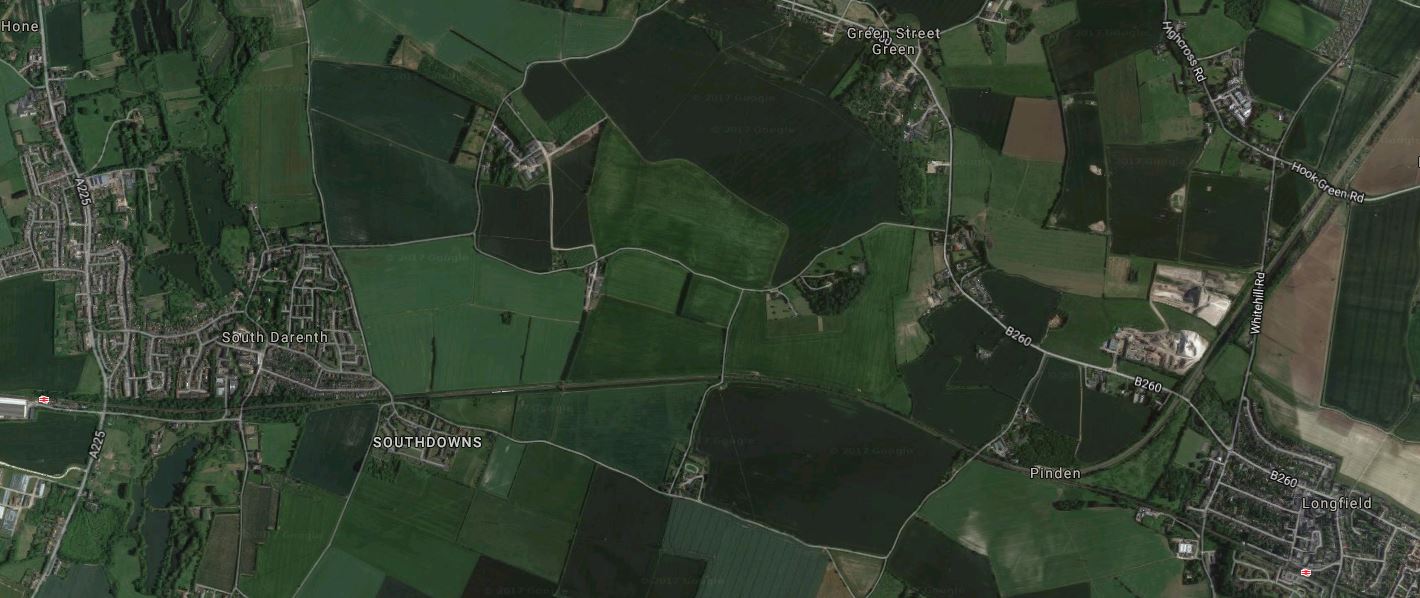
Note.
- The Chatham Main Line goes from West to East across the map.
- Fawkham Junction to the West of Longfield station.
- The rail line curves away North-Easterly to Ebbsfleet International station, using the same track-bed as the former Gravesend West Line.
This Google Map shows Ebbsfleet International station.
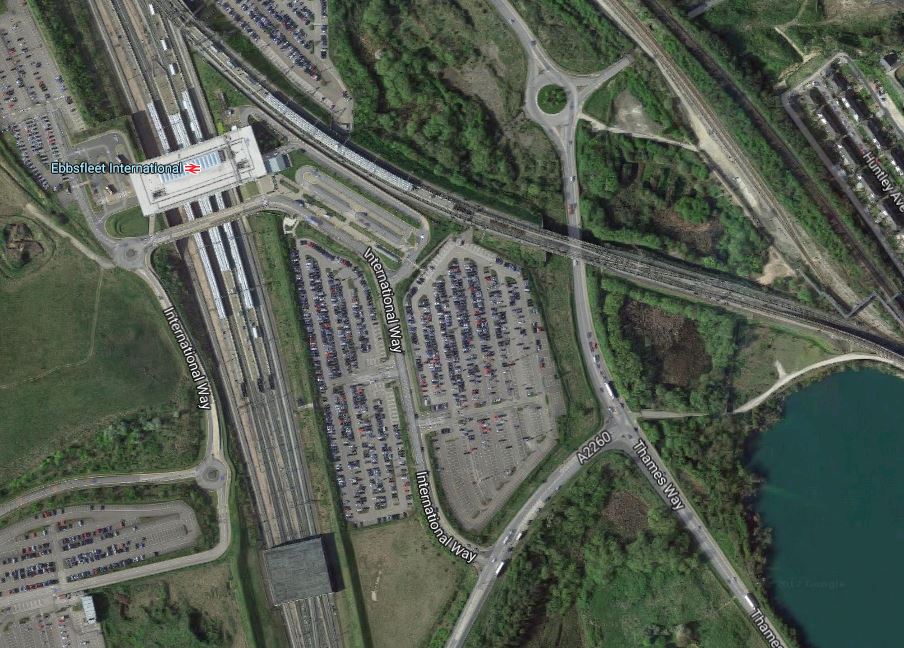
Note.
- HS1 runs North-South through the station.
- HighSpeed services to Thanet destinations use the line that runs across the map from North-West to East.
- HighSpeed services to Ashford Internationl station have their own separate platforms on HS1.
The local line into Ebbsfleet International station can be as simple or complicated as the budget will allow.
The simplest arrangement would be where a single track chord connects the Gravesend West Line into the space between the stations and its Eastern car parks.
This Google Map shows the station and the Gravesend West Line.
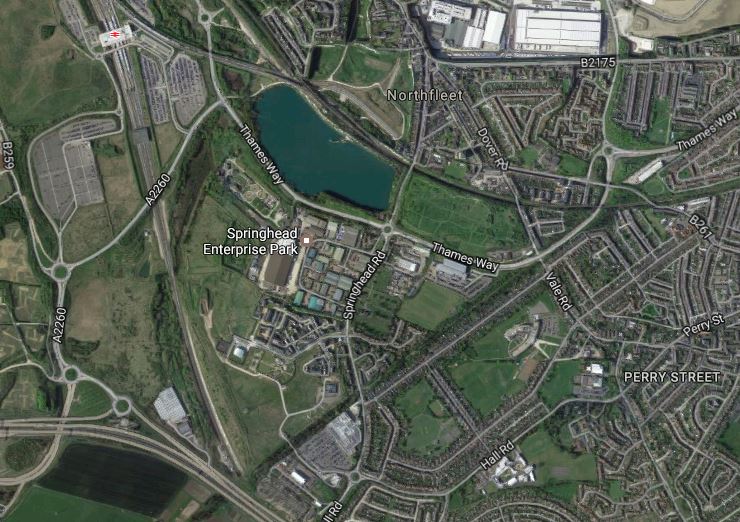
It almost looks like a good bit of space was left to connect Ebbsfleet International station to Fawkham Junction.
Train Services To Ebbsfleet
Southeastern and Thamesline are probably in pole position to provide services, as their services call at Swanley station which would be directly connected to Ebbsfleet International by the new link.
The most efficient solution would be a shuttle train or even a tram-train, at a frequency of four trains per hour.
But we shouldn’t forget Crossrail, that could be extended to Gravesend.
 The Anonymous Widower