Ranging Around Suffolk And Norfolk
I took the 09:30 Mark 3 express out of Liverpool Street station to Ipswich, buying a Day Ranger ticket for East Anglia north of Ipswich and Cambridge on the way from the conductor on the train for £11.40.
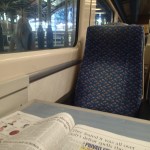

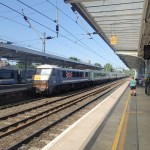
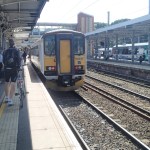
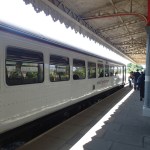
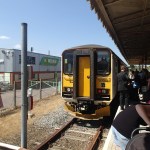


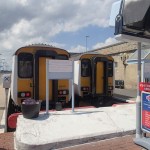
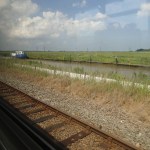

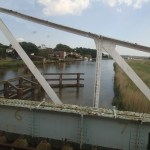

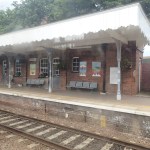
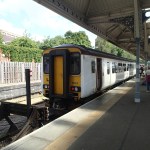


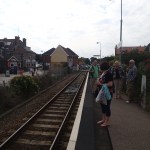
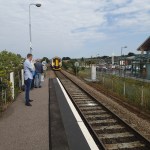

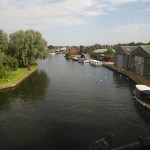
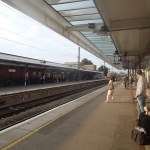
I hadn’t really decided on a route, but I started by taking the single coach Class 153 to Felixstowe and back.
The service between Ipswich and Felixstowe is now nearly twenty trains each way in the day and it seems to be more reliable since the Bacon Factory Curve has opened, which means that the service doesn’t have to thread its way through freight movements in Ipswich yard. Hopefully incidents like the one I suffered here, will happen less often.
When I lived in the town in the early 1960s, there were just a handful of services each way. It did wonders for a teenager’s social life when you didn’t have a car. The train I took wasn’t full, but it was pretty busy, with lots of families and tourists with buggies and bikes.
I wonder how long it will be, before the Felixstowe branch will be generating enough traffic for a two-car train? As it is, because of the length of the line, where a journey takes just twenty-five minutes or so, it means that an hourly service can be achieved with just one train.
There have been calls to reopen Felixstowe Beach station, but this simple schedule would be broken and two trains and some clever train operating would be required. So I’d be surprised, if it ever opened. It would probably be a lot cheaper to fund a bus, that met the train and distributed and collected the passengers all over Felixstowe.
The only way it will open, is if they electrify the line and the Port of Felixstowe encourages staff to come to work by train to a rebuilt Felixstowe Beach/Port station. But again, a bus from Felixstowe station would probably be better and more affordable.
Unfortunately, from Felixstowe I had to return to Ipswich to get the train to Lowestoft, as there is no easy train connection at Westerfield any more between the Lowestoft and Felixstowe branches .
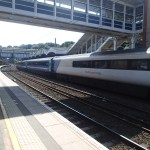
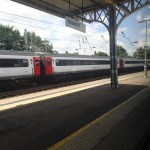
At Ipswich, I was treated to a passing through of one of Mark 3 expresses in Greater Anglia’s new livery. These coaches just refuse to go quietly.
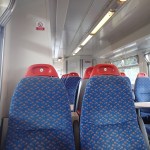
On the trip to Lowestoft, I used the new disabled toilet, that as I reported had been recently installed in the Class 156. The most remarkable thing about using the toilet was that I didn’t realise it was the new design. It was different and slightly more compact, but you didn’t have to think about how you used the door or the flush. But then that is the test of good design. If your target users don’t immediately know how to use something, then it is a bad design.
At Lowestoft I walked across the platforms to take another Class 156 on the Wherry Line to Norwich, where I stayed on the train to take the Bittern Line to Sheringham, where I intended to have lunch.
I did make a mistake in that my train back from Sheringham to Norwich, didn’t connect with a direct Cambridge train, as many do. So I had to go to Ely on a Nottingham service, before buying a ticket from there to London on First Capital Connect. My Ranger ticket covered the journey to Ely and I spent another £12.50 to get home.
Greater Anglia’s scheduling of the trains I took was excellent, as I didn’t wait more than a few minutes at either change of train or service. Looking at the timetables, it would appear that some journeys like say Beccles to Sheringham use these quick changes to minimise journey times. With a few more trains, it might even be possible to tie all these services together on an hourly basis. After all, if you knew that if you turned up at Lowestoft, Ipswich or Norwich and that in a few minutes your next train would be leaving, it would be a great incentive to travel by train.
Judging by the people, I saw on these busy trains, Greater Anglia will find that their services around Norfolk and Suffolk will see an increasing patronage.
Untangling The Knitting
I said in this post that due to good project management, I don’t believe that Crossrail 2 will get built as the planners think it should be now.
On the Great Northern branch, it is not just a question of choosing between New Southgate and Alexandra Palace as the terminus.
This branch will also be shared with two other services; Thameslink to the South of the Thames and the Northern City line into Moorgate.
Not only do you have the East Coast Main Line, but you have the Hertford Loop, going to Stevenage and the North.
To further complicate matters, you have the problem of the Digswell Viaduct and the possibility of the East West Rail Link going through the area.
I think the only certainty is that Crossrail 2 will be the catalyst that pushes the engineers to find a brilliant but unexpected solution.
In fact, I think from a logical point of view the problem of the Digswell Viaduct and the associated double-track section should be solved first, as it could be the key key that unlocks everything.
After all, if the line was four tracks all the way to Stevenage ans possibly even Peterborough, it would give the train companies all sorts of options about where to terminate suburban services out of London.
If there was more capacity on this section of the East Cosast Main Line, I’m sure that the train companies would find plenty of innovating ways to use it.
Should Crossrail 2 Go To Alexandra Palace Or New Southgate?
It looks like the planned terminus of the Great Northern branch of Crossrail 2 is going to be New Southgate rather than Alexandra Park.
I knew that area well fifty years ago, but looking at a recent map, there still seems to be plenty of space for a depot for the trains.
So at a first glance it would seem that the choice is probably down to engineering, operational and architectural reasons.
Project Managers Having Fun In The East
A lot of people moan that London and the South East get all of the rail infrastructure investment, but next time you travel up and down the country from Edinburgh or Newcastle to London, moaning why the A1 is such an inferior road or your train seems always to be held up, then you should perhaps be pleased that things might be getting a bit better due to one of the largest rail projects in the UK, that will be commissioned later this year.
The Great Northern and Great Eastern Joint Railway (GNGE) It ran from Doncaster to Cambridge via Lincoln, Sleaford and Spalding a dozen or so miles to the east of the East Coast Main line. It was built primarily as a freight line to get coal from Yorkshire to East Anglia.
Some southern parts of the line and the by-pass around Lincoln have been closed, but the rest of the line was used by passenger trains although gauge limitations meant that moving large freight trains was difficult.
One of the problems of the East Coast Main line is the number of freight trains that need to use the line. Between Peterborough and Doncaster, a lot of the line doesn’t have four tracks, so the fast express passenger trains have to mix it with much slower freight trains, which need to be passed.
This problem could have been solved by just four-tracking the main line, but Network Rail found that it would be cheaper to enable the GNGE to take all the freight traffic.
So a £230m project was started to upgrade the GNGE and provide the line with new track and signalling. As a by-product of the work tens of level crossings on the route will be eliminated.
This may seem a lot of money for essentially creating a freight by-pass from Peterborough to Doncaster, but according to this article in Rail Engineer it is a major project. Here’s what they say about the scope.
The first thing that strikes is the surprising scale of the scheme – some £330 million pounds is being spent on a stretch of railway which does not come across as particularly high profile. The changing pattern of freight has seen the route drop below the horizon and it is the resurgence in the last few years that has brought awareness of its potential to support, and help capacity, on the main East Coast route south of Doncaster. That scale can be summed up as 86 miles of route between Werrington and Doncaster and the renewal of 27% of the track and 53% of the point ends.
On top of the trackwork itself there are 49 underbridges, 19 overbridges and 82 culverts to be dealt with. There is even a tunnel where there is a 66 metre track-lowering job.
By comparison, the Borders Railway south from Edinburgh is a 50 km stretch of reopened railway from Edinburgh to Tweedbank and is budgeted to cost £348m. It should open in 2015.
The completion of the updated GNGE line later this year, should have some major benefits.
As many of the freight trains will be removed from the East Coast Main line between Peterborough and Doncaster, this will mean that passenger trains on the line will have more paths and will be less likely to be slowed. So this should mean more and faster trains up and down from London to Leeds, Newcastle and Edinburgh.
The ease of getting freight trains between Peterborough and Doncaster should mean that more traffic from Felixstowe and London Gateway to the North will be able to go by rail.
In the longer term, will it mean that more passenger services are run from Peterborough to Lincoln and from Lincoln to Doncaster?
The only problem I can see, is that all these freight trains trundling through the level crossing at Lincoln are going to create a lot of congestion. I discussed this infamous crossing in this post. A new footbridge has been approved which could help, but this level crossing really needs to be bypassed and closed.
The Long-Awaited Walthamstow Link Is Nearly Here
It should have been a simple job, but it has grown into an eighteen year saga.
Walthamstow Central and Queen’s Road stations are not far apart and a pedestrian link has been needed for years to make interchange possible. Finally, it will be opening next month, as is reported here in ThisisLocalLondon. In the end despite an agreement the Council had to take the developers to the High Court.
How many other simple links should be created to make travelling by public transport easier?
A Journey Into History At Todmorden
The title of this post is borrowed from this article in the Todmorden News about the opening of the new curve that I wrote about here.
The tone of the article is enthusiastic and it shows how these smaller rail projects are often really useful in their local area. This curve for instance will allow direct Manchester to Burnley trains for the first time in forty years.
All they need to do is rustle up some decent diesel multiple units. Then they’ve got to work out what services will use the curve. Judging by my experience of Burnley Manchester Road station, it couldn’t be used as a terminus. So where will the trains go after that station?
The area of the country that lies between Leeds and Manchester is an area that needs to be given a lift.
Projects like this can only help.
If this one proves to be the success all of its promoters expect, I suspect we’ll be seeing more of this type of project.
Network Rail engineers will hopefully be doing what they like to do most!
Blackpool And Huddersfield May Get Direct Services To London
I’m leaving the may in the title, as nothing is cast in stone yet, but according to this article, Network Rail have found the space to squeeze direct services to Blackpool and Huddersfield from London into the schedule, by a new train operator called Great North Western Railway.
The services won’t be running until 2017 at the earliest, as trains have to be ordered and built.
And who knows what will happen in the negotiations?
The Project Manager’s Lot Is Not An Easy One
I found this article on the Rail Engineer site and it describes in detail how the project managers at Network Rail reinstated the Todmorden Curve.
This paragraph talks about the checks that needed to be done before a level crossing was eliminated.
And then there’s the new footbridge. Sorry, didn’t I mention that? Previous usage surveys suggested that Dobroyd crossing was visited only by occasional dog-walkers; nobody expected any great issue with closing it. But due diligence demanded that another survey was conducted, with the crossing being monitored by CCTV around-the-clock for ten days. Initially the team didn’t believe the results: they suggested peaks of 150 users daily, most of them being children. Only then did it become clear that an activity centre had opened at nearby Dobroyd Castle in 2009 and the chosen route to get groups up there was over the railway. This launched the crossing’s risk assessment score into the north-west’s top ten.
Nothing is as simple as it is first thought!
Supper In St. Neots
I went to St. Neots for supper last night.
The ticket I got on First Capital Connect must have had the most bizarre restriction I’ve ever seen. It was an Off Peak return ticket bought with a Senior Railcard for £15.65. When I bought the ticket the machine said that I couldn’t use it out of Paddington.
How do you take a train out of Paddington and end up in St. Neots?
Coming back, I came into Finsbury Park station from where I came home by using the Piccadilly line to Manor House and then a 141 bus.
If there is one station in London that should be loved by a demolition ball it is Finsbury Park. There is a plan mentioned here on Wikipedia, but nothing seems to be happening.
My Pension Could Get A Boost in 2029
I have a good pension, although if I have a problem with it, it’s that I can’t find enough ways to spend it.
But the announcement yesterday that Crossrail 2 might open in 2029 can only be good for me.
I live in a quiet plesant tree-lined road about five minutes walk from Dalston Junction station, which could be one of the stops on the line. Even if it is not and Hackney Central and Angel are the two nearest stops, it all must be beneficial for the value of my house.
I would suspect that if Dalston Junction is not on Crossrail 2, then the Eastern Curve at the station might be reopened, so that East London Line trains can terminate somewhere in North East London.
After being ignored by transport planners for years it now seems that the North Eastern areas of London are finally getting the public transport, they desperately need.
Judging by the welcome the Overground has received in this area, I suspect that the good burghers of Hackney will welcome Crossrail 2 with open arms.
Crossrail 2 is having a consultation locally in July. I shall be going.
 The Anonymous Widower