Rail Ticket Machines
The on-line rail ticket system is good, in that you can pick up your tickets from any machine you want, anywhere in the UK. They do ask you to nominate a specfic one, but I generally use the ones in Kings Cross, as they are convenient for me and are often not very busy, as there are lots of them. They are also slightly more private than some I could name.
The biggest problem is that you need to type in a randomly generated transaction number. I usually text it to my mobile phone, so that when I look at the Inbox, all I see is the numbers of tickets I need to collect, so I can hold the phone in my left hand, whilst I type with my right.
The system could be improved, by allowing you to type in a collection code, when you buy your ticket on-line. So for East Coast, you might use EC and the last four digits of your phone number. As to get the tickets, you’d need to put in the right credit card, that would probably be as secure as the current system. In fact it could be more so, as I’ve seen people take little bits of paper out of their wallet and then read the code, whilst they type it. Some machines have a Qwerty keyboard, which can be difficult for those who don’t type too well.
It would of course mean that collecting multiple tickets, as I’m doing all the time at the moment would be very easy, as I’d use the same code.
So I would end up with a pile of little orange cards, that I’d have to check before I left the station. But that happems now. It’s just that I have to type in several numbers instead of one.
I would also like to see the fact that the ticket had been collected acknowledged to me in an e-mail. That way mistakes and fraud would be spotted earlier.
And why not have a few chairs by the machines so that some like me could sit down and sort everything out.
What Do We Do With the Old District/Met/Circle Line Trains?
Last night, I travelled to and from to Upton Park on some of the old D-stock trains. They may be thirty years old and are to be replaced in 2015, but they asren’t fit for the scrap heap yet. In fact with a bit of a tart-up, they would probably last another twenty years or so, judging by how well most Metro-Cammell trains were built.
Ride to Upminster and back on one and then say that they should be scrapped forthwith. You won’t get the words out, as none of the problems on the line, are the D-stock.
The good burghers of Harrogate, who might or might not live up to that Yorkshire stereotype of being canny have proposed that some of these trains be used between Leeds, Harrogate, Knaresborough and York.
The respected rail commentator, Alan Williams, hasn now weighed in with some south common sense. It might be Yorkshire common sense to, as I think he lives in Scarborough.
- He asks why this system is not being proposed elsewhere, like for the Welsh Valleys.
- He also says that it the thinking is very much in line with the McNulty Report. I suppose one could ask, if the civil servants are in-line with it. They probably aren’t as they never travel outside of London, except by air or limousine! It would be interesting to know how many of the top civil servants, who effectively run our railways have travelled in a Pacer.
- He says too, that they could use a modern protected third rail system, where the electric rail couldn’t be touched by trespassers. This is used on the DLR in the UK and in many places abroad. Perhaps civil servants would be more impressed with the proposals after a round trip of Europe inspecting systems elsewhere?
We could have a competition, where there was a prize for the most innovative use in a railway context of the D-stock trains.
Avoiding the Rain on the Train
One of the reasons, I wanted to use the bus to get home, even if it meant a change, was that it was raining hard. If I could have ended up on any one of several routes, I would have been dropped within a hundred metres of my house. Usually when you change buses, you don’t get that wet too, if you choose the changeover with care.
I have three choices of train from Stratford. I usually take one of.
- The Overground to Dalston Kingsland and walk.
- The Overground to Hackney Central and get a bus.
- Central line to Bank and then a bus.
All though would have meant a ten minute walk in the rain. And I didn’t have an umbrella with me.
So in the end, I took the Overground to Canonbury, then back on the East London line to Dalston Junction and then a bus along the Balls Pond Road. Not the simplest, but definitely the driest. It was very wet as this picture at Canonbury shows.
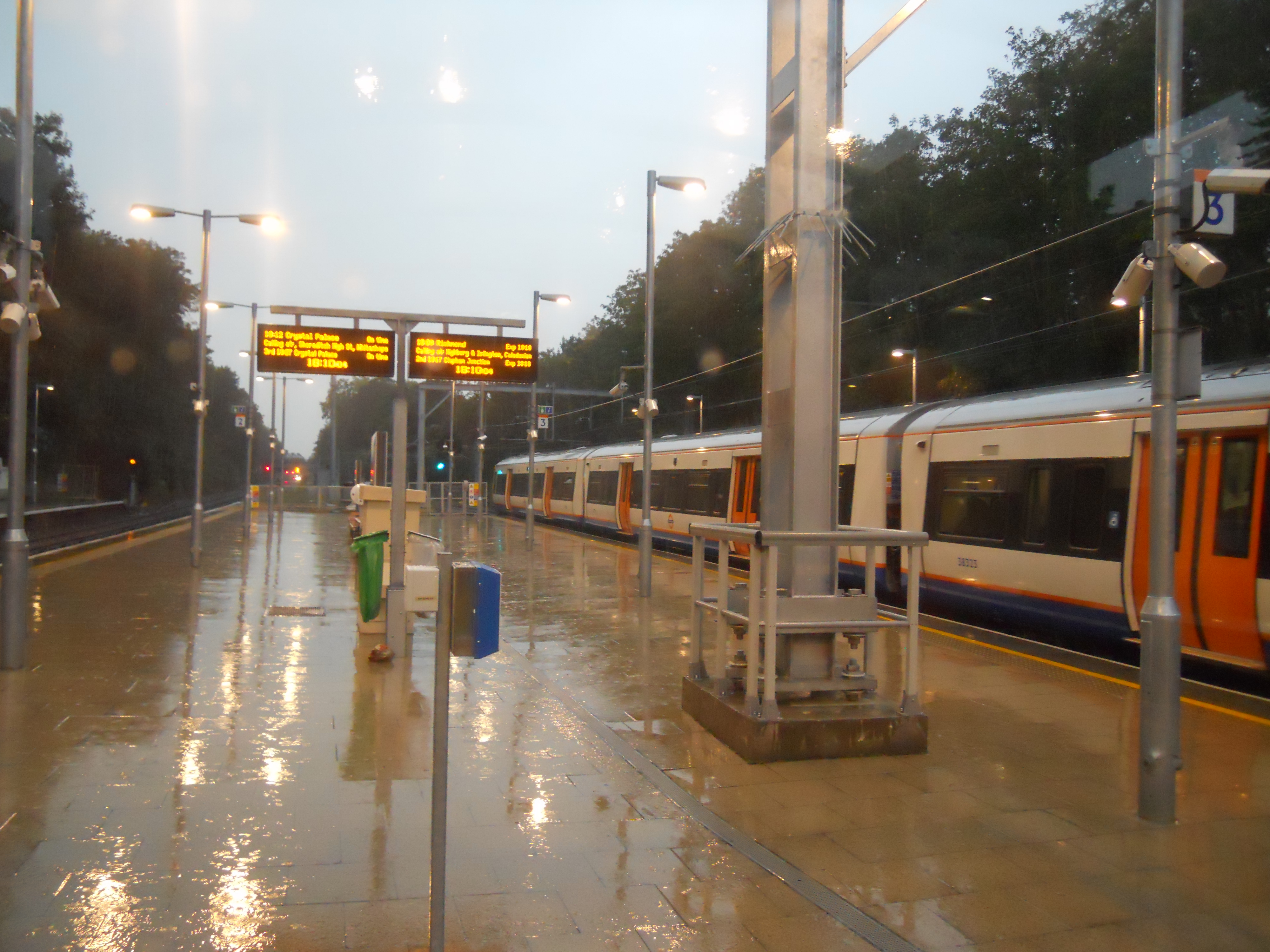
Canonbury in the Rain
To make matters worse, my preferred route via Hackney Central requires a walk over an uncovered bridge and I wasn’t the only person, who on seeing the weather there, declined to get off.
The Overground is one of those modes of transport, that is very good in fine weather, but some stations get you very wet, when it rains heavily.
The amount of passengers using the line is starting to cause problems. I left Stratford in the rush hour and getting to the platforms was difficult because of large numbers of passengers going the other way. I used the lift to avoid them. The platforms also need a Next Train indicator, as is common on many parts of London’s railways, both over and under the ground.
East Coast Tickets Are Not Exchangeable For A Sensible Fee
For my Day 1 trip from Accrington to London, I booked an advance ticket on the 10:05 from Leeds to London, that arrived at 12:30. The ticket cost me £26.45.
But at the time I booked, I hadn’t thought that I could fit in the Aston Villa part of the trip.
So I found that if I took an earlier train from Leeds, it would give me more time. But no matter, it said that I could exchange the ticket for a fee.
So I looked it up on the web this morning and found that there were tickets for earlier trains still available, albeit at a higher price. There were also Super Off Peak tickets available at £28.90, which is probably what I should have bought in the first place.
So I went to Kings Cross and found out that to exchange the ticket for a named train would cost me a fee of forty-one pounds or so. I’ve changed advance tickets in the past and I think I got charged five or ten pounds or so. That would have been reasonable, but not ideal, as in fact, I’m not sure which train I want to take. As it’s a Saturday, I have a feeling that a Super Off Peak ticket allows me to travel on most, if not all trains.
So I left, after realising I had a nice story for my blog and of course, I still had a valid ticket on the 10:05, even if it is a bit tight to get to Aston Villa.
At home, I found that the £28.90 ticket was still there, so to see if I could get it cheaper, I tried the TrainLine. But that wanted £40.90. I don’t pay booking fees to anybody, so they can go and find some other mugs.
So I went back to East Coast and eventually bought the ticket at £28.90.
It’ll be interesting to see what price, I could pay for a walk-up ticket at Leeds on Saturday.
To return to the title of this page. I don’t consider, a forty pound plus fee acceptable, when I can buy a fully flexible ticket for about two-thirds of the sum.
This trip is starting to get interesting. Perhaps I should follow Tony Hawks lead and travel with a fridge. The problem is that I’ve had enough medical problems in the past few years, I don’t want another caused by humping a fridge.
Kings Cross to Waterloo and Back
Waterloo is south of the river, so it doesn’t connect well to civilisation using the Underground.
On my trip between Accrington and Aldershot, I’ll need to travel from Kings Cross to Waterloo. I’ll also have to come back to get to the Arsenal. I did do a recce earlier, but today I checked out using the Bakerloo and then the Piccadilly or Vict0oria lines.
Going south, it’s just a Victoria line to Oxford Circus and then a cross platform transfer to the Bakerloo line for Waterloo.
Going north, you walk to the left on coming off a train at Waterloo and take the escalator down marked Bakerloo. At the bottom, you go through the gates and take another escalator. Then you can actually turn immediately left and take a shirtcut throgh to the northbound Bakerloo, where I found it was better to get in about the middle of the train. This means at Piccadilly Circus, you just walk to the back of the train to take the subway to the Piccadilly line. Get in towards the back of the train and you’ll be well placed to go straight up the escalators at Kings Cross. But as on Day 1, I’m going to Arsenal, I’ll get in towards the middle.
Hopefully, I’ll save a minute or so.
Slow West Trains
I wanted to get my ticket from Waterloo to Aldershot today for next Saturday.
As I wanted to get a ticket from the Zone 6 Boundary, and I have a Freedom Pass, I had to queue up at Waterloo.
I waited about twenty minutes, as they just didn’t have enough staff and I was not buying a ticket for today.
The good thing was that the ticket cost me just £6.20 return with a Senior Railcard and the Freedom Pass.
The Solution’s Behind You
The BBC were interviewing Ed Balls today at the Labour Party conference in Liverpool. He was pontificating on the solutions, that he would do to could Britain out of the financial mess, that largely his party got us in.
Who is right or wrong on the solution is a matter for the future.
Butb I think, that the solution to our problems was behind Ed Balls in his BBC interview. But then politicians never look behind themselves, except to see where the knife is coming from.
Over the last twenty years or so, Liverpool has been transformed, from a basket case, to one of the most vibrant cities in the world, by developing the city in a professional and quality manner. Liverpudlians will point to the European City of Culture in 2008, as a catalyst for a lot of the change, but in some cases it just gave developers a reason and possibly an excuse to invest.
London too, is changing and has been greatly improved over the last few decades. The development of Docklands started it and now the Olympics is pushing the city to new heights.
You could also argue, that Manchester got a kick start from the 2002 Commonwealth Games, but just as with Liverpool and London, the process was going to happen anyway and perhaps these events were just advertising for the place on a wider scale. Wikipedia says a lot about how the Games got Manchester moving after the 1996 IRA bombing. One might even say now that Manchester’s driving force is football.
Liverpool is getting a lot of publicity over the next couple of days, and how many will think about going there for a weekend break? When I was there last, I met a plumber who had come to the city for the day to ride his bicycle along the Mersey. Liverpool is almost becoming a seaside resort!
These three cities have benefited from a process that could best be described as Infrastructure for All.
I could also add how Newcastle has benefited from the waterfront developments along the Tyne. Other cities, like Leeds and Birminghamhave also been improved to everybody’s benefit.
I should also ask, if Glasgow is seeing the benefit for the 2014 commonwealth Games yet.
We must do this more in our run-down cities and districts.
Even on a local basis, Dalston has improved a bit in the year I’ve been here, mainly because of the opening of two new railways, that got built early because of the Olympics. But even if the Olympics hadn’t happened, they would have still gone ahead.
So we should look at all the infrastructure projects on the stocks and do those that are most valuable as soon as finances allow.
Priorities should obviusly go to those that give the greatest benefit. I would start with.
Housing, which would provide homes for our ever increasing population. It should be energy efficient and hopefully built, so that people who live there, don’t need to own one car per person, as we must wean ourselves off our own personal travelling spaces, they cost everyone else dear.
Selective rail projects, to remove bottlenecks and level crossings, improve stations and add a few new ones. In Suffolk, they are adding a new loop at Beccles so that more trains can run from Ipswich to Lowestoft. How many more Beccles-like problems are there out there, that need urgent removal. Many of these projects would have positive knock-on effects in other areas. Some level crossings, like the one in the centre of Lincoln, would have enormous benefits to road traffic, if they were removed.
Rail freight projects, which remove trucks from the roads. This would mean a few more interchanges such as Radlett, but the benefit to roads like the A14 and M1 would be high.
Personally, I would add a better bus network, with much better ticketing and disabled-friendly, information rich two-door buses, like you have in London. I have a free pass for buses, so why do I have to be issued with a ticket when I use a bus in Cambridge. It should be just touch in on all buses.
And of course, it’s important that we create interesting places for people to go. Some sports clubs have been trying to build new grounds for years and this process should be speeded up. And we don’t want any more stadia, like Coventry, Scunthorpe and the Rose Bowl designed solely to be driven to. They should be built near the transport hubs., which in itself would probably make them more financially viable.
You will notice, I’ve missed out new roads.
In many ways they are not infrastructure for all.
Some may need to be built or widened, but our priority should be to get unnecessary traffic off the roads.
I believe that we are seeing a drop in the number of trucks from the roads, as more and more container traffic is diverted to the trains. But this process needs some selective action at rail junctions, and it also needs more rail-based distribution centres near large conurbations. But the Nimbys don’t like these. Some also object to freight trains passing through at night.
There has been talk for years about taxing foreign lorries in this country, just as the Swiss do. The last time I drove the southern part of the M25, it was full of trucks registered aboard. We have the Channel Tunnel and goods to and from Europe should go through it on container trains, just like most of the freight goes in and out of the ports at Southampton, Felixstowe and Liverpool.
Every truck removed, is an increase in road capacity.
We also need better interface between the roads and rail. How many cities build large car parks in the centre, when perhaps building them on the outskirts and providing a tram or rail link to the centre? Cambridge was very much derided by doing this with a guided busway, by many including myself, but they now seem to be making a success of it.
 The Anonymous Widower