Dalston Junction Gets a Step Nearer To Being Fully Open
I went past Dalston Junction station this morning and the Southern entrance can now be used by pedestrians. Not only does this give me a safer route to the trains, without fighting my way through all the obstructions on the Kingsland Road, but it’s a couple of minutes quicker.
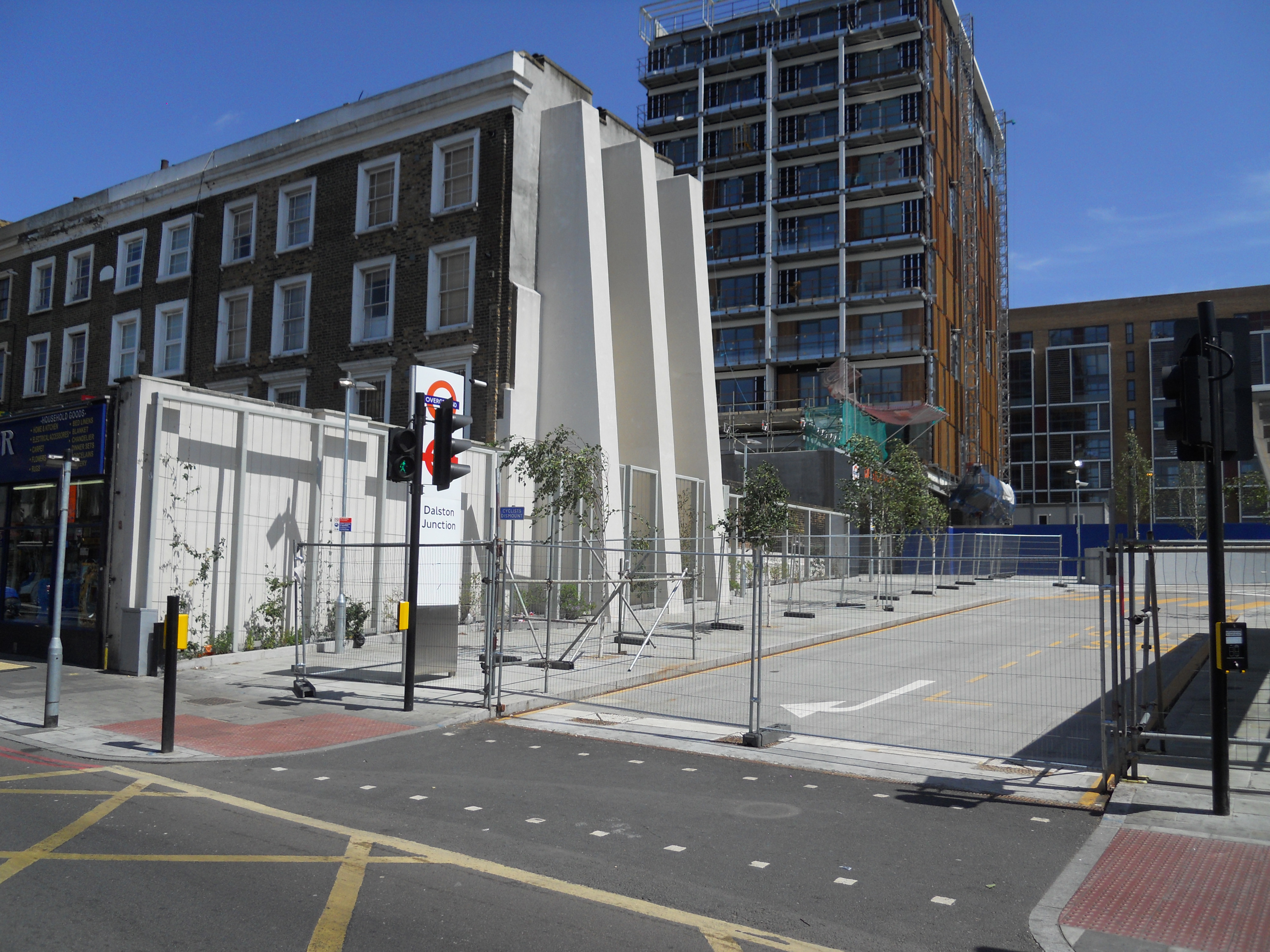
The Almost Fully Open Southern Entrance at Dalston Junction Station
There is still a wire fence, but according to the staff, I sopke to, it will remain open.
It also means that if you want to change at Dalston Junction to or from a 76 or 149 bus say, then it is all very quick and easy, as there is a light-controlled crossing across the Kingsland Road.
All the station needs now is the opening of the bus stand in the station itself, the extension of the 488 route and another light-controlled crossing over Dalston Lane.
Incidentally, it has been announced that there will be more trains on the North and West London Lines. So a trip to Earl’s Court will be just one across platform change from Dalston Junction.
Travelling With a Horse
Well not really, as the pony wasn’t allowed on the train.
I do remember a news story many years ago, where someone took a billy goat to a Scottish Island, by train from London. It travelled as a dog.
Bethnal Green Tube Station
I had to go to East London today and took time out at Bethnal Green station.
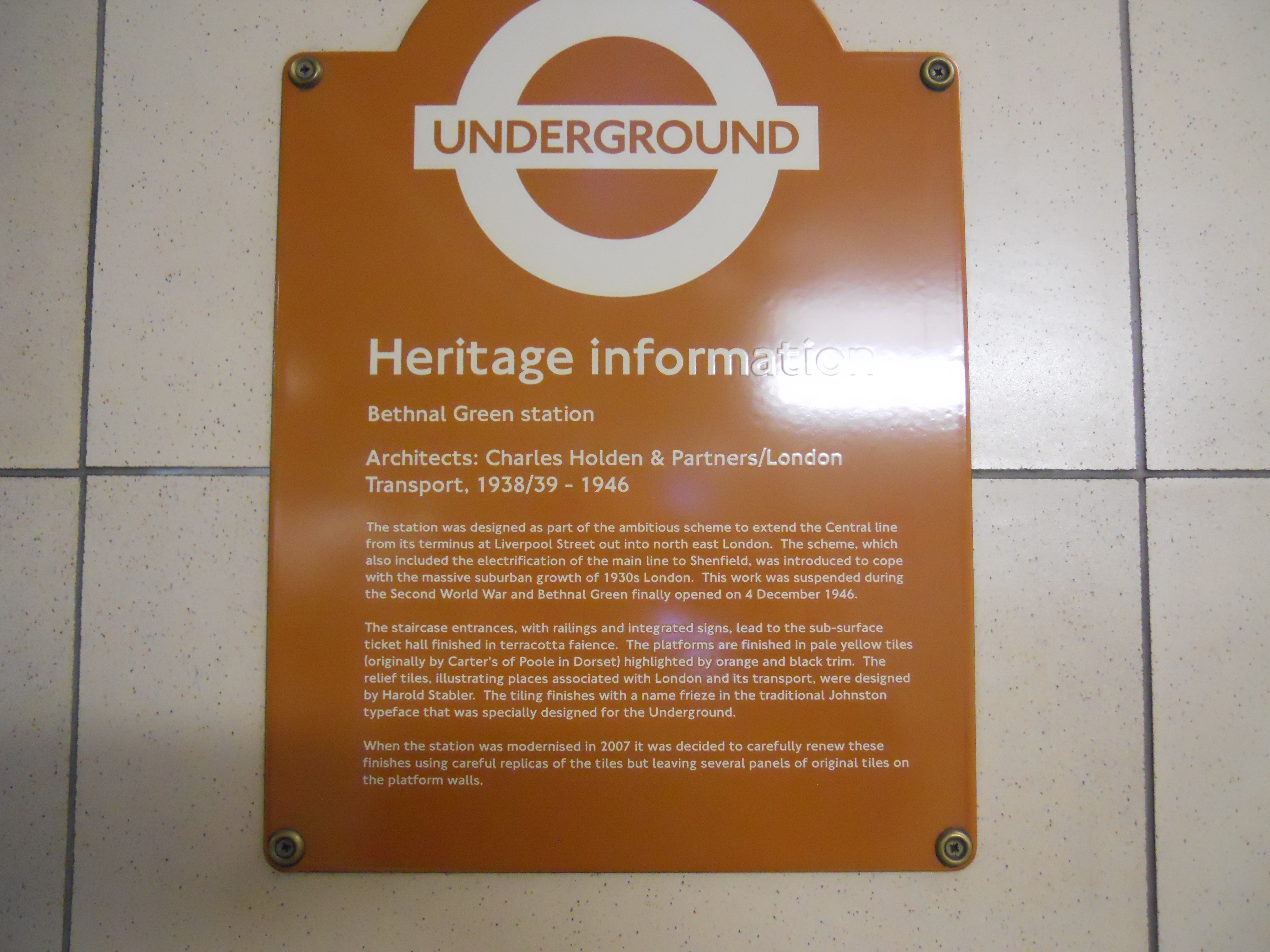
Heritage Plaque at Bethnal Green Station
This plaque is the first I’ve seen in a London Underground station and gives details of the architecture.
We need a lot more.
I’d been to the station before, when my late son and his family lived nearby and knew a little about the wartime disaster at the station.
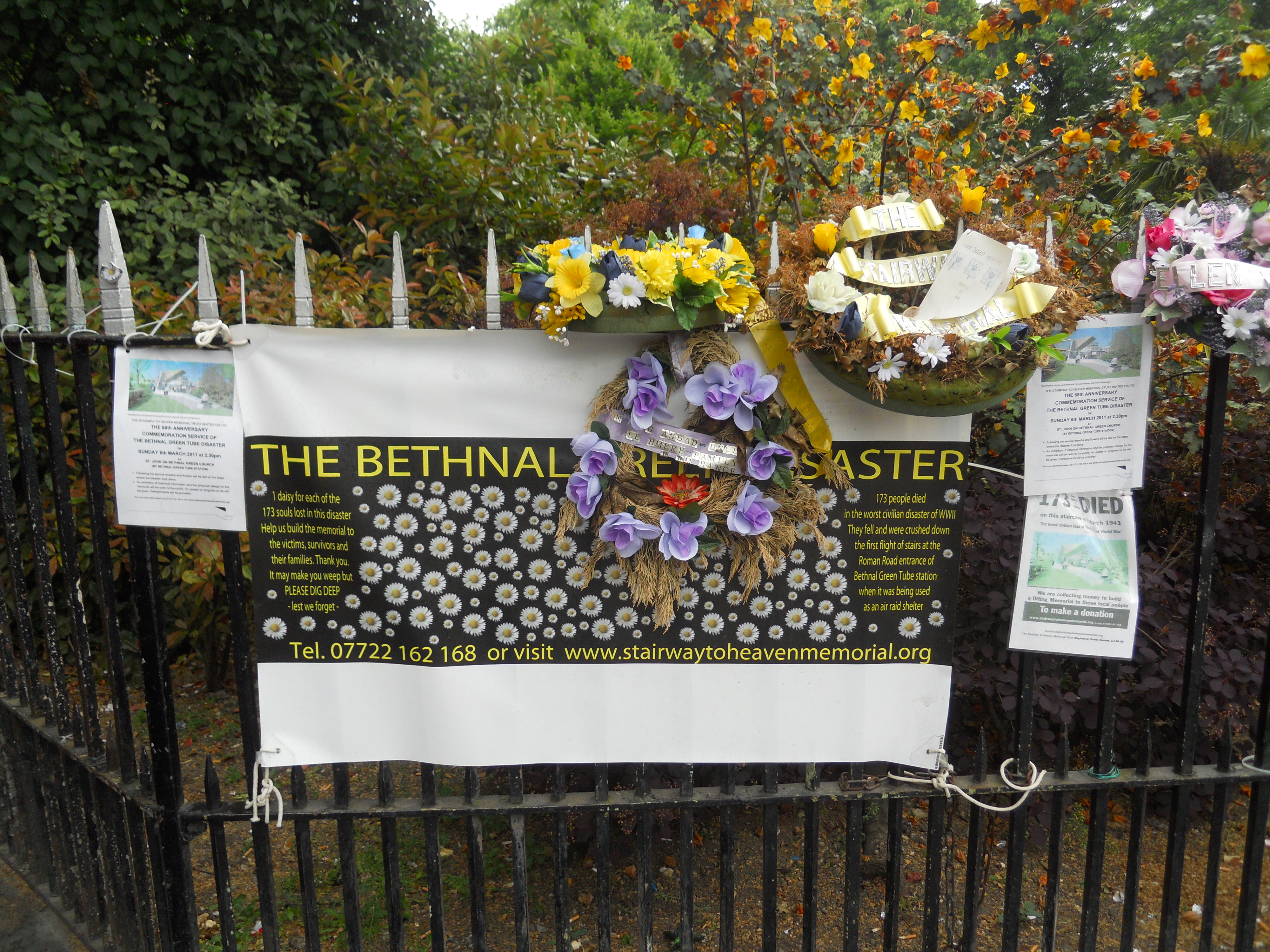
Memorial Banner and Flowers to the Bethnal Green Disaster
173 people died not from enemy action, but from a rush down the stairs to get into the station. A memorial has been designed and given planning permission. For more details of the disaster and the memorial see here.
I hope this memorial to the worst disaster on the London Underground goes ahead.
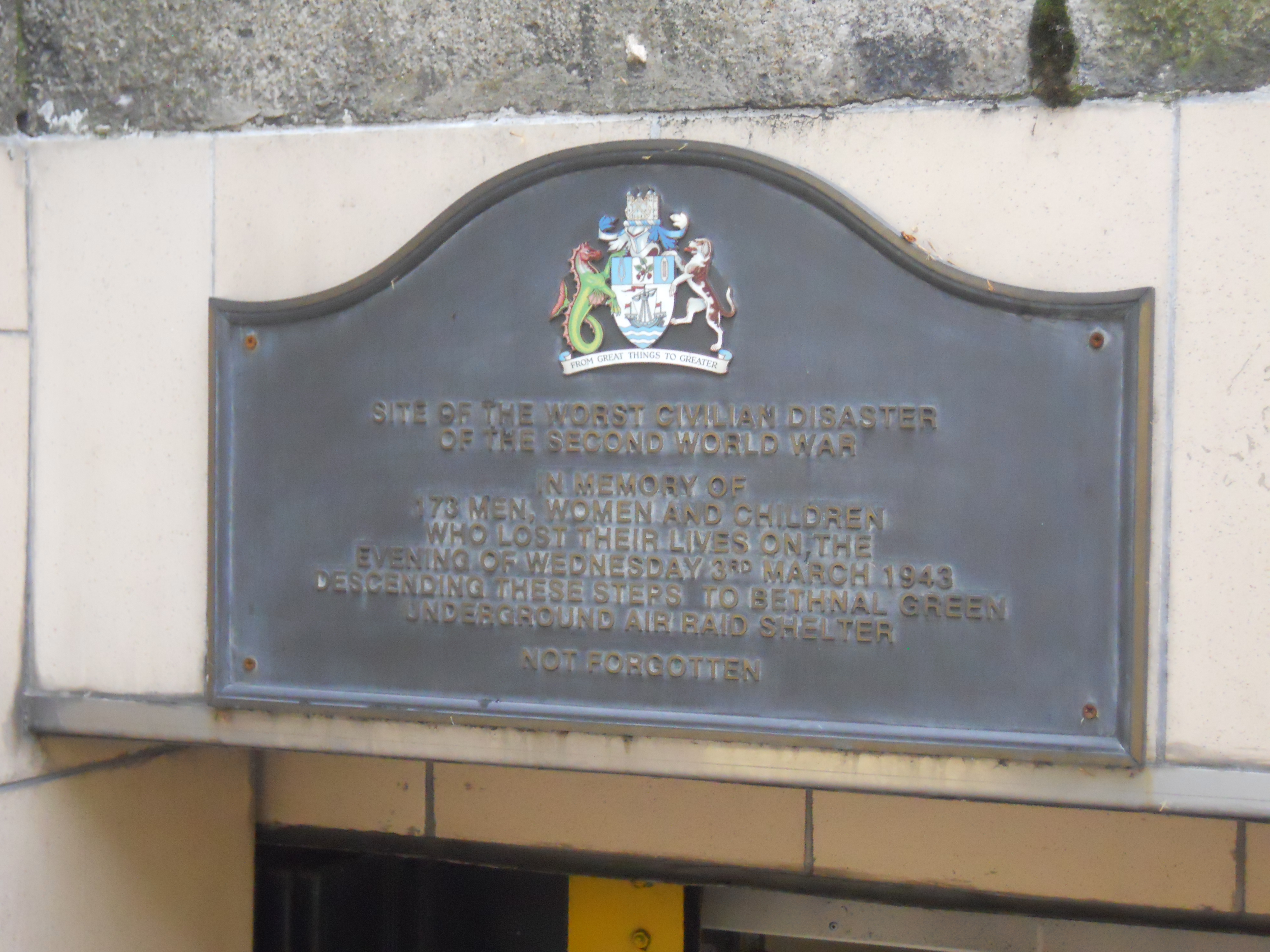
Memorial Plaque to the Bethnal Green Disaster
At least there is a plaque outlining the disaster.
Cable Thefts on the Railways
New figures suggest that cable thefts on the railways are increasing dramatically, as they were up 52% between 2010-2011 and the previous year.
It would appear that the two main problems are the high price of scrap copper and the fact that many scrap yards give cash back on a no-questions-asked basis!
I always remember some work I did with British Rail about twenty years ago, where we were analysing signal faults on one particular main line. There the copper cables had een exchanged for fibre-optic ones and we found that most breakages occurred because of over-zealous track gangs over-tamping the ballast between the track. My software, Daisy, showed that in one area they didn’t occur at the same rate and the better performance was due to some members of the track gang knowing about signalling. So that problem was solved by better training of the gangs.
However, in one area we found that there were a large number of incidents of deliberately-cut fibre optic cables. This area had been a particularly bad area for the theft of cables and it turned out the thieves were cutting the cables in the vain hope that they would be replaced with stealable copper.
More Works At Dalston Junction
The pavement at Dalston Junction station was partially blocked again yesterday and the bus-stop had been moved back a hundred metres.
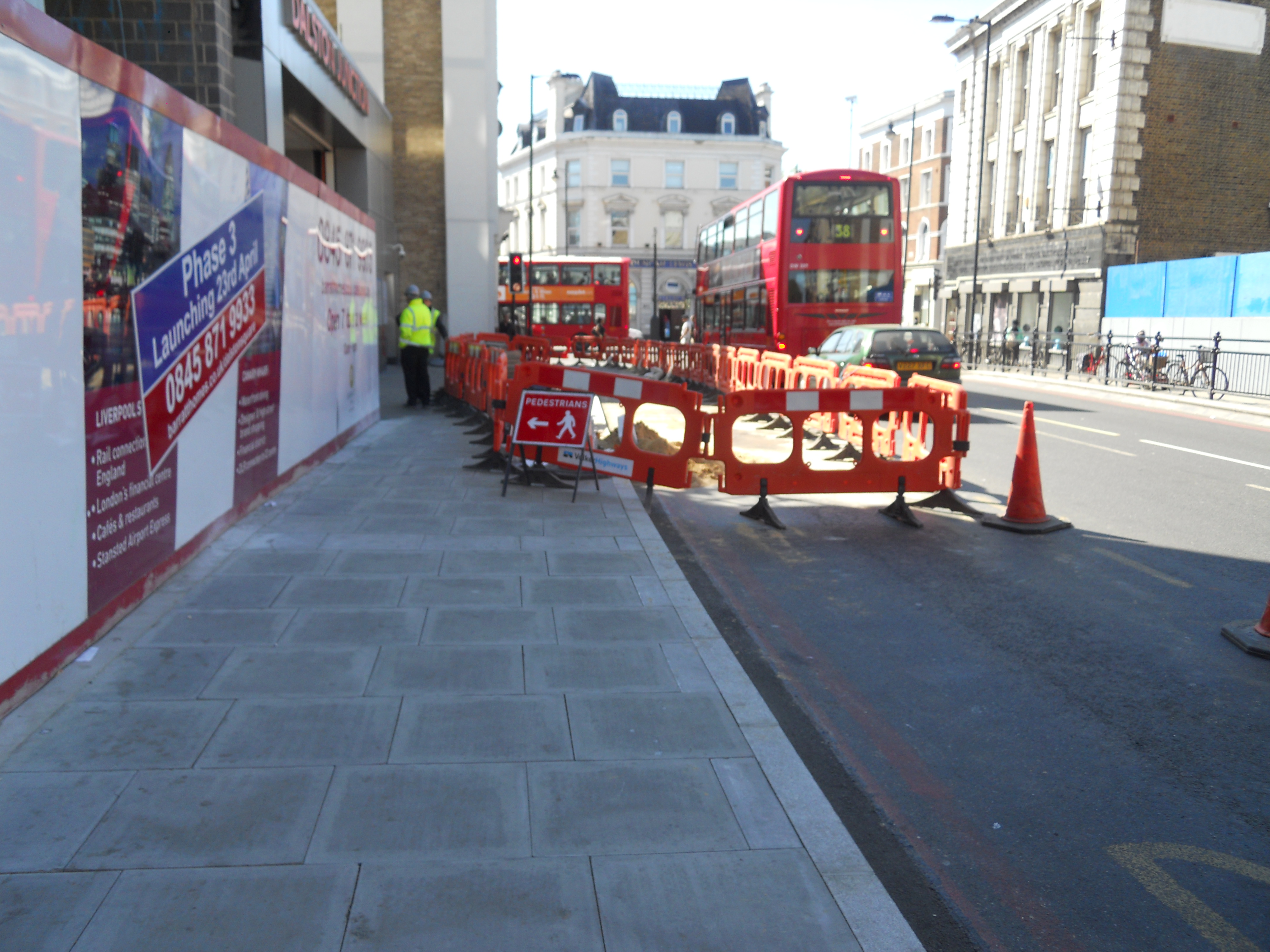
More Roadworks at Dalston Junction Station
But at least it appears there are only putting in new kerbs. Hopefully, to make a permanent bus stop outside the station.
The Future Worldwide Public Transport Ticketing is Almost Here
I read last month, that Transport for London would be aiming to introduce ticketing using contactless bank cards before the Olympics next year. They would work instead of or alongside the Oyster card.
So after some of the comments with regard to public transport in the Aston Martin post, I thought I’d look up the progress.
I myself have a Freedom Pass, so you might ask why I would need to pay in other way. I usually keep it in the back pocket of my trousers, so I have forgotten it a couple of times, when I’ve changed in the middle of the day. I also keep an emergency Oyster card in my wallet, in case I lose the Freedom Pass or I meet someone from outside London, who doesn’t have an Oyster.
So how is it all progressing? Read about it here.
This is an extract.
Hany Fam, President of MasterCard UK & Ireland, said: ‘We’ve been working closely with TfL since 2006 to make this shared vision a reality and recently announced a deal for the exclusive branding of TfL’s Oyster card wallet for 2011.
‘MasterCard was the first to introduce contactless bankcard payments on UK public transport in 2009 and we’re delighted that from 2012 consumers with a PayPass card issued anywhere in the world can use it to access London’s transport system.
‘We believe that London’s leadership will pave the way for adoption of contactless payments in other major cities across the world.’
What is this worldwide universal ticketing, going to do for worldwide tourism?
So perhaps the banks, helped by lots of clever engineers and computer programmers are going to do something worthwhile for a change.
You might ask what’s in it for them?
These contactless transactions are much cheaper to process than one with a pin. I suspect too that as your bank card will be able to buy your travel, your paper and your lunch, you’ll only carry one card much of the time and hence theft and the associated fraud will be a lot less.
Visiting the Lee Valley Park
Today, I needed to get to Blackhorse Road station for lunch nearby, and as Arsenal were at home around the same time, and this would mean a lot of people at Highbury and Islington station, I decided to take a more roundabout route.
The plan was essentially simple.
- Take a 73 or more preferably a 476 bus, as I hate the bendy ones, to Seven Sisters station.
- Take a National Express train from that station to Cheshunt.
- Walk through the Lee Valley Park, looking at the new Lee Valley White Water Centre for the London Olympics.
- Walk to Waltham Cross station for a train to Tottenham Hale and then to Blackhorse Road.
It wasn’t as easy as it should have been, as although the park was pleasant, there was an event going on and the public weren’t allowed into the White Water Centre.
But I was running late, so I had to get to Waltham Cross station. But don’t go there on a Sunday, as trains are only one an hour. I’d also been sold the wrong ticket at Seven Sisters, so I had to buy another. but it was only £1.30, so it wasn’t a problem.
It does look though, that they’ve got a good venue for the Olympics, as set where it is, you could take a picnic there on a train from Central London. I’ve put in for some tickets.
Another Truck Runs Into a Coach
There was another horrendous crash on the two lane section of the M11 last night, in which two people were killed and many were injured.
There was also the Sudbury train crash, where a truck crossed the line and derailed a train and the incident where a cement mixer fell on top of a train.
You have to question why accidents like this happen.
When I used to fly private aircraft, I had to take various competency checks every year and professional drivers do a lot more. Do the drivers of trucks have to take these sort of checks?
Also, as many drivers are from outside of the UK and may well be licensed in their own country, do they have proper checks?
But we mustn’t get xenophobic here, as there have been several accidents involving British coaches on the continent. There was also at least one in the UK, where the driver had been thought to be drinking.
I think that the best we can do at present, is to analyse all of the accidents and make recommendations.
One thing that is a common factor in many accidents involving trains and other vehicles is level crossings. And this is not just a British problem, but one that occurs everywhere there are level crossings. I stood by the level crossing at Northumberland Park last week and was surprised at how many times it opened and closed in the half hour I was there. No-one tried anything silly while I was watching, but this is a classic crossing that could be closed to road traffic, as there is a bridge fairly nearby. It might cause inconvenience for a couple of months, but closing the crossing, might save a few lives. How many other crossings could be closed?
Today’s accident happened on an unlighted two-lane section of motorway. Should we light more of the dangerous sections of roads?
Other factors are also involved in many traffic accidents.
We should analyse and act!
Northumberland Park Station
I made a mistake to get off the 341 bus and take the train from Northumberland Park station.
It might better be called No Rthumberland Park, as it had no staff, no timetables on the wall, no train information indicators and no trains for an hour. I actually had to phone rail information on 08457484950 to find out when the next train would arrive. There was though a betting shop on the corner and one of London’s last level crossings inside the M25.
Eventually, a train did turn up and I went all the way to Stratford for interest, rather than a quick journey. I then took the North London line and a bus home. If I’d stayed on the 341 bus, I’d have been home thirty minutes earlier. I will travel from Tottenham Hale to Stratford again, as it gives good views of the Olympic site, HS1 and the train sheds for Eurostar and the fast trains to Kent from St. Pancras.
High Speed Train to Swansea
I said that I was going to see Ipswich in Swansea yesterday. I had bought a Standard Class ticket out and a First Class back at a total cost of £45.20. I had actually booked six days in advance, so these good prices weren’t the result of very early booking.
The trip takes three hours and is probably one of the longest trips you can do from London easily in a day in a High Speed Train or IC125 both ways. I got six and three quarter hours in Swansea, which was enough time for a wander round the city, have some lunch and see the match.
As to the latter, I’ll not be talking about that!
According to the guy who served me coffee in the buffet, the train out had just been refurbished. It was certainly in very good condition and completely clean. I think it might have been the same train set on return, as it was in an equally pristine state.
So how did Standard and First Clases compare?
According to Ian Walmsley ‘s excellent article in Modern Railways a couple of months ago, he scored 82.1% for First Class and 76.2% for Standard for the IC125.
I’m not going to argue with those figures, although, I actually found the more upright Standard Class seat slightly more comfortable. But then my spine doesn’t curl under correctly and I’ve always found that too soft chairs are less uncomfortable than hard ones. When I used to drive, I found some cars particularly difficult.
My one complaint is that the tray in Standard Class is not big enough to lay the paper out, so I could do the Sudoku.

Small Seatback Tray on an IC125
However, I did get two seats to myself going out, so I could spread sideways a bit.
Perhaps I need a Working Class coach. This would be Standard Class but everybody would get a proper table, just like you originally got, when the trains were built.
I know the new layouts get more people on the trains, but have we really progressed?
As to progress, I did walk through several carriages to get to the buffet. The train was rather busy and there were several of those trolley cases, I hate so much, in the aisles. Despite this, I didn’t have any problems getting to the buffet and getting back carrying the coffee. Compare that with the problems I had on the Pendolino. But then I was running yesterday at 125 mph on a railway built for 60 mph in the Victorian era, in a forty year old train.
If I had the choice, I’d take a High Speed Train or failing that a Mark 3 Carriage anytime I could! When I travel to Ipswich, I always book one of the Norwich trains, as these are made up of Mark 3’s.
When booking on-line, you should be told the type of train you would normally be getting.

