On Line Rail Tickets Aren’t Always Cheapest
I’m going to Reading today to see Ipswich play Reading at the Madejski Stadium. It is one of the easiest out-of-town stadia to get to, as there is a bus service from the main Reading station.
I live about a ten minute walk away from Dalston Junction station on the Overground.
They have recently updated the ticket machines there, so you can buy any point to point ticket for use on the day or the next one after 16:00.
So yesterday, I would my ticket for Reading today at Dalston Junction station. As I have a Freedom Pass, which gives me free travel to any station within the Zone 6 Boundary, I was able to buy a ticket from the machine that took me from the Zone 6 Boundary to Reading. Previously to this clever machine appearing on the Overground, the only way to buy this extension ticket was to go to a Ticket Office and queue for often twenty minutes or so.

Zone 6 Boundary to Reading Ticket
The ticket cost me £7.40 with my Senior Railcard.
That seemed cheap to me, so this morning I looked at the First Great Western web site, to see how much they’d charge.
It would have cost me £11.70.
Was the ticket machine programmed by a senior citizen with a Freedom Pass or just somebody, who understood how holders of such passes think and behave!
I suspect though that over a season buying my London to Ipswich tickets at an Overground station, might save me nearly a hundred pounds.
The only problem for some people will be that their local Overground or Underground station doesn’t have these new ticket machines.
But as they are so comprehensive and surely every non-London ticket sold is revenue to Transport for London, it can’t be long before these are the universal ticket machines in London.
The only thing they don’t do is to issue Oyster cards, which is probably not needed, as they will probably not be needed for ticketing at some point in the next few years.
Moscow To Neryungri
I found this article about long journeys by train in Russia on the RailStaff website.
Fascinating, but there are lots of easier places to see first!
London’s Other New, But Forgotten Rail Tunnels
Crossrail with its fifteen billion pound budget gets all of the attention, but it could be argued that two much smaller tunnels outside Kings Cross and St. Pancras will have a significant effect on several million people. And not just those living in London.
This extract from an article in Rail Engineer describes the Canal Tunnels.
Each tunnel was constructed with a six metre diameter bore and fitted with a pre-cast concrete lining, and they are both more than 660 metres in length. At the King’s Cross end there is a 100 metre cut-and-cover concrete box which leads up to an open area which, in total, forms a 1km length of new twin track railway.
Despite their significance to the Thameslink programme, they don’t have a Wikipedia article.
They may be much shorter than those of Crossrail, but they are the way that trains passing through the Thameslink core go up the East Coast Main Line. Thus they help to add a hundred new stations to Thameslink and allow 24 trains an hour to pass in both directions through London.
I took this picture of the tunnel entrance from a local train between Kings Cross and Finsbury Park.
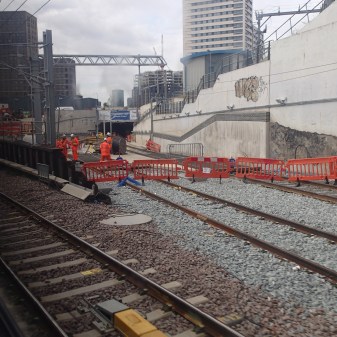
The Canal Tunnel Entrances At Kings Cross
I also obtained this image of the area from Google Maps
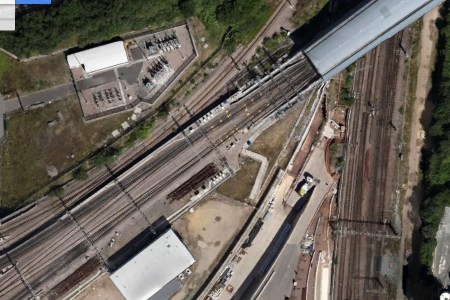
Kings Cross From Above
Three existing main railway lines are shown in the picture.
- The multi-track railway down the right of the picture is the East Coast Main Line.
- The railway from top-right to bottom-left is High Speed One. Note the tube that the line runs in to cut noise at the right hand side.
- Above this line runs the North London Line.
The Canal Tunnels can be seen in the angle of the East Coast Main Line and High Speed One, with the dark shadow showing the cut-and-cover concrete box entrance. These pictures are obviously some weeks old, as no track has been laid yet, unlike in my picture.
I do wonder if the public might be given a chance to walk through these tunnels before they are opened.
At present all you can do is catvh a glimpse from trains running into or out of Kings Cross or St. Pancras.
Wandering Around Kings Cross
I took these pictures as I walked around Kings Cross.
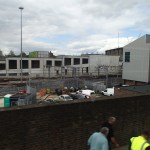
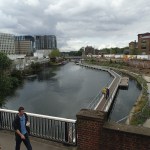
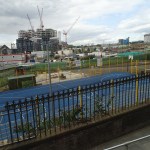
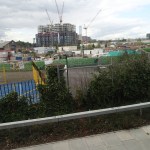
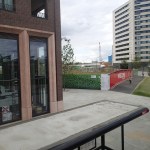
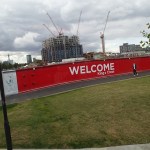

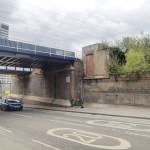
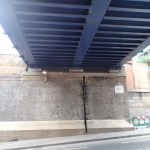
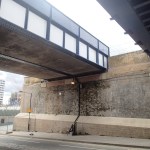
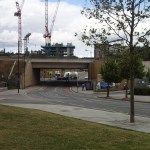
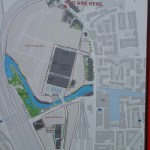
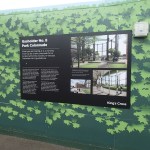
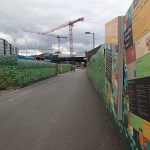

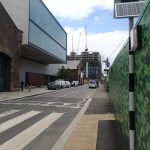
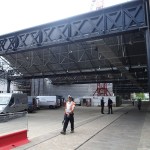
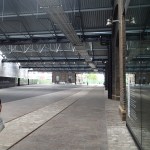
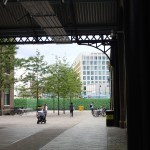
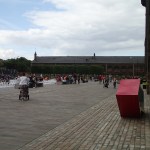
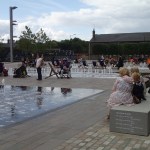
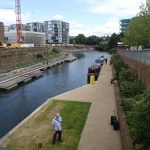
Some of the first pictures were taken from a 390 bus.
Things are certainly happening!
Crawley For The Carling Cup
I went to Crawley Town to see Ipswich get knocked out of the Carling Cup in extra time.
It wasn’t a good match for Ipswich, except that some youngsters made promising debuts.
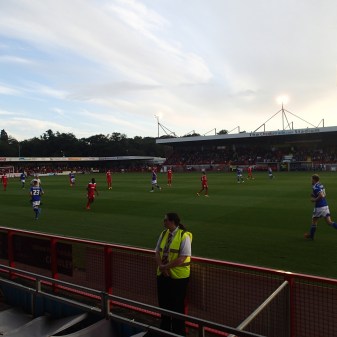
At Crawley Town
I had got to the ground courtesy of a lift from my cousin, with whom I had supper.
But coming home. there was no other way thsan to get a taxi to Three Bridges. Luckily I was able to get a lift with a Crawley Town supporter, who was also going back to London on the train.
Crawley would appear to be one of those grounds, where to get away after an evening match you are going to need a taxi.
Can We Extend Overground Connectivity In North London?
The East London Line has four termini in South London; New Cross, West Croydon, Crystal Palace and Clapham Junction, but only two in the North; Dalston Junction and Highbury and Islington.
In the North the Lea Valley Lines are being added to the system and although these lines meet the North London Line at the Hackney Downs/Central station complex, they are not intimately connected to the core route of the East London Line, as this would need a change of train at Canonbury.
So how could we improve the extend the connectivity?
Hackney Central/Downs
I regularly take the Overground from Stratford to my home. On a wet day, I would take a train to Canonbury from Stratford, walk across the platform to a southbound train and then go one stop to Dalston Junction, from where I would get a bus two stops to my home. On a sunny day, I might change at Hackney Central to a 38 bus or walk from Dalston Kingsland.
But I usually take the Canonbury route, as it has the least amount of walking and if I’ve got a heavy parcel, there is a lift at Dalston Junction.
The two Hackney stations are being connected by a covered high level walk and this would help those changing between the North London Line and Lea Valley and Cambridge services.
But two other things could be done, if the run-down area around the stations is redeveloped.
If you want to get a bus or walk to the Town Hall area, after alighting on the westbound platform at Hackney Central, you have to cross the tracks on a footbridge. An entrance needs to be provided on the south side of the station.
The connection to the buses are better than they were a few years ago, but Downs/Central should have easy access to stops for the high-frequency bus routes that pass through the area.
I have a feeling that they may have spent a lot of money on making the footbridge step-free with lifts and in a few years time, it will be rarely used, as other better routes are developed. A southern entrance would help in this respect.
Crossrail 2 will be the driving force here, as the planners have stated a preference for only having one station in Hackney, to save a billion pounds. Whether this station is Dalston Junction or Hackney Downs/Central doesn’t matter, provided that these two stations are connected by other means. There are already two routes; the North London Line and the high-frequency buses.
For this reason, the access to buses from Hackney Downs/Central must be made as easy as possible. But that doesn’t need to wait for Crossrail 2!
There is a superb opportunity here for a developer to create a real town centre at Hackney Central/Downs, of which everybody can be proud. The original station building is not used, but it is a building worthy of saving as are few other historic buildings in the area.
An Extra Terminal In The North
If the frequency on the core section of the East London Line is increased from 16 tph to 24 tph as is stated in TfL’s plans, there could be a need for another Northern terminus to supplement Dalston Junction and Highbury and Islington, where these trains could turn back.
An extra terminus might ease the overcrowding that is prevalent at Highbury and Islington.
In the original plans for the Overground, there was talk about some East London Line trains going as far as Willesden Junction and terminating there.
With plans for a new super station at Old Oak Common, that could be a possibility. But even New Cross to Old Oak Common would be a journey of about an hour, and there will be faster ways via Crossrail at Whitechapel.
So a terminus for the East London Line at Willesden Junction or Old Oak Common, would be more about inceasing the frequency of trains on the North London Line, by using some of the eight extra trains an hour on the East London Line to provide the extra trains.
There are two other possibilities for extra Northern terminals.
If the Dalston Eastern Curve were to be reopened, then trains could move easily between Hackney Downs/Central and Stratford and the East London Line.
This would mean that Stratford could be an additional terminal and also that some East London Line trains could have an interchange with the Lea Valley Lines.
There is also a curve at Canonbury that connects the North London Line to the East Coast Main Line. It used to be double track, but is only single track now! So could this be used to get to a new Northern terminus?
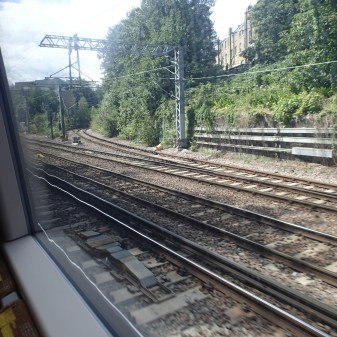
The Canonbury Curve To The East Coast Main Line
It all depends on the passenger flows, which of course TfL has at its fingertips.
We must also take note of passenger behaviour in using cross-city railways.
When Crossrail opens in 2019, all parameters will change, as many who want to use the East London Line to get on the Underground at Highbury and Islington, might get on Crossrail at Whitechapel instead. This passenger will probably go to Oxford Street, by walking to Dalston Junction, before taking the East London Line to Whitechapel for Crossrail. The alternative of taking a bus to Highbury and Islington and then getting the Victoria line, means I have to use a station I avoid as much as possible, due to the excessive walking involved to get to the trains.
The Eastern Curve At Dalston Junction
This seems an easy option to improve connectivity, as it would allow trains to pass easily between Stratford and Hackney Downs/Central and the East London Line. But there are two problems.
It might be a difficult sell to the Dalstonistas and the shopping centre at Dalston Kingsland is being redeveloped, although the Eastern Curve is safeguarded.
It would seem though, that in the next couple of years, there is a chance to make a good fist of sorting out the shops and stations at Dalston.
Tying In The Lea Valley Lines
There has been little or no speculation about how the London Overground will link the Lea Valley Lines to their current lines. London Overground has said that it will deep clean the trains and stations and that new trains are on the way.
They have also got at least three out of station interchanges between the new lines and the current system.
- Walthamstow Central to Walthamstow Queens Road.
- Hackney Downs to Hackney Central, although the way that is going, it will probably become a single station.
- Seven Sisters to South Tottenham
There are also a couple of junctions where useful connectivity already exists.
There is a rail line called the High Meads Loop that goes between the Lee Valley Lines and the North London Line, virtually straight under the old Olympic Village. This is the North London Line End just after Hackney Wick station.
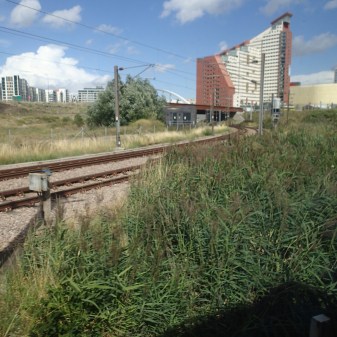
High Meads Loop At Stratford Joins North London Line
And this is the other end on the Lea Valley Line, between Stratford and Tottenham Hale
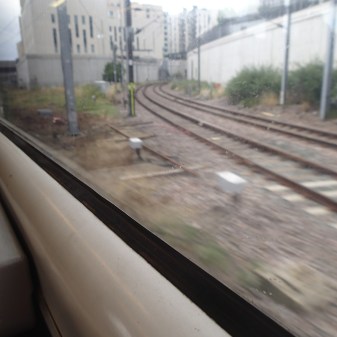
High Meads Loop At Stratford Joins Lea Valley Line
Incidentally, I don’t think there is a station under all those dwellings.
There is also another junction that links the Lea Valley Line to the Gospel Oak to Barking Line to the East of South Tottenham station.
Perhaps the most interesting proposal though, is to reinstate the Hall Farm Curve in conjunction with the reopening of Lea Bridge station. I travel to Walthamstow Central regularly and the curent timetable of the GreaterAnglia service is a bit threadbare to say the least. So if this curve is reopened, will we see trains linking Walthamstow to Stratford and even to and along the North London Line by way of the link I showed in the pictures to my local station at Dalston.
If the Eastern Curve at Dalston Junction was to be reinstated, then some of those extra trains through the core section of the East London Line could go to Walthamstow and Chingford.
Summing Up
The more I look at the East London Line, the basic concept of a high frequency line through Marc Brunel’s Thames Tunnel, fanning out to several destinations on both sides of the river, was a stroke of genius, which was probably dreamed up in the time-honoured manner of so many other good ideas on the back of serviettes, beer mats or fag packets in a real ale hostelry somewhere.
Who can predict with any certainty what the Overground will look like in 2020, let alone the 2050 target of Transport for London?
The only certainty is that Transport for London will have created another iconic brand to go with Underground and Routemaster.
It could also be argued that London’s three new cross-London lines;Thameslink, Crossrail and East London, are all following a similar design of a central tunnelled core, with a collection of branches at each end.
Certainly the current Thameslink and East London Line have shown that the concept works and if they perform in the next few years, this can only mean that further lines in London and further afield follow a similar pattern. Crossrail is adding more branches and termini and the basic design for the proposed Crossrail 2 appears to have been designed by the use of a photocopier.
Around Loughborough Junction Station
I took these pictures close to Loughborough Junction station.
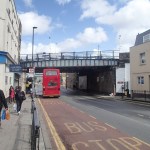
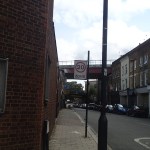
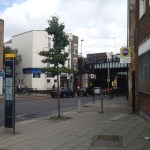
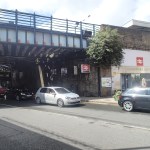
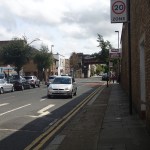
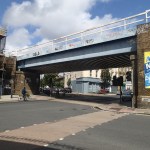
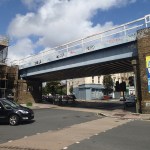
They show the triangle of lines that make up the junction and some of the buildings in the area. In An Overground Station For Camberwell, For pictures from the station see this post.
I quoted the 2050 Transport Plan as saying this.
e.g. at Camberwell, that can plug connectivity gaps and act as development nodes.
Surely there is a connectivity gap between the London Overground and Thameslink, but the Luftwaffe didn’t do anything creative to help with clearing the site for the development node, the area needs.
How Will Crossrail Affect My Rail Journeys?
It may be wishful thinking as I’ll be 72, when Crossrail fully opens in December 2019.
But how will the new line affect the journeys I take regularly?
Access To Crossrail
I will get to and from Crossrail in one of two ways.
I am within walking distance of Dalston Junction station, where I could use the Overground to get to and from Whitechapel station, which is a major station on Crossrail.
This route is a good one for coming home, as I just walk up the stairs or take the lift at Dalston Junction, before waiting no more than a couple of minutes for a bus to perhaps fifty metres from my house.
The other way to go to Crossrail is to get a bus directly to the line. At present, I have three routes within a hundred metres that go direct to stations, that will be on Crossrail. The 56 goes to Barbican and the 21 and 141 go to Moorgate. I suspect that the buses will be reorganised for Crossrail, so the 38 might be routed to stop by an entrance to the Crossrail station at Tottenham Court Road.
Coming back, if the stop for the 21 and 141 is sited as well as it is now for Moorgate station, this would probably be my preferred route in the rain, as the stop for those routes, is just across a zebra crossing from my house.
If anything my biggest problem about access to Crossrail, is choosing from a selection of convenient routes. Especially, as the buses could well be a few minutes quicker than they are now.
Ipswich
This is probably the most common destination out of London, where I go to the football.
I doubt that I’ll change my route much, but it should be easier to get to and from Liverpool Street and I doubt, I’ll ever use a taxi again.
The only possible change I could see is that if the Great Eastern Main Line links up better with a cross-platform interchange at Shenfield, I might use this route. Hopefully, Ipswich services could also be faster under the Norwich in Ninety program, so sitting in a comfortable train will be less important, than say a journey in under an hour from Liverpool Street.
Liverpool And Manchester
I’ve bracketed these two cities together, probably much to the annoyance of a lot of residents of the two cities, but by the time Crossrail opens, there will be a thirty minute service every ten minutes between the two cities. Much of this happens late this year, so we’re not talking about possible projects.
So for many who live between and around the two cities, your route to and from the South will become one of personal preference and convenience.
Coupled with all the other Northern Hub developments, I suspect that both cities will have a more frequent service to and from London and the South than they do now. It might also be quicker, if 225 kph running is enabled by new signalling.
If Milton Keynes is a Crossrail terminal, I could see up to three trains an hour to both cities stopping there to pick up and set down passengers.
If say Liverpool and Manchester did get three trains an hour from Milton Keynes, you would have a maximum wait of twenty minutes for a train to your desired destination.
I would probably book a seat from Euston, but as that dreadful station starts to be rebuilt, I’d probably hop on Crossrail for Milton Keynes.
If though it was four trains an hour to Liverpool and Manchester from Milton Keynes, and perhaps I wanted to see an exhibition at the Tate Liverpool, I’d probably book a Standard Off Peak Ticket the night before and take my chances on getting a decent seat at Milton Keynes.
The more I look at it, Crossrail must terminate at Milton Keynes and that city should be a stop on a large number of Virgin services.
Reading
I’m going to Reading next week to see Ipswich. This one is a no-brainer and it’ll be Crossrail all the way.
Birmingham
I’m also going to Birmingham next week and this one could be difficult choice from a multiplicity of routes.
By 2019, Birmingham’s tram system and some extra trains will link a lot more parts of the city, so depending on where I’m going I might not even go through New Street station. If I’m still going to Bordesley for Birmingham City, will the worst station I’ve used recently be a better proposition and perhaps easier to get to?
But again Milton Keynes is an option.
At the southern end, Crossrail doesn’t really ease the Marylebone problem if I use Chiltern to get to Birmingham. Unless of course getting to the Bakerloo Line at Paddington is easy. The alternative might be to exit Bond Street Station on Crossrail, walk to Oxford Street station and get the Bakerloo Line to Marylebone.
Paddington
I’m always surprised that Brunel’s Great Western had such bad connections to his father’s Thames Tunnel.
Finally, with Crossrail, Paddington gets put on my list of stations that are easy to get to.
But will I actually go there or get a Reading train and change for Wales and the West there?
I think it depends on whether the new Class 800/801 trains are better than InterCity 125s!
Heathrow
Definitely a go direct and no more slogging along the Piccadilly Line.
Will Crossrail Go To Hertfordshire?
Yesterday, it was reported on the BBC that the government is seriously thinking of diverting some Crossrail trains to Hertfordshire possibly terminating them at Tring.
This is an old idea originally proposed by Network Rail and discussed here in Wikipedia. This is what is said.
Network Rail’s July 2011 London & South East Route Utilisation Strategy (RUS) recommended diverting West Coast Main Line (WCML) services from stations between London and Milton Keynes Central away from Euston, to Crossrail via Old Oak Common, to free up capacity at Euston for High Speed 2. This would provide a direct service from the WCML to the West End, Canary Wharf and other key destinations, release London Underground capacity at Euston, make better use of Crossrail’s capacity west of Paddington, and improve access to Heathrow Airport from the North.[113] Under this scheme, all Crossrail trains would continue west of Paddington, instead of some of them terminating there. They would serve Heathrow Airport (10 tph), stations to Maidenhead and Reading (6 tph), and stations to Milton Keynes Central (8 tph).
I think this could turn out to be an excellent change of plan. It certainly won’t add a billion or so to the costs of the project. Tring station would appear to have quite a large number of platforms and the only major infrastructure for the route would appear to be a tunnel at Old Oak Common.
Crossrail as originally designed went to Heathrow and Maidenhead in the West and Shenfield and Abbey Wood in the East. Sensibly in my view, Maidenhead has been changed for Reading in the West, to add a whole new level of connectivity to the West of England and Wales. Connecting to the West Coast Main Line could add similar connectivity to the North West of England, North Wales and Scotland.
So should Crossrail go to Tring or perhaps a more substantial interchange on the West Coast Main Line, which has cross platform interchange to Virgin’s streams of Class 390 Pendolinos to speed North? The excerpt from Wikipedia, I quoted earlier, says eight trains an could go to Milton Keynes.
I estimate that if Crossrail services terminated at Milton Keynes, the trains would get there within a few minutes of an hour from Canary Wharf. That is only twenty minutes more than it will take from Heathrow to Canary Wharf.
But Milton Keynes is more than a New City on the West Coast Main Line, it is an important staging post on the East-West Rail Link from Cambridge and East Anglia to Oxford and the West Country, so making Milton Keynes one of the Crossrail termini and linking it to the North with frequent services, could give whole new areas of the country like East Anglia and the West of England much better train services to the North.
If Milton Keynes was developed as this major hub, this would have other consequences.
- The East-West Rail Link should probably be built as a 200 kph capable railway, so that Oxford to Cambridge services could be well under two hours.
- The East-West Rail Link connects to the Midland Main Line at Bedford and Chiltern Services at Bicester, so should it complete the set by going to Cambridge via Peterborough, where it can interchange with the East Coast Main Line. It is the cheapest possible route of the rail link, but what people who live in places like Oakham will think about it, I do not know.
- HS2 might be being built in the wrong place, as if Milton Keynes becomes this important rail hub, surely it should visit the city.
All I can say, is that extending Crossrail to Hertfordshire and Milton Keynes, will make planners think very hard about connections from the terminus to points to the North, East and West.
Tracing The Goblin Extension – The Alternative Route From Wimbledon To Peckham Rye
This is what I called the Alternative Route in the post, where I laid out possible routes.
It goes a slightly shorter way and avoids changing direction at Wimbledon.
Incidentally, I found out today that Platform 9 at Wimbledon has trains that stop there running in both directions.
The train I got from there today, actually waited for a few minutes, so it might be a place, where a train could wait if necessary.
The only problem on the route was that I had a Peckham Rye style change at Tulse Hill. I doubt that a couple with a baby in a buggy could negotiate the two staircases easily. Something of course that won’t be necessary with the Goblin Extension, as the trains will just circulate continuously.
 The Anonymous Widower