Around Waterloo East Station
In Southern Crossrail, Idiscussed the possibility of creating a direct link from Waterloo across London to London Bridge. The proponents of Southern Crossrail also take about rebuilding Waterloo East station.
So I went to look at the station and took these pictures.
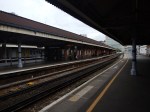



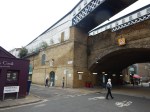
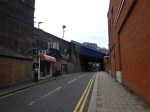


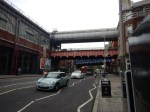


Note.
- The complex arrangement of high bridges.
- The highest white bridge is the pedestriain link between the two stations.
- The red bridge is what remains of the former rail link.
- It’s about a hundred metres between the two stations, with a slope down to the platforms at Waterloo East station.
This Google Map gives a view from above.
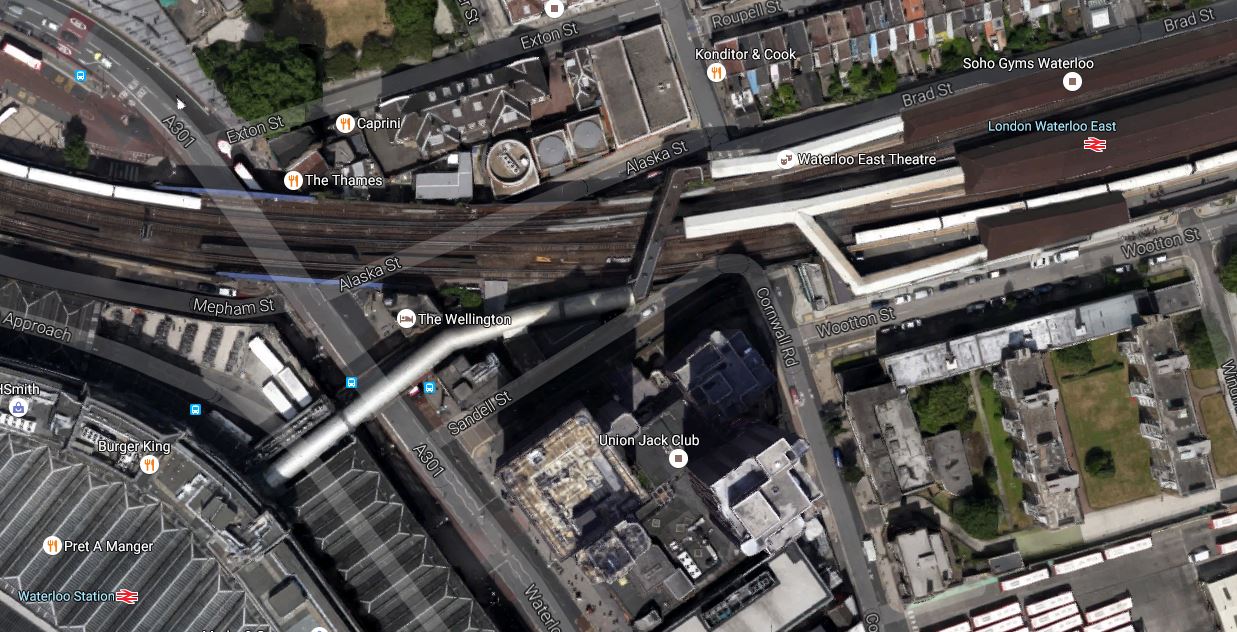
The Link Between Waterloo And Waterloo East Stations
The link is the white-coloured link that goes between the two stations. Don’t confuse it with the two trains in the map.
In the previous post, I said that rebuilding this station could be a project that a quality developer would relish.
But I do think that Southern Crossrail’s dream of connecting Waterloo East and Waterloo stations with a rail link is an impossible dream.
- There is now a retail balcony at Waterloo station, which was built in 2012 at a cost of £25million. It would need to be demolished.
- The lift and a couple of escalators to Waterloo East station are in the middle of where the new track would go at Waterloo station.
- The residents of the area probably wouldn’t like to have trains trundling through at height.
In the previous post, I said that rebuilding this station could be a project that a quality developer would relish.
Consider.
- Waterloo East station could be replaced with a better station.
- There is probably space around and above the station to add some sympathetic development.
- Escalator and lift connections could link Waterloo East station to the Northern, Bakerloo and Jubilee Lines.
- A full step-free connection could be built between the two Waterloo stations.
- The current connection to the Jubilee Line at Southwark is poor.
- The Waterloo and City Line will soon be getting a very good connection at Bank, so why not build a good one one to both Waterloo and Waterloo East.
This is one of those pedestrian links, that can benefit the around seven million or so passengers, who go through Waterloo East station every year.
Given the right financial figures, I think that there could be a developer, who would create the sort of development that residents, passengers and visitors to the area would like.
My ideal station would have the following.
- Four platforms to match the four platforms 6-9 at London Bridge station.
- Sympathetic over-site and surrounding development, preferably with affordable housing.
- Escalator and lift connections to the Underground and Waterloo and City Line.
- Full step-free access to Waterloo station, which would probably use the current entrance on the balcony.
- Better passenger facilities at Waterloo East station.
- A proper passenger entrance on Waterloo Road for Waterloo East station.
- The ability to handle an increased number of trains from the current fourteen trains per hour between London Bridge and Charing Cross stations.
All of this would probably be more affordable, than rebuilding Waterloo station.
The Walbrook Entrance To Bank Station
This press release from TfL is entitled BANK STATION: WORK STARTS ON A NEW ENTRANCE.
It describes how work has started to fit out the new Walbrook entrance, which will give step-free accress to the Waterloo and City Line.
So I went to have a look.

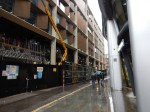

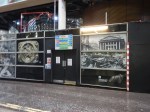




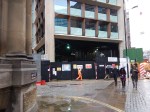


I didn’t see an obvious entrance, but is it actually on the north-west corner where Walbrook joins Cannon Street.
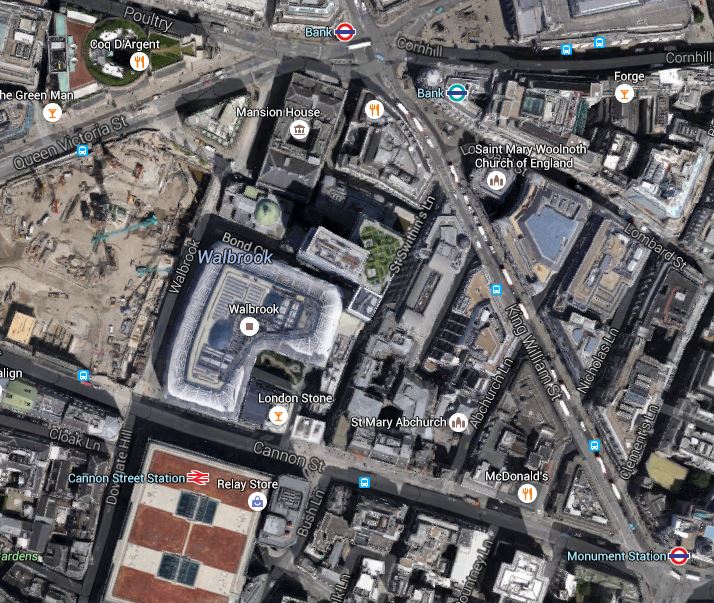
This Google Map shows the area.
The New Walbrook Square Entrance At Bank Station
Cannon Street station is the brown and white roofed building at the bottom, which is south-east of the junction of Walbrook and Cannon Street. The big bare site on the opposite quadrant of the junction, now contains Walbrook Square, with the station entrance to be built on or close to the junction on the Walbrook side of the building.
Note the three other main entrances to Bank station.
- The roundel at the top in the middle is main entrance under the major road junction called Bank.
- The roundel at the bottom-right indicates the Monument entrance.
- The McDonald’s on Cannon Street will be replaced by the new Cannon Street entrance.
The station certainly has the area covered, when you add in all the smaller entrances.
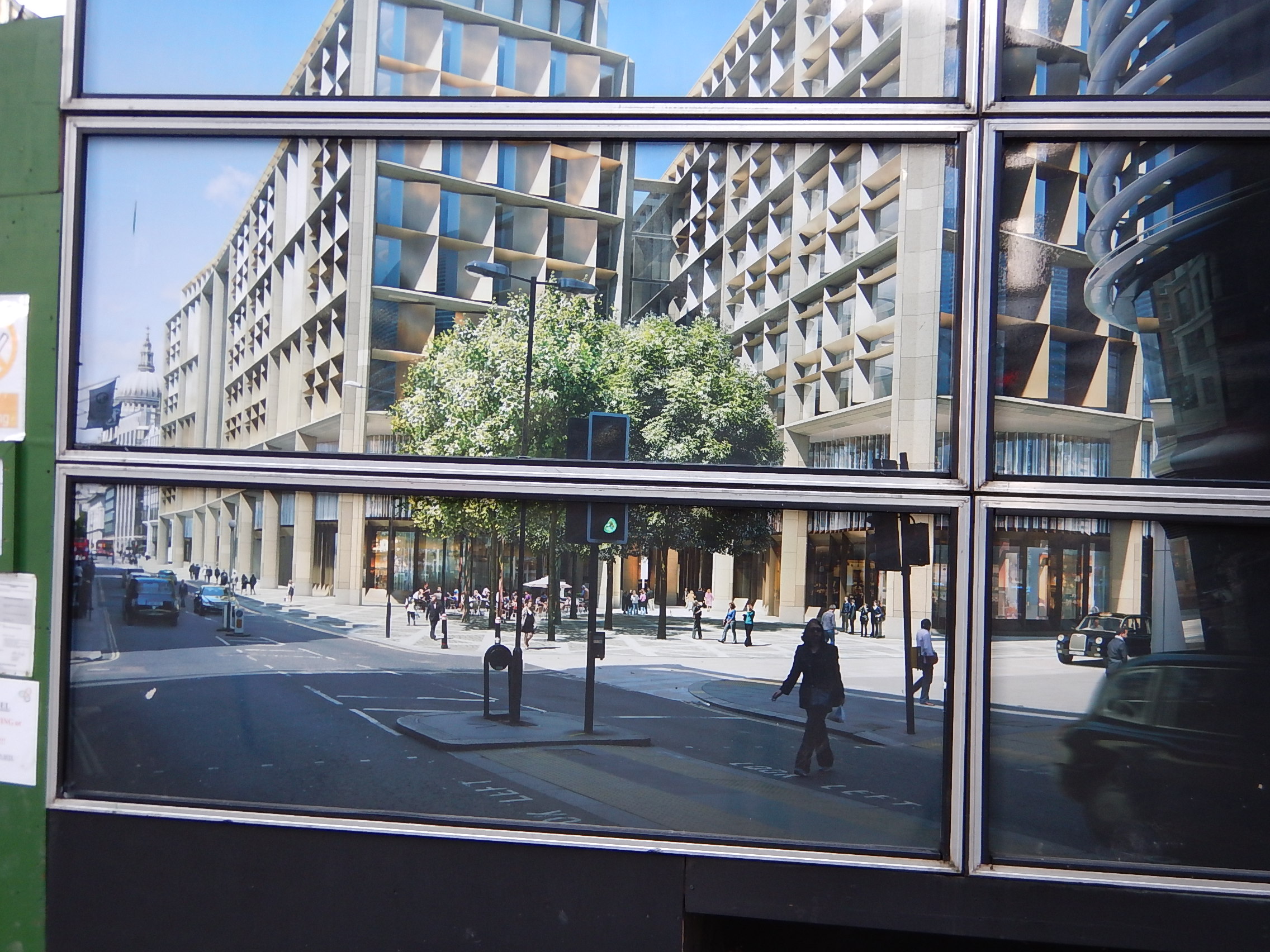
I returned a few days later on a Sunday in the sun. This picture from the hoardings outside the construction side, shows the corner of the building opposite Cannon Street station.
The Walbrook Entrance To Bank Station
That looks like a square with a cafe to me.
I assume the Walbrook entrance to Bank station is somewhere behind.
Whither Waterloo?
After looking at Waterloo International, I sat in a train before it left for Clapham Junction and it got me thinking about the future of Waterloo station.
It is busy as this extract from the Wikipedia entry shows.
With over 94 million passenger entries and exits between April 2011 and March 2012, Waterloo is Britain’s busiest railway station by passenger usage. The Waterloo complex is the 15th busiest passenger terminal in Europe, and the 91st busiest railway station in the world. It has more platforms and a greater floor area than any other station in the United Kingdom (though Clapham Junction, just under 4 miles (6 km) down the line, has the largest number of trains).
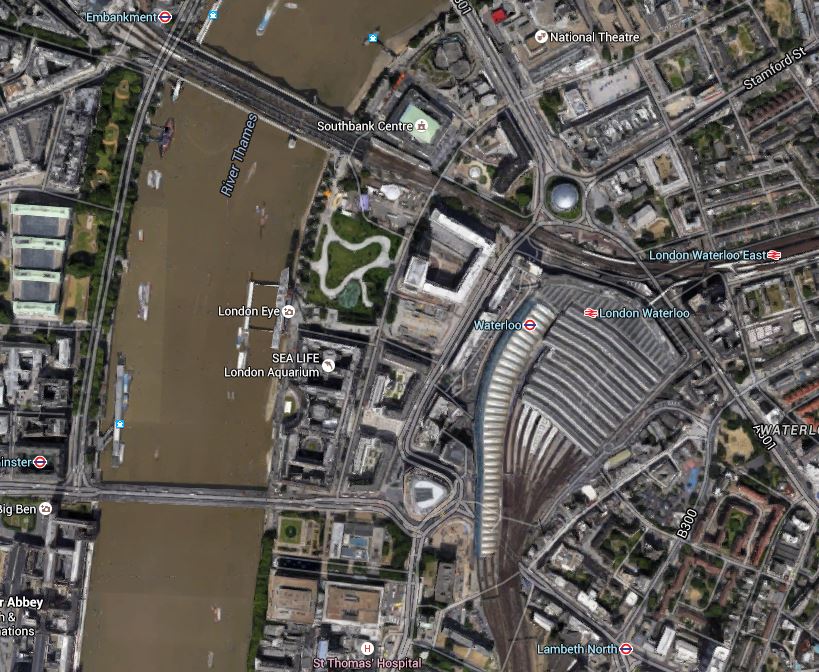
This Google Map shows how big and hemmed in on all sides, the station complex is.
Waterloo Station
It certainly has its problems.
1. Waterloo Station Doesn’t Have Enough Capacity For Trains
South West Trains want to run ten-car trains and the platforms need to be lengthened. That project is in the pipeline, but little seems to be happening.
They also want to bring the other four Eurostar platforms into use. As these platforms were built for the very long Eurostar Class 373 ytrains, they are a complete mismatch for the typical trains that South West Trains typically run.
2. The Lines Into Waterloo Need Sorting
If you increase the trains using the station, you’ll need to increase the capacity on the lines leading into the station.
3. Waterloo Station Doesn’t Have Enough Passenger Facilities
$25million has been spent on creating a retail balcony with shops and restaurants.
But I think that even this is proving not to be sufficient at busy times!
4. The Underground And Waterloo And City Line Don’t Have Enough Capacity
Getting to Waterloo is not easy for people like me in East London and we’re not the only area of London, from where getting to Waterloo is difficult and often overcrowded.
There are two ways that Waterloo can go. Either you try and squeeze more and more trains and passengers into the existing sites or you reduce the number of both to fit the current facilities.
If Crossrail 2 is designed properly and built, it will have the following effects on Waterloo,
1. Reduce the number of trains needing to use Waterloo, by diverting trains and passengers into the tunnel at Wimbledon and then under Central London.
2. This will in turn, free up much-needed platform space and train paths.
3. As passengers will not be changing at Waterloo, but passing underneath on their way to Central London, the pressure will be taken off the station facilities.
If the Northern and Bakerloo Lines get some of proposed capacity increases, this will also take the pressure off Waterloo. But the one I’d improve would be the Waterloo and City Line and make it run 24/7.
There is also an unofficial proposal for Crossrail 3, which would link Waterloo and Euston via a tunnel.
Possibly! But let’s make full use of Thameslink, the East and West London Lines and Crossrail 2 first. I think that if we reorganise Old Oak Common and manage to get an extra track or two along the West London Line.
Can Any More Of London’s Smaller And Forgotten Railways Be Reused?
I ask this question, as last night and today, I got stuck in the City, because of monumental traffic jams due to roadworks and was thinking that perhaps the Waterloo and City Line might be extended North East from Bank to perhaps Liverpool Street and Shoreditch to create another route across the City. It would be good for me, as I would just go to Shoreditch High Street on the East London Line and then use the Waterloo and City to get to Waterloo.
Reading Wikipedia, I’m eighty years too late, as it says this under plans for the line in the 1930s.
In 1934 the London Passenger Transport Board (LPTB), operator of most of the London Underground system, proposed that the Waterloo & City should have a new intermediate station at Blackfriars, connecting with the District line station there. They further proposed that the Waterloo & City line should be extended to Liverpool Street station and Shoreditch, the trains there continuing over the East London Railway to New Cross and New Cross Gate. It is not clear whether the scheme had been costed, but nothing came of it.
It would probably be more difficult now to do anything sensible with this orphan line of the Underground.
A better plan would probably be to improve the trains and the station to a modern step-free standard and run at an increased frequency.
As the Central Line runs directly underneath the East London Line at Shoreditch High Street, it would seem logical that after Crossrail is completed, these two busy lines are connected.
But what of all the other smaller and forgotten railways in London. Can any be used to improve London’s transport system?
East London Line
The East London Line used to be a semi-detached part of the Metropolitan line, but is now been extended to be a very important part of the Overground.
It just shows how infrastructure can be reused successfully.
Transport for London are now talking about squeezing 24 trains per hour, up and down this line.
Greenford Branch Line
The Greenford Branch Line is one of the few remaining branch lines in the London area. Crossrail will see it cut back to a line from West Ealing to Greenford with four trains per hour.
Greenford itself is an unusual station, with two Central Line platforms on an island, that has a bay platform to accept the branch line trains. Platform sizes on the branch, mean that only two coach trains can be used.
According to Wikipedia, Ealoing council have proposed extending the line to West Ruislip in the North West and Clapham Junction in the South West.
I think it is true to say, that some very innovative thinking is needed to make something useful out of this line.
The only circumstances under which I can envisage anything radical happening, is if Chiltern Railways gets electrified and West Ruislip station gets rebuilt to allow the Greenford Branch to terminate there.
North London Line City Branch
Trains ran on the North London Line City Branch from Broad Street to Willesden Junction and onto Richmond.
Like the old East London Line the northern part of this line is part of the East London Line of the Overground.
I probably use the line at least half-a-dozen times a week.
Northern City Line
The Northern City Line used to be part of Underground, but since 1976 has been part of the suburban services to Welwyn Garden City, Letchworth and Hertford North.
The new franchise holder; Govia Thameslink Railway, has ambitious plans to replace the Class 313 trains on the line and extend the service hours. This document contains all the details on the new franchise.
Palace Gates Line
The Palace Gates Line ran from Seven Sisters to Palace Gates and I remember it well as a child, when I used to sit on ledgers in my father’s office in Station Road, Wood Green and watch the tank engines trundling up and down the line.
In my lifetime, it has probably never been viable as a working railway, but it seems that Crossrail 2 might run in tunnels along more or or less the same route, just as HS1 runs underneath the route of the North London Line. I suppose this might give construction advantages, if you want to sink something like a ventilation shaft down to the railway.
Romford to Upminster Line
The Romford to Upminster Line must be one of the smallest branch lines in the UK. It has just one track and three stations; Romford, Upminster and Emerson Park.
In some ways the surprising thing about the line, is that it has survived at all and has even been electrified.
But obviously, it is needed or has a very important politician living on the line, because it is being taken over by the London Overground in May 2015 and they’re even spending money on a brand-new train for the line.
After writing this I found that the Stourbridge Town branch line, is shorter with only two stations and claims to be the shortest branch line in Europe. But that line is not electrified and passengers are transported in Parry People Movers, which uniquely have flywheel drive!
As the operating speed on the Romford to Upminster line is just 30 mph, perhaps the company could come up with an appropriately-sized train for this line!
On the other hand if you read about the history of the line through Chafford Hundred Lakeside station, it says this.
The single track line through the area was opened in 1893 by the London, Tilbury and Southend Railway as part of a branch fromRomford to Grays via Upminster.
So perhaps, as the other part of the old branch serves the Lakeside Shopping Centre, it might be an idea to recreate the old branch line, as it would give this centre,Grays, Tilbury and possibly even London Gateway simple access to Crossrail. It would mean that the shopping centre would be just fifteen minutes away from Crossrail. The Shopping Line would get another attraction.
Conclusion
With the exception of the Greenford and Romford-Upminster branches, there doesn’t appear to be much scope for reusing any more of London’s old railway lines.
Riding The Drain For The First Time
Surprisingly, I’d never ridden on the Waterloo and City Line (a.k.a. The Drain) until today.



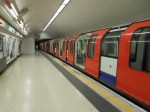

Normally, it’s closed on a Sunday, but to help out the Northern line, TfL were running it today.
I must be the first Londoner, who first rode the Drain in his sixties on a Sunday.
When I used it today, I just walked up the travelator to the surface, up a few steps and along Princes Street and I was at the stop for the 141 bus to take me home.
I do hope that the Drain is going to be run to a similar schedule to the rest of the Underground, as getting to and from Waterloo isn’t the easiest of journeys from Dalston.
I’ll probably use the line again in the future!
 The Anonymous Widower