What Is Happening At Waterloo In August?
There have been various alarming headlines promising chaos at Waterloo sation for the whole of August.
This article in Rail Engineer, which is entitled Waterloo and South West Route Upgrade, gives a factual view of what should happen.
An Outline Of The Work To Be Done
This is a list from the article, which lays out the work being done.
- Redevelopment of the previous International terminal and platforms;
- Extension of Platforms 1-4 to accommodate 10-car trains in place of the present eight-car units;
- Platform extension at 10 outlying stations – Feltham, Chertsey, Camberley, Egham, Virginia Water, Sunningdale, Ascot, Martins Heron, Bracknell and Wokingham;
- Track and signalling alterations on the approaches to Waterloo to create longitudinal space for the platform alterations;
- Thirty new five-car Desiro class trains;
- Improvements in access to the Bakerloo, Northern and Jubilee tube lines from platforms 1/2 and 3/4 and from the former International terminal.
This Google Map shows the platform ends at Waterloo station.
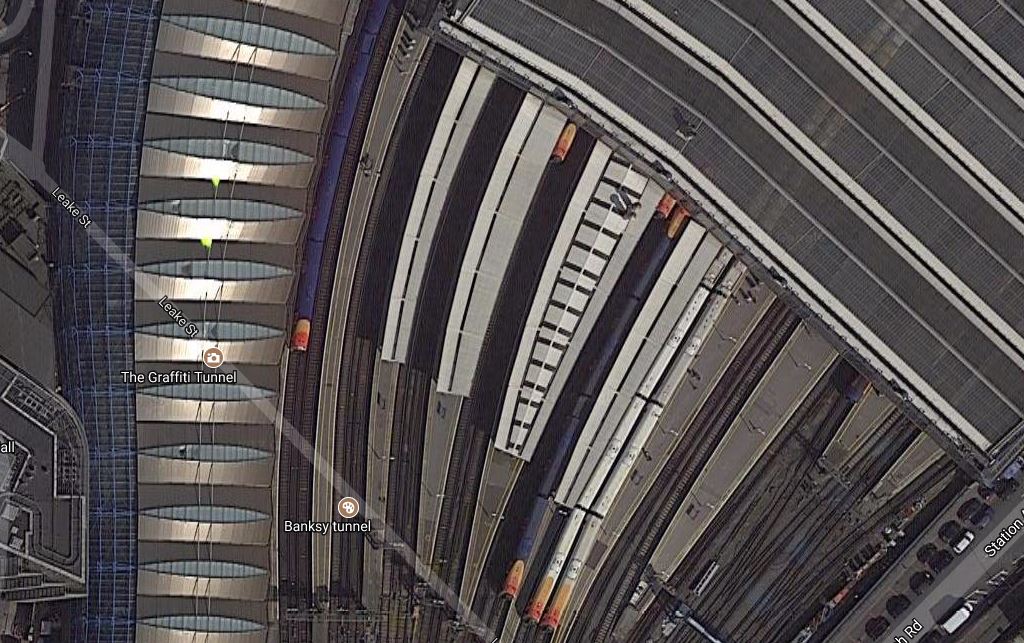
Note.
- The curved roof of the International station at the left
- The square roof of the main station, at the top right.
- Platforms are numbered from 1 to 24 from right-to-left.
- The five platforms in the International station are numbered 20-24.
- Platforms 1/2 and 3/4 are the shortest platforms to the right and will be lengthened to ten-cars.
- Platforms 5/6 and 7/8 are the medium length platforms. .
- Trains are visible in Platforms 8, 9 and 10.
- Platforms 11/12, 13/14, 15/16, 17/18 are all longer platforms.
- A train is visible in Platform 19, which lies alongside the International station.
This Google Map shows Platforms 1/2, 3/4 and 5/6.
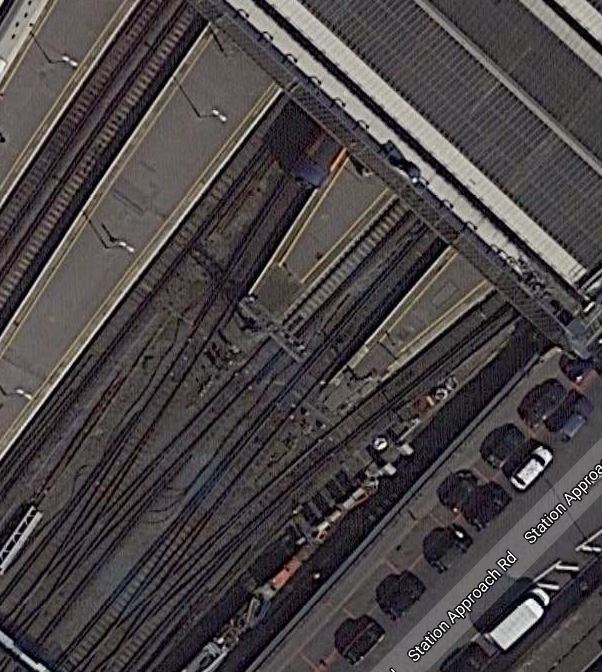
Note.
- The complicated track layout, linking the tracks out of Platforms 1 to 4 together.
- The nose of an eight-car train in Platform 4.
- Platforms 1-4 will probably need to be lengthened by something like forty metres.
- The black cabs and a white one alongside the station, which are 4.6 metres long.
It certainly isn’t a small and simple project.
The Work Schedule For August
This is a shortened extract from the article describing how the work will be done.
The overall programme commenced in 2016 with the initial redevelopment stages of the International platforms. They have been shortened at their far ends to take 12-car trains.
When these platforms are ready for use by Windsor line services on 5 August this year, Platforms 1 to 10 will be closed between then and 28 August. This closure will allow Platforms 1 to 4 to be extended to accommodate 10-car trains and Platforms 5 to 8 will be modified.
An even more severe closure, of Platforms 1-14, between 25 and 28 August, over the Bank Holiday weekend, is needed in order to complete the track and signalling alterations.
Extension of the platforms at the outlying stations is now complete apart from the work at Feltham, which is complicated by the proximity of a level crossing.
The end result of this, the largest investment for decades, will be an increase in peak time capacity into Waterloo of 30 per cent.
There is a lot more information in the full article.
What’s Wrong With The Class 707 Trains?
As I wrote earlier under point 5 in An Outline Of The Work To Be Done, thirty Desiro City Class 707 trains were to be bought for this capacity upgrade .
But the new operator; South Western Railway has decided that these trains are not wanted.
Why?
I’ve ridden both the Class 700 trains, which are the Thameslink version of the Class 707 train and Crossrail’s Class 345 train, which is a version of Bombardier’s new Aventra, which South Western Railway have ordered to replace their suburban fleet.
- In my view in terms of noise, vibration and harshness, the Bombardier product is better.
- The Class 345 train also gives a strong impression of space with its seating layout and large windows with slim pillars.
- The Class 345 train is a bit more spartan, but then it is effectively a large Underground train, rather than a long-distance commuter train.
- The Class 345 train has wi-fi and 4G connectivity, whereas the Class 700 trains have none.
Some of the trains being replaced by South Western Railway are refurbished Class 455 trains. They may be thirty-five years old, but after a high-class refurbishment, they do a good job and set a very high standard, that any new train must exceed.
If I was on a route across London , where I had a choice of one of these Class 455s or a new Class 700 train, I’d choose the older British Rail product, if there was no difference in time.
But it can’t just me passenger reaction to the two new trains, that have made South Western Railway ditch the trains. Although it is very important.
Bombardier have not disclosed all of the technical details of the Aventra and I think that these technical details are the key to the decision.
I have been suspicious for some time that Aventras are fitted with batteries to handle the regenerative braking and other issues.
In Do Class 800/801/802 Trains Use Batteries For Regenerative Braking?, I describe the electrical systems of Hitachi’s new trains and come to this conclusion.
I will be very surprised if Class 800/801/802 trains don’t have batteries.
Will the Class 385 trains for ScotRail have similar traction system?
So if Hitachi are using batteries, why shouldn’t Bombardier? In Is The Battery Electric Multiple Unit (BEMU) A Big Innovation In Train Design?, I write about my trip in Bombardier’s prototype battery train in February 2015.
So does an Aventra have a sophisticated battery system to handle the regenerative braking?
As an Electrical Engineer, I believe that using a battery to handle regenerative braking energy is much more efficient than returning the energy through the third rail or overhead wire, as another train needs to be close to use the energy.
Regenerative braking is quoted as saving up to twenty percent of the energy, but how much could be saved by an integrated train-track electrical system? Bombardier are understandably keeping their mouths shut.
But every Watt saved is less operating cost for the train operator!
Trains with onboard energy storage could give Health and Safety advantages, in places like stations and level crossings. If all trains using a level crossing were had onboard storage or were diesel, could the third rail be cut back to reduce the daanger to tresspassers?
There is also the facility for joining two five-car trains into a ten-car train automatically, which I’m sure is available on Aventras, just as it is with the Hitachi trains.
Splitting and joining at an intermediate station, as Sputheastern do at Ashford International, Great Northern do at Cambridge and Southern do at Gatwick, gives the following advantages.
- Only one train path is needed between London and the intermediate station.
- Between London and the intermediate station, capacity is maximised.
- The two split services have more appropriate capacity to their routes.
- Train companies probably spend less on track access charge and electricity.
- Train companies might even need less trains.
The only disadvantage is that passengers must get in the right portion of a train.
Is the major problem with the Class 707 train, that they don’t have the ability to couple and uncouple automatically?
Increasing Capacity On Waterloo Suburban Services
A new franchise is taking over the services out of Waterloo station to the South West.
There is an informative article in Rail Technology Magazine, which is entitled First MTR joint venture awarded South Western franchise.
I wrote about the suburban services in An Analysis Of Waterloo Suburban Services Proposed To Move To Crossrail 2.
The Services Proposed To Move To Crossrail 2
These suburban termini and their routes are proposed to be connected to Crossrail 2.
- Chessington South – 34 minutes – 9 stops
- Epsom – 37 minutes – 9 stops
- Hampton Court – 36 minutes – 9 stops
- Shepperton – 51 minutes – 14 stops
The times are for a typical one-way journey from Waterloo, which usually has a frequency of two trains per hour (tph).
But consider.
- The routes are probably timed for 75 mph Class 455 trains.
- The latest Class 707 trains are 100 mph trains and probably execute a station stop much quicker.
I would think it is highly likely that a Class 707 train could do a round trip to Chessington South, Epsom and Hampton Court stations, within an hour. For the purpose of this calculation, I’ll assume that trains to Shepperton take two hours for the round trip.
So this would mean that to execute the current 2 tph, would need the following number of five-car trains, which would work as a ten-car unit.
- Chessington South – 2×2 = 4 trains
- Epsom – 2×2 = 4 trains
- Hampton Court – 2×2 = 4 trains
- Shepperton – 4×2 = 8 trains
So a total of 20 new five-car Class 707 trains would be needed to run these four services at a frequency of 2 tph, stopping as they do now!
As they can’t do the round trip in an hour with the current stock, they need to use more trains. And drivers and depot space!
Services to Windsor and Eton Riverside
Services between Waterloo and Windsor and Eton Riverside stations currently take 54 minutes.
I don’t think it is unreasonable to expect that a Class 707 train could do the round trip in two hours.
So that means that just eight trains are needed to run the ten-car 2 tph service to Windsor.
Services On The Hounslow And Kingston Loop Lines
These seem to be timed as follows.
- Hounslow Loop – 85 minutes – 20 stops.
- Kingston Loop – 79 minutes – 22 stops
Consider.
- The services are probably timed for 75 mph trains.
- 100 mph Class 707 trains with a faster station-stop performance could save a minute at each stop.
- All the platforms on the loop have only recently been updated for ten-car trains.
I wouldn’t be surprised to see Class 707 trains, run round the Hounslow and Kingston Loop Lines in under an hour.
This would enable clockface services, simplify train scheduling and please passengers, signallers and the train operating company.
Other Services
There are other services that would benefit from Class 707 trains.
These are two examples of services out of Waterloo
- Weybridge via Hounslow and Virginia – 75 minutes – 20 stops.
- Guildford via Epsom – 71 minutes – 17 stops
Would a Class 707 train, bring these journeys under the magic hour including a turnback?
Waterloo Station
When the former International platforms at Waterloo station has been upgraded in the Summer, it will have five new Platforms 20-24.
To gain efficient access to the new Platforms, Network Rail are replacing the Eurostar tracks, with lines that enable trains to take a sneaky quick route in and out of Platforms 20-24.
These pictures show the lines going from Platforms 1 and 2 at Vauxhall station to the former Eurostar Platforms.
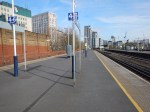

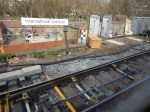
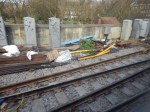
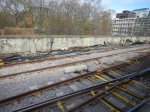
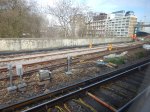
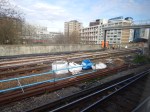
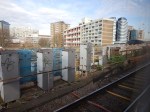
It looks like when it’s finished Platform 1 at Vauxhall will be the up platform towards Waterloo and Platform 2 will be the down platform.
Currently Platform 2 at Vauchall seems to handle services that come through Putney and Clapham Junction stations, with services going the other way using Platform 3.
According to Services in the Wikipedia entry for Putney station, typical off-peak service at the station is.
- 10 tph to London Waterloo
- 2 tph to Weybridge, calling at all stations via Hounslow.
- 2 tph fast to Windsor & Eton Riverside, calling at Richmond, Twickenham, Whitton, Feltham and all other stations.
- 2 tph taking the Kingston Loop Line via Richmond to return circuitously to Waterloo
- 2 tph in each direction round the Hounslow Loop Line to return circuitously to Waterloo
- 2 tph between Waterloo and Reading, which go through without stopping, but they stop on Sundays.
This means that there are 12 tph in both directions from Putney to Waterloo via Clapham Junction and Vauxhall.
It does look that after all the work is finished, these services will go into the rebuilt Platforms 20-24.
Will the various services be given their own platforms in Waterloo?
It would be a way of increasing passenger throughput in the station at busy times, as commuters would know that their trains always used the same platform. Simple and efficient!
It could be done with all services and I think this is done to a certain extent now.
Conclusion
South West Trains new fleet of thirty Class 707 trains is sized to run the services to Chessington South, Epsom, Hampton Court, Shepperton and Windsor and still leave a couple of spares for breakdowns and maintenance.
This calculation shows that you can sometimes replace a large number of 75 mph trains with a significantly smaller number of 100 mph units and still attain the same service frequency.
As they have just lost the franchise, I feel a little bit sorry for Stagecoach. But not that sorry!
Upgrading Waterloo Station
Some reports are giving Network Rail a good kicking over a month-long closure in August of Waterloo station.
I will point readers to this article on Time Out, which is entitled Passengers have been told to avoid Waterloo station for a whole month during major re-building works, as it gives facts rather than emotion.
I have found this video on this page of the South West Trains web site.
It explains the problem well.
South West Trains summarise the work at Waterloo as follows.
- Create a spacious, modern and accessible station concourse by rebuilding the former Waterloo International Terminal.
- Increase services by bringing platforms 20–24 back into use and introducing modern facilities along with new track and signalling.
- Allow longer ten-carriage trains to run to suburban routes by extending platforms 1–4.
Time Out finish their article like this.
All the chaos is down to an £800 million upgrade of Waterloo and South West, which aims to provide 30 percent more space for passengers as well as faster, more frequent services. If anything, it could be a decent excuse to book a holiday somewhere sunny. That’s how we’re taking the news, anyway.
It is probably good advice.
The Eurostar Platforms At Waterloo Station Are Being Brought Back Into Use
When travelling to Shepperton, I walked from Waterloo East station to the balcony at Waterloo station.
You get a good view of the disused Eurostar plaforms, which are being brought back into use.
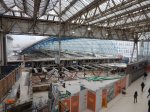
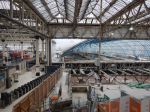
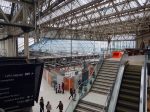
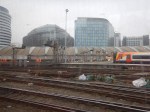
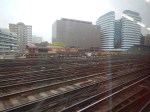
I also took a few as my train left the station.
At least this monument to bad planning of the Channel Tunnel Rail Link, is being put to a laudable use of providing more capacity at Waterloo.
There’s some more pictures from before the work started in Waterloo’s Blue Elephant.
Southern Crossrail
I noticed that Southern Crossrail has appeared in the list of proposed UK rail projects on Wikipedia.
There is a Southern Crossrail web site.
An Outline From History
Basically through tracks at Waterloo station would go straight on and take over the lines from Charing Cross station, through Waterloo East station.
This is said in the Wikipedia entry for Waterloo East station.
Formerly a rail connection ran across the concourse of the main station. This saw little service, although H.G. Wells’s novel The War of the Worlds describes its use to convey troop trains to the Martian landing site. The bridge which carried the line over Waterloo Road subsequently accommodated the pedestrian walkway between the two stations until replaced by the current high level covered walkway. The old bridge remains and is now used for storage.
So it’s not science fiction courtesy of Mr. Wells.
Shutting Stations And Joining Up Services
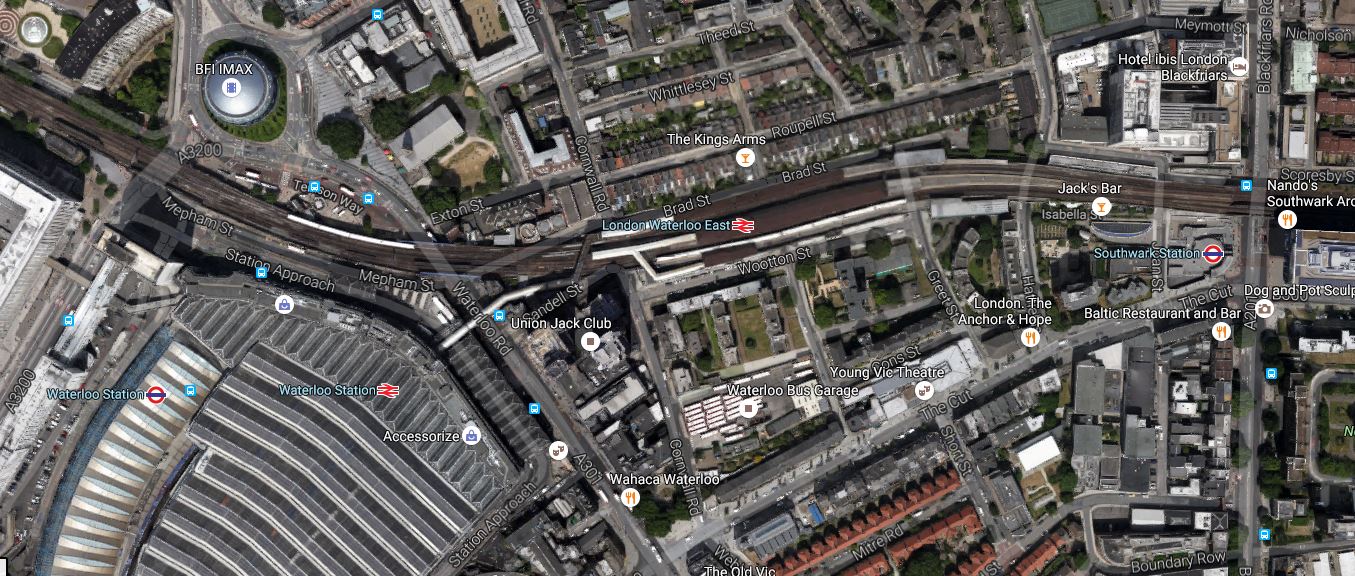
Charing Cross station could be shut or reduced in size, Waterloo East could be moved over Southwark tube station and the services into Charing Cross would run back-to-back with some into Waterloo.
This Google Map shows the stations and the lines.
Southern Crossrail
Destinations Served
Destinations in the West could include.
With the following destinations in the East.
At least it does something useful with the Hayes Line.
Building Southern Crossrail
Southern Crossrail say this about the engineering required.
The minimum engineering requirement would be for the centre part of the concourse at Waterloo to rise up over four through tracks. There would need to be lifts and escalators.
A new bridge, alongside the old one, would be required to carry three new tracks over Waterloo Road.
The old bridge referred to is the one that is referred to in Wikipedia, as being used for storage.
The engineering involved is probably no more difficult than that used to update Thameslink at London Bridge, with the new viaducts over Borough Market.
But I can remember , that when that project was mooted, there was a lot of local opposition.
Given the farce of at times, when London Bridge station was being rebuilt, I think passenger groups will be against the changes.
Southern Crossrail give these additional changes on their web site.
- Signalling changes to increase the throughput
- Flyovers between Battersea and Waterloo thus allowing the local, suburban and express lines to be segregated on the approach to Waterloo, would increase throughput further
- Waterloo East Station would close releasing some land and a new station above the new Southwark station on the Jubilee line could be opened for interchange with Thameslink
- Closing the line up to Charing Cross would allow for greater throughput. Commuters travelling to the west end can change at London Bridge using the Jubilee line. This will have the added advantage of opening up the front of Waterloo through to the South Bank.
My views on these changes and other points follow.
Signalling And Flyovers
The signalling and flyovers probably need to be done anyway, whether Southern Crossrail is built or not.
Certainly, both Thameslink and Crossrail provoked a bit of a track sort-out on the approaches to London.
A sort-out of the lines into Waterloo would probably need to be done for Crossrail 2 anyway.
Rebuilding Waterloo East Station
I rarely use Waterloo East station, but it has a terrible connection to Southwark tube station and a tortuous walk to Waterloo station, unless you’re going to the balcony for lunch or to meet someone.
The map from carto.metro.free.fr shows the Undserground lines beneathe Waterloo East station.
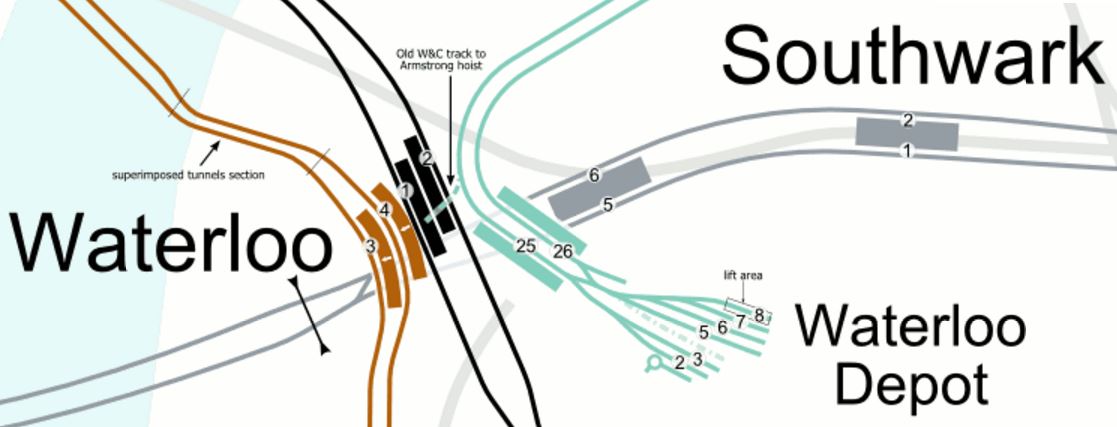
Lines Underneath Waterloo East Station
A new Waterloo East station could be built that had better connections to all of the Underground Lines in the area.
- Bakerloo Line – Very useful for the West End and Crossrail.
- Jubilee Line – Double-ended with connections to both Waterloo and Southwark stations.
- Northern Line (Charing Cross Branch)
- Waterloo and City Line
If rebuilding Waterloo East station would allow building on released land and above the station, together, then surely it is a project a quality developer would relish.
Decent pedestrian links could also be provided into Waterloo, as they should be anyway.
I think that there could be a strong case for the redevelopment of Waterloo East station, whether Southern Crossrail is built or not.
Improving The Waterloo And City Line
One of the side effects of rebuilding Waterloo East station would be improved access to the Waterloo and City Line.
A new entrance is being built at the Northern end and if the Southern end were sorted, London would have got a useful short new Unerground line, with a lot of the money provided by property development.
Serving Charing Cross Station
I believe that a rebuilt Waterloo East station would give better connections to the Underground, than does Charing Cross.
What Waterloo East lacks is connection to the District and Circle Lines and good walking routes to Whitehall. And you mustn’t annoy the Sir Humphries in their commute from Sevenoaks or Petts Wood!
Providing you didn’t close Charing Cross completely, there would be a same platform interchange at London Bridge.
But I suspect that an innovative solution could be found to get passengers from Waterloo East station to the North Bank of the Thames.
Properly done, it would enable passengers using the trains at Waterloo to get easily across the river .
Why are we wasting millions on the Garden Bridge, when a proper cross river connection further West would give benefit to millions of travellers?
At present these are the services that serve Charing Cross in the Off Peak.
- 2 trains per hour (tph) Dartford via Bexleyheath
- 2 tph Gravesend via Sidcup
- 2 tph Gillingham via Lewisham and Woolwich Arsenal
- 2 tph Hayes avoiding Lewisham
- 2 tph Sevenoaks via Orpington
- 2 tph Hastings via Tunbridge Wells
- 1 tph Dover via Ashford International
- 1 tph Ramsgate via Ashford International and Canterbury West
Obviously, there is a lot more in the Peak.
As it looks like the limit of trains through London Bridge to Waterloo East and Charing |Cross is somewhere around or above 20 tph, it could be that if Southern Crossrail is built, then there is a logical split.
- Suburban services go through to Waterloo and into the South West suburban network.
- Long distance services go to Charing Cross.
Platform arrangements at London Bridge and Waterloo East could be designed, so that if you’re on a train going to the wrong destination, you step off and step on the next one.
The Jubilee Line By-Pass
Now that we can see the new London Bridge station emerging and Charing Cross services are calling at the station again, I think we’ll see some interesting ducking-and-diving alomg the South Bank of the Thames.
Suppose you arrive at London Bridge on perhaps a train from Uckfield and need to go to Waterloo to get to Southampton. Until about a month ago, you would have to struggle across London on the Underground. Now you could take a frequent Charing Cross service to Waterloo East and just walk into Waterloo.
We mustn’t underestimate the effects that a fully rebuilt Thameslink and London Bridge station will have on passengers getting across South London.
If Southern Crossrail was built, it would be an alternative for the Jubilee Line between London Bridge and Waterloo.
Southern Crossrail might even lead to a rethink about how the Jubilee Line operates.
Positive Points
- Terminal platforms are released in Waterloo station, as services are joined up.
- No infrastructure changes would be required at London Bridge station.
- No tunnelling
- Southern Crossrail can be built before Crossrail 2.
- Southern Crossrail can be built to be compatible with Crossrail 2.
- The Tramlink connects Wimbledon in the West to Elmers End in the East.
But it will exceedingly difficult to convince the powers-that-be that it is a viable project.
Conclusion
I think it could be one of those projects that is so bizarre and wacky it might just be feasible.
But if it is built or not, London could benefit tremendously, by a quality rebuild of Waterloo East station.
In a phased building of Southern Crossrail, the order of construction could be.
- Rebuild Waterloo East station.
- Upgrade the lines into Waterloo with flyovers and signalling.
- Rebuild the concourse at Waterloo, so that the connecting tracks could go through to Waterloo East.
- Put in the bridges between Waterloo and Waterloo East.
- Connect up the services one-by-one.
It is the sort of project, that a good project management team, could push through with little disruption to services and passengers.
Whither Waterloo?
After looking at Waterloo International, I sat in a train before it left for Clapham Junction and it got me thinking about the future of Waterloo station.
It is busy as this extract from the Wikipedia entry shows.
With over 94 million passenger entries and exits between April 2011 and March 2012, Waterloo is Britain’s busiest railway station by passenger usage. The Waterloo complex is the 15th busiest passenger terminal in Europe, and the 91st busiest railway station in the world. It has more platforms and a greater floor area than any other station in the United Kingdom (though Clapham Junction, just under 4 miles (6 km) down the line, has the largest number of trains).
This Google Map shows how big and hemmed in on all sides, the station complex is.
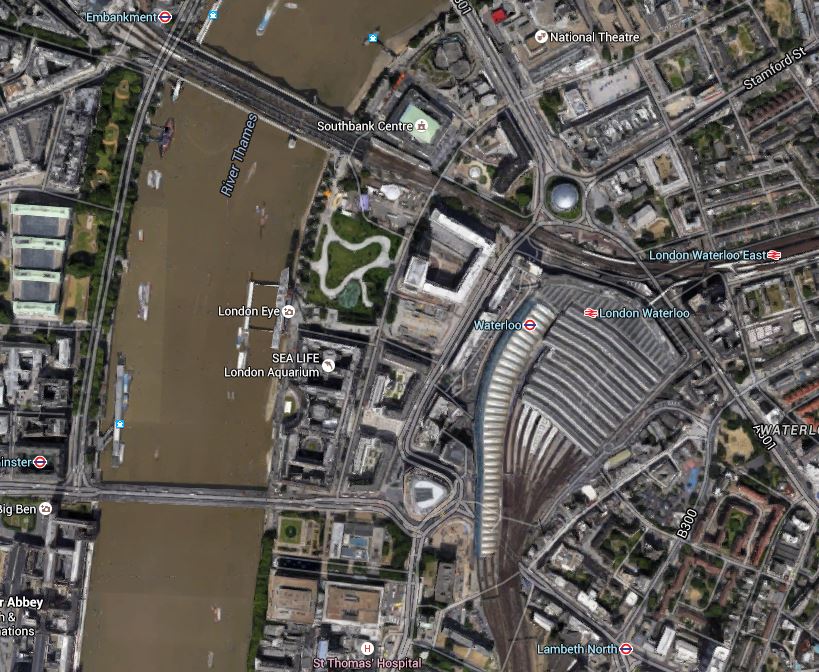
Waterloo Station
It certainly has its problems.
1. Waterloo Station Doesn’t Have Enough Capacity For Trains
South West Trains want to run ten-car trains and the platforms need to be lengthened. That project is in the pipeline, but little seems to be happening.
They also want to bring the other four Eurostar platforms into use. As these platforms were built for the very long Eurostar Class 373 ytrains, they are a complete mismatch for the typical trains that South West Trains typically run.
2. The Lines Into Waterloo Need Sorting
If you increase the trains using the station, you’ll need to increase the capacity on the lines leading into the station.
3. Waterloo Station Doesn’t Have Enough Passenger Facilities
$25million has been spent on creating a retail balcony with shops and restaurants.
But I think that even this is proving not to be sufficient at busy times!
4. The Underground And Waterloo And City Line Don’t Have Enough Capacity
Getting to Waterloo is not easy for people like me in East London and we’re not the only area of London, from where getting to Waterloo is difficult and often overcrowded.
There are two ways that Waterloo can go. Either you try and squeeze more and more trains and passengers into the existing sites or you reduce the number of both to fit the current facilities.
If Crossrail 2 is designed properly and built, it will have the following effects on Waterloo,
1. Reduce the number of trains needing to use Waterloo, by diverting trains and passengers into the tunnel at Wimbledon and then under Central London.
2. This will in turn, free up much-needed platform space and train paths.
3. As passengers will not be changing at Waterloo, but passing underneath on their way to Central London, the pressure will be taken off the station facilities.
If the Northern and Bakerloo Lines get some of proposed capacity increases, this will also take the pressure off Waterloo. But the one I’d improve would be the Waterloo and City Line and make it run 24/7.
There is also an unofficial proposal for Crossrail 3, which would link Waterloo and Euston via a tunnel.
Possibly! But let’s make full use of Thameslink, the East and West London Lines and Crossrail 2 first. I think that if we reorganise Old Oak Common and manage to get an extra track or two along the West London Line.
Waterloo’s Blue Elephant
Waterloo International station was built for Eurostar services at a cost of £120million. I needed to get out of Waterloo to Clapham Junction and I noticed that the first train was in Platform 20 in the old Waterloo International.
So I went and had a look inside for the first time since C and myself went to Paris for the weekend.
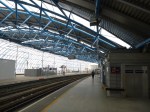
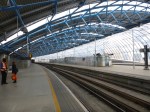
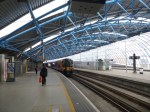
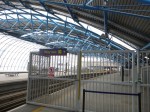
I could have thought of better ways to spent £120million on the railways.
Every Transport Minister in the UK, should have a photograph of this blue elephant subtitled Don’t Create Another Of These on his or her desk.
Architects might like the design, but I think that there are much better-designed stations in the UK. Manchester Victoria is my current favourite, which scores highly on design, quality of construction and affordability.
The biggest crime though for Waterloo International, is that it was designed and built and when it was found to be inadequate, a replacement station was started.
It definitely scored -2 out of 10 for overall planning.
It is interesting to note that the whole farce of the Channel Tunnel Rail Link was more politically-led, whereas Crossrail is much more led by what engineers and architects say is possible. From what I’ve found out about Crossrail 2, it would appear that it has gone further down that route.
The Connection From Waterloo East Station To Southwark Tube Station Is Only For The Young, Fit And Agile
My mother’s advice as a Ponders Plonker (her words) from North London, advised me never to go South of the Thames as you’d get lost or have trouble.
Today, I wanted to do a bit of shopping, as one does, and thought I’d go to Bluewater for a change, as I needed a John Lewis, a big Marks and Spencer, and preferably a Carluccio’s for a pit stop. Westfield doesn’t have a John Lewis, Eastfield is a gluten-free desert and Oxford Street is often crowded.
So Bluewater seemed a good idea at the time! It was as I got all I needed and the Shopping Centre was very quiet.
For Bluewater, you go to Greenhithe station and get a bus, but today there had been a derailment on the North Kent Line at Charlton as reported in this article in the Standard, so my preferred route to Greenhithe via the Overground and the DLR to Greenwich or Woolwich Arsenal was blocked. So I had to go to Charing Cross station to get a direct train to Greenhithe via Sidcup or some such place in the wilderness that is South London.
I got to Greenhithe and Bluewater with just the odd delay and after a successful shop, I returned to Greenhithe with a bag from M & S, to be told that there were still delays, but a direct train to Charing Cross would be arriving in six minutes.
So I took it and was treated to a tour of places I didn’t know. I had hoped the train would stop at Lewisham, so I could cut off the corner using the DLR to Shadwell and then the Overground to Dalston Junction for a bus home.
But it didn’t!
So I decided that as Waterloo East station has an interchange with Southwark station on the Jubilee Line, that it would be easier to change there and go to Canada Water for the Overground.
Southwark station was built for the Jubilee Line Extension in 1999, so I assumed that it would be an easy modern connection with a full spectrum of stairs, escalators and lifts.
First, I had to walk to the far end of the platform and then descend a long flight of fairly steep steps to a concourse below. I’ve certainly been on worse flights of steps in the Underground, but it didn’t prepare me for what I would encounter. Instead of an escalator from the concourse to the Jubilee line platforms, I found that the down escalator was under repair and I would be expected to descend a set of steps you’d more likely find in the Swiss Alps.
There wasn’t even a warning like there is at Hampstead tube station, but it was certainly more difficult than the steps there.
So I turned back and asked the guy on the gate, where the Way Out was. But there isn’t one! He told me, you had to go back to the platform and then use the bridge to Waterloo. So I had to climb back up the first set of stairs and in the end got a train to Charing Cross to come home by means of the District Line and the Overground.
My company, Metier Management Systems supplied Artemis software to do the project management for the Jubilee Line Extension. I have heard some odd stories about this project which had to be finished before the Millennium, so that the Great and Good could get to the Dome.
The guy on the gate did tell me that Transport for London tried to get an entrance to the concourse, but the residents objected. Whoever heard of a train station without a Way Out to the street?
At the present this interchange is an accident waiting to happen and there are no signs discouraging those who are not of a supreme fitness level from taking the route.
There are signs pointing to the Jubilee Line on the platforms at Waterloo East and after going through the barriers for those at Waterloo East, you are opposite the barriers for Southwark Tube station, which is only accessible by the extremely steep stairs.
Something needs to be done!
I could have probably managed it, if I wasn’t carrying my bag from Bluewater.
But I am a person, who doesn’t take unnecessary risks.
Dalston To Wimbledon And Back
Yesterday evening, I went to Wimbledon to have a drink with a friend. It’s not a difficult journey, but I was going out in the rush hour and Victorian railway planners didn’t really expect anybody to travel from the very poor East London to the affluent South-West.
They only built two cross-river rail links east of London Bridge and one of these was a re-use of some leftover infrastructure in the shape of the Thames Tunnel. It’s got better in recent years, with the re-opening of an extended East London Line, through the Thames Tunnel and new lines in the shape of the Jubilee Line and the Docklands Light Railway to Lewisham, but if you live in Dalston and want to go south-west regularly, you’re living in the wrong part of the city.
If I’ve got plenty of time to get to Wimbledon, I have three slow routes I can take.
1. Walk to Canonbury station and take a North London Line train to West Brompton, where I change onto the District Line to Wimbledon.
2. Walk to Dalston Junction station and take an East London Line train to Clapham Junction, where I change to a train for Wimbledon.
3. Take a 76 bus to Waterloo and then get a train to Wimbledon.
The first two routes are best used at a non-busy time, where perhaps you’ve got a paper to read and the third can be very slow, if the traffic is heavy.
Because of Crossrail work and diverted buses, taking a bus to Bank for the Drain to Waterloo is not the serious proposition it should be.
To further complicate matters, the Transport for London Journey Planner, says walk to Dalston Junction and take a train to Canada Water, from where you get the Jubilee Line to Waterloo,
In the end, I took a 141 bus to Bank and struggled to Waterloo through a very crowded Drain.
Coming back, it was after eleven, so I had to wait ten minutes for a train to Waterloo, where I decided to come home via Canada Water and the East London Line. This is a good route coming home, as it means two stops on any bus, drops me just round the corner from my house.
If Crossrail 2 ever gets built, this journey will become much easier, as between Dalston Junction or the Gateway to the North-East and Wimbledon or the Gateway to the South-West, there will be only seven intermediate stations; Angel, Kings Cross/St. Pancras/Euston, Tottenham Court Road, Victoria, Chelsea Kings Road, Clapham Junction and Tooting Broadway.
So using my mother’s Ready Reckoner, Dalston to Wimbledon will take just sixteen minutes.
I’m certainly backing Crossrail 2!
It Was Beautifully Cold Outside Carluccio’s In Waterloo
I don’t mind the cold and I ate breakfast virtually by myself outside on the balcony at Carluccio’s in Waterloo.
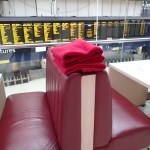

To be fair, staff said that it was cold and would I like to be inside. But I wanted to watch the destination board and I was wearing my thick Puffa coat!
 The Anonymous Widower