The Connection From Waterloo East Station To Southwark Tube Station Is Only For The Young, Fit And Agile
My mother’s advice as a Ponders Plonker (her words) from North London, advised me never to go South of the Thames as you’d get lost or have trouble.
Today, I wanted to do a bit of shopping, as one does, and thought I’d go to Bluewater for a change, as I needed a John Lewis, a big Marks and Spencer, and preferably a Carluccio’s for a pit stop. Westfield doesn’t have a John Lewis, Eastfield is a gluten-free desert and Oxford Street is often crowded.
So Bluewater seemed a good idea at the time! It was as I got all I needed and the Shopping Centre was very quiet.
For Bluewater, you go to Greenhithe station and get a bus, but today there had been a derailment on the North Kent Line at Charlton as reported in this article in the Standard, so my preferred route to Greenhithe via the Overground and the DLR to Greenwich or Woolwich Arsenal was blocked. So I had to go to Charing Cross station to get a direct train to Greenhithe via Sidcup or some such place in the wilderness that is South London.
I got to Greenhithe and Bluewater with just the odd delay and after a successful shop, I returned to Greenhithe with a bag from M & S, to be told that there were still delays, but a direct train to Charing Cross would be arriving in six minutes.
So I took it and was treated to a tour of places I didn’t know. I had hoped the train would stop at Lewisham, so I could cut off the corner using the DLR to Shadwell and then the Overground to Dalston Junction for a bus home.
But it didn’t!
So I decided that as Waterloo East station has an interchange with Southwark station on the Jubilee Line, that it would be easier to change there and go to Canada Water for the Overground.
Southwark station was built for the Jubilee Line Extension in 1999, so I assumed that it would be an easy modern connection with a full spectrum of stairs, escalators and lifts.
First, I had to walk to the far end of the platform and then descend a long flight of fairly steep steps to a concourse below. I’ve certainly been on worse flights of steps in the Underground, but it didn’t prepare me for what I would encounter. Instead of an escalator from the concourse to the Jubilee line platforms, I found that the down escalator was under repair and I would be expected to descend a set of steps you’d more likely find in the Swiss Alps.
There wasn’t even a warning like there is at Hampstead tube station, but it was certainly more difficult than the steps there.
So I turned back and asked the guy on the gate, where the Way Out was. But there isn’t one! He told me, you had to go back to the platform and then use the bridge to Waterloo. So I had to climb back up the first set of stairs and in the end got a train to Charing Cross to come home by means of the District Line and the Overground.
My company, Metier Management Systems supplied Artemis software to do the project management for the Jubilee Line Extension. I have heard some odd stories about this project which had to be finished before the Millennium, so that the Great and Good could get to the Dome.
The guy on the gate did tell me that Transport for London tried to get an entrance to the concourse, but the residents objected. Whoever heard of a train station without a Way Out to the street?
At the present this interchange is an accident waiting to happen and there are no signs discouraging those who are not of a supreme fitness level from taking the route.
There are signs pointing to the Jubilee Line on the platforms at Waterloo East and after going through the barriers for those at Waterloo East, you are opposite the barriers for Southwark Tube station, which is only accessible by the extremely steep stairs.
Something needs to be done!
I could have probably managed it, if I wasn’t carrying my bag from Bluewater.
But I am a person, who doesn’t take unnecessary risks.
Dalston To Wimbledon And Back
Yesterday evening, I went to Wimbledon to have a drink with a friend. It’s not a difficult journey, but I was going out in the rush hour and Victorian railway planners didn’t really expect anybody to travel from the very poor East London to the affluent South-West.
They only built two cross-river rail links east of London Bridge and one of these was a re-use of some leftover infrastructure in the shape of the Thames Tunnel. It’s got better in recent years, with the re-opening of an extended East London Line, through the Thames Tunnel and new lines in the shape of the Jubilee Line and the Docklands Light Railway to Lewisham, but if you live in Dalston and want to go south-west regularly, you’re living in the wrong part of the city.
If I’ve got plenty of time to get to Wimbledon, I have three slow routes I can take.
1. Walk to Canonbury station and take a North London Line train to West Brompton, where I change onto the District Line to Wimbledon.
2. Walk to Dalston Junction station and take an East London Line train to Clapham Junction, where I change to a train for Wimbledon.
3. Take a 76 bus to Waterloo and then get a train to Wimbledon.
The first two routes are best used at a non-busy time, where perhaps you’ve got a paper to read and the third can be very slow, if the traffic is heavy.
Because of Crossrail work and diverted buses, taking a bus to Bank for the Drain to Waterloo is not the serious proposition it should be.
To further complicate matters, the Transport for London Journey Planner, says walk to Dalston Junction and take a train to Canada Water, from where you get the Jubilee Line to Waterloo,
In the end, I took a 141 bus to Bank and struggled to Waterloo through a very crowded Drain.
Coming back, it was after eleven, so I had to wait ten minutes for a train to Waterloo, where I decided to come home via Canada Water and the East London Line. This is a good route coming home, as it means two stops on any bus, drops me just round the corner from my house.
If Crossrail 2 ever gets built, this journey will become much easier, as between Dalston Junction or the Gateway to the North-East and Wimbledon or the Gateway to the South-West, there will be only seven intermediate stations; Angel, Kings Cross/St. Pancras/Euston, Tottenham Court Road, Victoria, Chelsea Kings Road, Clapham Junction and Tooting Broadway.
So using my mother’s Ready Reckoner, Dalston to Wimbledon will take just sixteen minutes.
I’m certainly backing Crossrail 2!
It Was Beautifully Cold Outside Carluccio’s In Waterloo
I don’t mind the cold and I ate breakfast virtually by myself outside on the balcony at Carluccio’s in Waterloo.
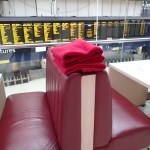
To be fair, staff said that it was cold and would I like to be inside. But I wanted to watch the destination board and I was wearing my thick Puffa coat!
How Thameslink Sorts Out London’s Trains
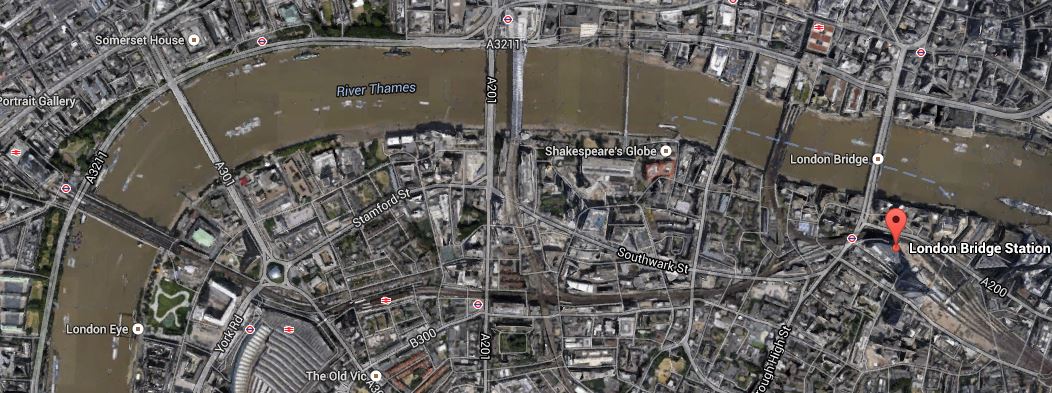
After taking the pictures of the new viaduct at London Bridge yesterday, I thought it would be good to post a map, which showed how it all fits together.
Stations Along The Thames
The picture shows most of the stations along the river that serve the South. And of course the North if they’re connected to Thameslink.
The main stations from left to right (west to east) follow.
Charing Cross is at the far left of the image, where it sits at the end of the Hungerford bridge, by which all trains enter and leave the station. The station is marked by the red British Rail double-arrow symbol, with the London Underground roundel showing the related Embankment tube station.
Waterloo is opposite Charing Cross at the other side of the Thames, although there is no direct rail connection between the stations.
Waterloo East is to the east of Waterloo and this station does have a rail connection to both Charing Cross and London Bridge.
This picture shows the position of the three stations and the rail lines to a larger scale.

Charing Cross, Waterloo and Waterloo East Stations
Note the rail lines going across Hungerford Bridge between Charing Cross and Waterloo East. I’ve never been to Waterloo East or even stopped at it on a train, but you can walk between the two Waterloo stations.
In this image the domed circular roof of the Waterloo IMAX cinema and Nelson’s Column can be clearly seen.
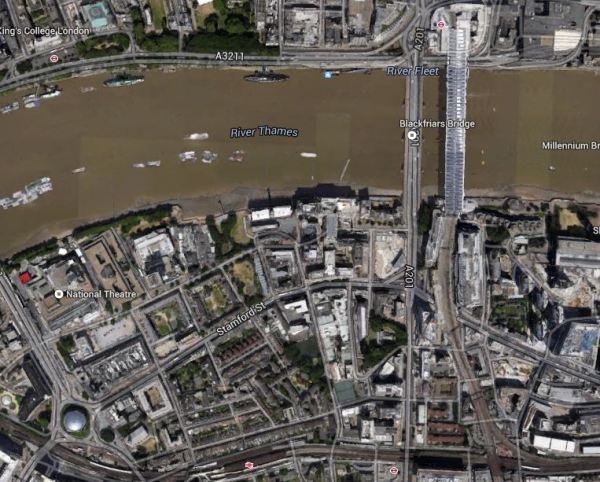
Blackfriars is the next station and its unique position across the river is shown in the middle of the main picture. It is the right one of the pair of bridges and the British Rail symbol indicates the main station entrance on the North Bank of the Rover. This picture shows its position in more detail.
Blackfriars and Thameslink
Note how the Thameslink lines from Blackfriars to the south go in two directions.
One line goes to the East for London Bridge, after joining with the lines from Charing Cross and Waterloo East, at the bottom right of the picture.
The other line goes directly South to Elephant and Castle.
The Temple area is at the top left of this picture, where there is a tube station. London’s new Garden Bridge will between here and the Southbank area, when it is built.
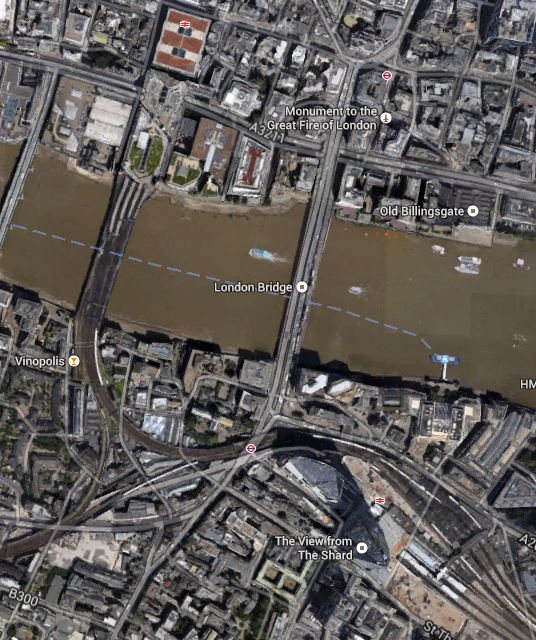
Cannon Street on the North Bank is the next station and like Charing Cross, all trains access the station by a bridge over the Thames.
Cannon Street and London Bridge
Note the triangular junction South of the Thames, that gives access to both Charing Cross and London Bridge from Cannon Street.
London Bridge station is shown in more detail in this picture.

London Bridge Detail
The detail would be a lot better, if it wasn’t for the shadow from The Shard, which is visible at the bottom right.
The pattern of the lines to and through London Bridge that will be in operation with the full Thameslink scheme is beginning to emerge.
1. The number of through platforms at London Bridge, for services on Thameslink and to/from Charing Cross and Cannon Street is being increased from six to nine.
2. The extra viaduct over Borough High Street and the Market can be seen.But it doesn’t have any tracks in this image.
3. London Bridge station itself, appears to be a big building site, with trains going through.
Incidentally, I’m not sure of the date of the Google Earth view.
The Thameslink program is vast and will add a hundred stations to the existing network. Wikipedia sums it up like this.
The Thameslink Programme, is a £6 billion project in south-east England to upgrade and expand Thameslink to provide new and longer trains between a wider range of stations to the north and to the south of London without requiring passengers to change trains in London. Work includes platform lengthening, station remodelling, new railway infrastructure, and additional rolling stock.
In this post, I have traced it south of the Thames and shown how it interfaces with the lines into Charing Cross and Cannon Street. If the architects have got the design of London Bridge station right, this alone should unlock a myriad of new routes for all those millions of Londoners and those that come into the City.
A couple of years after the new London Bridge is completed, Crossrail with its connection to Thameslink at Farringdon will open, adding even more travel possibilities.
Some months ago, I wrote a post called A Divided City.
Hopefully, the enlarged Thameslink, will help to cross the great divide of the Thames, that without which London wouldn’t even exist.
The TfL Journey Planner Knows Best
Yesterday, I went to see Ipswich at Bournemouth, who play within walking distance of Pokesdown station.
That area is served from Waterloo, and if there is a difficult station to get to from Dalston, it is Waterloo. In fact it’s difficult for anybody, who doesn’t start their journey on the Bakerloo line, Jubilee line or some parts of the Northern line. I usually use a bus or buses to get to the station, or bypass it totally and pick up the train from Clapham Junction, after getting there on the Overground.
But, yesterday, I thought, I’d see what the TfL journey Planner recommended.
It recommended taking the Overground from Dalston Junction to Canada Water station, and then using the Jubilee line to get across to Waterloo.
It seemed a bit of a roundabout way, but it does appear to be quickest.
Whilst waiting for my Overground train, I told a driver, waiting for his train to arrive, what the Journey Planner had recommended.
He was as surprised as I was!
One of the other things about the Overground/Jubilee route, is that it is step-free, at all stations.
Waterloo’s Disgrace
Behind the Premier Inn at Lambeth are the old Eurostar platforms at Waterloo International station.
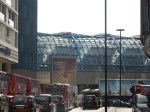

They have been virtually derelict since services transferred to St. Pancras in 2007.
I suppose they must be one of most expensive ruins of recent years.
If we were going to move the services to St. Pancras, why did we build such a grand station as an interim measure? Especially, when the French just made do, with what they had at Gare du Nord. And of course, they still do!
Beware Of Angry Tweets
According to this article in the Daily Mail, an analysis of Twitter messages from rail passengers has shown that South West Trains are the least popular train company.
I took the company yesterday to Portsmouth Harbour in order to go to the Isle of Wight and I have no complaint about them, except that for First Clash passengers, they are the meanest. On a similar length journey to Ipswich, I may not get many perks, but at least I can get a free bottle of water or a coffee.
I know it’s not much, but it’s the thought that counts.
I wouldn’t choose the company, if there was an alternative, except that Waterloo is a better station for me than say Victoria.
Perhaps though companies should take more notice of what is said on sites like Twitter!
To Cobham And Back
After Southwark Cathedral, I took the Tube to Waterloo to get the train to Cobham and Stoke D’Abernon station. Being a little bit early, I sat and had a cup of tea in Carluccio’s on the balcony in the station.
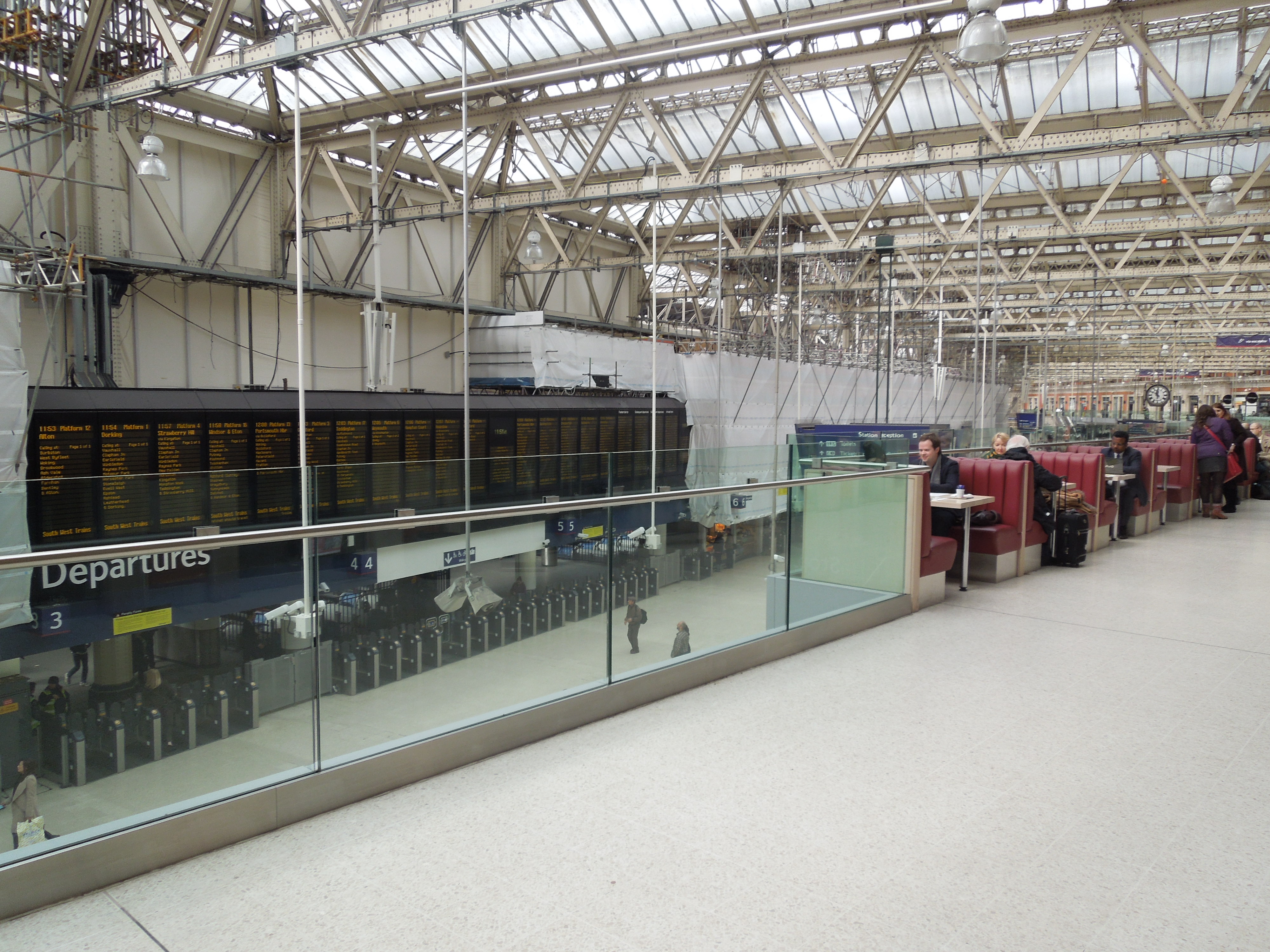
Is This The Best Place To Wait For A Train?
Waterloo station must have the most comfortable place to watch for your train to be allocated a platform.
The journey out and back were in two very clean Class 455 units. For trains built in the 1980s, they’ve scrubbed up well. in fact Wikipedia states this.
This refurbishment was so comprehensive that many passengers thought the refurbished units were new trains.
They almost fooled me, but I knew the age of the design, as you see similar trains elsewhere in the UK.
It probably says that rather than buy expensive brand new trains, which often provide jobs these days for overseas companies, why not rebuild some of what we’ve got?
Coming back, I was unlucky to just miss a train, so I had to wait half-an-hour for another train.
Another good point about the trip, was that I paid just £3.30 for my return ticket.
Meeting At Waterloo
In a post a couple of weeks ago, I said that the clock at Waterloo was no longer the meeting place of choice it once was, due to the new balcony with all its shops and cafes. These pictures taken on Sunday, show even less people than the previous post.


The cafes weren’t that busy, but people did seem to be meeting on the balcony.
The Clock At Waterloo Has Got More Comfortable
The balcony at Waterloo station is now more of less complete and there are now some wonderful places to meet people high up in the station. That’s if you have anybody to meet!



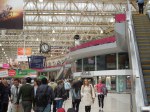


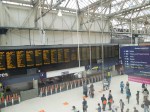
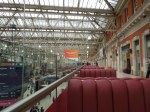

I was in Carluccios, which as you can see from the photo, has quite a few seats looking down on the concourse.
in 1962, the BBC showed an episode of Comedy Playhouse, called Sealed With A Loving Kiss. Wikipedia describes the comedy thus.
Arnold, played by Ronald Fraser, and Freda, played by Avril Elgar, have been having a relationship by correspondence and when they meet for the first time they discover neither has been totally truthful.
They meet for the first time under the clock at Waterloo. Or it could have been Victoria! Now they would meet in one of the cafes upstairs. Although today, there seemed to be large numbers of people underneath the clock. Including one proper gentleman with flowers.

