Ambitious £10bn Plans For Gatwick Heathrow HS4Air Rail Service Rejected
The title of this post is the same as that of this article on Rail Technology Magazine.
This paragraph outlines the reasons for rejection of HS4Air.
But the DfT has reportedly turned down the proposal, primarily over concerns about the affordability and that it would likely face issues because the proposed route will run across greenbelt land.
It would appear from the report, that the promoters of the project; Expedition Engineering, are not happy.
This is the last three paragraphs of the article
Lenczner said that most of the rail line was going to be in tunnels, ensuring the impact to open green areas was limited and less than the Lower Thames Crossing.
He said: “We’re trying to encourage people to get out of cars and use more sustainable modes of transport and the HS4Air would have contributed to that.
“We have had lots of messages of support who are also utterly gobsmacked that it has been rejected at this stage.
He added that “we don’t intend to back down,” and said the engineering company plans to challenge the DfT’s decision.
Alistair Lenczner is a director of Expedition Engineering.
I think that HS4Air proposal is the sort of bold infrastructure project, that we will increasingly need in a post-Brexit world.
There were four major proposals to create better rail access to Heathrow up before the Department of Transport.
In Could Rail Access To Heathrow Be Formed Of The Best Bits Of Various Schemes?, I summed them all up.
Heathrow Southern Railway
I summed up the Heathrow Southern Railway like this.
- Connectivity to Waterloo, Clapham Junction, South and South West London
- Extends Heathrow Express to Woking and Basingstoke
- Adds a new route for commuters into Paddington.
- Extends Crossrail from Heathrow to Staines.
- It will be built alongside the M25 with a tunnel to Terminal Five.
- All terminals served
- Provides a freight route into the airport from the South West.
- Privately funded.
HS4Air
I summed up HS4Air like this.
- Connectivity to High Speed 2, the Midlands, North and West of England and WalesHigh Speed
- Possible connection to Gatwick and Ashford for the Continent.
- North-South station in a tunnel deep under Heathrow.
- The Heathrow station will be able to handle full-length high speed trains from Birmingham, Cardiff and Manchester.
- Heathrow could become a High Speed Rail hub serving Greater Western London.
- Sneaks along the M25.
- All terminals could probably be served, by escalators and lifts from the deep station.
- Provides a freight route into the airport from the North and West.
- Privately funded
I’m keener on the section North of Heathrow, than that to the South.
Western Rail Approach To Heathrow
I summed up the Western Rail Approach To Heathrow like this.
- Connectivity to Slough and Reading and further West with a change.
- All terminals served.
- Provides a freight route into the airport from the West.
- Network Rail’s proposed scheme.
- Government funded (?)
Windsor Link Railway
I summed up the Windsor Link Railway like this.
- Connectivity to Slough and Reading and further West with a change.
- All terminals served.
- Provides a freight route into the airport from the West.
- Privately funded
This scheme also unlocks development of upmarket housing in Windsor.
Why Does Heathrow Need Better Rail Access?
Heathrow Airport is continuously expanding and needs better transport access.
To the man or woman in the Woking 4×4, the baggage handler in his clapped diesel Toyota and the myriad numbers of Air Cargo operators with their polluting trucks, that means better and cheaper parking and more comprehensive road networks at the Airport.
We are not talking about an American Airport with masses of space, but an airport with limited land surrounded by housing, office and commercial development.
It also has a massive non-aviation pollution footprint, caused by all the diesel vehicles serving the airport.
Surely, more and better electric trains and road vehicles into Heathrow should be part of the solution. Most politicians, trade union officials, businessmen and travellers, probably feel so.
The Airport Of The Future
In the modern world, an ideal airport should be designed so that.
- All air-side vehicles serving the planes, runways and airport buildings, should be battery-powered or zero carbon.
- All passengers and airport workers must arrive or leave the airport, by means of electric train, bus, tram or taxi.
- All supplies and air cargo must arrive and leave the airport by means of electric train or truck.
Heathrow will have a large fight to get the Planning Permission for their new runway and expansion plans. But declaring the Airport to be electric vehicle only on the ground, could be a bold move, that could turn the minds of opposing residents, politicians and Local Authorities.
Electric Air-Side Vehicles
This is starting to happen, with even giant electric aircraft tugs for A380s now available.
Moving People To And From The Airport
Add up all the numbers of passengers and workers and there isn’t enough capacity at the preset time.
There needs to be the following.
- More frequent and longer trains.
- More platforms
- Access to the West
- Access to High Speed Two
HS4Air offered a different approach of a North-South railway through the Airport, which could be built without disturbing the existing rail network at Heathrow.
But it has been rejected.
HS4Air would also have allowed important local networks to be built onto Crossrail.
- Extending Crossrail to Staines.
- Adding the West London Orbital Railway to Old Oak Common.
I feel that combining the best bits of HS4Air, Heathrow Southern Railway and the West London Orbital Railway could be a good idea, to bring all those important workers to the Airport.
Moving Air Cargo And Supplies To And From The Airport
Some of the automated-logistics networks used by the likes of Amazon are incredibly impressive.
Could a massive logistics hub be built in the centre of the Airport?
- Electric trains would arrive with pre-loaded containers of air cargo and supplies.
- The containers would be automatically directed to the appropriate place on a network of tracks deep under the airport.
- Containers would also travel in the reverse direction with inbound air cargo, returned empties and rubbish.
I’m sure something like this will happen and underneath the third runway is surely the place to build such a logistics hub.
My Views On Each Proposal
These are my views on each proposal are as follows.
Heathrow Southern Railway
This is probably the second largest and boldest of the four schemes.
It has the following advantages.
- It gives good connections to large areas of South and South West London.
- It connects to the two big rail hubs of Waterloo and Charing Cross.
- It extends Heathrow Express from a short express airport service into a much-needed new commuter route between Surrey and Hampshire and London.
- It extends Crossrail to Staines to create an important local link into the Airport for the workforce.
- It could connect to a freight logistics hub under the new third runway.
- It could be built without affecting existing services.
- It will probably be a privately-funded scheme.
But there is a big disadvantage; there is no connection to Reading, Slough and the West.
HS4Air
This is probably the largest and boldest of the four schemes.
It has the following advantages.
- It connects to High Speed 2 and the Great West Main Line.
- It could be connected to Gatwick and High Speed One in the future.
- It would be built mainly in tunnel under Heathrow Airport.
- It proposes a North South station under Heathrow Airport, below existing rail links.
- It would be able to handle full-size high speed trains.
- It could connect to a freight logistics hub under the new third runway.
- It would fit in well with the development of a third runway and new terminals, as it will be well below in tunnel.
- It could be built without affecting existing services.
But there are disadvantages
- It will probably be a very expensive privately-funded scheme.
- It does provide good connectivity to Slough, but doesn’t improve the connectivity to other areas, where workers at the Airport will live.
I think if this scheme is built, then the following two smaller schemes should be built as well.
- West London Orbital Railway.
- Crossrail extension to Staines.
These schemes would bring in Heathrow’s much-needed workers.
I don’t think we’ve heard the last of this scheme.
Western Rail Approach To Heathrow
It has the following advantages.
- It should provide good connectivity to Reading, Slough and further West.
- It wouldn’t be difficult to build.
- It could connect to a freight logistics hub under the new third runway.
But there are disadvantages.
- Except for Slough, it doesn’t connect to much affordable housing, where Heathrow’s massive workforce live.
- It is Network Rail’s pet scheme.
- Would it need to be government-funded?
As with HS4Air, I think if this scheme is built, then the following two smaller schemes should be built as well.
- West London Orbital Railway.
- Crossrail extension to Staines.
These schemes would bring in Heathrow’s much-needed workers.
Windsor Link Railway
This is very much a local scheme and doesn’t give enough capacity increase for the Airport.
But I don’t rule out in the future, a tunnel under Windsor connecting Slough and Staines to aid the development of the important town.
A Pragmatic Approach
Could a pragmatic approach be taken to give Heathrow, the world-class rail access it needs?
What About The Workers?
This may seem a strange place to start, but I believe that if Heathrow expands, the following will be true.
- The airport will need large numbers of workers.
- Not all jobs will be high salaries, so good access to areas of low-cost housing from the airport on a 24/7 basis will be needed.
- If you work at the airport, then it’ll be the first place from where you want to fly on holiday.
- Heathrow will not want workers to add to the Airport’s chronic, local pollution footprint.
Prime areas for the recruitment of airport workers will be Basingstoke, Bracknell, Reading, Slough, Staines and North West and South London.
All currently have bad rail connections to Heathrow.
To ease these journeys, the following local connections must be built.
Crossrail Extension from Heathrow Terminal 5 To Staines
In Heathrow Southern Railway’s Plans For Staines, I looked at this extension in detail and came to the conclusion that four trains per hour (tph) could run to and from Staines for Crossrail.
Although this extension came about because of the Heathrow Southern Railway proposal, I feel that it should be built whatever scheme is chosen.
- It will add a capacity of up to 6,000 passengers per hour, between Staines and Heathrow, in both directions.
- It will increase the capacity of Heathrow Terminal 5 station.
- It will enable extra Crossrail services between Central London and Heathrow Terminal 5.
But the main reason is that it will create a new route between Staines and Abbey Wood via Old Oak Common (for High Speed Two) the West End, Farringdon ( for Thameslink), the City and Canary Wharf.
West London Orbital Railway
The West London Orbital Railway is planned to run in a circular manner around North West London.
I wrote about it in detail in New Railway Line For West London Proposed.
Two routes are proposed.
- Brentford to West Hampstead Thameslink via Old Oak Common.
- Kew Bridge to Brent Cross via Old Oak Common.
The routes would use the freight-only Dudding Hill Line.
Major costs would be.
- Resignalling the route.
- Up to half-a-dozen new or upgraded stations.
- A small number of battery-electric Class 710 (?) trains.
Crossrail or High Speed Two it is not!
The railway will bring large numbers of travellers to Old Oak Common station, where Crossrail will take them to the Airport or Central London.
Windsor Link Railway
I said I was taking a pragmatic approach to rail access to Heathrow and the Windsor Link Railway build in conjunction with extending Crossrail to Staines could have several advantages.
- Remove a lot of road traffic from the Centre of Windsor.
- Create a rail service between Reading and Heathrow via Windsor and Slough.
- A Park-and-Ride could be built South of Slough by the M4.
- Unlock land for development in Windsor.
- One tunnelling project could be used to access Heathrow Terminal 5 station.
The route could be run with a frequency of four tph, using Crossrail trains.
Perhaps it should even be part of Crossrail?
What About The Air Cargo And Supplies?
Extra Intermediate Stations On Crossrail
Various groups and councils regularly ask if there could be an extra station on Crossrail, that would be convenient for their needs.
Can Extra Stations Be Accommodated In The Timetable?
There is not much point in building an extra station, if it means that a realistic timetable can’t be achieved.
Every station stop will introduce a delay intro the timetable. The train may only be stationary for thirty seconds or so, but there is extra time in the braking and acceleration either side of the stop.
But the Class 345 trains have been designed so that the times to execute a station stop are minimised.
Rapid Acceleration And Deceleration
The trains have been designed with eight motored cars out of a total of nine.
- This high-proportion of powered axles gives the trains acceleration and deceleration, which is fast, but well within the levels for passenger safety and comfort.
- The trains also have regenerative braking, which is powerful and smooth.
- At times on the current service between Liverpool Street and Shenfield, I have noticed the trains waiting at stations for a couple of minutes, to allow the timetable to catch up.
These trains have the performance to execute a station stop in the smallest time possible.
Wide Doors And Spacious Lobbies
The trains have been designed with wide double doors and spacious lobbies.
This enables fast unloading and loading of passengers at each station.
Level Access Between Train And Platform
Trains and platforms could be arranged, so that all passengers can embark and disembark as fast as possible.
Precision Driving And Automatic Train Control
As much of the route uses modern digital signalling and the trains have a comprehensive driver assistance system, the trains should be driven to a high degree of precision.
Conclusion
All of these factors will make it possible to execute station stops very quickly.
Thus, if it is desired to add a new station stop, the stop might only add a few minutes to the timetable.
You wouldn’t want to add half a dozen stops between Stratford and Shenfield, but the odd stop here and there shouldn’t be a problem!
Could Extra Stations Be Added In The Tunnels?
I would hope that Crossrail’s design process wouldn’t have left out an important station in the Underground sections of the line.
In my lifetime only one station has been added to a line after it opened, except on an extension. That station was Pimlico on the Victoria Line, but that was a late addition to the project and opened within fourteen months of the opening of the rest of the line.
I think, that I can safely say that from the history of London’s extensive network of underground railways, that it would be extremely unlikely to add a new underground station to Crossrail.
But I think though the following could happen.
New Entrances To Existing Stations
Even these will be extremely unlikely, if Crossrail have done their planning thoroughly.
But then there are massive property developments, sprouting up all over Central London.
One of London’s latest signature office developments, the Norman Foster-designed Bloomberg London will incorporate an entrance to Bank Underground station.
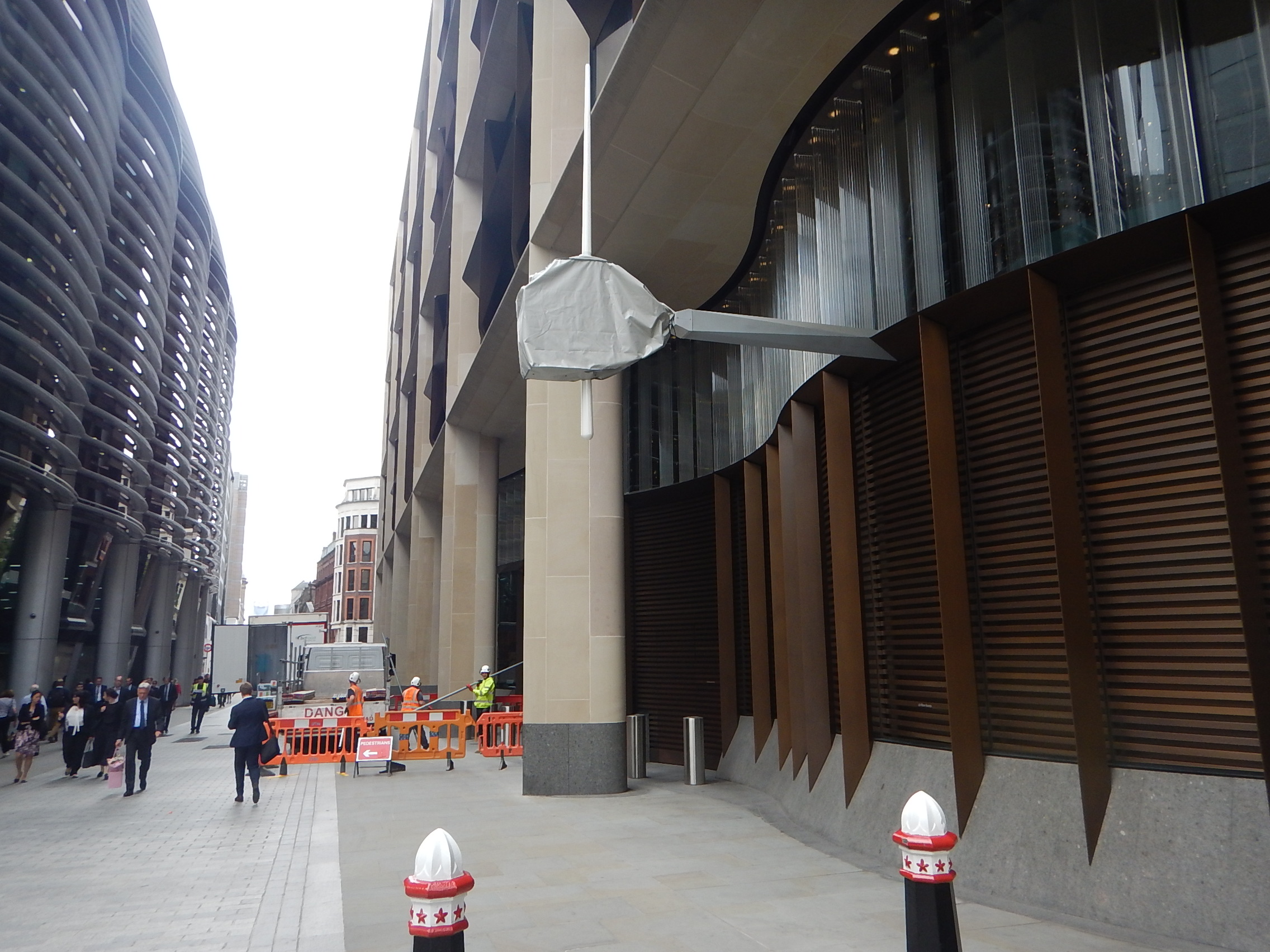
Hopefully, the entrance will open soon.
Bank station’s new step-free entrance will also incorporate a massive office development on the top.
If a property developer is spending around a billion pounds on a development, and it can be connected to a station, they will seriously look at doing it.
I can’t believe that no new developments will want to have an entrance to a Crossrail station.
The New Museum Of London
The current site of the Museum of London is too small and difficult to find. The Museum is planning to move to Smithfield and will be very close to Farringdon station.
There is a massive over-site development on top of the station, that I wrote about in TfL Gives Go Ahead To Build Above Farringdon Station.
This Google Map shows the relationship between the station and the new site of the museum.
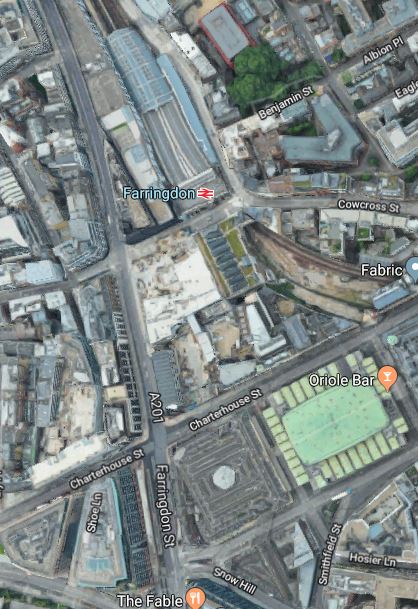
Note.
- The building with the light-green roof is the Poultry Market.
- Thameslink runs under the Poultry Market.
The basement of this Poultry Market together with the site to its West and the triangular site to the South, will be transformed into the new Museum of London.
Much of the space between the Poultry Market and Farringdon station is a Crossrail work-site and whole area is ripe for development, which must surely incorporate some form of connection between the Museum and Farringdon station.
Farringdon, which for many years was just a meat market surrounded by a lot of low grade buildings, should evolve into a visitor attraction in its own right.
For a better look at the current state of the area, visit A Detailed Look At The Space Between Farringdon Station And The New Museum Of London Site.
As a Friend of the Museum of London, I am looking forward to what will happen!
The Liverpool Street-Moorgate Mega -Station
I don’t think many, who use Liverpool Street and Moorgate stations understand what will happen when Crossrail opens.
This visualisation shows the below-ground elements of the Crossrail station, that will connect the two current stations.
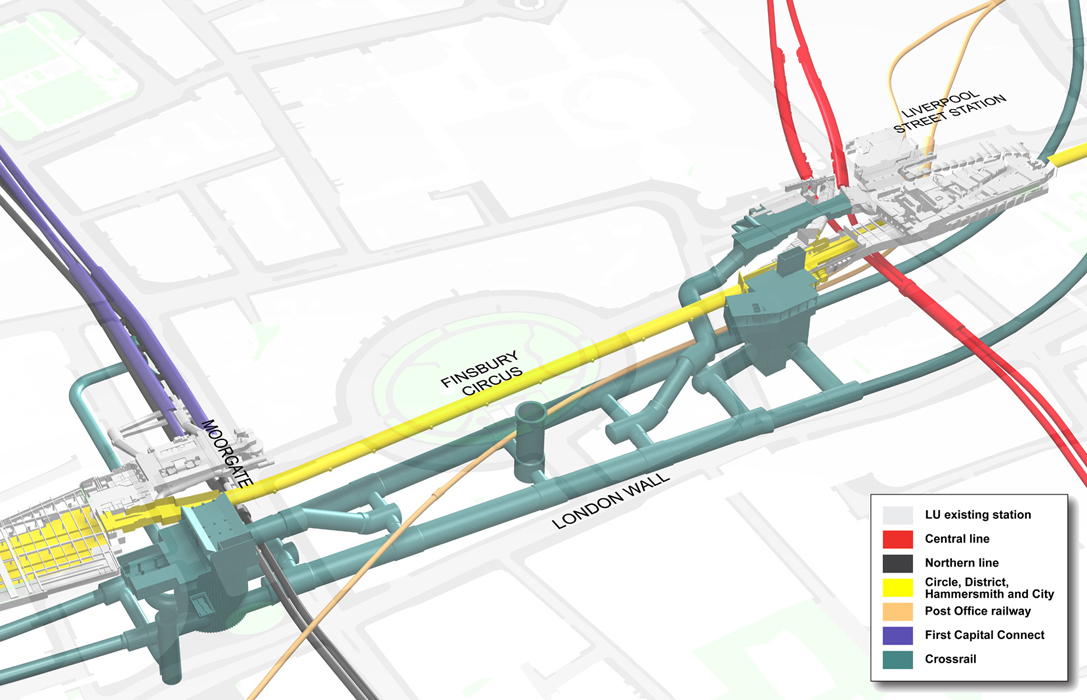
Note.
- On the right is the Central Line, which is shown in red and continues South to Bank station under Bishopsgate.
- On the left is the Northern Line, which is shown in black and continues South to Bank station.
- The Circle, Hammersmith and City and Metropolitan Lines, which are shown in yellow.
- Crossrail is in blue.
- The ventilation and evacuation shaft for Crossrail in Finsbury Circus.
This Google Map shows the area of the stations.
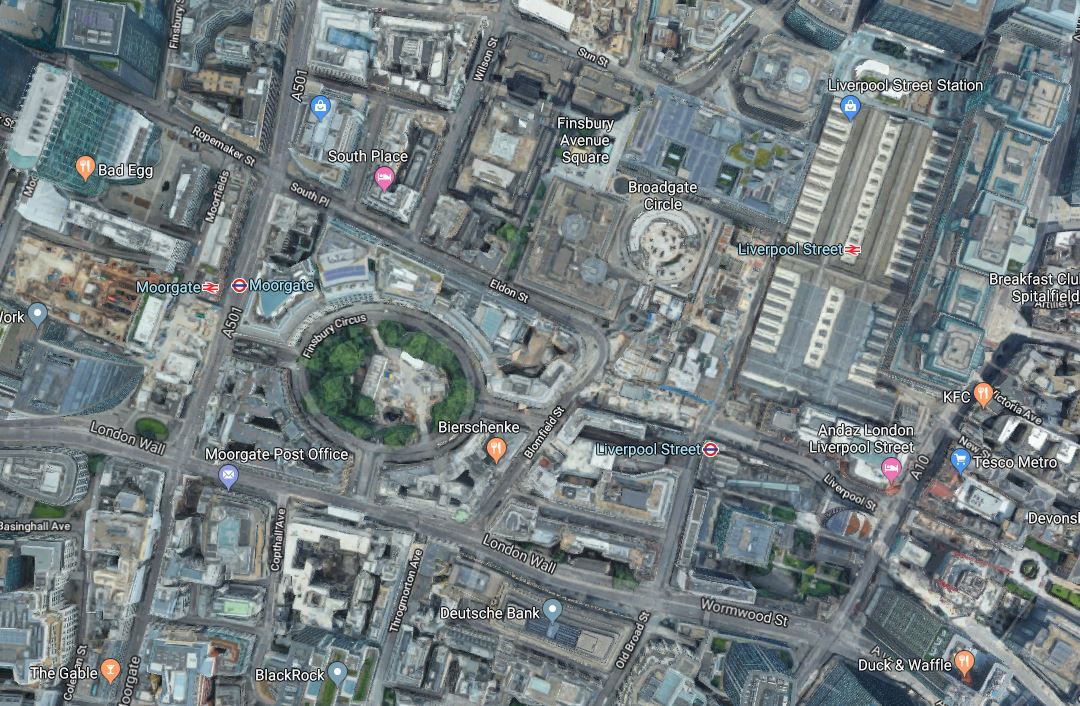
Note Finsbury Circus in the middle.
I would not be surprised if some redevelopment has access into this mega-station complex, that stretches either side of Finsbury Circus.
This access needn’t be below ground, as I strongly believe that the City of London will become virtually traffic-free in the next ten years.
Missing Interchanges
One of the omissions in the design of Crossrail, is the lack of a link to both the Piccadilly and Victoria Lines.
Consider.
By 2024, these two lines will be running at least thirty-six trains per hour (tph) in both directions.
The capacity of Crossrail in each direction could be thirty tph each carrying 1500 passengers or 45,000.
Dear Old Vicky’s current trains hold 876 passengers, so if she achieves the magic forty tph, which I believe she will, then this equates to just over 35,000.
Siemens will surely ensure, that the capacity of the Piccadilly Line will at least be as high, as that of the Victoria Line.
It is just amazing to think what might be squeezed out of twentieth-century infrastructure, some of which is over a hundred years old.
Oxford Circus Station And The Hanover Square Entrance To Bond Street Crossrail Station
This is the easy interchange between Crossrail and the Victoria Line.
- Oxford Circus station is full-to-bursting and will be rebuilt in the next few years, with wider platforms, more escalators and full step-free access.
- I also think, that provision of an easy walking route to the Hanover Square entrance of Bond Street station will be provided, either by pedestrianising much of the area or perhaps building a pedestrian tunnel with travelators.
- It is probably less than two hundred metres to walk on the surface.
Coupled with some property development along the route, there must be possibilities for an innovative scheme, that would ease passengers on routes between Paddington and Heathrow and North and East London.
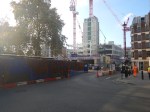
I took these pictures, as I walked between Oxford Circus Tube station and Hanover Square.







This Google Map shows the route from Oxford Circus station to Hanover Square.
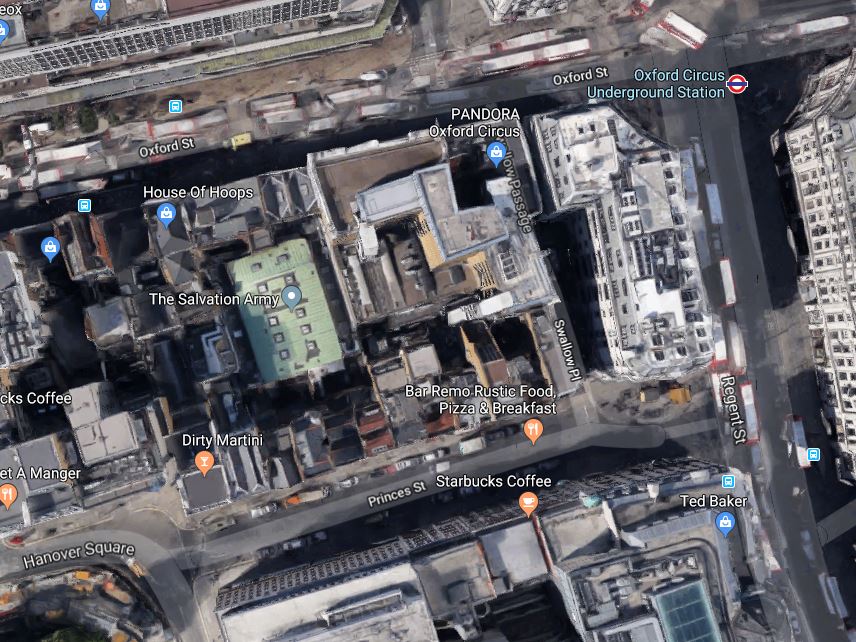
In the simplest scheme, part-pedestrianisation of Hanover Square and Princes Street might just do it!
- A new entrance to Oxford Circus station could also be constructed in the middle of a large pedestrian area, at the shut off junction of Princes Street and Regent Street.
- A short tunnel would connect the new entrance, to the rebuilt.Oxford Circus station.
- Walking wouldn’t be long, with the possibility of a wait in the gardens in the centre of Hanover Square.
- Appropriate retail outlets could be placed along Princes Street.
- Crossings with lights would enable pedestrians to cross into and out of the gardens.
Was this always Transport for London’s plan to link Crossrail to the Victoria Line?
It’s certainly feasible and works with little or no construction.
The Importance Of Finsbury Park Station
Finsbury Park station has two direct routes to Crossrail; Thameslink to Farringdon and the Northern City Line to Moorgate and could have a third if the Victoria Line has a better connection at Oxford Circus/Bond Street.
Passengers needing to use Crossrail from the Northern reaches of the Piccadilly Line could walk across the platform to the Victoria Line and then use the Oxford Circus/Bond Street connection.
It is not a perfect route, but if Finsbury Park were to be upgraded to a passenger-friendly interchange, it would be a lot better.
So it looks like, it will be Vicky to the rescue again.
Never in the field of urban transport was so much owed by so many to a single railway built on the cheap.
Interchange Between Crossrail And The Piccadilly Line At Holborn Station
Consider.
- Holborn station is due to be rebuilt with a second entrance in the next few years.
- Crossrail passes under Holborn station.
- After rebuilding, Holborn station will probably offer the best interchange to an East-West route from the Piccadilly Line.
- To add extra platforms on Crossrail, would probably mean long closures on the line.
It is one of those projects, that can be done, but not without immense disruption.
But at some point in the future, it is a link that could be added, so I wouldn’t be surprised to see the expanded Holborn station will have provision for a link to Crossrail.
New Surface Stations On Crossrail
Usually, when you look at old maps of railway lines there are a number of places, where stations used to be.
However, between Reading and Shenfield stations, there is no station that has been closed. There is a site for Crowlands station that was planned near Romford, in the early twentieth century, but was never built. No-one is suggesting it should be opened now.
So where are stations planned or proposed?
Old Oak Common Station
In fifteen years or so, Old Oak Common station could be one of the most important non-terminal on Crossrail.
Current plans say that the following lines will call at the station.
- Crossrail
- Great Western Railway
- High Speed Two
In addition the following lines may call.
- London Overground
- West London Orbital Railway
- Chiltern Main Line
It could become a very comprehensive interchange station.
This Google Map shows the vast Old Oak Common site.
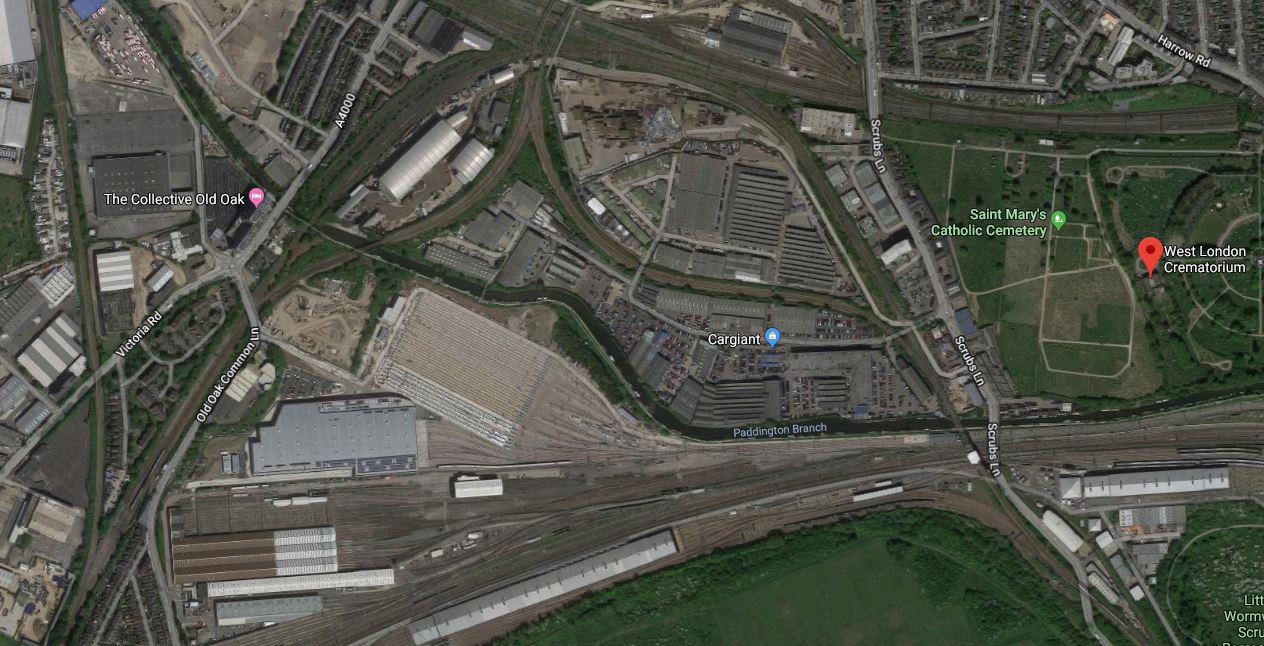
Note.
- The Grand Union bisecting the site in an East-West direction.
- The inverted-Y of the Overground, with North London Line to Richond going South-West and the West London Line to Shepherds Bush going South-East.
- The Great Western Main Line going East-West across the bottom of the map.
- The West Coast Main Line going East-West across the top of the map.
- The Dudding Hill Line going North-South at the Western side of the map.
Between the Grand Union Canal and the Great Western Main Line, there are currently four rail depots. From South to North, they are.
- Hitachi’s North Pole depot, where they service the Class 800 trains for Great Western Railway.
- The Heathrow Express depot.
- The Great Western Railway depot.
- Crossrail’s main depot.
The Heathrow Express depot is due to be demolished to make way for the new Old Oak Common station.
Wikipedia says this about the station.
The High Speed 2 line will be below ground level at the Old Oak Common site, with the parallel Great Western Main Line and Crossrail tracks on the surface to the south.
This map from Wikipedia, shows how the lines connect.
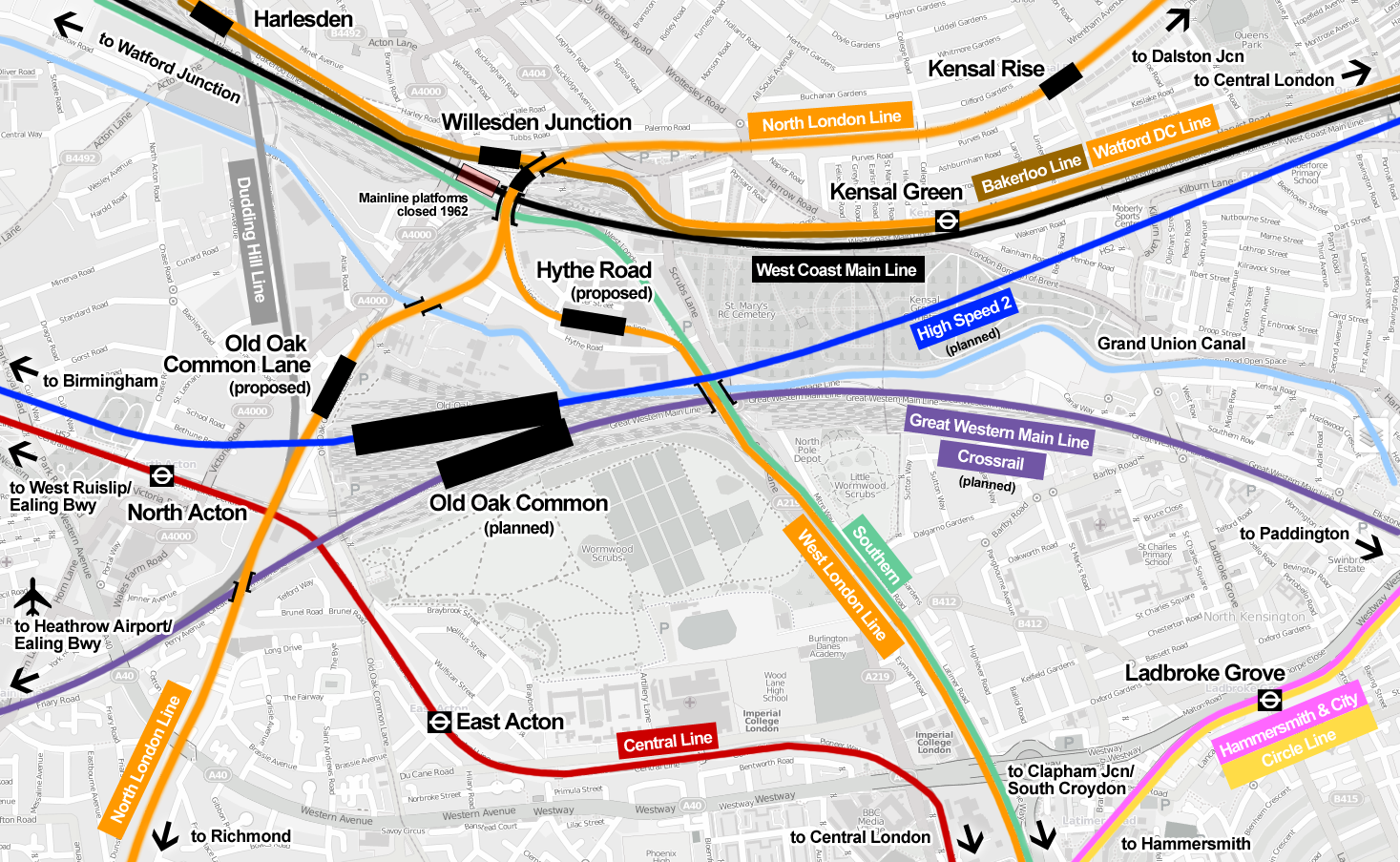
A few points.
- Considering that the High Speed Two tracks are below the surface and the Crossrail and Great Western tracks will be on the surface, I am fairly sure that a simple clean interchange will be created.
- The different levels will also mean that if say there were to be a Crossrail branch to Watford or High Wycombe, then the High Speed Two tracks are well out of the way.
- The High Speed Two platforms will be almost four hundred metres long, with the Crossrail and Great Western platforms probably about half as long. This should give lots of scope to create good connections to the other lines through the station.
- The new Old Oak Common Lane station will be on the North London Line between Stratford and Richmond stations, will be the way I access High Speed Two from Dalston and it will be 350 metres West of the main station.
- The West London Orbital Railway could have a station on the Dudding Hill Line, which runs to the West of, but close to Old Oak Common Lane station.
- The new Hythe Road station will be on the West London Line between Stratford and Clapham Junction stations and will be 1100 metres from the main station.
- Hythe Road station will incorporate a turnback platform for services from Clapham Junction. It would be ideal for a service between Gatwick Airport and High Speed Two.
- It should not be forgotten that there is going to be a large number of houses built around Old Oak Common.
It looks to me that if I took the wrong train from Dalston Kingsland station to get a High Speed Two train to Birmingham or the North, I might end up at the wrong end of my double-length High Speed Two train, with a walk of up to 1100+400+350 = 1850 metres to get to the required place on my train.
I would hope that the High Speed Two station would have some form of high-tech people mover, that stretched across the station site. It could be like a cable car without the cable.
Hopefully, the designers of Old Oak Common station will create what needs to be one of the best stations in the world.
London City Airport Station
Wikipedia says this about adding a station for London City Airport.
Although the Crossrail route passes very close to London City Airport, there will not be a station serving the airport directly. London City Airport has proposed the re-opening of Silvertown railway station, in order to create an interchange between the rail line and the airport. The self-funded £50m station plan is supported ‘in principle’ by the London Borough of Newham. Provisions for re-opening of the station were made in 2012 by Crossrail. However, it is alleged by the airport that Transport for London is hostile to the idea of a station on the site, a claim disputed by TfL.
In 2018, the airport’s chief development officer described the lack of a Crossrail station as a “missed opportunity”, but did not rule out a future station for the airport. The CEO stated in an interview that a station is not essential to the airport’s success
This Google Map shows the Western end of the terminal at London City Airport and the Docklands Light Railway running to the station at the Airport.
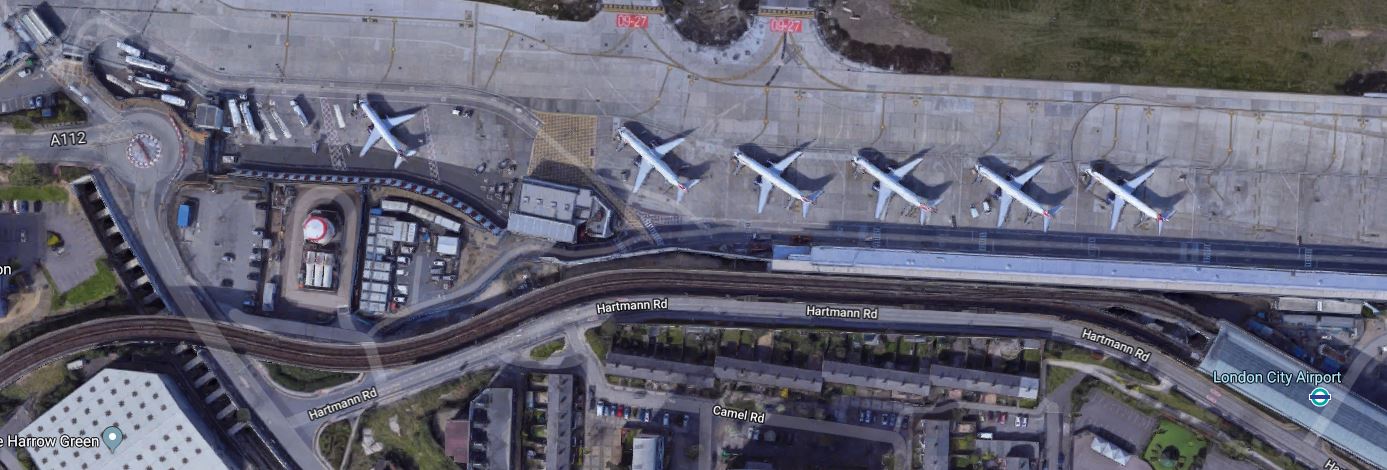
The Southern portal of Crossrail’s Connaught Tunnel can be seen under the DLR at the left end of this map, due to the concrete buttresses across the cutting rebuilt for Crossrail.
Surely, it would not be the most difficult of designs to build a station, somewhere in this area, where the former Silvertown station once stood.
I said more about this station in August 2017 in Action Stations On Crossrail Howler.
I will be very surprised if this station isn’t built.
Ladbroke Grove Station
If Ladbroke Grove station is built, it will because of property development. Wikipedia says this about current plans.
At a site just to the east of the Old Oak Common site, Kensington and Chelsea Council has been pushing for a station at North Kensington / Kensal off Ladbroke Grove and Canal Way, as a turn-back facility will have to be built in the area anyway. Siting it at Kensal Rise, rather than next to Paddington itself, would provide a new station to regenerate the area. Amongst the general public there is a huge amount of support for the project and then-mayor of London Boris Johnson stated that a station would be added if it did not increase Crossrail’s overall cost; in response, Kensington and Chelsea Council agreed to underwrite the projected £33 million cost of a Crossrail station, which was received very well by the residents of the Borough. Transport for London (TfL) is conducting a feasibility study on the station and the project is backed by National Grid, retailers Sainsbury’s and Cath Kidston, and Jenny Jones (Green Party member of the London Assembly).
This Google Map shows the wider area.
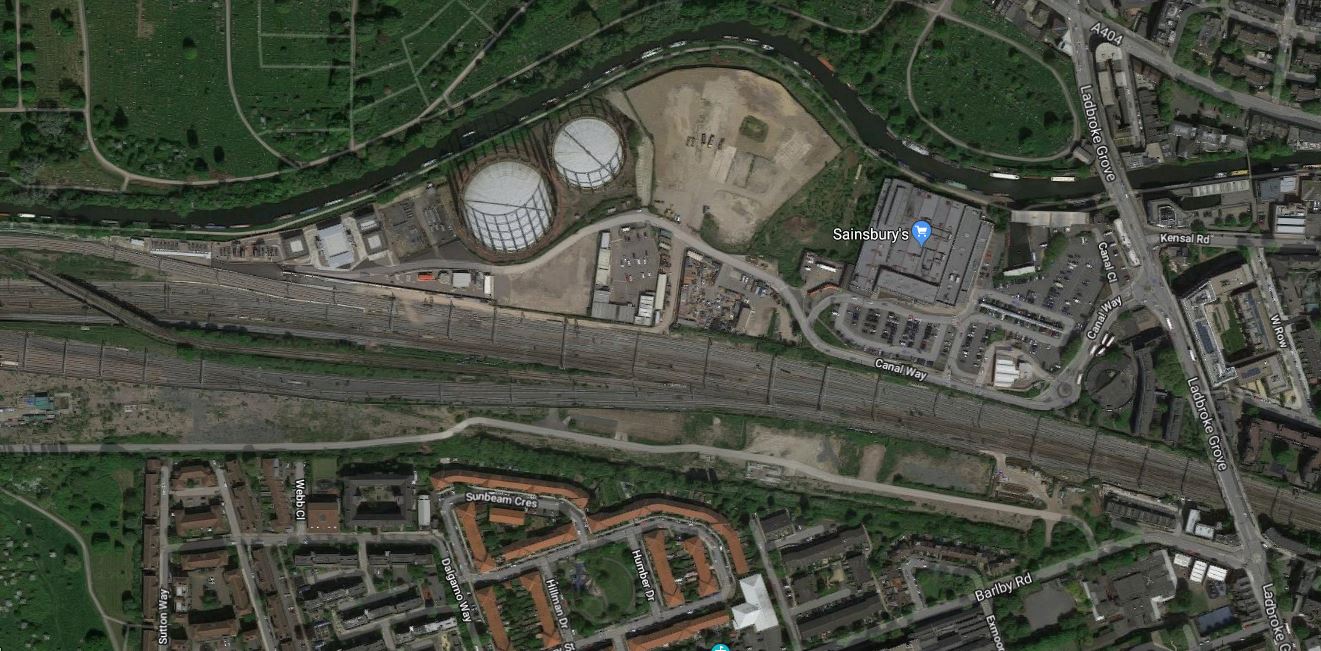
Note.
- Ladbroke Grove is the road running North-South at the right side of the map.
- Canal Way is the twisting road running North of the railway.
- Sainsbury’s supermarket is North of Canal Way.
- The cleared site of the old Kensal gasworks is earmarked for housing.
The Crossrail tracks are on the North side of the railway, so access from a station to the housing could be very easy.
Conclusion
Crossrail is not even open yet and it looks like when it does, it will start a large number of projects to expand its scope.
Some will be about extending the system, some about better transport links and other about property development.
Crossrail will be an unlimited opportunity for London and the South East.
SWR Applies To Build New London Maintenance Depot
The title of this post is the same as that of an article in Edition 865 of Rail Magazine.
This is the first paragraph.
Hounslow Borough Council is considering an application by South Western Railway to build a new depot on the site of Feltham’s former marshalling yard in South West London.
This Google Map shows the site.
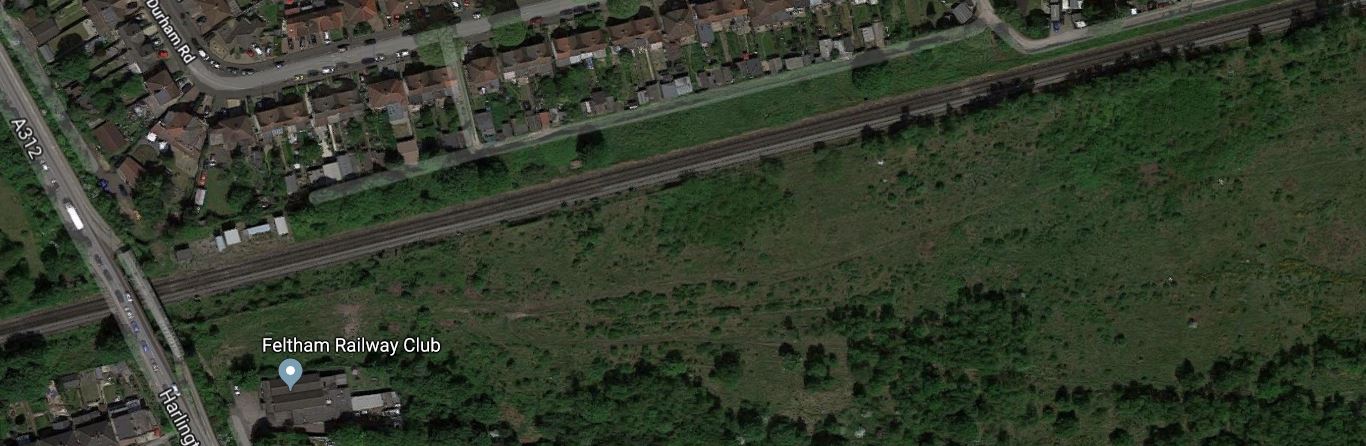
It appears to be remarkably clear and the only clue to its former use must be Feltham Railway Club.
- The depot will lie between Feltham and Whitton stations on the Southern side of the Waterloo-Reading Line.
- The depot will have ten roads and will be able to accommodate ten car trains.
- Construction will start in February 2019 and the depot will open in 2020.
There houldn’t appear to be too many construction problems.
I do have a few questions.
Would The Opportunity Be Taken To Upgrade The Waterloo-Reading Line?
Waterloo to Reading and Windsor services might be increased in frequency.
Could an extra track be added alongside the depot or other works be performed to add capacity to services Reading and Windsor?
What Will Be The Affects Of The Proposed Heathrow Southern Railway?
The Heathrow Southern Railway is a proposal for a new route between Waterloo and Heathrow Airport via Clapham Junction and Staines.
Should Level Crossings In The Area Be Closed?
There are level crossings at Barnes, Feltham, Isleworth, Mortlake and North Sheen.
Would The Land Be Better Used For Housing?
This could be the major objection from the Council.
They could always build a depot with housing on top.
Could A Bigger Feltham Station Be built At The Same Time?
This could be a possibility, with perhaps a turnback platform for the proposed West London Orbital Railway.
Conclusion
Building the depot seems a good and fairly simple plan, but willit cover all possibilities?
Batteries In Class 378 Trains Revisited
Two and a half years ago, I wrote Will London Overground Fit On-board Energy Storage To Class 378 Trains?.
This post effectively updates that post, with what we now know.
As far as I know, batteries have not been fitted to the Class 378 trains, but there have been other developments involving Bombardier since.
Aventras
The linked post was based on statements by Marc Phillips of Bombardier in this article in Rail Technology Magazine entitled Bombardier enters key analysis phase of IPEMU. He also said about Aventras.
Bombardier is also looking at battery options on new builds, including its Aventra platform.
I have stated several times including in Rail Magazine, that the Class 345 trains for Crossrail must have batteries and no-one has told me that I’m wrong.
Battery Train Applications
The Rail Technology article also says this.
Bombardier has started assessing potential customers for battery-powered trains, looking first at branch line applications. Batteries could be a solution allowing non-continuous electrified infrastructure, and emergency rescue and last-mile opportunities.
The article was written three and a half years ago and I suspect Bombardier have been busy researching the technology and its applications.
The High-Speed Bi-Mode Aventra With Batteries
This train was first reported to be in development in this article in Rail Magazine, which was entitled Bombardier Bi-Mode Aventra Could Feature Battery Power.
The article stated the following.
- Battery power could be used for Last-Mile applications.
- The bi-mode would have a maximum speed of 125 mph under both electric and diesel power.
- Bombardier’s spokesman said that the ambience will be better, than other bi-modes.
I very much believe that the key to the performance of this train is using batteries to handle regenerative braking in both electric and diesel modes.
In Mathematics Of A Bi-Mode Aventra With Batteries, I looked at how the train might operate.
Bombardier with better data and the latest mathematical modelling techniques have obviously extensively modelled the proposed trains and prospective routes.
No sane company listed on a Stock Exchange would launch such a product, if it didn’t know that the mathematics of the dynamics and the numbers for the accountants didn’t add up.
Voyagers With Batteries
In Have Bombardier Got A Cunning Plan For Voyagers?, I discuss a snippet found in the July 2018 Edition of Modern Railways, in an article entitled Bi-Mode Aventra Details Revealed.
In a report of an interview with Bombardier’s Des McKeon, this is said.
He also confirmed Bombardier is examining the option of fitting batteries to Voyager DEMUs for use in stations.
Batteries appear to be being proposed to make the trains more environmentally-friemdly and less-noisy.
Talent 3 With Batteries
Bombardier have launched a version of their Talent 3 train with batteries. This is the launch video.
Some of Bombardier’s points from the video.
- Emission-free
- The current range is forty kilometres
- The range will be extended to a hundred kilometres by 2020.
- Charging for forty kilometres takes between seven and ten minutes from overhead electrification.
This looks to be a serious train with orders from German train operators.
It would appear that Bombardier are very serious about the application of batteries to both new and existing trains.
Class 378 Trains And Batteries
What could batteries do for the Class 378 trains?
It looks like over the next few years, the Class 378 trains will be increasingly used on the East London Line, as they have the required evacuation capability for the Thames Tunnel.
Various documents indicate that to maximise capacity on the line, the following may happen.
- Some or all services may go to six trains per hour (tph)
- Trains may be lengthened to six-cars from five-cars.
Extra destinations might be added, but although this could be easy in South London, it would probably require a lot of station or platform development in the North.
Trains Required For The East London Line
If you look at the timing of the East London Line, you get the following journey times for the four routes.
- Highbury & Islington to West Croydon – 52-57 minutes
- Dalston Junction to New Cross – 24 minutes
- Highbury & Islington to Crystal Palace – 46 minutes
- Dalston Junction to Clapham Junction – 47-48 minutes
It could almost have been choreographed by Busby Berkeley.
This means that to run four tph on the routes needs the following number of trains.
- Highbury & Islington to West Croydon – 8 trains
- Dalston Junction to New Cross – 4 trains
- Highbury & Islington to Crystal Palace – 8 trains
- Dalston Junction to Clapham Junction – 8 trains
Which gives a total of 28 trains.
To make all these services six tph, would require the following number of trains.
- Highbury & Islington to West Croydon – 12 trains
- Dalston Junction to New Cross – 6 trains
- Highbury & Islington to Crystal Palace – 12 trains
- Dalston Junction to Clapham Junction – 12 trains
Which gives a total of 42 trains.
At present only the Crystal Palace and Clapham Junction routes have dates for the extra trains and if only these routes were increased in frequency, there would be a need for 36 trains.
Six-Car Trains
The trains might also go to six cars to increase capacity on the East London Line.
As I indicated in Will The East London Line Ever Get Six Car Trains?, cars could be used from the five-car trains not needed for the East London Line.
You would just end up with a number of three- and four-car Class 378 trains, that could be used on other routes with less passengers.
My conclusion in Will The East London Line Ever Get Six Car Trains? was this.
It will be interesting to see how London Overground, increase capacity in the coming years.
There are fifty-seven Class 378 trains in total, which have the following formation.
DMOS-MOS(B)-PTOS-MOS-DMOS
They can be lengthened and shortened, by adding or removing MOS cars.
As an extra MOS car was added to convert all trains from four-cars to five-cars a few years ago, I suspect it is not the most difficult of processes.
It should also be noted that the original three-car trains for the North London Line had the following formation.
DMOS-PTOS-DMOS
If all East London Line routes go to six tph, the required number of trains would be forty-two.
This would leave a surplus of fifteen trains to act as donors for lengthening.
To make all trains six-cars would require a further forty-two MOS cars.
Reducing the trains not needed for the East London Line to three-cars, would yield thirty MOS cars.
This could give the following fleet.
- Thirty six-car trains.
- Twelve five-car trains
- Fifteen three-car trains
To lengthen all trains needed for six-cars would require another twelve MOS cars to be obtained.
Some services could be run with five-car trains, but I don’t think that be a good idea.
I am inevitably led to the conclusion, that if the the Class 378 trains need to be extended to six-cars, then Bombardier will have to produce some more cars.
Adding Batteries To A Six-Car Class 378 Trains
Batteries would be added to Class 378 trains for all the usual reasons.
- Handling energy from regenerative braking.
- Health and safety in depots and sidings.
- Short movements on lines without electrification
- Emergency train recovery
But there might also be another important use.
The Thames Tunnel is under five hundred metres long.
As the only trains running through the tunnel are Class 378 trains, it might be possible and advantageous to run services on battery power through the tunnel.
I will estimate the kinetic energy of a six-car Class 378 train, as the batteries must be able to handle the energy of a full train, stopping from maximum speed.
- The empty train will weigh around 192 tonnes
- The maximum speed of the train is 75 mph.
- The train will hold 1050 passengers, who I will assume each weigh 90 Kg with baggage, bikes and buggies.
- This gives a fully loaded train weight of 286.5 tonnes.
Using the Omni Kinetic Energy calculator gives an kinetic energy of 45 kWh.
If four 100 kWh batteries can be fitted under a two-car Class 230 train, then surely a reasonable amount o capacity can be fitted under a six-car Class 378 train.
These pictures show the under-floor space on a dual-voltage Class 378/2 train.
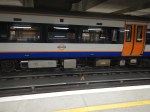
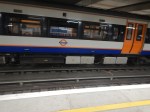
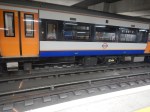
As a six-car train will have five motored cars, why not put one 50 kWh battery in each motored car, to give a capacity of 250 kWh.
In an article in the October 2017 Edition of Modern Railways, which is entitled Celling England By The Pound, Ian Walmsley says this in relation to trains running on the Uckfield Branch, which is not very challenging.
A modern EMU needs between 3 and 5 kWh per vehicle mile for this sort of service.
So how far would a six-car Class 378 train go with a fully-charged 250 kWh battery?
- 5 kWh per vehicle mile – 8 miles
- 4 kWh per vehicle mile – 10 miles
- 3 kWh per vehicle mile – 14 miles
- 2 kWh per vehicle mile – 20 miles
This is only a crude estimate, but it shows that fitting batteries to a Class 378 train with batteries could give a useful range.
Adding Batteries To A Three-Car Class 378 Trains
The same calculation can be performed for a three-car train created by removing the two MOS cars.
- The empty train will weigh around 96 tonnes
- The maximum speed of the train is 75 mph.
- The train will hold 525 passengers, who I will assume each weigh 90 Kg with baggage, bikes and buggies.
- This gives a fully loaded train weight of 143.3 tonnes.
Using the Omni Kinetic Energy calculator gives an kinetic energy of 22.4 kWh.
Unsurprisingly, the kinetic energy of the three-car train is around half that of a six-car train.
As a three-car train will have two motored cars, why not put one 50 kWh battery in each motored car, to give a capacity of 100 kWh.
Using the Ian Walmsley formula gives the following ranges.
- 5 kWh per vehicle mile – 7 miles
- 4 kWh per vehicle mile – 8 miles
- 3 kWh per vehicle mile – 11 miles
- 2 kWh per vehicle mile – 17 miles
When you consider that the length of the Greenford Branch Line is 2.5 miles, these ranges are very useful.
Routes For Three-Car Class 378 Trains With Batteries
I would suspect that these trains will have the following specification.
- Dual-voltage with ability to use either 25 KVAC overhead or 750 VDC third-rail electrification.
- A maximum speed of 75 mph
- Three cars
- Passenger capacity of 525 passengers.
- Range of between seven and fifteen miles
So for what routes would the train be suitable?
Brentford Branch Line
There have been various ideas for reopening the freight-only Brentford Branch Line to passenger traffic.
The simplest proposal would be to run a two tph shurttle train Southwards from Southall station.
As the branch is only four miles long, I believe that a three-car Class 378 train, which ran on battery-power and charged at Southall station could work the branch.
Greenford Branch Line
I’ve already mentioned the 2.5 mile long Greenford Branch Line.
The following work would need to be done before the trains could be used.
- Electrification of the bay platform at West Ealing with 25 KVAC overhead wires.
- Electrification of the bay platform at Greenford with 750 VDC third-rail.
- Minor lengthening of the bay platform at Greenford to allow sixty metre long trains.
- An extra crossover at the West Ealing end of the branch.
With these modifications it might be possible to run four tph on the branch.
Romford To Upminster Line
Currently, the Romford-Upminster Line uses a single train to shuttle the three miles at a frequency of two tph.
If the passing loop were to be reinstated, I believe that two trains could run a four tph service.
Using battery-power on the line and charging on the existing electrification at either end of the line might be a more affordable option.
It should be noted that increasing the current two x four-car tph to four x three-car tph, would be a doubling of frequency and a fifty percent increase in capacity.
West London Orbital Railway
The West London Orbital Railway is outlined like this in Wikipedia.
The West London Orbital is a proposed extension to the London Overground that makes use of a combination of existing freight and passenger lines including the Dudding Hill Line, North London Line, and the Hounslow Loop. The route runs for approximately 11 miles from West Hampstead and Hendon at the northern end to Hounslow at the Western end via Brent Cross West, Neasden, Harlesden, Old Oak Common, Acton and Brentford.
This is one of those plans, which ticks a lot of boxes.
- The tracks are already in existence.
- There is a proven need.
- Passenger numbers would support at least four tph.
- The route connects to Crossrail and HS2.
- Changing at Old Oak Common to and from Crossrail gives a quicker route to Heathrow for many in West London.
- There is electrification at both ends of the route, with only four miles without any electrification.
- At only eleven miles, it could be run by electric trains under battery power.
- The cost is quoted at around £250 million.
- Studies show it has a benefit cost ratio of 2.2:1.
As the route is now being promoted by the Mayor of London, I have a feeling this route will be created in time for the opening of HS2 in 2025.
If you want to know more about the proposals, this document on the Brent Council web site, which is entitled West London Orbital Rail, was written by consultants WSP to analyse the proposals and give a cost.
This is paragraph 5.4.38
At this stage we are assuming that the railway will be operated by diesel traction, or possibly battery or hybrid traction. While the Kew – Acton and Dudding Hill Line sections are not electrified, all the rest of the line is and battery technology may have developed sufficiently by the time of opening to be a viable option. Therefore, potential subsequent phases of the
enhancement plans could electrify the non-electrified sections.
The consultants go on to say, that stabling for diesel trains is more difficult to find in London than for electric..
The route would be suitable for Class 378 trains with batteries, but the consultants say that four-car trains will be needed.
So four-car Class 378 trains with a battery capability will be needed.
Alternatively, new four-car Class 710 trains, which I’m certain are built around a battery capability could be used instead.
A rough estimate says that for the full service of two four tph routes will need a total of eight four-car trains.
This is a much-needed route with definite possibilities.
Should A Battery MOS Car Be Designed?
If the Class 378 trains are lengthened to six cars, it looks like there will be a need for at least twelve new MOS cars.
I wonder, if it would be better to design a new BMOS car with batteries, that could either be created from an existing MOS car or newly-built.
The car would have the following specification
- It would be able to replace any current MOS car.
- It would contain the appropriate size of battery.
The advantages of a compatible new BMOS car are.
It would not require any modifications to the PTOS or DMOS cars, although the train software would need to be updated.
It would make it possible to easily create trains with a battery option with a length of four and five cars.
Could The PTOS Car Be Updated With Batteries?
This could be a logical way to go, if a battery of sufficient size can be fitted in the limited space available with all the other electrical gubbins under the floor of a PTOS car.
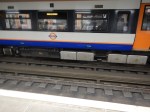
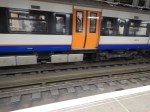
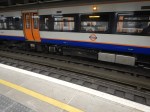
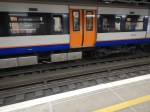
These pictures show a Class 378/2 PTOS car.
Modifying only the PTOS cars would give the following advantages.
- Only the PTOS car would need to be modified.
- PTOS cars for Class 378/1 trains would be 750 VDC only.
- PTOS cars for Class 378/2 trains, would be dual-voltage.
- Only PTOS cars for Class 378/2 trains would have a pantograph.
I will propose that the PTOS car is fiited a 100 kWh battery.
This would be sufficient for the six-car East London Line services, as all it would do was handle the regenerative braking energy, which has a maximum value of just 45 kWh. Battery range of the train would be between three and five miles, which would be enough to recover the train if power failed.
For three-car trains, the 100 kWh ranges would be as I calculated earlier.
- 5 kWh per vehicle mile – 7 miles
- 4 kWh per vehicle mile – 8 miles
- 3 kWh per vehicle mile – 11 miles
- 2 kWh per vehicle mile – 17 miles
Which is a very useful range.
If some four-car trains, were built by adding a new MOS car, the ranges on 100 kWh batteries would be.
- 5 kWh per vehicle mile – 5 miles
- 4 kWh per vehicle mile – 6 miles
- 3 kWh per vehicle mile – 8 miles
- 2 kWh per vehicle mile – 12.5 miles
As the Dudding Hill Line is only four miles long with electrification at both ends, these four-car Class 378 trains would be able to work the routes of the West London Orbital Railway.
Conclusion
Fitting batteries to Class 378 trains opens up a lot of possibilities.
One scenario could be.
- Forty-two six-car trains for the East and |South London Lines.
- One three-car train for the Brentford Branch Line
- Two three-car trains for the Greenford Branch Line.
- Two three-car trains for the Romford to Upminster Line.
- Eight four-car trains for the West London Orbital Railway.
There would be two spare three-car trains and another twenty MOS cars would be required.
.
A North London Line With Digital Signalling
In Digital Signalling Implications For North London, I indicated that there may be benefits in equipping the North London Line with digital signalling.
- It would ease co-ordination of services between Gunnersbury and Richmond stations, where track, stations and signalling are shared with the District Line.
- All freight trains are being fitted with digital signalling capabilities.
Obviously, the other benefits of digital signalling like closer running of trains would apply.
Current Service Levels
The Service Levels section of the Wikipedia entry for the North London Line, gives the following details..
Services run seven days a week and since the December 2018 timetable change are the same all day.
- Four trains per hour (tph) – Richmond and Stratford
- Four tph – Clapham Junction and Stratford
Which gives eight tph between Willesden Junction and Stratford
Compared to the service I remember from the 1980s, it is a great improvement.
Possible Future Service Levels
London Reconnections is a web site, that usually gets things right.
In this article, which is entitled More Trains for London Overground: A Bargain Never to be Repeated, this is said.
London Overground have a long-held desire to increase the frequency on the WLL from 4tph to 6tph. They also aspire to another 2tph (at least) from Clapham Junction continuing to Stratford, to further increase the frequency on the North London Line (NLL). This would enable 10tph on eastern end of the North London line. This is due to be implemented with the main order of the new Class 710 stock.
What, it is suspected, London Overground would really like is to have 6tph from Richmond to Stratford and 6tph from Clapham Junction all the way to Stratford. Unfortunately, the additional trains to Stratford would appear to rely on freight, travelling between East London and the West Coast Main Line, using the route via Gospel Oak instead of via the NLL. Until that actually happens, sometime after the electrification of the GOBLIN, such an intensive service on the NLL can only be a dream.
Would this mean this service?
- Six tph – Richmond and Stratford
- Six tph – Clapham Junction and Stratford
Which gives twelve tph between Willesden Junction and Stratford
I can’t say I’d complain living equidistant from Dalston Kingsland and Canonbury stations.
Richmond Station
The current service between Richmond and Gunnersbury station is as follows.
- Four tph – London Overground to Stratford
- Six tph – District Line to Upminster
Digital signalling on the District Line is likely to add 33% capacity to Peak Hour services, so this would mean another two trains to Upminster.
So a future service could be as follows.
- Six tph – London Overground to Stratford
- Eight tph – District Line to Upminster
This level of service could be easily handled by conventional signalling and good driving or by digital signalling.
Piccadilly Line To Ealing Broadway Station
This article on Chiswick W4, is entitled Major Reorganisation Of Local Tube Services Planned.
This is said.
The decision appears to have been made by Transport for London (TfL) to press ahead with a major restructuring of local underground services. This would see the District line service to Ealing Broadway ended and services switched to the Piccadilly line. The rolling stock would transfer to the Richmond and Wimbledon branches of the District line allowing an increase in regularity for these services.
Currently, Ealing Broadway station has a six tph service to Upminster on the District Line.
This map from carto.metro.free.fr shows the lines at Ealing Broadway station.
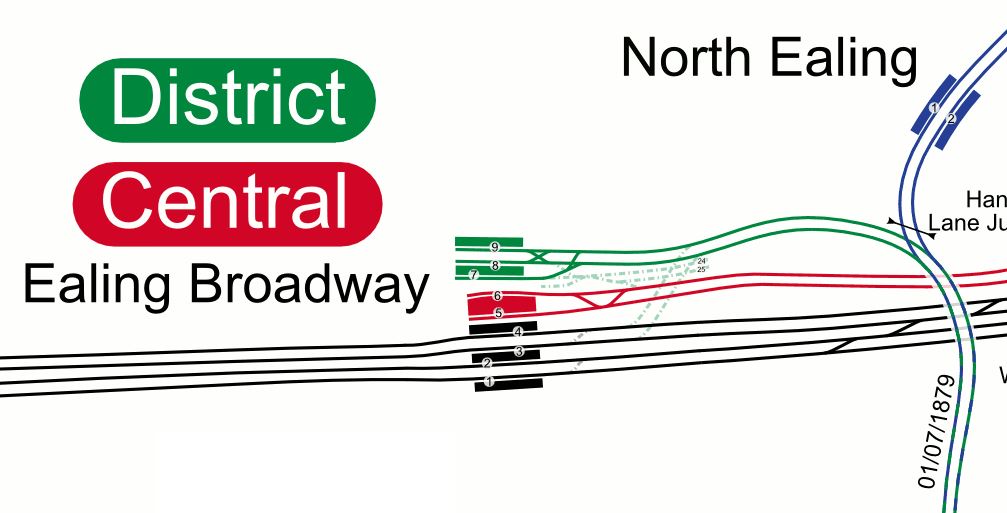
Note that after the changeover, the following would apply.
- The Piccadilly Line would have three platforms.
- In a few years time, the Central and Piccadilly Lines will have similar trains.
- Passengers for Turnham Green, Stamford Brook and Ravensbrook Park, would use the Piccadilly Line, which would probably have a higher frequency.
- Passengers for Victoria and other stations in the East on the District Line, would probably have a step-free cross-platform interchange at a number of stations.
But I think, that probably the main reason for the change, is that it will make the proposed frequency of well upwards of twenty tph of the Piccadilly Line easier to operate.
Consider.
- The platforms would help with service recovery,
- I suspect that TfL would like to see a Victoria Line frequency of thirty-six tph.
- Currently, twenty-four tph run between Arnos Grove and Acton Town in the Peak.
- Twenty-one tph run in the Off Peak.
If thirty-six tph is the intended frequency, then two terminal platforms in a rebuilt step-free Ealing Broadway station, could turn a lot of trains.
A Side Effect Of Changing The District Line Terminus
If the District Line service of six tph to Ealing Broadway, were to be reallocated between Richmond and Wimbledon, this would add three tph to the section between Gunnersbury and Richmond.
So now we could be looking at seventeen tph between Gunnersbury and Richmond stations.
Will that mean that North London Line trains to Richmond will need digital signalling and automatic train control?
The West London Orbital Railway
The proposed West London Orbital Railway will use the Dudding Hill Line to create the following services.
- West Hampstead to Hounslow
- Hendon to Kew Bridge
If both routes run at four tph, then it will add eight tph to the North London Line between Acton Wells and South Acton junctions.
Added to the six tph between Richmond and Stratford, this would be fourteen tph through Acton Central and South Acton stations.
Digital signalling on the North London Line and the West London Orbital Railway would probably ease the merging of trains for the joint section.
Freight
It appears that there are up to four freight trains per hour in both directions on the line.
The Level Crossing At Acton Central Station
I doubt the users of the level crossing at Acton Central would like the levels of traffic, that digital signalling would enable.
A Summary Of Passenger Services
I can summarise the passenger train frequencies as follows.
- Stratford to Willesden Junction – 12 tph
- Willesden Junction to Acton Wells Junction – 6 tph
- Acton Wells Junction to South Acton Junction – 14 tph
- South Acton Junction to Gunnersbury – 6 tph
- Gunnersbury to Richmond – 16 tph
I have assumed all developments mentioned earlier take place.
The Effect Of High Speed Two And Crossrail
When High Speed Two and Crossrail open at Old Oak Common station, this must surely increase the number of passengers using the North London Line, by a significant amount.
There will be two new stations.
- Old Oak Common Lane station will be between Willesden Junction and North Acton stations.
- Hythe Road station will be on the West London Line between Willesden Junction and Shepherds Bush stations.
Will the proposed six tph, each of five cars have sufficient capacity?
Conclusion
It looks to me, that they’ll come a time, when digital signalling will be needed to squeeze the required number of trains along the North London Line.
As I said in the previous section, traffic will continue to grow on the North and West London Lines because of High Speed 2 and Crossrail, as it has done since the route’s reopening with new trains in 2010.
I feel there will come a time, when trains will have to be lengthened from their current length of five cars.
Can all the stations on the route be extended if necessary?
Latest On The New London Overground Class 710 Trains
The August 2018 Edition of Modern Railways has a two-page article on the latest on the new Class 710 trains for the London Overground.
Seating Arrangement
Wikipedia says this about the seating.under Background And Specifications.
The units will be delivered in two sub-classes; an AC-only version with longitudinal and transverse seating (very similar to the S8 units on the Metropolitan line of the London Underground) for use on the West Anglia and Romford-Upminster services, and a dual-voltage version with longitudinal seating for the Watford DC and GOBLIN services.
But it now appears that all the seats on the trains will be longitudinal ones.
I use the current trains a lot to go to Walthamstow and I also use the Class 378 trains, which have longitudinal seats, frequently on the North and East London Lines of the Overground.
I probably aren’t bothered too much about longitudinal seats, but I suspect there will be others who will complain.
This discussion of RailForums is entitled Annoying Things About The Class 378. Search for “seat” and you don’t find many complaints about the longitudinal seating, which is also used on much of the Underground.
On the other hand, if all the trains have identical interiors, this must save on construction and maintenance costs.
If the interiors are basically similar to the Class 378 trains, it must also save on staff training costs.
I actually think, that the biggest complaint will not be about the new trains, but why don’t the older Class 378 trains have wi-fi and USB charging points!
Eight-Car Trains On West Anglia Routes
The article also states that services on West Anglia routes to Cheshunt, Chingford and Enfield Town stations will work as eight-car trains or a pair of four-car trains.
If they are always working in pairs, why not build them as eight-car trains in the first place?
In A Detailed Layout Drawing For A Class 345 Train, I said that the formation of a Class 345 train for Crossrail is as follows.
DMS+PMS+MS1+MS3+TS(W)+MS3+MS2+PMS+DMS
Note.that the train is composed of two identical half-trains, which are separated by the TS(W) car.
As the Modern Railways article says that these trains are to be the last to be delivered, would it not be sensible to fully understand the four-car units and then decide if instead of pairs of four-car units, they were built as eight-cars.
Consider.
- Trains would be formed of identical four-car half-trains.
- An eight-car Class 710 train would be nearly fifty metres shorter than a nine-car Class 345 train.
- Passengers would be able to walk through the whole train.
- Passengers can position themselves for their best exit at their destination station.
- Would passenger security be better on a train, where passengers could walk all the way through?
- I have seen drivers on Class 345 trains change ends inside the train
- Aventras and other modern trains are fitted with intelligent control systems, that determine the number and type of the intermediate cars in the train.
- Two Driving Motor Standard Cars (DMS) would be replaced with simpler Trailer Standard (TS) or Motor Standard (MS) cars.
- The choice of a TS or MS car would depend partly on performance issues, which could be tested with the earlier four-car trains.
- Building and maintenance cost savings by reducing the number of driving cars, must be possible.
- Capacity could be increased by adding cars in the middle, if platforms were long enough!
- Would providing overnight stabling for fifteen eight-car trains be easier than for thirty four-car trains?
It should also be noted, Cheshunt station has a very long platform without a roof. Passengers could walk to the front of the train inside a warm dry train. This already happens with the Class 378 trains at Highbury & Islington station.
Romford-Upminster Shuttle
The Modern Railways article says this about the service on the Romford-Upminster Line.
TfL is still considering whether to utilise a ‘710’ on the Romford to Upminster shuttle or to retain an older unit for the line.
I wrote about this in A Heritage Class 315 Train For The Romford-Upminster Line, after this article in London Reconnections, which is entitled More Trains for London Overground: A Bargain Never to be Repeated, said that it is possible that this line could be served by a Class 315 train, held back from the scrapyard.
I came to this conclusion.
If it is decided that a Class 315 train is to be used on the Romford to Upminster Line, I believe that the service could be marketed as a quirky heritage unit, that in conjunction with its main purpose of providing a public service, could also be used for other education, training, marketing, innovation and research purposes.
Eversholt Rail Group might even shift a few redundant Class 315 trains!
Why not?
Chingford Upgrades
The Modern Railways article says this.
A £7million investment has seen the stabling facility at Chingford upgraded, including the addition of an AVIS-scanner here as well.
These pictures show the investment.



With the Automatic Vehicle Inspection System (AVIS), Chingford is becoming more than a stabling facility.
Note the large maintenance structure, so that trains can be worked on in the dry.
A Few Questions Of My Own
I have a few of my own questions.
If The Thirty Four-Car Trains For West Anglia Routes Are Converted To Eight-Cars, What Happens To The Spare Driving Motor Cars?
If the thirty four-car trains are converted to fifteen eight-car trains, it appears to me that Bombardier could have at best many of the long-lead components for thirty Driving Motor Standard (DMS) cars. At worst, they would have thirty DMS cars for Class 710 trains.
But London Overground will have need for a few more trains in a few years.
In Increased Frequencies On The East London Line, I showed this London Overground table of improvements.
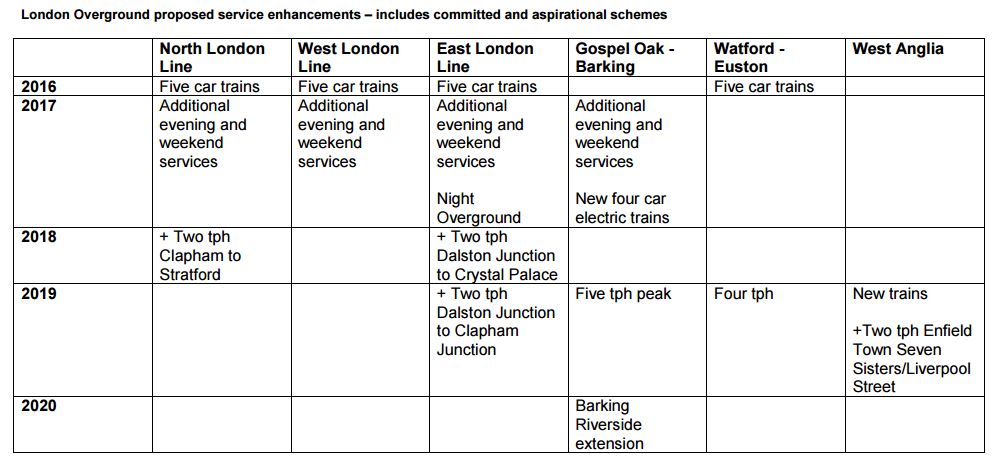
LO Improvements
Note that two extra tph are proposed on the Liverpool Street to Enfield Town service. I calculate, that this would need another two Class 710 Trains.
Similarly, to add two tph to the Liverpool Street to Cheshunt service, would appear to need another three trains.
The Mayor is also looking favourably at creating the West London Orbital Railway.
I estimate that the two proposed routes would need around four trains each to provide a four tph service, if they could be run using dual-voltage Class 710 trains with a range of perhaps ten miles on battery power.
What Is Happening About The Hall Farm Curve?
I heard from someone, who should know, that the Hall Farm Curve and the Coppermill Curve will be reinstated.
These curves would allow the following.
- A direct service between Chingford/Walthamstow and Stratford.
- Better access to the upgraded stabling at Chingford.
But I think these curves would be invaluable in maintaining services, during the construction of Crossrail 2.
Will A Bay Platform Be Developed At Lea Bridge Station?
I also wonder if a bay platform will be developed at Lea Bridge station, which would enable a four tph service to be run between Lea Bridge and Chingford stations, if Chingford Branch trains couldn’t get into Liverpool Street station, because of construction works.
I certainly feel that the curves connecting the lines at Coppermill Junction will have a major part to play in the development of East London’s railways.
West Hampstead Station – 7th July 2018
The new bridge at the West Hampstead station is now in use and it looks like the new station will be completed by the end of the year.
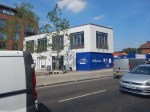
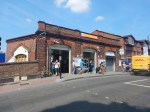
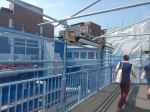
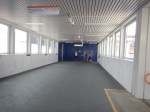
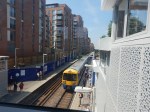
As the last picture shows this could be one of those station developments, where a deck could have been built over the North London Line to increase the number of flats built in the development on the South side of the railway.
This Google Map shows West Hampstead station on the North London Line and West Hampstead tube station on the Jubilee and Metropolitan Lines, although the latter don’t stop.
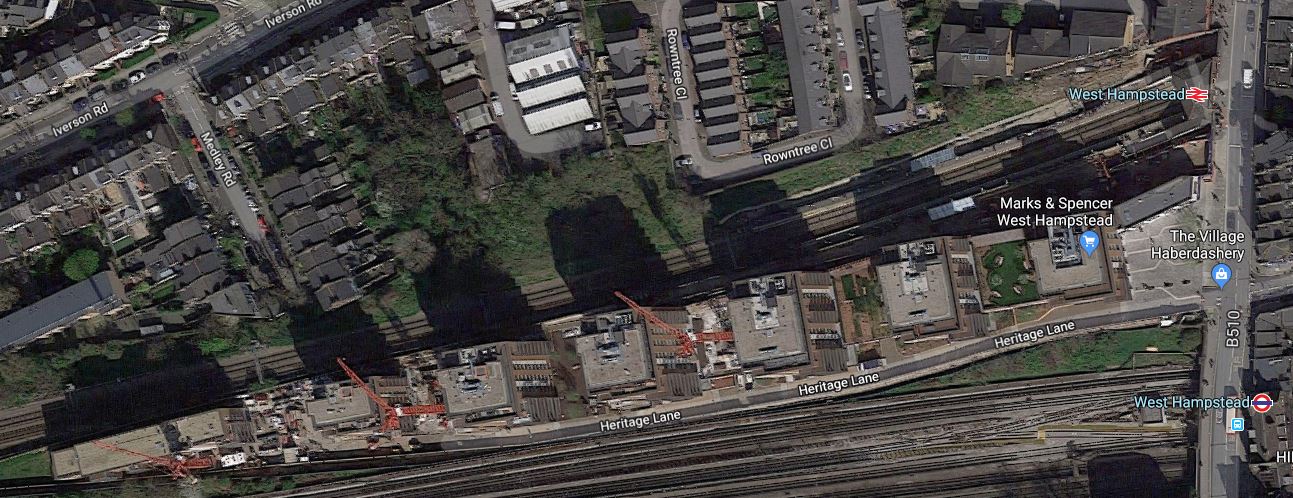
Note the development stretches a long way to the West between the North London Line and Underground Lines.
There have been plans to create a West Hampstead Interchange on West End Lane.
As these envisaged moving the Overground station to the East side of West End Lane and the new station is being built on the West side, It would appear there’s been a rethink.
Perhaps the Underground station is to be moved to the West side of West End Lane and will have an entrance on the small square in front of the M & S Simply Food and alongside the new Overground station.
This Google Map shows an enlargement of the area.
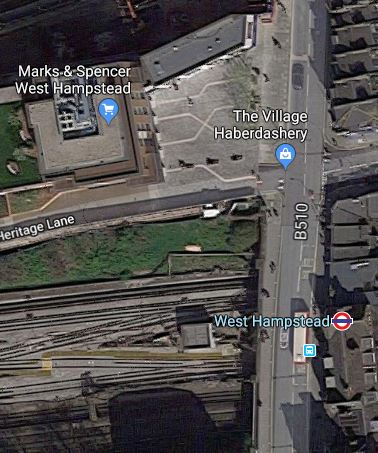
The new station could have platforms on the following lines.
- Jubilee Line
- Metropolitan Line
- Cjhiltern Railway
It would be a very worthwhile interchange. Especially, as passengers could do the following.
- Walk across the square for the Overground for East London.
- Walk perhaps another hundred metres to West Hampstead Thameslink station, which is also proposed as the terminus of the West London Orbital Railway.
There could also be a development on the top of the new station, which would hopefully contribute to the cost.
I have no idea, if anything will happen here, but Transport for London are looking to create new stations with over-site development. The Mayor also seems keen on the West London Orbital Railway, as it is based on under-used infrastructure and requires no new track or tunnels.
Heathrow Southern Railway And West London Orbital Railway
West London waits umpteen years for more rail lines and then two come along at the same time.
Both do substantially, what their names imply.
This map from carto.metro.free.fr shows the tracks between Feltham, Hounslow and Whitton stations.
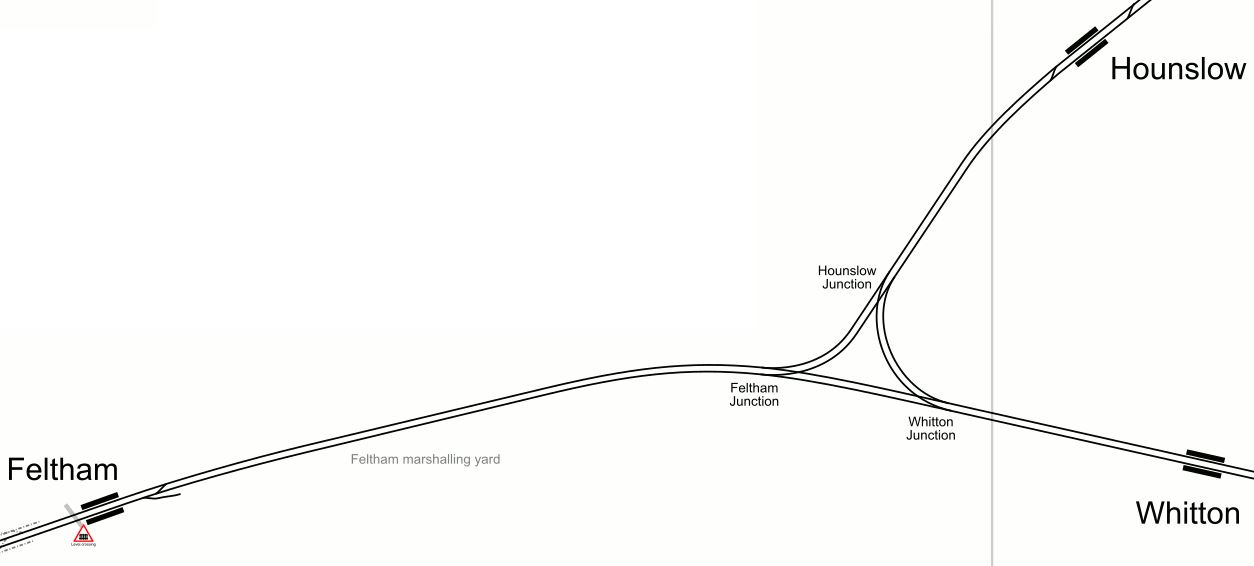
Note.
- Heathrow Southern Railway’s proposed Heathrow – Clapham Junction – Waterloo service will probably go via Whitton, rather than the Hounslow, as Whitton is the faster route.
- Hounslow is the proposed terminus of the route of the West London Orbital Railway from West Hampstead Thameslink station.
- Hounslow will have a new East-facing bay platform, to handle the trains from West Hampstead.
- Heathrow Southern Railway have said their service between Heathrow and Waterloo will be four trains per hour (tph)
I suspect that the West London Orbital Railway will have a typical Overground frequency of four tph.
Unfortunately, the two railways don’t meet up, as it would probably be worthwhile to give more stations a simple route to Heathrow with perhaps a change at Feltham station.
This Google Map shows Feltham station.
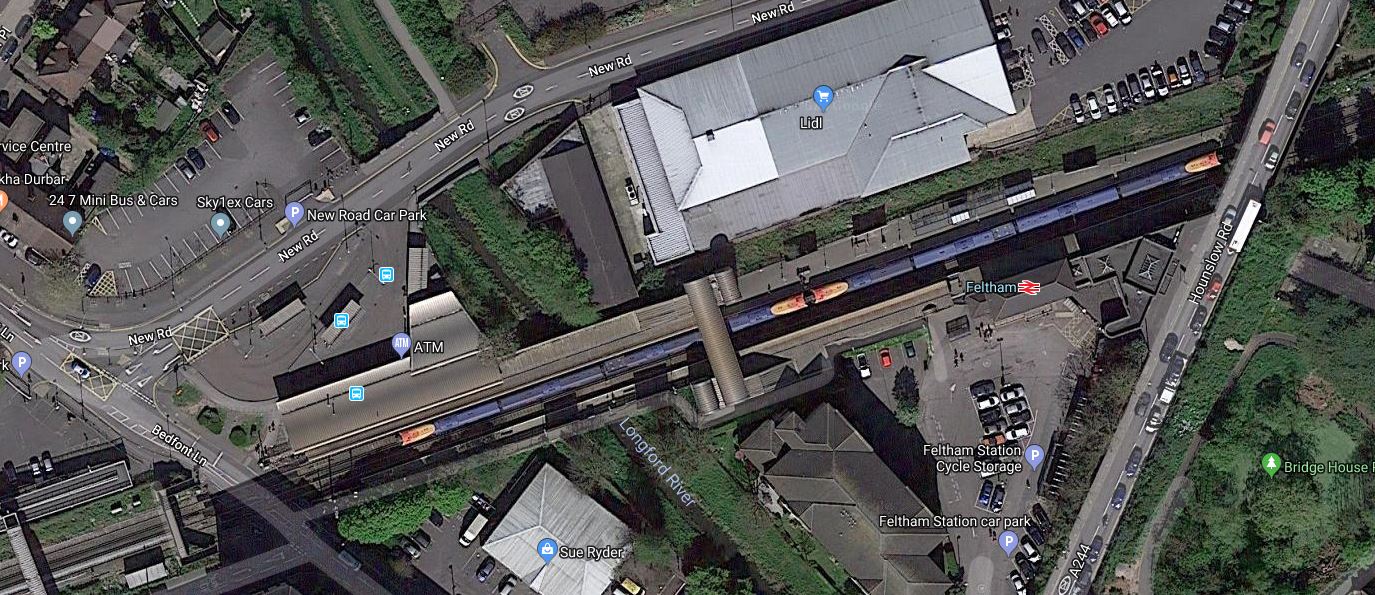
Would there be space to squeeze in an East-facing bay platform on the North side of the station?
- It could be the terminus of the West Hampstead service of the West London Orbital Railway
- It could be useful if there were operational problems to turn trains.
- There is the advantage that Feltham is a step-free station and Hounslow isn’t.
I went to Feltham station and took these pictures.


By the side of the track on the other side of the road bridge to the station, is the Feltham Signalling Centre and a Network Rail yard.
I think it could be possible to fit a platform into the space, behind Platform 1.
- A five-car platform looks possible.
- It would be an island platform with the current Platform 1.
- I doubt overhead electrification could be used.
- Slab track might be needed to squeeze the train under the bridge.
Ideally, it should be able to take a ten-car train, which might be possible, by extending the platform to the other side of the bridge.
Currently, there are six tph each-way through the station. The following new services will be added if both the Heathrow Southern and West London Orbital Railways are built.
- 4 tph – Heathrow Southern Railway’s proposed service between Heathrow Terminal 5 and Waterloo via Staines, Feltham, Twickenham, Richmond and Clapham Junction.
- 4 tph – West London Orbital’s proposed service from Feltham to West Hampstead
Would modern trains and signalling, coupled with good driving, be able to handle this level of trains?
Looking at the tracks and the space on either side, it might be possible to thread a third track between Feltham Station and Feltham Junction.
This Google Map shows Feltham Junction
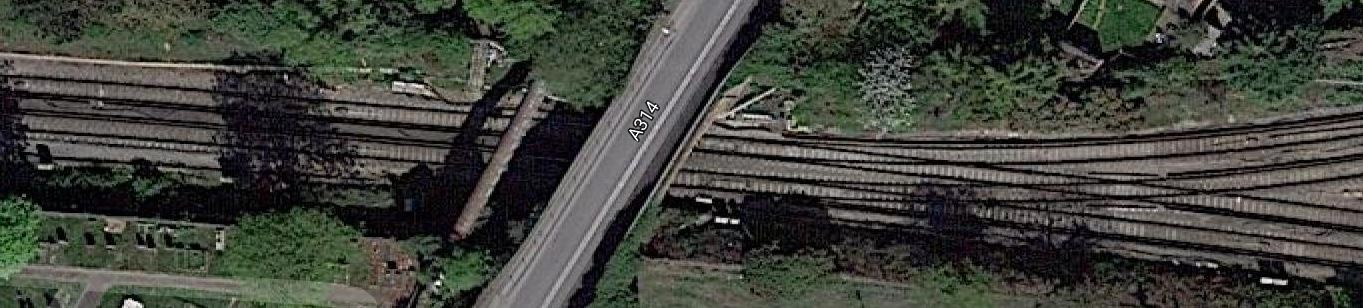
There would appear to be more space on the South side of the tracks, so perhaps an extra track could go on this side.
But I suspect Network Rail could find a solution from their library of cunning plans.
There could be advantages.
- West London Orbital Railway could terminate in a step-free station.
- Travellers between South Acton and Hounslow get a step-free route to Heathrow.
- The bay platform at Feltham, could help when the service is disrupted.
- An extra track to the East of Feltham, might help capacity between Clapham Junction and Staines.
I’m certain that be a simple connection between the two systems can be built.
Conclusion
There are possibilities to connect the West London Orbital Railway to the Heathrow Southern Railway, which could be beneficial for all parties.
Could Crossrail And Thameslink Serve Clapham Junction Station?
This may seem a silly question, but I believe it is a valid one for the following reasons.
Clapham Junction Is A Major Interchange
Wikipedia says this about Clapham Junction station.
Routes from London’s south and south-west termini, Victoria and Waterloo funnel through the station, making it the busiest in Europe by number of trains using it: between 100 and 180 per hour except for the five hours after midnight. The station is also the busiest UK station for interchanges between services.
It is also the tenth busiest station measured by passenger numbers in Great Britain.
Clapham Junction Is Step-Free
Clapham Junction station has both a bridge and a subway between the seventeen platforms.
The bridge is fully step-free with lifts to all platforms.
Clapham Junction Has A Wide Bridge
The bridge between platforms is not only step-free, but very wide.
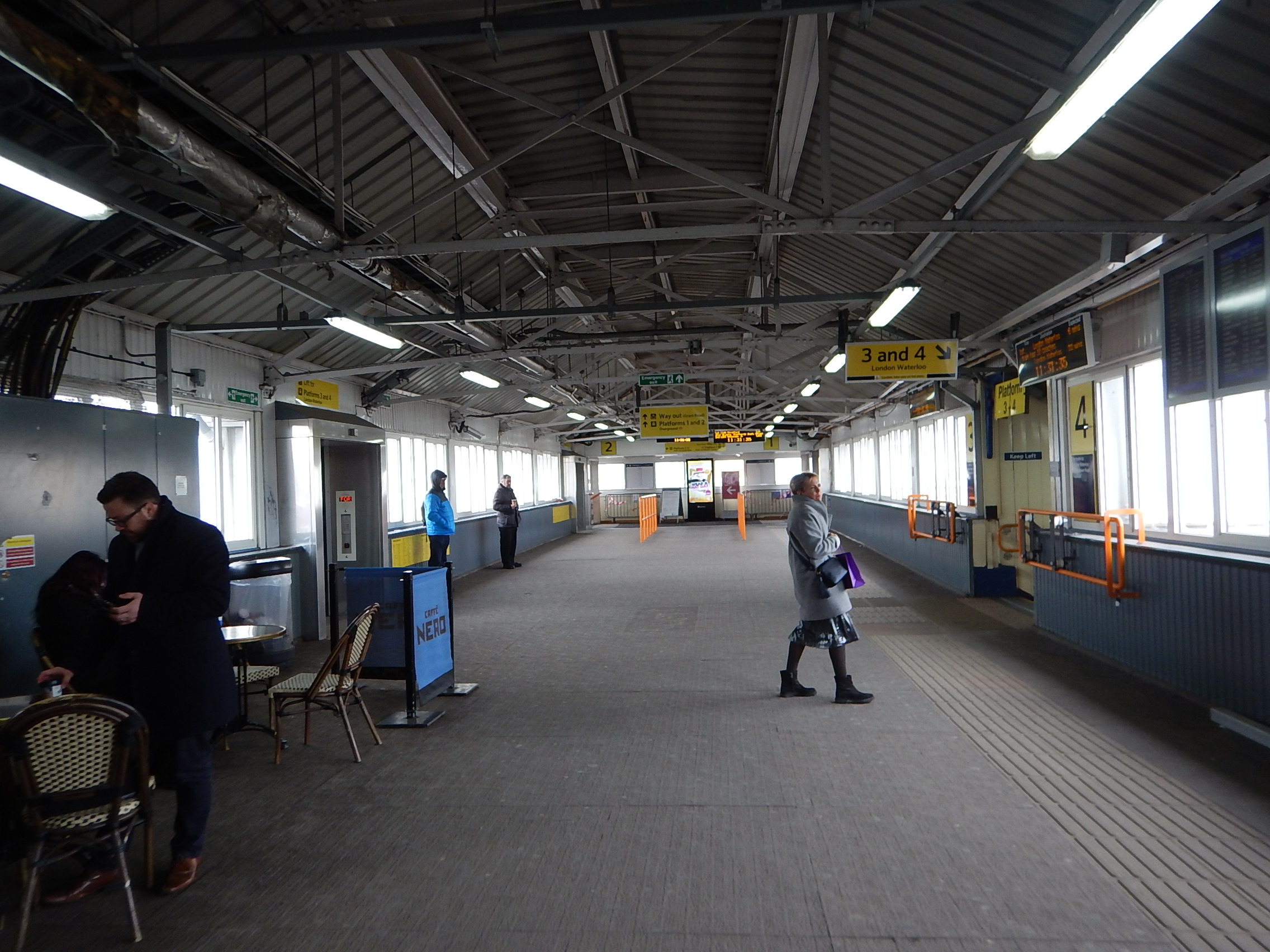
rchitects have copied this Victorian design at Leeds and Reading stations.
Clapham Junction Is Often A Convenient Place to Change Trains
When I go to Portsmouth or Southampton, I will often avoid Waterloo, by using the Overground between Dalston Junction and Clapham Junction stations.
It may be slower, but it is a very easy interchange, especially if I go step-free on the wide bridge.
Perhaps this explains why interchange passengers at Clapham Junction, are almost as many as those entering or leaving the rail network.
With some journeys like say Southampton to Wembley Stadium, changing at Clapham Junction is probably the most convenient.
Clapham Junction Links To The Overground
This interchange, is something I use a lot, as I have four trains per hour (tph) on the London Overground, from my nearest station at Dalston Junction.
As there are thirty-one stations on London’s circular railway, the interchange probably generates a lot of traffic.
Clapham Junction Seems To Be Well-Organised
If you want to go to say Gatwick, then generally the same platform will be used.
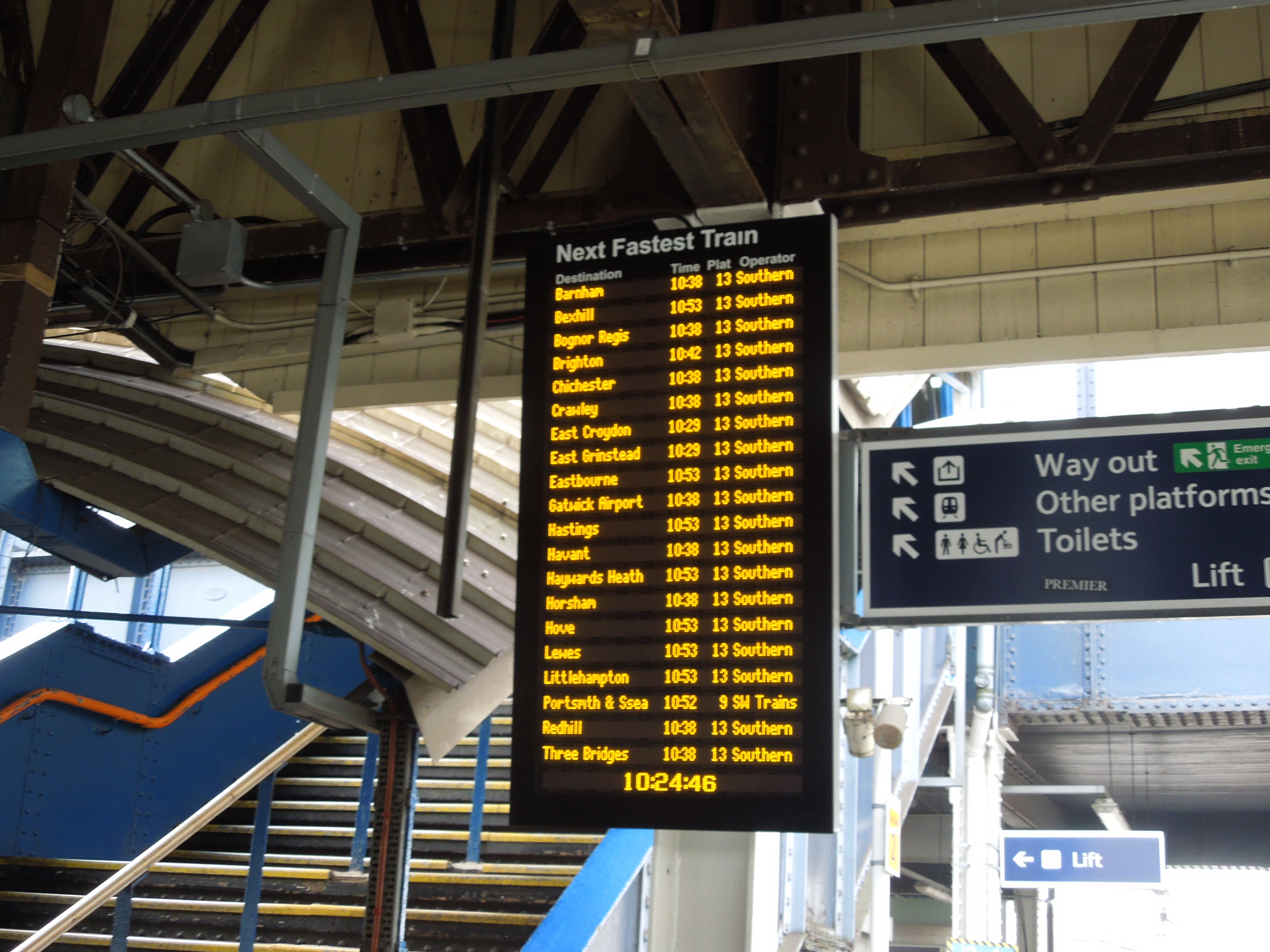
All Trains To Gatwick Go From 13
This can’t be said for many stations.
The station even has lists of stations and the platform to use.
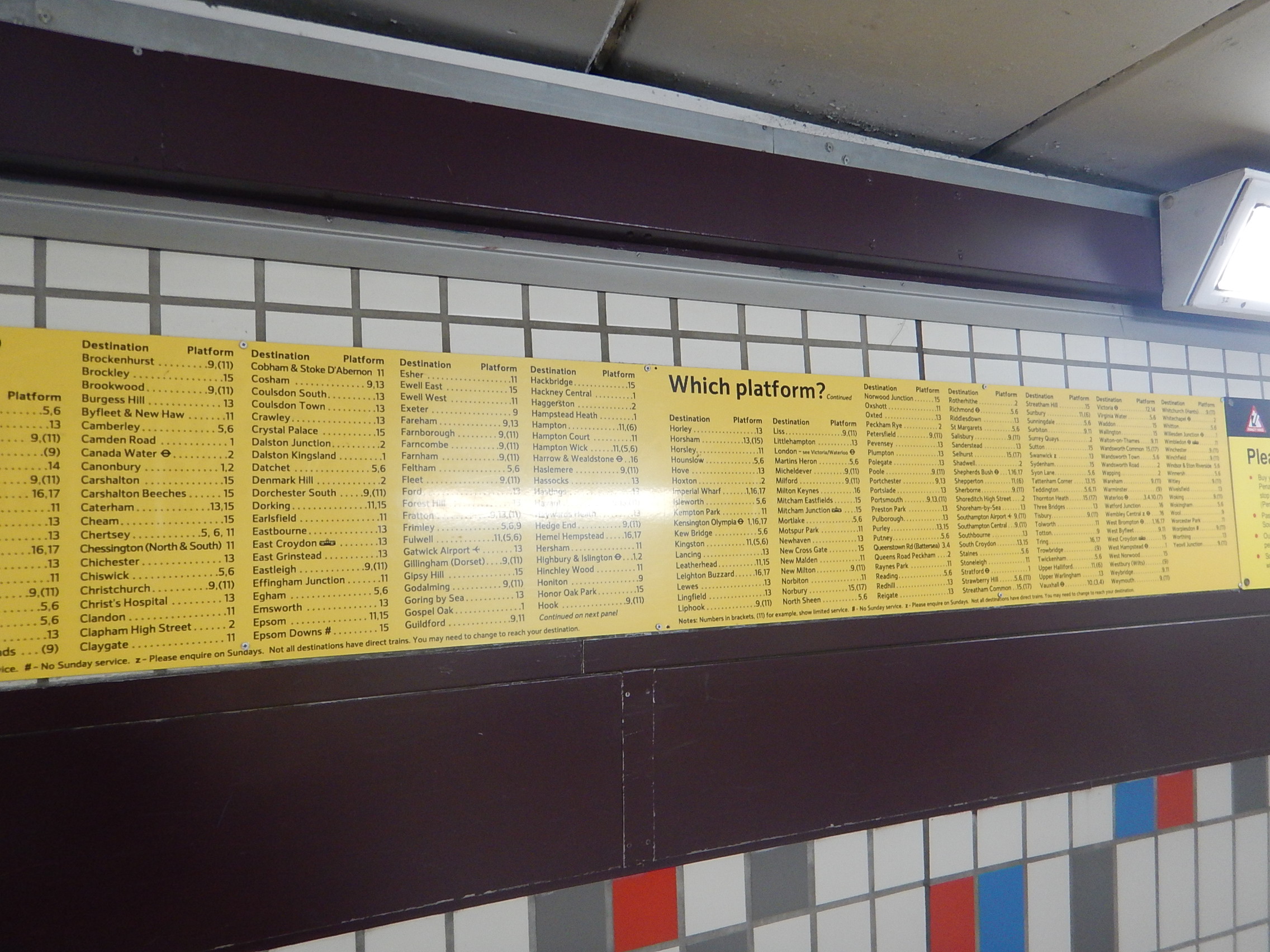
This would be impossible at most large stations!
But this is the busiest station in Europe by the number of trains using it!
The Victorians certainly got the design right!
Does this passenger-friendly design attract passengers?
Crossrail, Thameslink And Clapham Junction Station
Crossrail and Thameslink don’t call at Clapham Junction station.
But some services do directly link Crossrail and Thameslink to Clapham Junction station.
London Overground From Stratford To Clapham Junction Via Willesden Junction
This West London Line service has a frequency of four tph, which from some time this year will be raised to six tph or one train every ten minutes.
It will have the following interchanges in the future.
- Thameslink at West Hampstead
- Crossrail at Old Oak Common
It will also have interchanges with the Bakerloo, Central, District, Jubilee and Victoria Lines.
London Overground From Stratford To Clapham Junction Via Canada Water
This South London Line service has a frequency of four tph, which from some time this year will be raised to six tph.
It will have the following interchanges in the future.
- Thameslink at Denmark Hill and Peckham Rye
- Crossrail at Whitechapel
It will also have interchanges with the District, Docklands Light Railway, Hammersmith and City,Jubilee and Northern Lines.
Southern From East Croydon To Milton Keynes
This West London Line service has a frequency of one tph.
It will have the following interchanges in the future.
- Thameslink at East Croydon
- Crossrail at Old Oak Common
If Crossrail is extended along the West Coast Main Line, there will be additional interchange stations.
It will also have interchanges with the Bakerloo, Central, District and Northern Lines.
Southern From Clapham Junction To Brighton Main Line
There is a high-frequency service from Clapham Junction along the Brighton Main Line.
- 3 tph – Brighton
- 1 tph – Hastings
- 2 tph – Eastbourne
- 2 tph – Littlehampton
- 4 tph – Horsham
- 4 tph – Haywards Heath
- 4 tph – Three Bridges
- 6 tph – Gatwick Airport
- 12 tph – East Croydon
Most of these services terminate at Victoria.
The named stations, except for Hastings and Eastbourne, will also be served by Thameslink.
From the passenger point of view, those going to and from London from the Brighton Main Line and South Coast stations, have a choice of London terminus.
- Thameslink – London Bridge, Blackfriars, City Thameslink, Farringdon, St. Pancras and Thameslink’s Northern stations.
- Southern – Clapham Junction and ictoria.
The two separate routes have Central London fully covered.
Deficiencies Of The Current System
Suppose you want to travel from the extremities of Crossrail and Thameslink to say somewhere like Basingstoke, Bournemouth, Exeter, Portsmouth or Southampton, that is served by Waterloo and Clapham Junction in Central London.
- From Brighton and other stations on the South of Thameslink, there is a high-frequency Southern service.
- From Luton and other stations on the North of Thameslink, you will probably use the Jubilee Line between London Bridge and Waterloo.
- From Shenfield and other stations on the East of Crossrail, you will probably use the Jubilee Line between Bond Street and Waterloo.
- From Heathrow, Reading and other stations on the West of Crossrail, you will probably use the Bakerloo Line between Paddington and Waterloo.
All the Underground interchanges will be fully step-free with lifts and lots of escalators, but the connections could be simpler.
The Arrival Of Old Oak Common Station
The building of the new mega-hub station at Old Oak Common will tie together the following lines.
- Crossrail
- HS2
- North London Line
- West Coast Main Line
- West London Line
There is also the possibility of the West London Orbital Railway linking Old Oak Common to Hendon and West Hampstead Thameslink.
Old Oak Common and Clapham Junction stations will be two mega-hub stations, that for obvious reasons will need a high-frequency connection service.
Currently, that is planned to be the following services.
- 6 tph – London Overground from Stratford to Clapham Junction.
- 1 tph – Southern from Milton Keynes to East Croydon.
It is not enough, especially, if either connection at Old Oak Common and Clapham Junction is a long walk.
But there are easy ways to increase the numbers of connections.
Improve The Southern Service
In his report, Chris Gibb recommended that this Milton Keynes to East Croydon route be transferred to the London Overground. I wrote about this in Gibb Report – East Croydon – Milton Keynes Route Should Be Transferred To London Overground.
In my view Chris Gibb is right for the following reasons.
- All passenger services on the West London Line would then be run by London Overground.
- London Overground have a reputation for running a good train service.
- The Milton Keynes to East Croydon service could be integrated with the Watford DC Line, the North London Line and a possible West London Orbital Railway to produce an integrated frequent local service in an area of West London, that needs a greatly improved train service.
- Frequency between Old Oak Common and Clapham Junction could be raised to as high as ten or twelve tph.
- It would improve connections between Watford and the expanding Wembley Stadium complex with South London.
I doubt it would be an expensive and difficult project to move this service between operators.
Build The West London Orbital Railway And Extend It To Clapham Junction
In this article on Ian Visits, this is said about the service on the proposed West London Orbital line.
Phase 1: 4 trains per hour from West Hampstead to Hounslow, calling at West Hampstead, Cricklewood, Neasden, Harlesden, OOC, Acton Central, South Acton, Brentford, Syon Lane, Isleworth, Hounslow.
Phase 2: additional 4 trains per hour from Hendon to Kew Bridge, calling at Hendon, Brent Cross/Staples Corner, Neasden, Harlesden, OOC, Acton Central, South Acton, Kew Bridge.
The track is all in place and with a new bay platform at Hounslow, trains running on batteries could work Phase 1 with ease. The batteries would be charged South of Acton Central station.
Because of the importance of Clapham Junction as an interchange,, would it be a sensible idea to extend Phase 2 from Kew Bridge to Clapham Junction, by way of Chiswick, Barnes Bridge, Barnes, Putney and Wandsworth Town stations?
This may not be possible, as the route may not be able to accept four extra trains.
This map from carto.metro.free.fr shows the track layout around the two Overground platforms at Clapham Junction.

I also took these pictures of Platform 2.
I suspect that a bay platform could be added, opposite to Platform 2.
- There would appear to be plenty of space.
- The platform would share the lift, facilities and staff with Platforms 1 and 2.
- It would make a good interchange, with simple connections to Platforms 1 and 2.
There could even be the possibility of making Platform 2 bi-directional so that a loop service from Hendon to Dalston Junction could be created, if that was considered the best solution.
One advantage of extending the Phase 2 Kew Bridge route, would be that it would give more electrified running to charge a battery train.
Luton/Bedford to Clapham Junction
If this route from Hendon to Clapham Junction via Old Oak Common and Kew Bridge can be successfully created, it establishes the important link between the Luton/Bedford branch of Thameslink and Clapham Junction.
Cambridge/Peterborough to Clapham Junction
There is no direct route, but probably the fastest is to dive into the Victoria Line at Finsbury Park and go to Vauxhall, from where it’s a single stop to Clapham Junction.
Just avoid changing to the Victoria Line at St. Pancras, unless you like long walks.
Crossrail to Clapham Junction
Three factors will determine how good using a double change at Old Oak Common and Clapham Junction to get between Crossrail and Clapham Junction will be.
- The frequency of trains between Old Oak Common and Clapham Junction.
- The quality of the interchange at Old Oak Common. As it will also involve HS2, I suspect it should be good.
- The quality of the interchange at Clapham Junction. It probably needs improvement, but it’s not bad for something designed by the Victorians.
It could be a very good link.
Could Thameslink Serve Clapham Junction Directly?
From the Brighton Main Line, there is a frequent service, but going North to Thameslink is not easy.
It could be possible to use the West London Orbital Railway to get to and from Hendon, but whether anything other than a local route is needed is open to doubt.
Could Crossrail Serve Clapham Junction Directly?
This Google Map shows the Old Oak Common area.
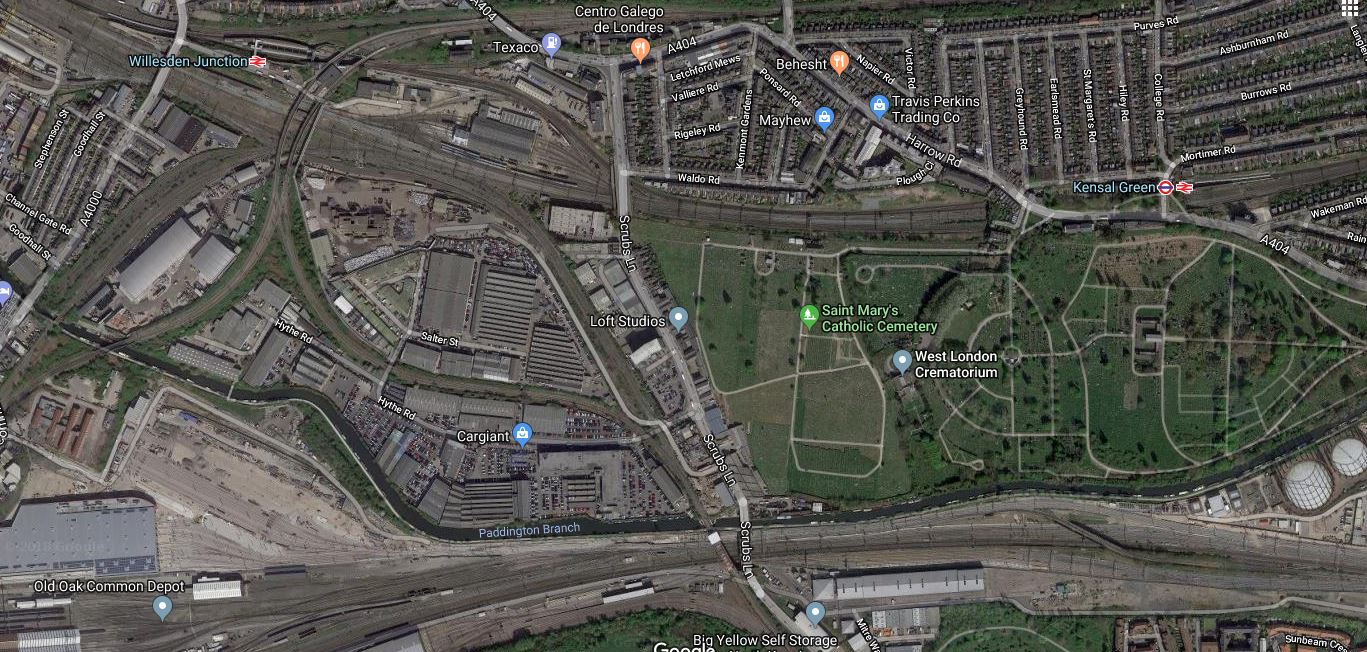
The railway running across the map to the North is the West Coast Main Line, whilst the Great Western Main Line goes across the bottom.
Looking at the map in detail, it might be possible to thread flyovers or dive-unders into the area to allow Crossrail trains to take the West London Line to the North or South from the East or West.
Consider
- There are certainly some large industrial sites that could be cleared.
- There are a couple of cemetries too.
- There are Central, Chiltern, Crossrail, Great Western Main Line, HS2, North London Line, West Coast Main Lines to connect together.
- A Heathrow to Gatwick Link could be threaded through.
It all depends on how much can be spent!
And Then There’s The Heathrow Southern Railway!
This is a bit different, as it’s a privately-funded railway that aims to sneak into Heathrow by following and hiding by the M25 and the use of the odd tunnel.
This map is a schematic of the proposed railway, which is caused the Heathrow Southern Railway.
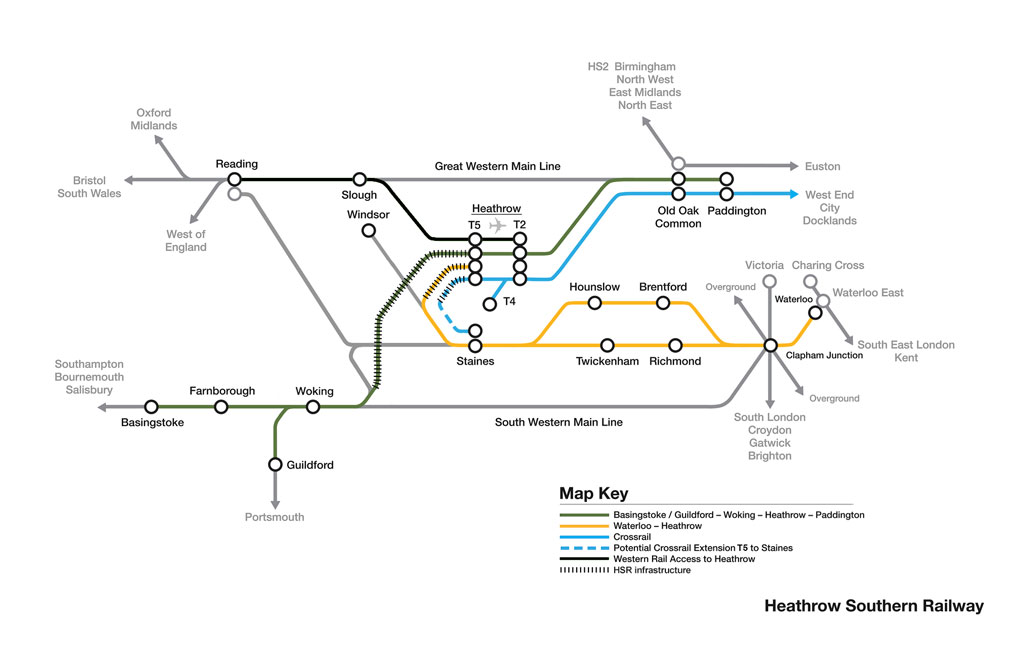
Note.
- The blue line is Crossrail.
- The yellow line is a direct link from Waterloo to Heathrow.
- The station in a six pointed star is Clapham Junction.
On the Heathrow Southern Railway web site there is a section called Service Opportunities.
It details two routes.
Heathrow – Staines – Clapham Junction – Waterloo
- Most track is existing.
- New track will run along the M25.
- Trains will be fully-integrated with South Western Railway.
- Four tph should be possible with planned capacity improvements.
- A bay platform will be added at Staines, within the current railway.
- Xrossrail could be extended from Terminal 5 to Staines.
Heathrow Southern Railway envisage that a lot of passengers from Staines will use Crossrail for London.
Basingstoke/Guildford – Woking – Heathrow – Paddington
The web site says this about the route.
An exciting additional benefit of Heathrow Southern Railway is the scope to introduce half-hourly services from Basingstoke and Guildford to Heathrow and Paddington. These trains would provide a 15-minute frequency from Woking, with stops at Farnborough Main (Basingstoke services), Woking, Terminal 5, Terminal 2 and 3 and Old Oak Common.
I like the ideas and the tone of the project.
Conclusion
With all the ideas in the West of London, I think that some very good things will happen to the railways in the area, whether Heathrow Airport builds another runway or not.
In
 The Anonymous Widower