X1 Wind’s Floating Prototype Delivers First Power Offshore Canary Islands
The title of this post, is the same as that of this article on offshoreWIND.biz.
This is the sub-heading.
X1 Wind has announced that its floating offshore wind turbine prototype delivered first power to PLOCAN’s smart grid in the Canary Islands, Spain.
The article is based on this news item from X1 Wind, which is entitled X1 Wind’s X30 Floating Wind Prototype Delivers First kWh, which starts with these two paragraphs.
X1 Wind has announced today (MARCH 07) that its X30 floating wind prototype, installed in the Canary Islands, successfully produced its first kWh.
The milestone marks the world’s only floating wind platform currently installed with a TLP mooring system, which dramatically reduces the environmental footprint and improves compatibility with other sea uses. It further heralds Spain’s first floating wind prototype to export electricity via a subsea cable.
Note.
- TLP is short for tension leg platform, which is described in this Wikipedia entry.
- The TLP Wikipedia entry contains a section, which describes their use with wind turbines.
- TLPs have been in use for over forty years, with the first use in the Hutton field in the North Sea.
- TLPs work well for water depths of between 300 and 1,500 metres.
I also suspect there’s a lot of experience from the oil and gas industry around the world about how to deploy TLPs.
The X1 Wind news item also has this paragraph.
The novel X30 platform is equipped with a specially adapted V29 Vestas turbine and ABB power converter. Another key design feature, developed through the EU-backed PivotBuoy Project, combines advantages of SPM and TLP mooring systems. The proprietary SPM design enables the floater to ‘weathervane’ passively and maximise energy yields, with an electrical swivel ensuring electricity transfer without cable twisting. The TLP mooring system also dramatically reduces the seabed footprint, compared to traditional designs proposing catenary mooring lines, minimizing environmental impact while maximizing compatibility with other sea uses, in addition to its suitability to move into deeper waters.
SPM is short for single point mooring, which is described in this Wikipedia entry, where this is the first sentence.
A Single buoy mooring (SrM) (also known as single-point mooring or SPM) is a loading buoy anchored offshore, that serves as a mooring point and interconnect for tankers loading or offloading gas or liquid products. SPMs are the link between geostatic subsea manifold connections and weathervaning tankers. They are capable of handling any tonnage ship, even very large crude carriers (VLCC) where no alternative facility is available.
Note.
- The use of the weathervane in both paragraphs.
- If an SPM can handle a VLCC, it surely can handle a well-designed floating structure with a wind turbine mounted on top.
- I suspect that an SPM used for a wind turbine will be much simpler than one used to load or unload a gas or oil tanker.
As with TLPs, I also suspect there’s a lot of experience from the oil and gas industry, from around the world about how to deploy SPMs.
It looks to me, that X1 Wind have used the proven attributes of SPMs and TLPs to create a simple mooring for a wind turbine, that is designed to align itself with the wind.
X1 Wind Are Open With Their Technology
Today’s news item from X1 Wind also links to two other useful documents.
- X1 Wind Adaptation Of A Vestas V29 Turbine To Downwind Configuration
- X1 Wind Successfully Installs Floating Wind Platform In Spain
They are certainly open with their information.
The news item, also includes this video.
Thoughts
These are some thoughts.
Capacity Factor
The capacity factor of this wind turbine could be an interesting figure.
As the turbine constantly will turn to be downwind, this should maximise the amount of electricity produced over a period of time.
Tetrahedrons
The design is effectively a tetrahedron.
Alexander Graham Bell knew a lot about the properties of tetrahedrons and invented the tetrahedral kite.
This document details Bell’s involvement with tetrahedrons and says this.
Bell found the tetrahedron to have a very good strength to weight ratio.
Put more simply this means that an object is structurally very strong but at the same time very lightweight.
So X1 Wind’s design is probably extremely strong for its weight.
Large Turbines
X1 Wind’s prototype uses a wind turbine of only 225 KW.
Manufacturers are building 15 or 16 MW turbines now and talking of 20 MW in the next few years.
Given the strength of the tetrahedron, I wonder, if it will be possible to build a PivotBuoy, that is capable of hosting a 20 MW wind turbine?
Conclusion
Although it appears radical, it uses proven technology to generate power in an innovative way.
In some ways the thinking behind the design of this floating technology, is a bit like that of Issigonis in his design for the first Mini, where he took proven technology and arranged it differently to perform better.
Ørsted Joins Global Offshore Wind Alliance
The title of this post, is the same as that of this article on offshoreWIND.biz.
This is the sub-heading.
Ørsted has become the first energy company to join the Global Offshore Wind Alliance (GOWA) to support a faster deployment of offshore wind and create a global community of action.
These two paragraphs outline GOWA.
GOWA is a new global organisation that brings together governments, the private sector, international organisations, and other stakeholders to accelerate the deployment of offshore wind power.
The alliance was launched last year at COP27 by the International Renewable Energy Agency (IRENA), the Global Wind Energy Council (GWEC), and the Danish government.
For more information look at the GOWA web-site.
Flotation Energy, Vårgrønn Take First Permitting Step For Another Oil & Gas-Powering Floating Wind Farm
The title of this post, is the same as that of this article on offshoreWIND.biz.
This is the sub-heading.
Flotation Energy and Vårgrønn, who recently filed a Marine Licence application for their 500 MW Green Volt floating wind farm in Scotland, have now submitted a Scoping Report for the 1.4 GW Cenos floating offshore wind farm to Marine Scotland.
And this is the first paragraph.
The developers have submitted leasing applications for both Cenos and Green Volt as part of the Crown Estate Scotland’s Innovation and Targeted Oil and Gas (INTOG) leasing round, whose winners are expected to be announced in the second quarter of this year.
Both wind farms have web sites, where you can find more information.
It’s beginning to look like applications for the INTOG leasing round, are going to use quality floating technology and generate very large numbers of megawatts.
In Cerulean Winds Is A Different Type Of Wind Energy Company, I wrote about their plans for a 6 GW proposal for INTOG, spread around four sites in the North Sea.
It looks like we have several companies flexing their technologies to harness the dragons of the Celtic Sea and now it appears, the new giants of the wind are preparing to make a good fist of decarbonising oil and gas in the North Sea.
Surveys Completed For Celtic Sea Floating Offshore Wind Projects
The title of this post, is the same as that of this article on offshoreWIND.biz.
This is the sub-heading.
N-Sea Group has finished a series of benthic and geophysical surveys for Llŷr 1 and Llŷr 2 floating offshore wind projects in the Celtic Sea.
I described the two projects in detail in Two More Floating Wind Projects In The Celtic Sea.
- At least the surveys are complete and it still appears that a commissioning date of 2026/27 is still feasible for these twin 100 MW projects.
- In the original documents, it was stated that there would be six next generation turbines in each wind farm, with a capacity of between 12 and 20 MW.
- There appears to be no decision on the floats or turbine size to be used.
I wouldn’t be surprised to see larger turbines used and the capacity of the farms increased.
Dutch Take Aim At Lower Green Hydrogen Costs By Combining Offshore Wind And Floating Solar
The title of this post, is the same as that of this article on offshoreWIND.biz.
This is the sub-heading.
A consortium of Dutch companies has launched a government-backed project to explore the synergies between offshore wind, offshore solar and hydrogen production at sea for improved sustainability of North Sea renewable energy projects.
T thought about calling this post, The Dutch Go For The Full Monty, but there is no mention of wave or tidal power.
These two paragraphs outline the project.
The four-year project, dubbed Solar Enhanced North Sea Energy Hub (SENSE-HUB), is expected to accelerate the rollout of offshore solar into offshore renewable energy systems.
Let by TNO, short for Netherlands Organization for Applied Scientific Research, the project will address the integration of various energy system modules for the Dutch North Sea by understanding and removing the implementation barriers for future SENSE-HUBs from a technical, economical, ecological, legal and societal perspective.
I wouldn’t be surprised to see more integrated systems like this in the waters around our coasts.
I also believe that the ultimate offshore energy production system will also use wave and tidal power to generate electricity and have inbuilt energy storage.
Unique Study: Birds Avoid Wind Turbine Blades
The title of this post, is the same as that of this media report from Vattenfall.
This is the sub-heading.
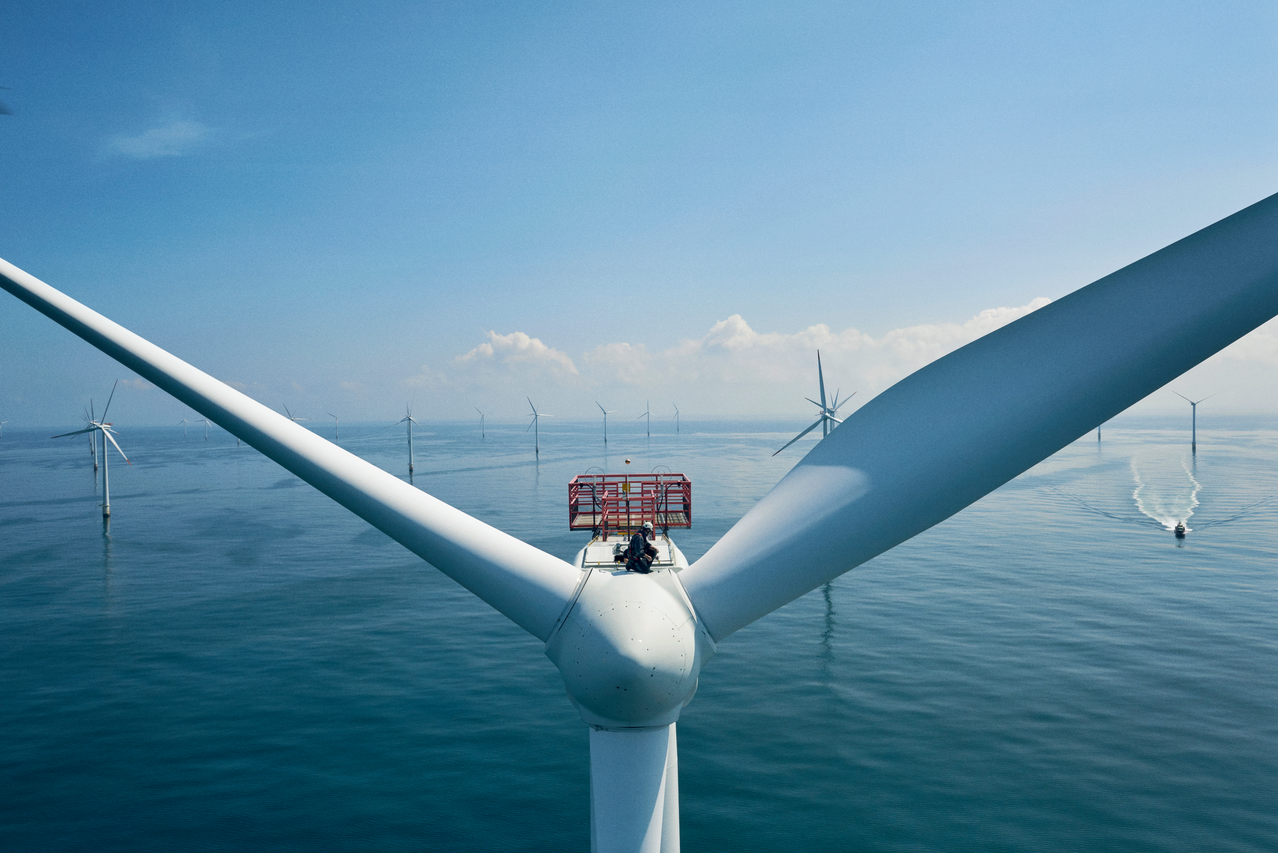
Seabirds deliberately avoid wind turbine rotor blades offshore – that is the main finding of a new study that mapped the flightpaths of thousands of birds around wind turbines in the North Sea. Most importantly, during two years of monitoring using cameras and radar, not a single bird was recorded colliding with a rotor blade.
I must admit I’m not surprised, as I’ve landed a light aircraft many times with birds flying above the runway and I can’t remember ever hitting one. But I have seen several dive out of the way.
The report is a fascinating read.
Floating Foundation For 15+ MW Offshore Wind Turbines Launches
The title of this post, is the same as that of this article on offshoreWIND.biz.
This is the sub-heading.
Odfjell Oceanwind has launched the Deepsea Star™ harsh environment floating wind foundation designed to support wind turbines with a capacity of 15 MW and more.
Note.
- Odfjell Oceanwind is a Norwegian company and has this web site.
- This news item from Odfgell Oceanwind is entitled Odfjell Oceanwind Launches The Deepsea Star™ 15MW Floating Wind Foundation and was published on the 28th of February, 2023.
- The news item was the source of the iffshoreWIND.biz article.
- In the news item, one of the designers, explains some of the features.
I very much believe that ,my twenty-three-year-old self armed with ICI’s PACE 231-R would have had great fun examining the dynamic proiperties of a structure like this.
Activity Ramping Up On Irish Floating Wind Test Site
The title of this post, is the same as that of this article on offshoreWIND.biz.
This is the sub-heading.
The Sustainable Energy Authority of Ireland (SEAI) is busy with bringing forward its Atlantic Marine Energy Test Site (AMETS), a floating wind and wave energy technology test site which has been in development for several years now. Along with offshore surveys scheduled for next month, SEIA has also commenced work on procuring an onshore substation and a floating LiDAR for AMETS.
It all sounds very professional.
The Atlantic Marine Energy Test Site will be located off Annagh Head in the West of Ireland. This Google Map shows the location of Annagh Head on the island of Ireland.

I do have a imperfect memory of a weekend of good hospitality and gourmet food at a hotel called the Cashel House Hotel to the West of Galway, but I can’t remember how C and I flew there. Did we fly to Knock or Shannon either using a scheduled airline or my Cessna 340 A?
All I can remember of the holiday, was that it was very windy at times and driving through Westport. So did we explore towards Annagh Head?
This Google Map shows a close-up of Annagh Head.
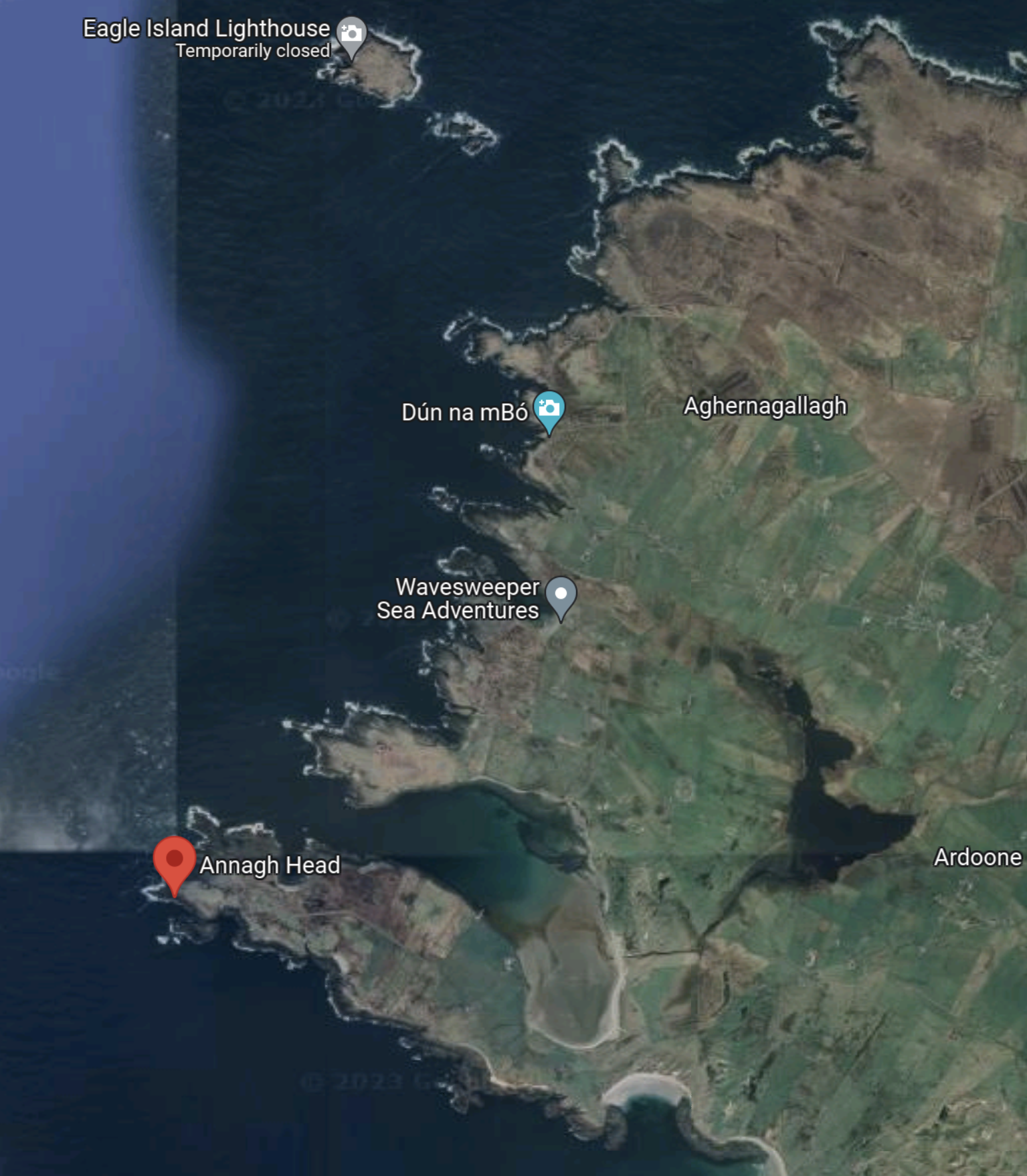
I suspect that Annagh Head is an ideal location to test floating wind and wave power.
There will also be good hospitality and airlinks to the UK and Europe.
In So Many Floating Wind Designs, So Few Test Sites – Norwegian METCentre Sold Out, I wrote about the shortage of test sites for wind power.
So perhaps, AMETS will help to fill the gap?
In
Entrion Wind Wins ScotWind Feasibility Deal For Its 100-Metre Depth Foundation Tech
The title of this post, is the same as that of this article on offshoreWIND.biz.
This is the sub-heading.
Entrion Wind has been awarded a project to evaluate the feasibility of its patent-pending fully restrained platform (FRP) offshore wind foundation technology by a Scotwind developer.
Having worked on similar structures for reusable oil platforms in the 1970s, I reckon these FRP monopoles can be made to work.
The structures, I mathematically-modelled were for a company called Balaena Structures, that had been started by two Cambridge University engineering professors. The structures were about a hundred metres high and perhaps thirty metres in diameter.
They would have been built horizontally in the sort of dock, where you would build a supertanker and would have been floated into position horizontally. Water would then be let in to the cylinder and they would turn to the vertical. From that position, they would be lowered to the sea-bed by adjusting the water in the cylinder. They had a method of holding the Balaena to the seabed, which relied mainly on the weight of the structure and what they called the gum-boot principle.
Sadly, they never sold any platforms and the company folded.
Until recently, you could find the expired patents on the Internet.
There’s more on Entrion Wind’s technology on this page on their web site.
 The Anonymous Widower