The Tallest Timber Residential Structure In The World
You’d have thought that this would be somewhere like Japan, Scandinavia or perhaps Canada, but despite it’s name, the Stadthaus is in Murray Grove in the London Borough of Hackney.
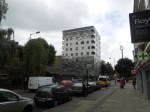


Wikipedia says this about the building.
It is thought to be the tallest timber residential structure in the world.It was designed in collaboration between architects Waugh Thistleton, structural engineers Techniker, and timber panel manufacturer KLH.
Stadthaus is the first high-density housing building to be built from pre-fabricated cross-laminated timber panels. It is the first building in the world of this height to construct not only load-bearing walls and floor slabs but also stair and lift cores entirely from timber.
I like it and it shows how modern buildings don’t have to be constructed using traditional methods. It was also constructed in just 49 weeks and residents moved in ahead of schedule.
So as we need more housing and we need it quickly, perhaps we should build more houses and flats using these methods.
Art At The Bus Stop
My local bus stop has got the treatment from Art Everywhere.
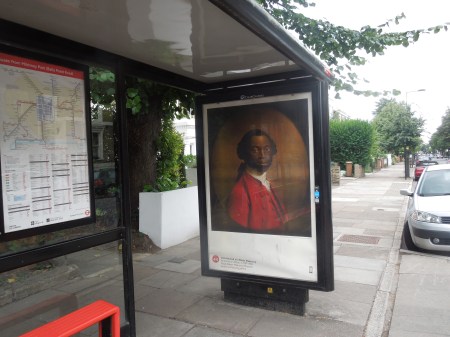
Art At The Bus Stop
I think, I’ll go and find the original some time next week.
Is Gluten-Free Beer Illegal In Italy?
I have puzzled for some time, why there is no Italian gluten-free beer, as if Germany with their strict brewing regulations can have one, surely can most countries.
So I searched Google using “birra senza glutine” and found this Italian site. It says this about a beer called Beautiful Elena.
Beautiful Elena : Italian craft beer derived from rice. By law in Italy can not be called beer, because this name is reserved only to beverages that contain barley or barley malt, then find it on the shelves labeled “rice drink alcohol.”
So it looks like many of the gluten-free beers we have couldn’t be brewed in Italy. But they can sell other countries’ products.
A Very Different Gluten-Free Beer
Most beers these days are light in colour, but this Dark G-Free from St. Peter’s Brewery in Suffolk is very much like an old-fashioned brown ale.

A Very Different Gluten-Free Beer
It was rather nice and very different to all other gluten-free beers I’ve tasted.
Until further notice, I shall make sure, I’ve always got a few of these in my cupboard.
I bought mine from Beers of Europe.
A Restricted View Seat At Loftus Road
My seat at Loftus Road was marked Restricted View, but it wasn’t too bad.
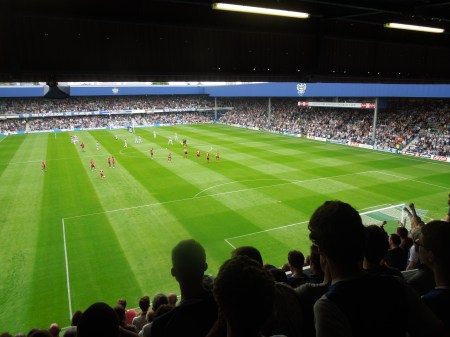
A Restricted View Seat At Loftus Road
In fact, the experience was a lot better than last time I came. QPR seemed to have bought some paint and repaired the seats.
The End Of Television As I Knew It!
On the way to see Ipswich at QPR yesterday, I walked past the old BBC Television Centre at the White City.
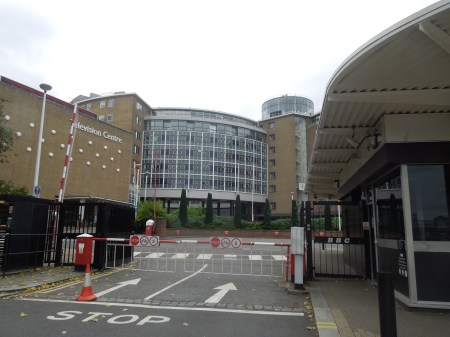
The End Of Television As I Knew It!
It is all rather sad to see such an iconic building on the way down!
Royal Mail Iconography
I took these two pictures on Friday and Saturday respectively.


The brickwork has been saved and incorporated into the wall in the new Royal Mail sorting office in Islington and the Penford pillar box is behind the Westfield shopping centre in Shepherd’s Bush.
Are These Trains The Key To Improved Rail Services in The UK?
I must admit I’ve been critical of the Hitachi Super Express Train to be built in the North East of England.
As an engineer, I don’t like the idea of an electro-diesel version, that lugs diesel engines around, so it can be self-propelled on non-electrified lines.
I also feel, that the last government wanted the project for overtly political reasons and hence the decision to build the trains in the North East.
But now the orders are being made for both the Class 800 and Class 801 trains, I’m warming to the project.
This is partly because, I have travelled into Kent several times by the Class 395 trains, which are to a similar design by Hitachi, as proposed for the Class 800 and Class 801. Although, they are probably less grand, as they are essentially commuter trains. But even these humbler trains have a top speed of 225 kph, which is the same as the Inter City 225 units on the East Coast Main Line.
If all of the improvements to the East Coast Main Line detailed here are implemented, then the line could be a 225 kph four-track line all the way from London to Newcastle.
The major problems then to adding capacity and obtaining that speed most of the way, are the slower 160 kph trains, that run from London to Cambridge and Peterborough and share the lines to the north of York and Doncaster. But if these units like the current Class 365 and Class 185 were replaced with another electrical multiple unit from the same 800/801 family capable of working at 225 kph, this problem would be alleviated.
If we look at the West Coast Main Line, the Class 390 Pendelions could travel on a lot of the line at 225 kph with improved signalling, but again they are held up by other slower services. in fact, there is talk of ordering more mini-Pendelinos to serve places like Holyhead, Chester, Blackpool and Shrewsbury.
Once the Great Western Main Line is fully electrified to Bristol and South Wales, it should be a 225 kph railway, virtually run by the 800/801 family of trains, with a few Inter City 125s, still working down to Devon and Cornwall. So I suspect we’ll see the Oxford, Cheltenham and Worcester services run by faster trains to reduce capacity constraints.
But all this does show again, how by running more 225 kph trains under better signalling systems, with probably more selective quadruple tracking can greatly increase the capacity on our railways.
It could be argued than one of the successes of the Inter City 125s, is that because there are so many they can be moved between operators and reconfigured easily for changing circumstances. If ever there was a chameleon train, it is these.
i suspect that if we had a large number of 800/801 trains or in fact any other type, then this would make them cheaper to purchase and support and probably more reliable. We have too many one route only classes of trains.
So what other lines could benefit from 225 kph trains, such as the 800/801 family?
Obviously, the East Midland Main Line is a candidate, especially as there have been plans to make a lot of the line capable of speeds of 200 kph. It would be an easier and earlier way to substantially speed up journey times to Sheffield. Dual voltage versions of the 800/801 family aren’t proposed, but the closely related Class 395 can run on overhead wires or third rail. So could we see a high-speed service from Sheffield to Brighton, through the Thameslink tunnels, stopping in Central London and Gatwick Airport?
The Great Eastern Main Line on the other hand is probably not a candidate, as it is only a 160 kph line, as like most East Anglian infrastructure, it was built on the cheap. But the line is crying out for new trains and I have heard that electrical multiple units would save time to Ipswich and Norwich.
The Trans Pennine Lines are a disgrace and at least are scheduled for electrification. As the trains using these lines often travel over the East and West Coast Main lines, faster trains are needed for some routes like Liverpool to Newcastle and Glasgow to Manchester.
I would also electrify the Chiltern Line to Birmingham and replace the third rail systems south of London to perhaps, Brighton, Portsmouth, Southampton and Bournemouth. For freight purposes this is being done partly already.
So I think we’ll see lots of the 800/801 family of high speed trains.
Do We Need A Rolling HS2?
The report today by the think tank, the Institute of Economic Affairs, which says that HS2 will cost a lot more than is currently budgetted for. It’s all reported here on the BBC.
They make a lot of good points in the report.
Extra infrastructure such as trams and trains, will be needed to link other areas to the route.
Extra tunnels and other infrastructure will be needed to buy off the opposition.
The BBC summarises it like this.
The report said HS2 “and the add-on transport schemes will be heavily loss-making in commercial terms – hence the requirement for massive taxpayer support”.
As someone, who is very familiar with project management, I’ve always felt that the logic of HS2 and the way it is being implemented could and will be improved.
If we look at the current rail network, it has problems that will eventually be solved or helped by HS2.
Euston station is not fit for purpose and should be redeveloped and/or relieved. I favour a second terminus of the West Coast Main Line at Old Oak Common, as I mused here.
There are very severe capacity problems on the northern part of the West Coast Min Line between Wigan and Glasgow. This is not part of the current HS2, so perhaps it should be done to make sure the Scots get their connections to the South improved.
The East Coast Main Line to Leeds and Newcastle, has a notorious bottleneck at the Digswell Viaduct and according to this report on the BBC web site, it could be removed for under half a billion.
One problem that HS2 doesn’t solve is the bad connections across the north of England from Liverpool to Leeds and Hull. This BBC report includes an estimate of a billion plus.
So should we just define the route for HS2 and then break it into a series of manageable projects, that are implemented over the years.
We might design large stretches for say 300 kph, but most of the upgraded network would have limits of around 200 to 250 kph. Effectively large sections of the East and West Coast Main Lines can now handle 225 kph and just need resignalling.
The new Class 800 and Class 801 trains will be built to a design speed of 225 kph.
In some ways these trains may be the key to the whole of the expansion of high-speed services. I suspect, we’ll see them on London to Sheffield and Norwich for a start.
Weapons Of The Spirit
The BBC is showing a piece about the wartime history of the village of Le-Chambon-sur-Lignon, in saving thousands of Jews from the Nazis. The story is here on Wikipedia.
The title of this post comes from the documentary about the story, made by Pierre Sauvage, who was born and sheltered in Le Chambon.
 The Anonymous Widower