Grayling On Crossrail 2
This is Chris Grayling’s thoughts on |Crossral 2 for this article in City AM.
I am a supporter of Crossrail 2 but given its price tag we have to ensure that we get this right. The mayor and I have agreed to work together on it over the coming months to develop plans that are as strong as possible, so that the public gets an affordable scheme that is fair to the UK taxpayer.
Following a successful outcome being reached I am keen to launch a fresh public consultation to help gather views to improve the scheme and clarify the position around the safeguarded route.
So perhaps, the line will get built after all.
A Class 345 Train At Shenfield Station
These pictures show a Class 345 train at Shenfield station.


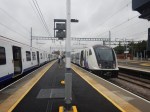
There’s still only one train running.
Note how the step-free access isn’t much better than the Class 315 train on the left.
Bi-Mode Trains And CrossCountry
The CrossCountry franchise runs trains all over the UK.
I wonder how bi-mode trains will effect their services.
These are just a few thoughts.
InterCity 125 Trains
CrossCountry have enough Class 43 locomotives and Mark 3 carriages to make-up five 2+8 InterCity 125 sets.
These trains will not meet the regulations in a couple of years, so will they be replaced or refurbished.
It is probably not an easy decision for the following reasons.
- Passengers and I suspect drivers too, love them.
- They are probably ideal for longer routes like Devon and Cornwall to Scotland
- Scotrail and Great Western Railway will be updating several trains each.
- They are forty years old.
- There may be pressure to retire the trains because of environmental problems.
- If they even wanted to acquire a few extra sets, the type retirement by other operators might help.
Left to the Marketing Department, there would only be one decision.
Class 800 Trains
Class 800 trains or more likely Class 802 trains, specified for their routes may offer advantages to CrossCountry on some of their routes.
Consider these features of Class 802 trains.
- Available in any number of cars between four and twelve.
- Designed around a flexible interior.
- Dual voltage is probably available.
- Wi-fi and power sockets.
- Hitachi have designed the trains for lower track-access charges.
Costs and the marketing advantage of new electric trains will probably decide.
Devon and Cornwall to Scotland
Consider.
- Plymouth to Edinburgh and Glasgow is an hourly service that takes just under nine hours to Edinburgh with no changes.
- One train per day goes from Plymouth to Aberdeen in eleven hours.
- A lot of the route is not electrified, but it is North of York.
- Would a Class 802 train have enough fuel capacity?
I suspect current arrangements will continue.
Southampton Central And Bournemouth To Manchester And Newcastle
Consider.
- North of Leeds, the route is electrified using 25 KVAC overhead
- South of Basingstoke, the route is electrified using 750 VDC third-rail.
- Any bi-mode train would need to be dual-voltage.
- Range should be less of a problem
A dual-voltage bi-mode Class 802 train might be ideal.
Other Routes
Most other routes only have a small proportion of running on electrified track.
Conclusion
I think it unlikely, that CrossCountry will go for a total replacement of their fleet with bi-mode trains.
But I suspect, they’re keeping a watching brief on developments in electrification and trains.
Electricity Shake-Up Could Save Consumers ‘up to £40bn’
The title of this post is the same as that of this article in the BBC.
The electricity shake-up was forecast in yesterday’s Sunday Times and I wrote about it in Giant Batteries To Store Green Energy.
In We Need More Electricity, I talked about what RWE are doing to create an all-purpose Energy Centre at Tilbury.
The Tilbury Energy Centre will feature.
- Efficient energy generation from natural gas.
- Substantial energy storage.
- Peak energy production from natural gas.
- Load balancing of wind power with storage and generation from natural gas.
But I suspect, it will get involved in other advanced techniques, like using carbon dioxide to get greenhouse fruit and vegetables to grow quicker.
The electricity market is changing.
Scotland’s Floating Wind Farm
This article on the BBC is entitled World’s first floating wind farm emerges off coast of Scotland.
In the early 1970s, I worked on a unique concept for a reusable oil platform called a Balaena.
I wrote about using a Balaena for a wind turbine in Could a Balaena-Like Structure Be Used As a Wind Power Platform?.
There is also a brief description of the idea in The Balaena Lives.
I have a strong feeling that revisiting all of the work done for a Balaena over forty years ago, could enable a better way to build a floating wind farm.
I would build my Baleana-based floating wind-power turbine like this.
- A steel cylinder is built, which will form the tower, horizontally in a dry dock.
- It is floated out horizontally to some very deep water perhaps in a fjord.
- It is then raised to a vertical position by letting a calculated amount of sea water into the tank.
- It will float vertically, if the weight profile is right and by adjusting water levels in the tank, the top can be raised on lowered.
- The tower is adjusted to a convenient height and the turbine is placed on the top.
- It would then be towed vertically into position.
Note that Balaenas were designed to sit on the sea-bed using a skirt and a gum-boot principle to hold them to the bottom, with extra anchors and steel ropes.
 The Anonymous Widower