N-Sea To Connect German Offshore Wind Farm To Dutch Gas Platform
The title of this post, is the same as that of this article on offshoreWIND.biz.
This is the sub-heading.
Dutch upstream oil and gas company, ONE-Dyas, has awarded N-Sea with a contract to install a subsea power cable between the Riffgat offshore wind farm in the German North Sea and the new, to-be-built N05-A gas production platform.
At a first look it appears that wind power is being used to power the gas production platform.
Other points from the article include.
- The distance of the connecting cable is ten kilometres.
- The Dutch government approved the scheme in June 2022.
- A final investment decision was made in September 2022.
I have some thoughts and further information.
Borkum, Rottumerplaat and Schiermonnikoog
The article says this about the position of the gas platform.
The N05-A platform will be installed some 20 kilometres north of the islands of Borkum, Rottumerplaat and Schiermonnikoog, and approximately one and a half kilometres from German waters.
This Google Map shows the three islands.
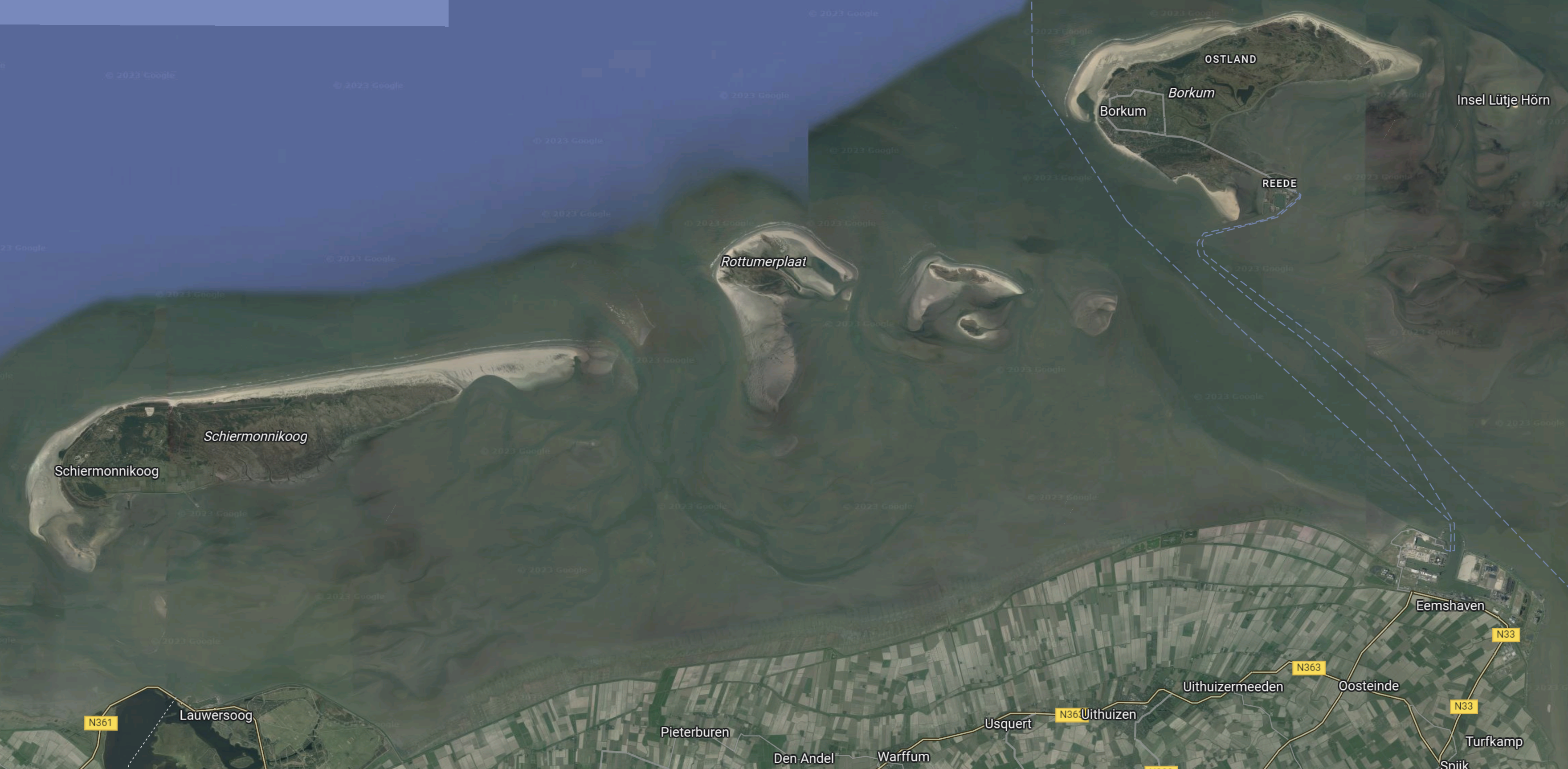
Note.
- Borkum is the horseshoe-shaped German island in the North-East corner of the map.
- Schiermonnikoog is the long and thin island in the West.
- Rottumerplaat is the larger of the two Dutch islands in middle map.
- Eemhaven, which I wrote about in The Train Station At The Northern End Of The Netherlands, is in the South-East corner of the map.
Shipping routes run up the River Ems and German-Dutch border in the East of the map
Riffgat Wind Farm
This web page on the EWE web site, gives this description of the wind farm.
EWE has built the first commercial wind farm in the German North Sea in summer 2013 with Riffgat. The modern wind farm has a total capacity of 108 megawatts of power and can supply around 120,000 households with environmentally friendly electricity. In just 14 months of construction, the 30 wind turbines of the 3.6 megawatt class have been installed 15 kilometers off the north seas of Borkum. The rotor diameter of the units is 120 meters, while the hub height is 90 meters, which corresponds to the height of the Bremen dome. Overall, the plants are 150 meters high from the water surface to the top rotor blade tip. They are founded on 70 meter long steel foundations (monopiles), 40 meters deep in the sea bottom. The water depth in the wind farm is between 18 and 23 meters. In addition to the wind power plants, Riffgat also consists of a substation which transports the generated electricity to a better transportable voltage level.
It looks a pretty standard 100 MW wind farm with fixed foundations.
The N05-A Platform
The article says this about the N05-A project.
The N05-A project is part of the so-called GEMS area, an area approximately 20 to 80 kilometres north of the Ems estuary. ONE-Dyas, together with partners Hansa Hydrocarbons and EBN, aims to extract natural gas from the N05-A field as well as surrounding fields in the German and Dutch North Sea.
The GEMS area has a web site with a URL with a .co.uk extension.
It has an informative video, which I don’t think would go down with Dutch chapter of Just Stop Oil.
The North Sea’s First Gas Platform To Run Entirely On Wind Power
The article says this about the N05-A project.
While the N05-A platform will not be the first in the North Sea to run on wind energy, it will be the first to do so entirely.
Hywind Tampen floating wind farm will be the first.
Conclusion
This looks like a good pragmatic solution to me.
I can see more connections between offshore wind farms and oil and gas facilities all over the world.
Farewell! Mary Quant!
This is a true story I heard, when I worked for ICI.
Do you remember those horrible drip-dry shirts, that men used to wear in the 1960s?
I suspect I took some to University, as my mother felt I could wash them.
Did you know that Mary Quant was partly responsible for their demise?
Mathematics tell us, that a pair of tights need a lot more nylon, than a pair of stockings.
As Mary Quant got a lot more ladies wearing tights to go with mini-skirts, there was a shortage of nylon.
ICI, who made much of the UK’s nylon, decided unilaterally to divert nylon from men’s shirts to ladies’ hosiery.
Bye bye! Nylon shirts!
RIP Dame Mary
BP And EnBW Hire Kent For 2.9 GW Scottish Offshore Wind Project
The title of this post, is the same as that of this article on offshoreWIND.biz.
This is the sub-heading.
Engineering and design service provider Kent has been awarded a contract by EnBW and BP to carry out pre-Front End Engineering Design (FEED) studies for the 2.9 GW Morven offshore wind project in Scotland.
Morven offshore wind farm would appear to be on its way.
According to Wikipedia’s list of UK offshore wind farms, the water depth in the Morven wind farm is between 65-75 metres.
- Total power is given as 2907 MW, which indicates that 14 MW turbines could be used.
- Siemens Gamesa 14 MW turbines have a blade length of 108 metres and their 10 MW have a blade length of 94 metres.
- This would seem to indicate that the wind turbine will be as much as 160 to 185 metres above the sea-bed.
A radical design of fixed foundation will be needed.
In Entrion Wind Wins ScotWind Feasibility Deal For Its 100-Metre Depth Foundation Tech, I look at technology that might work.
I also say this about work I did in Cambridge in the early 1970s.
The structures, I mathematically-modelled were for a company called Balaena Structures, that had been started by two Cambridge University engineering professors. The structures were about a hundred metres high and perhaps thirty metres in diameter.
They would have been built horizontally in the sort of dock, where you would build a supertanker and would have been floated into position horizontally. Water would then be let in to the cylinder and they would turn to the vertical. From that position, they would be lowered to the sea-bed by adjusting the water in the cylinder. They had a method of holding the Balaena to the seabed, which relied mainly on the weight of the structure and what they called the gum-boot principle.
Sadly, they never sold any platforms and the company folded.
Until recently, you could find the expired patents on the Internet.
I believe that a development of the Balaena design could be the solution to deep water fixed foundations.
 The Anonymous Widower