ESB, Irish Port Team Up To Make Shannon Estuary Go-To Place For Floating Wind
The title of this post, is the same as that of this article on offshoreWIND.biz.
This is the sub-heading.
Irish energy company ESB and Shannon Foynes Port, the company with statutory jurisdiction over all marine activities on the Shannon Estuary, have entered into a collaboration to develop the region into a centre for the deployment of floating offshore wind projects in both Irish and international waters.
This is the introductory paragraph.
Back in 2021, ESB and its then-partner Equinor announced the development of the 1.4 GW Moneypoint floating wind farm in Ireland, with a broader plan under its Green Atlantic @ Moneypoint project to transform the Moneypoint power station in County Clare into a green energy hub and to support wider plans of Shannon Foynes Port to help make the Shannon Estuary a focal point for the offshore wind industry in Europe.
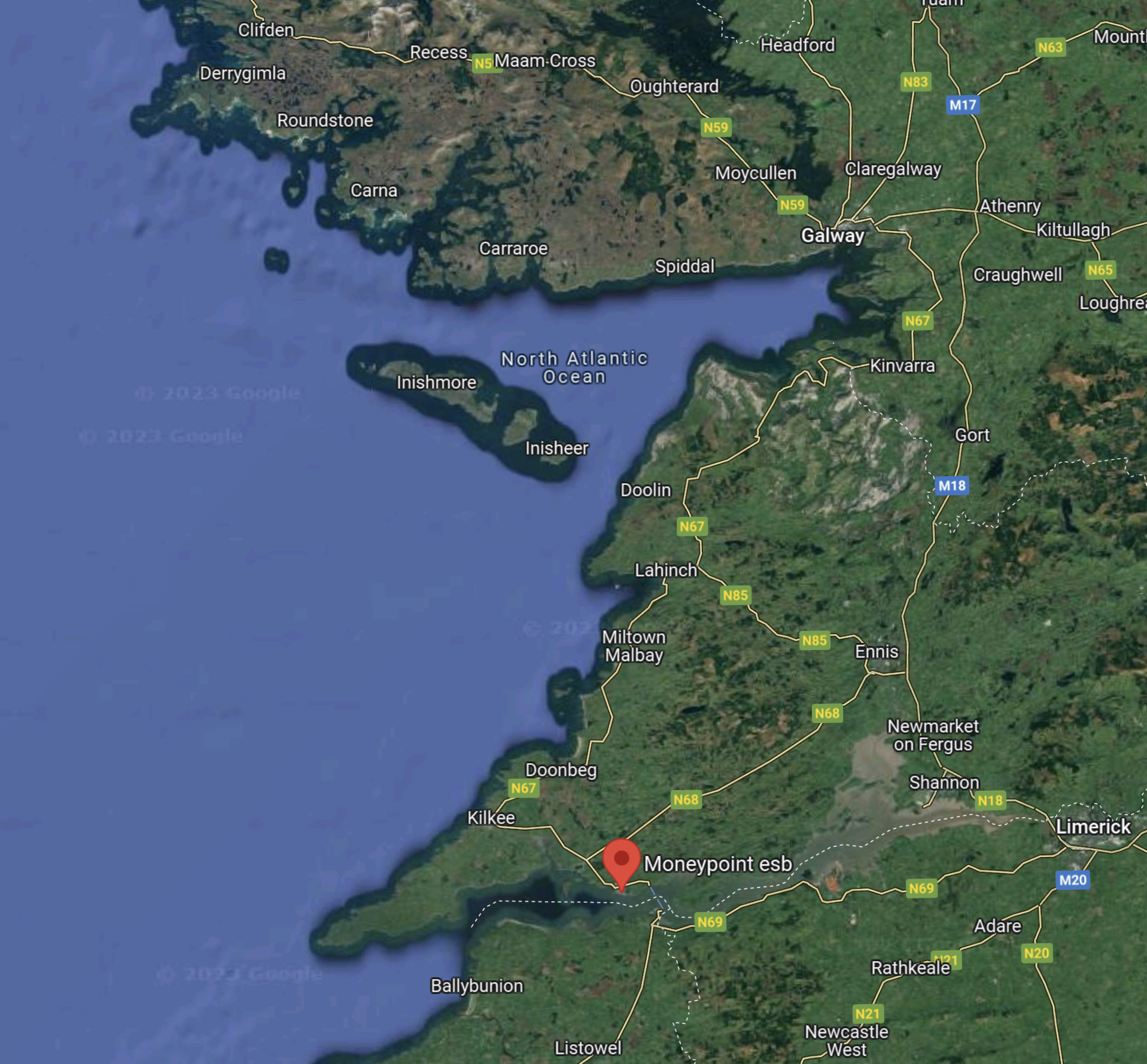
This Google Map shows the location of Moneypoint power station with respect to the Shannon Estuary.
Note.
- Moneypoint power station, which is indicated by the red arrow is on the River Shannon.
- The city pf Limerick is to the East of Moneypoint.
- There’s certainly a lot of water in the West for floating wind turbines.
This second Google Map shows a close-up of the power station.
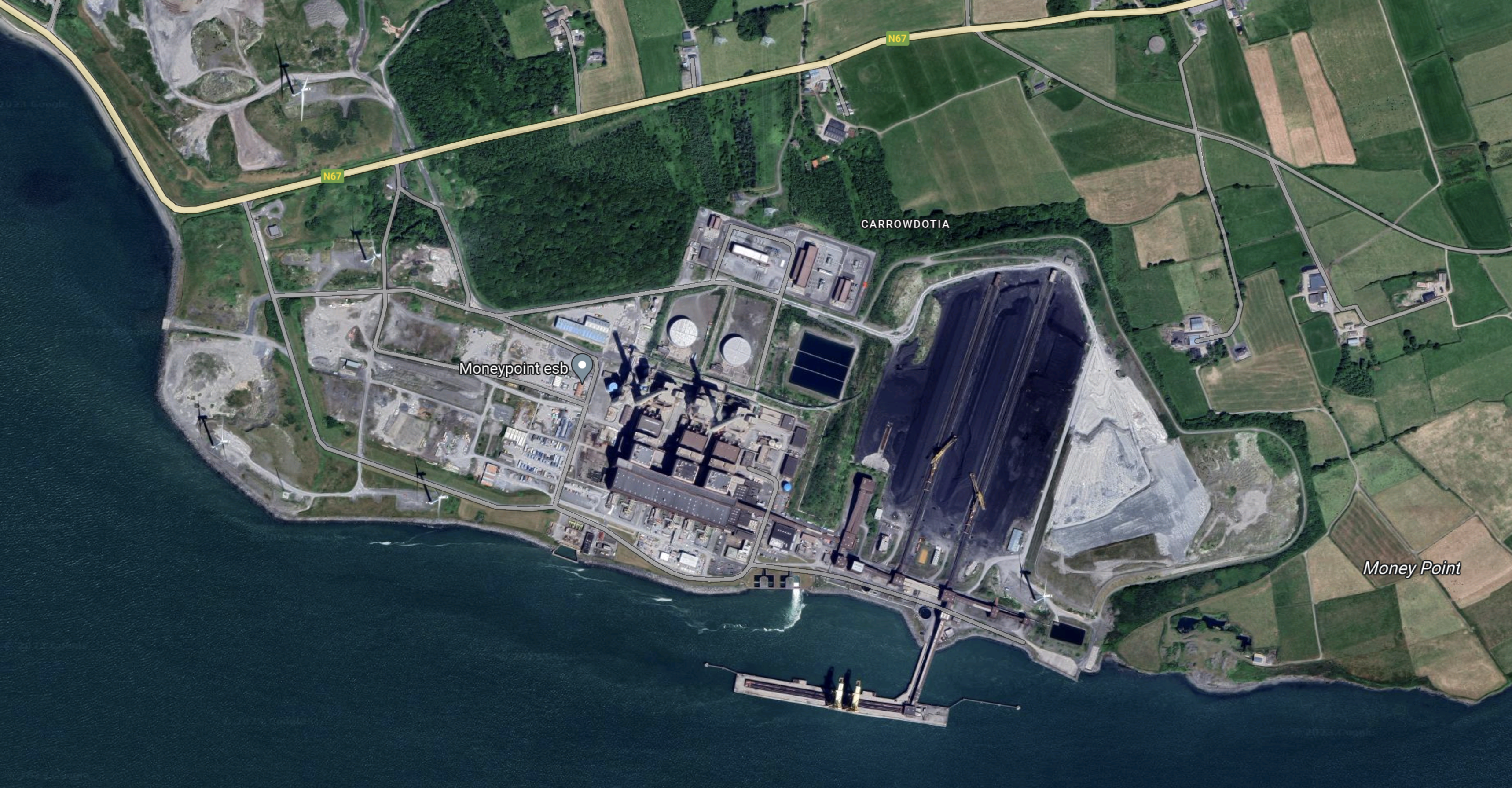
This is a shortened version of the first paragraph of the Wikipedia entry for the power station.
Moneypoint power station is Ireland’s largest electricity generation station (output 915 MW) and only coal-fired power station. Commissioned between 1985 and 1987, it is located on the River Shannon near Kilrush, County Clare. It was constructed at a cost of more than £700m in one of the largest capital projects in the history of the state. The station operates largely on coal, making it both unique in the context of Irish electricity production and the country’s single largest emitter of greenhouse gases. It is capable of meeting around 25% of customer demand across the country. It has two Heavy Fuel Oil (HFO) storage tanks with a capacity of 50,000 tonnes which can be used as a back-up fuel if required.
In some ways, the only good things about this power station are the grid connection that can handle most of a GW and the large site, which could be used for a variety of energy-related purposes, like green hydrogen generation and storage.
In Shannon Estuary Could Support Build-Out of 30 GW Of Floating Wind, House 2 GW of Electrolysis Capacity, I wrote about the potential of this area.
Those figures of 30 GW of floating wind ans 2 GW of electrolysers will certainly mean a lot of investment going into Moneypoint!
I would also feel, that Moneypoint will need a lot of energy storage to support and balance the grid.
Masons Of Yorkshire Distillery Enters Partnership With LNER
The title of this post, is the same as that of this article on Rail Advent.
These two paragraphs outline the partnership.
A Yorkshire Distillery has entered a partnership with London North Eastern Railway for its vodka to be served in the railway’s first-class carriages.
In the agreement, Classic Vodka from the highly awarded Masons of Yorkshire Distillery will be the only vodka served on all first-class routes between Inverness, London Kings Cross, and Aberdeen and Kings Cross.
As the railways are now effectively controlled by the UK Government, perhaps we should see more British food and drink featuring on trains.
SeaTwirl, Kontiki Winds To Explore Powering Oil & Gas Assets With Floating Wind
The title of this post, is the same as that of this article on offshoreWIND.biz.
This is the sub-heading.
The Sweden-headquartered SeaTwirl has signed a Memorandum of Understanding (MoU) with Kontiki Winds to identify and discuss the opportunities to electrify oil and gas assets and other offshore applications, with the use of SeaTwirl’s floating wind turbines.
And this is the first paragraph.
Under the MoU, the two companies will explore new opportunities in the market to implement offshore wind into new and existing oil and gas assets and microgrid applications such as the powering of fish farms, desalination plants and/or other small-scale applications that currently are based on fossil fuel electricity generation.
Note.
- The current turbines are only 1 MW.
- They appear to be mounted on a long monopole foundation.
- My mathematical modelling experience suggests to me, that these could be very stable devices.
- I suspect they could be built into specialist equipment like a buoy with a light to mark something.
I suspect that there will be large numbers of applications, especially if the manufacture and installation of Sea Twirl’s turbines is an efficient process.
 The Anonymous Widower