Centrica To Build Largest Battery Storage Project To Date
The title of this post, is the same as that of this news item from Centrica.
These three paragraphs outline the news.
Centrica Business Solutions has secured the development rights to a 65MW two-hour battery storage plant in Perthshire, Scotland, its largest battery storage acquisition to date.
The site in Abernethy is located near a connection for North Sea offshore wind farms and will help manage grid capacity by charging when demand for power is low, and discharging when demand is at its highest.
Once connected to the grid in 2028, the 65MW two-hour battery will be able to store enough electricity to power 130,000 homes for an hour – the equivalent to a town the size of Aberdeen. The discharge could happen up to four times a day.
This map shows the site of the substation at Abernethy.
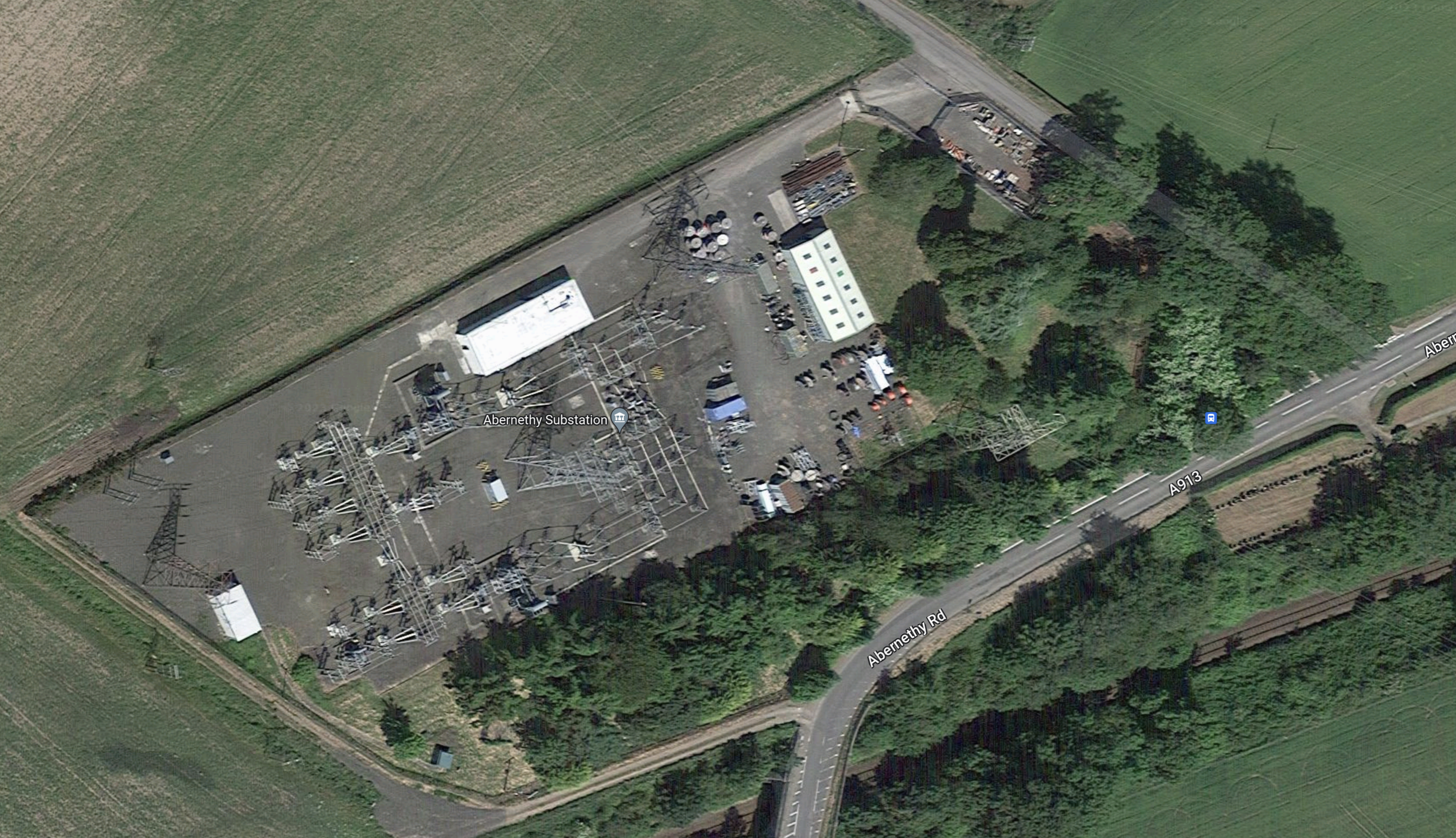
It seems a site with enough space for a 65 MW/130 MWh battery.
But is that a railway running past the site in the South-East corner of the map?
Yes! It is the single-track unelectrified railway that is used by trains to go between Edinburgh and Perth.
- There are stations at both ends of the single-track section at Ladybank and Perth.
- Abernethy substation looks like it is about halfway between the two end stations.
This page on Scotland’s Railway is entitled Fife Electrification and lists these four phases.
- Haymarket and Dalmeny
- Kinghorn and Thornton North
- Thornton and Lochgelly
- Thorton and Ladybank
The page also says that the electrification will support BEMUs (Battery Electric Multiple Units)
I feel that the electrification to Ladybank and Centrica’s battery could be linked.
- If the electrification was extended a few miles to Abernethy substation, this would surely be a reliable way to power the electrification.
- It would also be ideally placed, if Perth and Ladybank were to be electrified.
- The new battery would surely smooth out any deviations in the power supply.
I certainly don’t expect that Centrica will object to a new customer.
Electrification Between Edinburgh And Ladybank
Consider.
- Edinburgh and Ladybank is 39 miles and takes a couple of minutes over an hour.
- Once, the four phases of the electrification are complete, only the 13.6 miles between Dalmeny and Kinghorn, will be without electrification.
- I doubt that Dalmeny and Kinghorn will ever be electrified, as it includes the Forth Rail Bridge.
- Dalmeny and Kinghorn is 13.6 miles and takes around twenty-four minutes.
It looks like the BEMUs will be under wires for 25.4 miles and nearly forty minutes, which will be more than enough to charge the trains.
Edinburgh And Aberdeen
In Thoughts On Batteries On A Hitachi Intercity Tri-Mode Battery Train, I said this about services between Edinburgh and Aberdeen.
Consider.
-
- The gap in the electrification is 130 miles between Edinburgh Haymarket and Aberdeen.
- There could be an intermediate charging station at Dundee.
- Charging would be needed at Aberdeen.
I think Hitachi could design a train for this route.
The 25.4 miles of new Fife electrification between Haymarket and Ladybank will reduce gap in the electrification to 105 miles and ensure trains leaving Ladybank for Aberdeen had a full battery.
Discover How Greater Brighton Is Championing The Transition To Hydrogen
The title of this post, is the same as that of this news item from Brighton & Hove Council.
This is the introduction to the news item.
Local experts will present the strengths and opportunities for developing the hydrogen economy in the Sussex area at an online launch on 11 July.
Register for the online launch of the Hydrogen Strategy
Developed by local company Ricardo, on behalf of Hydrogen Sussex, the Greater Brighton Hydrogen Strategy shows that with the right focus, collaboration and action, the region has real potential to stand out within the UK hydrogen landscape and gain economic and environmental benefits.
Brighton & Hove Council seem to be taking a sensible approach, but then they do have one of the world’s most respected hydrogen companies; Ricardo, a few miles to the West.
This section outlines, how Brighton is embracing hydrogen.
Hydrogen is a fast-growing sector with the potential to enable decarbonisation, support national energy security, create green growth and improve air quality.
The Greater Brighton and wider Sussex area has already broken ground in the Hydrogen industry, with advanced engineering, education and research being very well represented. Local initiatives include:
-
- Hydrogen buses: Metrobus has just launched 15 hydrogen buses to serve the Crawley and Gatwick area, with a further 34 hydrogen buses joining their fleet over the next 18 months.
- Shoreham Port: The port is working with partners H2Green to create a Green Energy Hub, producing green hydrogen in a multi-megawatt electrolysis plant – initially for Shoreham Port, and then supplying green hydrogen across the region.
- Maritime sector: Sussex’s engineering companies are at the forefront of hydrogen decarbonisation in the maritime sector. Bramble Energy, Cox Marine, Ceres Power and Ricardo are just some of the local companies which have received Government funding to tackle marine decarbonisation.
- Sussex and Brighton universities: The two universities in the area have PHD studies on innovations in the sector, with Brighton University partnering with companies to win government research funding.
- Worthing Crematorium: Could become the first in the world to trial a switch to 100% hydrogen. If testing is successful with cremator manufacturer DFW Europe, hydrogen technology will be brought over to Worthing Crematorium as early as spring 2024.
The region is already home to several hydrogen technology companies and has a strong capacity for innovation which could be developed to expand its engineering excellence.
That list looks fairly comprehensive.
Conclusion
Other towns, cities and regions in the UK, should look at what Brighton is doing, with respect to hydrogen.
Eltham Station – 6th July 2023
I’d never used Eltham station until yesterday. But as I’d documented half of bus route 132 for Exploring London Bus Route 132, it seemed a good place to start following the second part.
I took these pictures as I passed through.







The station is an unusual design, which is summed up, in this paragraph from the stations, Wikipedia entry.
Both stations were closed and replaced by the current station which was opened by British Rail on 17 March 1985 when a new section of the A2, the Rochester Way Relief Road, was opened. A bus station that was built on a raft above the A2 was opened at the same time.
This Google Map shows the layout of the station.
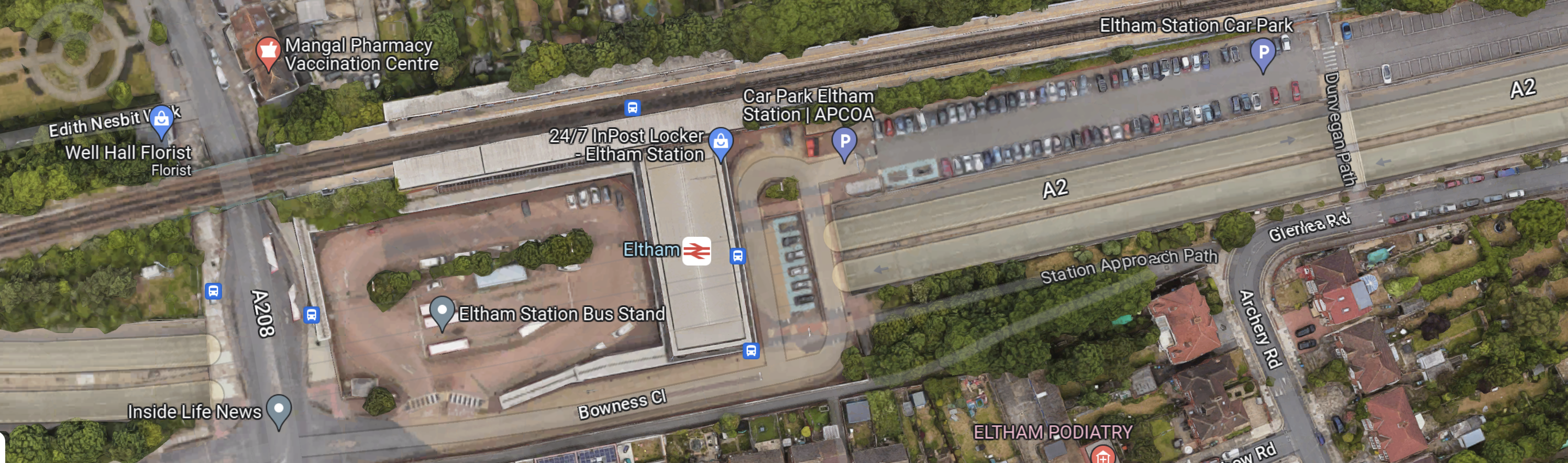
Note.
- The station is step-free using ramps.
- There are no lifts, but I suspect they could be easily added.
- On my visit yesterday, I hadn’t realised that there was a dual-carriageway road underneath the station.
- It is a comprehensive interchange between trains and buses.
For the 1980s, it is an excellent example of a station built to modern principles.
The underlying principle of this station could be used to create transport interchanges where railways, major rods and busy bus corridors intersect.
Denmark Exploring Multiple Platforms As Alternative To Building Artificial Island
The title of this post, is the same as that of this article on offshoreWIND.biz.
This is the sub-heading.
After concluding that the current concept of its North Sea Energy Island would be too expensive for the State, the Danish government, the transmission system operator (TSO) Energinet, and other relevant agencies are now looking into the concept for the island to be established on several large platforms.
I feel this could be a sensible decision, as it would fit well with a modular approach to the building of offshore wind farms.
Suppose, the floating turbines used by a company like Ørsted were all similar. This would surely simplify management of their portfolio of wind farms.
If it works for floating wind turbines, surely, it would work for substations, electrolysers and other offshore hardware.
Conclusion
Artificial energy islands may seem an impressive way to go, but I suspect that the modular approach using standard components, that either sit on the sea bed or float may be a more affordable and faster way to build offshore wind farms.

