Exagen Given Green light for new 500MW / 1GWh Battery Storage Project In Leicestershire
The title of this post is the same as that of this article on PV Magazine.
This is the outline of the project, which will be called the Normanton Energy Reserve.
The new 500MW / 1GWh battery site will be capable of powering 235,000 homes for two hours, equivalent to 80% of the homes in Leicestershire.
Approximately 45% of the 19-acre site will be set aside to improve biodiversity by extending Normanton Millennium Wood and creating wildflower meadows. The project will deliver more than 25% biodiversity net gain.
Exagen will establish a circa £4M community fund to spend on improvements in the local area, with residents consulted on how the fund is used.
Note.
- A 500MW / 1GWh battery is not small.
- The size probably makes it a good backup for Leicestershire.
- Nineteen acres is a 277 metre square.
- Any biodiversity net gain is worthwhile.
- A £4M community fund is not to be sneezed at.
It all sounds very good.
Normanton Wood has a web site, where this is said on the home page.
Normanton Wood is one of The Woodland Trust’s ‘Woods on Your Doorstep’ woodlands created to commemorate the Millennium. It lies near Earl Shilton Leicestershire and was planted by members of the local community.
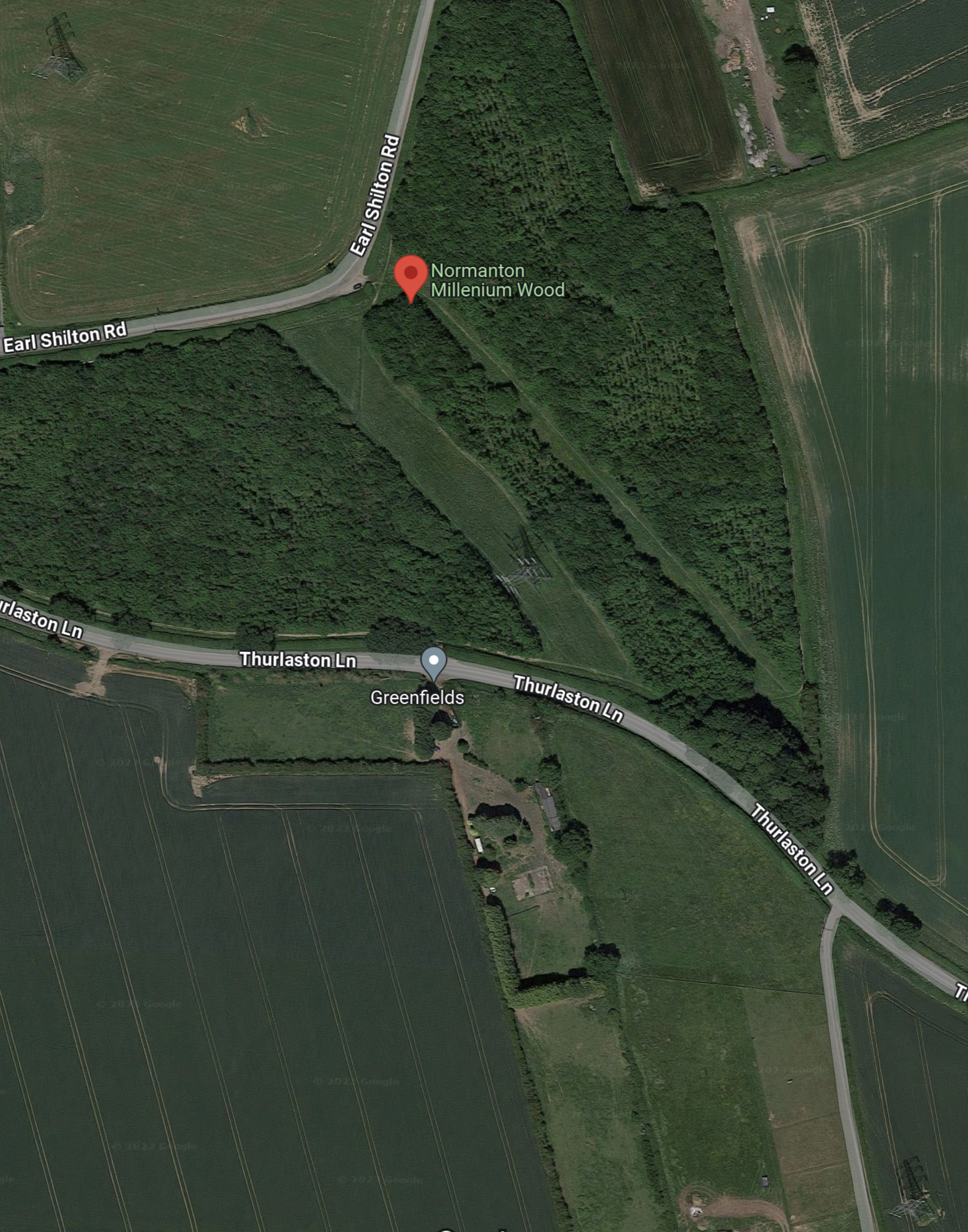
This Google map shows the wood.
Note.
- The red arrow indicates Normanton Millennium Wood.
- I suspect that cleared space in the woodland leading South-East from the red arrow is about 300 metres long and 15 metres wide, which is about 1.1 acres
- As Normanton Millennium Wood is 16.75 acres, I suspect it includes all the woodland to the East of the red arrow, up to the cultivated farmland.
- If you look carefully, you can see a large electricity pylon in the wider cleared area, to the South of the red arrow.
- When I created this map, I clipped it so that the next pylons to the North-West and South-East were in the respective corners of the map.
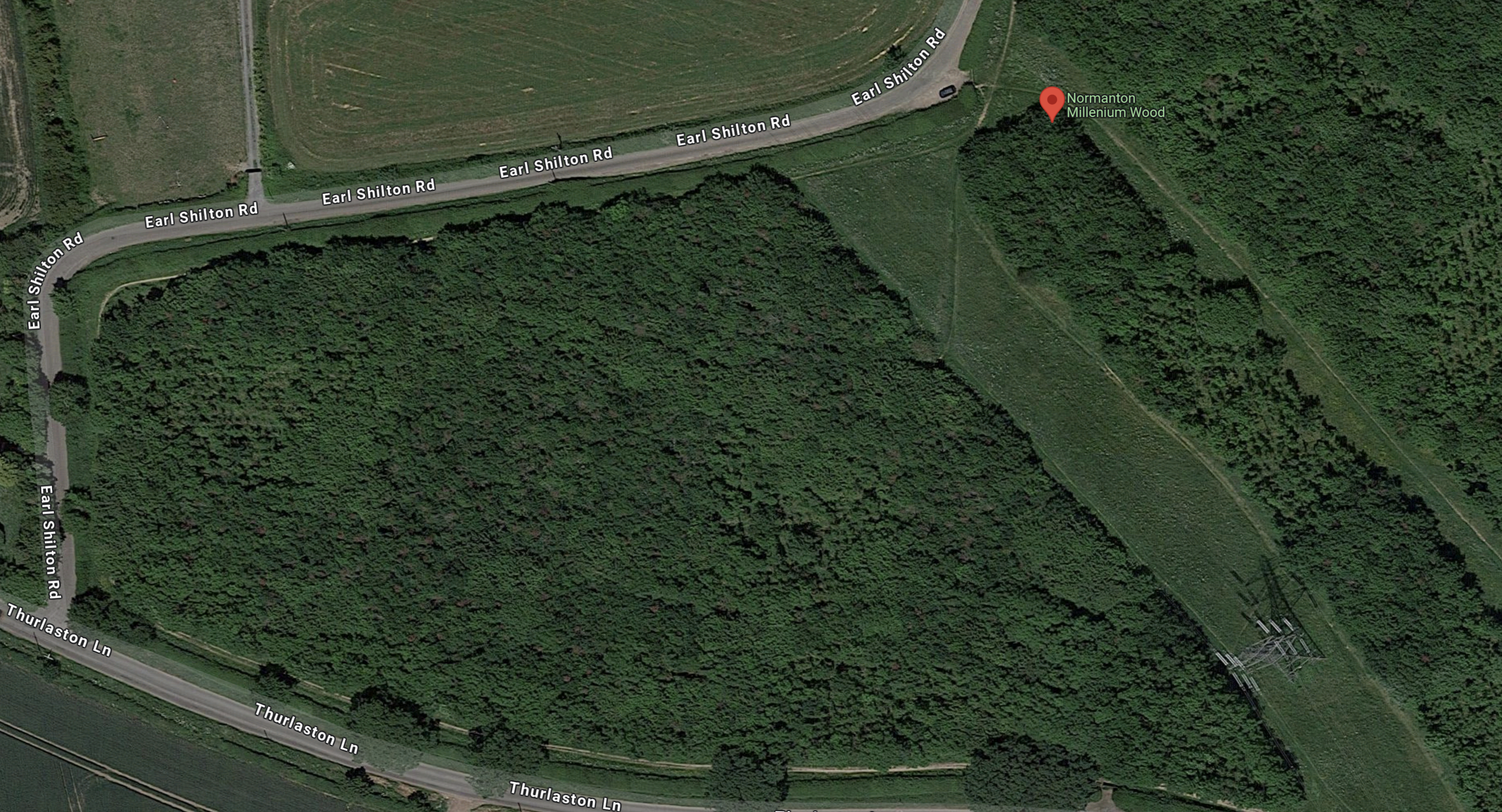
This second map shows the land to the West of the red arrow, which is enclosed by the roads.
Note.
- As before the red arrow indicates Normanton Millennium Wood.
- The electricity pylon is clearly visible on the cleared strip.
- The land to the East of the cleared strip looks like its been planted with trees in the last decade or so.
- The land to the West of the cleared strip looks more like scrub, that has grown up after years of neglect.
- I estimate that the area of the cleared strip and the scrub, is around nineteen acres.
- This news story from Exagen, is entitled Woodland Planting At Normanton Energy Reserve – Becca Leake is a must-read as it outlines how woodland will be planted at the site.
As there is no local substation, it looks to me, that a new substation will be built close to the electricity pylon, with the battery to its West.
Conclusion
It seems a good design for a large battery site, which will be shielded from neighbours by a large area of woodland.
I am also sure, that this battery and the one talked about in New Octopus Energy Makes First Investment To Develop UK’s Largest Battery, are the same battery.
All the numbers in both articles are identical.
Slow Tourism Train Operator Launches First Service
Tyhe title of this post, is the same as that of this article on Railway Gazette.
These are the first two paragraphs.
FS Group’s recently formed tourist train business FS Treni Turistici Italiani has launched its first service.
Branded Espresso Cadore, the overnight service between Roma Termini and Calalzo-Pieve di Cadore-Cortina will run every Friday night until mid-February. On arrival, a connecting bus takes passengers to Cortina d’Ampezzo in 45 min. The return train departs on Sundays, arriving at Roma Termini on Monday morning.
It is surely an interesting concept and I believe it could work on several routes in the UK.
- Settle and Carlisle would be an obvious route.
- Cumbrian Coast Line.
- Bristol and Oxford, which I wrote about in Leisure Market Boom? GWR’s Vision For Direct Bristol-Oxford Services.
There must also be a couple of routes in Scotland and Wales.
As the three routes, I named are electrified at both ends, there is a possibility that they could be run by quiet battery-electric trains.
World’s First Floating Wind Farm To Undergo First Major Maintenance Campaign, Turbines To Be Towed To Norwegian Port
The title of this post, is the same as that of this article on offshoreWIND.biz.
This is the sub-heading.
The world’s first commercial-scale floating wind farm, the 30 MW Hywind Scotland, officially entered the operations and maintenance (O&M) phase in October 2017. After a little over six years of operation, the wind farm’s Siemens Gamesa wind turbines are now due for some major maintenance work.
And this is the first paragraph.
While offshore wind farms undergo turbine maintenance work more than once during their lifespans and tasks such as major component exchange are nothing uncommon, this is the first time a campaign of this kind will be done on a floating farm.
Hywind Scotland has a web site, where this is said on the home page.
The world’s first floating wind farm, the 30 MW Hywind Scotland pilot park, has been in operation since 2017, demonstrating the feasibility of floating wind farms that could be ten times larger.
Equinor and partner Masdar invested NOK 2 billion to realise Hywind Scotland, achieving a 60-70% cost reduction compared with the Hywind Demo project in Norway. Hywind Scotland started producing electricity in October 2017.
Each year since Hywind Scotland started production the floating wind farm has achieved the highest average capacity factor of all UK offshore windfarms, proving the potential of floating offshore wind farms.
This news item from Equinor is entitled Equinor Marks 5 Years Of Operations At World’s First Floating Wind Farm, says this about the capacity factor of Hywind Scotland.
Hywind Scotland, located off the coast of Peterhead, Scotland, is the world’s first floating offshore wind farm and the world’s best-performing offshore wind farm, achieving a capacity factor of 54% over its five years of operations. Importantly, Hywind Scotland has run to high safety standards, marking five years of no loss time injuries during its operation.
Any capacity factor over 50 % is excellent and is to be welcomed.
Maintaining A Floating Wind Farm
One of the supposed advantages of floating wind farms, is that the turbines can be towed into port for maintenance.
This first major maintenance of a floating wind farm, will test that theory and hopefully provide some spectacular pictures.
 The Anonymous Widower