Mersey Ferry To Be Decommissioned After 67 Years
The title of this post is the same as that of this article on the BBC.
This is the sub-heading.
A “much-loved” ferry that has crossed the River Mersey for 67 years is being decommissioned.
These three paragraphs add more details.
Mersey Ferries confirmed The Royal Iris of the Mersey is to be replaced by the new £26m Royal Daffodil later this year.
From its launch in Devon in 1959 until a major refurbishment in 2001, The Royal Iris was named Mountwood. She was renamed on her return to service in 2002, following a major revamp.
Mersey Ferries said it was considering how best to mark her farewell “with further details to be confirmed in due course”.
When I was a student at Liverpool University, it was named Mountwood and I used it regularly.
This is a video of the ferry, that I found on Youtube.
I have a thought.
Is There Any Other Public Transport, That I Have Used Recently, That Was Built In 1957?
I can’t think of anything, except the occasional Routemaster bus.
UK To Launch Next CfD Allocation Round In July
The title of this post, is the same as that of this article on offshoreWIND.biz.
This is the sub-heading.
The UK government has announced that the next Contracts for Difference (CfD) allocation round will open in July 2026.
Contracts for Difference Allocation Round 7 did well and according to Google AI raised these contracts.
Contracts for Difference (CfD) Allocation Round 7 (AR7) results, announced in January 2026, secured a record 8.4 GW of offshore wind capacity, enough to power 12 million homes. The auction awarded contracts to 6.865 GW of fixed-bottom offshore wind and 192.5 MW of floating wind, with strike prices around £91/MWh (2024 prices).
Key Results of AR7:
Capacity Secured: Over 8.4 GW (8,437.5 MW) of offshore wind, with 6,090 MW in England, 1,380 MW in Scotland, and 775 MW in Wales.
Key Winners: RWE secured nearly 6.9 GW across four projects, including Dogger Bank South and Norfolk Vanguard; SSE Renewables secured 1,380 MW for Berwick Bank Phase B; and floating wind projects included Pentland and Erebus.
Strike Prices: Fixed-bottom offshore wind cleared at £91.20/MWh (£89.49/MWh in Scotland), while floating offshore wind cleared at £216.49/MWh.
Investment & Jobs: The projects represent over £22 billion in private investment and support approximately 7,000 jobs.
Timeline: The projects are expected to start delivering power from 2028 onwards.
Out of curiosity, I asked Google AI, “How Many GWs Are Expected To Be Signed Up In The UK’s CfD Round 8” and received this answer.
Allocation Round 8 (AR8) of the UK’s Contracts for Difference (CfD) scheme is expected to launch in July 2026. While specific, finalized GW targets for the winning bids have not yet been announced, the government is adapting the auction to support increasingly large projects, including potential floating offshore wind farms of 1GW+.
Following the record-breaking AR7, which secured 8.4 GW of offshore wind capacity in January 2026, AR8 is expected to focus on continuing this momentum to meet the UK’s “Clean Power 2030” objectives.
Key context regarding expected AR8 capacity includes:
Growing Project Scale: The AR8 consultation indicates that upcoming floating offshore wind projects are likely to be much larger (potentially 1GW+) than previously expected, prompting changes to the scheme to support this scale.
Targeted Procurement: Industry sources previously indicated that the combination of AR7 and AR8 was expected to secure significant capacity to meet 2030 goals, with over 20 GW of offshore wind previously identified as eligible for upcoming rounds.
Supply Chain Focus: The government has issued, or is planning, Supply Chain Plan requirements for solar projects of 300 megawatts or more and for onshore wind, indicating high volumes are anticipated in these sectors.
The application window for AR8’s Clean Industry Bonus is currently planned for May 2026, with the main auction following in July 2026.
Conclusion
It doesn’t really indicate a figure for AR8, but does indicate that AR7 and AR8 together have a joint target of over 20 GW.
- I can do a small calculation.
- AR7 secured 8.4 GW of offshore wind capacity in January 2026.
- As AR7+AR8 are expected to secure 20 GW before 2030, that means AR8 will secure 11.6 GW.
So this means that AR8 could be 38 % bigger than AR7.
Vestas Unveils Plans For V236-15.0 MW Nacelle Factory In Scotland
The title of this post, is the same as that of this article on offshoreWIND.biz.
This is the sub-heading.
Vestas plans to build a nacelle and hub assembly facility in Scotland to support offshore wind projects in the UK and across Europe.
These four paragraphs give what looks to be a full outline of a more or less comprehensive plan.
The proposed factory would require a capital investment of more than EUR 250 million and is planned to manufacture nacelles and hubs for the company’s V236-15.0 MW offshore wind turbine. The new facility is expected to create up to 500 direct jobs, with additional employment across the supply chain.
According to Vestas, the plan to set up the factory follows the results of the Contracts for Difference Allocation Round 7 (AR7) in January 2026, the company’s growing offshore wind order book in the UK, and strategic discussions with the UK and Scottish governments on the next steps to develop and co-invest in the facility.
The plan also includes the potential co-location of suppliers producing other major turbine components, as part of a broader manufacturing setup.
The final investment decision (FID) on the new factory will depend on Vestas securing sufficient UK-based orders for the AR7 projects and those from the upcoming AR8. Subject to the timing of those results and the planning process, the facility could begin production by 2029 or 2030, Vestas said on 25 March.
- V236-15.0 turbines are 15 MW turbines, for which Vestas have 256 orders in the UK for Inchcape, Norfolk Vanguard East and Norfolk Vanguard West.
- In addition to new wind farms, will these large turbines be used for refitting to older wind farms?
- If other manufacturers or components could be involved, this would surely be sensible.
The picture in the original article shows the large size of these nacelles, which would suggest a site with good access to water might be good to ease transport.
Did The Help For Steel, Six Days Ago Help?
On the 19th March, I wrote UK Steel Industry Backed By Major New Trade Measure And Strategy. Did this help for steel to formulate Vestas’s plans? I wouldn’t be surprised, if the steel can be taken to the site Vesta chooses by rail or water.
We Live Three Minutes From The Station — And Can’t Catch A Train
The title of this post is the same as that of this article on The Times.
This is the sub-heading.
A line connecting Oxford to Milton Keynes was finished 16 months ago. So why does it remain useless to families who moved to be next to it?
These four paragraphs add more details.
Nearly two years after moving to Winslow for its rail connections, Rachael Lee is still waiting to catch her first train.
Winslow station, a three-minute walk from Lee’s house, should have opened last year, connecting locals to Oxford, Milton Keynes and beyond. But as the site remains plagued by delays, the only people to pass through its doors are the security guards paid to keep watch.
“All the lights are on and there’s ticket machines that are on,” said Lee, 36, a marketing professional who moved to the Buckinghamshire town with her family in June 2024. “Who’s paying for all of that? It just feels like it takes the mickey when you drive and walk past it.”
Construction issues, union disputes about onboard guards and a lack of ready trains have all delayed the opening of the station, which was built for East West Rail (EWR) in a £6 billion government-funded project to reconnect Oxford and Cambridge by train for the first time since 1967. It is one of the country’s biggest rail projects, begun in 2014, and is expected to bring tens of thousands of jobs and billions of pounds to the regional economy.
Harold Wilson would have solved this problem with beer and sandwiches at No. 10.
Olympia Partners With TfL To Boost Peak-Time Mildmay Line Services
The title of this post, is the same as that as this press release from Transport for London.
These two bullet points act as sub-headings.
- Olympia, London’s newest entertainment destination, is funding 16 extra peak‑time services per weekday, providing increased capacity to support rising demand on this part of the Mildmay line as well as reducing customer journey times
- The additional shuttle services will depart from Clapham Junction Platform 17, with three services in the morning peak and five in the evening peak
These two paragraphs add more details.
Customers will benefit from easier access to the transformed Olympia, set to become London’s newest destination for entertainment, culture and hospitality, as well as Westfield London and improved links to other TfL services
Customers will benefit from more frequent services between Clapham Junction and Shepherd’s Bush from Monday 18 May, as Transport for London (TfL) introduces additional peak weekday shuttle services on the Mildmay line.
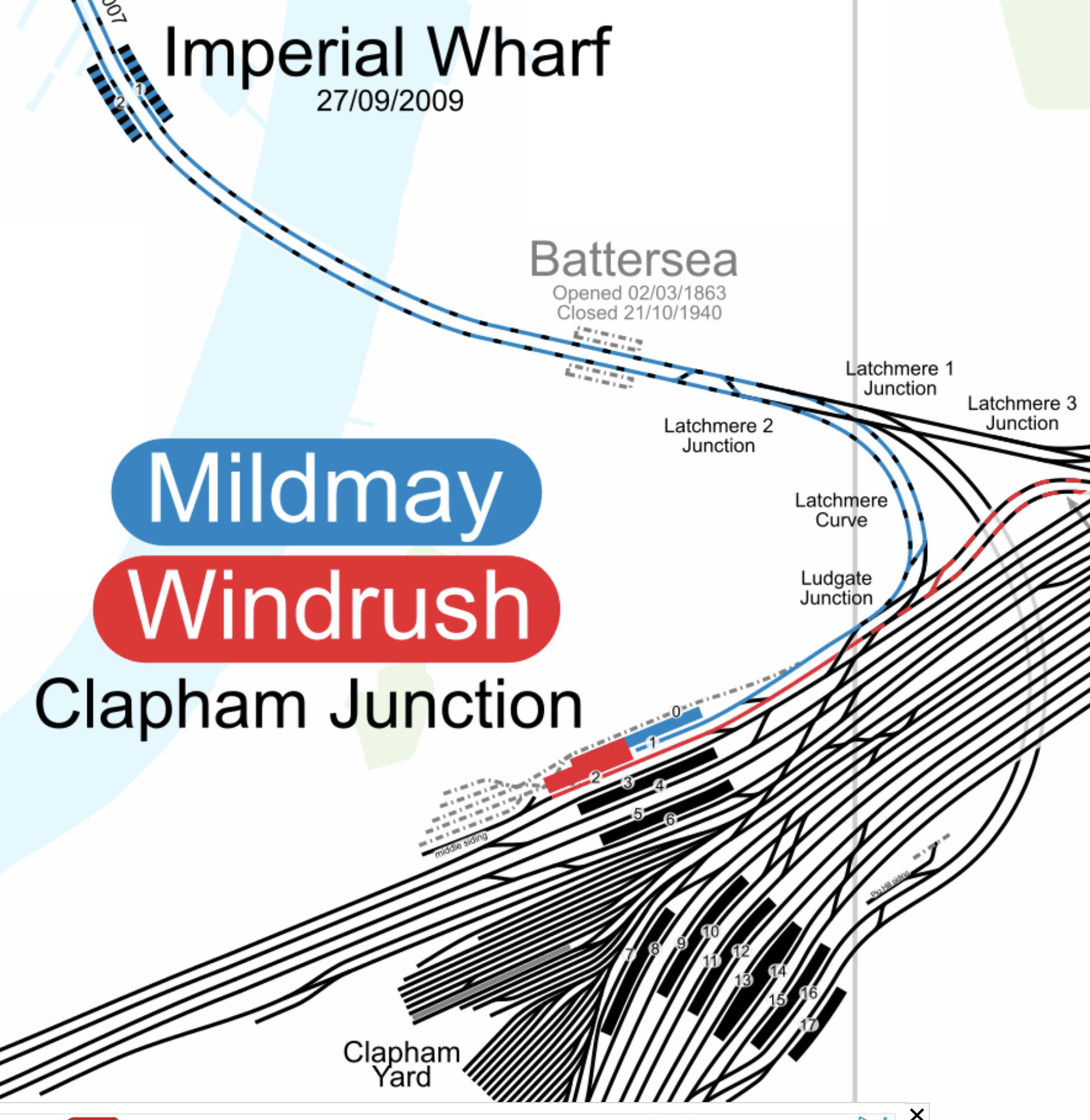
This map from CartoMetro shows how trains will get to Platform 17 at Clapham Junction.
Note.
- Mildmay services from Stratford on the North and West London Lines are shown in blue and terminate in Platform 1.
- Windrush services from Dalston Junction on the South London Line are shown in red and terminate in Platform 2.
- Platform 17 is the Southernmost of the platforms at Clapham Junction.
The new services will take the same route as Southern’s Watford Junction and East Croydon service through Clapham Junction.
- Trains will go through Imperial Wharf station and Latchmere 2 Junction.
- They will then take Latchmere 1 Junction and pass under the lines to get to Platform 17.
- There is a crossover between the two tracks, so that trains can get on the left-hand track.
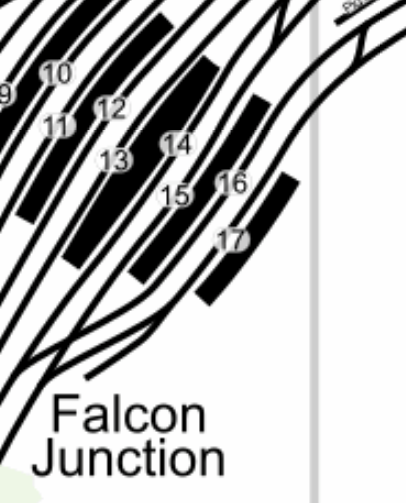
This second CartoMetro map shows Platforms 16 and 17 to a larger scale.
Note.
- Platform 17 doesn’t look very long, but it is 172 metres.
- Five-car Class 378 trains are 101.35 metres, so should fit.
- The crossover, that will be used by returning shuttle trains is clearly visible in the top-right corner.
It does appear though that there will need to be no major trackwork needed for the new service.
I do have one thought.
Will Clapham Junction Station Get A Platform 0?
This was proposed in Will Clapham Junction Station Get A Platform 0?, but there is no mention of it in the press release, although Michael Volkert, who is CEO of Olympia estates does say this.
The new train services will depart from platform 17 at Clapham Junction. Existing services to Stratford will continue to operate from Platform 1. For the latest travel information customer should check TfL Go, Journey Planner on the TfL website or station departure screens.
Commuters will have to hone their ducking and diving skills.

