Is This The Problem At Bedford With The East West Railway?
The East West Railway certainly has problems at Bedford.
These two posts seem to be creating an impasse on getting the railway built and/or operational.
So I took a quick look at the rail lines in the rail around and trough Bedford, as shown in this OpenRailwayMap.

Note.
- The Midland Main Line runs down the left hand side of the map.
- Bedford station is marked by the blue arrow,
- The East Coast Main Line runs down the right hand side of the map.
- Stations on the East Coast Main Line from North to South are St. Neots, Sandy, Biggleswade and Arlesey.
- The East West Railway is planned to connect to the East Coast Main Line at a new station at Tempsford , which will be South of St. Neots.
- The original connection was to be at Sandy.
- There used to be a railway between Bedford and Sandy.
- This railway between Bedford and Sandy, was the Varsity Line and I write about its current status in Is The Varsity Line Trackbed Between Bedford And Sandy Still There? – No, is the only answer.
- In Did Beeching Recommend Closure Of The Varsity Line?, I find out that he didn’t and it was totally the fault of Labour Politicians; Barbara Castle and Tom Fraser, with perhaps some help from Harold Wilson. Were they jealous that Oxford and Cambridge had a better link than the non-existent one across the North?
Is The Varsity Line Trackbed Between Bedford And Sandy Still There?
I asked Google AI, the question in the title of this post, and received this answer.
The trackbed between Bedford and Sandy largely survives as an open, walkable alignment, but the original tracks themselves were removed decades ago.
Today, much of this section of the old Varsity Line (often referred to as the Bedford-Cambridge route) operates as National Cycle Route 51, though a few specific areas have seen modern development.
The status of the trackbed varies depending on the specific location:
:Bedford to Sandy (General): The rails and sleepers are long gone, but the formation is still clearly visible.
A large section of the trackbed between Bedford and Sandy has been repurposed as a traffic-free path for cyclists and walkers (National Cycle Route 51).
Sandy Station Area: The former Varsity Line platforms at Sandy were cleared after the line closed in 1968.
New housing has been built over parts of the route through the town, altering the original alignment.Because the original alignment was interrupted by modern housing and other developments in certain areas, the upcoming East West Rail project—which aims to re-establish a direct railway between Oxford and Cambridge—will bypass the original trackbed for the central section (Bedford to Cambridge).
The new railway is slated to follow a slightly different route.
Conclusion
Peaks And Dales Line Feasibility Study Identifies £2-£8 Billion Potential
The title of this post, is the same as that of this article on RailUK.
The first two paragraphs add some detail.
The full Feasibility Study for the proposed Peaks and Dales Line – a reinstated rail corridor linking the North West and East Midlands between Manchester and Derby, via Chinley, Buxton, Bakewell, and Matlock – has now been formally submitted to the Department for Transport for review through the Better Value Rail Working Group, comprising the DfT, Network Rail, and the Office of Rail and Road.
The submission marks a significant milestone for the project and confirms that no prohibitive technical, environmental, planning or delivery barriers have been identified at feasibility stage that would prevent the corridor progressing to the next phase of development, a Strategic Outline Business Case (SOBC).
But it is probably best to read the full report.
The full study identifies that reinstating the Peaks and Dales Line could:
- Generate £2-£8 billion in additional Gross Value Added (GVA) by 2040.
- Remove approximately 1.0-4.3 million car ‘trips’ per year from the road network (from visitor travel alone).
- Deliver carbon savings of around 15,000-60,000 tonnes of CO₂e per year.
- Provide a viable sustainable travel option for the 13-26 million people who visit the Peak District annually, around 85% of whom currently arrive by car.
- Improve access for the 3.16 million people across the connected regions who do not own or have access to a car.
- Support sustainable access to approximately 17,870 previously identified potential new homes, all located on brownfield land outside the National Park.
- Enable £447-£804 million in potential voluntary Land Value Capture contributions, reducing reliance on public funding.
These are large claims and yet more reasons to believe that Harold Wilson was one of our worst Prime Ministers, as Beeching’s most heinous crimes, were performed under his watch.
This paragraph sums up the work to be done.
The study also confirms that only around 11.5 miles of reinstated railway would be required to reconnect a corridor of nearly 50 route miles, representing a highly efficient reuse of historic rail infrastructure. Various upgrade options are being considered across the remainder of the route.
I wonder, if it might be best to go for a single-track railway, that could be upgraded to full double-track later.
This image from a Stadler press release shows their prototype RS ZERO.
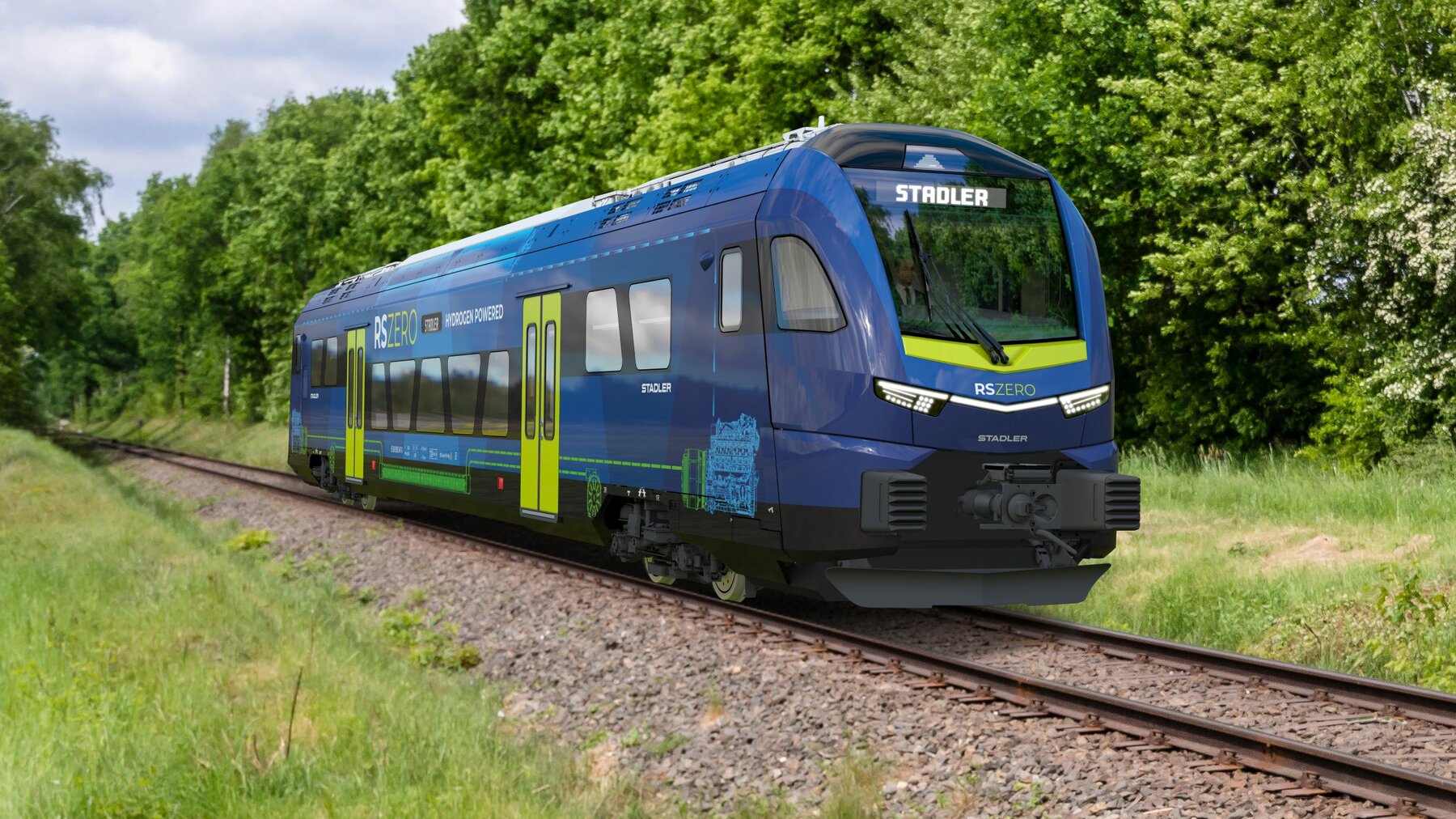
As these trains can run on hydrogen, this could create a zero-carbon railway through the Peaks and Dales.
Using this approach could see the railway running before the next election.
We Live Three Minutes From The Station — And Can’t Catch A Train
The title of this post is the same as that of this article on The Times.
This is the sub-heading.
A line connecting Oxford to Milton Keynes was finished 16 months ago. So why does it remain useless to families who moved to be next to it?
These four paragraphs add more details.
Nearly two years after moving to Winslow for its rail connections, Rachael Lee is still waiting to catch her first train.
Winslow station, a three-minute walk from Lee’s house, should have opened last year, connecting locals to Oxford, Milton Keynes and beyond. But as the site remains plagued by delays, the only people to pass through its doors are the security guards paid to keep watch.
“All the lights are on and there’s ticket machines that are on,” said Lee, 36, a marketing professional who moved to the Buckinghamshire town with her family in June 2024. “Who’s paying for all of that? It just feels like it takes the mickey when you drive and walk past it.”
Construction issues, union disputes about onboard guards and a lack of ready trains have all delayed the opening of the station, which was built for East West Rail (EWR) in a £6 billion government-funded project to reconnect Oxford and Cambridge by train for the first time since 1967. It is one of the country’s biggest rail projects, begun in 2014, and is expected to bring tens of thousands of jobs and billions of pounds to the regional economy.
Harold Wilson would have solved this problem with beer and sandwiches at No. 10.
50,000 Journeys Made On Northumberland Line In First Month
The title of this post is the same as that of this press release on the Northumberland County County.
These are the first few paragraphs of the press release.
Passengers have made more than 50,000 journeys on Northumberland Line services in the first month after the opening.
The line reopened to passengers – for the first time in 60 years – in December, thanks to a £298.5m project involving the Department for Transport, Network Rail, Northumberland County Council and Northern.
Services now call at Newcastle, Manors, Seaton Delaval and Ashington, with a journey along the entire 18-mile route taking around 35 minutes and a single ticket costing no more than £3.
Tickets for more than 50,000 journeys have been bought since the opening and Saturdays have been particularly popular.
That includes more than 3,500 journeys made on the opening day (Sunday, 15 December), when the platform in Ashington was packed with people waiting to catch a glimpse of the first service.
That is what I would call a good start.
But after I wrote Dartmoor Line Passes 250,000 Journeys On Its First Anniversary, As Rail Minister Visits To Mark Official Opening Of The Station Building, a year after that line opened, I don’t think 50,000 for the Northumberland line is a high figure.
At 50,000 in the first month with only four stations, they must be on course for well over half a million passengers, when the line is fully open.
Figures like these show that enthusiasts for rail closures like Richard Beeching and Harold Wilson were so very wrong.
We need several reopened and new railway lines like this!
Dr. David Owen And The NHS Infected Blood Scandal
I am writing this post, mainly using Dr. David Owen’s Wikipedia entry.
This paragraph describes Dr. Owen’s early days as a minister in Harold Wilson’s first government and the early days of Harold Wilson’s second government
From 1968 to 1970, Owen served as Parliamentary Under Secretary of State for the Navy in Harold Wilson’s first government. After Labour’s defeat in the 1970 general election, he became the party’s Junior Defence Spokesman until 1972 when he resigned with Roy Jenkins over Labour’s opposition to the European Community. On Labour’s return to government in March 1974, he became Parliamentary Under-Secretary for Health before being promoted to Minister of State for Health in July 1974.
There is also this paragraph describing his involvement as Minister of State for Health in the NHS Infected Blood Scandal.
As Minister of State for Health he encouraged Britain to become “self-sufficient” in blood products such as Factor VIII, a recommendation also promoted by the World Health Organisation. This was principally due to the risk of Hepatitis infection from high-risk blood donors overseas who were often paid and from “skid-row” locations. David Owen has been outspoken that his policy of “Self-Sufficiency” was not put into place (although he was, himself, Minister of Health) and gave rise to the Tainted Blood Scandal which saw 5,000 British Haemophiliacs infected with Hepatitis C, 1,200 of those were also infected with HIV. It was later described in the House of Lords as “the worst treatment disaster in the history of the National Health Service”.
So why did Dr. Owen’s and the World Health Organisation’s view of making the UK “self-sufficient” in blood products such as Factor VIII not prevail?
Did Sir Brian Langstaff and his team go through minutes of cabinet meetings, when Dr. David Owen was Minister of State for Health?
Did Harold Wilson or the Chancellor; Denis Healey overrule David Owen’s view, as they needed what little money we had for other purposes?
I must admit, that if I had been in Dr. Owen’s position in 1974 and the Government were proposing to something against, my engineering experience, I would have resigned. Note that Dr. Owen did resign in 1972, over Labour’s opposition to the European Community.
If any doctors are reading this, who were qualified at the time, I’d like to hear their views.
Conclusion
One way to ascertain the truth, would be to charge Dr. Owen with something serious and led the Law decide.
Airport Of The Future
I am fairly sure, that in ten years, there will be a lot of zero-carbon aircraft flying short haul routes. I have been particularly impressed by some of the ideas from Airbus, although Boeing seem to be very quiet on the subject. Perhaps it’s the difference between visionaries and engineers, and accountants.
But you rarely read anything about how airports are preparing for even a low-carbon future.
- Some long-stay car-parks could be made electric vehicles only, so they would become massive grid batteries, whilst owners are travelling.
- Airside vehicles can all be made zero-carbon.
- Sustainable aviation fuel (SAF) shouldn’t be a problem, as it would be handled like jet fuel.
- Do airports have a large enough grid connection for all the electrification of vehicles and some planes?
- Do airports have a plan for hydrogen?
The last two points, probably mean we should have built Maplin.
- It could have a cable and a hydrogen pipeline from wind farms and co-located hydrogen electrolysers in the Thames Estuary.
- The Elizabeth Line or a new line could easily be extended or built to the airport, to give a 125 mph connection.
But that enemy of the planet; Harold Wilson cancelled it.
Mersey Tidal Project And Where It Is Up To Now
The title of this post, is the same as that of this article on the Liverpool Echo.
This is the sub-heading.
With a major agreement on the project reached this week, we take a look at what it all means.
There is a section, which is called So What Is A Mersey Tidal Project?, where this is said.
The idea is to build a huge damn structure in the River Mersey with turbines that can harness energy from the tides of the river and convert it into clean power. The city region combined authority is hopeful that this could power up to 1 million homes and create thousands of local jobs
The city region has one of the country’s largest tidal ranges so it is seen as a perfect opportunity to explore a tidal project here. It is hoped such a project could generate a ‘plentiful, reliable supply of clean, green energy for generations to come.
In the 1970s, I did a small project management consultancy at Frederick Snow and Partners in London. They showed me their ambitious plans for a Severn Barrage, which was a tidal scheme, that would have created a tenth of our electricity and would have cost around a billion pounds.
But Harold Wilson, who was Prime Minister at the time, felt that the money would be better spent on building massive coal-fired power stations, rather than building a clean power station, that would last centuries.
A second section is called What Happened This Week?, where this is said.
This week the Liverpool City Region signed an agreement with the company behind the current world’s current largest tidal project with a view to learning lessons.
The Sihwa Lake tidal range power plant, which is operated by Korea Water Resources Corporation, generates 552GWh of clean, green energy every year, replacing the equivalent of 862,000 barrels of oil a year.
Jeong Kyeong Yun, Vice President of Korea Water Resources Corporation, known as K-water, was in Liverpool this week to sign an historic Memorandum of Agreement with Mayor Rotheram. It is hoped the agreement will pave the way for close co-operation between the two tidal power projects, through reciprocal visits and information sharing.
Note.
- The Liverpool Echo is still making spelling mistakes, like damn instead of dam. In the 1960s, Fritz Spiegl used to give us all pleasure by writing about them.
- 552 GWh would keep the UK powered up for nearly a month.
- The Sihwa Lake Tidal Power Station has a comprehensive Wikipedia entry.
- The Sihwa dam has a road over the top.
- Unlike Frederick Snow’s scheme for the Severn, Sihwa only generates power, on the incoming tide. But it does generate 254 MW.
As ever, Liverpool is thinking big and getting the experience from those, who know what they are doing.
This last paragraph, gives the thoughts of the Mayor.
Mayor Rotheram said that with the right support, he hopes the project could be generating clean, renewable power by the end of this decade.
I would go along with that.
The Mersey Tidal Project And The Mersey Gateway Bridge
Frederick Snow’s plans for the Severn could have incorporated a new road and rail crossing of the estuary.
This Google Map shows the the Sihwa Lake Tidal power station.
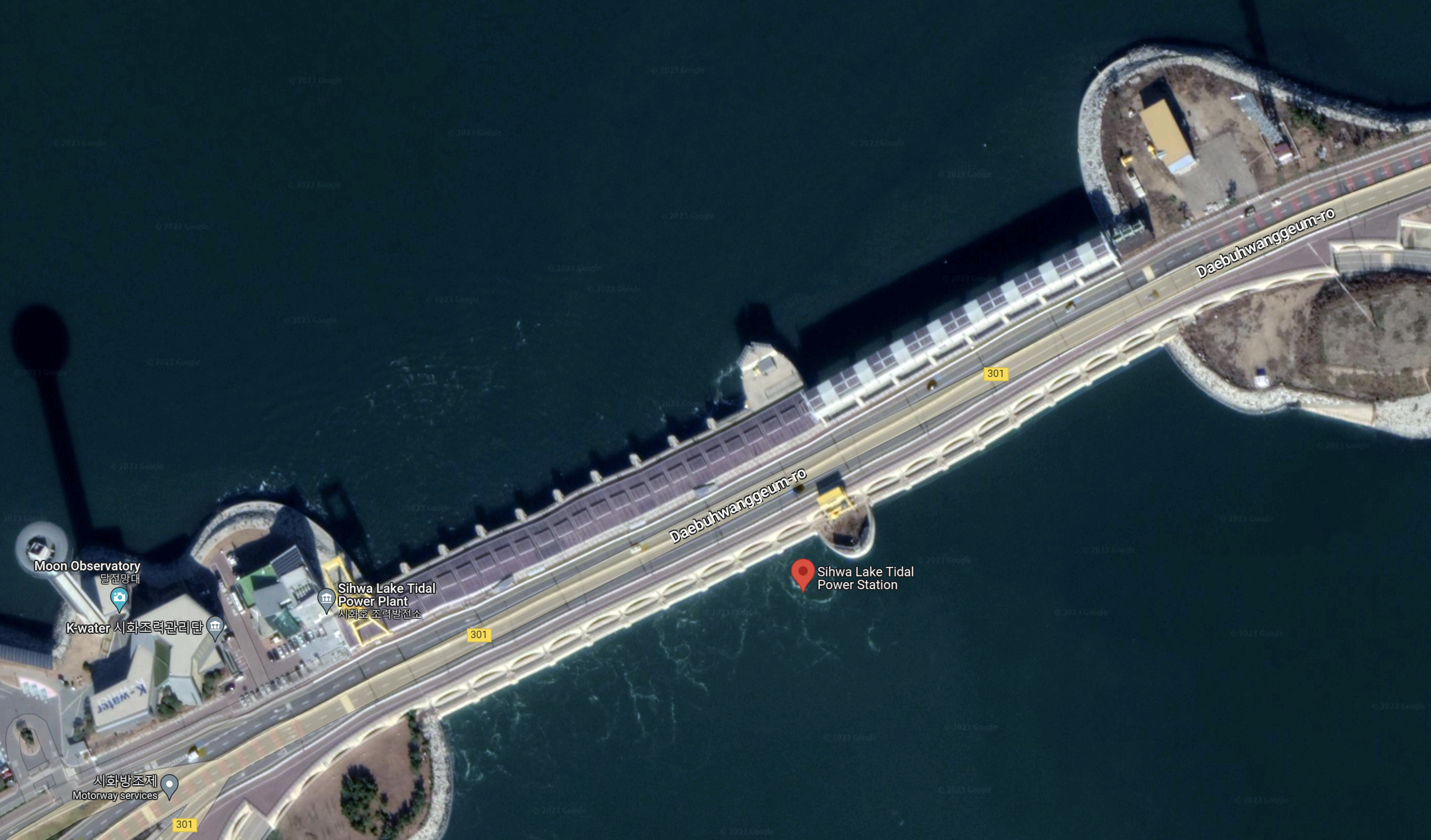
The road over the dam is clearly visible.
I took these pictures of the Mersey Estuary as I came back from Liverpool on Tuesday.





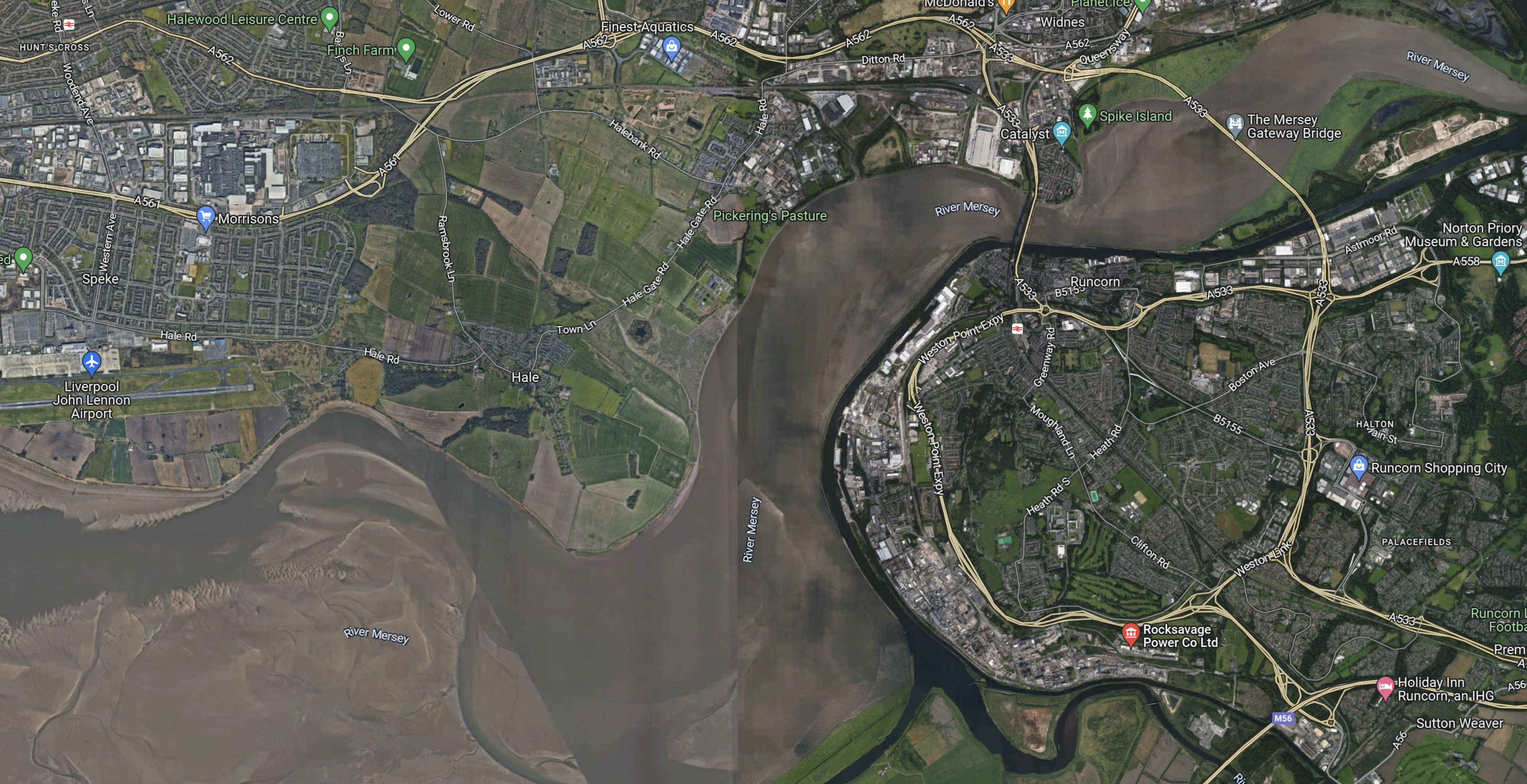
This Google Map shows the Mersey Estuary.
Note.
- The River Mersey flowing from the North-East corner of the map to the South-West corner.
- On the South Bank of the Mersey, there is the deep-water channel of the Manchester Ship Canal.
- The bridge in the North-East corner of the map is the Mersey Gateway Bridge.
- Then there is the pair of bridges at Runcorn; the Silver Jubilee Bridge and the Runcorn Railway Bridge.
I am fairly sure, that the Mersey Tidal Project would be built downstream of the pair of bridges at Runcorn.
This Google Map shows the Mersey Estuary from the Runcorn Bridges to the mouth of the Manchester Ship Canal.

Note.
- The Mersey Gateway Bridge and the two Runcorn bridges are in the North-East corner.
- The route of the Manchester Ship Canal is clearly visible.
- Liverpool John Lennon Airport is on the North Bank of the Mersey.
- The M56 and M53 Motorways run East-West across the map to the South of the River.
This map leads me to the conclusion, that a tidal barrage with a road on top could link Liverpool to the M56.
I have some thoughts.
Rail Access To Liverpool
There is an electrified railway between Liverpool and Ellesmere Port.
- The railway can be picked out running across the bottom of the map.
- In Liverpool’s Vision For Rail, I talked about Liverpool City Region’s plan to expand this service to Helsby, Frodsham and Runcorn East.
- Helsby and Frodsham are shown on the map.
I wouldn’t be surprised to see a new Park-and-Ride station, where the M56 and the railway cross.
Ship Access To Manchester And Other Ports
Barrages usually have to provide access for ships to pass through to any ports behind the barrage.
But the Mersey Tidal Project already has that access. – It was built in the 1893 and is called the Manchester Ship Canal.
There is probably strong protection between the Mersey and the Canal between the mouth of the Canal and Runcorn, which may impact positively on the costs of the barrage.
The Simple Barrage
Sihwa Lake Tidal power station is a simple barrage with a bridge over the power station in the middle.
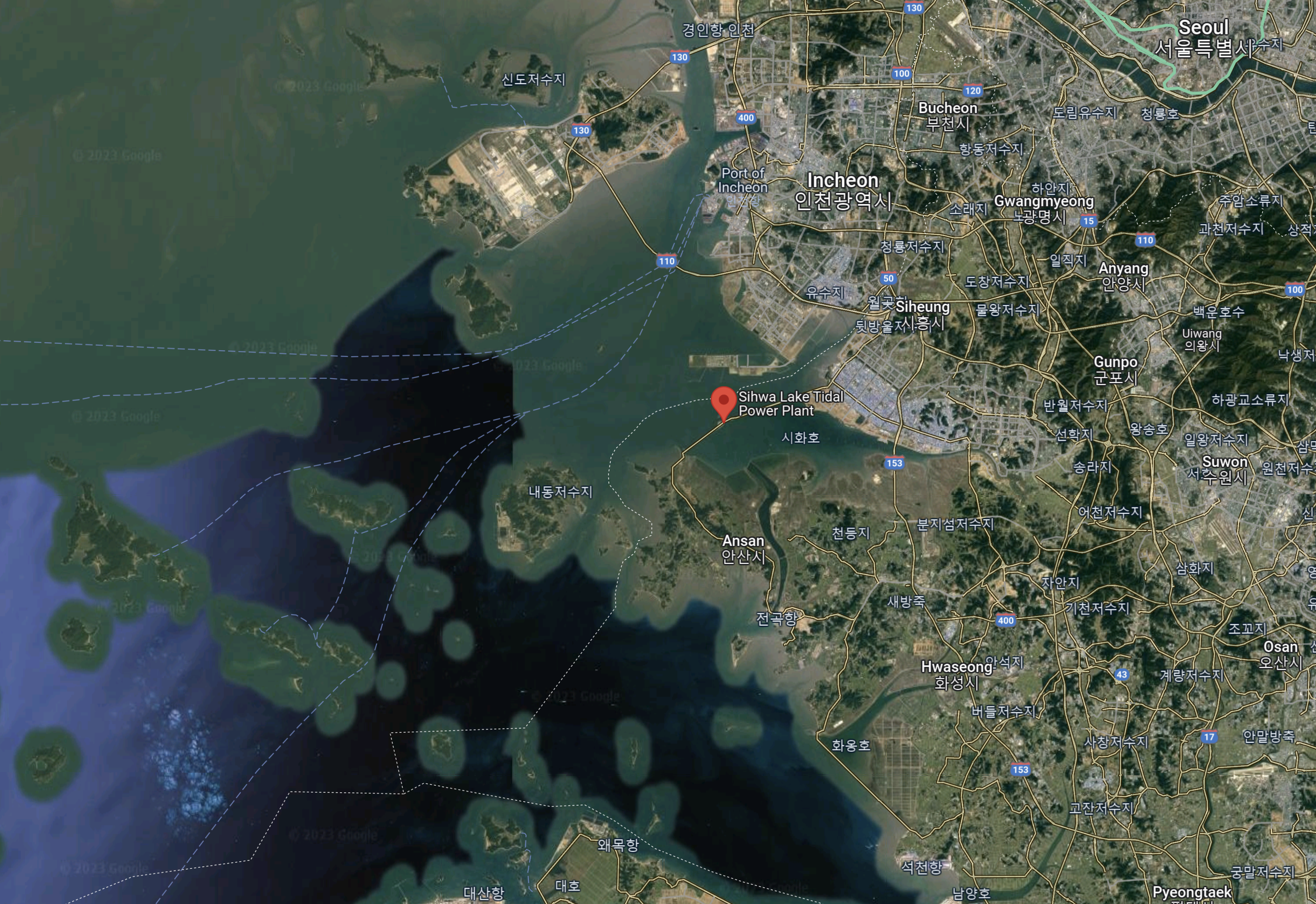
This Google Map shows the location of the power station.
Note.
- Seoul is in the North-East corner of the map.
- The Sihwa Lake Tidal power station is marked by the red arrow.
This Google Map shows a close-up of the power station.
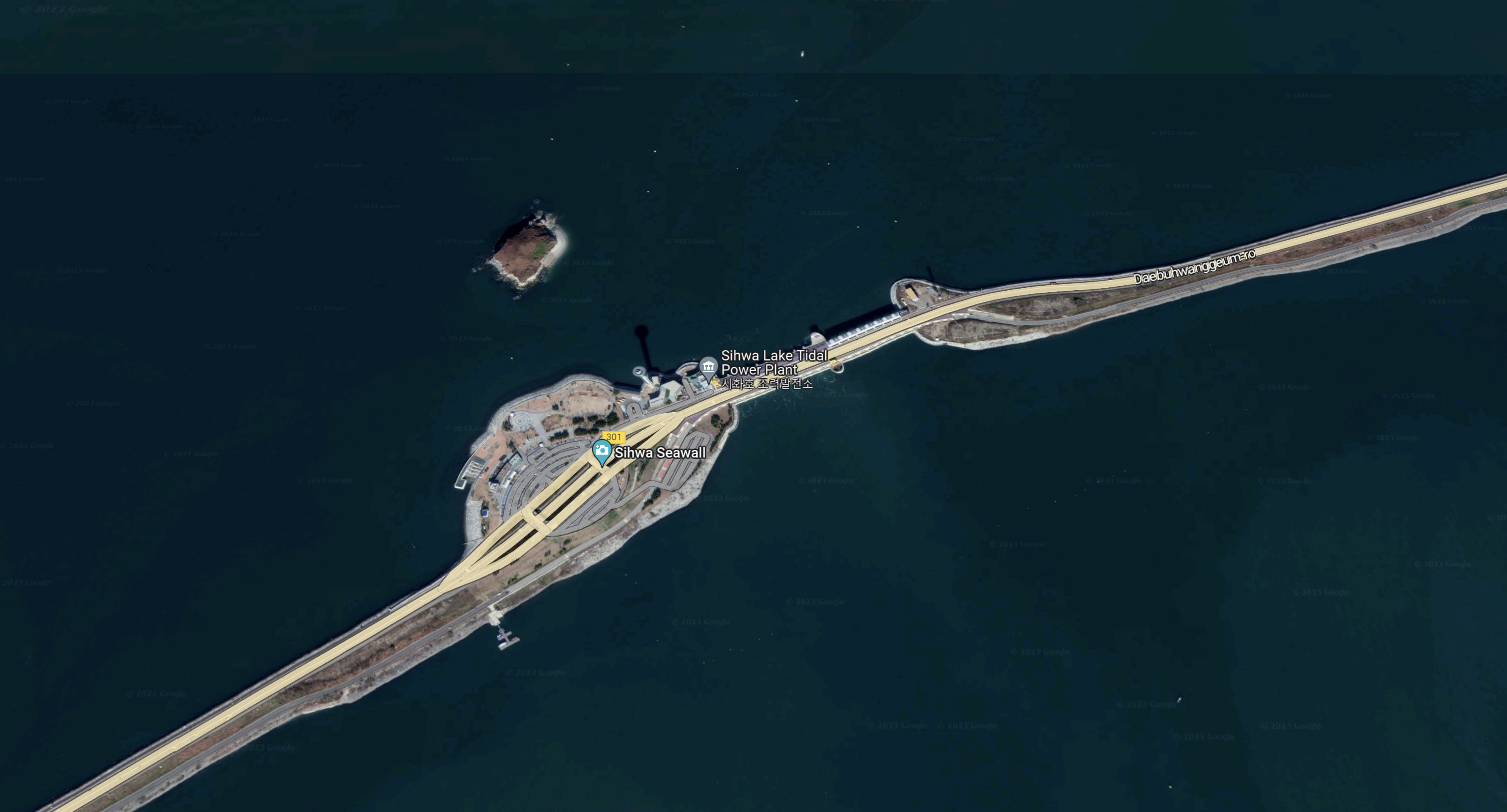
Note.
- The ten turbines appear to be in the gap.
- There appears to be a road on top of the barrage.
- The area to the West of the power station is marked as a rest area.
- A Moon Observatory is marked.
- It has bus stops, showing that it is served by the 123 and 123-1 buses.
It is an impressive structure.
I’m sure that this type of barrage would work over the Mersey.
- A road could be built on top.
- It may only be able to generate electricity,from an incoming tide, like Sihwa.
- It could incorporate a rest area.
I do suspect though Liverpudlians would add a few unique touches of their own. Perhaps some liver birds or superlambananas.
The Frederick Snow Solution
The Severn is a wide river and he proposed that there would be a dam across the river, with a spine running East along the middle of the river.
- The spine would divide the river into two lakes.
- On the incoming tide, sluices would open and allow water to flow into the Northern or high lake from the Mersey estuary.
- On the outgoing tide, sluices would open and allow water to flow out of the Southern or low lake into the Mersey estuary.
- Water would flow between the high and low lake through turbines to generate electricity.
- I have assumed that the high lake is on the North side, but if the geography is more suitable, the high and low lakes could be reversed.
In the design for the Severn Barrage, an International airport would have been built on the spine.
But Liverpool already has a nearby International airport, so perhaps it could be much better to install a large electrolyser and hydrogen storage on the spine.

