How’s The Overground To Enfield Town Doing?
In Transport for London Do The Sensible Thing, I said this.
Various news items on the Overground like this story in the Enfield Independent, have been reporting that the Class 315 and Class 317 Trains on the Lea Valley Lines are not very reliable. I’ve read somewhere that they are spending up to two million pounds to get them running better.
So I thought I had better go and check to see how the lines to Enfield were doing, by taking the train to Enfield Town from Hackney Downs and then walking to Enfield Chase to get a Class 313 train back home.
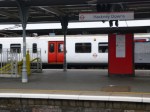
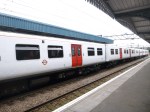
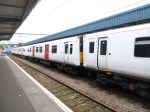
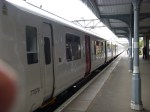
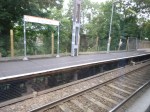
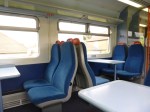
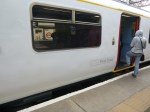
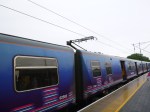
The pictures show the following.
1. An eight-car Class 315 train was working one of the last of the rush-hour services into Liverpool Street. So hopefully, London Overground have now got all services back up to their correct length.
2. Most trains I saw seemed to have a London Overground roundel on the side, even if they weren’t repainted.
3. I travelled out to Enfield Town in a very clean eight-car Class 317 train, that had been upgraded for the Stansted Express with tables, luggage racks and First Class. When was Enfield Town last served by a train so luxurious? In some ways it’s a waste, as surely there are other places, where as soon as the replacement Class 378 trains arrive, these old Stansted Expresses could be more gainfully employed.
Perhaps, they could serve Glasgow Airport? But then the Scots would complain, that they were getting London’s clapped-out second-hand trains. I noticed as I left that the train had had a full service in September last year. Old they may be, but they are far from scrapyard-ready! I suppose an old Mark 3-based train, is still a Mark 3-based train, with all the strength and ride quality that means.
4. In the meantime, this Class 317 train, is probably doing a good job in pacifying the natives of Enfield.
5. After my walk through Enfield Town centre, I got on a Class 313 train to get back to London. Now that is a clapped-out train and I wonder how many passengers for London from Enfield are thinking about changing their point of departure for London. If you commute and have a Freedom Pass, this is now unrestricted from Enfield Town, so this must have an effect on commuting pstterns.
6. I took the picture of the pantograph on the Class 313 train, as this is a special job, so that the trains can run in the restricted tunnels to Moorgate. It only needs to fold away very snuggly, as that section of line uses third rail for its electricity.
I will ask this question, about what I saw.
London Overground have put an option for 249 extra vehicles in the order for the Class 378 trains, as I reported in Have Transport for London Other Plans For The Overground?
So will some of these optional vehicles in the Class 378 order end up working the Great Northern lines into Moorgate and Kings Cross?
They have a lot going for them.
1. They are certified for working in tunnels, as on the East London Line, they run sixteen times each hour both ways through the Thames Tunnel.
2. There is a dual-voltage variant of the Class 378 train.
3. There would be the problem of designing a new pantograph well and certifying them for the Great Northern tunnel, but that is not as great a task as designing a whole new class of train.
It would probably be a special variant of the Class 378 train, but it hopefully, it would not be a difficult design to create.
We can do a little calculation on where the 249 extra vehicles might go.
Various documents show that by 2030, London Overground wants to be running six-car trains on the North and East London Lines. So if the existing fleet was all made six car, that would probably need 63 vehicles, as there are 57 trains on the system currently and another six are on order.
If we assume that Transport for London’s other target, the Dartford Lines, comes with some fairly new trains, this may or may not use up some of those options.
Taking the 63 off the 249 gives us 186 vehicles, which leaves 186, which can be 62 three-car trains or 46 four-car ones, with a few vehicles left over. Intriguingly, they could also be configured as 31 six-car trains.
So how many trains would be needed? At present the line is worked by 44 3-car trains. So if it was deemed that under London Overground, the service would be as now, there would be plenty of vehicles.
But as I pointed out, 186 vehicles gives us 31 six-car trains. Wikipedia states that the tunnels to Moorgate will accept trains of this length, so would it be a simple decision to make all the Great Northern trains six-car to turn the service into a higher-capacity, seven days a week, Metro service? As this would be a distinct variant, they might even be given a bit more performance to ease them along the East Coast Main Line to Hitchin. After all other members of the family to which a Class 378 belongs are 100 mph as opposed to 75 mph trains.
Running six-car walk-through trains into Morgate, rather than two three-car ones coupled together, gets rid of one of the restrictions of running in tunnels, which insists that passengers can walk through the train to get out in case of trouble.
So the more I look at this, the more I think, that Transport for London has an option on trains to work the Great Northern services.
As Transport for London have said, they might like to take over some of the inner Thameslink services, I suspect that the flies on the wall in meetings between Govia Thameslink Railway and Transport for London will have interesting tales to tell.
Have Transport for London Other Plans For The Overground?
It is now widely-publicised that Transport for London have started the process to get Class 378 trains delivered for the Lea Valley and Gospel Oak to Barking Lines. This article in Rail News gives full details.
But the History section in the Wikipedia entry for the Class 378 trains has this paragraph.
On 19 June 2015 it was announced that Bombardier had won a contract to supply a further 45 units, with an option for a possible 249 additional vehicles. The 45 units would comprise of 30 sets to replace class 315 and 317 units on the recently taken-over former Greater Anglia routes, one unit for use between Romford and Upminster, six to strengthen the existing London Overground fleet and eight units to replace the class 172 diesel units on Gospel Oak to Barking services.
So what are TfL proposing to do with the optional 249 vehicles, if it eventually is part of the order?
If they are four-car trains that would be over sixty sets, which as they need thirty sets for the current Lea Valley operation, would mean they could support two similar services of the same size.
It is an open secret,that Transport for London wants to be responsible for Dartford services from London, so that would probably require thirty to forty sets, which still leaves enough to takeover another service or perhaps add an extra car to all the five-car sets on the North and East London Lines.
Or could they be looking at the Great Northern services out of Moorgate and Kings Cross? These currently use forty-four rather clapped-out Class 313 trains, comprising 132 vehicles.
It just seems that we’re going to get a Big Orange!
At Last, A Station For Crossrail With Style
With the exception of Canary Wharf and Custom House stations, a lot of the designs have been poorly-received by architectural critics.
So I was surprised and pleased to see this piece on the Crossrail web site describing the new West Ealing station. This picture of the new station building is shown.
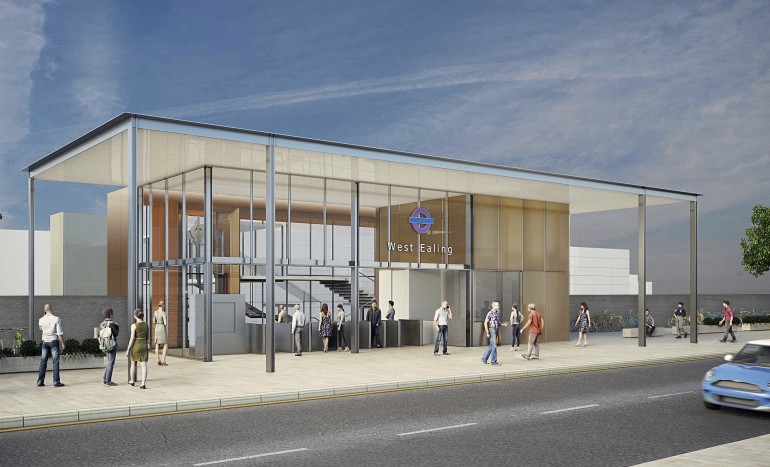
West Ealing Station
It has style and I also believe that it is designed to fit the purpose for which station buildings are now needed. All a station building needs to be today is a shelter for the barriers, ticket machines, staff and perhaps a retail kiosk or two. Get the people flow through them correct and they can be even smaller and more affordable.
It is interesting to look at the layout of the lines. This Google Map shows the situation at present.
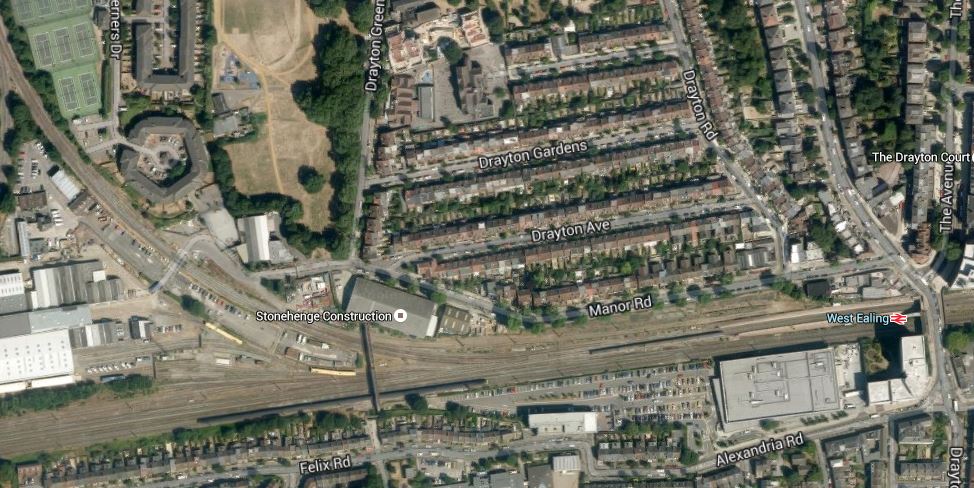
West Ealing Current Layout
Note the Greenford Branch curving away to the North. This branch is probably an operational headache for rail managers, as the trains currently have to join the line to get to their terminus at Paddington station. After West Ealing station has been rebuilt, there will be a bay platform for trains on the branch. It is shown in this drawing I found on the Internet.
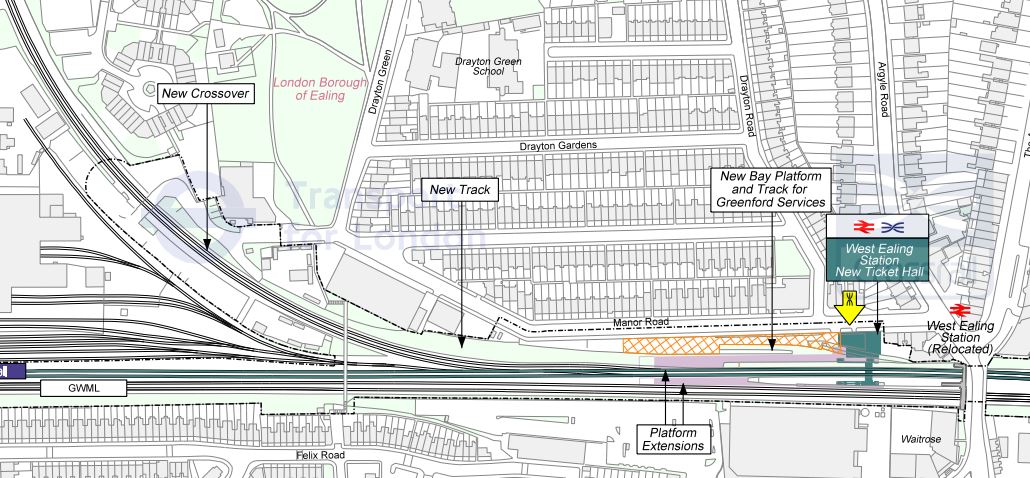
West Ealing New Layout
You have to wonder if the Greenford Branch will be developed and Wikipedia has a section on the branch’s future. Should it be electrified and should as Ealing Council have suggested the line be extended to Clapham Junction via the West London Line?
Undoubtedly, it should be electrified and the published plan of four trains per hour would certainly improve matters. But as with many things, we’re waiting for Crossrail and the plans for Old Oak Common to be vcompleted.
It does seem to me that the design for West Ealing station has set a new standard for Crossrail stations.
But as the first comment received has shown, there is a problem with access to the station from the South. This Google Map shows an enlarged view of the current station.
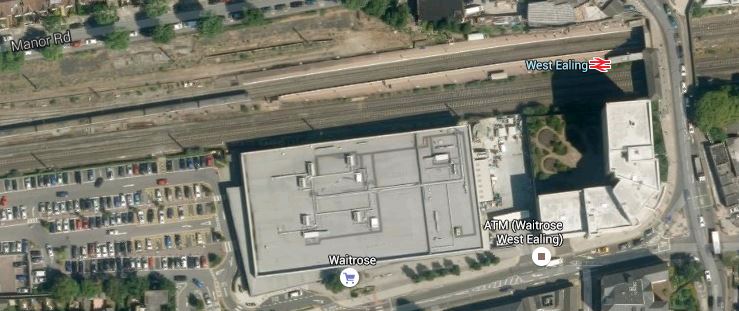
An Enlarged View Of West Ealing Station
Note how the supermarket and the car parks, backed by the two fast lines of the Great Western Main Line create a barrier that is impenetrable to any access to the station. Even if access were possible, it would be a long walk between Alexandria Road and the new station.
It strikes me that the only way better southern access to the station could have been enabled, would have been if the new station had been designed in conjunction with the supermarket, when that was developed.
It should be noted that at present West Ealing station has no car parking and do many of the locals feel that this should be provided in the new station?
To sum up, West Ealing station has problems in resolving some design issues, as it was not properly designed, when the supermarket and the land south of the railway was developed.
In my view, it illustrates one of the problems of the surface sections of Crossrail, They have been left to rot for years, when they should have been upgraded well before construction of the line started.
Now The TransWilts Wants More Stations
According to this article in the Swindon Advertiser, the TramsWilts Community Rail Line wants to open new stations at Royal Wootton Bassett and Blagrove.
The more the merrier I say!
Is A Mobile Phone A Dog And Bone With Legs?
My father, who was not really a real Cockney, as you couldn’t quite hear Bow Bells from where he was born, was a regular user of rhyming slang.
I was writing a message to someone and suggested we text each other.
I then realised that I’d never heard rhyming slang for mobile phone, which led me to the title of this post.
This page supports the use of Obi Wan Kenobi.
Where Are The 33cL Water Bottles?
In the UK, I generally carry a small bottle of water. Usually, it’s a 33cL Evian or if I’ve been on a train a 33cL Harrogate.
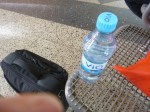


As the pictures show, these bottles are smaller than the 50cL ones that you have to use on the Continent. On my recent trip, I never managed to find a smaller bottle.
I prefer the smaller bottles, as there is less to carry. And they fit my jacket pocket!
I would have thought that there might be an economic advantage for both consumers and retailers in the smaller bottle. Not knowing the costs of production, I can’t do a full calculation.
Amber Rudd Puts Onshore Wind Out Of Its Misery
I don’t like onshore wind farms so I was pleased to see this announcement by Amber Rudd on the BBC, which is titled Earlier end to subsidies for new UK onshore wind farms.
Onshore wind blights the countryside and you have to use a lot of subsidy to make a development viable.
But, I mainly don’t like the concept of wind power, because it is too mechanical, as opposed to solar, where you put up a panel and its control system and you get electricity.
Solar’s other big advantage is just emerging and that is the ability to link it to an intelligent battery such as the Tesla Powerwall to provide an independent power system for a building or something remote that needs good clean energy.
In a few years time, I predict that all new houses will have solar panels on the roof and the next generation of storage battery in the garage. Coupled with increases in insulation quality, I also think, we’ll see the likes of Barratt advertising houses with no external gas and only a stand-by electricity connection, for use on the dullest days.
The big energy companies won’t like it! But surely this is the sign of a good idea?
My energy usage isn’t high, but when the solar/battery powerplant drops in price sufficiently, I’ll fit one!
Don’t Let’s Be Beastly to the Germans
The title of this post comes from Noel Coward’s wartime comic song – Don’t Let’s Be Beastly to the Germans.
Generally, the Germany has got more visitor-friendly and on this trip their restaurant menus have improved beyond recognition for coeliacs and other allergy sufferers.
But there is one thing, where the reality does not live up to the German reputation for good design, reliability and efficiency.
Deutsche Bann, their trains and some stations just doesn’t cut the mustard. Or whatever they say in Germany.
In a related area, the local trams, metros and buses I’ve used are much better, even if in some cities, the maps and information aren’t up to the standard of the better cities like Munich or Leipzig!
On the train from Brunswick to Osnabruck, I was talking with a commuter and he was saying his commute was often late.
Service Frequency
One thing you notice in Germany, as that on important main-line routes, trains are not as frequent, as you’d find in say France, Italy or the UK, which seems to have the most frequent trains in Europe.
Comparing Berlin-Hamburg with the London-Liverpool route I know well, shows that for direct trains, the cost is about the same and there is one train an hour on both routes. But Liverpool also has two extra trains each hour, which are only a few minutes slower with a change at Crewe.
But the journeys on this trip, where I was doing an hour or so journey on a main line, I usually had the choice of just one train every two hours.
So when planning a train trip in Germany, make sure you plan well and never rely on if you miss a train, they’ll be another one along soon!
I have found that it is often better to take the slower regional trains, as I did several times on this trip, as although they are slower, many are double-deck and you can hide yourself upstairs and watch the countryside go by.
But I think German regional trains are more under control of the individual state or area, rather than Deutsche Bahn.
If this is the case and coupled with the often excellent interchanges at stations to trams and buses, this must be a good argument for local control of train services. But then as a Londonder could I believe anything else?
Finger-Aching Ticketing
The German automatic ticketing machines work well, but be prepared to wear out your fingers.
I counted that to buy a simple ticket from Liepzig to Braunschweig took a dozen menu choices and that didn’t count typing in the names.
Train Design
Increasingly, in the UK, our trains are a level step from train to platform and vice-versa. Look at this wide easy-entry door on a Class 378 train.
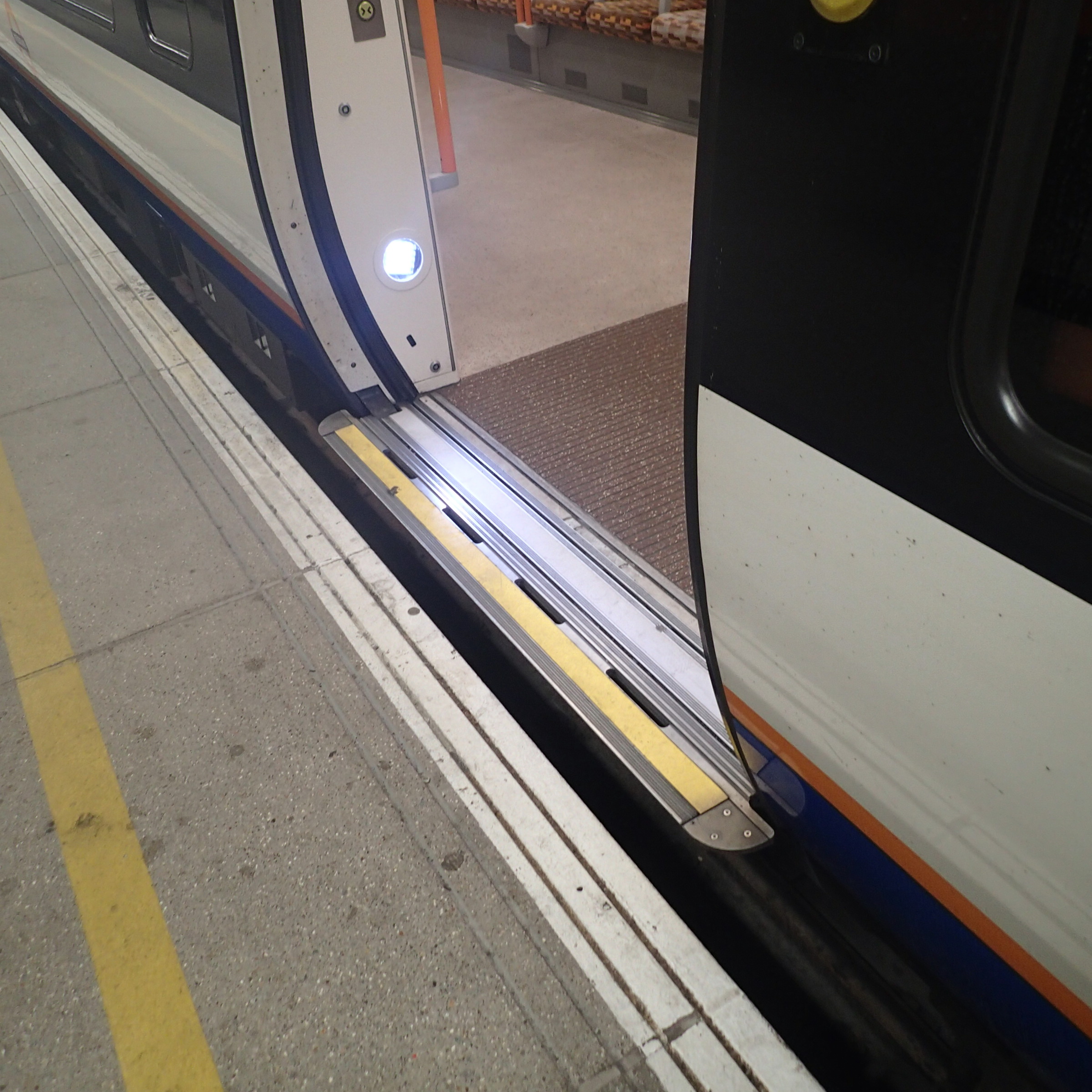
Regularly you see wheelchair-users push themselves across. This is a typical entrance to a Deutsche Bahn IC train.
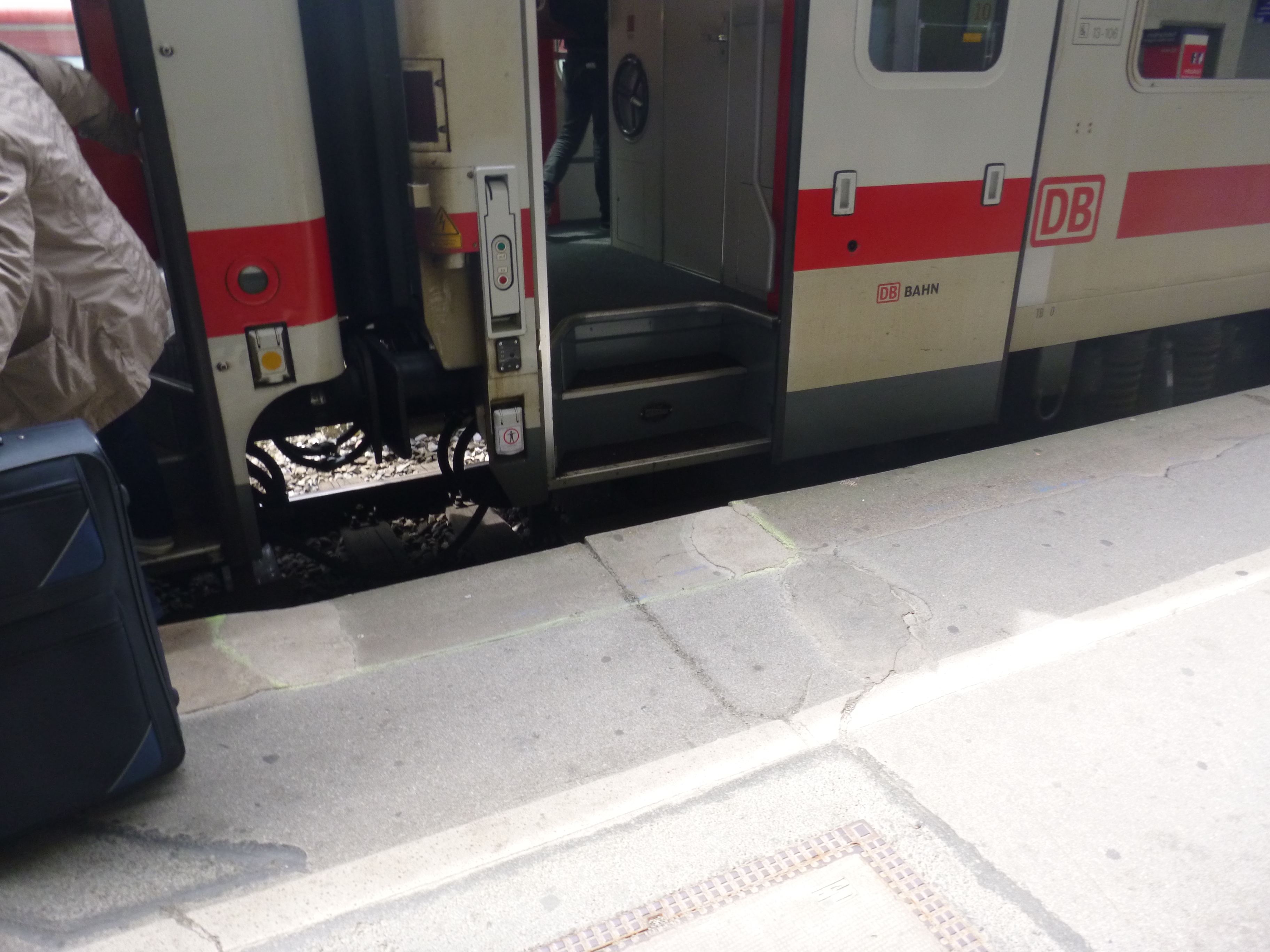
With my eye-sight, I sometimes miss my footing and in Germany, I worry about putting my foot in the often big gap between train and platform, which is never level.
As to wheelchair users in Germany they must despair. I thought that EU disability regulations meant trains had to be disabled-friendly.
On-Train Information
Nearly all the trains had displays for traffic announcement, but the information was a bit thin. As the Belgians were more comprehensive, I suspect it’s just the way they’ve programmed the system.
When you are a tourist in an area you don’t know well, you really do need adequate warning of your station. With Deutsche Bahn you don’t get it every time!
I shall finish this rant later!
Surely Taking Your Children To Syria Is Child Abuse?
I’m no lawyer, but I did live with one of East Anglia’s finest children’s barristers for forty years and for at least twenty of those years, C was at the top of her profession.
So to my trained-by-association legal mind, if you take your children to a war zone, like Syria, you’re putting your children in danger and that in my view and probably would in C’s mind, be akin to child abuse and should get the mother, father or guardian into Court.
As well as the case of the three Bradford sisters on their way to Syria and possible oblivion, we also have the case of the attack on the pregnant woman in Peckham.
In the second case someone has been charged and will appear in Court today.
As the Authorities knew something was up with the Bradford sisters, why was nothing done to sort the problem earlier, when they went to Manchester Airport the first time?
When I went out on Eurostar on my way to Kassel, there was a lady about fifty, who was travelling with a young girl of about four. The lady got a minute or so’s questioning from Immigration at St.Pancras. Which was quite right, as C was often in Court trying to get children produced that had been sneaked out of the Jurisdiction. I seem to have read that immigration rules have been tightened to make taking children out of the country, against one parent’s wishes more difficult.
Perhaps, if they were tightened again, it might stop a repeat of the case of the Bradford sisters and their nine children.
 The Anonymous Widower