The View From Platform 1 At Birmingham Moor Street Station
Birmingham Moor Street station is one of my favourite stations, as it is rather a unique restoration and enlargement of an old Great Western Railway station.
I hope the restoration for Crossrail of Hanwell and West Drayton station please me as much.
My train was leaving from Platform 1, so I took these pictures whilst I waited.
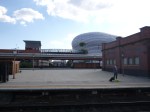
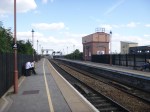
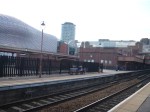
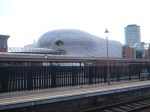
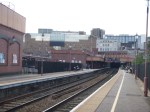
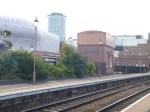
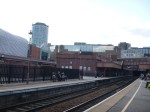

Platform 1 and 2 are either side of the lines to Birmingham Snow Hill station and were opened in the 1980s and when the station was enlarged later the buildings were matched to the original terminus, which is Grade 2 Listed
The low-flying barrage balloon in most of these pictures is Birmingham’s Selfridge store.
A Short Trip On Birmingham’s Cross-City Line
The Cross-City Line In Birmingham, which runs from Lichfield to Redditch is the city’s equivalent of one of London’s Overground lines. It operates on similar principles, with a frequent service run by modern electric trains.
As I found myself at Five Ways station on the line, I thought I’d take a short tip to somewhere the other side of the city, before returning to New Street for my trip back to London from Moor Street.
I took these pictures on the journey.
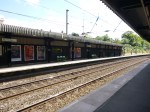
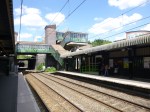


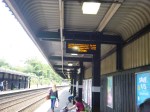
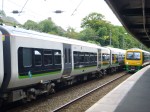


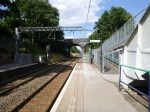


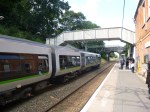


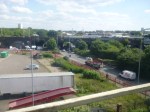


I went as far as Gravelly Hill station, which is just past the infamous Spaghetti Junction, where the M5, M6 and A38 meet.
Walking The Route Of The Midland Metro Line One Extension
I’ve walked the Line One Extension of the Midland Metro between New Street and Snow Hill stations before, but I’ve never walked the proposed extension as far as Five Ways. I took these pictures on the route.
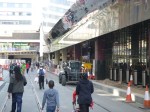
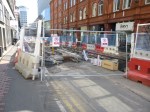
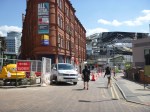
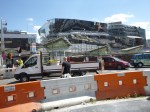



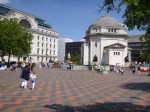
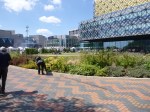

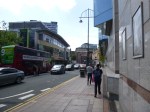
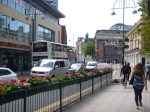
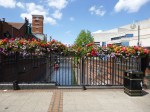
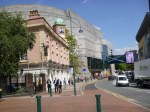
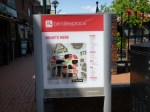
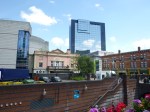

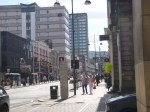
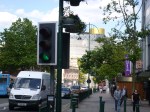
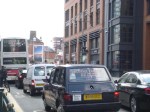
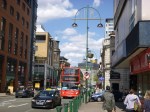
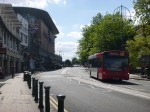
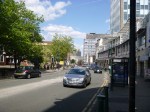
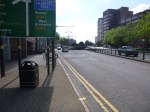


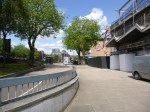
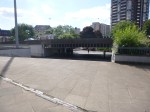
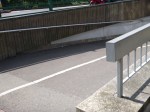

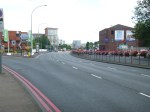
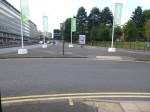
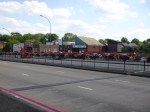
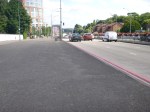
The Extension was planned to be opened to Centenary Square in 2017 and to Brindleyplace, Five Ways and Egdbaston later. Nothing much seems to be happening past New Street station, except for some utility works, which must be sorted before tram tracks and station are put over the top.
The walk is fairly easy, but the last section around Five Ways and to Five Ways station was designed using Birmingham’s 1960s philosophy of deling with traffic and pedestrians, that I’ve seen going to Birmingham City several times – Pedestrians should be channelled into dangerous areas, so they are run over and killed. This would of course make it less likely a driver will damage his car, by hitting one.
Birmingham could do a lot worse than extend the tram to Five Ways. Some of the running routes would be challenging and Birmingham’s many drivers would probably object, but if they want more visitors to the City, surely it is a price worth paying?
I do wonder about the costs of extending tram lines, as opposed to building new ones. Obviously, some costs like new trams and getting power to the trams will be minimised, but you’ve still got the costs of actually putting in the rails and divering utilities.
Electrification Of Britain’s Railways Isn’t Easy
There are a lot of reports in the media talking about the delays in electrifying railways in the UK, like this report in the Yorkshire Post, which talks about the Trans Pennine and Midland Main Line schemes.
I have just found this report in the Rail Engineer, which talks about a forty-four day closure of the important Winchburgh Tunnel between Edinburgh and Glasgow to prepare for electrification as part of the Edinburgh Glasgow Improvement Program. The report starts with this paragraph.
A legacy of the rapid early growth of Britain’s railway network is that the UK has one of the world’s most restrictive loading gauges. As a result, typically half of the cost of British electrification projects is the civil engineering work to adapt structures to provide clearance for wires and pantographs.
As anybody who’s ever got to grips with any old building, what it looks like on the surface is very different to what is underneath.
The project described in the article is challenging to say the least. This extract describes the building of the tunnel.
Winchburgh tunnel lies at the eastern end of a five- kilometre long cutting. It is 338 metres long and was opened in 1842, having taken two years to complete. When digging the cuttings and tunnel, the contractor, Gibb and Sons, removed 200,000 tons more rock than expected and consequently made a loss.
The tunnel was cut through dolerite rock, mudstone and shale. In the middle on the nineteenth century, these oil shale deposits once made West Lothian one of the world’s biggest oil producers. This shale was also a factor in an unfortunate accident during tunnel construction in 1839 when a man was severely burnt by firedamp.
The cutting is crossed by two streams, west of the tunnel. A twin four-foot diameter cast-iron inverted syphon was provided to carry Myers Burn under the railway. Swine Burn crosses the cutting on an aqueduct that had to be re-decked as part of the EGIP electrification works. Downstream of the aqueduct is a pumping station, which drains the cutting west of the tunnel. This is an area with significant drainage issues, some of which are addressed by the tunnel works.
So making it large enough for electrification wasn’t easy. As is typical on a project such as this, concrete slab track was used. You don’t see it much on UK railways, as where it is used is generally in tunnels and other places, where you have tight clearances.
In the Winchburgh tunnel slab track was used and they are also using an overhead rail system to get the power to the train.
In searching for a good article about slab track, I found this article on Balfour Beatty’s Rail web site, which is entitled Polyurethane Slab Track.
Balfour Beatty have worked with Herriot Watt University to create a method of using polyurethane to create a method for strengthening track in awkward places.
One example describes how a bridge was improved to cope with modern loads.
While George Stephenson was a forward thinker, even he didn’t predict freight trains running at 80mph with 25 tonne axle loads over his bridge. So he hadn’t calculated for those stresses. The bridge has done a good job of coping with them for 190 years, but it was getting a bit tired.
The article also highlights that Network Rail has 25,000 masonry arches, so you can see why there must be a need for such a technique.
The technique has also been used to increase the headrom for electrification in a tunnel on the Midland Main Line.
It’s all impressive engineering.
St. Martin’s Queensway Tunnel
In looking on the Internet to see if anybody had ever proposed adding low-level platforms at Birmingham Moor Street station to access the local services out of Birmingham New Street station, I found this article in the Birmingham Post entitled Tunnel link between New Street and Moor Street stations set for facelift.
Now I’ve been to Birmingham many times and often I’ve walked between the two stations and I’ve never seen or heard anything about this tunnel.
Does it actually exist?
The article says this.
A city centre tunnel is set to get a £5.5 million facelift to improve the route between two of Birmingham’s busiest railway stations.
The St Martin’s Queensway Tunnel, which runs under the Bullring shopping centre, will be transformed into a well-lit attractive route for rail commuters.
Road crossings and the public areas outside the revamped New Street Station will also be improved to encourage people to walk between there and Moor Street station.
Currently about 1.4 million people a year walk through the dingy tunnel between the stations, but some have complained of feeling unsafe and it is also poorly signed for visitors to the city.
Some councils may spend £5.5million on imaginary projects, but I don’t think Birmingham would.
The Future Of The Midland Metro
The Test Match being in Birmingham this week, got me thinking about the new extension to the Midland Metro, I saw this week.
Unlike the tram systems in Blackpool, Croydon, Manchester, Nottingham and Sheffield, the Midland Metro hasn’t really caught the public’s imagination and been a rip roaring success.
When I visit other places with trams, I often use them, even if like in Nottingham, it’s just to get up the hill. But I’ve never used the Midland Metro, unless my trip has been taken to ride on the tram. A section in Wikipedia entitled Line One (Birmingham City Centre) Extension starts like this.
The fact that the existing line does not run into Birmingham City Centre has been identified as one of the reasons why it has failed to attract the predicted patronage. The Birmingham City Centre Extension (BCCE) will extend Line 1 into the streets of central Birmingham. Originally it was planned to terminate the extension at Stephenson Street, adjacent to New Street railway station. In September 2013, Centro started consultation on proposals to extend the city-centre extension from New Street station to Centenary Square. This would be another stage towards extending the line to Five Ways the original planned destination. The plan was approved by Birmingham City Council in October 2013, allowing the line to add an additional stop at Birmingham Town Hall.
I have watched this project unfold from a distance and it doesn’t seem to have had the strongest leadership or most intelligent design, when and since it was first opened in 1999.
As my pictures earlier this week showed construction is well underway and hopefully the line will arrive at New Street station this year. Perhaps this line across the city centre will give the Midland Metro an uplift.
On a selfish note, when I go to Birmingham, the places I want to get to are the football grounds and Brindley Place for lunch with friends.
Aston Villa and Wolverhampton have good train access and Birmingham is through the terrible station at Bordesley, but A stop at Brindley Place is on the next part of the Line 1 extension, which won’t be built until 2017 at the earliest. I don’t think it has even been started and possibly even fully planned, judging by the several alternatives talked about in Wikipedia. At present the line is going to Five Ways station, which is shown on this Google Map of the city centre.
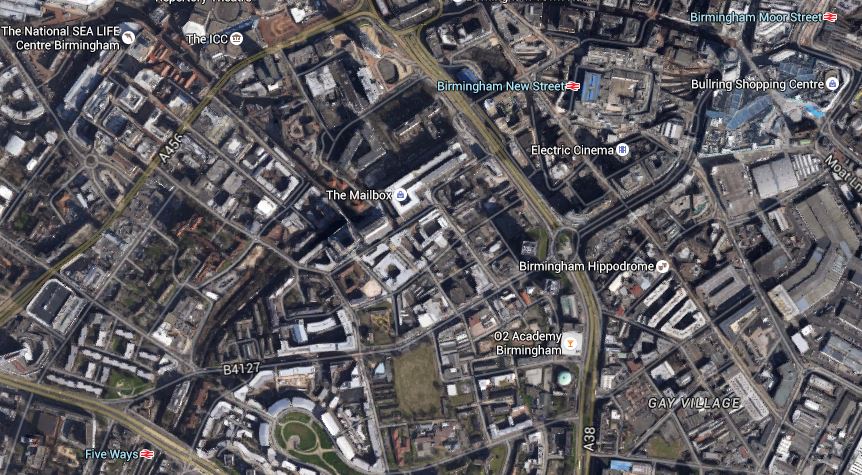
Midland Metro In Birmingham City Centre
I’ve included Birmingham Moor Street station on this map, but it won’t be connected to this phase of Midland Metro extension. However, Birmingham Snow Hill station will be, but that is not on the main lines from Euston, Liverpool and Manchester.
Will the line finish at Five Ways or will it continue past Edgbaston Cricket Ground, Birmingham University and the Queen Elizabeth II Hospital?
This second map shows the area between Five Ways and University station, with the cricket ground marked by a red arrow
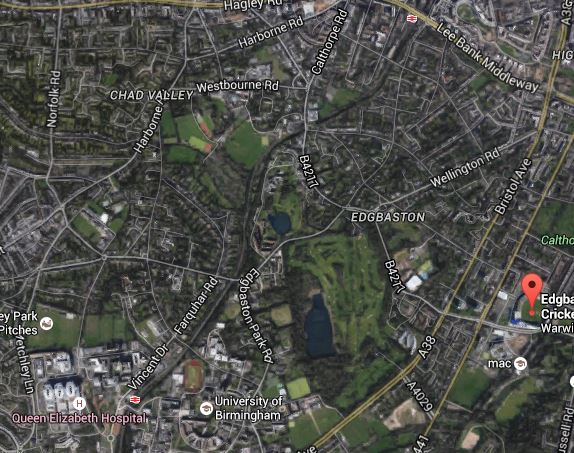
Midland Metro Line 1 Extension And Edgbaston
Note the university, the hospital, the Alexandra Stadium and University station clustered together in the bottom left corner of this map.
It is worth noting that Five Ways and University stations are both on the Cross-City Line that goes from Redditch to Lichfield via New Street. It is the busiest commuter line outside London and has upwards of six services an hour in both directions. The frequency of the Midland Metro is one tram every eight minutes, so the Cross-City Line is only a little bit less frequent.
The Cross-City Line is currently being extended to Bromgrove and there are unfulfilled plans to reopen the Camp Hill Line, that my train from Oxford to Birmingham used.
There seem to be a lot of competing proposals for money to be spent in the West Midlands, so perhaps if a West Midlands Combined Authority was setup properly, then it could decide what happens.
Perhaps, then Birmingham would get the local transport system it needs and deserves. After all, I think it was very much short-changed in the 1960s with the creation of the unloved New Street station. Let’s hope the new station opening in September, solves at least some of those fifty year old problems.
One of the biggest problems is that Birmingham effectively has two independent sets of local rail lines, with no common interchange.
The Snow Hill Lines though Snow Hill and Moor Street were built by the Great Western Railway and are operated by diesel trains. They carry about twenty percent of the rail services into the city. According to this Future section in the Wikipedia entry for Moor Street station, there are plans for more local services out of Moor Street
There are also an extensive mainly electrified network centred on New Street, which includes the Cross-City and Chase Lines and some services on the West Coast Main Line.
The trouble is there is no obvious connections between the two sets of lines, as is described here in Wikipedia. This Google Map shows the two stations and the shopping centres in between.
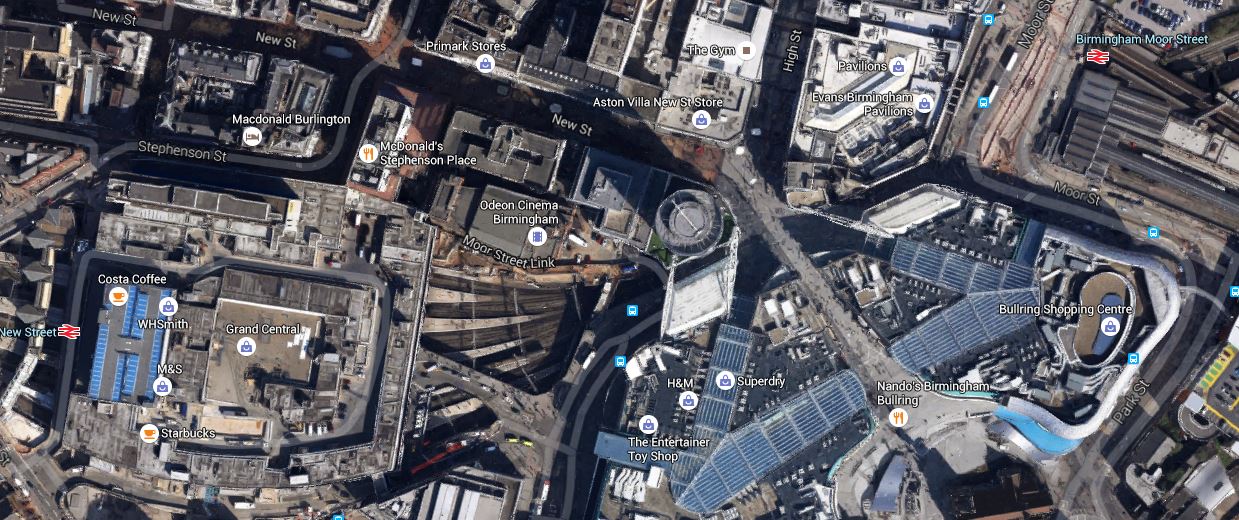
Birmingham New Street And Moor Street Stations
It would seem to my untrained mind, that there must be possibilities for putting a low level station under Moor Street with platforms on the local lines through New Street. I can’t find any proposals or ideas on the Internet, but then I don’t probably know where to look.
One proposal that might help is the opening of the Camp Hill Line into Moor Street, as this would link up to the Cross-City Line at Kings Norton.
Birmingham seems to be a mass of railway lines, which an intelligent planner could probably use to create transport links in the Greater West Midlands.
In the meantime, the arrival of the Midland Metro to New Street station, the Cross-City Line reaching Bromsgrove and the electrification of the Chase Line to Rugeley, will bring more people into the city centre and hopefuly make interchange easier.
It does appear, that the electric services on the Cross-City Line and Chase Line may need more trains, but at least there will be plenty of Class 315 trains available for cascade from London.
Serial Cooking – Roast Sausage And Lentils With Wild Rocket And Cherry Tomatoes
This recipe is another from Lindsey Bareham in The Times.
The main ingredients, are 24 M & S gluten-free cocktail sausages, a 250g sachet of cooked lentils, 125g of sliced chorizo and 400g of cherry tomatoes.
It is exceedingly simple and is shown in these pictures.








It may be quick, but it’s gorgeous.
Will Another Of Beeching’s Closures Be Reversed?
Lord Beeching wrote his infamous reports about Britain’s railways in the 1960s and died in 1985.
He gets a lot of blame for today’s rail problems, from various interest groups, but to be fair, the problems were severe at the time and some managers cut a lot harder than he recommended.
I think that for example in Scotland and other places, rail lines were closed in such a way they could be reopened, whereas in others, the land was sold and to reopen the line would be impossible without spending billions.
In the last thirty years two things have happened; there are a lot more of us and we’ve discovered that trains are an increasingly useful method of transport.
So sometimes the reason why the Victorians built a line, is even more valid today. The soon to be reopened Borders Railway is probably more needed now, than it was when it was built, because leisure and tourism is so much more important.
The Borders Railway was a victim of the Beeching Cuts and will join a long list of lines and stations that have since reopened.
That list will continue to grow.
The latest possible reopening is detailed in this article on Global Rail News entitled Milestone for Portishead-Bristol line restoration. The article describes how the Portishead to Bristol Line could be incorporated into the Greater Bristol Metro or MetroWest.
If all goes well, it could open in 2019.
More Class 68 Locomotives On The Way
So far there have been twenty-five orders for the new Class 68 locomotive and as there is no adverse criticism of the new locomotive on the web or in the railway press, it has to be assumed that they are working fairly well.
So it was no surprise to see this article on Global Rail News, with a title of DRS orders further seven Class 68 locomotives.
Let’s hope when the related Class 88 locomotives from the same manufacturer generate such a small amount of negative publicity, when they are introduced in the next year or so.
Whitechapel Station – 29th July 2015
They have been busy at Whitechapel station over the long weekend.


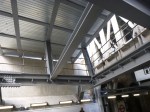
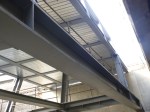
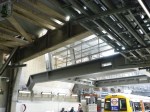
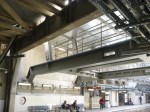
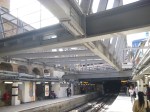

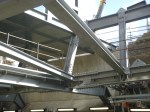
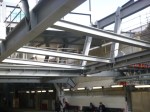
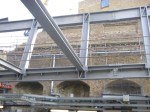


There’s even a bridge going across the Overground tracks at a high level.
 The Anonymous Widower