Crown Estate’s Auction Of Seabed For Wind Farms Attracts Sky-High Bids
The title of this post, is the same as that of this article on The Times.
This is the opening paragraph.
An auction of seabed rights to build offshore wind farms around England and Wales has attracted frenzied bidding that could be worth hundreds of millions of pounds a year to the Treasury and the Queen.
I don’t find this surprising.
Bigger Seems Better Offshore
Wind turbine technology is getting better and much larger. It also seems that the new larger floating turbines are much more efficient and generate power for a greater proportion of the day.
- Hywind Scotland is the world’s first commercial wind farm using floating wind turbines.
- It is situated off Peterhead.
- It consists of five 6 MW turbines.
- Wikipedia says it has a capacity factor of over 50 %.
My project management software helped to harvest North Sea Oil and I have been told by many in the industry, that North Sea Oil really took off when platforms and the equipment like cranes used to build them got truly enormous.
I feel, we could be seeing the same size effect happening as we harvest the wind!
Hydrogen And Wind Power
The latest development is not to generate electricity, but to use it in the turbine to generate hydrogen, which is then piped to the shore.
- The UK Government is funding this technology in part with a grant to ITM Power.
- I wrote about the technology in ITM Power and Ørsted: Wind Turbine Electrolyser Integration.
- Existing gas networks can be reconfigured to bring the hydrogen to the shore.
- Piping hydrogen costs less than cabling electricity.
- Hydrogen networks are being built at several places in the UK, to fuel homes, power stations and industry like steel-making and petrochemicals.
Could all this explain Big Oil’s involvement?
Do they want to exchange fossil fuels for green hydrogen?
They certainly know how to distribute it.
Energy Storage
For my own investments, I’m looking at energy storage, where the UK has at least three promising new ideas, all of whom have had Government grants.
- Gravitricity
- Highview Power
- ReEnergise
The Government has also indirectly-backed Cornish Lithium
Spot The Battery
RheEnergise have just released this picture, of one of how one of their pumped storage systems might look.

They describe it as a typical small site after landscaping.
This is their description of the image.
This is an image of a small water works in Fife Scotland, you can just see 2 small water tanks at the base of the hill. This is an example of what a small High-Density Hydro project could look like after landscaping.
How many times have you seen a scene like this in the UK, Europe and all over the world.
They didn’t disclose the storage capacity of this system.
Gresham House Unveils 45-MW Battery Storage Purchase
The title of this post, is the same as that of this article on Renewables Now.
This is the introductory paragraph.
Gresham House Energy Storage Fund plc (LON:GRID) has acquired a 45-MW portfolio of battery storage systems in England, growing its operational fleet to 395 MW.
Gresham House are certainly growing.
As a Control Engineer and mathematical modeller, I certainly like what they are doing.
Modelling the cash-flow and earnings from all these batteries are is one of the sort of multi-variable problems, that I cut my teeth on, in early 1970s.
If I was starting out on my own now, as I did in 1972, Gresham House would be one of the companies I’d approach.
Their latest purchase is interesting in that it includes a 35 MW battery with a twelve year control to load balance for the National Grid.
There must also be a business model emerging for the developers of energy storage.
- Design and build an energy storage system to satisfy a company or local area’s need.
- Show it is working successfully for a period of time.
- Add a nice lucrative contract if you can!
The whole setup is then sold to someone like Gresham House.
At present, Gresham House has a portfolio, which is all lithium-ion storage. I don’t think, it will be a long time before other types of storage are added.
Corporate Funding In Battery Storage In 2020 Was Up By 136% Compared To 2019, Mercom Says
The title of this post, is the same as that of this article on Energy Storage News.
This is a paragraph, which sums up funding worldwide.
The amount of corporate funding coming into the global battery storage industry in 2020 was more than double the amount the previous year, with over US$6.5 billion raised last year compared to around US$2.8 billion in 2019.
It appears that serious money is increasingly going into energy storage.
Some very big deals involving hundreds of millions of dollars are detailed, in countries as varied as Sweden, Taiwan, the UK and the US.
Particular mention is given to a Swedish battery battery design and manufacturing start-up called Northvolt, who raised $600 million.
Most seem to be based on lithium-ion batteries, so the future could be bright for start-up companies like Cornish Lithium!
Faraday Battery Challenge Funded Project “Li4UK” Announces The First Domestic Production Of Lithium Carbonate From UK Sources
The title of this post, is the same as that of this press release from Li4UK.
This is the introductory paragraph.
Li4UK (Securing a Domestic Lithium Supply Chain for the UK), the Faraday Battery Challenge-funded project under the patronage of UKRI (UK Research and Innovation), is pleased to announce that the project Consortium, comprising Wardell Armstrong International Limited (WAI), The Natural History Museum (NHM) and Cornish Lithium Ltd (CLL), has successfully produced lithium carbonate from two UK sources – one from Cornish Lithium’s Trelavour project site in Cornwall and another from Scotland. High purity lithium carbonate is a raw material for lithium-ion battery cells, such as those used in electric vehicles.
When I first heard of this project, I wrote How To Go Mining In A Museum and felt that this project deserved to succeed, given the diligence of the founder.
You never know what you will find in the dusty vaults of a museum.
UK Battery Storage Startup Connected Energy Secures £1.2M
The title of this post, is the same as that of this article on UKTN.
This is the introductory paragraph.
UK-based battery storage startup Connected Energy makes use of electric vehicle batteries that are at the end of their in-car first life to create energy storage systems. The company combines as many batteries as needed for customised solutions with capacities from less than 100 kilowatt hours to up to 15 megawatt hours or higher.
Connected Energy has just received £1.2M funding from ENGIE New Ventures.
This sounds like a good idea.
Meet The British Inventor Who Came Up With A Green Way Of Generating Electricity From Air – In His Shed
The title of this post, is the same as that of this article on inews, which is written by the respected BBC journalist; Tom Heap.
This is the first two paragraphs.
In 25 years of reporting on the environment, I’ve become unshakably convinced in the seriousness and urgency of tackling climate change, but also rather dismayed that our successes in reducing greenhouse gases and promising scientific breakthroughs go largely unreported.
I’ve seen super plants that improve photo-synthesis, cows that belch less methane and next-gen solar panels. But there is one individual who deserves to be as famous in green-tech as Elon Musk for how his invention could help stop global warming.
The man is Peter Dearman from Bishop’s Stortford and his invention is the technology behind Highview Power, that is building a 250 MWh liquid air battery at Carrington, near Manchester.
Companies Have New Take On Old Energy Storage Tech
The title of this post, is the same as that of this article on Hackaday.
This is the introductory paragraph.
According to Spectrum, several companies are poised to make a splash storing energy with gravity. That sounds fancy and high tech at first, but is it, really? Sure, we usually think of energy storage as some sort of battery, but there are many energy storage systems that use water falling, for example, which is almost what this new technology is all about. Almost, since instead of water these new systems move around multi-ton blocks.
The article gives a review of Energy Vault, Gravitricity and another company called Gravity Power.
This is the article’s take on Gravity Power.
The scale of the weights is hard to imagine. Another company, Gravity Power, claims they could deliver 400 megawatts for 16 hours using an 8 million metric ton piston. There’s no word on how long it takes to bring that piston back to the charged position after the 16 hours, though. A Boeing 757-200, for example, weighs about 100 tons when loaded with fuel and passengers. So imagine 80,000 giant airplanes melted down. It makes Energy Vault’s 35-ton weights seem much more reasonable.
Looking at the Gravity Power web site, their technology is described on this page, where this is the first paragraph.
The GPM (Gravity Power Module) uses a very large piston that is suspended in a deep, water-filled shaft, with sliding seals to prevent leakage around the piston and a return pipe connecting to a pump-turbine at ground level. The piston is comprised of reinforced rock and in some cases concrete for low cost. The shaft is filled with water once, at the start of operations, but is then sealed and no additional water is required.
This graphic from the page explains the technology.
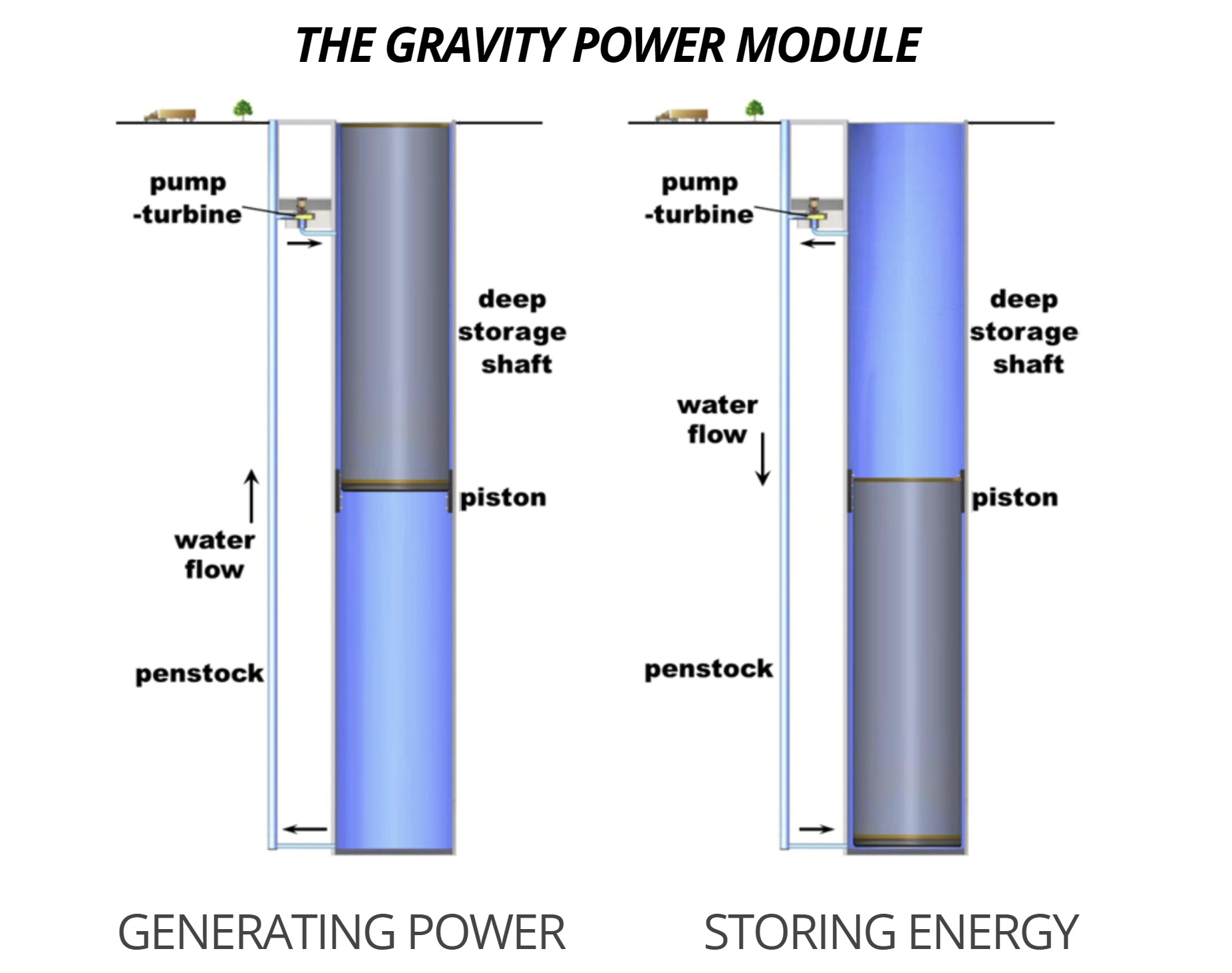
My worry would be water leakage past the piston.
This does sound like an idea from William Armstrong, who was responsible for many things including the hydraulic accumulator.

The picture shows the hydraulic accumulator at Limehouse in London.
I visited the Limehouse Accumulator during Open House in 2012 and wrote about it in Open House – The Limehouse Hydraulic Accumulator.
Sweden’s Grand Plan To Make Zero-Carbon Steel
The title of this post is the same as that of this article on theTelegraph.
It adds a lot of colour and background to Sweden’s plan to make zero-carbon stell using a process called HYBRIT, that I wrote about in Funding Award to Supply An 8MW Electrolyser and is illustrated in this infographic.
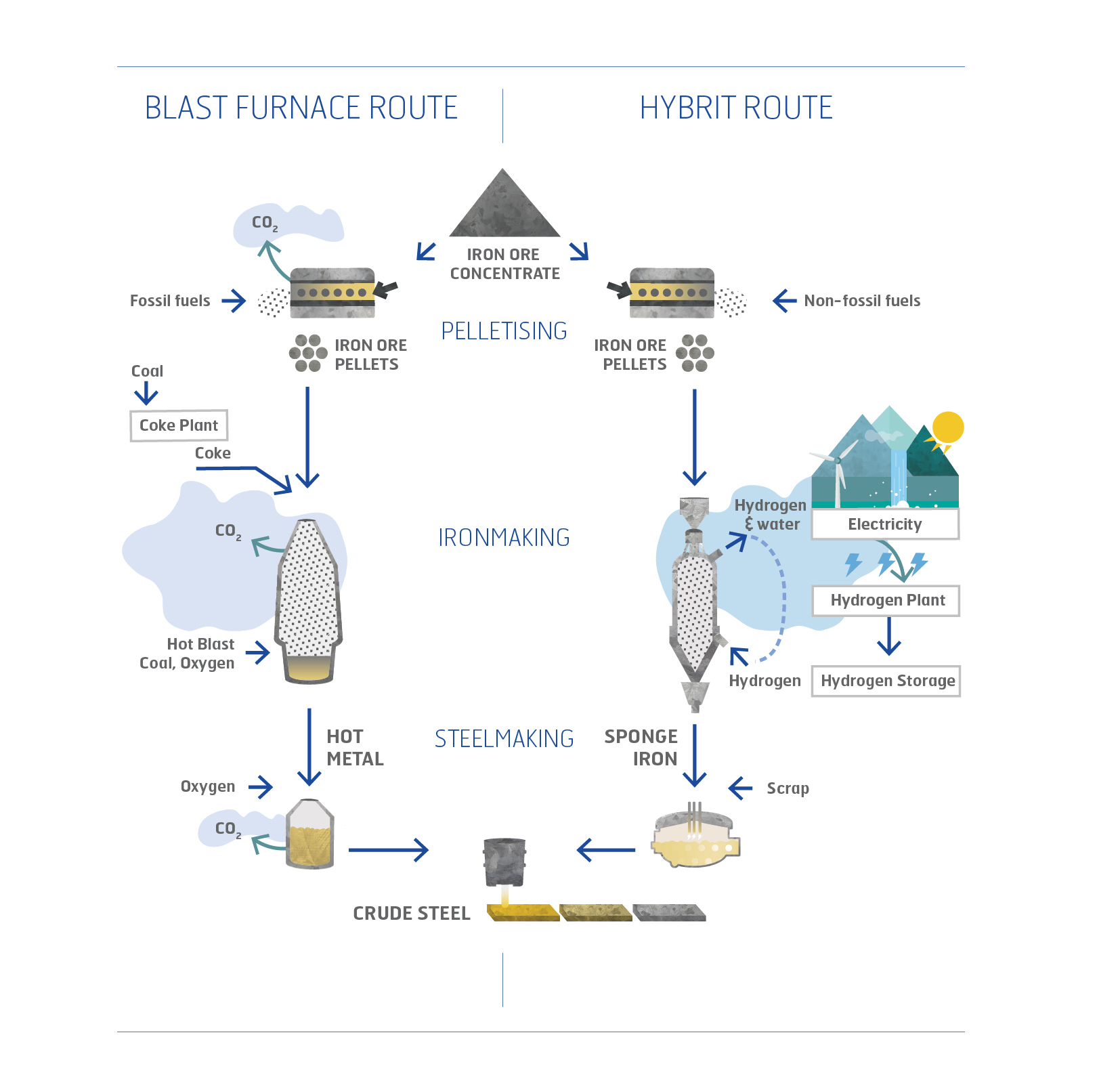
The amount of hydrogen needed is large as this paragraph from the Telegraph article says.
HYBRIT’s demonstration plant, for which an investment decision is due in 2022, will require 400MW of power just for the electrolysers to make the hydrogen. Sweden’s largest existing wind farm, Björkhöjden, produces just 288MW. Then to store the hydrogen, Vattenfall plans to build 120,000 m3 of lined underground storage, enough to store 100GWh worth of the gas.
Will they procure the electrolysers from the UK’s experts in the field; iTM Power? This innovative company is building the world’s largest electrolyser factory in Rotherham, which will be able to produce a GW of electrolysers in a year.
Conclusion
This well-written article in the Telegraph explains a lot about steel produced using hydrogen instead of coal.
Sweden has a lot of advantages at Lulea to create steel.
- The iron ore is mined locally.
- Sweden has ninety percent of Europe’s iron ore.
- Ships can sail to Lulea, which is at the top of the Baltic.
- There is gigawatts of zero-carbon electricity from the River Lule.
- They can build wind farms in the area, which has a low population.
It does look that they might export the iron ore as sponge iron, which can then be processed directly into steel products using electric arc furnaces.
EDF Determined To Play ‘Major Role’ In UK Flexibility As It Signs 50MW Battery Optimisation Deal
The title of this post is the same as that of this article on Energy Storage News.
This is the opening two paragraphs.
EDF is set to optimise Gresham House Energy Storage Fund’s 50MW Wickham Market lithium-ion battery site.
The French energy giant will use its Powershift platform to optimise the asset to deliver optimal value and minimise battery degradation at the site in Suffolk, England.
This is a paragraph from the article.
Recently, EDF has signed a number of agreements with battery storage owners, including to optimise SWGT‘s 30MW utility-scale battery earlier in December. The company is also working to build up its own battery portfolio, investing in cleantech startup PowerUp to support its 10GW of storage by 2035 ambition.
Note.
- I suspect in this section of the article, whoever wrote it, doesn’t know a MW from a MWh or a GW from a GWh. Storage or capacity should be measured in GWh not GW.
- SWGT would appear to be Still Waters Green Technology, who are building the 30 MW battery near Swindon.
- EDF purchased Pivot Power in June 2020.
It seems to me that EDF Energy are moving fast into both building and optimising energy storage.
Conclusion
Brexit seems to making little difference to EDF’s plans to invest in the UK.
But then we have the potential for the generation of Gigawatts of offshore wind, that is less of a resource for France.
 The Anonymous Widower