Electricity Networks Accelerate Potential Connection Dates Of Over 200 Clean Energy Projects
The title of this post, is the same as that of this press release from National Grid.
This is the sub-heading.
7.8GW of clean energy projects, more than double the output of Hinkley Point C nuclear power station, have had their connection offer dates brought forward by up to 10 years through the Technical Limits programme, which is allowing projects to connect to lower voltage distribution networks prior to reinforcement of the high voltage transmission network.
These are the first two paragraphs.
Networks have so far sent offers to 203 projects totalling 7.8GW with an average connection acceleration of 6.5 years. In total 393 projects are eligible for the programme with the further 190 projects able to receive accelerated offers once they have progressed through the connection offer process. Last month a solar farm near Bridgwater in Somerset became the first project to be energised under this scheme. Horsey Levels solar farm, which will provide clean energy for 10,000 homes annually, connected to National Grid’s electricity distribution network significantly ahead of its original planned connection date. This initial acceleration has been delivered in the first phase of the Technical Limits programme, with further phases and analysis planned.
Technical Limits, a collaborative project from National Grid Electricity Transmission, Energy Networks Association, the Electricity System Operator and the Distribution Network Operators (DNOs) forms part of the ongoing collaborative industry efforts, together with Ofgem and government, to speed up and reform connections to the grid. Scottish Transmission and Distribution network owners have been involved in developing the Technical Limits programme and are in the process of rolling out the programme in their license areas also.
Note.
- National Grid seem to measure large amounts of power, with respect to Hinkley Point C nuclear power station, which will have an output of 3.26 GW.
- The Technical Limits programme seems to be a sensible idea.
- Was the idea thought up by National Grid or is it an idea borrowed from another country?
- If it allows another 7.8 GW of clean electricity projects to be connected an average of 6.5 years earlier, then there can’t be much wrong with the idea.
- Horsey Levels solar farm is to the East of the M5, just to the North of Bridgwater.
I shall be following the roll-out of National Grid’s Technical Limits programme, as more clean power projects are connected to the grid.
National Grid And Innovation
This is another post about innovation at National Grid.
Others include.
- £9.2m Electricity Research Project To Save 39,000 Tonnes Of C02 Gets Go-Ahead, which talks about modifying transmission lines to carry more electricity. This means, that theoretically, we’ll need less and smaller transmission lines.
- £400k For National Grid Innovation Projects As Part Of Ofgem Fund To Help Shape Britain’s Net Zero Transition, which talks about Ofgem grants to fund innovation.
- National Grid Fast-Tracks Overhead Line Upgrade Project To Help Accelerate Connection Dates Of 175 Clean Energy Projects, which describes acceleration of projects.
- National Grid To Accelerate Up To 20GW Of Grid Connections Across Its Transmission And Distribution Networks, which also describes acceleration of projects.
- National Grid Goes Carbon-Free With Hydrogen-Powered Substation Trial, which describes work to use hydrogen as back-up power for substations.
- University Of Manchester And National Grid Team Up To Develop SF6-Free Retrofill Solution For Electricity Network, which describes a project to remove SF6 from the grid. SF6 is a greenhouse gas.
- National Grid Installs LineVision Sensors To Expand The Capacity Of Existing Power Lines, which describes an interesting idea from the United States.
- National Grid ESO And Reactive Technologies Launch Flagship Inertia System To Measure Grid Stability, which describes an innovative Spanish way to measure grid stability.
Note.
- I have included projects, that accelerate connection of new projects to the grid.
- Does National Grid benefit from operating grids in the UK and US, as it gets offered the best technology from both sides of the Pond?
National Grid seem to be big innovators.
Mercia Power Response & RheEnergise Working Together To Build Long Duration Energy Storage Projects In The UK
The title of this post, is the same as that as this news item from Mercia PR.
As it is from the 16th of August last year, I wonder why my Google Alert didn’t pick it up.
This is the sub-heading.
Mercia Power Response, a key provider of flexible power response services to the UK grid, has signed an agreement with RheEnergise to explore the potential deployment of RheEnergise’s new and innovative form of long-duration hydro-energy storage, known as High-Density Hydro® (HD Hydro).
These are the first three paragraphs.
Mercia Power Response, a key provider of flexible power response services to the UK grid, has signed an agreement with RheEnergise to explore the potential deployment of RheEnergise’s new and innovative form of long-duration hydro-energy storage, known as High-Density Hydro® (HD Hydro). Mercia Power Response (“Mercia PR”) and RheEnergise will work together to identify suitable sites for additional HD Hydro storage projects. The two companies’ initial focus will be the feasibility of getting 100MW of HD Hydro in commercial operation by 2030 by utilising Mercia PR’s existing grid connections.
With 40 sites having a combined capacity of 263MW and a number of sites under development and construction over the next 5-10 years, Mercia PR believes that RheEnergise’s HD Hydro storage technology would be a complementary, low carbon solution to its operating portfolio.
Additionally, Mercia PR’s industry partners bring market expertise in energy trading and forecasting, helping RheEnergise to optimise grid-connected energy storage projects.
Note.
- The average size of Mercia PR’s batteries would appear to be 6.5 MW.
- Working on the often-used two-hour duration, that would be a storage capacity of 13 MWh.
- I suspect some of Mercia PR’s sites will be more suitable for lithium-ion batteries and some will be more suitable for RheEnergise’s HD Hydro systems.
- I have witnessed local Nimbys objecting to lithium-ion systems on grounds of the fire risk.
- I am fairly sure, that the National Grid will be able to cope with both lithium-ion batteries and RheEnergise’s HD Hydro systems.
- I suspect Mercia PR’s industry partners, with their market expertise in energy trading and forecasting, could turn a small wind or solar farm into a nice little earner.
This looks to be a good fit between two innovative companies.
Ireland Charts Course For 37 GW Offshore Wind Development
The title of this post, is the same as that of this article on offshoreWIND.biz.
This is the sub-heading.
Irish Minister for the Environment, Climate and Communications, Eamon Ryan, has launched the Future Framework for Offshore Renewable Energy, which provides a roadmap for Ireland to deliver 37 GW of offshore wind by 2050.
This is the introductory paragraph.
The framework sets out the pathway Ireland will take to deliver 20 GW of offshore wind by 2040 and at least 37 GW in total by 2050. Critically, it also provides the evidence base for Ireland’s offshore renewable energy (ORE) targets.
This document from the UK Government, which is called Offshore Wind Net Zero Investment Roadmap, says this.
With the highest deployment in Europe, we have proved that offshore
wind can be delivered at ever increasing scale whilst decreasing the
costs to consumers.
The UK has a world-leading ambition to deploy up to 50GW by 2030,
with up to 5GW coming from floating offshore wind.
Irish ambitions look to be more or less in line with the UK’s.
These are some further thoughts.
Ireland Interconnectors
These are interconnectors connecting Ireland to the UK and Europe.
- Celtic Interconnector – 700 MW – Between the southern coast of Ireland and the north-west coast of France.
- East-West Interconnector – 500 MW – Between Portan in Ireland to Shotton in Wales.
- Green Link – 500 MW – Between County Wexford and Pembrokeshire.
- Moyle Interconnector – 500 MW – Between Scotland and Northern Ireland.
If Ireland is going to install 37 GW of offshore wind, as opposed to about 4.7 GW in total generation now, I suspect Ireland will need more interconnectors or industries, that need a lot of GWs.
RheEnergise To Build First-Of-A-Kind Hydro Storage System
The title of this post, is the same as that of this article on Power Technology.
This is the sub-heading.
A demonstrator of the company’s long-duration hydro-energy storage system will be constructed at Sibelco’s Devon mine.
These are the first two paragraphs.
UK hydro-energy storage company RheEnergise is to build a first-of-a-kind demonstrator of its long-duration hydro-energy storage system at Sibelco’s mining operations at Cornwood, near Plymouth, Devon. The construction of the demonstrator will start soon, with commissioning scheduled in September.
The power generated by RheEnergise’s HD Hydro demonstrator, which has a peak power production of 500kW, will support Sibelco’s mining operations at times of high energy demand and help the company decarbonise its operations. The Cornwood site produces kaolin, mainly for sanitary ware, ceramics, tiles and industrial applications.
I have some thoughts.
A Short Construction Time
If RheEnergise’s timescale is correct and it is the same in RheEnergise’s original press release, then I can draw the following conclusions.
- Five months is a short construction time.
- I would suspect that the system can be built from readily available components.
- RheEnergise’s HD Hydro system, which uses a fluid with a specific gravity of 2.5 can work with standard pipes and turbines.
I wouldn’t be surprised, that the only difference between RheEnergise’s system and a standard water-based hydro system is the fluid and a few settings on the control system.
It might even be possible to check that the system works by using water as the storage fluid.
But that would of course shorten the testing time.
Could An Existing Pumped Storage System Be Uprated With RheEnergise’s Fluid?
Consider
- There are only a few small pumped hydro systems.
- The RheEnergise system needs to be sealed.
- The storage capacity would be raised by 2.5 times.
It is an interesting idea, but could be possible in some cases.
What Will Be The Storage Capacity Of The Sibelco System?
This is not stated, but typically a battery system has a duration of two hours.
So that would give a capacity of 1 MWh.
Could RheEnergise’s HD Hydro System Back Up A Wind Or Solar Farm?
Consider.
- Batteries are always a good addition to a wind or solar farm, as they stabilise the output.
- A lot would depend on the possible size of the RheEnergise system battery.
- The location of the wind farm is probably important.
An onshore wind farm on top of a hill might be an ideal candidate.
Conclusion
RheEnergise could be installed in a lot of sites.
Octopus Energy Invests In Floating Offshore Wind Tech Company
The title of this post, is the same as that of this article on offshoreWIND.biz.
This is the sub-heading.
Octopus Energy’s generation arm has invested in US-headquartered Ocergy to boost the development of floating offshore wind farms globally.
These are the first three paragraphs.
According to Octopus, Ocergy has an innovative approach to designing and manufacturing floating foundations, reducing the time and cost of building them.
Ocergy is pioneering a hyper-local supply chain approach, working with local manufacturers and creating green jobs in the areas where the wind turbines are installed, said the company.
Further efficiencies are unlocked through Ocergy’s lighter and modular designs which make the turbine foundations easy to transport and assemble at their final destination, according to the press release.
This page on the Ocergy web site contains the press release, mentioned in the article.
These are some sentences from the press release.
- Ocergy, which is headquartered in the US and has operations in France, is pioneering a hyper-local supply chain approach, working with local manufacturers and creating green jobs in the areas where the turbines are installed.
- Further efficiencies are unlocked through Ocergy’s lighter and modular designs which make the turbine foundations easy to transport and assemble at their final destination.
- Floating foundations are used in areas with coastlines that are too deep for foundations that are fixed to the seabed. Around 80% of global offshore wind resources are located in deep waters, underscoring this technology’s vast untapped potential.
- It comes as governments across the globe have set ambitious targets for floating offshore wind. The UK alone is targeting 5 GW of floating offshore wind capacity by 2030.
I certainly like their approach.
believe that innovative designs and streamlined manufacturing will play a large part in installing the large amount of floating wind, that is planned by governments worldwide.
I also believe that because of the repetitive nature of the building of these floating structures, innovative project management software and systems will be developed.
I certainly have my own ideas for that!
National Grid Shares Proposals For Green Electricity Projects In Lincolnshire And West Norfolk, Needed To Boost Home-Grown Energy Supplies And Progress Towards Net Zero
The title of this post, is the same as that of this press release from National Grid.
These four bullet points, act as sub-headings.
- National Grid is inviting communities in East Lindsey, Boston and South Holland in Lincolnshire, and King’s Lynn and West Norfolk, to view proposals for two new primarily offshore electricity infrastructure projects.
- National Grid will consult communities from 23 April – 17 June to introduce the proposed project and ask for local peoples’ opinions.
- Eastern Green Link 3 (EGL 3) and Eastern Green Link 4 (EGL 4) will be able to transport enough clean energy generated in Scotland to power up to four million homes in the Midlands and South of England.
- The projects form part of The Great Grid Upgrade, the largest overhaul of the grid in generations, with new infrastructure across England and Wales helping the UK to meet its net zero ambitions, reduce its reliance on fossil fuels and contribute to lower energy bills over the long-term.
These five paragraphs outline the two projects.
National Grid is inviting communities to comment on early proposals for two green electricity infrastructure projects which will help deliver the UK’s energy security strategy and net zero targets.
The eight-week initial consultation, which begins on 23 April, shares proposals for Eastern Green Link 3 (EGL 3) and Eastern Green Link 4 (EGL 4) projects – two new, primarily subsea high voltage direct current (HVDC) electricity links, with associated infrastructure, between Scotland and England.
National Grid Electricity Transmission (NGET) is jointly developing EGL 3 with SSEN Transmission (SSEN) and EGL 4 with SP Energy Networks (SPEN).
EGL 3 would run from Peterhead, Aberdeenshire, under the North Sea via marine cables to a potential landfall location on the Lincolnshire coastline, either at Theddlethorpe or Anderby Creek. EGL 4 would run from Westfield, Fife, also via marine cables under the North Sea to the same landfall location as EGL 3.
After making landfall, both projects’ cables will run underground for approximately 100km to two proposed converter stations in the Walpole, King’s Lynn and West Norfolk, area. Underground cables would then connect the converter stations to the transmission network via a new proposed substation, also within the Walpole area.
Note.
- These would appear to be early proposals.
- National Grid appear to be planning and consulting on two interconnectors at once.
- There would appear to be a lot of underground cable on land. But then the cables will be dug into good Fenland soil.
- All the electrical gubbins seem to be in the Walpole area.
These paragraphs invite people to comment.
Throughout our initial consultation, we are holding a series of face-to-face events to consult on the electrical infrastructure required in England.
Our consultation events are being held across the project area. Information about our proposals will be on display and copies of maps and technical documents will be available to view. Members of the project team will be available to talk through our proposals and answer any questions.
National Grid have also announced dates of when public information events are being held.
- Tuesday 30 April 2024 – 2pm-7pm – Dunes Complex, Central Promenade, Mablethorpe, LN12 1RG
- Wednesday 1 May 2024 – 2pm-7pm – Anderby Village Hall, Sea Road, Anderby, Skegness, PE24 5YD
- Thursday 9 May 2024 – 12:30pm – 6pm – Alford Corn Exchange, 9 Market Place, Alford, LN13 9EB
- Monday 13 May 2024 – 2pm-7pm – Leverington Village Hall, Gorefield Rd, Leverington, Wisbech, PE13 5AT
- Wednesday 15 May 2024 – 2pm-7pm – Eastville, Midville and New Leake Village Hall, Station Rd, Eastville, PE22 8LS
- Thursday 16 May 2024 – 2pm-7pm – Poachers Country Hotel, Swineshead Road, Kirton Holme, PE20 1SQ
- Monday 20 May 2024 – 2pm-7pm – Walpole Community Centre, Summer Close, Walpole St Andrew, PE14 7JW
- Wednesday 29 May 2024 – 2pm-7pm – The Holbeach Hub, Boston Rd South, Holbeach, PE12 7LR
- Wednesday 5 June 2024 – 2pm-7pm – Burgh le Marsh Village Hall, Jacksons Lane, Burgh le Marsh, Skegness, PE24 5LA
I would have hoped, that some of the venues would have been easier to get to by public transport.
I have some thoughts and observations.
What Will Be The Capacity Of Green Link 3 And Green Link 4?
I can find references to the capacity of Eastern Green Links 1-4 and it appears that all four have a capacity of 2 GW.
A Map Of Green Link 3 And Green Link 4
I have found this map of Green Link 3 and Green Link 4.

National Grid are going to be busy, as they’re also building Green Link 1 and Green Link 2.
Will Green Link 3 And Green Link 4 Share A Route Between The Coast And Walpole?
There is only one green HVDC onshore cable on the map. But surely laying two 2 GW cables in the same trench will cost less, than digging two cable routes.
Looking at the three converter stations would appear to confirm that Green Link 3 and Green Link 4 share a route.
Will Landfall Be At Theddlethorpe Or Anderby Creek?
This Google Map shows the coast between Theddlethorpe and Anderby Creek.
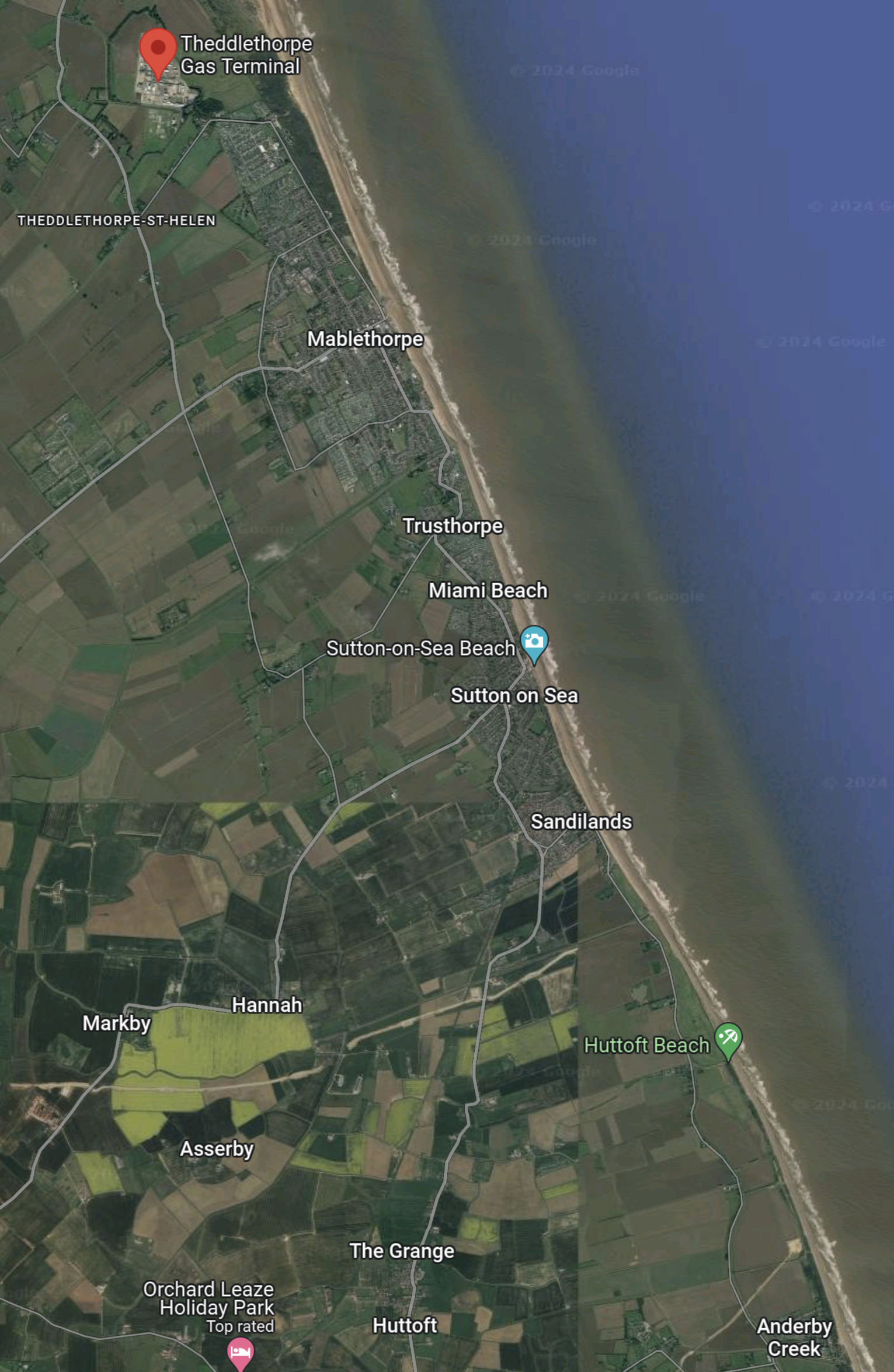
Note.
- The decommissioned Theddlethorpe gas terminal is indicated by the red arrow.
- The seaside resort of Mablethorpe lies between the two possible landing sites.
- Anderby Creek is in the South-East corner of the map.
This second Google Map shows the Theddlethorpe Gas Terminal and the North of Mablethorpe.
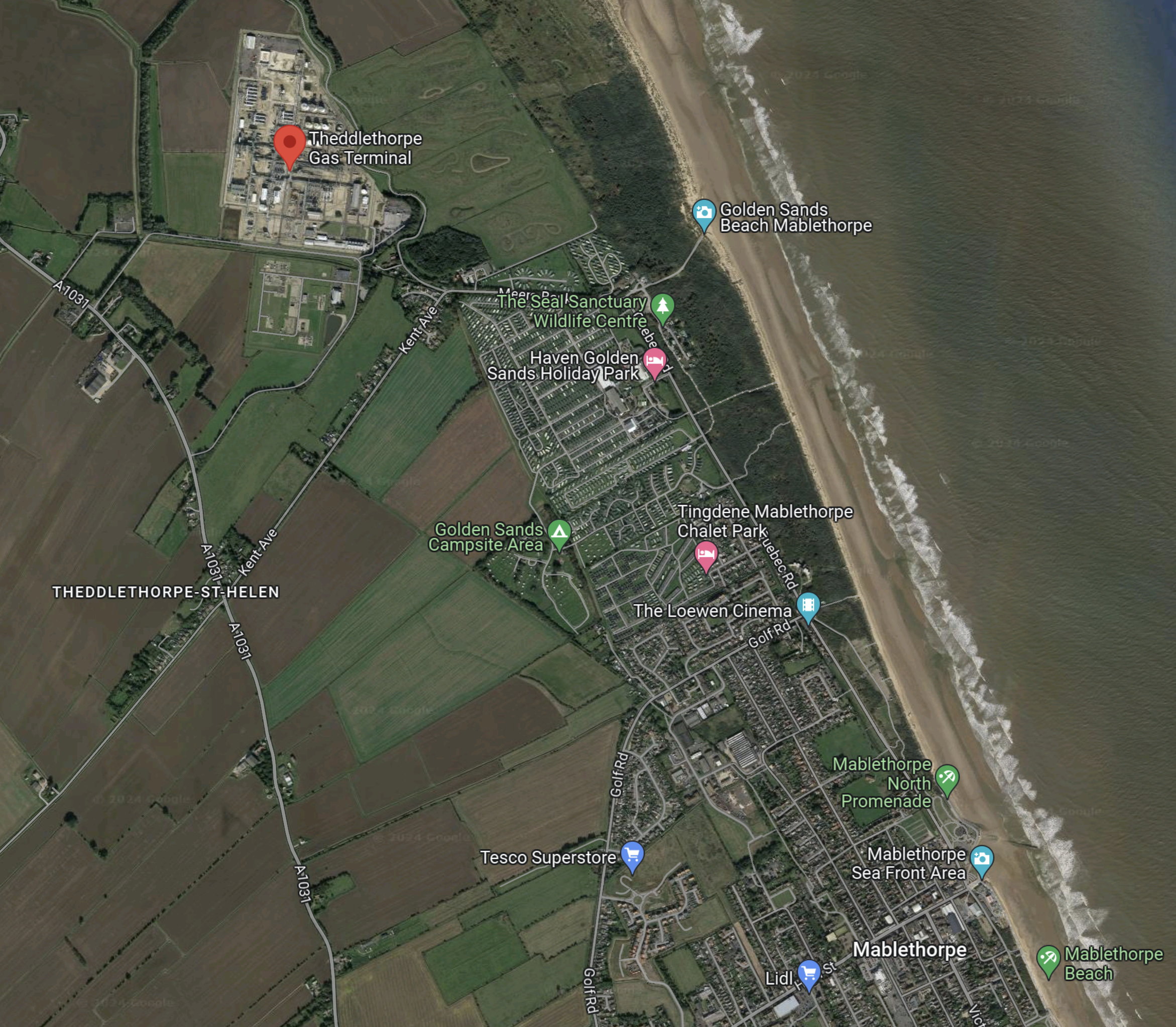
Note.
- The decommissioned Theddlethorpe gas terminal is indicated by the red arrow.
- Mablethorpe beach appears to be on a high quality.
Both sites would appear to be strong possibilities.
Both sites have plenty of space, but the Theddlethorpe gas terminal is a large brownfield site.
The Anderby Creek site would probably be a shorter underground cable across Lincolnshire.
The Triton Knoll Wind Farm
The Wikipedia entry for the Triton Knoll wind farm starts with these two paragraphs.
Triton Knoll Wind Farm is an 857 MW round 2 offshore wind farm 33 kilometres (21 mi) off the coast of Lincolnshire, in the North Sea, England.
RWE Npower Renewables were awarded the lease to the development area in 2003. The offshore elements of the wind farm of up to 1200MW power gained planning consent in 2013; RWE reduced the scope of the wind farm to 900MW or under in 2014, to reduce cost per MW.
Note.
- The wind farm was commissioned in January 2022.
- The wind farm cables make landfall at Anderby Creek.
- They then travel underground to Bicker Fen substation.
This Google Map shows Bicker Fen and Anderby Creek.
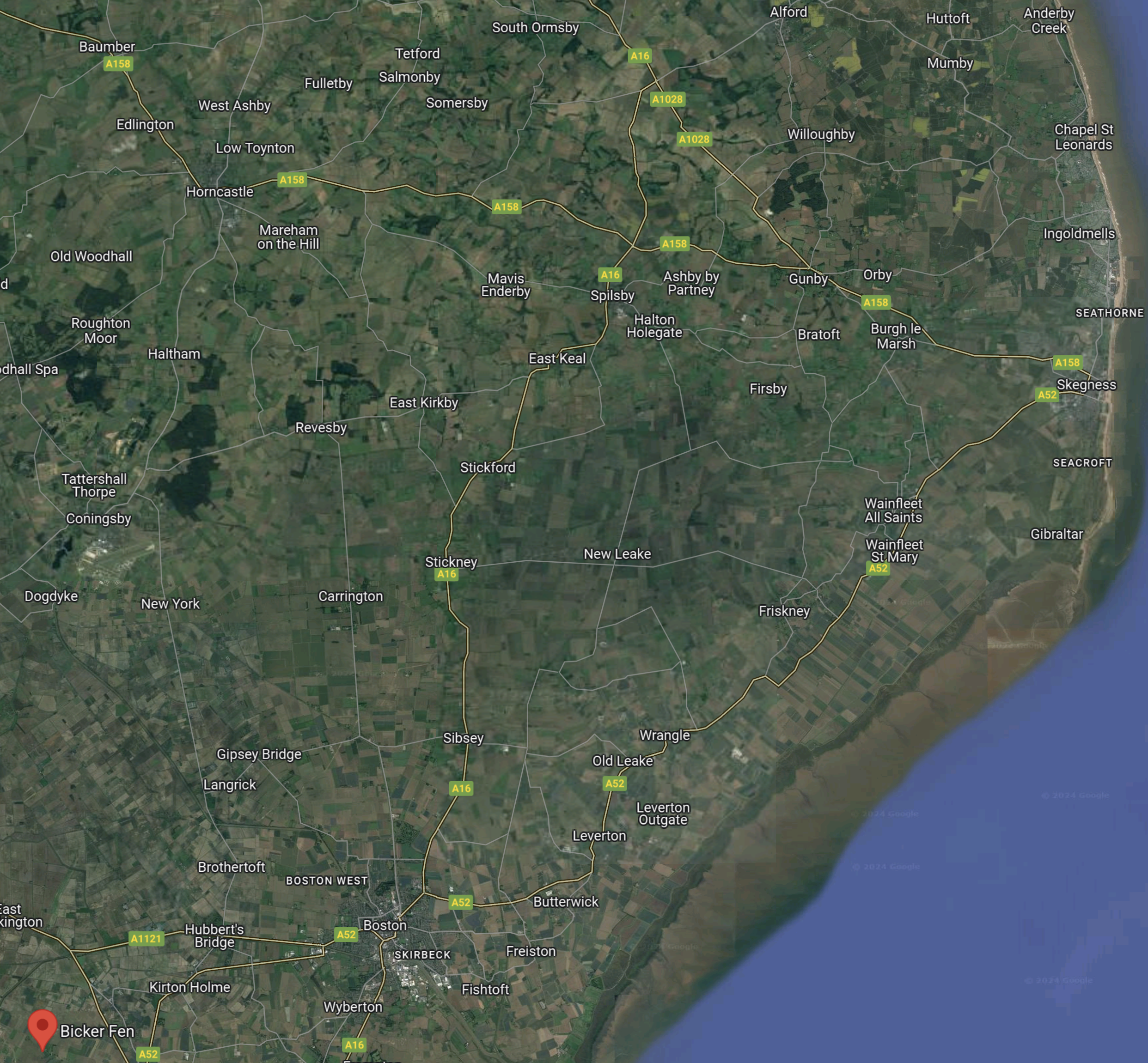
Note.
- Bicker Fen substation is in the South-West corner of the map and is indicated by a red arrow.
- Anderby Creek is in the North-East corner of the map.
- The cable is underground.
- This page on the Murphy Group website, describes the work the company did to install the cables.
- It appears from the Murphy document, that there are six cables between Anderby Creek and Bicker Fen.
This Google Map shows Anderby Creek.
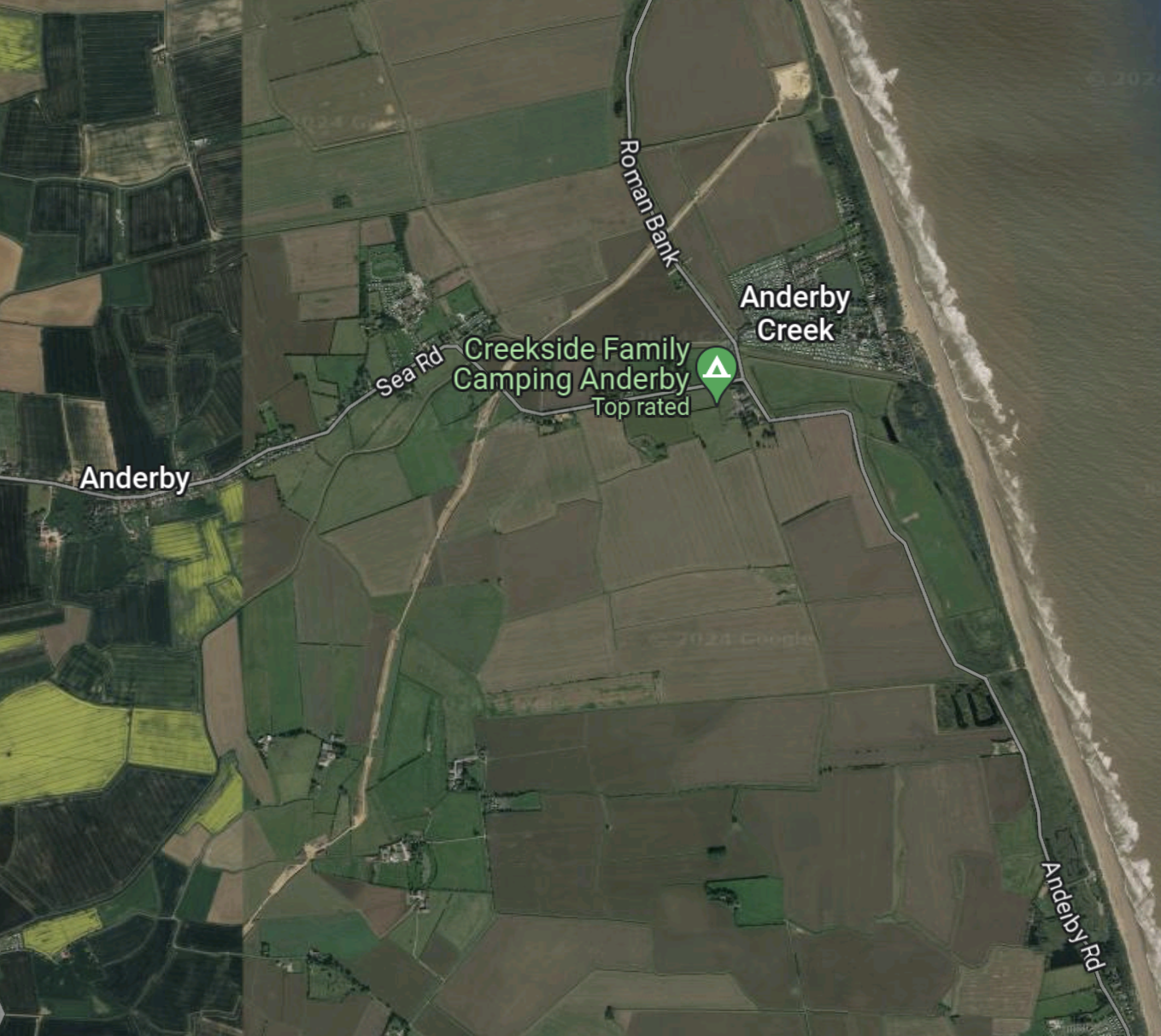
Could the scar across the land to the West of Anderby Creek, be the connection to the offshore Triton Knoll wind farm?
I think it is! And I also think that it can carry more than just the 857 MW Triton Knoll wind farm!
I am suspicious, that one of Baldrick’s ancestors has been at work and the Triton Knoll export cable system could be used to connect Green Link 3 and Green Link 4 to Bicker Fen and Walpole substations.
This would surely allow Scottish wind power to be sold to Denmark and then sold onward to Germany.
The VikingCCS Project
The VikingCCS project is a carbon capture and storage project, that is proposed to be based at the decommissioned Theddlethorpe gas terminal.
The VikingCCS project has a web site.
Would the use of the Theddlethorpe gas terminal mean that it is more likely that Green Link 3 and Green Link 4 will make a Southern landfall at Anderby Creek?
Will There Be A Connection To Viking Link?
The Viking Link is a 1400 MW at 525 KV electricity interconnector between Bicker Fen in Lincolnshire and Revsing in Jutland, Denmark.
This Google Map, shows the location of Bicker Fen, about halfway between Boston and Sleaford.

This second map shows the position of the current Walpole substation with respect to the Wash.
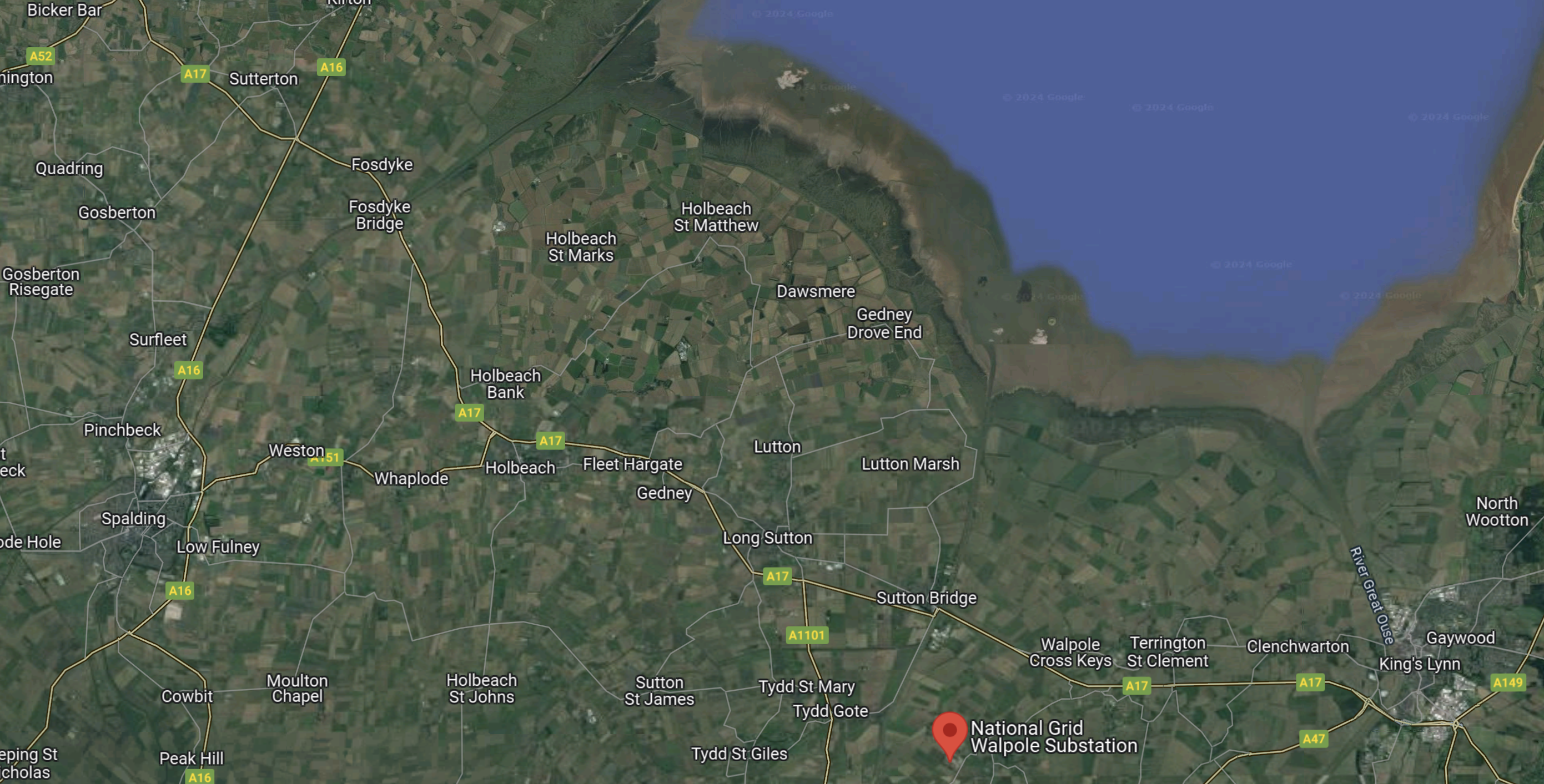
Note.
- Bicker Fen is in the North-West corner of the map.
- The current Walpole substation is marked by the red arrow.
- King’s Lynn is in the South-East corner of the map.
I suspect, if National Grid wanted to connect Green Link 3 and Green Link 4 to the Viking Link, then this would be possible.
If the Viking Link were to be connected to Green Link 3 and Green Link 4, this would allow surplus Scottish renewable energy to be sent to Denmark and on to Germany.
Green Link 3, Green Link 4 And Viking Link Appear To Be Underground In Lincolnshire
I can’t find any trace of overhead cables for the Viking Line in Lincolnshire and the press release says this about Green Link 3 and Green Link 4.
After making landfall, both projects’ cables will run underground for approximately 100km to two proposed converter stations in the Walpole, King’s Lynn and West Norfolk, area.
The connection to the Triton Knoll wuind farm is also underground.
It does appear that National Grid, are going for a Nimby-friendly approach for cables between Walpole and the coast.
Hopefully putting the cables underground will save money in legal arguments and fees.
BW Ideol Unveils Mass Production-Ready Floating Wind Foundation
The title of this post, is the same as that of this article on offshoreWIND.biz.
This is the sub-heading.
France-based BW Ideol has unveiled its standardised floating foundation product and a blueprint for mass production that could drive costs down across projects.
This is the first paragraph.
With over 22 GW already awarded in Scotland, around 8 GW in the US, and several GW currently being awarded or in the tendering phase elsewhere in the world, the floating wind is now entering an industrialization phase, said BW Ideol.
It looks like the French have come up with a solution that’s needed.
These are previous posts about BW Ideol.
- BW Ideol And Holcim To Explore Use of Low-Carbon Concrete In Floating Offshore Wind
- BW Ideol, ABP To Explore Serial Production Of Floating Wind Foundations At Port Talbot
There is also this video of proposed serial production of BW Ideol floaters at the Port of Ardersier.
This Google Map show the area of Scotland to the North-East of Inverness Airport.

Note.
- Inverness Airport indicated by the red arrow.
- Ardersier village in the middle of the map on the bay.
- Fort George is at the North end of the bay.
The Port of Ardersier is the large slab of concrete in the North-East corner of the map, the Carse of Ardersier marked below it.
BW Ideol are claimining they can build one floater a week or one GW a year.
World’s First Energy Island Starts Taking Shape – Video
The title of this post, is the same as that of this article on offshoreWIND.biz.
This is the sub-heading.
The first of the 23 caissons being built for Princess Elisabeth Island in Vlissingen, the Netherlands, is almost finished and will be immersed in the North Sea this summer. The artificial Belgian energy island is a world first.
Note.
- This web site is the web site of Belgium’s Princess Elisabeth energy island.
- This YouTube video describes the Princess Elisabeth island.
The video shows the importance of this project, that will have interconnectors to both the UK and Denmark, and connections to a large number of offshore wind farms.
These two paragraphs describe the roll-out of the caissons.
When the caissons are ready, a semi-submersible vessel will transport them further down the harbour, where they will be placed in the water and temporarily stored. They will then be moved to their final location in the North Sea this summer, weather permitting.
The caissons will form the outer walls of the energy island. The island itself will be created using approximately 2.3 million square metres of sand, extracted locally. The island will be finished in late 2026, when the electrical equipment can start to be installed. Contracts for this will be tendered this year.
These pictures show four Pheonix Caissons from Mulberry Harbours that are used as a museum in The Netherlands.







Nothing is new! But at least the Belgians won’t have to tow their caissons across the Channel under enemy fire.
A Video Description Of Princess Elisabeth Island
This web site is the web site of Belgium’s Princess Elisabeth energy island.
This YouTube video describes the Princess Elisabeth island.
From the video the following can be determined.
- The Princess Elisabeth island is 45 km. from the Belgian coast.
- An interconnector to the UK could come ashore at the site of the decommissioned Bradwell nuclear power station.
- An interconnector to Denmark could come ashore in Southern Jutland, just North of where the Viking Link connects to Denmark.
This map clipped from the video shows the location of Princess Elisabeth island.

Note.
- Belgium is shown in red.
- Istend is in the middle of the straight Belgian coast.
- The red dot between Belgium and the UK is Princess Elisabeth island.
- The interconnector to the UK could feasibly go to Bradwell.
- The interconnector to Denmark could go via a wind farm, which would explain the kink.
- Could the kink point be at the Dogger Bank, where there could be 20 GW of wind farms?
Has Belgium made a bid to dominate European energy distribution?
This Google Map shows the Belgian and English coast lines.
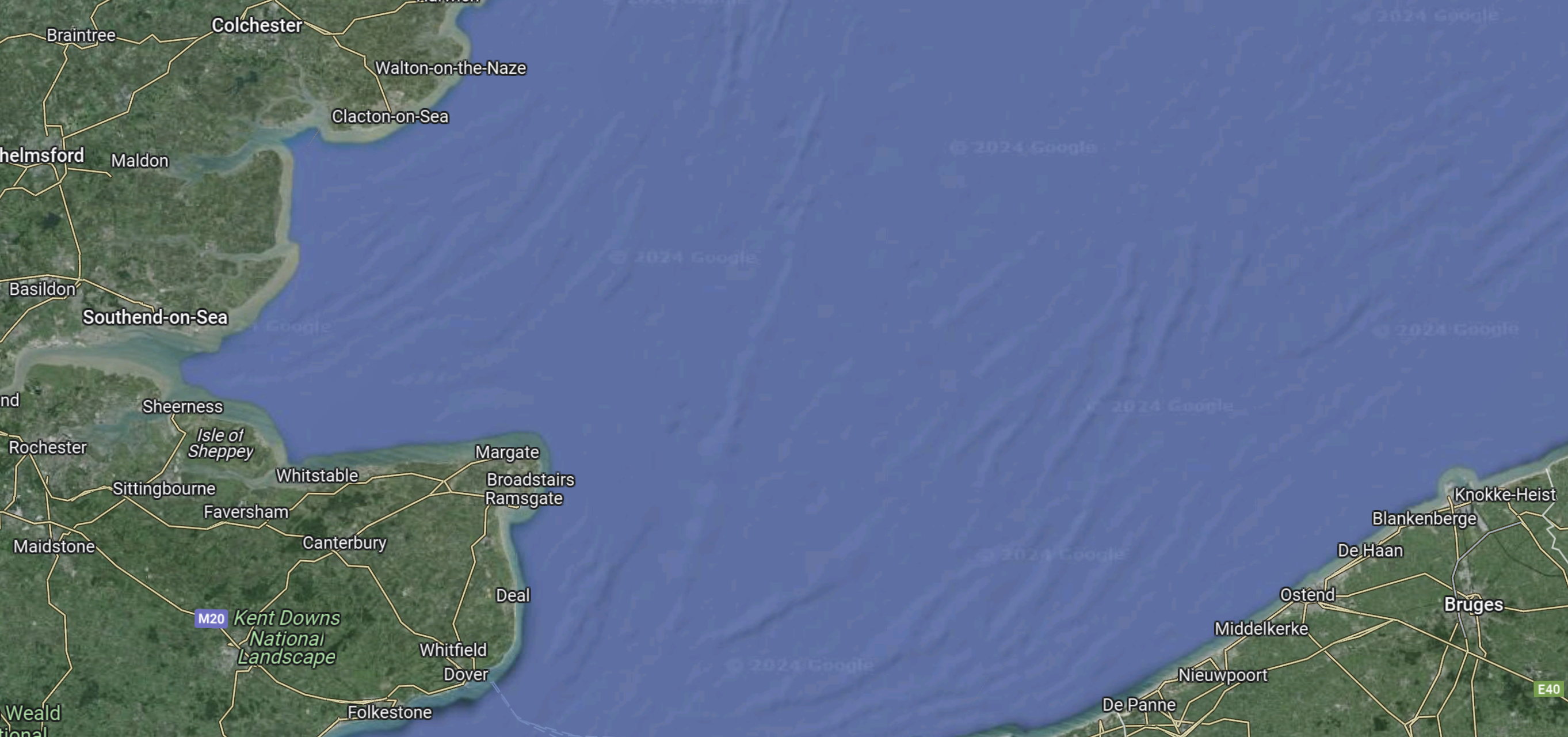
Note.
- Bradwell is on the coast to the North-East of Southend-on-Sea.
- As it used to be a nuclear power station site it still has an electricity connection to the grid.
- The Princess Elisabeth island is 45 km. from the Belgian coast at Ostend.
I estimate that a Bradwell and Princess Elisabeth island interconnector would be about 150 miles.
Denmark Launches Massive Offshore Wind Auction
The title of this post, is the same as that of this article on offshoreWIND.biz.
This is the sub-heading.
Denmark has opened a new offshore wind tender, the country’s largest ever, offering a minimum of 6 GW of new capacity spread over six wind farms, with the overplanting option allowing for 10 GW or more of new capacity to be added.
These are two paragraphs from the article.
The offshore wind farms must deliver at least 6 GW, and as a new element, there will be freedom to establish as much offshore wind as possible on the tendered areas, with the exemption of Hesselø with a maximum capacity of 1.2 GW.
If the market utilizes this freedom to optimize the usage of the areas, it could result in the construction of 10 GW offshore wind or more, the agency said.
Recently, some wind farms in the UK have been increased in size after the auction.
In Crown Estate Mulls Adding 4 GW Of Capacity From Existing Offshore Wind Projects, I note how 4 GW of overplanting could be employed to raise the total capacity from 4.6 GW to 8.6 GW.
So have the Danes decided to build expansion into the tender?
One of the wind farms in the auction is called Nordsøen I.
- It will be about 50 km. from the West Coast of Denmark.
- It appears it will have a capacity of at least 1 GW.
- It could connect to the shore, not far from where the Viking Link between Lincolnshire and Denmark connects to the Danish grid.
- There is a 700 MW interconnector between the area and Eemshaven in The Netherlands.
- There is 1.5 GW of overland transmission lines to Germany.
All these connections, increase energy security for Denmark, Germany, the Netherlands and the UK.
Could the Danes be building the Nordsøen I, so it could work with the all the connections in Southern Jutland and improve energy security?
 The Anonymous Widower