The Potential For Floating Solar In The UK
The title of this post, is the same as that of this article on Solar Power Portal.
I like the concept and I have written a few posts on the topic, which can be viewed from this link.
The application, I particularly like, is the use of floating solar on reservoirs, which in addition to producing energy, can reduce water evapotation and reduce the forming of algal blooms.
This Google Map shows the farm in the Queen Elizabeth II Reservoir, near Walton-on-Thames.
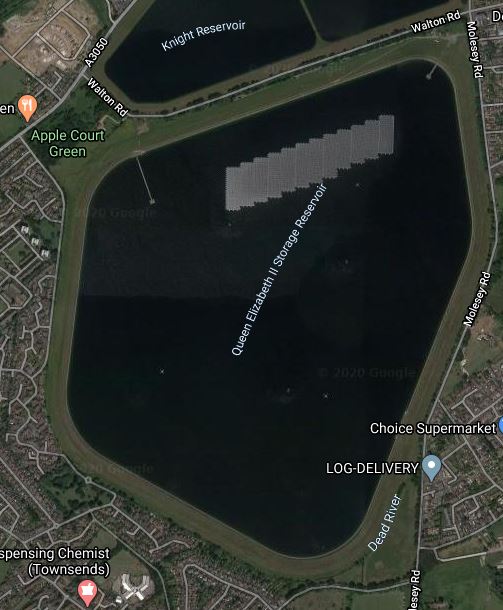
There is also this article in the Guardian, which is entitled World’s Biggest Floating Solar Farm Powers Up Outside London. It gives a good description of the project.
Conclusion
The article is a must-read and we need more floating solar in the UK, especially on reservoirs.
Principle Power Unveils New Floating Wind Foundations For 15 MW+ Turbines
The title of this post, is the same as that of this article on offshoreWIND.biz.
This is the sub-heading.
Principle Power has expanded its WindFloat portfolio by introducing two new semisubmersible floating wind foundation designs, called WindFloat TC and WindFloat FC, which are said to be optimised for 15 MW+ wind turbines.
A large picture and these two paragraphs introduce the new designs.
According to the company, the new designs are natural evolutions of the existing WindFloat technologies that support a wind turbine located on a column in the centre of the platform.
Designed to complement the existing perimeter column designs WindFloat T and WindFloat F, the new solutions share the same 4th generation design heritage and benefits.
Smart Hull Trim System
The article also mentions a Smart Hull Trim System in this sentence.
Some of these include a Smart Hull Trim system to maximise annual energy production and reduce loads.
I would assume that the Smart Hull Trim System, works very much like the control surfaces of an aeroplane or submarine to keep the craft straight and level.
On the Principle Power web site, the various WindFloats are described as follows.
- WindFloat T – Proven WindFloat® design, suitable for tubular construction.
- WindFloat F – A pontoon-based design suitable for flat panel construction.
- WindFloat TC & FC – Center column design solutions, optimized for 15MW+ turbines with stiff-stiff towers.
From work, I did in the 1970s, with two Cambridge University engineering professors, I reckon that the TC and FC designs will be the best.
Conclusion
Whatever way you look at it, a 15 MW+ floating wind turbine, when you consider they can have capacity factors in excess of 50 %, could be a very powerful electricity generator.
1.4GW Of BESS Capacity Could Be Co-Located With AR6 Winners
The title of this post, is the same as that of this article on Solar Power Portal.
These are the first two introductory paragraphs of the article.
Analysis from Modo Energy has revealed that renewable energy projects awarded contracts under the Contracts for Difference (CfD) Allocation Round 6 (AR6) could facilitate 1.4GW of co-located battery energy storage systems (BESS).
While BESS projects themselves cannot directly participate in the CfD auction, projects awarded contracts are able to co-locate with a battery. Following changes to the rules following Allocation Round 4, BESS co-location is now a far easier prospect for generators, and AR6 saw record high levels of awards for solar projects.
Modo Energy have used two rules to decide which projects will have a battery.
Modo Energy analysis suggests that 5GW of the 9.6GW of renewable energy capacity awarded contracts in AR6 could be suitable for, or has already revealed plans for, co-located battery storage. As a result, as much as 1.4GW of BESS capacity could be created as part of new renewable projects resulting from the AR6.
Using an average ratio of 60MW of BESS capacity for every 100MW of solar generation capacity, Modo Energy has calculated that 1GW of this potential BESS capacity could come from solar projects alone.
Longfield Solar Energy Farm
The article and related documents also say this about Longfield Solar Energy farm.
- This could be the largest battery to co-locate with renewables from this allocation round.
- The project does have a web site.
- The farm has a 399 MW solar array.
- The web site says that the project will store or export up to 500 MW to and from the grid.
- The project is being developed by EDF Renewables.
- The solar farm appears to be North-East of Chelmsford.
The project should be completed by 2027/28.
Conclusion
As time goes on, we’lll see more and more batteries of all kinds co-located with renewable resources.
Ireland Joins Forces With EIB For Offshore Wind Port Upgrades
The title of this post, is the same as that of this article on offshoreWIND.biz.
This is the sub-heading.
The European Investment Bank (EIB) and the Irish Department of Transport have established an advisory cooperation to assess capacity, demand and financing strategies for the development of port infrastructure for offshore wind projects in Irish waters.
These are the first two paragraphs.
Signed by the Irish Minister for the Environment, Climate, Communications and Transport, Eamon Ryan, and EIB Vice President Ioannis, the advisory cooperation aims to evaluate the scale and nature of investment needed to upgrade Irish ports.
The initiative is said to unlock an estimated EUR 30 billion in investment in offshore wind projects in the country which plans to have 20 GW of capacity installed by 2040 and 37 GW by 2050.
It looks to me, that the Republic of Ireland will become a big player in the production of electricity from offshore wind.
I also suspect that Northern Ireland will play its part too!
Centrica Strikes 200MW Lithuanian Green Power Deal
The title of this post, is the same as that of this press release from Centrica.
This is the sub-heading.
- Centrica Energy is set to take on the responsibility of managing and trading the renewable power generated from two wind farms and one solar farm in Lithuania for European Energy.
A couple of months ago, Centrica published this press release, which is entitled Centrica Acquires Owner Of Leading Digital Platform, Ignition.
The press release about the deal with European Energy has this quote from Kristian Gjerløv-Juel, Vice President of Renewable Energy Trading & Optimization at Centrica Energy.
We’re very pleased to continue building on our strong partnership with European Energy. We have set an incredibly ambitious target to expand our portfolio of third-party renewable assets to 30 GW by 2030.
Note that 30 GW, would more than power the UK,
Ir appears to me, that Centrica have decided that there is money to be made from good management of both electricity production and distribution.
SSE Announces Construction Of Aberarder Wind Farm
The title of this post, is the same as that as an advert on my online edition of The Times.
Click the advert and you get this page, with the title of this post.
This is the sub-heading.
Aberarder secured 15-year CfD in UK Allocation Round 5
These three paragraphs give more details of the wind farm.
SSE has taken a final investment decision to proceed with Aberarder Wind Farm in the Scottish Highlands, in a circa £100m investment boost for its onshore wind portfolio.
Construction of the 12 turbine, 50MW wind farm, which is wholly owned by SSE Renewables, will begin before the end of the year with completion scheduled for the end of 2026. The Aberarder project was successful in September 2023 in the UK’s fifth Contract for Difference (CfD) Allocation round, securing a 15-year contract for low-carbon power generation.
Located at Strathnairn near Inverness, on a natural plateau at an average of 700m above sea level, the Aberarder project site sits directly adjacent to the operational 94MW Dunmaglass Wind Farm, which is jointly owned by SSE Renewables and Greencoat UK Wind.
It would appear that a £100m investment in the Scottish Highlands will get you a fully-operational 50 MW wind farm.
These are my observations and thoughts.
SSE’s Project Overview Of Aberarder Wind Farm
These four paragraphs are SSE’s project overview from this page on the SSE Renewables web site.
The Aberarder Wind Farm project is located in Strathnairn near Inverness, on a natural plateau at an average of 700m above sea level. It will sit directly adjacent to the operational 94MW Dunmaglass Wind Farm, which is jointly owned by SSE Renewables and Greencoat UK Wind.
The project was developed by RES and consented by The Highland Council in April 2017. The consent allows for the construction of a 12-turbine onshore wind farm, with each turbine having a maximum tip height of up to 130m and is expected to have an export capacity of 49.9MW. SSE Renewables reached an agreement with RES to acquire Aberarder in October 2022.
In September 2023 Aberarder was successful in the UK’s fifth Contract for Difference (CfD) Allocation Round and was awarded a 15-year contract for low carbon power generation. SSE took a final investment decision to proceed with Aberarder Wind Farm, in a circa £100m investment in May 2024, construction is scheduled to begin before the end of 2024 with completion scheduled for the end of 2026.
Our focus is now on building strong and meaningful relationships with the local community surrounding the Aberarder Wind Farm. As a responsible developer and operator, we are looking forward to working closely with the community in surrounding area to fully realise the benefits of this exciting project.
Construction has now started and it would appear that in two years, the twelve-turbine wind farm will be producing power.
SSE’s Description Of Dunmaglass Wind Farm
These four paragraphs are SSE’s description from this page on the SSE Renewables web site.
Located to the south east of Inverness, on a natural plateau at an average of 700m above sea level, Dunmaglass is SSE’s highest wind farm to be constructed.
SSE acquired the project from RES in May 2013 and initial enabling works began in the summer of 2013 which included the upgrading of 11km of tracks and the construction of two timber deck bridges.
Highland contractor RJ McLeod was awarded the £16m main civil works contract in summer 2014.
Dunmaglass became fully operational in 2017.
This paragraph also illustrates the challeges of the It looks like the construction of the larger Dunmaglass wind farm.
The height at which Dunmaglass is located presented its challenges during construction and the winter months brought high winds and plenty of snow. The site was fully completed and handed to the operations team in 2017.
Surprisingly, the legendary Highland midges didn’t get a mention.
The Sale Of 49.9 % Of Dunmaglass Wind Farm To Greencoat UK Wind
This sub-heading outlines the sale.
In February 2019, SSE sold 49.9% of Dunmaglass to Greencoat UK Wind PLC as part of a deal in which Greencoat acquired a 49.9% stake in both Dunmaglass and the nearby Stronelairg wind farm.
This paragraph gives more details of the sale.
In February 2019, SSE signed agreements for the sale of 49.9% of Dunmaglass wind farm to Greencoat UK Wind Plc (“UKW”). This sale was part of a £635m deal in which Greencoat acquired a 49.9% stake in both Stronelairg and Dunmaglass wind farms. The stakes equate to 160.6MW (megawatts) of capacity, with an average valuation for the two wind farms of around £4m per MW. This valuation demonstrates SSE’s ability develop quality, low carbon assets and infrastructure vital to the GB energy market.
The interesting figure is that SSE was paid £4m per MW for the interest of 160.6 MW, that they sold.
Aberarder wind farm is a 50 MW wind farm and it appears that it will cost £100 million to build.
If after a couple of years of operation, the wind farm is worth £4 million per MW, then SSE have doubled their money.
Does this illustrate, why the professionals like SSE and Greencoat UK Wind invest in wind farms?
- SSE would have taken the risk, that they could build the wind farm.
- SSE have the engineering skillsto do an excellent job.
- Greencoat UK Wind are buying into a producing asset, with a known cash flow.
SSE also get more money to build more wind farms.
Where Are Aberarder And Dunmaglass?
This Google Map shows the site of Aberarder wind farm with respect to Inverness.
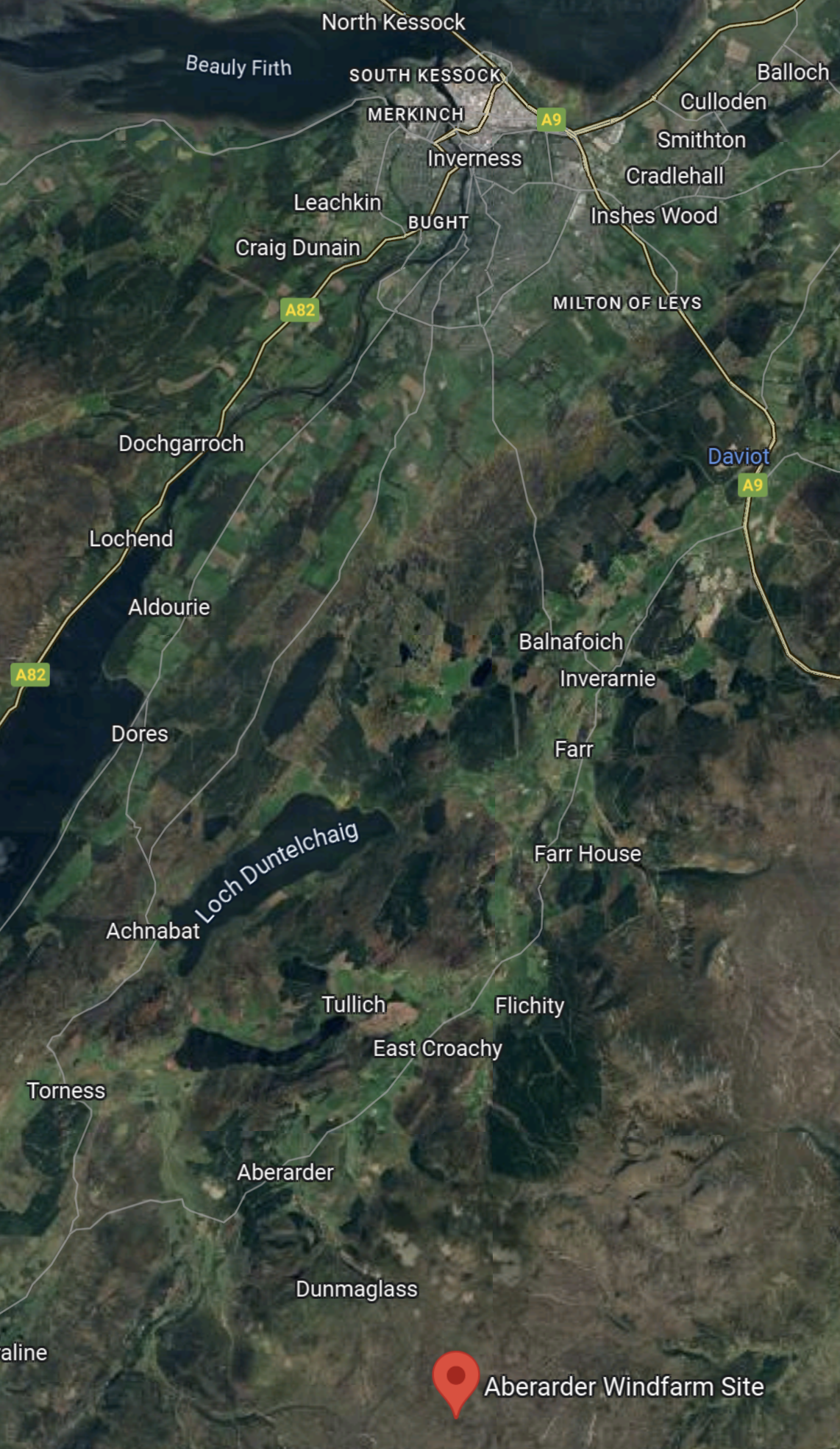
Note.
- Inverness is at the top of the map on the waters of the Solway Firth.
- Aberarder wind farm is marked by the red arrow.
- Aberarder is a hamlet to the North-West of the wind farm.
- Drumnaglass is a shooting estate to the North-West of the wind farm.
- Loch Duntelchaig is the main reservoir for Inverness.
This second Google Map shows the Drumnaglass wind farm.
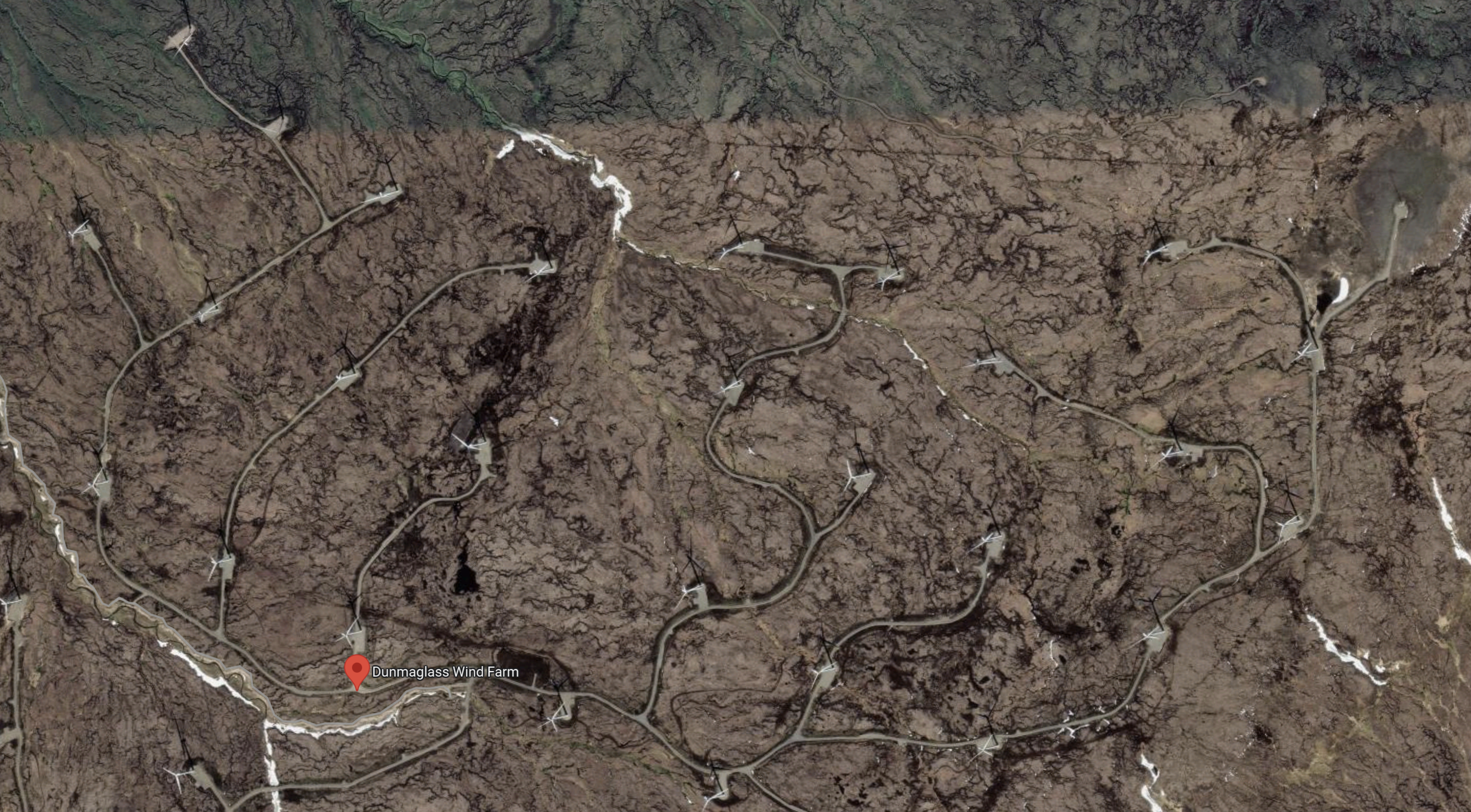
Note.
- Drumnaglass wind farm has 33 turbines and a capacity of 94.05 MW.
- There is a track network of 11 km. linking all the turbines.
- A good proportion of the turbines can be picked out on the map.
It would appear that Aberarder wind farm will lie to the South-East of this wind farm.
Aberarder Wind Farm To Fort Augustus
In Cloiche Onshore Wind Farm, I talked about the 130.5 MW Cloiche wind farm and its future construction to the East of Fort Augustus and Stronelairg wind farm.
This Google Map shows the position of Aberarder wind farm with respect to Ford Augustus.
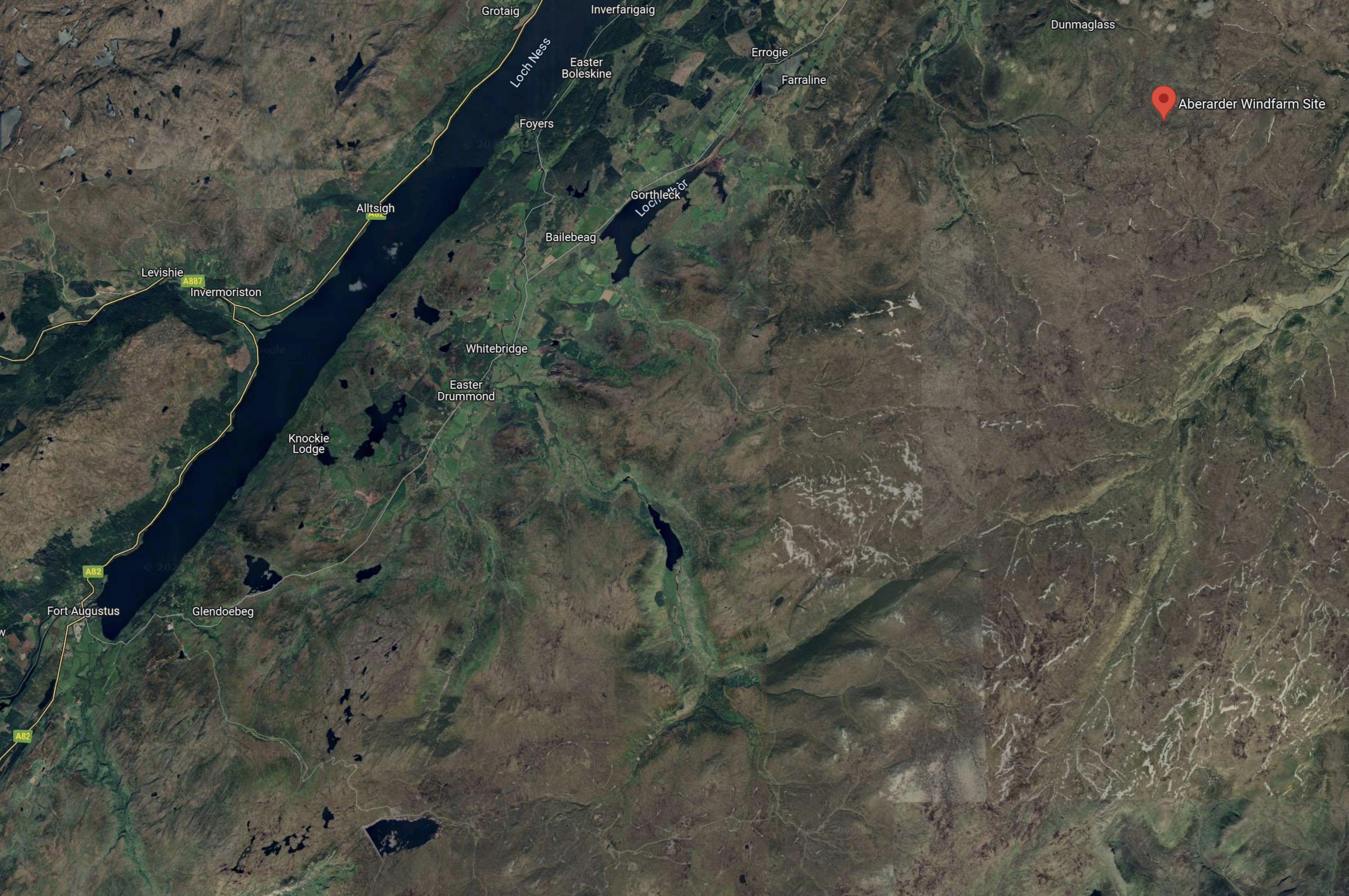
Note.
- Loch Ness runs across the North-West corner of the map.
- Fort Augustus and Stronelairg wind farm, are at the Southern end of the loch.
- The red arrow shows Aberarder wind farm.
- Foyers pumped hydro is on the Eastern bank of Loch Ness, at about the same latitude as the Aberarder wind farm.
- The lake at the bottom of the map, to the South-East of Ford Augustus, is the Glendoe Reservoir, that powers the Glendoe hydroelectric scheme.
There are certainly, a lot of SSE-owned and/or SSE-controlled assets in the area and I wouldn’t be surprised, if SSE integrated them more closely, or added a few more wind farms.
Why Are SSE Advertising The Start Of Construction?
SSE have been advertising for some time on The Times web site.
As they are not a retail energy company anymore, as they sold their retail business to OVO, the advertising, is probably about spreading a good corporate message and getting their strategy broadcast.
Slough Multifuel Energy-From-Waste Facility Begins Operations
The title of this post, is the same as that of this news item from SSE Thermal.
This is the sub-heading.
SSE Thermal and Copenhagen Infrastructure Partners (CIP), partners of a new energy-from-waste facility in Slough, have entered commercial operations ahead of schedule.
This section from the news item describes the operation of the plant.
Slough Multifuel will produce electricity and heat through burning waste-derived fuels made from various sources of:
- municipal solid waste
- commercial and industrial waste
- waste wood
The 55 MW facility will divert thousands of tonnes of waste away from landfill. It will convert it into a valuable source of energy. The facility is expected to process around 480,000 tonnes of residual waste each year. The station will support the UK Government’s strategy to reduce landfill waste and the export of waste.
Effectively, it is a sophisticated state-of-the-art incinerator, that has been built by Hitachi Zosen Inova.
In an ideal world, everything would be recycled and there would be no landfill or incineration.
But that would only be possible in a green fascist state.
Hawthorn Pit Solar Farm
This document from the Department of Business, Industry and Industrial Strategy lists all the Contracts for Difference Allocation Round 6 results for the supply of zero-carbon electricity.
Hawthorn Pit solar farm was given a Contract for Difference.
The solar farm has a web page on the Aura Power web site, where this paragraph describes the solar farm.
Aura Power is working on a solar farm proposal between Murton and South Hetton, with a capacity of up to 49.9MW (Megawatts). The solar farm will be built without subsidy and would generate enough clean electricity to power the equivalent of over 17,000 homes, saving around 15,203 tonnes of CO2 from entering the atmosphere each year.
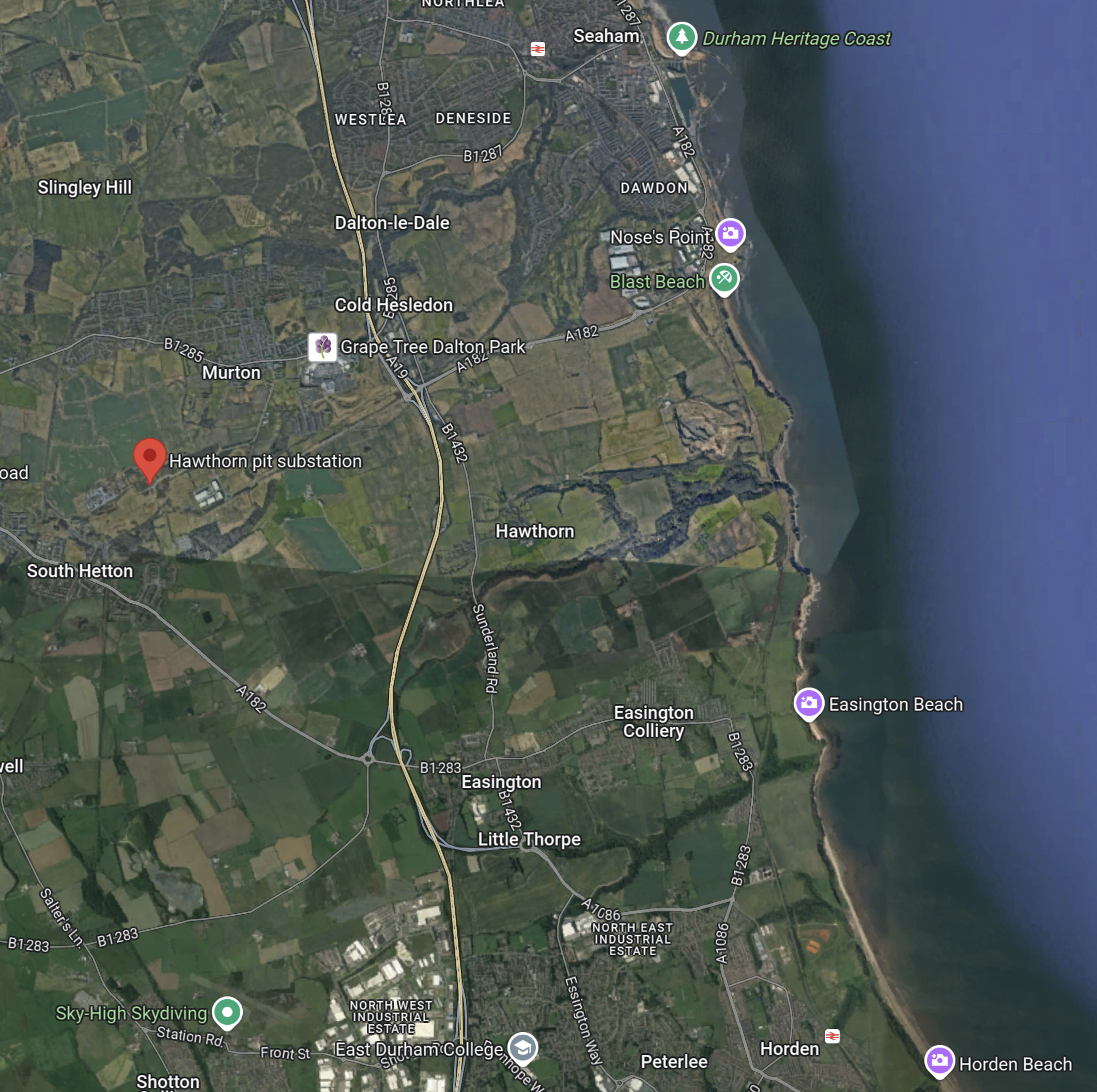
This Google Map shows the location of Hawthorn Pit.
Note.
- The Durham coast is at the East with Seaham at the North and Horden at the South.
- The A 19 runs North-South in the middle of the map.
- Hawthorn Pit substation is marked by the red arrow.
This second Google Map shows the substation in more detail.
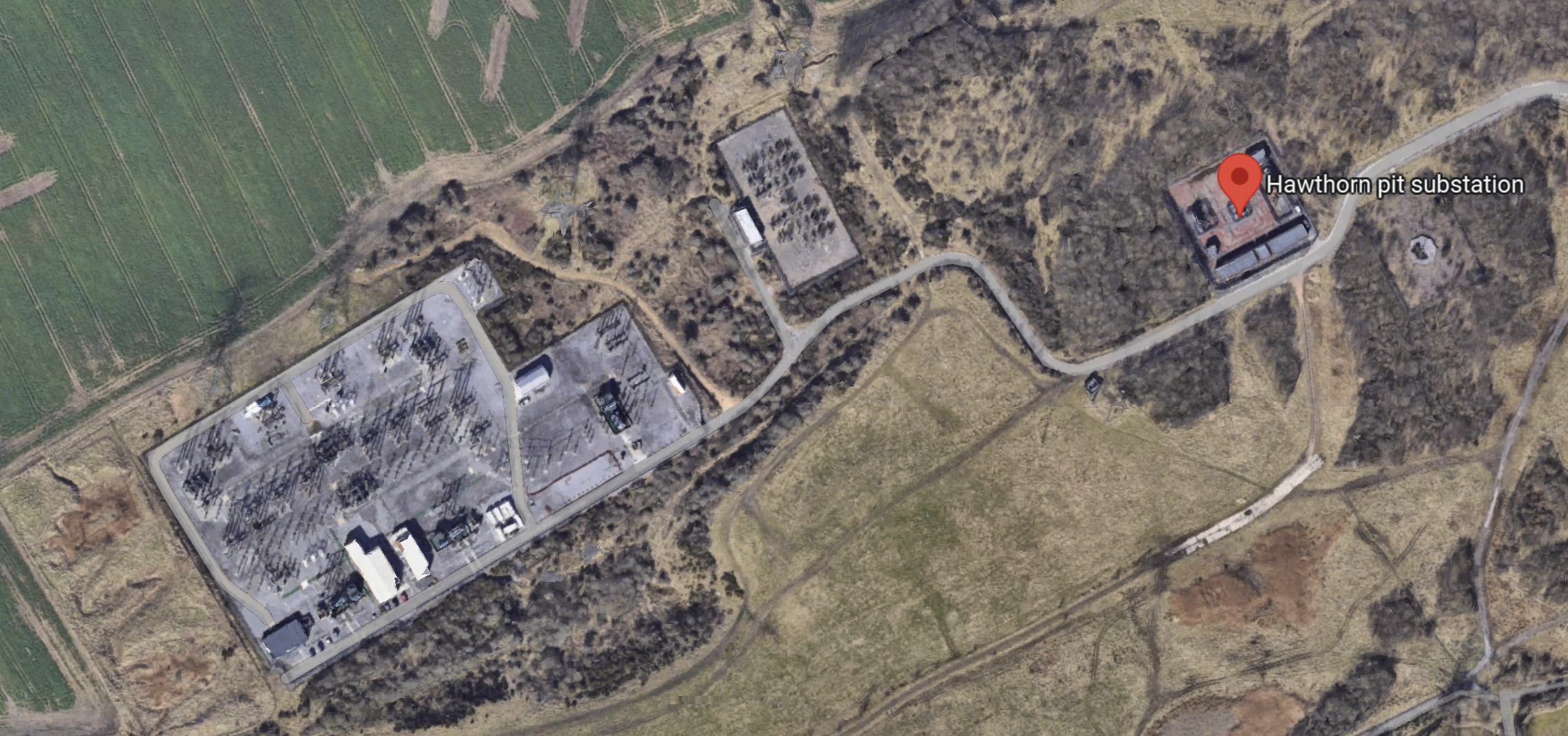
There are a lot of switches and wires.
From the map on the Aura Power web site, it appears that the solar farm is to to the North side of the substation.
Eastern Green Link One
In the future Hawthorn Pit substation will also host the Southern end of Eastern Green Link One, which will be a a 2 GW high voltage direct current (HVDC) electrical superhighway to be built between the Torness area in East Lothian, Scotland and Hawthorn Pit in County Durham, England.
This is number one of four such 2 GW undersea connections that will distribute energy between England and Scotland.
Conclusion
Hawthorn Pit substation could growto an important interchange in the grid.
Cloiche Onshore Wind Farm
This document from the Department of Business, Industry and Industrial Strategy lists all the Contracts for Difference Allocation Round 6 results for the supply of zero-carbon electricity.
The largest onshore wind farm in the Allocation Round, is the Cloiche wind farm, which has this web page,which is entitled Onshore Wind Projects , on the SSE Renewables web site.
It is the only project on the page and these two paragraphs describe its location and capacity.
The proposed 29 turbine Cloiche Wind Farm is located on the Glendoe and Garrogie Estates, adjacent to the operational Stronelairg Wind Farm and Glendoe Hydroelectric Scheme and approximately 11 kilometres (km) to the south-east of Fort Augustus in the Great Glen, in the Monadhliath mountain range.
It is anticipated that the wind farm will generate approximately 130.5MW.
This Google Map shows the location.
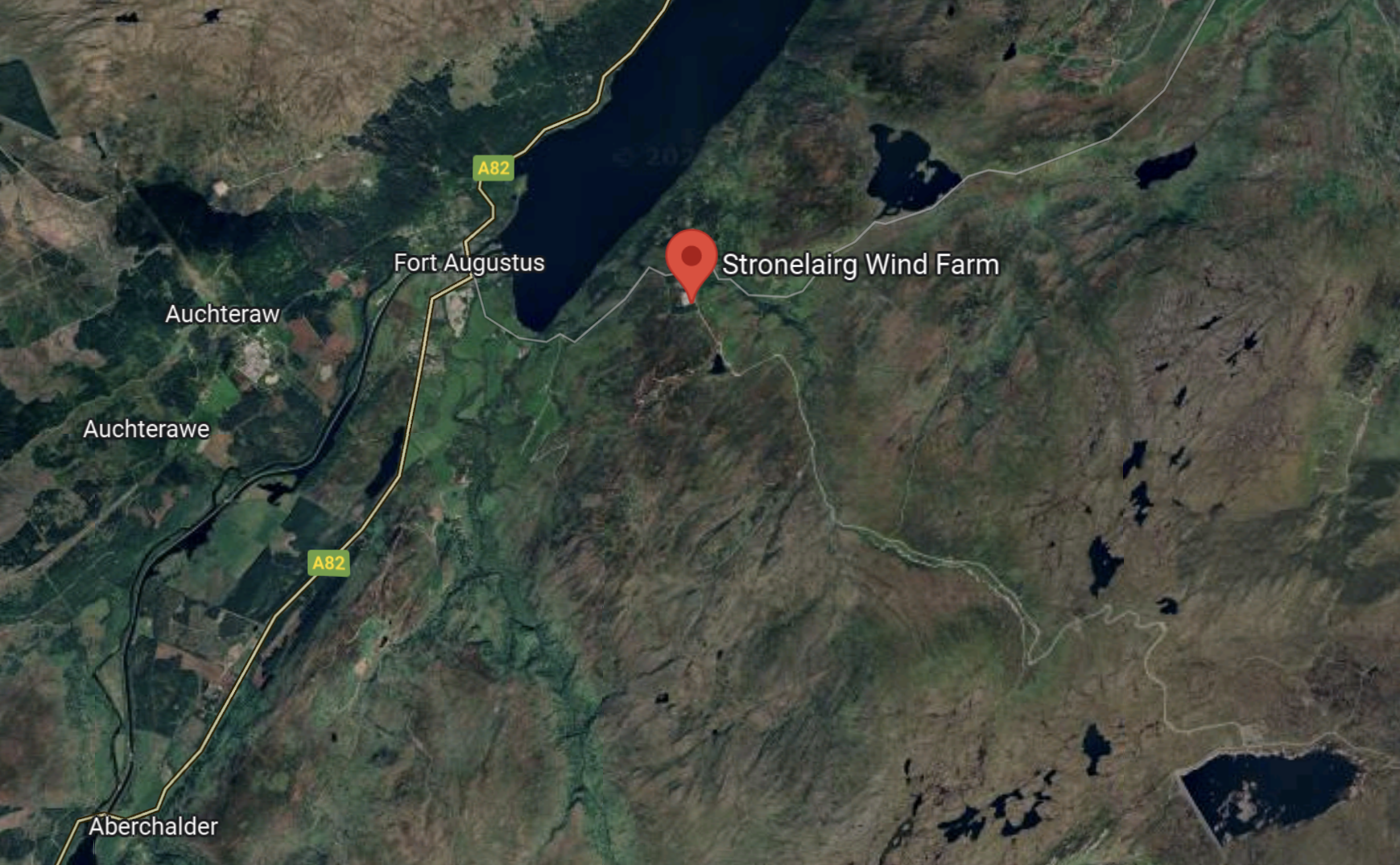
Between the village of Fort Augustus and the Stronelairg wind farm, lies the Southern end of Loch Ness.
In the South-East corner of the map, there is a large lake, which is shown in more detail in this Google Map.
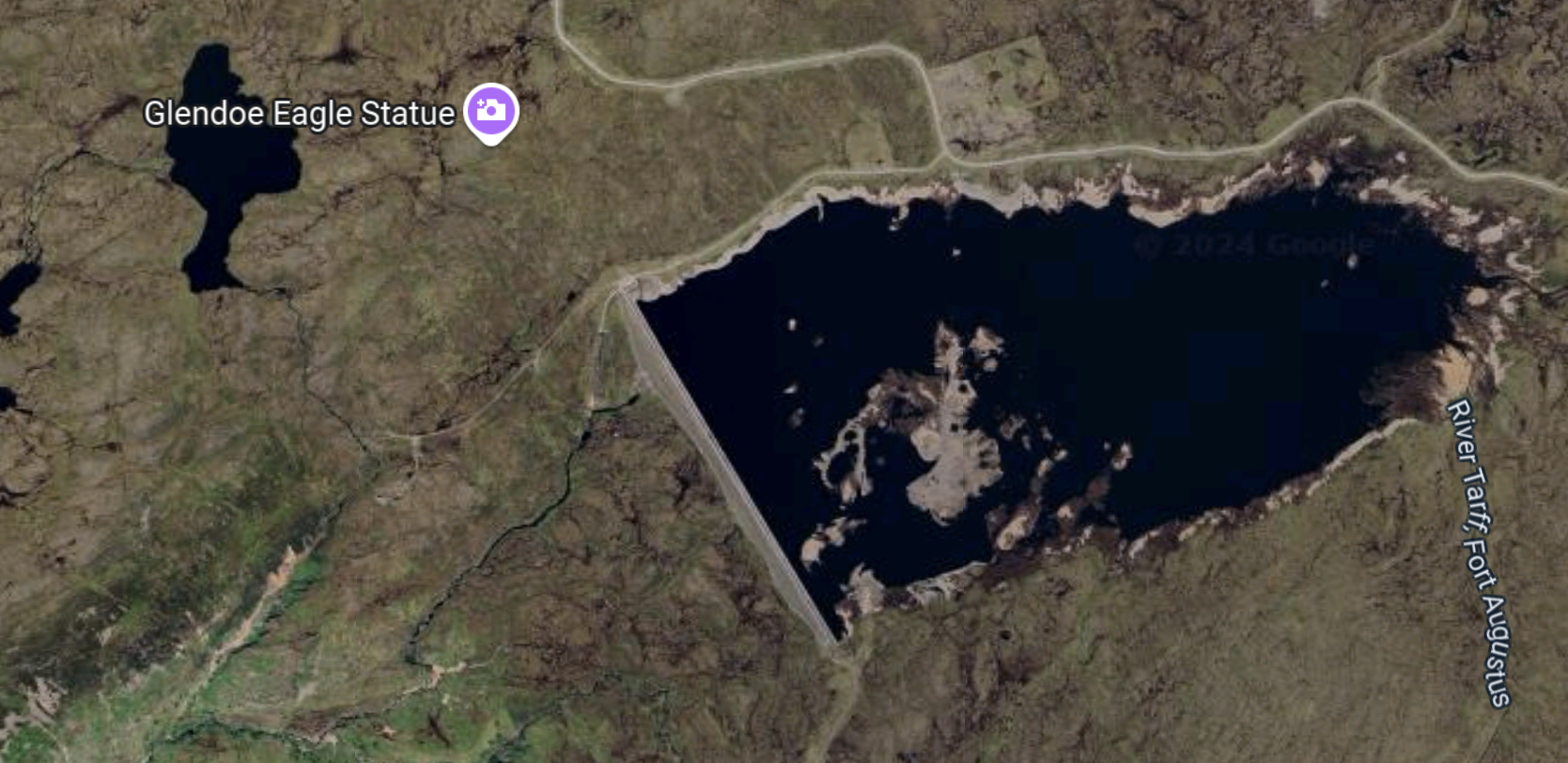
This is the Glendoe Reservoir for the Glendoe Hydro Scheme, that was built in the early years of this century, by damming the River Tarff.
The dam is clearly visible at the Western end of the Reservoir.
The Glendoe Hydro Scheme was opened in 2009 and has a generation capacity of 106.5 MW.
The planning and building of the scheme are described in this Wikipedia entry and the entry is well worth a read.
Stronelairg Wind Farm
Stronelairg wind farm, Cloiche wind farm and the Glendoe Hydro Scheme are all projects, that were or will be developed by SSE Renewables.
Stronelairg wind farm has 66 turbines and a total installed capacity of 228 MW.
It has a web page on the SSE Renewables web site.
These two paragraphs describe the location of Stronelairg wind farm.
Stronelairg sits at an elevation of around 600m above sea level in the Moadhliath Mountain range making it one of our windiest wind farms.
It sits within a natural bowl on a plateau, set well back from Loch Ness meaning that no turbines are visible from the main tourist routes in the area. Stronelairg is also located adjacent to our 100MW Glendoe hydro scheme and so the construction teams were able to use the hydro infrastructure as do our operational teams now.
Stronelairg wind farm appears tobe a powerful asset, hidden in the mountains.
Three Co-located Assets
As Cloche wind farm, will be adjacent to the operational Stronelairg Wind Farm and Glendoe Hydroelectric Scheme, these three energy producing assets, will be close together.
- Cloiche wind farm – 130.5 MW
- Stronelairg wind farm – 228 MW
- Glendoe Hydroelectric Scheme – 106.5 MW
Note.
- This is a total power of 465 MW.
- This would be equivalent to a medium-sized gas-fired power station.
- All three assets could use the same grid grid connection and other facilities.
It could be considered a 358.5 MW wind farm, backed by a 106.5 MW hydro power station.
When there is a shortage of wind, the Glendoe Hydroelectric Scheme could step in, if required.
Conclusion
Onshore wind, backed up by hydroelectric schemes would appear to be a good way to create reliable hybrid power stations.
Do any other schemes in Allocation Round 6, involve combining onshore wind with existing hydro schemes?
 The Anonymous Widower