Siemens Gamesa To Soon Install 21 MW Offshore Wind Turbine Prototype At Danish Test Site — Reports
The title of this post, is the same as that of this article on offshoreWIND.biz.
This is the sub-heading.
Siemens Gamesa is transporting a nacelle from its facility in Brande, Denmark, to the Østerild wind turbine test centre, a company spokesperson confirmed to offshoreWIND.biz. The spokesperson declined to reveal any specifics about the wind turbine but Danish media writes that it is the new prototype which Bloomberg reported earlier this year to have a capacity of 21 MW.
These first two paragraphs give a few more details.
DR (Danish Broadcasting Corporation) reported on 6 December that lamp-posts and traffic signs were being dismantled, and roundabouts widened last week to make room for an 11×11-metre nacelle to pass through on its way to Hvide Sande, starting last Friday. From there, the nacelle will be shipped to Hanstholm and then transported to Østerild, where it will be mounted on an already installed 170-metre tower, according to DR.
In June, Bloomberg reported sources familiar with the matter said that Siemens Energy had told customers it planned to build the largest wind turbine in the world by the end of the decade and the new offshore model would have an output of 21 MW, 40 per cent more than the company’s current largest turbine, the 14 MW platform that can reach up to 15 MW with the company’s feature called Power Boost.
I have a few thoughts.
Will Bigger Be Better?
Going back to the days of North Sea Oil and Gas, I can remember project managers saying that platform installation took off dramatically, as larger platforms, barges, cranes and equipment became available.
I can particularly remember one project manager extolling the virtues of giant 3000 tonne cranes.
Do We Need A Test Centre For Giant Turbines In The UK?
The question has to be asked, as we certainly have large open spaces of sea to put a 40 MW or larger turbine.
The Crown Estate Awards GBP 5 Million In First Supply Chain Accelerator Round
The title of this post, is the same as that of this article on offshoreWIND.biz.
This is the sub-heading.
The Crown Estate has awarded nearly GBP 5 million in funding to 13 organisations across England, Wales, and Scotland in the first round of its Supply Chain Accelerator.
These three paragraphs add more details.
According to The Crown Estate, the funding will help kick-start projects drawing down from a GBP 50 million fund established in May this year to accelerate and de-risk the early-stage development of UK supply chain projects that service the offshore wind sector.
The Crown Estate’s match funding will contribute to a combined development investment of over GBP 9 million, which, if the opportunities successfully conclude their respective development stages, could lead to more than GBP 400 million of capital investment, said the UK body.
Projects receiving funding include those enabling floating wind platforms, anchoring and mooring systems, operations and maintenance facilities, test facilities, and those supporting the skills
The grants have been widely spread in both the public and private sectors and appear to be supporting a variety of technologies.
What About Project Management?
When the four of us started Metier Management Systems to develop Artemis in the 1970s, we got no help from the Government or any agency.
I wonder what difference, government support of this nature would have made?
I don’t know whether any project management development is being supported, but it is my view, that each new generation of projects will bring forward new challenges.
ScottishPower Renewables Picks Port For East Anglia Two Pre-Assembly
The title of this post, is the same as that of this article on offshoreWIND.biz.
This is the sub-heading.
ScottishPower Renewables, Iberdrola’s UK arm, has selected Peel Ports Great Yarmouth as the staging ground for pre-assembly works for its 960 MW East Anglia Two offshore wind project.
This is the introductory paragraph.
The companies have signed a reservation agreement that will see the Siemens Gamesa turbine components and sections come together for assembly at the Norfolk site before installation in the southern North Sea in 2028.
Note.
- The Port of Great Yarmouth was used for this task with East Anglia One.
- The turbine blades will be manufactured at Siemens Gamesa’s offshore wind blade factory in Hull.
- The monopiles will come from Sif in Rotterdam.
This is the first sentence of the Wikipedia entry for the East5 Anglia Array.
The East Anglia Array is a proposed series of offshore wind farms located around 30 miles off the east coast of East Anglia, in the North Sea, England. It has begun with the currently operational East Anglia ONE, that has been developed in partnership by ScottishPower Renewables and Vattenfall. Up to six individual projects could be set up in the area with a maximum capacity of up to 7.2 GW.
These articles on offshoreWIND.biz indicate that ScottishPower Renewables has been busy signing contracts for East Anglia Two.
- December 4th, 2024 – Nexans Lands Export Cable Contract For East Anglia Two Offshore Wind Farm.
- November 28th, 2024 – Hitachi Energy to Integrate 960 MW East Anglia Two Wind Farm into UK Grid.
- November 12th, 2024 – Siemens Gamesa Bags GBP 1 Billion Turbine Contract For East Anglia Two.
- November 6th, 2024 – Seaway7 Wins East Anglia Two Inter-Array Cable Contract.
- October 31st, 2024 – Sif, Smulders to Deliver Monopiles and TPs For ScottishPower’s East Anglia Two Offshore Wind Farm.
They must have employed lawyers on roller skates to get five contracts signed in just over a month.
Conclusion
East Anglia Two appears to be definitely under way and the Wikipedia extract says there could be a lot more, if all the other wind farms are developed in the same way using the Port of Great Yarmouth.
A total capacity in the East Anglia Array of 7.2 GW will surely be good for both East Anglia and the UK as a whole, but will the natives be happy with all the onshore infrastructure?
I wouldn’t be surprised to see further wind farm developed to generate hydrogen offshore, which will be either brought ashore to the Bacton gas terminal, using existing or new pipelines or distributed using tanker ships to where it is needed.
Where Will Lumo Strike Next?
Yesterday, First Group reported that they had added more possible services to their network of open-access services.
I gave my view in FirstGroup Acquires London – South Wales Open Access Business And Plans Lumo To Devon.
Their list of possible services and destinations include.
- Hull Trains – London King’s Cross and Beverley via Stevenage, Grantham, Retford, Doncaster, Selby, Howden, Brough, Hull Paragon and Cottingham
- Hull Trains – London King’s Cross and Hull Paragon via Stevenage, Grantham, Retford, Doncaster, Selby, Howden and Brough
- Hull Trains – London King’s Cross and Sheffield via Worksop and Woodhouse
- Lumo – London Euston and Rochdale via Warrington Bank Quay, Newton-le-Willows, Eccles and Manchester Victoria
- Lumo – London King’s Cross and Edinburgh/Glasgow via Stevenage, Newcastle and Morpeth
- Lumo – London Paddington and Carmarthen via Bristol Parkway, Newport, Severn Tunnel Junction, Cardiff Central, Gowerton and Llanell
- Lumo – London Paddington and Paignton via Bath Spa, Bristol Temple Meads, Taunton, Exeter St David’s and Torquay
I believe that all services could be run by identical versions of Hitachi’s high speed Intercity Battery Electric Train, which are described in this page on the Hitachi web site.
The London Paddington and Paignton service would require the longest running without electrification at 210 km. and I don’t believe First Group would have put in a bid, unless they were certain zero-carbon trains with sufficient performance would be available.
Other possible open access services could be.
Hull And Blackpool Airport
Note.
- This could be the first half of a Green Route between the North of England and the island of Ireland, if zero-carbon aircraft can fly from Blackpool Airport.
- Trains would call at Selby, Leeds, Bradford, Huddersfield, Manchester Victoria, Blackburn and Preston.
- Blackpool Airport has good access from Squires Gate station and tram stop, which could be improved.
- Blackpool Airport could be well supplied with green electricity and hydrogen from wind power.
These are distances to possible airports.
- Belfast City – 111 nm.
- Belfast International – 114 nm.
- Cardiff – 143 nm.
- Cork – 229 nm.
- Donegal – 200 nm.
- Derry/Londonderry – 163 nm.
- Dublin – 116 nm.
- Inverness – 228 nm
- Ireland West Knock – 204 nm.
- Kerry – 253 nm.
- Ronaldsway, IOM – 59 nm.
- Shannon – 220 nm.
Note.
- The Wikipedia entry for the all-electric Eviation Alice, gives the range with reserves as 250 nm.
- The Belfast and Dublin airports could be within range of a round trip from Blackpool without refuelling.
- ,Cork, Kerry and Shannon airports may need to go by another airport, where a small battery charge is performed.
- The Isle of Man is surprisingly close.
Blackpool has reasonably good coverage for the island of Ireland.
London Euston And Holyhead
This could be the first half of a Green Route to Dublin, if the trains met a high speed hydrogen-powered catamaran to speed passengers across to Dun Laoghaire.
London King’s Cross And Aberdeen Or Inverness
Why not? But these routes would probably be best left to LNER.
London King’s Cross And Grimsby Or Cleethorpes
In Azuma Test Train Takes To The Tracks As LNER Trials Possible New Route, I talked about how LNER had run a test train to Grimsby and Cleethorpes.
The Government might prefer that an open access operator took the risk and got all the blame if the route wasn’t worth running.
Humberside is very much involved in the energy industry, with several gas-fried power-stations at Keadby.
It might be more efficient in terms of trains and infrastructure, if this service was an extension of the Lincoln service.
London King’s Cross And Scarborough Via Beverley
This would probably be one for Hull Trains, but it would also serve Bridlington and Butlin’s at Filey.
The BBC was running a story today about how holiday camps are making a comeback. Surely, one on a direct train from London wouldn’t be a bad thing. for operators, train companies or holidaymakers.
London King’s Cross And Middlesbrough, Redcar Or Saltburn
As with the Grimsby and Cleethorpes service, the government might think, that this might be a better service for an open access operator.
Teesside is heavily involved in the offshore wind industry and may add involvement in the nuclear industry.
London Paddington And Fishguard, Haverfordwest, Milford Haven Or Pembroke Dock
Note.
- This could be the first half of a Green Route to Southern Ireland, if the trains met a high speed hydrogen-powered catamaran to speed passengers across to Rosslare or an electric or hydrogen-powered aircraft from Haverfordwest Airport.
- These three ports and one airport will feature heavily in the development of offshore wind power in the Celtic Sea.
- RWE are already planning a hydrogen electrolyser in Pembrokeshire, as I wrote about in RWE Underlines Commitment To Floating Offshore Wind In The Celtic Sea Through New ‘Vision’ Document.
- According to the Wikipedia entry for Fishguard Harbour station, it was built as a station to handle ship passengers and is now owned by Stena Line, who run the ferries to Rosslare in Ireland.
- I can see a tie-up between FirstGroup and Stena Line to efficiently transfer passengers between Lumo’s planned service to Carmarthen and Stena Line’s ships to Ireland.
All four secondary destinations would be a short extension from Carmarthen.
Summing Up
Note how energy, a Green Route to Ireland and other themes keep appearing.
I do wonder if running a budget train service to an area, is an easy way of levelling up, by attracting people, commuters and industry.
Have the budget airlines improved the areas they serve?
They’ve certainly created employment in the transport, construction and hospitality industries.
Zero-Carbon Ferries And Short-Haul Aircraft
These will be essential for Anglo-Irish routes and many other routes around the world.
I will deal with the ferries first, as to create a zero-carbon ferry, only needs an appropriate power unit to be installed in a ship design that works.
But with aircraft, you have to lift the craft off the ground, which needs a lot of energy.
This article on Transport and Environment is entitled World’s First ‘Carbon Neutral’ ship Will Rely On Dead-End Fuel, with this sentence as a sub-heading.
The Danish shipping giant Maersk announced it will operate the world’s first carbon-neutral cargo vessel by 2023. The company had promised a carbon-neutral container ship by 2030 but now says it will introduce the ship seven years ahead of schedule following pressure from its customers. While welcoming Maersk’s ambition, T&E says the company is betting on the wrong horse by using methanol which may not be sustainable and available in sufficient amounts.
Note.
- I’d not heard of this ship.
- Pressure from customers brought the date forward by seven years.
- As always, it appears that the availability of enough green hydrogen and methanol is blamed.
Perhaps, Governments of the world should put more teeth in green legislation to ensure that companies and governments do what they say they are gong to do?
But worthwhile developments in the field of shipping are underway.
For instance, I estimate that this Artemis Technologies hydrofoil ferry could take passengers across the 54 nautical miles between Dun Laoghaire and Holyhead in around 90 minutes.
This ferry is being designed and built in Northern Ireland and I can’t believe, it is the only development of its type.
A Fast Green Route To Ireland
I have talked about this before in High-Speed Low-Carbon Transport Between Great Britain And Ireland and I am certain that it will happen.
- Air and sea routes between the UK and the island of Ireland carry a lot of traffic.
- Some travellers don’t like flying. Especially in Boeings, which are Ryanair’s standard issue.
- It is the sort of trip, that will appeal to a lot of travellers and most probably a lot with Irish connections.
- An electric or hydrogen-powered aircraft or a fast surface craft will be able to cross the Irish Sea in a quick time.
- High speed trains and then High Speed Two will consistently reduce the travel times on the UK side of the water.
Cross-water travel routes, be they by aircraft, ferries, bridges or tunnels are generally popular and successful.
Conclusion
Given the opportunity at Fishguard, I can see that FirstGroup next move would be to extend the Carmarthen service to Fishguard Harbour.
Permission Granted For Ayrshire Renewables Hub
The title of this post, is the same as that of this article on Scottish Construction Now.
This is the sub-heading.
Planning consent has been granted for a £150 million upgrade to an Ayrshire marine yard, paving the way for increased offshore wind power off the UK’s west coast.
These are the first three paragraphs.
Peel Ports Clydeport has secured permission for the complete redevelopment of the Hunterston marine yard as it prepares the site for major renewables infrastructure. The redevelopment works – which are expected to start in early 2025 and last for around two years – will include substantial upgrades to the marine yard, including infilling the current dry-dock basin and the creation of a new quay wall.
Highview Power recently announced it is to construct the world’s largest Liquid Air Energy Storage (LAES) facility at Hunterston, the latest in a string of renewables projects that are either underway, or in the pipeline, at the site.
The overall redevelopment of Hunterston is expected to attract £3.5 billion in inward investment and create over 5,000 jobs.
Note.
- The Highview Power battery will be 200 MW/3.25 GWh.
- There is also a 400 MW/400 MWh BESS being built at Hunterston.
- The 2 GW MacHairWind project is planned off the coast of Islay.
- According to their web site, MacHairWind will export its first power in the early 2030s.
More renewable infrastructure will surely follow.
Thousands Of Lobsters Settle At Triton Knoll Offshore Wind Farm
The title of this post, is the same as that of this article on offshoreWIND.biz.
This is the sub-heading.
RWE and the Whitby Lobster Hatchery have released 2,500 juvenile lobsters at the Triton Knoll offshore wind farm in the UK in what the wind farm developer says is an industry-first project, through which more than 15,000 lobsters are planned to be released at Triton Knoll.
These are the first two paragraphs.
The first batch of 2,500 juvenile lobsters was settled at the offshore wind farm in November and a further 2,500 are expected to arrive at the site early next year.
According to RWE, which said last month that the project’s goal was to help increase biodiversity in the North Sea, there is the potential for a further 10,000 lobsters to be released over the next two years, in 2025 and 2026.
The objective seems to be to introduce 100,00 juvenile lobsters into the sea.
Invinity’s New Flow Battery Aimed At Enabling ’24/7 Solar’ For The Grid
The title of this post, is the same as that of this article on Solar Power Portal.
These three paragraphs outline the story.
New vanadium redox flow battery (VRFB) technology from Invinity Energy Systems makes it possible for renewables to replace conventional generation on the grid 24/7, the company has claimed.
Anglo-American flow battery company Invinity launched its new product, Endurium, today. It follows around three years of R&D, testing, and prototyping, during which Invinity has partnered with Siemens Gamesa on technology development.
Designed for high energy throughput with unlimited cycling and with at least a 50% reduction in the footprint required for installation at project sites, the company said it could cost-competitively tackle present-day energy storage markets and emerging long-duration energy storage (LDES) opportunities alike.
This looks like it could be a bit of a breakthrough.
After reading this article, it would appear that traditional lithium-ion battery energy storage systems (BESS) now have another competitor along with Highview Power’s liquid air battery.
New Bid To Connect Heritage Railway To Mainline
The title of this post, is the same as that of this article on the BBC.
The is the sub-heading.
A bid to connect one of the longest heritage railways in Britain with mainline services has taken a step forward.
These are the first two paragraphs.
West Somerset Railway (WSR) and Somerset Council have now submitted a business plan to the government to restore the mainline from Taunton to the final WSR stop at Bishop’s Lydeard.
The proposal suggests Bishop’s Lydeard could become a commuter and tourist hub.
There has been several attempts to connect the branch to Taunton station.
These are my thoughts.
Minehead, Bishop’s Lydeard And Hinckley Point C
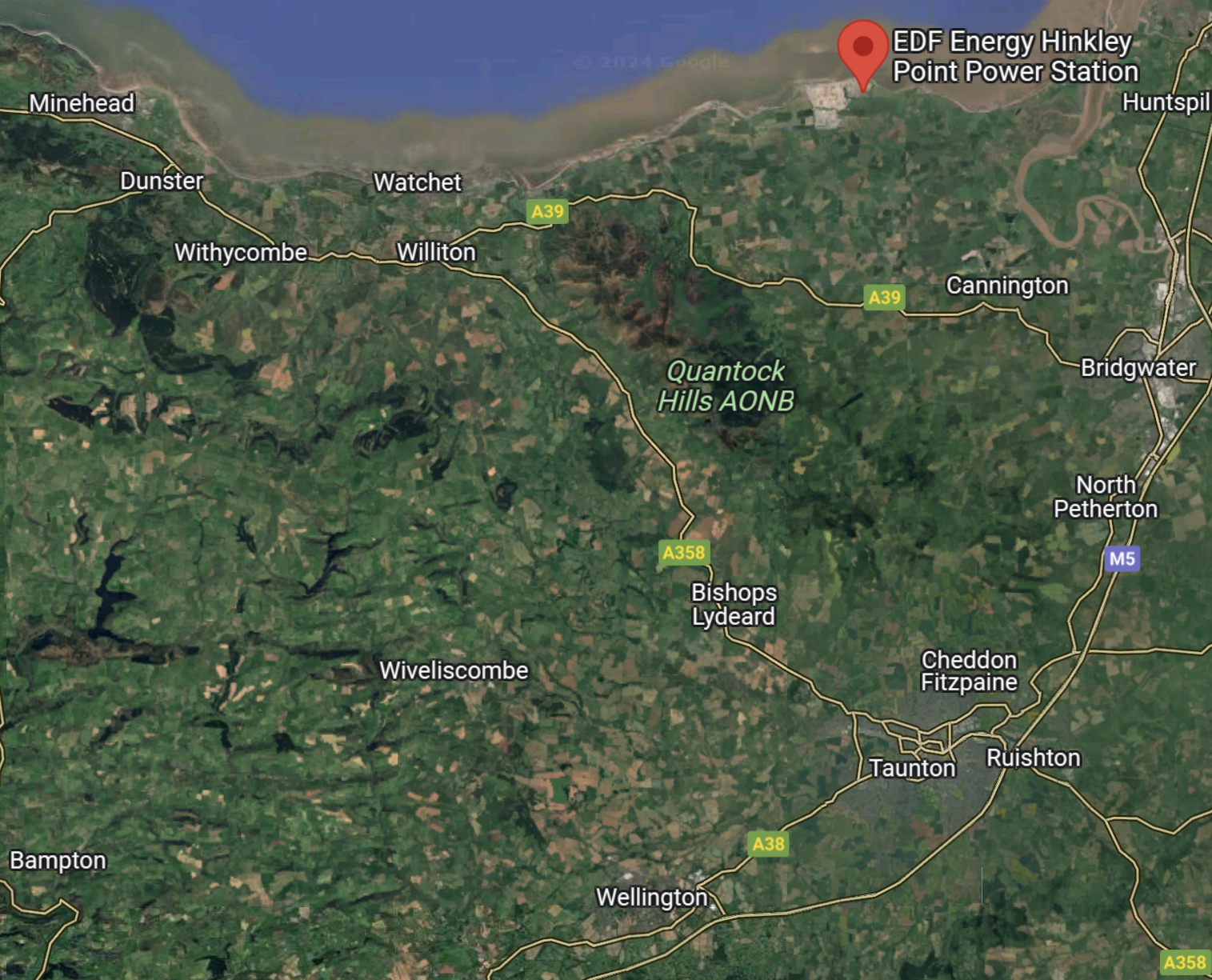
This Google Map shows the area.
Note.
- Minehead is in the North-West corner of the map.
- Hinckley Point power station is indicated by the red arrow.
- Bishop’s Lydeard is in the middle of the map.
- The M5 motorway curves diagonally between the North-East and South-West corners of the map.
- There are motorway services at Taunton Deane, which is to the South of Taunton and Cullompton, which is a few miles South-West of Wellington.
- The large town of Taunton is the junction of the London and Exeter and the Bristol and Exeter railway lines.
- The town of Wellington will be getting a new railway station.
It is a very busy area and it will only get busier, as the availability of power will only attract industry, like the battery factory pencilled in for Bridgewater.
The Major Effect Of Hinckley Point C
Hinckley Point C will generate 3.26 GW of electricity and to operate the power station will need around nine hundred workers.
I can also expect that the Hinckley Point site will get involved in other energy handling and use.
- The site would be an ideal place for a large electrolyser to produce hydrogen.
- Wind turbines in the Bristol Channel could use Hinckley’s grid connection.
- Energy could be stored on the site. It could be an ideal location for one of Highview Power’s 200 MW/3.25 GWh liquid air batteries.
- Hydrogen could be exported using coastal tankers.
- Interconnectors could take electricity to Cornwall, Devon, Wales and Ireland.
All of these activities would create needs for workers at all levels.
- A rail connection to Taunton and Bristol, will probably be needed to bring workers into Hinckley Point.
- A rail connection would be ideal for bringing construction materials, steel and other heavy goods into and out of the Hinckley Point site.
- Hydrogen could also be taken out in rail tankers.
- Nuclear waste could be taken out by train.
I think it is highly likely, that Hinckley Point will need a rail connection for efficient operation.
Sizewell C And Hydrogen
Hydrogen is so important to the philosophy of the design and construction of Sizewell C, that hydrogen has its own section on the Sizewell C web site.
Hydrogen produced by nuclear power stations like Hinckley Point C, is called pink hydrogen, but like green hydrogen it is zero-carbon and pollution-free.
Hinckley Point C And Hydrogen
I can envisage Hinckley Point C will create a lot of hydrogen both for use locally and distribution to remote users.
- Hydrogen could be delivered locally by truck, just as propane is today around the world.
- Coastal tankers could distribute the hydrogen from a jetty.
- Pipelines could connect the two nearby motorway service stations to the power station site.
Just as is happening at Sizewell, a local hydrogen network could be built.
Hydrogen Refuelling On The M5
Consider.
- In MAN Expands Its Zero-Emission Portfolio, I talked about MAN’s new hydrogen-powered hTGX truck, which has been designed with a 600 km. or 373 mile range.
- As Cullompton, which is the Southernmost of the two services on the M5 that are close to Hinckley Point C, is only 124.9 miles from Penzance, it should be possible for a truck, with a range similar to that of the MAN hTGX to do a round trip from the Southern end of the M5 to Penzance, without refuelling.
- As the total length of the M5 is only 163 miles, a hydrogen-powered truck with the range of the MAN hTGX would be able to do a delivery anywhere along the motorway and return to the hydrogen from Hinckley Point C, without refuelling.
- MAN are saying that the hTGX truck can be refuelled in less than fifteen minutes.
It looks to me, that a hydrogen electrolyser at Hinckley Point C would be ideally located to provide pink hydrogen for a zero-carbon hydrogen-powered route to and from the far South-West.
I believe that if there were a best-in-class hydrogen-refuelling facility close to Hinckley Point C, it would encourage those who regularly drove to Devon and Cornwall to look seriously at hydrogen-powered vehicles.
The Nature Of The Hinckley Point C Rail Link
Sizewell C are using a simple practical approach to connect the Sizewell C site to the nearby East Suffolk Line.
- The existing freight sidings are being expanded.
- Two Park-and-Ride sites are being created at stations in the East Suffolk Line.
- A link road will be built between the railway and the Sizewell C site.
- A fleet of hydrogen-powered double-deck buses has been ordered to take workers between the railway and the power station.
- The signalling on the East Suffolk Line is being improved.
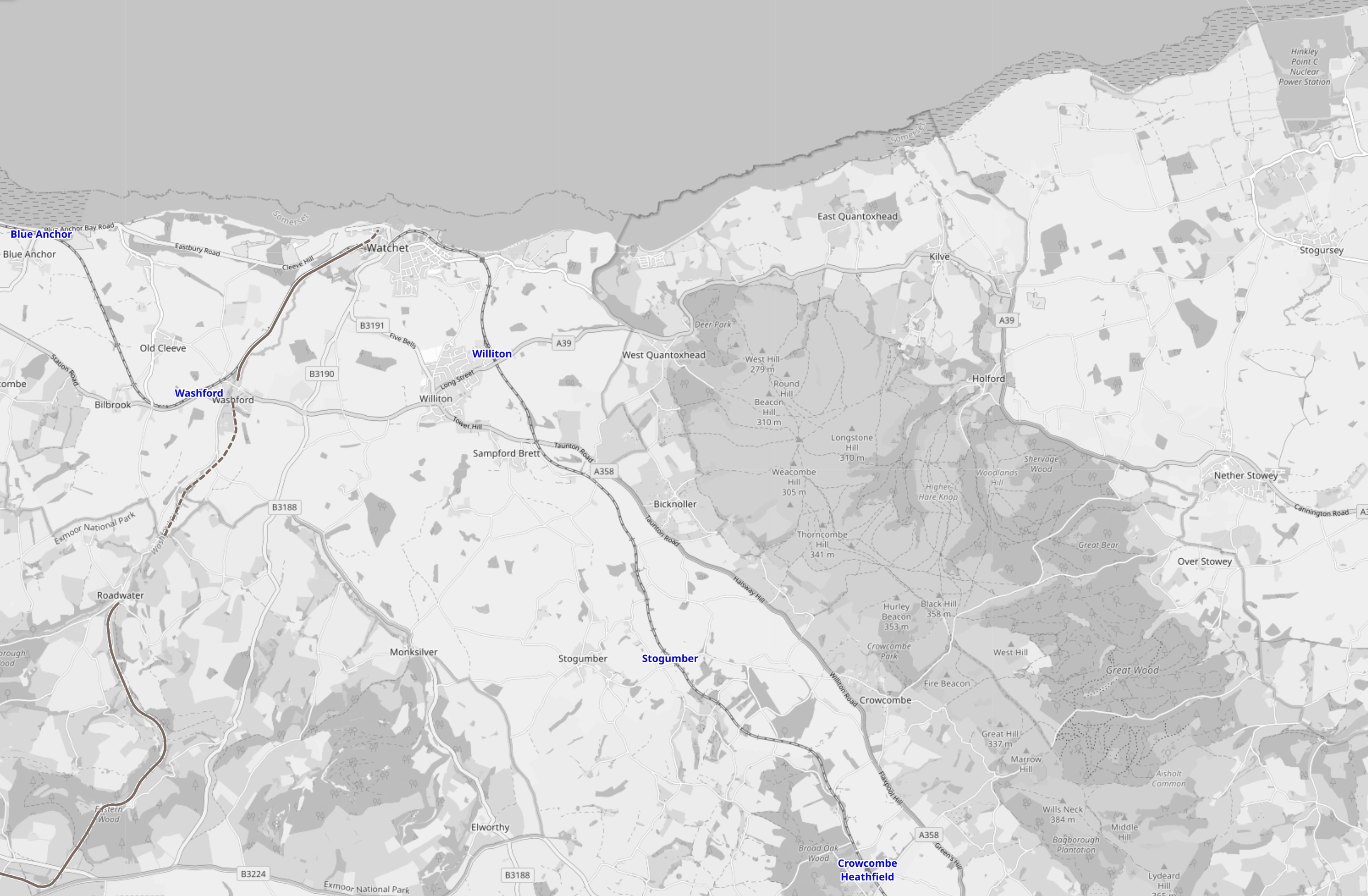
This map from OpenRailwayMap shows the Northern end of the West Somerset Railway and its relationship to Hinckley Point C power station.
Note.
- Hinckley Point C power station is in the North-East corner of the map.
- Crowcombe & Heathfield, Stogumber, Sampford Brett, Doniford Halt, Williton, Watchet, Washford and Blue Anchor are existing or former stations on the West Somerset Railway.
- Existing stations are shown in blue.
- West of Blue Anchor are the two existing stations of Dunster and Minehead.
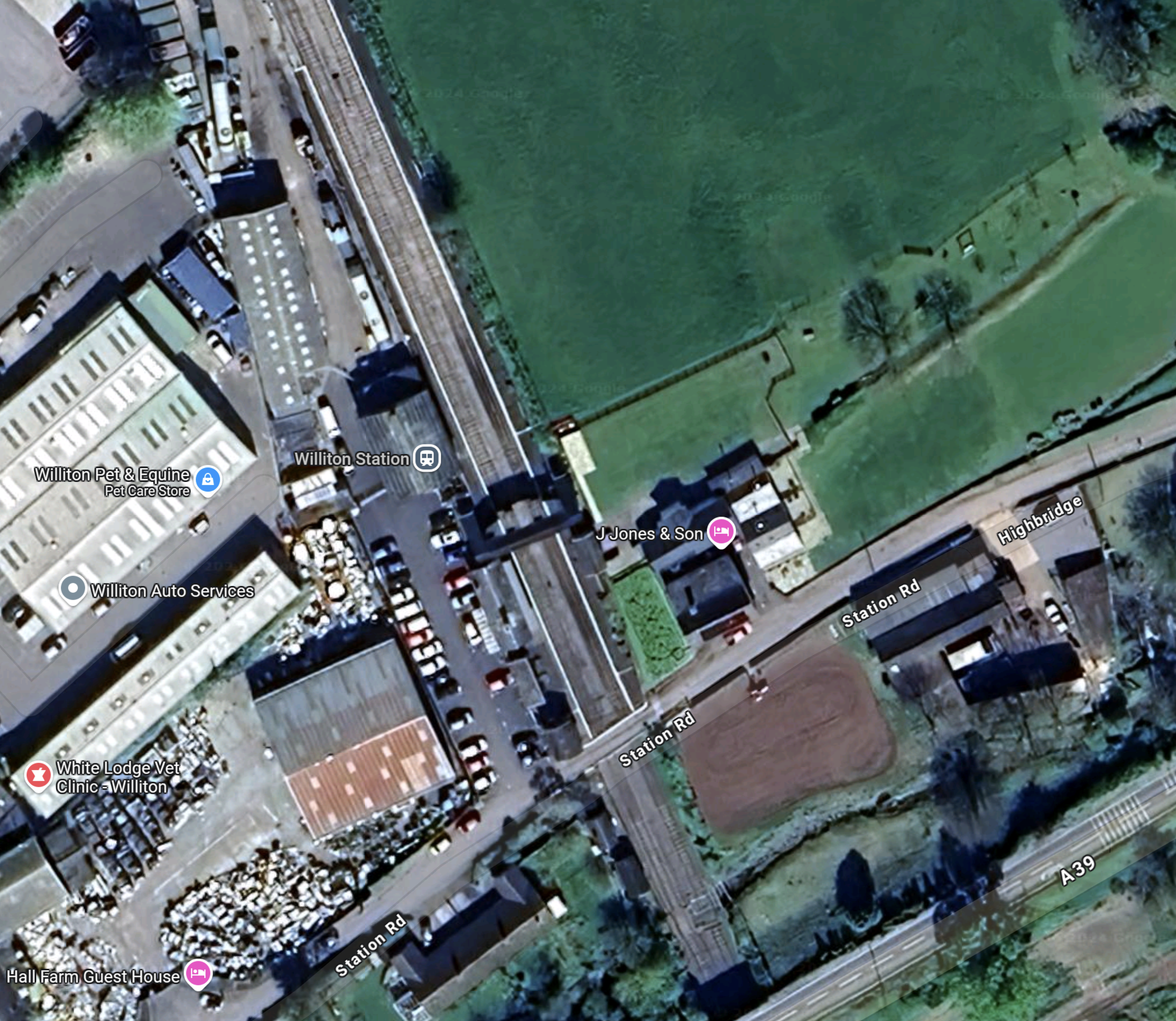
This Google Map shows Williton station, which is the nearest station to Hinckley Point C.
Note.
- The station has a footbridge, which was erected in 2011, so is probably in good condition.
- There are several Listed buildings on the site.
- Going East on the A39 should lead to Hinckley Point C.
I suspect a quality bus company could build a small fleet of buses to shuttle workers, visitors and others to Hinckley Point C.
As I’m sure, hydrogen will be in plentiful supply, I’m certain hydrogen-powered buses could be used.
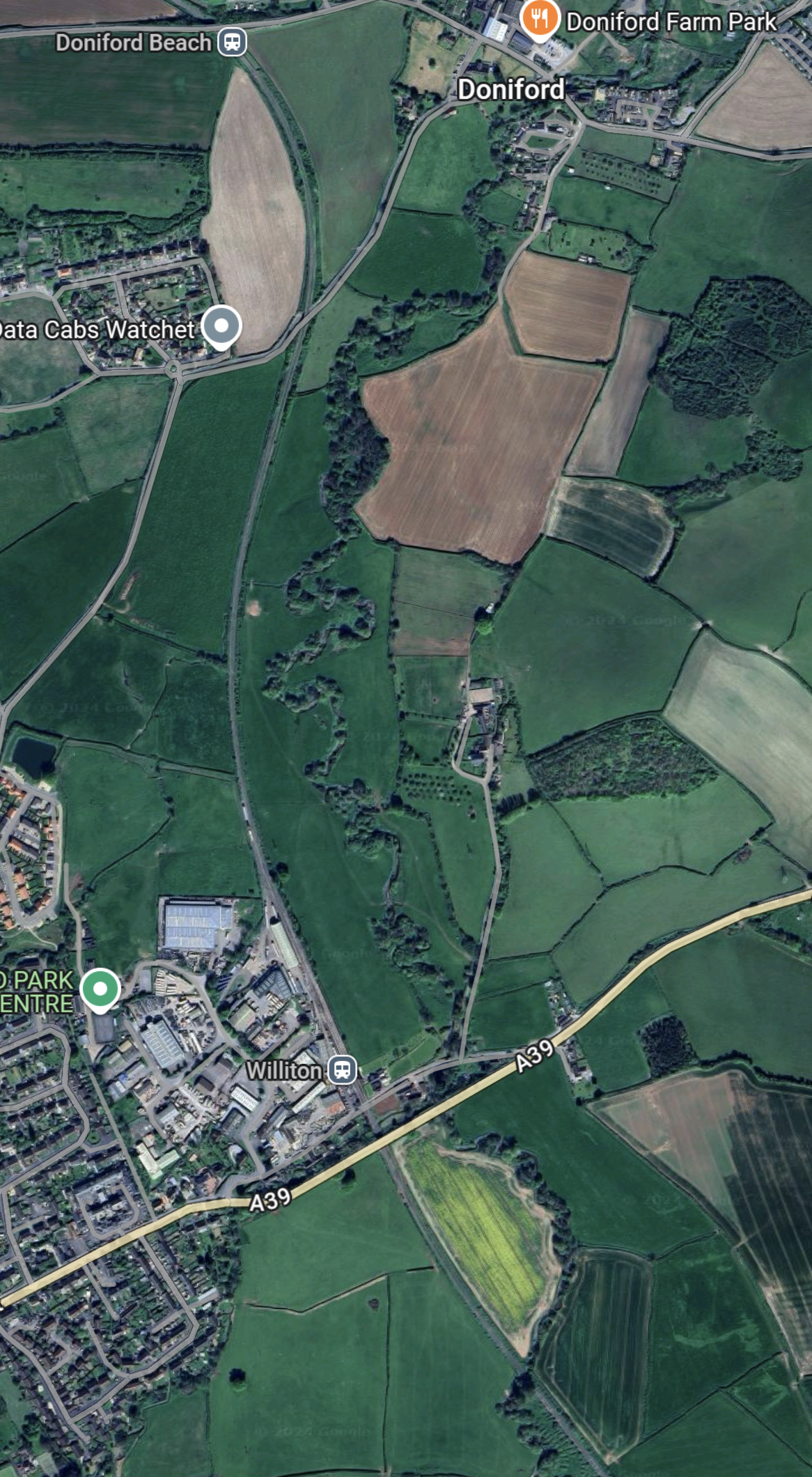
This Google Map shows a longer section of the West Somerset Line through Williton station.
Note.
- The West Somerset Line runs North-South down the map.
- Doniford Halt station is at the top of the map, where the coast road crosses the railway on a bridge.
- Williton station is in the middle of the map, where the A39 crosses the railway.
Looking at the railway, which runs mainly between fields, I wouldn’t be surprised that if Hinckley Point wanted a freight siding, they could fit one in.
Go-op
Go-op are an open access railway company, that wants to run services in Somerset.
I wrote about their successful application in Regulator Approves New Go-op Train Service Between Swindon, Taunton and Weston-super-Mare.
This is the first paragraph of their Wikipedia entry.
Go-op Cooperative Ltd.,[ branded as Go-op, is an open access train operating company, proposing to operate a service in south-west England between Taunton and Swindon, via Westbury. It aims to become the first cooperatively owned train operating company in the United Kingdom, to improve access to the public transport infrastructure through open access rail services linking main lines to smaller market towns, and by co-ordinating services with light rail, bus links and car pools.
If you read their Wikipedia entry and their web site, they seem to have ambition and be different.
According to Wikipedia, they have made no less than five different proposals, but it is the fourth that I find interesting.
In 2021, Go-op began discussions with Network Rail for services between Swindon and Bishops Lydeard (just beyond Taunton), which it hoped to begin in mid-2022. At first there could only be three services per day, due to congestion between Swindon and Westbury; a further three could be provided to Frome or Westbury, connecting with existing services to Swindon. These plans would also improve local services on the TransWilts Line, calling at Trowbridge and Melksham.
The plans for Bishops Lydeard would restore the link broken in 1971 between the national network and the preserved West Somerset Railway, which runs leisure services to Minehead.
This sounds very much like an extended and simplified version of the West Somerset Line proposal.
But it does look like two groups have looked at the infrastructure and what is needed and come to similar conclusions.
Perhaps, they have other things in common like train procurement and servicing.
Stadler Presents A World First In Berlin
The title of this section, is the same as that of this press release from Stadler.
These are the first two paragraphs.
With the RS ZERO, the rail vehicle manufacturer is presenting the successor to the successful Regio-Shuttle RS1 model. There is a choice of two modern and environmentally friendly drive technologies: Hydrogen and battery. Both will enable CO2 emission-free operation of secondary lines in the future.
Stadler today unveiled the prototype of the new RS ZERO, the innovative successor to the successful RS1 Regio-Shuttle. The Regio-Shuttle has been one of the most popular vehicles in German regional rail transport for 28 years, with around 500 RS1 vehicles currently in operation in Germany and the Czech Republic. Stadler is building on this proven technology and integrating state-of-the-art, environmentally friendly drive systems. The RS ZERO is optionally available with a hydrogen and/or battery drive and thus not only sets new standards for environmentally friendly rail transport, but also presents a world first.
These pictures from Chemnitz Trams And The Chemnitz Model, show the Regio-Shuttle RS1.




Note.
- The Regio-Shuttles can run as up to seven car trains.
- These Regio-Shuttles are electro-diesel.
- The distinctive diagonal windows.
- They can carry 170 passengers at 75 mph.
- They can run as train-trams using the Chemnitz model on compatible tram networks.
The Regio-Shuttle Wikipedia entry gives more details.
This image from the press release shows the prototype RS ZERO.
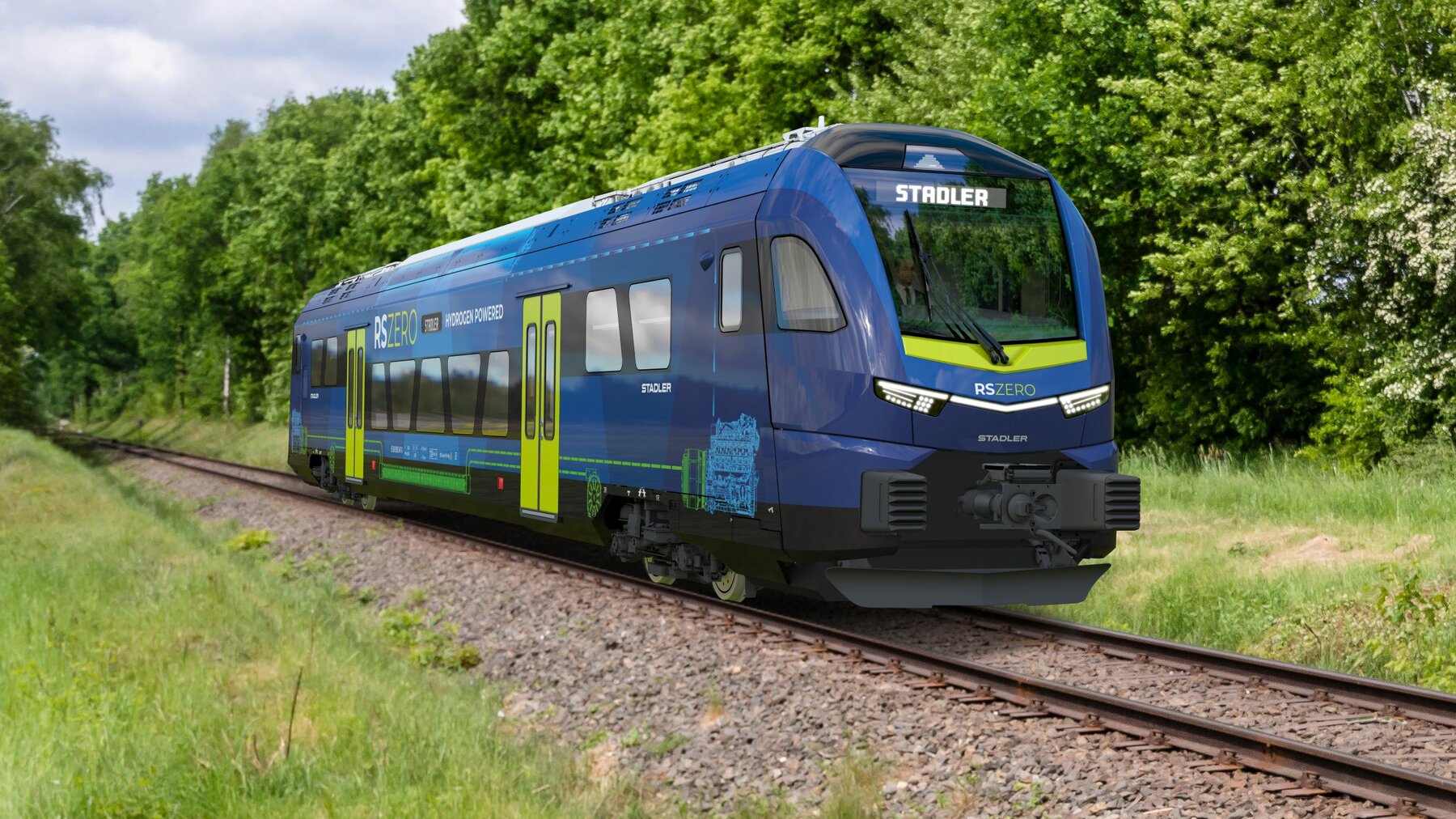
It looks very similar to my pictures from Chemnitz.
I have a few thoughts.
Comparison To A Class 150 Train
A Class 150 train can carry up to 149 seated passengers at 75 mph, which is similar to the RS ZERO.
As Stadler have built trains for Greater Anglia, Merseyrail and the Glasgow Subway, I believe that Stadler could build an RS ZERO, that would fit the UK loading gauge.
In What Train Is This?, I show the standard of interior, that can be achieved by refurbishing a Class 150 train, but unlike the RS ZERO, the train won’t be zero-carbon.
Does The RS ZERO Have A Toilet?
This is a paragraph from the press release.
The prototype of the RS ZERO presented today in Berlin is a one-car vehicle with hydrogen drive. Stadler is demonstrating the numerous design options with a multi-purpose area equipped for carrying bicycles, pushchairs and bulky luggage, lounge and comfort zones, standard and privacy seats, a wheelchair space, WC and a train office.
The train appears to be able to have what an operator might need.
What Will Be The Range Of An RS ZERO On Hydrogen?
I suspect, Stadler will provide a train, that will handle the route.
Would Stadler Be Able To Produce An RS ZERO That Could Satisfy The West Somerset/Go-op Requirement?
I obviously, can’t answer that.
But.
- The train is zero-carbon.
- It’s the right size.
- I suspect that the hydrogen fuel will be available from Hinckley Point C.
- The design has a proven track record.
- The train is not by any means vapourware!
- Stadler need a launch order.
- An experienced ROSCO would probably finance the trains.
One perk is that those involved in buying the train, could probably wangle a trip to Chemnitz to see several Regio-Shuttle RS1 trains at work.
Note that Chemnitz used to be Karl-Marx Stadt, so some of our Government will feel nostalgic.
But I do believe, this could be a very handy train to decarbonise branch and secondary lines in the UK.
Buccleuch Group Submits Plans For 39MW Solar, 10MW Storage Development
These are the two introductory paragraphs.
Solar and storage developer Buccleuch Group has submitted a planning application for a new solar plus storage development near Kettering, Northamptonshire.
The Oakley Bush solar and battery energy storage system (BESS) project is a proposed 39MW solar development, with a 10MW BESS proposed for the site. The application area, which covers 150 hectares of land on the Boughton Estate, could play host to as many as 130,000 ground-mounted solar modules, positioned around 3.5 metres above the ground.
The development is interesting for two reasons.
It Is Being Built With Both Solar Panels And A BESS
As a Control Engineer, I believe renewable power systems should have a battery, to even out the power.
The Batteries Could Be Vanadian Flow Batteries
The article says this about, the use of vanadium flow batteries.
According to the application documentation provided to Kettering District Council, two BESS technologies are being considered for use on-site: lithium-ion batteries or vanadium flow batteries. If vanadium flow batteries are used, the site could have an energy capacity of up to 50MWh, although this will be lower if lithium-ion batteries are used.
In a presentation given at a public information event for the project earlier this year, the developers noted that vanadium flow battery technology is being considered due to its significantly lower fire risk and longer lifespan than lithium-ion batteries. An operational lifespan of 40 years is expected for the site, with construction expected to take 18 months if planning consent is granted.
Note.
- Vanadium flow batteries appear to be larger.
- Vanadium flow batteries have a lower fire risk.
- Vanadium flow batteries have a longer life span, than lithium-ion.
With other batterers coming through, I wouldn’t be surprised to see costs, performance and reliability of batteries improve.
BP’s Morven Wind Farm At Risk Of Missing Start Date
The title of this post, is the same as that as this article in The Times.
This is the sub-heading.
A lengthening queue for grid connection could scupper plans to provide energy for three million homes from a development in the North Sea by the end of the decade
These two paragraphs introduce the article.
One of the largest wind farms in the UK risks missing its 2030 target to start generating power, due to lengthy grid connection queues and supply chain shortages.
The Morven Wind Farm being developed by BP, which is to be located 38 miles off the coast of Aberdeen, will have capacity of 2.9 gigawatts, which is expected to be capable of powering three million homes in Britain.
The delays in getting a grid connection and obtaining various electrical parts could derail BP’s plans.
The Morven wind farm is one of three being developed by a partnership of BP and a German company, which is outlined in this paragraph.
Morven is one of three UK wind farms being built by BP in a joint venture with Energie Baden-Württemberg AG (EnBW), the German energy company. The other two, Mona and Morgan, are being developed in the Irish Sea and have already secured grid connections.
These are my thoughts on the problems with the Morven Wind Farm.
Everybody is assuming that there will be a large cable to bring the 2.9 GW of electricity to the Scottish coast somewhere near Aberdeen.
Cables can be a problem as the article indicates, with connection to the grid and the erection of large numbers of pylons being major ones.
But the energy from Morven doesn’t necessarily need to go to Scotland.
It can be converted into hydrogen using an offshore electrolyser and sent to where it is needed by pipeline or a tanker ship.
I have also noted that BP’s partners are German and Germany has a massive need for zero-carbon energy to replace the large amount of coal they burn.
The Germans are building a massive pipeline called AquaVentus, from their North-West coast to the Dogger Bank, to collect hydrogen created by up to 10 GW of offshore wind farms in the German Ocean or their part of the North Sea to the shore.
I introduced AquaVentus in this post called AquaVentus.
This video shows the structure of AquaVentus.
I clipped this map from the video.

Note.
- The thick white line running North-West/South-East is the spine of AquaVentus, that will deliver hydrogen to Germany.
- There is a link to Esbjerg in Denmark, that is marked DK.
- There appears to be an undeveloped link to Norway, which goes North,
- There appears to be an undeveloped link to Peterhead in Scotland, that is marked UK.
- There appears to be a link to just North of the Humber in England, that is marked UK.
- Just North of the Humber are the two massive gas storage sites of Aldbrough owned by SSE and Brough owned by Centrica.
- Aldbrough and Rough gas storage sites are being converted into two of the largest hydrogen storage sites in the world!
- There appear to be small ships sailing up and down the East Coast of the UK. Are these small coastal tankers, that are distributing the hydrogen to where it is needed?
When it is completed, AquaVentus will be a very comprehensive hydrogen network.
- Pipelines from Denmark, Norway, The Netherlands and the UK will feed directly into AquaVentus.
- Will enBW and BP build a giant offshore electrolyser at Morven and send the hydrogen to Germany via the spine of AquaVentus?
- Will AquaVentus use the vast hydrogen storage North of Hull to store excess hydrogen?
- Will connections be built between AquaVentus and the UK’s Northern gas terminals at St Fergus and Easington?
If AquaVentus works as intended, Germany’s Russian gas will be replaced by zero-carbon hydrogen, a large proportion of which will come from the UK’s waters.
Where Will We Get Our Electricity From?
If the energy from Morven is sold to the Germans as hydrogen, where will we get the energy we need?
Morven is just one of several large wind farms and being developed around the North of Scotland and we’ll probably use the energy from another wind farm.
- Wind farms that can best send their energy to the grid, will do so.
- Wind farms that can best send their energy to one or more of the large Scottish pumped storage hydro-electric power-stations, will do so.
- Wind farms that can best send their energy to Germany as hydrogen, will do so.
- Wind farms that can best send their energy to Scotland or another country as hydrogen, will do so.
The hydrogen will get distributed to those who need it and can pay the appropriate price.
Where Will The Turbines And the Electrical Gubbins Come From?
I’m sure that if Morven was sending a couple of GW of hydrogen to Germany, Siemens could build the turbines and the associated electrical gubbins needed at a favourable price, with an acceptable delivery date.
Conclusion
Germany will likely be pleased, in that they will be able to close a lot of very dirty coal-fired power stations, by replacing coal with green hydrogen.
The UK should be pleased, as the Germans will pay us for the hydrogen.
As for Putin, who knows, what the mad Russian will do?

