How Much B12 In A Marks & Spencer Smoked Salmon Parcel?
I asked Google AI this question and received this answer.
A standard 55g serving (one parcel) of Marks & Spencer Smoked Salmon Parcels contains roughly 2 to 3 micrograms of Vitamin B12. This single serving provides over 100% of your recommended daily adult allowance, as oily fish is exceptionally rich in this nutrient.
I usually eat two parcels a week, each on a slice of gluten-free bloomer cut into four portions, as a couple of lunches.
A Walk Between Barbican Station And Snow Hill – 18th May 2026
When I wrote What Housing Is Being Built At Cockfosters Station?, I rambled off about the building of the London Museum over the tracks underneath Smithfield.
So this morning, I went and took these pictures, whilst I walked between Barbican Station and Snow Hill.












































Note.
Could A Gluten-Free Version Of The M & S Microwavable Full English Breakfast Be Created?
This link shows the product on the Ocado web site.
These are some details about the product.
- It costs £4
- It lasts two days including the delivery day.
- In How Much Vitamin B12 Is There In A Leon Full English Breakfast Egg Pot?, I got Google AI to analyse one of Leon’s very similar egg pots and these contain a good dose of B12.
These are the ingredients.
Baked Beans (50%) (Haricot Beans · Tomato Paste · Water · Sugar · Cornflour · Salt · Vinegar · Dried Onions · Natural Colour: Paprika Extract · Ground Paprika · Natural Flavouring · Garlic Extract · Onion Oil · Vegetable Oil (Sunflower/Rapeseed)) · British Pork Chipolata Sausages (20%) (Pork (73%) · Water · Wheatflour* · Pea Protein Isolate · Dextrose · Wheat Starch · Salt · Ground Spices (White Pepper · Black Pepper · Coriander · Mace · Nutmeg) · Dried Onions · Salt · Yeast Extract · Dried Sage · Raising Agent: E503) · Poached Egg (18%) · Chestnut Mushrooms (7%) · Smoked British Bacon (2.5%) (Pork Belly (made with 185g of Raw Pork per 100g of Cooked Bacon) · Curing Salt (Salt · Preservative: Sodium Nitrate, Sodium Nitrite) · Sugar · Natural Flavouring · Antioxidant: E301) · Rapeseed Oil · Salt · Coarse Black Pepper.
Sausages filled into natural pork collagen casings.
*Fortified with Calcium, Iron, Vitamins B3, B1 and Folic Acid.For allergens, including cereals containing Gluten, see ingredients in bold.
Note the added gluten, which can be swapped for a gluten-free flour.
How I Would Use These Meals
I was told by Addenbrooke ‘s Hospital, when I was first diagmosed as a coeliac to always start the day with a good meal, as if you are travelling the next meal might not be easy to find.
Given the rate at which coeliac-friendly restaurants are closing, no dietician ever made a better prediction.
So if say I was going to Liverpool for the day, I could put one of these in my fridge and have a good breakfast before I leave home. This also means I can leave home earlier and catch an earlier train.
Do Coeliacs Have A Sweet Tooth?
I am certainly coeliac and often, when I have a coffee or a hot chocolate, when I’m travelling, I will ask if the cafe has a gluten-free cake to go with it.
Increasingly, I am getting disappointed. But then chains that speciallised in gluten-free like Carluccios and Leon have had a hard time lately and the rise of Greggs, Gails and Pret, who don’t do gl;uten-free doesn’t help.
Usually, whilst I watch, the BBC ten o’clock news, I will have a mug of decaffeinated tea, in which I will dunk, three M & S gluten-free ginger snaps.
After I was diagnosed as a coeliac, my late wife, once said she thought I would eat more biscuits and cakes.
So what does Google AI think, when I ask it the question in the title of this post?
This was the answer I received.
Yes, many people with coeliac disease have a sweet tooth, and it is a common experience to experience intensified sugar cravings after starting a gluten-free diet.
Here is why this happens and how it is managed:
Intensified Cravings: After eliminating gluten, some coeliacs experience strong cravings for sugar, ice cream, and chocolate.
This can occur because the body is suddenly deprived of high-carb foods, or due to underlying imbalances in gut bacteria.
Nutrient Absorption: In the early stages of a gluten-free diet, the body may be absorbing nutrients better for the first time, which can trigger intense hunger and cravings.
Hidden Sugar in GF Foods: Many processed gluten-free products—like biscuits and cakes—contain more sugar to improve taste and texture, which can satisfy, but also encourage, a sweet tooth.
Gut Health Factors: Some individuals suspect that sugar cravings are linked to candida (yeast) overgrowth, which is sometimes associated with coeliac disease.
I suspect with me sometimes, it can be, just because I’m hungry due to low availability of gluten-free snacks.
This week, when I went to Blackpool North, I changed trains at Wigan North Western station, where I bought a delicious lemon tart in the coffee stall.


Note.
- The delicious lemon tart came in the aluminium tray it was baked in. Could this be for protection, as the tart was still in one piece, after some time in my brief case.
- My pictures don’t do the tart justice.
- The coffee stall is on the Northbound platform.
- The toilets are under the Southbound platform, but are some of the cleanest, I’ve found on UK railways.
- Wigan North Western station is fully step-free.
- Wigan North Western station could be ready for High Speed Two trains.
Wigan North Western and Wigan Wallgate stations are only a short walk apart, so it is a well used interchange to get to Northern parts of Merseyside and Greater Manchester, from London and the South.
A Crossing For Coeliacs?
I have been getting increasingly frustrated with the roadworks at the crossroads of Moorgate and Ropemaker Street and at the weekend, I wrote How Not To Resurface An Intersection.
But at last order is beginning to emerge and today, I took these pictures of the new diagonal crossing.
















Note.
- The diagonal crossing is in use.
- At the North-Eastern end of the crossing, is the Marks and Spencer on Finsbury Pavement, with its coeliac-friendly food department in the basement.
- At the South-Western end of the crossing on Moorgate is a branch of LEON, which serves excellent gluten-free food.
- The crossing also provides a shorter route between the Southbound bus stop and Moorgate station.
The work on the crossing appears to be more or less complete. Or will it be zebraed?
How Not To Resurface An Intersection
I took these pictures in the City of London at the North end of Moorgate this morning, where the road is crossed by Eldon Street and Ropemaker Street.




























Note.
- I had only gone to the area to get a 141 bus to travel home and found that no buses were running on Moorgate.
- There was no information or signs displayed to help travellers.
- The Marks and Spencer’s store appeared to be completely cut off.
- I believe that this road is the responsibility of the London Borough of Islington, not the City of London.
- Luckily, Leon was unexpectedly open, so I popped inside to have a delicious Full English, gluten-free breakfast and a cup of tea, before my walk.
- Also, one of their staff was tall enough to see over the road works and ascertain, that the buses were running in Finsbury Square.
With difficulty, I was able to walk to the next bus stop on Finsbury Square and get safely home.
I have a few thoughts.
This Was Mushroom Management At Its Worst!
All it needed was a few signs on the bus stop by Moorgate station and dotted around the site to explain the situation, but no-one took the responsibility to provide the information.
Surely, This Is The Type Of Site, Where Hydrogen Powered Construction Equipment Should Be Used!
- It would provide better atmosphere for workers and passers-by.
- Some equipment would be quieter.
How To Quickly And Safely Serve A Marks & Spencer’s Two-Part Chicken Jalfrezi
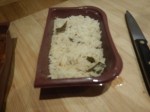
As I usually do, I cooked the curry in the microwave stirring the meal halfway through.
It’s when, I put the meal on the plate, that I burn fingers and make a mess.







Note.
- I didn’t get the pictures, as well as I might.
- But you get the gist of the method.
- The spoon in pictures 2-5 is probably over seventy years old.
- The two parts of the tray cut and split easily.
- In pictures 3 and 4, I’m building a wall with the rice.
- In 5, I just tip the curry over the top.
- In. 7, the tray could have been licked clean. It wasn’t, but everything fell on the plate.
- No mess!
I shall use this method in future.
Do Less Numbers Of Knives In A Kitchen Cut Knife Crime?
I’ve thought this might be possible, so I asked Google AI and I received this answer.
Yes, reducing the number of kitchen knives, particularly by replacing pointed-tip knives with safer, rounded-tip alternatives, is considered an effective, evidence-based method to cut knife crime. Research indicates that kitchen knives are used in at least half of all stabbings, making them a primary weapon in both domestic and public violence.
Here is a breakdown of how reducing the number or type of kitchen knives impacts knife crime:
The Impact on Knife Crime
Reduced Lethality: Studies in Crime Science and by De Montfort University found that round-tipped knives do not pierce clothing in the same way as pointed knives, significantly reducing the potential for fatal injuries in stabbing incidents.
Lowered Availability: Because many violent attacks are impulsive, reducing the availability of lethal kitchen knives—by limiting ownership, changing the design, or having fewer in the home—can stop them from being used as weapons of convenience.
Preventing Domestic Homicides: Pointed kitchen knives are involved in over 50% of stabbing homicides in the UK. Removing them is seen as a key way to reduce fatalities in domestic altercations.
Proposed Strategies to Reduce Knife Numbers
Phasing Out Pointed Tips: Researchers are calling for the phasing out of traditional pointed kitchen knives, replacing them with rounded-tip knives, as they still function fully for cooking but are far less effective as weapons.
“Pointless” Campaigns: Police units, such as those in Kent and Nottinghamshire, have launched “Safer Knife Replacement Schemes” that offer families rounded knives in exchange for their pointed ones.
Restricting Sales: Proposals include banning the sale of long-pointed kitchen knives, which are identified as a primary weapon and are not considered essential by many chefs for daily food preparation.
Limitations
Complex Issue: While reducing access to dangerous knives is a major step,experts believe it cannot be the only solution; it must be accompanied by education, youth support, and other crime-prevention initiatives.
Replacement Effects: There is debate over whether offenders will simply switch to other weapons if long, pointed knives are restricted, though studies on similar interventions (like reducing access to paracetamol) suggest that reducing the easiest means of violence still saves lives.
In summary, reducing the number of pointed, easily accessible knives in the kitchen is not just about having fewer knives, but changing the type of knives available, which is deemed a highly practical step in reducing violent injuries.
I wondered if the answer for a household would be the same.
Repeating the question with household, I received the following answer.
Yes, research suggests that reducing the number of easily accessible, pointed kitchen knives in households—or replacing them with safer, rounded-tip alternatives—can cut knife crime and reduce the severity of injuries.
Kitchen knives are the most common weapon used in stabbings and homicides, particularly in domestic violence situations, because they are readily available and often taken from the home.
Here is an analysis of how reducing household knife availability impacts crime:
The “Weapon of Choice” Problem
High Prevalence: Statistics from England and Wales show that pointed kitchen knives are involved in over 50% of homicides where the weapon type is known.
Impulsive Crime: Many knife offenses are spontaneous acts, often influenced by alcohol or drugs. When a weapon is not immediately available, the chance of the altercation escalating to a killing drops significantly.
Accessibility: Unlike illegal weapons like zombie knives or machetes, traditional kitchen knives are available in every home, making them a common choice for both teenagers and domestic abusers.
Evidence-Based Solutions
Replacing Pointed Knives: Research from De Montfort University found that round-tipped kitchen knives do not penetrate clothing in stab tests, whereas pointed ones do. Swapping pointed tips for rounded tips could significantly reduce the lethality of attacks.
Safer Knife Initiatives: Pilot projects, such as the “Pointless” scheme by the Kent and Medway Violence Reduction Unit, have successfully replaced pointed kitchen knives with round-ended knives in homes with residents at risk of violence.
Targeted Reduction: Experts recommend that a reduction in household knife crime can be achieved without restricting legitimate cooking activities by simply phasing out the long, pointed-tip knife in favor of safer designs.
Impact on Crime Rates
Lowering Lethality: While reducing the sheer number of knives is a factor, the primary focus is on reducing the lethality of the knives available, which is argued to reduce the overall homicide rate rather than just causing offenders to “switch” to other tools.
Preventing Domestic Tragedy: Because a large number of, specifically female, homicides occur in domestic settings, restricting access to sharp kitchen knives is viewed as a key preventative measure for this type of violent crime.
In summary, reducing the number of pointed knives in a household, or changing the standard design of kitchen knives to safer alternatives, is considered a practical, evidence-based intervention to cut knife-related deaths.
We Can Also Apply Delia’s Little Chopper
My picture has no knives visible, only this device.




It is difficult to deliberately cut yourself with this device. Especially as it needs to be plugged in.
Perhaps we need a lot more clever, safe machines and robots in the kitchen?
How Much Vitamin B12 Is There In A Leon Full English Breakfast Egg Pot?
I asked Google AI, the title of this post and received this answer.
Based on the ingredients of a LEON Full English Breakfast Egg Pot—which includes a poached egg, Cumberland sausage, bacon, and baked beans—this breakfast provides a substantial amount of Vitamin B12.
Estimated B12 Content: A single large egg contains roughly 0.6 micrograms (mcg) of vitamin B12. When combined with the pork sausage and bacon in the Full English pot, the total content likely provides a significant portion of the UK adult daily requirement of 1.5 mcg.
Key B12 Sources in the Pot: The primary sources of B12 in the pot are the free-range egg (specifically the yolk) and the meat (bacon and sausage).
Other Nutritional Highlights: The Full English Pot contains 25-28g of protein and 371-398 calories.
It certainly looks that this Leon egg pot gives a significant portion of the UK adult daily requirement of vitamin B12.
My Regular Ready Meals
These are the Marks & Spencer Ready Meals for one, that I regularly buy.
How Much B12 In An M&S Chicken Breast In Cheese & Ham Sauce For One?
How Much B12 In An M & S Chicken Jalfrezi With Basmati Rice For One?
How Much B12 In An M & S Lamb Hot Pot For One?
How Much B12 In An M & S Liver And Bacon For One?
Note.
In each of the linked posts, gives a B12 analysis from Google AI for each meal.

