Exploring Bilbao
Bilbao is an easy city to walk around, although there are virtually no maps, except rudimentary ones at Metro stations.




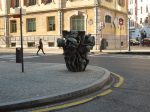
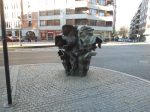

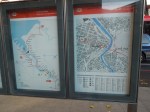














As you can see the weather was good and I found it helped my health, as it was mild and humid.
Bilbao also seemed to have a lot of clocks, most of which were working and showing the correct time. As Liverpool is the same, is this due to the connection with the sea?
Five Months Of Daily INR Testing
I’ve now been testing my INR using my Coaguchek device for five months now.
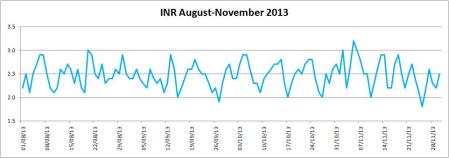
INR August-November 2013
I’ve missed very few days.
Nothing worries me about the results, but suppose you were testing every two weeks or so, you might start to get the impression your INR results were not what they should be.
I’ve now got enough data to start doing some serious analysis.
The Engineer Who Fixed His Own Heart
This story from the BBC’s web site is almost beyond belief, but it is totally true. Here’s the intro.
As an engineer, Tal Golesworthy is no stranger to taking things apart, figuring out what the trouble is and putting them back together with the problem solved.
But for more than 30 years, he lived with a life-threatening issue that was less easy to fix.
That is, until he took an idea from the garden, combined it with some basic procedures borrowed from the aeronautical industry and came up with a “beautifully simple” solution to treat his own heart condition.
He then managed to convince surgeons to put it into him.
That was nine years ago, and he’s still here!
Perhaps we need to train doctors more in simple engineering techniques.
A Must Read Opinion In The Sunday Times
Camilla Caendish’s opinion in the Sunday Ties today is very much worth reading. The title says a lot.
Tribal tensions on the ward are putting patients at risk
And it starts like this.
Managers bullying staff into fiddling cancer figures. Whistleblowers gagged with pay-offs. A&E doctors coping with patients who should have been seen by the GP. And that’s just last week’s headlines. With so many of the staff at loggerheads, it’s not surprising the National Health Service sometimes seems to forget about the patients.
It is full of nuggets that apply to any company or organisation. Like this one!
Hinchingbrooke Hospital in Cambridge has borrowed a programme from Toyota called Stop the Line. This lets any member of staff halt a procedure if they think the patient may be at risk. In one recent case, a patient was about to be stitched up after surgery when two theatre nurses found a swab was missing and “stopped the line”. An x-ray showed the swab in the patient’s abdomen. It was removed, saving the patient from harm and the hospital from heaven knows what kind of negligence claim.
If you can find the article, read it!
The Good And The Bad Of A & E
The saga of my hand is hopefully now finished.
But it does illustrate the good and the bad of A & E in the NHS.
The damage happened near to my surgery and the nurse patched it up. She also checked my tetanus and found it was up to date.
But possibly because of my Warfarin, the blood started to seep around the plaster and in the end, when I started dripping blood all over a Victoria line train, I got out at Warren Street station and I went to A & E at University College Hospital. They did a stronger patch but even that fell apart, probably because I type too much and the damage was on the point of the knuckle.
So it was back to the surgery and then on to Boots, where I bought a large traditional plaster to put over the lot, and some white cotton gloves to protect the whole package.
I still have a scab on the back of the hand and now because of the success of the hospital bandage, I wear a wrist support to take the pressure off my wrist and the knuckle.
The treatment, I got was generally good and quick, as who would complain at forty minutes in A & E for a minor injury.
But as I live alone and couldn’t patch it up myself with one good hand, it needed trips to get medical help.
So are we seeing more people going to A & E because so many of us now live alone? And is A & E geared up for it?
But the real problem that A & E has, is the lack of a joined up database with my GP. The nurse at the surgery checked my tetanus status, which I thought was good, but of course, I couldn’t remember the date. The nurse in the hospital asked and I told her it was good. but she had no means of checking.
Incidentally, one thing that saved time in A & E was that I’d been an in-patient at the hospital and I was already registered.
Those who object to a large joined up NHS patient database, are probably the people, who complain loudest at the wait in A & E.
But how much time and effort would it save?
My Annoying Hand
My poor hand doesn’t seem to have the will to allow a plaster to stick on it.
The nurse at the surgery had a go this morning and his effort with steri-strips is coming to grief, as my skin doesn’t seem to offer enough grip for them.
-
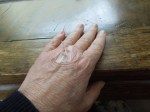
- The Strips That Won’t Stick
-

- A Proper Dressing
-
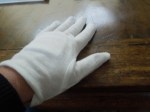
- Covered In A Cotton Glove
So I’ve now put a solid old fashioned lint patch and zinc-oxide plaster over the wound. I now cover it with a cotton glove to help stop the plaster being disturbed.
After all it is the Eve of All Saints’ Day.
I suppose the problem is that, as the wound is on the point of the knuckle, any movement stretches the skin. I think I might go to Rymans, if this doesn’t stick and buy a large rubber band.
It is all very annoying!
The Problem Of Living Alone
Yesterday wasn’t the worst of days by a long way, but it does illustrate the perils of living alone.
I had four jobs to do, when I planned my day.
1. Take delivery of my new television from John Lewis.
2. Go to the Regent’s Canal to prepare myself for the Ward Forum tonight.
3. Go to John Lewis to see if one of their kitchens would fit my requirements, when I replace Jerry’s terrible one.
4. I was also expecting the builder to come round to sort out when he would finish my half-completed bathroom.
That would all seem very simple.
But the builder and the television turned up at the same time, so I naturally asked him, if he’d help me put it on the wall. All it needed was to remove the old television, swap the bracket and then lift the other one on. But of course the old bracket didn’t fit and just needed to be drilled out. The sort of job, that I could have easily done, if I could find my Workmate, which is somewhere under the builder’s mess in the garage. The builder then left, leaving the old television on one sofa and the new one on the other.
So I decided to go for a walk along the Regent’s Canal and then when I got to Haggerston take the 242 bus to Oxford Street for John Lewis and lunch. But then I cut my hand on something and had to get it patched up. As I was a fair walk from home, I decided to go to my doctor’s surgery to clean myself up first. They checked the wound and put a plaster on it, so at least that bit worked. I then walked home looking for someone to drill out the plate. I didn’t find anyone, as most small engineering workshops have closed.
I then realised that I also needed to get a set of spare keys cut, as the builder has all my spare ones, so I walked around the corner to the local Locksmith. And there it was, sitting in the back of the shop, a proper bench drill. So I got the keys cut and the plate drilled so that it would fit the new television. And all for £14. Well done, Barry!
In some ways though, it was my undoing, as I now fitted the bracket and attempted to lift the television onto the wall. I could lift it with ease, but the constant stretching of the fingers in my left hand, meant that the cut opened up and the plaster fell off. This picture shows the location of the cut, which explains a lot.
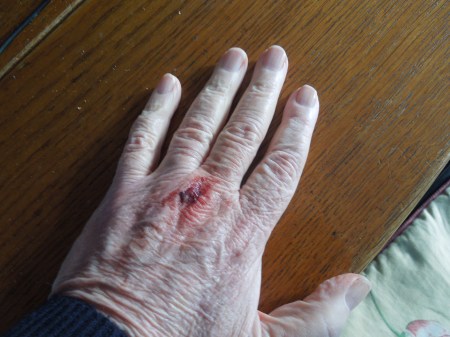
My Poor Hand
I couldn’t mount the television, as it is a job that needs two hands and two sets of eyes, because the television blocks your view of the bracket.
So eventually, I set off for Oxford Street to hopefully go to John Lewis and have some lunch. The first bus to arrive was a 30 and I intended to take it to Highbury and Islington station to go to Oxford Circus. But the dreaded roadworks struck again and the driver couldn’t take a direct route, so he went round the houses before dropping me and perhaps twenty irate passengers at the station.
I got a train without a problem, but by the time I got to Euston, blood was now going everywhere, so at the next station I chickened out and went to A & E at University College Hospital, where I got it properly bandaged. I was also in and out in forty minutes.
I now have the problem of putting one television on the wall and getting the old one downstairs for the Council. If I could do just one of these jobs, I could at least sit on a comfortable chair.
You can really understand, how One Foot In The Grave got written. But it’s just so much more likely that things will go wrong, when you live alone. After all, if I still lived with C, she’d have cleaned up the first cut, ut a decent plaster on it, told me to take it quiet and probably made cups of tea for me all day.
I’ve now got the problem of strapping a plastic bag over my hand, so I can have a bath.
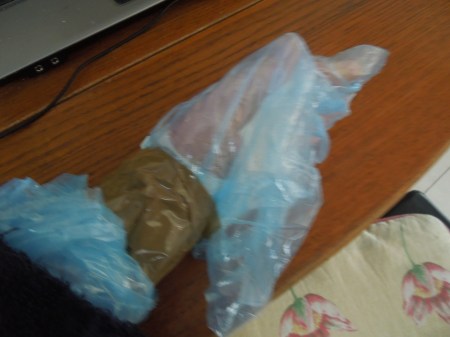
A Bath In A Bag Hand
It wasn’t too difficult. But this is probably because the fingers of the left hand work better in their bandage and I could cut the parcel tape before I put the bag on.
My Poor Hand
This morning, I cut my hand accidentally, as I walked the Regent’s Canal. How I don’t know, but despite timely repairs by the nurse at my surgery nearby, the wound refused to stop bleeding and I had to go to A & E at University College Hospital.
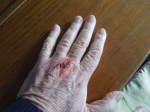
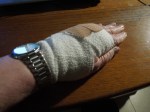
The nurse at UCLH, who bandaged my hand, put the bleeding down to the interaction between Warfarin and the other drugs I am taking.
The strange thing is that I can now type easier and get the Shift and Control keys right.
Who’d Have Thought It?
I have a Google Alert on my name and sometimes it picks up an interesting story like this one from NBC, entitled Curing Mississippi’s blues with Iranian care? Here’s the introduction.
An American doctor from Mississippi searched far and wide for solutions to his state’s endemic health problems.
Now, after years of practicing what he calls “health diplomacy,” Dr. James Miller, director of Oxford International Development Group in Mississippi, thinks he may have found some solutions in what may seem like an unlikely place: Iran.
Whether he’s right or not I don’t know, but you have to agree it’s not a story, you’d expect to read on an American news feed from NBC.
Good luck to the doctor.

