Platform Space At Milton Keynes Central
In Future Rail Developments At Milton Keynes, I said that there with all the new services, there would have to be some extra platform space.
So I went to Milton Keynes Central station and took these pictures.
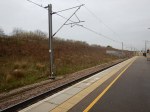
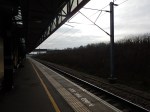

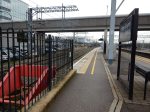
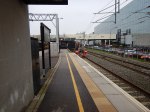
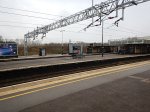
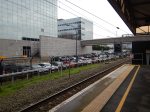
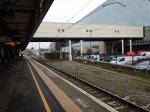
At a quick look there does appear to be more space, than is normal in stations of this size. But then it was only built in 1982.
Platform 2A
The Platforms and Layout section of the Wikipedia entry for the station, says this about the length of Platform 2A.
Platform 2A is a five-car south-facing bay platform.
I would assume, that the car length is the standard British Rail length of twenty metres.
The pictures clearly show that the platform is electrified.
Future Rail Developments At Milton Keynes
The Milton Keynes area and its stations at Bletchley, Bow Brickhill, Fenny Stratford, Milton Keynes Central and Wolverton, are in for a lot of development in the next few years.
The East West Rail Link
This map shows the East West Rail Link.

East West Rail Link
Note how it crosses the West Coast Main Line at Bletchley and has a connection to Milton Keynes Central.
The Wikipedia entry for Bletchley station has a section called Future. This is said.
The Marston Vale Line is the passenger carrying remnant of the Varsity Line. As of 2014, the line beyond Bletchley through Winslow to Bicester Town is closed to passenger traffic, with goods traffic going only as far as Newton Longville sidings for the waste disposal site there. The high level crossing (officially named the “The Bletchley Flyover” – built in 1959 as part of the Modernisation Plan, with 7 x 56 ft (17 m) spans and then expected to be used by 80 trains a day) over the WCML at Bletchley remains in place and in occasional use. There is a funded plan to re-open the line to passenger traffic via Bicester to Oxford by 2019 and an unfunded desire to rebuild it from Oxford right through to Cambridge. A key element of the plan is to build a Bletchley high level station so that passengers may transfer between the lines. (Note that there is no corresponding east to north route).
It is obviously, a bit out of date, as the East West Rail Link is now planned and funded to Bedford.
This Google Map shows the track layout at Bletchley with the Marston Vale Line joining from the East and Fenny Stratford station.

Bletchley Station And The East West Rail Link
Note.
- Stadium MK at the top of the map.
- The East West Rail Link can be seen curving to the west to the south of Bletchley station.
- The flyover over Bletchley station.
- Fenny Stratford station is to the south west of the large building at the east.
- The next station to the East is Bow Brickhill.
Bletchley will become a more important station.
East West Rail Link Services From Milton Keynes Central
The Wikipedia entry for Milton Keynes Central has a section called East West Rail. This is said.
From 2019, services are planned to operate (over a rebuilt East West Rail Link) to Oxford via Bletchley, Winslow and Bicester Town; and also to London Marylebone via Aylesbury and High Wycombe. Extension of the Oxford service to Reading has been mooted.
This will definitely need some more platforms at Milton Keynes Central, other than the single one 2A built for the still-born extended Marston Wale service to Milton Keynes.
I published some pictures in Platform Space At Milton Keynes Central, which show that there is some space.
Implications For Bletchley
I have now written The The Bletchley Flyover to cover the implications for Bletchley.
Great North Western To Blackpool
The Wikipedia entry for Milton Keynes Central has a section called Great North Western. This is said.
Great North Western Railway has been given permission to run 6 trains a day from London to Blackpool North from 2018, with conditional permission for a stop at Milton Keynes Central dependent upon future capacity after infrastructural work.
This will probably be very much a development, that will only affect Milton Keynes Central station.
Crossrail To Milton Keynes Central
The Wikipedia entry for Milton Keynes Central has a section called Crossrail. This is said.
Network Rail’s July 2011 London & South East Route Utilisation Strategy (RUS) recommended diverting West Coast Main Line (WCML) services from stations between London and Milton Keynes Central away from Euston, to Crossrail via Old Oak Common, to free up capacity at Euston for High Speed 2. Doing so would provide a direct service from the WCML to the Shenfield, Canary Wharf and Abbey Wood, release London Underground capacity at Euston, make better use of Crossrail’s capacity west of Paddington, and improve access to Heathrow Airport from the north. Under this scheme, all Crossrail trains would continue west of Paddington, instead of some of them terminating there. They would serve Heathrow Airport (10 tph), stations to Maidenhead and Reading (6 tph), and stations to Milton Keynes Central (8 tph).
In August 2014, a statement by the transport secretary Patrick McLoughlin indicated that the government was actively evaluating the extension of Crossrail as far as Tring and Milton Keynes Central, with potential Crossrail stops at Wembley Central, Harrow & Wealdstone, Bushey, Watford Junction, Kings Langley, Apsley, Hemel Hempstead, Berkhamsted, Tring, Cheddington, Leighton Buzzard and Bletchley. The extension would relieve some pressure from London Underground and London Euston station while also increasing connectivity. Conditions to the extension are that any extra services would not affect the planned service pattern for confirmed routes, as well as affordability.
Extending Crossrail to Milton Keynes would seem to be a sensible idea.
It would increase the capacity and frequency of services between Milton Keynes and London and open up several more direct destinations.
The quote from Wikipedia talks of increasing connectivity to Crossrail.
- The Watford DC Line is joined is joined at Wembley Central, Harrow & Wealdstone, Bushey and Watford Junction
- The Bakerloo Line is joined at Wembley Central and Harrow & Wealdstone
- The Metropolitan Line will be joined at Watford Junction.
This connectivity is in addition to that created by an Old Oak Common station.
As with the East West Rail Link, it will probably need extra platforms at Milton Keynes Central. But there is at least some space to create them.
Conclusion
Milton Keynes Central will be a lot bigger and busier than it is now.
But it will join that elite group of stations that are Crossrail’s and Thameslink’s super-hubs.
Report from Sir Peter Hendy to the Secretary of State for Transport on the Replanning of Network Rail’s Investment Programme
This report is crucial to a lot of reconstruction work continuing on railways in parts of the UK.
I’ve put the link, so I can find the report easily.
Here’s a taster of what the report contains.
This extract is entitled Case study – Aristotle Lane, Oxford and talks about the problems of closing a private level crossing in Oxford.
Network Rail planned to install a replacement footbridge over the Oxford to Banbury Line north of Oxford Station and close an adjacent private level crossing for safety reasons. People walking from a nearby car park, across some allotments to the other side of the tracks, used the level crossing. The new bridge will have a link to the allotments removing the need for people to cross the tracks.
The level crossing is not a public right of way and the rights to use it are owned by Oxford City Council. As part of the East West Rail (phase 1) improvement scheme, Chiltern Railways made an application in 2009 to close the level crossing as part of a wider project to upgrade the railway line.
Objections from allotment holders at the Public Inquiry meant that the approval was not granted. This meant that Network Rail needed to pursue a separate planning application in order to complete the work and deliver Marylebone to Oxford services.
Efforts to close the crossing and deliver the scheme continued. Meetings were held in 2012 between Network Rail, ORR and the Council to find a solution. Finally, in 2014 the principle to close this one level crossing was granted, but with the conditions that Network Rail had to fund and construct better access to the allotments, arrange a land swap so the local school could be expanded and to fund and build a new car park. All of these require further, and separate, planning permissions.
A planning application was submitted in May 2014 and approved a year later after three separate planning committee presentations. Construction of the bridge is now planned to start in January 2016 with completion in September 2016. The level crossing will then be closed seven years after the first application.
Kafka is certainly alive and well and living in Oxford.
For more information on this fiasco/farce/cock-up/vexacious litigation/waste of money (delete as appropriate!) read this article in the Oxford Mail, entitled Network Rail changes its plan for new Aristotle Lane bridge after protests.
Some of the comments are priceless.
I am very much of the opinion that all level crossings should be shut on safety grounds. If there are serious objections, then surely the railway should be closed until an agreed solution is negotiated.
A Better Experience In Milton Keynes
Milton Keynes has never been my favourite place, since I used to take my late son; George, to his boarding school, which inevitably meant a trip round the endless roundabouts. I was then mugged in the city by the street furniture, that I wrote about in A Pedestrian-Unfriendly City.
So when Ipswich were playing MK Dons, I thought I’d give the city one more chance.



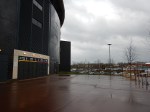

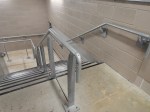










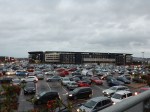
These are a few observations.
- The London Midland train was filthy and swimming in beer. I would assume it was supporters going to London.
- There is no information at Milton Keynes Central station, as to how you get to the ground.
- Bus 1 from Milton Keynes Central station, drops you just a rather cluttered short walk from Stadium MK.
- There are no signs or maps for Away supporters, as to what is the best route.
- Someone told me, that if you drive to the ground, parking costs £7 and you have to pay on-line.
- I’ve never been to a British stadium before, where burger vans and tea stalls outside the ground, were conspicuous by their absence.
- Several of the larger restaurants outside serve gluten-free food.
- The stadium has some of the best handrails I’ve seen in a ground.
- Coming back I just missed a bus and had to wait half-an-hour for the next small but full bus in a freezing cold shelter. I’d have taken a taxi, but there was no sign of a taxi rank.
I’ve never seen a ground, where it is assumed that everyone comes by car or supporters coach before.
I would have been distinctly miserable if Ipswich hadn’t won!
Milton Keynes is going to have to improve the buses. The number one bus, that I caught links Stadiujm MK and Milton Keynes Hospital to the stations at Milton Keynes Central and Bletchley.
This Google Map shows the area of Milton Keynes.
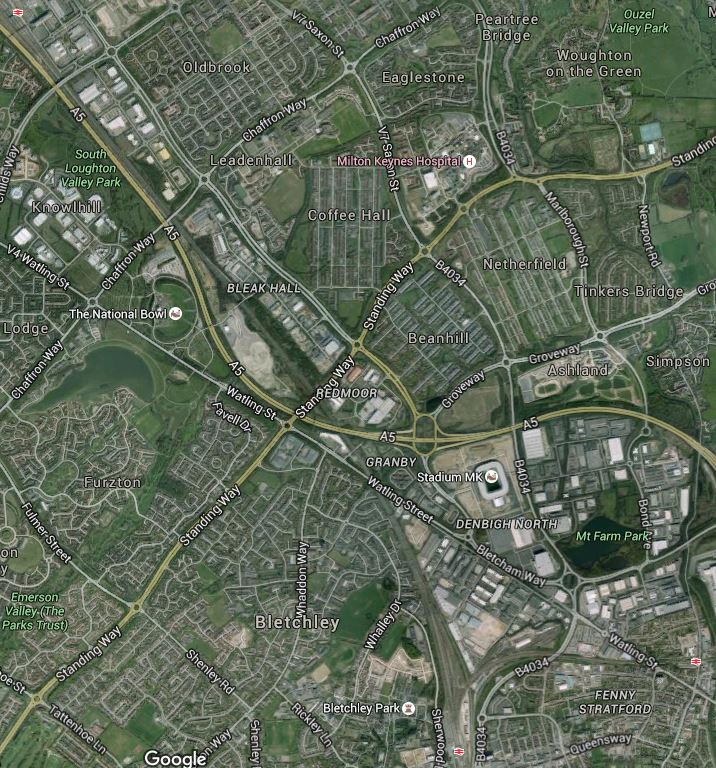
Milton Keynes Stations, Stadium MK And The Hospital
Milton Keynes Central station is in the North West corner, with Bletchley station st the bottom. The other station at the right is Fenny Stratford station on the Marston Vale Line, which will be incorporated into the East West Rail Link.
This map shows the route of the proposed line.
East West Rail Link
Wikipedia talks about extending the Marston Vale line to Milton Keynes Central, but although the track has been created, no trains have run.
Chiltern are also looking to extend their Aylesbury service to Milton Keynes Central via Bletchley, so hopefully this might prompt improvement in the bus services to Stdium MK and the Hospital.
I doubt it will, as Milton Keynes is one of those places where you’re a total loser, if you don’t have car and why should their taxes provide for better bus transport for the disabled, elderly and those that can’t drive.
I think we need a law in this country, that every hospital should have at least a four buses per hour direct service to the main railway and bus stations.
While Cameron Dithers About London, Manchester Decides!
I picked up two reports on airports this week.
This report on the BBC is entitled Heathrow airport delay gutless, says business group and talks about a lot of the fallout from David Cameron’s decision not to decide on a new runway for the South-East.
In contrast, you have this report in the Manchester Evening News entitled New images shows possible high-tech future of Manchester Airport’s check-in after ‘Super Terminal’ transformation, which describes the airports expansion plans.
Expanding Heathrow seems to generate controversy in super-tanker loads, whereas Manchester doesn’t sem to attract anything like the same level, even when you take the different sizes into account.
Look at this Google Map of Heathrow.
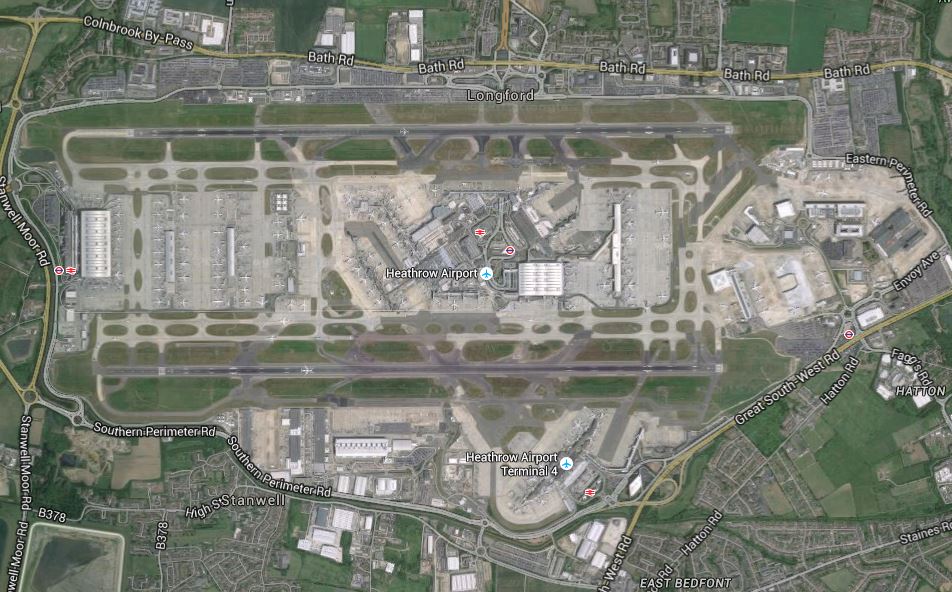
Heathrow Airport
Compare it with this one of Manchester Airport.
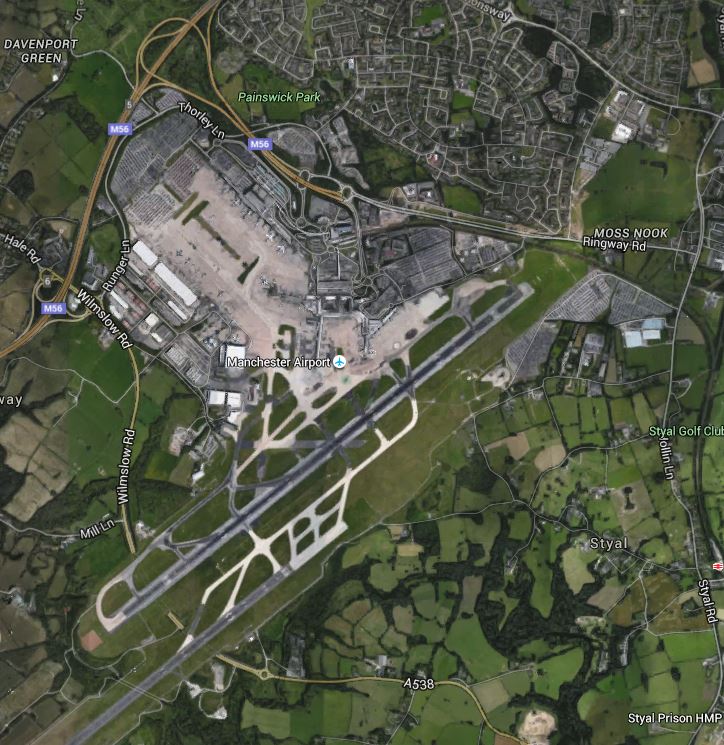
Manchester Airport
I don’t know for sure, but it would appear from these maps and larger ones, that Heathrow has used up much more of the available space around the runways, whereas Manchester hasn’t!
When Heathrow wanted to build Terminal 5, they had to move a sewage works, and another terminal would be difficult on the same site. Manchester has some space left.
So any expansion at Heathrow needs to expand the airport site, which is where a lot of the opposition comes from.
In my view the only way to expand Heathrow is to make better use of the current runways and the terminals. But that can only go on for so long!
And would the locals object to more landings and take-offs? You bet they would!
David Cameron is no fool and he knows that with the opposition of Boris Johnson and nearly all the candidates for the London Mayor against Heathrow, that it will never gain a third runway.
I hate to look backwards but the Roskill Commission of the 1960s and their eventual decision by a roundabout route was for an airport on Maplin Sands to the East of Southend.
But Harold Wilson’s government cancelled this airport, just as they did the Picc-Vic Tunnel in Manchester and improvement of the rail lines across the Pennines.
In my view as air traffic increases, Heathrow needs to expand to just survive, as there is competition all around.
- Schipol, Paris Charles de Gaulle and even Manchester competing for the interchange traffic.
- Trains to the Continent
- Birmingham, Gatwick, Luton, Southend, Stansted and others nibbling Heathrow’s markets.
- HS2
- Passengers are increasingly savvy and go from any convenient airport, using an acceptable airline at the right time and price.
- Internet technology will guide people to the best and cheapest way to travel from say Cambridge to Boston. An expensive Heathrow could be its own worst enemy.
- Other airports will offer better car-friendly solutions.
So as it can’t expand, due to the politicians and local residents, Heathrow must accept that it can’t and it must prepare itself for downgrade to just an airport for London and those living locally.
It also means, the South East must eventually find another site for a new airport to replace Heathrow.
The only place is the Thames Estuary!
So why didn’t the Davies Airport Commission recommend the Boris Island?
Howard Davies is a man of the City Establishment, who are very conservative with a small c and love the convenience, which Crossrail will make better, of Heathrow. How many submissions were against the Boris Island because it would mean too much change in their business?
But a properly designed Thames Hub Airport, could also incorporate the new Thames Barrier and Lower Thames Crossing that London needs.
To many of London’s residents and a lot of their politicians, it is a no-brainer! But for the City, only an expanded Heathrow will do!
So how will Manchester Airport affect London’s Airport mess in the future.
I believe that Manchester Airport will start to dominate air transport in the North of England and Scotland, just as Heathrow used to dominate the South.
- It has space for new terminals and aircraft and car parking.
- A rail network is developing to bring passengers to the airport from all over the North and Scotland.
- HS2 and probably HS3 are coming to the Airport.
- When it needs to expand it decides to and does!
It could also be combined with Liverpool Airport using a very high speed train, if it needed more runway capacity. It’s just forty-four kilometres as a Maglev would fly at 200 kilometres per hour, up the Mersey. Manchester and Liverpool airports could work together, much better than Heathrow can work with either Gatwick, Luton or Stansted.
So will an expanded Manchester Airport take a big bite out of Heathrow’s traffic? You bet it will. Especially, if Heathrow continues to not expand.
I think we should start to plan a Thames Estuary Airport now, even if we don’t built it for twenty years.. If we don’t, then when we need to start building, we’ll take another fifty years to make a decision.
Or we could always do what we’re doing now and let market forces, various interests and passenger choice decide our airports policy?
And as ever, engineers and architects, will improve aircraft and airports, so that we find them acceptable.
The airports problem won’t be solved until perhaps in about 2060, when the Dutch get fed up with Schipol and we join with them and the Belgians to create an airport perhaps slightly east of the Thames Estuary connected to various countries by high speed rail lines. It could be called Canute International!
The only certainty, is that I won’t be here to see it built!
Towards A Thames Valley Metro!
After my visit yesterday to Twyford Station and the Henley Branch and today to The Marlow Branch, I think something bigger could be emerging.
On the Great Western Main Line, between Paddington and Didcot, there are several branch lines and other more major routes that run local services into Reading and/or Paddington.
Taken in order from Paddington, they are.
- Acton to Northolt Line – 11 miles – Rather a leftover line that gets used for all sorts of traffic, including freight, diversions and driver training.
- Greenford Branch from West Ealing – 2.7 miles – Another leftover line, that is being rerouted to a bay platform at West Ealing – Could be transferred to the London Overground.
- Brentford Branch Line – 4 miles – Freight only
- Staines and West Drayton Line – 5.5 miles – Freight only.
- Windsor and Eton Branch from Slough – 2.5 miles
- Marlow Branch from Maidenhead – 7.15 miles – I wrote about it in The Marlow Branch.
- Henley Branch from Twyford – 4.5 miles – I wrote about it in Twyford Station and the Henley Branch
- Waterloo to Reading Line – Electrified, but links to the North Downs Line for Gatwick Airport, which isn’t!
- Reading to Basingstoke Line – To be electrified, with possibly some extra stations.
- Cherwell Valley Line from Didcot Parkway – To be electrified.
What follows are my observations.
Class 387 IPEMU Trains
Great Western Railway is to receive twenty-nine Class 387 trains from Thameslink and eight new ones from the factory.
These could easily be upgraded to IPEMU variants by the addition of batteries.
Once the power is switched on as far as Didcot Parkway station, I suspect that all these mainly short branches could be run using IPEMU trains, if passenger services were required or required to be run by electric trains.
Some like Greenford, Windsor and Eton, Marlow and Henley, would be as now, one train per branch. But elderly two car diesels would be replaced by new four car electric trains with a superior performance.
In Rumours of Battery Powered Trains, I reported on an article in Modern Railways magazine, which speculated that the extra Class 387 trains were to be IPEMUs and that they could be used on routes like Bedwyn and Oxford.
So it’s not my speculation!
Electrification Of The Branches
Some of the branches like Marlow Branch with its unusual layout and the Bourne End bridge and Windsor and Eton Branch with the historic nature of where it goes, will not be straightforward, as I suspect the heritage lobby will have a field day. As I wrote in Why We Should Use Independently Powered Electric Trains, the opposition to electrification in sensitive areas is stirring.
Electrification of the Greenford Branch might be more straightforward, but with five stations and a terminus in a bay platform at Greenford, I would suspect that a dedicated Class 387 IPEMU would cost less and only require the bay platform at West Ealing station to be electrified.
North Downs Line
In some ways, the North Downs Line is the most interesting, as I think that a dual-voltage IPEMU could easily supply a high quality service between Reading and Gatwick.
At present the direct service is hourly and takes around eighty minutes, using a two car Class 156 train.
Reading to Gatwick by Crossrail and Thameslink could on current figures and predictions for Crossrail times, take a few minutes over a hundred.
So the current direct route is quicker now with Class 165 diesel trains!
What difference would a faster four-car electric train make?
Crossrail’s Effect On The Great Western Main Line
The biggest effect will be when Crossrail arrives at all stations on the Great Western Main Line from Paddington to Reading.
Stations like Slough, Maidenhead and Twyford, where branches connect, will see a positive effect, as I suspect that more connections to and from the branches will be easier and involve less waiting.
Improving Services On The Branches
I think we could see some reorganisation of the services on the branch lines to give increased frequencies?
I think if Great Western Railway take the IPEMU route instead of electrifying the branches, there is scope for providing improved services from Slough to Reading and on the branches in the area. Diagrams could be arranged that after trundling down a few branches, the IPEMU did a section on the electrified lines to charge the batteries.
On thing I noticed on my trip to Marlow, was that Network Rail seem to be installing a lot of bay platforms at Crossrail stations. Some are London-facing for flexibility in the Crossrail schedules, but some are facing the other way. Could Network Rail be thinking out of the box and making sure, they don’t compromise any possible future services?
Reading As An Important Hub
As the routes develop, it would almost be like a Thames Valley Metro centred on the extremely well-connected Reading.
- Great Western Railway to Wales, the West Country and London
- Crossrail to London and beyond.
- Cross-Country Trains to the South, Midlands and North
- In a few years time the East West Rail Link could join Reading to Oxford, Milton Keynes, Bedford and the East.
The Class 387 IPEMU trains could serve the following stations from Reading, with very little extra electrification and perhaps the odd curve or two.
- Basingstoke
- Bedwyn
- Gatwick Airport
- Heathrow Airport
- Henley-on-Thames
- London Paddington
- Marlow
- Newbury
- Oxford
- Windsor and Eton Central
- Wokingham
If the Marlow Branch were to be extended, the trains could even reach High Wycombe.
Reading is going to have a very interesting time!
The Marlow Branch
After my exploration yesterday of Twyford Station And The Henley Branch, I felt I had to explore one of the other branches today.
So I took the Great Western Railway to Maidenhead station and went up and down the Marlow Branch Line.





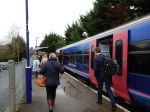
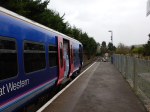
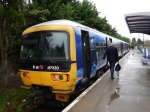
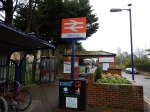





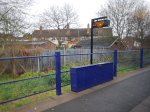


Unlike at Twyford, where you have several minutes to make the connection, at Maidenhead, I only had a couple, so pictures of Maidenhead station are a bit sparse in the gallery. However, I did take some others in Before Crossrail Maidenhead Station.
Much of what was said about the Henley Branch applies to the Maidenhead Branch.
- It is a short branch of just over seven miles with a change of direction in the middle at Bourne End station.
- An IPEMU would appear to be more than capable of providing a service on the line.
- At a quick look, it would appear that the platforms at Bourne End, Cookham, Furze Platt and Marlow stations could easily be made long enough for a four car train.
- The line has several level crossings and a couple of low bridges, that could cause problems with traditional electrification.
- Bourne End Railway Bridge is an historic bridge and I doubt that the heritage lobby would allow it to be electrified using overhead wires.
Operation
One almost unique quirk of the line is that the reversal of direction at Bourne End, where the driver has to walk to the other end of the train.
The Class 165 train is over twenty years old and was built before trains had modern control and wi-fi systems. Surely, a modern train could be driven from the rear, using CCTV for forward vision between Bourne End and Marlow.
Extending From Bourne End To High Wycombe
I think that it is true to say, that a lot of people would be very pleased if the branch line still continued past Bourne End and on to High Wycombe station.
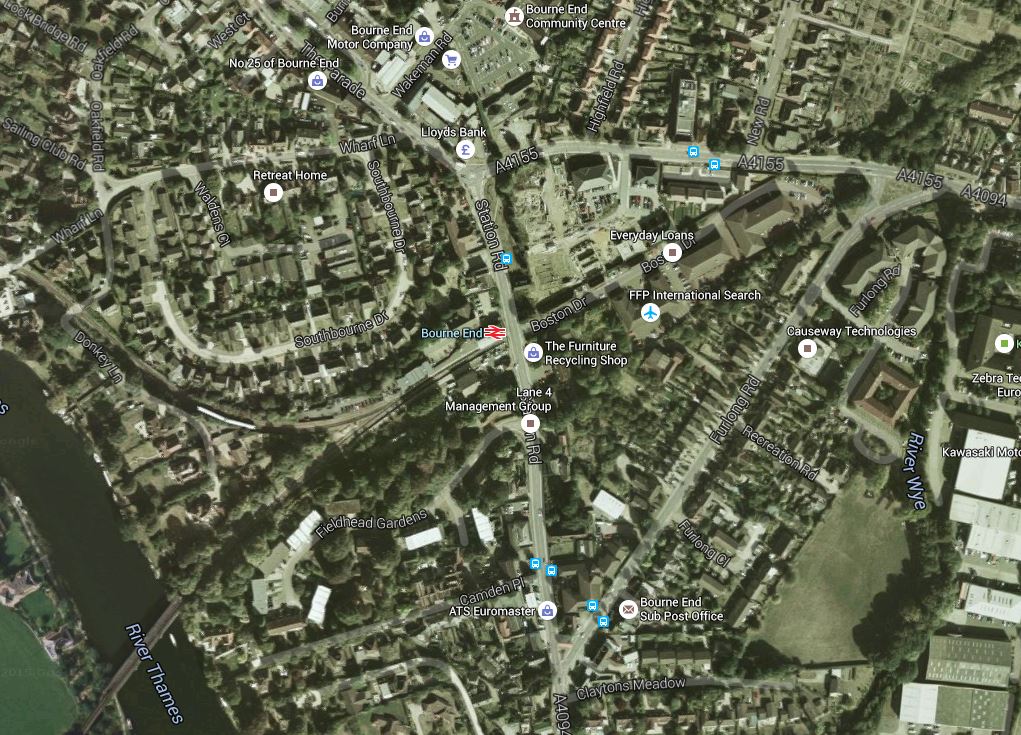
This Google Map shows Bourne End station.
Bourne End Station
Note how the line from Maidenhead comes in from the South West and the line continues to Marlow along the river after the change of direction. The former line to High Wycombe is visible as a green scar going off to the North East.
I certainly think that the ambitious natures of Chiltern Railways, Great Western Railway and Crossrail/Transport for London will mean that this extension to effectively make High Wycombe one change away from Crossrail will be seriously looked at by the train companies.
Work Starts At Ealing Broadway Station
Ealing Broadway station is the latest Crossrail station to call in the builders.


At present, they appear to be closing everything off and clearing out the old buildings.
The page on Crossrail gives more details. This is a visualisation.
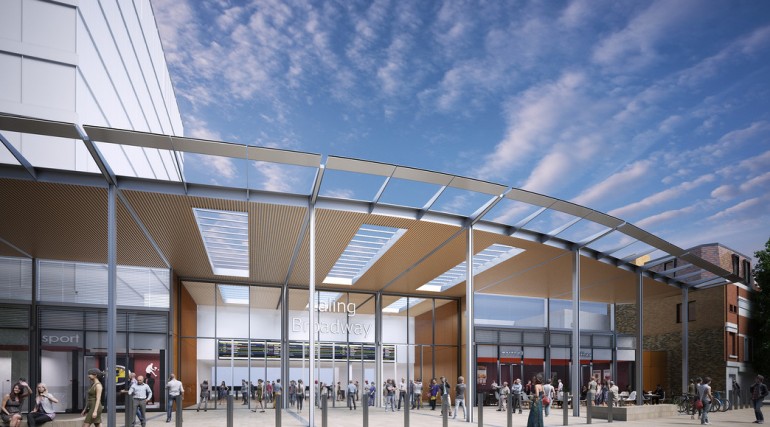
Ealing Broadway Station
I used to use Ealing Broadway station a lot in the past and it certainly looks much better.
Twyford Station And The Henley Branch
I went for lunch in Henley-on-Thames today taking the Great Western Railway to Twyford station for the Henley Branch Line to Henley-on-Thames station.
These pictures document the journey between my two train changes at Twyford station.
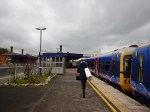
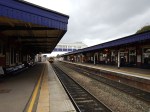
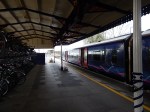
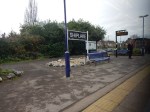
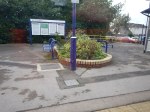
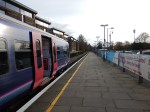
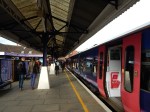




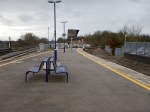
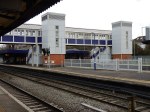


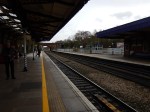
The branch is a typical single-track rural branch line that trundles its way through the countryside, over the River Thames to a single platform, that can take eight car trains.
It is currently served by a single two car Class 165 train, that goes up and down every fifty minutes or so all day, which is augmented by a couple of direct trains in the peak.
I feel that the Henley Branch Line could easily by worked by an IPEMU train. This could be either one of Class 387 trains ordered by Great Western Railway and converted to the technology or a new Aventra train.
Consider the following about the Henley Branch.
- It is only four and a half miles long.
- The speed limit of the line is fifty miles per hour.
- The bridge over the Thames has a lower speed limit and would probably be challenging to electrify.
- The two intermediate stations of Shiplake and Wargrave are built for eight car trains.
- There is at least one level crossing on the branch.
- The bay platform at Twyford station looks like it could take a five car train.
The Class 379 IPEMU test train with its sixty mile range could probably do six up-and-downs without a recharge. When an IPEMU train needed a recharge it would just pull into Platform 4 at Twyford station instead of the normal bay Platform 5, raise the pantograph and charge the batteries. Alternatively, Plstform 5 could have a short length of overhead wiring for recharging the battery.
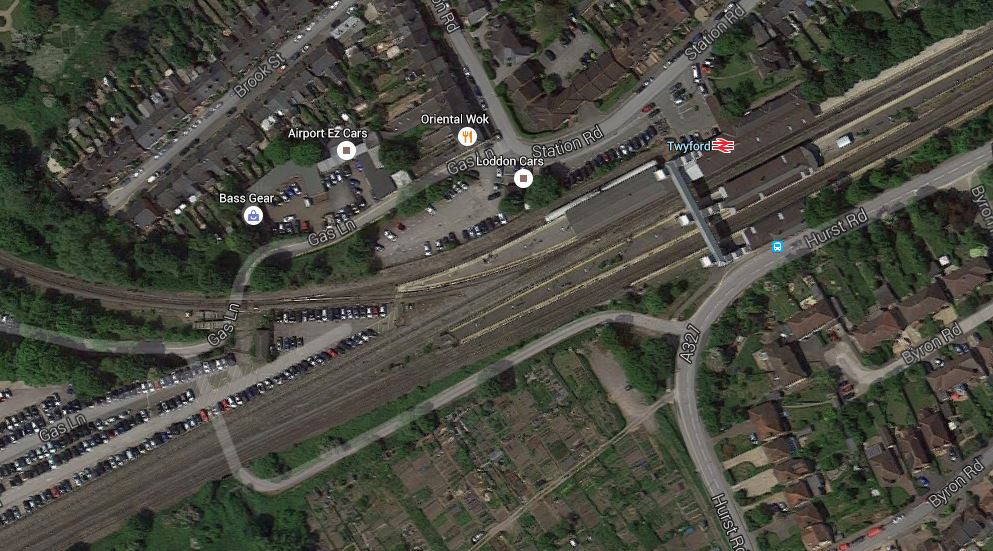
This Google Map shows Twyford station.
Twyford Station
Note the two car train in Platform 5 and the Henley Branch Line leading away to the north from the Great Western Main Line..
If Class 387 trains modified with IPEMU technology were to be used, Henley could receive four car electric trains as soon as the power was switched on as far as Twyford, with no major works on the Branch.
Two Class 387 trains could be coupled together to make an eight car train, that could also be run to and from Paddington during the peak and the Henley Regatta.
 The Anonymous Widower