Crossrail Are Uphill Excavating Again
In Coal Mining In Whitechapel, I described how the Crossrail contractors were using a technique called uphill excavation to connect the Crossrail tunnels to the existing Whitechapel station above.
In this document on the Crossrail web site, the company describes how the technique is being used again to connect the running tunnels to the Broadgate ticket hall above. This is said about the methods used.
This excavation will be carried out using an innovative method of uphill excavation. Traditional uphill excavation is considered unsafe due to the risk of excavated material falling onto the excavator and operatives, however the BBMV team realised that the ability to excavate upwards from existing tunnels at the base of the escalator shaft would generate significant time and cost savings. In response BBMV introduced a bespoke uphill excavator that is suspended from the ceiling of the construction tunnel and advances in line with the tunnel progression. A walkway along the side of the excavator provides the engineer with a safe working area and emergency egress for the operator. Once this excavation of this escalator shaft is complete we will begin to construct an access passage that will lead passengers from the Ticket Hall into the station tunnels, in early 2016.
There is also the first published picture I’ve found of an uphill excavator.
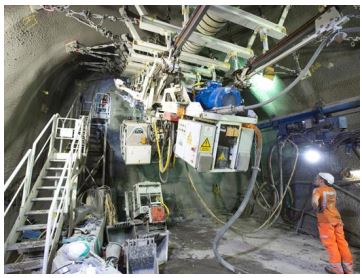
BBMV’s Uphill Excavator
I think we’ll find in the coming years that uphill excavation will be increasingly used in the construction of railways and other tunnels underneath towns and cities.
I’m sure, Crossrail 2 will use the technique to create stations at Angel, Chelsea and Tottenham Court Road. The biggest advantage is that it will silence the Militant Wing of the heritage lobby and all the luvvies, who are against London getting a better public transport system.
I also think, that we could build underground stations for HS2 at Euston, Birmingham, Manchester and Leeds, and use the technique to provide link tunnels to the existing stations above.
TPOD or Blockade?
This article on the Rail Engineer web site is entitled Preparing The Way For Bath Electrification.
It is a good read and it brings a new acronym into the English language – TPOD. This is said about the change of wording.
Normally, closing a 20 mile stretch of the main line, from Thingley Junction to Bath Station, for six weeks would be referred to as a ‘blockade’ but, during the consultation process, the word blockade became a very sensitive issue. It implied that Bath was closed for business, which wasn’t the case. Therefore, to ensure that tourists were not put off travelling to the city, it was suggested that Network Rail should use a different description for the closure. As a result the acronym TPOD was created – Temporary Period of Disruption! So the work was carried out during a six week TPOD. You’ll get used to it.
Only time will tell, if this friendlier word TPOD becomes accepted. Or will it have the same connotations as Rail Replacement Bus?
But words are important!
As an example, I object to messages on trains and buses using the word terminate at the end of a journey.
It sounds so final!
At least, it seems to be becoming more common for a message like.
This train finishes its journey here.
To be used. Especially, where train staff are giving an announcement.
Is Northern Electrification Going To Use Battery Trains?
This report on the BBC is entitled Network Rail to restart electrification of train lines. This is said.
The electrification of two railway lines is to be restarted after the projects were halted so a review could be carried out, the government says.
Work on the TransPennine Express Railway – between Manchester and York – and Midland Mainline – from London to Sheffield – was paused in June.
Sir Peter Hendy, chair of Network Rail, said the “temporary pause” had “given us the space to develop a better plan”
The Aventra IPEMU
Looking at the electrification of the two lines in posts over the previous few days, I have come to the conclusion that properly engineered battery trains built by Bombardier in Derby called Aventra IPEMUs (Independently Powered Electrical Multiple Units) could charge their batteries on existing sections of electrification and jump the gaps at speeds of up to at least 110 mph and possibly 125 mph, by running on batteries.
If that sounds like something that is too good to be true, I don’t believe it is! I was impressed when as a paying passenger, I rode the prototype train between Manningtree and Harwich.
For those who think that a battery train is just so-much Mickey Mouse-technology, note that the battery supplier; Valence is linked to Tessla; the electric vehicle manufacturer. A review of their latest car is on Autocar. The biggest problem with the car is not the power, range and performance, but the time it takes to charge the car from a typical supply. In addition to the overhead wire or third rail of the railway, an Aventra IPEMU has to charge the battery, the train will also charge the batteries using the regenerative braking system.
The TransPennine Line
On the TransPennine Line from Liverpool to Newcastle, the only gap in the electrification is the forty-three miles between Leeds and Manchester.
Aventra IPEMUs have a range of sixty miles, so Liverpool to Newcastle would be electric all the way and could be faster by up to thirty minutes on the current three hour journey.
Read Jumping The Electrification Gap Between Leeds And Manchester for full details on what it would entail.
The Midland Main Line
On the Midland Main Line, the electrification reaches from St. Pancras to Bedford.
As Corby, Kettering and Leicester are all within an Aventra IPEMU’s range from Bedford, these places could be served by these trains, once a certain amount of track and station work had been completed.
Read Thoughts On Midland Main Line Electrification for full details.
Delivering The Projects
The BBC article says this about the schedule.
The TransPennine upgrade is expected to provide capacity for six “fast or semi-fast trains” per hour between Manchester, Leeds and York , reducing journey times by up to 15 minutes.
The Manchester to York section of the work is now planned to be completed by 2022.
Once completed, the whole line from Liverpool to Newcastle will be fully electrified, the Department for Transport added.
The electrification of Midland Mainline north of Bedford to Kettering and Corby will now be completed by 2019, and the line north of Kettering to Leicester, Derby, Nottingham and to Sheffield will finish by 2023.
My project management knowledge and observations of Network Rail, say that to get electric trains to Kettering and Corby by 2019, would be a very tight schedule to perform on a working railway using conventional electrification!
But if it were needed to replace the current Class 222 trains with Aventra IPEMUs, it would just be a matter of certifying the line for the new Aventra IPEMUs and training the drivers and other staff.
There would be little or no work outside in the elements and all of the electrification would effectively be done in a comfortable warm factory at Derby!
I also feel that if say Network Rail said that the projects would be delivered on a particular date, that the risk of non-delivery would be very small.
Aventra IPEMUs can’t be delivered earlier, as the Derby factory will be jammed solid with production of Aventras for Crossrail.
On the other hand to prove the concept, would Bombardier modify a Class 387 train to create an IPEMU variant to run in passenger service between St.Pancras and Corby. Note that there have already been rumours of Class 387 IPEMU variants for Great Western Railway.
I wouldn’t be surprised if such a train is created, as it would be a superb way to identify any problems, train staff, prove the credibility of battery trains to a sceptical public and even deliver electric trains earlier.
A Cunning Plan
There are twenty seven Class 387 trains running on the Thameslink route at the moment, that will be replaced by Class 700 trains between 2016 and 2018.
As the Great Western Main Line won’t be electrified to Newbury, Swindon and Oxford until 2019 or whatever, there does seem to be the possibility of some very new Class 387 trains going into storage.
But as they are very similar to the Class 379 that was used for the IPEMU demonstrator, I do wonder if those clever engineers at Bombardier could convert some of these 110 mph trains into an IPEMU variant that could be used on services on TransPennine and the Midland Main Line.
If there were any spare Class 379 trains, I’m sure that other train companies would find a use for them! Especially, if Bombardier developed a plug-in battery system for the trains, so they could be used to prove if IPEMUs improved the lot of passengers on secondary lines.
You have to make your assets sweat.
Conclusion
I may be wrong, but I can’t see any other way to meet the schedule that has been published, unless some form of IPEMU is used to bridge the gaps in electrification..
It could be said that the North needs fast electric trains now and George Osborne needs them by 2020, as he has an election to win!
It might not matter much to most people if the trains didn’t run until say August 2020, but George Osborne would be unlikely to win an election in May 2020, if the trains were not delivered and running smoothly.
Developments At And Around Lea Bridge Station
These are the latest pictures I took of the station on September the 21st.
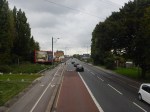

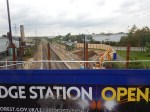
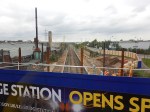
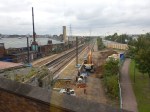
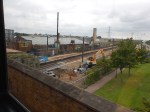
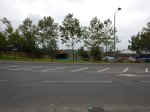


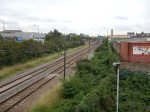

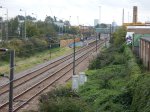



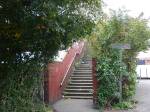
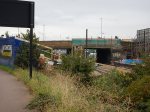

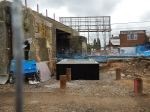

The pictures also show that around the area of the station are a large amount of industrial units, some of which couldn’t be described as high class, by any means. This Google Map shows the area.
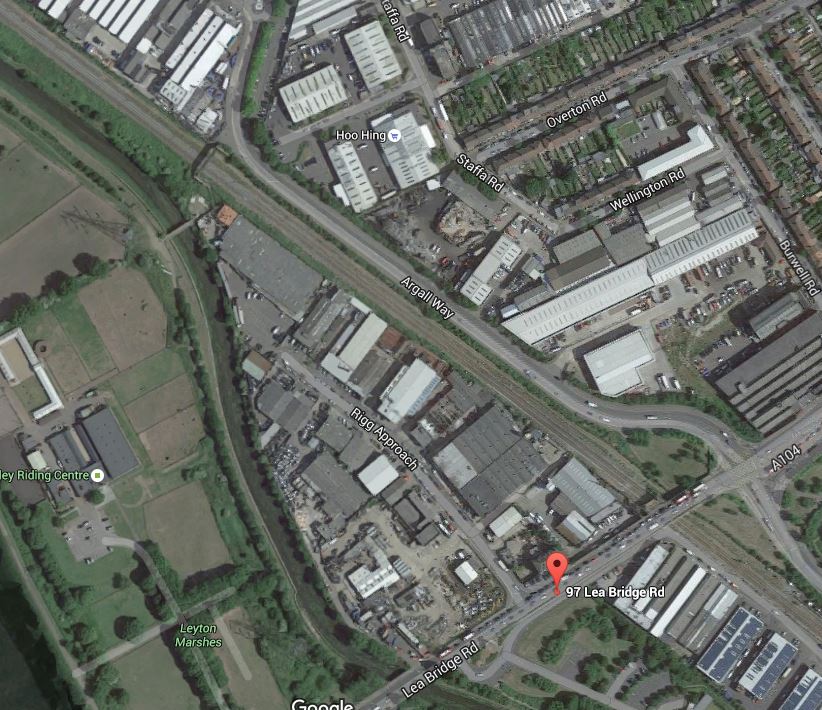
Around Lea Bridge Station
The station is being built in the curve of Argall Way, where the railway goes under Lea Bridge Road. The dreadful bridge over the railway can be spitted where Argall Way branches away from the railway at the top of the image.
97, Lea Bridge Road is picked out as that is a site owned by Bywater. According to this report from the Guardian series of local papers, the site and several others in the area are slated for the development of a thousand houses. This is the first two paragraphs.
Two huge housing developments will be discussed next week as developers look to build hundreds of homes in Waltham Forest.
Separate sites in Leyton could be transformed into new neighbourhoods after ambitious plans are put to Waltham Forest council.
Is the station the chicken or the egg?
Jumping The Electrification Gap Between Leeds And Manchester
The Battery High Speed Train
An Aventra uses a modern version of the same bogies that are used in the Class 222 trains, which are capable of 200 kph. As the Class 387 train, which is a version of the Electrostar, can travel at 110 mph, I wouldn’t rule out that the more modern Aventra could run at 200 kph or 125 mph. Obviously, this speed would probably only be attainable in places on the East Coast Main Line.
Example times between York and Newcastle include.
- East Coast InterCity 225 – 56 minutes
- East Coast InterCity 125 – 62 minutes
- Transpennine Class 185 – 67 minutes
So if the performance on the line of an Aventra IPEMU was the same as an InterCity 225, then this would knock eleven minutes of the trip to Newcastle
Acceleration on batteries would be the problem, not maintaining a high speed. that had been built up whilst running under the wires.
When jumping the gap in the electrification between Leeds and Manchester, as the train will have been running from either Liverpool or York, I would suspect that it would set out over the Pennines with a full load of electricity.
Manchester To Leeds Electrification Gap
The Manchester to Leeds electrification has now been paused and it is likely that it will not be completed in the next ten years.
The line has its problems as the three-car Class 185 trains, that work the line, are totally inadequate for the route.
There are two major routes between Leeds and Manchester.
- The Huddersfield Line via Dewsbury, Huddersfield and Stalybridge.
- The Calder Valley Line via Bradford Interchange, Halifax, Hebden Bridge, Todmorden and Rochdale.
The shortest distance by rail between Manchester and Leeds is just 43 miles. When I saw this, I didn’t believe it, but it’s all in this article in the Guardian.
So this means that if you want to run an electric train between Liverpool and Manchester to Leeds, York and Newcastle, the Aventra IPEMU would bridge the gap with ease.
The demonstration version of the Aventra IPEMU was a modified Class 379 Train and had a range of sixty miles on batteries.
So even this modified Stansted Express would have been able to bridge the gap on both routes with ease.
A fully engineered production Aventra IPEMU would be unlikely to have a shorter range on batteries.
So Aventra IPEMUs create a fully-electrified TransPennine route from Preston, Liverpool and Manchester in the West to Leeds, York and Newcsastle in the East.
Destinations In The West
These are all current Western destinations for Transpennine Express.
- Barrow – On an unelectrified branch line from an electrified Carnforth.
- Blackpool North – On an unelectrified branch line from an electrified Preston.
- Liverpool – On a direct line from Manchester that is completely electrified
- Liverpool via Warrington – On a direct line from Manchester that is partially electrified.
- Manchester Airport – Electrified from Manchester
- Windermere – On an unelectrified branch line from an electrified Oxenholme.
All could be served by using Aventra IPEMUs.
I suspect it would also be possible to serve Chester.
I’m not sure how Aventra IPEMUs would affect slower services like York to Blackpool North across the Pennines, but I suspect they would be faster than the current diesel multiple units.
With the franchises being reallocated, I suspect that it will be done in such a way, that the trains across the Pennines give a much better service.
Destinations In The East
These are all current Eastern destinations for Transpennine Express.
Cleethorpes – Probably too far, but the Class 185 trains could run the service as they do now!
Hull – Hull is perhaps fifty miles East of the East Coast Main Line and I believe that a solution can be found to do this on an out-and-back basis.
Middlesbrough – This is a few miles from Darlington
Newcastle – Electrified all the way from Leeds
Scarborough – The York to Scarborough Line is forty two miles long and I believe that a solution can be found to do this on an out-and-back basis.
Whether Aventra IPEMUs can do the return trip from the East Coast Main Line on an out-and-back basis to Hull and Scarborough, depends very much on how the range of the trains work out, when the production trains are delivered. I suspect Bombardier know and have either calculated it or proven it on a test rig, but obviously they are keeping it quiet and sticking with the sixty miles total range obtained with the Demonstrator.
If they can’t make it, I suspect that they can provide some form of charging at the Eastern termini.
I do suspect that because of the reorganisation of the two franchises we may see some extra destinations in the East.
Times Across The Pennines
At present times on the major routes are.
Liverpool to Newcastle – 3 hours
Liverpool to Hull – 2 hours 30 minutes with a change at Leeds
As I indicated earlier there is eleven minutes to take off the Newcastle journey and the change at Leeds probably wastes ten minutes on the Hull trip.
Other factors would have an effect.
- The time spent on a stop by the Aventra IPEMU will be less than that of the current Class 185 trains.
- If diesel multiple units on the two TransPennine routes can also be replaced with Aventra IPEMUs, then these trains would be less likely to slow the fastest expresses.
- The Aventra IPEMUs are faster than the current trains.
- Network Rail will probably be able to do some small amount of trackwork to speed trains up in places.
I have no idea what the eventual TransPennine time will be, but it will be a few minutes less than today’s times.
Is Coal In Terminal Decline?
I’m no lover of coal, because of all the pollution and carbon dioxide it creates. I’ve also never met anyone from a coal mining family, who would ever want to work in a mine.
So when I look at the latest freight statistics from the Office of Rial and Road, I am rather pleased to see that in the last year coal traffic on UK railways has fallen over the last twelve months, from 1.66 billion net tonne km to 0.64 billion net tonne km (a drop of 61.2%).
As this is mainly imported coal to be burned in coal-fired power stations, I don’t think it is bad for employment. Power stations may be closing, but new ones must be opening to fill the gap in electricity generation.
An Open Letter To George Osborne About Teeside
I should say, I have no connection to Teeside, except that I quite like the area.
There is little that can be done about SSI Redcar, other than hope for a miracle, as there is so much steel being produced in the world, that the price will only get lower and the plant will get less and less economic.
I also live in Dalston, which since the arrival of the London Overground five years ago, has very much gone up in the world! And in some ways, like employment, gone up for those at all levels in society.
So I very much feel, that improving a railway and other forms of public transport, can only make an area more attractive for investment, employment, living and leisure.
Teeside has been lobbying for a Metro for years, to link the knit the area together.
There is only one way that this can be provided in the absolutely necesary short time-scale.
The railway line between Newton Aycliffe and Middlebrough should be electrified, as soon as possible. Immediately, this would enable.
- The new trains being produced at Newton Aycliffe by Hitachi, to get to the East Coast Main Line under their own power.
- Direct electric train services between Middlesbrough, Darlington and all points North and South from Edinburgh to London on the East Coast Main Line.
Northern Rail or their successor have been mandated in the new Invitation to Tender for the franchise to provide 120 new carriages to replace the disgusting Pacer trains.
Some of these new carriages should be the IPEMU variant of the new Aventra trains, being produced by Bombardier at Derby, which could by the use of the electrification at Middlesbrough and on the East Coast Main Line and the trains on-board batteries be able to run on the following routes.
- Saltburn to Bishop Auckland via Middlesbrough and the Tees Valley Line
- Hexham to Nunthorpe via the Tyne Valley Line, Newcastle, Sunderland, the Durham Coast Line, Hartlepool and Middlesbrough.
- Middlesbrough to Whitby could be done later.
The faster electric trains would increase capacity, decrease journey times and improve frequencies.
The only construction needed for the new trains, would be a small amount of platform lengthening and adjustments to the track and signalling.
Other Train, Tram And Tram-Train Manufacturers And IPEMUs
The Aventra IPEMU is a Bombardier product, but I can’t see anything about using batteries in a train being patentable.
In the future we will see a range of energy storage devices based on all sorts of technology for transport applications. Kinetic Energy Recovery Systems describes the technology in Wikipedia
To deliver energy saving in transport, they need to be installed with regenerative braking and some clever control systems.
They are best generally described as kinetic energy recovery systems or KERS.
Applications will include.
- Passenger Cars – A sexy image would sell top-of-the-range hybrid and electric cars.
- Buses – Hybrid and electric buses in cities are the way forward and they’ll need intelligent energy storage.
- Trucks, Vans and other Commercial Vehicles – Why not, if it makes them more attractive to operators and makes vehicles more environmentally friendly?
- Trams, Trains and Tram-Trains – The Aventra IPEMU is just the first.
Looking at KERS in motor sport and Formula One in particular, in Wikipedia, there are several ideas, some of which are based on batteries and others on mechanical systems like flywheels.
As buses, trams, trains and tram-trains tend to be large vehicles with plenty of available space, where quite a large KERS can be tucked away, it is probably not the demanding weight-sensitive application of say motor sport or passenger cars.
So I don’t see any reason why a train or bus manufacturer like Alstom, Hitachi, Siemens or Wrightbus will not fit KERS.
Wrightbus are mentioned in this press release from Torotrak entitled FUEL SAVING KINETIC RECOVERY SYSTEM PROJECT READY FOR NEXT PHASE. This is the first paragraph.
Wrightbus have confirmed that an innovative Kinetic Recovery System (KERS) project, developed in a collaborative partnership and partially funded by Innovate UK, the UK’s innovation agency, is in full service trials with project partner Arriva.
Overall, this project looks very like the partnership that created the IPEMU demonstrator to prove the technology for trains, as it involves a bus manufacturer, a couple of technology or engineering companies, a transport operator and funding from the Government.
Incidentally, Torotrak is a British company with links to BAe Systems.
According to the press release the prototype bus is in service in Gillingham in Kent.
I can’t believe that the other train manufacturers are not looking seriously at KERS.
It is interesting to look at this article from Bus and Coach, which describes the Wrightbus project.
It is complicated mechanical setup, compared to installing KERS in an all-electric tram, train or tram-train, where it is a matter of designing an intelligent control system to link.
- Overhead electric supply at 25 kVAC or 750 VDC
- Third rail supply at 750 VDC
- Traction motors
- KERS
- On-board electrical systems like air-con, lights and passenger displays
The control system would balance the sources and needs according to route and load.
I think that any train manufacturer that doesn’t offer KERS as standard on a train or tram will be an also-ran!
The Technology That Enables The Aventra IPEMU
It is worth stating why it looks like the Aventra IPEMU looks so promising.
Steel Wheel On Steel Rail
The dynamics of this are well known and mean the following.
- There is a very low rolling resistance.
- As more weight is applied, the rolling resistance goes down.
- A fully loaded train might use less energy than an empty one.
You can’t ignore the laws of physics.
Aerodynamics
The air resistance of something like a train rises with the square of the speed.
But by careful aerodynamic design, you can reduce this energy loss substantially.
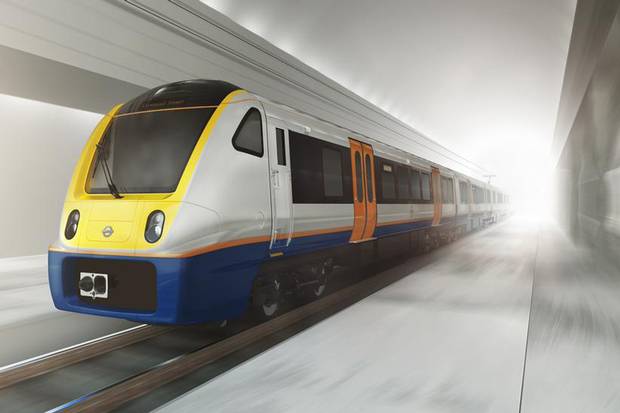
An Artist’s Impression Of A Proposed Aventra
The picture shows the clean lines of an Aventa
FLEXX-Eco Bogies
Boring but the design saves energy.
Low Energy Interiors
Air-conditioning and door and lighting systems have made great strides in recent years on reducing energy consumption.
Improved Energy Storage
The Class 379 Demonstrator used batteries, as nothing else was available. Better technology for this application like large capacitors and flywheels may be better suited to a train.
Because of the steel wheel on steel rail advantage weight is not a problem.
I think in a few years time, trains will use KERS. Like Formula 1, only bigger! It will be more affordable than batteries, as it’s purely electro-mechanical!
Regenerative Braking
Regenerative braking can save large amounts of energy, with Class 390 Pendolinos reportedly saving seventeen percent. But these trains give their generated energy to the overhead lines, whereas an Aventra IPEMU will keep the energy for itself in the storage device, if there is capacity.
From an electrical engineering point of view, I do wonder if energy storage is the best way to handle the electricity generated by regenerative braking, as otherwise it might have to be converted to transmit it back into the overhead wire or third rail.
I can see a time coming, when all electric trains have regenerative braking and energy storage!
Lightweight Construction
This only helps in the acceleration of the train, so it may not be as important as it would seem, because of the steel wheel on steel rail advantage.
Could it be that one of the reasons a High Speed Train rides so well, is that it is built out of steel and is strong and heavy?
Automated Systems
Things like pantograph deployment will be automatic, thus meaning when the train needs to add power and there is an overhead wire, this will be connected to power the train or top up the battery.
Automatic Train Control
But the biggest automation will be in the driving of the train. As on the Victoria Line the driver will tell the train to start and then it will go automatically to the next station. The train will collect information from the timetable, signals, GPS and sensors determining things like weather and passenger load and be driven accordingly.
Planes have been flown like this for many years.
Conclusion
The range of sixty miles quoted for the Demonstrator could be exceeded by a wide margin.
Thoughts On Midland Main Line Electrification
I have been thinking about how the method of electrifying the Midland Main Line might change if the Aventra IPEMU was available.
These are thoughts in no particular order.
The Battery High Speed Train
An Aventra uses a modern version of the same bogies that are used in the Class 222 trains, which are capable of 200 kph. As the Class 387 train, which is a version of the Electrostar, can travel at 110 mph, I wouldn’t rule out that the more modern Aventra could run at 200 kph or 125 mph.
Acceleration on batteries would be the problem, not maintaining a high speed. that had been built up whilst running under the wires.
Also, when the train comes to the end of its northward journey at say Corby, it has to brake. With regenerative braking on the Aventra IPEMU, all of this energy would go back into the batteries.
So does this mean that no charging would need to be provided at say Corby?
I’m not totally sure of the mathematics and physics, but I’m certain that a battery electric train with regenerative braking, would put a significant part of the electricity it would need to accelerate away from a station, into the batteries as it stopped.
This would mean that stops at Wellingborough and Kettering would not stop Corby services from reaching their destination.
St. Pancras to Corby
I estimate that the distance from the end of the electrification at Bedford and Corby station is about thirty five miles.
This would mean that this route out of St.Pancras could be covered by an Aventra IPEMU.
Would this release a Class 222 train for use elsewhere? Or would the Aventra IPEMUs enable East Midlands Trains to offer more capacity or an increased frequency on this service?
St. Pancras to Leicester
I estimate that the distance from the end of the electrification at Bedford and Leicester station is about fifty miles.
This would mean that this route out of St.Pancras to Leicester could be covered by an Aventra IPEMU, especially if it were possible to recharge the train at Leicester, using the sort of short electrification, I wrote about at Rugeley Trent Valley station in Up And Down The Chase Line.
Leicester has problems as a station, as this extract from Wikipedia says.
Train operators using the station include CrossCountry and East Midlands Trains. Due to a 15 mph maximum speed to the south of the station, all passenger trains stop at the station. Up until the winter 2008 timetable, the morning southbound The Master Cutler express from Leeds to London St Pancras was an exception although this now also calls.
Leicester is a bottleneck station as it has only four platforms. All platforms are well utilised, especially platforms two and three which receive freight as well as passenger trains. A freight loop goes to the east of the station alongside the carriage sidings which run adjacent to platform four.
This Google Map of the station shows the platforms and the freight loop.

Leicester Station
It does look that there would be space to expand the station and from this section in Wikipedia, I’m sure Network Rail are working on an upgrade to the area to address all the problems.
It would appear to be stating the obvious to say, that Leicester station must be sorted first before any electrification in the area.
An extra bay platform would probably allow Aventra IPEMUs to run an electrified service to St. Pancras, if East Midlands Trains felt this was needed. Because of the regenerating braking of the train, it might not be necessary to provide a means of charging the trains at Leicester.
Creating A High Speed Route To Chesterfield and Sheffield
A few years ago, much of the Erewash Valley Line was upgraded ready for electrification and high speed running. On the Future of this line, Wikipedia says this.
Network Rail as part of a £250 million investment in the regions railways has proposed improvements to the junctions at each end, resignalling throughout, and a new East Midlands Control Centre.
As well as renewing the signalling, three junctions at Trowell, Ironville and Codnor Park will be redesigned and rebuilt. Since the existing Midland Main Line from Derby through the Derwent Valley has a number of tunnels and cuttings which are listed buildings and it is a World Heritage Area, it seems that the Erewash line is ripe for expansion. As the new signalling is rolled out, train detection is moving away from the traditional Track circuit detection of trains to Axle counting.
So could we see all of the very fastest services from St. Pancras to Chesterfield and Sheffield using this route?
Is the route from Trent Junction in the South to Chesterfield and Sheffield in the North ready for electrification?
Network Rail must ensure that as much of the line is capable of 125 mph running and that all bridges and tunnels have sufficient clearance from London to Sheffield via Chesterfield.
Creeping The Electrification North
From Bedford the electrification would be crept north at a sensible pace, which would be designed to cause minimum disruption to services.
Every mile it went north would increase the reach of the new electric trains, but only after the bottleneck of Leicester was eased to allow high speed running through the station.
The Electric Spine
If the Electric Spine was to be implemented in full from Southampton to Sheffield and Doncaster, then the electrification must be completed North of Bedford.
But as there are a lot of places where the electrification will not be completed elsewhere, will we see a shift towards electro-diesel freight locomotives like the Class 88.
So although freight would take advantage of an electrified Midland Main Line, it may not be as important as many think.
Completing The Electrified Routes to Sheffield, Nottingham and Derby
These three important cities all have extensive local rail networks, that could benefit from an electrified hub, so that Aventra IPEMUs could be used to bring benefits to all the communities served by diesel multiple units and in Sheffield’s case, quite a few Pacers.
So as a minimum, this electrification must be completed.
- East Midlands Parkway to Derby
- East Midlands Parkway to Nottingham
- East Midlands Parkway to Chesterfield and Sheffield via the Erewash Valley Line.
Chesterfield to Derby would probably be filed in the Too Difficult box, but would be an easy run for an Aventra IPEMU.
Note that I would start the electrification from East Midlands Parkway, as this station and the Airport are talked about as destinations for tram-train services.
Obviously to complete the Electric Spine, the following electrification would also need to be done.
- Complete the electrification between Bedford and East Midlands Parkway.
- Sheffield to Doncaster.
But once Sheffield station is electrified none of the many local lines reaching out from the city would need to be electrified, as most services could be run using Aventra IPEMUs. Obviously, if there was a special reason like freight or tram-trains, this wiring would only help the Aventra IPEMUs.
New Elecric Services
Once electrification has been installed up the Erewash Valley Line to Sheffield, lots of important places become within range of Aventra IPEMUs running from St. Pancras.
- Barnsley
- Bradford
- Huddersfield
- Leeds
- Manchester
It would also mean that several existing cross-country services could be run using electric trains.
- Liverpool to Norwich
- Nottingham to Cardiff
- Bristol to Newcastle
Remarkable in some ways as a lot of electrification has been dropped.
 The Anonymous Widower