An Essex Girl Shows New Yorkers How To Behave
We often forget that Dame Helen Mirren was brought up in Leigh-on-Sea, although she was born in Hammersmith.
There’s a story in the Daily Telegraph showing her riding in state on the New York subway and the praise she has received for her perfect posture and behaviour.
Essex Girls may be the butt of jokes, but like Dame Helen, they are often blessed with strong wills to do the right thing.
Travel First Class For Less Than Standard
I’ve just booked my train ticket for the Rotherham Ipswich match next Saturday on East Midland Trains.
Coming back, the First Class ticket was actually four pounds less than Standard.
It’s actually costing me £38.25 with a Senior Railcard for the First Class Return. Typically, I pay £35.45 for a First Class Return to Ipswich, which is a journey that normally takes under half the time of one to Rotherham.
Electrification In East Anglia
East Anglia is very much a backwater as regards rail investment. Of the main lines only the Great Eastern Main Line is fully electrified and the trains on that line are not in the best of states. At least the line is going to be updated to allow refurbished trains to get to Norwich in ninety minutes and Ipswich in under the hour from Liverpool Street.
This speeding up of the easternmost line coupled with the improved links of Cambridge and Peterborough with Thameslink and Shenfield with Crossrail, will show up the rest of East Anglia’s railways for the crap they are.
Yesterday’s tiresome journey to and from Ipswich, illustrated how when there is major work or problems on the Great Eastern Main Line, the secondary routes can’t cope and bus replacements have to be used.
Suppose that the Ipswich to Ely Line together with the Cambridge branch had been electrified, as it should have been some years ago, when the bridges were opened up to take the larger freight containers.
This would have enabled passengers between Ipswich and London to have done the journey a lot easier with a change at Cambridge. Or for planned closures like yesterday, perhaps an hourly service could be run between London and Ipswich via Cambridge. As the part of the Great Eastern Main Line between Ipswich and Norwich was open, they could even have done the full trip with a reversal at Ipswich.
Electrification of the line from Ipswich to Ely and Cambridge, would give other benefits other than the broad one of flexibility, when a need for diversions arises.
1. More and more freight trains are going across Suffolk to and from the port of Felixstowe. At present all are diesel hauled, mainly by noisy and smelly Class 66s.
If there was an all-electric route from Felixstowe to Peterborough, then many of these trains could be hauled by environmentally-friendly and quieter electric locomotives. But that would mean electrifying the Felixstowe branch and the the port.
However, before this extra electrically eventually happens, we will see the arrival of the Class 88 locomotive. This locomotive which can run either using electric or diesel power will probably have sufficient diesel range and power to bridge the non-electrified gaps from Felixstowe to the East Coast Main Line.
2. Capacity on the routes between Ipswich and Cambridge and Ely is severely limited and electrification would enable something a bit larger than the current trains to be used.
3. Cambridge is overflowing with ideas, investment and jobs. But there is a shortage of space for housing where all the people drawn to the area can live.
So an increased capacity line to Ipswich, with hopefully a more frequent service, would surely help out with some of Cambridge’s space problems.
4. An efficient and good rail service between Ipswich and Cambridge, would certainly help development along the line and especially at Bury St. Edmunds and Newmarket. Both towns need stations to fit their increasingly important status.
5. Cambridge is getting a new station at the Science Park, This will not generally effect the line from Ipswich to Cambridge unless an extra curve is built at Ely to allow a direct connection between Ipswich and the new station.
6. Cambridge and possibly Ely are going to become more important rail interchanges, because of Thameslink, the new East West Rail Link and probable improvements in services direct to the Midlands and the North. Difficult journeys like Ipswich-Gatwick will possibly be easier with a simple change at Cambridge.
On the technical side, electrification of the Ipswich to Cambridge Line has a lot going for it, to make it not the most difficult electrification project. There’s no tunnels and the line has recently been upgraded to make the erection of overhead wires fairly easy compared to some other places. The line runs between two electrified main lines across fairly flat country.
There is probably a suitable resource of refurbished trains, like Class 317 or Class 365 that could be used on the line. Concerning the Class 365, which currently only run the Kings Cross to Cambridge, Kings Lynn and Peterborough services, many of which will be replaced by the extended Thameslink, where will these trains end up?
If Ipswich and Cambridge are joined together by an electrified railway, you can just hear the loud cries of unfairness from Norfolk, where the belief is that Norwich always takes precedence over Ipswich. After all Norwich is a city and Ipswich and Bury St. Edmunds are not!
But to be fair, a lot of the reasons for electrifying the Ipswich to Ely Line also apply to the Breckland Line, that links Cambridge and Norwich via Ely.
1. It would give the opportunity to run services direct to London, if the Great Eastern Main Line has to be closed for some reason.
2. It would enable capacity and frequency of trains to be increased.
3. It would help take the pressure off Cambridge.
4. It would help development all along the line.
5. The new Cambridge Science Park station is on the line.
6. Connecting Norfolk to Cambridge for all those ongoing services, would probably be a good thing.
The only factor which is not important on the line is freight.
If Norwich and Ipswich are fully connected to Cambridge and Ely by electrified railways, that only leaves one major line in East Anglia not electrified; the Ely to Peterborough line.
With all that freight going to and from Felixstowe, I can’t believe that this line will not be electrified.
Looking Through A Five Car Class 378 Train
I finally got a picture this morning of the view through a five car Class 378 train.
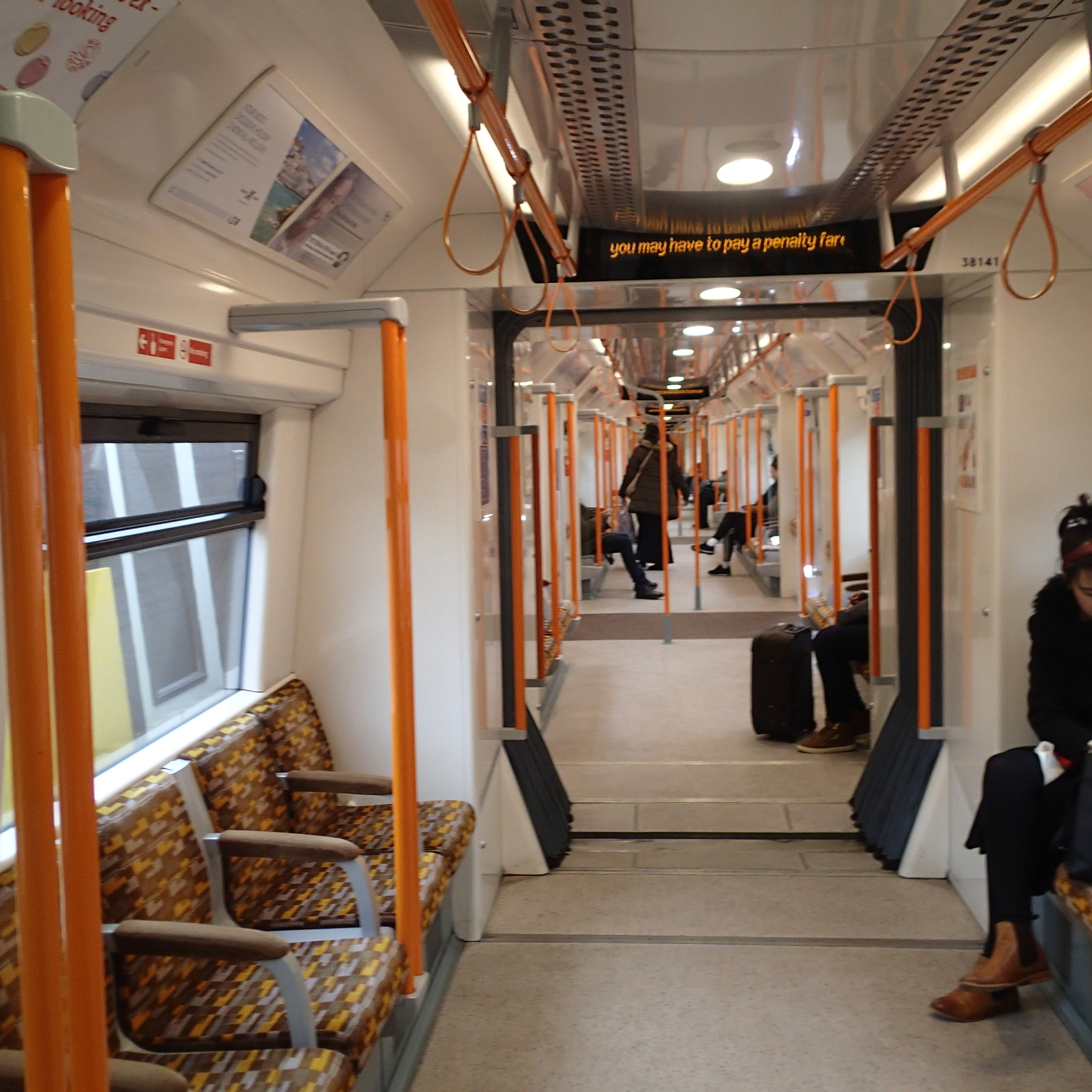
Looking Through A Five Car Class 378 Train
There’s certainly a lot of London Overground’s signature colour.
Hindsight is a wonderful thing.
If Transport for London had known that the Overground would be such a success, I suspect they’d have ordered five car trains and the lengthened the platforms before the line opened.
At least though Bombardier designed the trains so they could be broken in half and extra carriages could be inserted in the middle.
I wonder if in a few years time, we’ll see another lengthening of trains and platforms. Some documents from TfL say that six cars is a possibility.
Work Starts On The Bridge At Highbury Corner
I walked past Highbury and Islington station this morning and it appears that work is starting on replacing the bridge.


The crossing has been moved away from the station, but the old Post Office hasn’t been demolished yet.
You Can Do Better Than This; Greater Anglia
There has been a lot of anger from Ipswich Town about the lack of communication from Abellio Greater Anglia over weekend closures of the Great Eastern Main Line. This report on the BBC gives full details.
I took the 12:03 train out of Liverpool Street for Billericay. I had checked on the Internet and knew that this train gave me an arrival in Ipswich around two. But there had been a decided lack of information at Liverpool Street.
1. The staff seemed to have not been well-briefed.
2. Where were the informational posters, saying something like This way for all Chelmsford, Colchester, Ipswich and Norwich passengers?
The consequences was that there was a lot of confusion and an elderly couple travelling to Colchester with me didn’t know whether they should get out at Shenfield or Billericay. I wonder how many passengers missed the stop at Billericay and ended up at Southend!
One thing to which I’m right to object, is that I was paying the same £25.60 for a Senior Standard Class single, that I would pay on Monday for a similar ticket on a faster train all the way to Ipswich in just over an hour. Compare this with the price of £35.45, that I typically pay for a Senior First Class Return.
Abellio Greater Anglia also provided a Class 321 train without a toilet. Or at least I couldn’t find one. Many passengers would have expected a proper train with facilities and a rather tired Class 321 wasn’t good enough.
At Billericay, the system was much better organised and I even found a toilet. But then the town is in Essex and the county knows how to live on scraps and hand-me-downs.
I can’t complain about the coach that was provided either, except that it took what seemed to be an age to get to Ipswich.
There wasn’t much chaos at Ipswich, and I was able to enter the station to get a much-needed cup of hot chocolate.
The journey had taken two hours as against a normal direct journey of just over an hour. And of course for no reduction in price.
Coming home, I decided that it was better to go the long way round via Cambridge, where I could get a snack and then a train to Tottenham Hale. At least I got a First Class seat all the way, as I had the unused return half of a ticket for the last time I went to Ipswich, when I got a lift back home.
But the train was a rather overcrowded Class 170 train, although I did have a comfortable seat in First. But judging by the number of passengers on the 17:20 train after a match with Ipswich riding high in the Championship, a three car train is not big enough.
I just missed the connecting Tottenham Hale train, so I had to wait in the cold. But I did have time for a pit-stop and to purchase a snack in the Marks and Spencer in the station.
Normally, I get home about seven, but I didn’t get home until nine.
,
London To Edinburgh In Four Hours
In the February edition of Modern Railways, details of the new Virgin Trains East Coast franchise are beginning to emerge.
One of the details is that there will be a half-hourly four-hour service between the two capitals.
Anybody with any marketing nous will reckon that this alone will give the service a tremendous boost.
As there are a considerable number of improvements that could be implemented in the next few years, I think that by the end of the decade several minutes under four hours will become the norm.
The new Hitachi Class 800 and 801 trains arriving from around the end of the decade, won’t be any faster than the twenty-five years old InterCity 225, that currently work the route.
In fact, Modern Railways says that these trains may live on as a Golden Stud on the flagship services between London and Edinburgh.
But by 2020, if all goes well with ERTMS, both the InterCity 225s and the new Hitachi trains will be cleared to run at their top speed of 225 kph.
Could we see times reduced between the capitals to around three and a half hours?
I certainly think that the train company will be looking to see how fast they can run a capital-to-capital service!.
The line is 632 kilometres long, so three hours would need an average speed of 210 kph, which the current and proposed trains could probably attain over a straight railway line with no other traffic for perhaps an hour or so.
This illustrates that although trains get all the headlines, the real improvements in timings over the next few years will come with improvements to track and signalling.
The engineers of the East Coast Main Line have plenty of work to do, but they may bring a bigger service improvement than those building the new Hitachi trains.
No Wi-Fi On New Thameslink Class 700 Trains
Modern Railways in February is stating that the new Class 700 trains for Thameslink won’t have wi-fi.
I was told by a Furst Great Western employee that wi-fi will be important in the future to attract passengers onto the railway.
Some companies like Chiltern now offer free wi-fi to all passengers and this will become a norm in the next few years over much of the network.
The omission of wi-fi on the Class 700 trains will have to be rectified.
I did find this link, where someone is trying to get the notes from the Department for Transport on why the trains were specified this way.
Perhaps the reason is that free wi-fi would attract too many commuters onto the trains and they’d have to buy more trains to reduce the overcrowding.
Energy Saving In Thameslink Stations
Thameslink have made a lot of fuss about the solar panels on the roof of Blackfriars station, which is on a bridge across the Thames. Read this article in The Guardian.
It’s certainly impressive and good PR, but I changed trains on the bridge platforms a couple of weeks ago and it was rather cold and draughty. A station guy felt it was an awful place to work.
At the new London Bridge station, they are not using solar panels, as the dreaded Shard puts the station in the shade for a lot of the day. But they are going to use a ground source heat pump and possibly footfall tiles that generate electricity.
I think we should think very hard about how we design stations and other large buildings, so that they don’t need the energy in the first place.
I suspect we all have our least-favourite cold and draughty station.
I think is is probably true to say that designing the perfect station is an impossible task. In some ways one of the best in London is Liverpool Street, which was the second major terminus (after Euston) to be rebuilt in the modern era. Of the stations serving the South, Waterloo is an order of magnitude better than the others, since the latest updating. But generally, it is still a 1920s station. But both Liverpool Street and Waterloo aren’t high up in the cold and draughty league.
Will Dudley Get A National Very Light Rail Innovation Centre?
In London, there are several types of railway.
1. The main lines coming into London like the East Coast Main Line and the London Overground would typically be classified as heavy rail.
2. The London Underground is a metro, underground of rapid transit system. Take your pick on the name, but in London’s case it’s complicated by some Underground trains sharing tracks with heavy rail services.
3. The Docklands Light Railway is probably best described as what it says in the name; a light railway.
4. There is also the Tramlink, which in London is a tram that runs both on-street and on dedicated tracks.
Looking around the world, there are a multiplicity of types of railway and every country seems to have their own versions.
So I was interested to see this article on the BBC web site, which talked about a proposed Very Light Rail Innovation Centre and a new transport link in Dudley in the West Midlands.
So what is very light rail?
I suppose the only truly very light rail system in the UK, is the Parry People Mover in Strourbridge, which is a lightweight vehicle powered by an innovative electric drive train using a flywheel for energy storage.
It is my belief, that as you make vehicles lighter, they become more efficient and this improves the economics. This applies to both road and rail vehicles.
As the Dudley project is backed by the well-respected Warwick Manufacturing Group, I suspect that quite a few influential organisations, will think the Innovation Centre could be a worthwhile project.
This is a project that needs to be watched.
But consider.
1. The Docklands Railway is successful and liked by passengers and operators. So why is it, that there is no similar driverless system using the same technology?
2. How many proposals for trams and light rail systems in the ?UK, have never come to fruition?
3. Every tram system I’ve ever ridden seems to be a one off design from the stations and track to the vehicles and the ticketing system.
We must be able to do better!
And surely a properly-funded Innovation Centre, backed with the right technical resources wiill help us create better urban transport systems in the UK and the wider world.
 The Anonymous Widower