The Tragic Sinking Of The ‘Titanic Of The 1950s’
The title of this post, is the same as that of this article from The Telegraph.
This is the sub-heading.
The wrecking of Italian liner SS Andrea Doria, 70 years ago on Sunday, bore eerie similarities to the most infamous maritime disaster ever
These two initial paragraphs add more details.
The sinking of the Titanic has entered folklore to such an extent that practically every other maritime disaster is measured against it. Equally, the dreadful loss of life on that bleak April night in 1912 – and the sequence of unfortunate events that precipitated it – was so awful that, on the face of it, nothing could ever really bear legitimate comparison.
And yet, Sunday marks the 70th anniversary of what has been referred to as “the Titanic of the 1950s” – a description that is far from inaccurate. True, the events of July 26 1956 did not come at a cost of 1,496 people. Nor have they been the subject of a major Hollywood movie. But in other ways – a luxury liner heading for New York; a sudden but avoidable collision; damage that, from the first moment, could only have one result; a manic race to save those in peril; a wreck site in the North Atlantic – there were significant similarities.
I remember the disaster well and I suspect, that was because, I was only a few days short of my ninth birthday and it was extensively covered on our new black-and-white television.
But because a transatlantic liner was involved, it may have been more relevant to my family, as my mother’s Aunt Beattie was a regular user of the great ocean liners of the era. She also flew the Atlantic in a BOAC Stratocruiser.
The article on The Telegraph is well worth a read.
What Housing Is Being Built At Cockfosters Station?
I was looking for something to watch on the television and noticed that Cockfosters FC were in the FA Vase final today at Wembley against AFC Stonham.
For the first sixteen years or so of my life, I lived in Cockfosters, and until now, I never knew they had a football team, which is actually based just around the corner from the church, where I got married to C on September 7th 1968.
This Google Map shows the area.
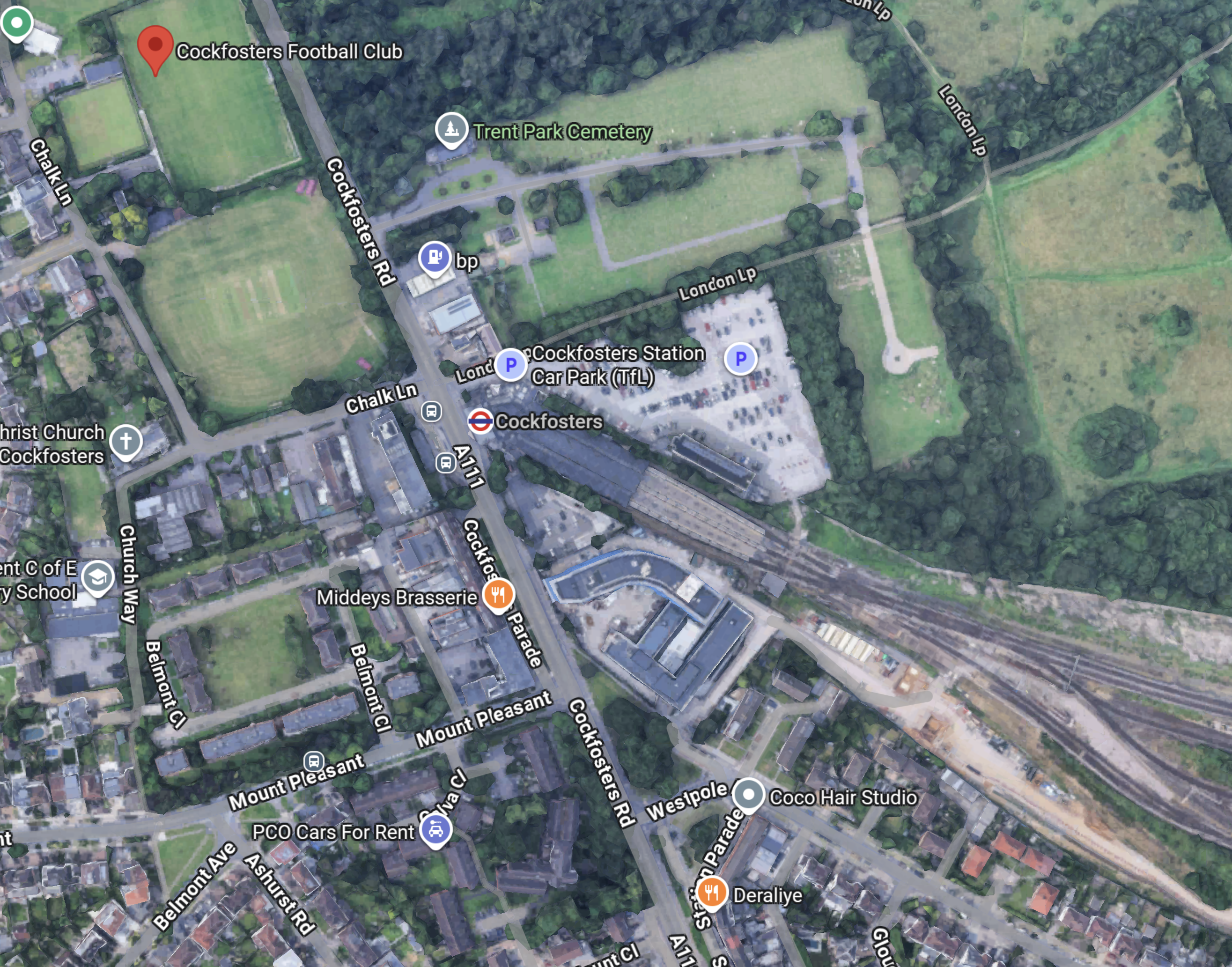
Note.
- The red arrow at the top of the map indicates Cockfosters F.C.
- Christ Church, Cockfosters is to the South of the football club.
- Cockfosters Road runs slightly diagonally down the map.
- Cockfosters station on the Piccadilly Line is indicated by the London Transport roundel.
- Cockfosters station has extensive car parking to the North-East of the station
- Cockfosters Depot is to the South-East of the station.
Our house was just off the Southern edge of the map, by Southgate School.
A 3D Image Of Cockfosters Station
This Google Map shows a 3D image of Cockfosters station and the buildings around it.

Note.
- Cockfosters station is indicated by the roundel.
- The station is a Grade II Listed building.
- The station has an elevation of 97 metres.
- Half of the station car park is going to be turned into housing.
- Trent Park lies to the North of the station.
- The road in front of the station is Cockfosters Road, which to the North joins the M25 at Junction 24.
- The building between Cockfosters Road and the railway used to be offices, but it is now being converted into starter housing.
In Starter Homes At Cockfosters, I write about starter homes being developed on the South side of the station.
Artificial Intelligence On The Housing In The Car Park
I asked Google AI the question in the title of this post and received this answer.
Places for London (Transport for London’s property arm) and Barratt London are building 373 residential apartments across four tower blocks on the former Cockfosters Station car park site. The largely car-free, mixed-use scheme includes 40% affordable housing, new public open spaces, and revamped TfL staff facilities.
Key Project Details
Total Homes: 373 apartments (a mix of 1, 2, and 3-bedroom properties).
Housing Tenure: All flats will be built for rent, with 40% of them allocated as “affordable” (including social rent and intermediate housing).
Building Heights: Four tower blocks ranging between 5 and 15 storeys tall.
Station Parking: The development is largely car-free.
Around 68 parking spaces will be retained at the station, including 12 dedicated Blue Badge spaces.
Public Amenities: The scheme introduces about 4,500 square meters of publicly accessible open space, children’s play areas, cycle storage, and minor commercial floor space.
Development Background
While planning permission for housing on the site was originally granted by Enfield Council in 2022, the project faced years of delays.
In late 2025 and early 2026, revised plans were submitted to add an extra storey to each building to accommodate updated fire safety legislation—adding 22 more homes to the initial 351 proposal.
You can track local planning updates and track progress via the Enfield Council Planning Portal.
I have some thoughts about this development.
Was There Any Opposition To Building Flats On Cockfosters Station Car Park?
From when I lived in the area, I remember that Cockfosters car park was well used in the 1960s and that trains on the Piccadilly Line were exceedingly busy, as I sometimes used to get them to travel to school.
I asked Google AI the question in the title of this section and received this answer.
Yes, there was intense opposition to the proposal to build flats on the Cockfosters Station car park.
The plans to build over 350 homes across blocks reaching up to 14 storeys faced major pushback from local residents, commuters, and Conservative MPs.
The primary points of contention included:
Loss of Parking: Opponents were concerned that wiping out hundreds of park-and-ride parking spaces would reduce the station’s accessibility.
It sparked fears that it would increase traffic on local roads and make journeys impossible for many, particularly blue-badge holders.
Over-development: The proposed height and density were heavily criticized for being out of character for the surrounding outer-suburb.
Heritage and Green Belt Impact: Residents argued that the massive tower blocks would negatively impact the neighboring Trent Park Conservation Area and the Charles Holden-designed Grade 2-listed station building.
Despite the controversy—which generated nearly 3,000 objections and was temporarily halted by the government in 2022—the project was officially given the green light to proceed. You can find full details on the planning outcomes via the Enfield Council Planning Portal or by reviewing the BBC News coverage of the development’s approval.
Do Any Train Depots Have Housing On Top?
I feel that we should maximise housing and in estates like the Barbican, there is extensive housing on top of car parking and even some active railways.
So why not on top of train depots like Cockfosters?
I asked Google AI the question in the title of this section and received this answer.
Yes, train depots and railyards increasingly feature housing built directly on top of them. Because large, open plots are scarce in dense cities, decking over active railway infrastructure has become an innovative engineering solution to generate new residential spaces.
Prominent examples of housing built over railway land include:
Royal Mint Gardens (London, UK): luxury residential and mixed-use development built directly above active train tracks on the approach to London Fenchurch Street.
Hudson Yards (New York, USA): The largest private real estate development in the U.S. features numerous residential skyscrapers built on a massive elevated platform constructed directly over the active John D. Carolan West Side Yard.
North Manhattan Rail Yards (New York, USA): Several multi-family residential projects, such as the Triangle Equities development over the MTA’s East 180th Street depot, utilize air rights to stack housing above active transit operations.
Hong Kong (Global Pioneer): Many of the city’s MTR depots (such as the Tseung Kwan O or Siu Ho Wan depots) and their surrounding stations have extensive private residential estates (known as Rail + Property Developments) built directly onto elevated decks atop the facility.
How is it done?
Building over a depot or railway requires constructing a heavy-duty “crash deck” or podium over the tracks. To prevent the noise, vibrations, and emissions of the trains from disturbing residents, developers use advanced building vibration isolation techniques. The residential buildings are structurally separated from the rail lines using specialized acoustic bearings and shock-absorbing foundations.
As we haven’t got the land in our big cities we should go for it.
Is The New London Museum Built Over Train Tracks?
This link shows all my posts on the new London Museum, as it will be called.
But what does Google AI say in answer to my question?
Yes, the new London Museum at Smithfield Market is built directly over and intertwined with active railway infrastructure.
The multi-billion-pound cultural project is located over or alongside a number of key transport elements:
Thameslink Tunnels: The subterranean galleries and historic brick vaults of the museum sit adjacent to active Thameslink railway lines that pass through a combined basement complex.
Historical Goods Depot: The museum’s underground level occupies what was originally the Great Northern Railway’s Farringdon goods depot.
Train Viewing Area: The museum features a specialized window where visitors can watch passing trains rumble by.
London Museum
To explore the building’s design, you can read more about it on the London Museum Buildings Guide.
World Cup 2026: Fans To Pay $150 For Train Ticket To Stadium
The title of this post, is the same as that of this article on DW.com.
This is the sub-heading.
Transportation costs for World Cup fans traveling to US stadiums could be more than 10 times higher than regular fares. Local officials and FIFA bosses are trading blame for the increased prices while fans feel fleeced
These three paragraphs add some detail.
Football fans trying to get to MetLife Stadium from New York City for the World Cup matches this summer will have to pay $150 (€127) for a round-trip, according to local transportation officials.
The price is almost 12 times higher than the usual $12.90 fare for the 15-minute trip from Penn Station in Manhattan to the stadium in East Rutherford, New Jersey.
“We are going to charge $150 for our roundtrip ticket on our system. So from New York to MetLife, MetLife back to New York,” said Kris Kolluri, the president and CEO of NJ Transit.
For less than the equivalent of $150 dollars, I could get a ticket from my house to any of the Premier League grounds in England and some will take a lot longer than 15 minutes.
Welcome to Trumpland, where the World Cup is primarily to make money.
New York Governor: ‘I Will Not Allow This Federal Overreach To Stand’
The title of this post, is the same as that of this article on offshoreWIND.biz.
This is the sub-heading.
Following the order of the US Department of the Interior (DOI) to halt all construction activities on the Empire Wind 1 offshore wind project, New York Governor Kathy Hochul said she would fight the federal decision.
This fight could get very nasty.
In the green corner, we have the New York governor; Kathy Hochul, Østed, Denmark and probably a lot of workers who thought they’d retrained for a new growing industry.
And in the orange corner, we have Donald Trump, Vladimir Putin and all the other useful idiots.
Interestingly, I may have met one of referees to this spat.
In The Lady On The Train, I describe a meeting with one of the most powerful justices in the United States.
As she either sat on the US Supreme Court or the New York State Supreme Court, it will be interesting how she would judge this case, given the liberal scientifically-correct conversation we had a few years ago.
The fight in the Courts would be very hard against a whole bench of formidable adversaries like this lady.
Offshore Wind Innovation Hub in New York Opens Third Call For Applications
The title of this post, is the same as that of this article on offshoreWIND.biz.
This is the sub-heading.
The Offshore Wind Innovation Hub in New York, led by Equinor in collaboration with Urban Future Lab at NYU Tandon School of Engineering and National Offshore Wind Research & Development Consortium (NOWRDC), opened the 2025 application process on 15 January, issuing the third call for its accelerator programme since the Hub was officially launched in January 2023.
These two paragraphs describe the work of the innovation hub.
“We look forward to building on the strong foundation of the Innovation Hub and supporting the next round of entrepreneurs and emerging technologies”, said Molly Morris, President, Equinor Renewables Americas. “The solutions identified by the innovators will play a critical role in advancing the offshore energy industry, developing supply chains, and strengthening energy security for future generations of New Yorkers.”
Last year, six companies were selected to join the Hub’s accelerator programme and receive support to develop further their solutions that could help advance offshore wind in New York and the US: Boxkite Software, Claviate, Indeximate, Pliant Energy Systems, Sensatek, and Triton Anchor. Through the first call for applications in 2023, the Innovation Hub selected Benchmark Labs, Flucto, Heerema Engineering Solutions, RCAM Technologies, OSC, and VinciVR.
Note.
- Many countries have innovation hubs like these based on research institutions and universities.
- Molly Morris, with her Norwegian support, seems the sort of woman, who can keep Trumkopf under control.
- The Offshore Wind Innovation Innovation Hub certainly seems to spread their support around.
- I don’t think the Innovation Hub’s philosophy fits with Trump’s ‘Drill, Baby, Drill’
I can see Molly Morris, Equinor and The Innovation Hub really annoying Trump.
Let the battle commence!
RWE And National Grid Answer New York Offshore Wind Call
The title of this post, is the same as that of this article on offshoreWIND.biz.
This is the sub-heading.
Community Offshore Wind, a joint venture of RWE and National Grid Ventures, has submitted a proposal to the New York State Energy Research and Development Authority (NYSERDA) to develop 1.3 GW of new offshore wind capacity in response to New York’s expedited fourth competitive offshore wind solicitation.
These four paragraphs add more details.
This next phase of the project builds upon Community Offshore Wind’s provisional offtake award to deliver 1.3 GW of wind capacity as part of New York’s third solicitation for offshore wind. In total, the projects are expected to generate USD 4.4 billion in economic benefits to New York.
Combined with its provisionally awarded New York project, Community Offshore Wind is on track to deliver nearly USD 100 million in workforce and economic development investments, the developer said.
The new proposal includes nearly USD 50 million in funding for workforce and community initiatives, with a focus on creating opportunities for diverse New Yorkers and supporting local non-profit organizations.
The proposal also includes an investment of up to USD 10 million in the offshore wind supply chain, to help New York businesses prepare for the economic opportunities the growing industry will create. All of these commitments are contingent on NYSERDA’s final selections.
is this partly a result of the meeting between Energy Security Secretary Claire Coutinho and Germany’s Vice Chancellor, Robert Habeck, that I wrote abut in UK And Germany Boost Offshore Renewables Ties?
We certainly seem to be getting some good deals on renewable energy these days with the Germans and the Koreans.
Perhaps someone in the government is doing something right?
BESS Projects Represent ‘Encouraging Progress’ in New York Efforts To Replace Dirty And Polluting Peakers
The title of this post, is the same as that of this article on Energy Storage News.
These are the first three paragraphs.
Battery storage is playing an active role in helping New York City retire its fleet of peaker power plants, with around 700MW of its most polluting power generation assets already fully retired.
According to a new report, 4,019MW – about two-thirds of a 6,093MW fleet – has either retired or put in place plans to replace turbines with cleaner technologies since New York adopted its climate goals and environment protection policies in 2019.
In addition to 700MW already retired, around the same amount again is actively being moved towards end of life.
Note.
- Just over 6,000 MW seems a lot of extra peaker power, even for a city as large as New York.
- But at least over 4 GW has been retired or the plans to replace it with cleaner technologies are in place.
- The New Yorkers certainly seem to be getting on with the conversion, with about a GW/per year either retired or planned to do so.
The article says this about batteries.
Battery storage is one of a number of different technologies that can be used to replace peaking capacity. While lithium-ion batteries with 4-hour duration might be the most directly analogous in terms of technical capability to peakers, effectively retiring the power plants could be facilitated with a combination of other resources including rooftop solar, offshore wind and energy efficiency measures.
I find the 4-hour duration interesting, but I suspect the Yanks know what they’re doing.
So if you were going to replace the 240 MW Glanford Brigg power station, which Centrica describe as a peaker station, with energy storage, you’d use a 240 MW/960 MWh battery, if you were working to New York rules.
Batteries in the UK, that I’ve talked about lately include.
Amp Hunterston – 400 MW/800 MWh – 2 hours
Amp Kincardine – 400 MW/800 MWh – 2 hours
- Carlton Energy Park – 1040 MW/2080 MWh – 2 hours – Close to an 884 MW gas-fired power station.
- Coalburn – 500 MW/1000 MWh – 2 hours- Close to a 946 MW collection of wind farms.
- Gateway Energy Centre – 450 MW/900 MWh – 2 hours – Close to an 732 MW gas-fired power station.
- Normanton Energy Reserve – 500 MW/1000 MWh – 2 hours
- Richborough Energy Park – 100 MW/100 MWh – 1 hour
- Spalding Energy Centre – 550 MW/1100 MWh – 2 hours – Close to an 860 MW gas-fired power station.
Note.
- The first field is Output/Storage Capacity.
- The second field is the duration.
- I have assumed Spalding Energy Centre is another two hour duration system, like Gateway Energy Centre, which is also being developed by Intergen.
- Two hours seems to be the most common duration for a UK battery.
Adding the batteries up gives a virtual 3940MW/7780MWh battery.
It amazing how they add up to quite large values. But then every little helps!
And these are only the ones I’ve talked about.
Virgin Atlantic Granted Permit For Historic 100% Sustainable Aviation Fuel Flight
The title of this post, is the same as that of this press release from Virgin Atlantic.
These two paragraphs outline the proposed flight.
Virgin Atlantic’s historic 100% sustainable aviation fuel flight has been granted a permit to fly by the Civil Aviation Authority.
Virgin Atlantic plans to fly across the Atlantic from London Heathrow to New York JFK on 28 November 2023 to test and showcase the feasibility of flying on 100% SAF.
Note.
- Strangely, I’ve never flown Virgin, although I did once book then to go to Kenya, but as the flight was cancelled at the last minute, I swapped to Kenya Airways.
- Virgin have seventeen Rolls-Royce-powered Boeing 787s.
As Branson is involved, I do wonder, if this is more about PR than anything else.
This paragraph talks about sustainable aviation fuel (SAF).
SAF is fuel derived from non-petroleum based renewable sources that is capable of being used as a replacement for, or blended with, kerosene. SAF can currently be used in jet engines to a maximum blend of 50% with traditional kerosene without the need for any modifications. There are several processes to produce SAF, including algae, synthesised fuels from hydrogen waste, or from directly capturing carbon dioxide. When fully replacing kerosene, SAF could reduce lifecycle carbon emissions by over 70% compared to conventional fossil jet fuel.
There is nothing specifically said about the fuel, that Virgin Atlantic will use.
I first mentioned this flight in a post in December 2022, which is entitled World’s First Net Zero Transatlantic Flight To Fly From London in 2023, Powered By The Rolls-Royce Trent 1000.
The press release from Rolls-Royce, said that the flight would be this year. So, that appears to be happening.
In fact, it does appear that Rolls-Royce are being thorough with their testing of sustainable aviation fuel, as these posts include both Rolls-Royce and sustainable aviation fuel.
- Rolls-Royce Completes Next Step On Its Journey To Decarbonising Business Aviation
- New Rolls-Royce Small Engine Set To Begin Tests To Advance Hybrid-Electric Flight
- Rolls-Royce And Gulfstream Give Wings To Sustainable Business Aviation
- News Of The Day From Rolls-Royce
- First In-flight 100% Sustainable-Fuels Emissions Study Of Passenger Jet Shows Early Promise
- Rolls-Royce Joins Boeing And World Energy For Successful 100% Sustainable Aviation Fuel Flight
Several are based on Rolls-Royce press releases.
World’s First Net Zero Transatlantic Flight To Fly From London in 2023, Powered By The Rolls-Royce Trent 1000
The title of this post, is the same as that of this press release from Rolls-Royce.
These are the three main bullet points.
- World first as Virgin Atlantic wins UK government funding to operate historic London – New York flight
- Rolls-Royce, Boeing, Imperial College London, University of Sheffield, Rocky Mountain Institute (RMI) and ICF also form part of an iconic British-led consortium
- Heralds future of low carbon aviation, with the wider sustainable aviation fuel (SAF) industry potentially creating thousands of UK jobs while supporting delivery of net zero aviation emissions by 2050
Note.
- The flight will take place next year.
- The aircraft will be one of Virgin Atlantic’s flagship Boeing 787s, which are powered by a pair of Rolls-Royce Trent 1000 engines.
- When fully replacing kerosene, SAF can slash lifecycle carbon emissions by more than 70% compared to conventional fossil jet fuel.
- This flight is expected to be fuelled by SAF made primarily from waste oils and fats, such as used cooking oil.
- SAF could create a UK industry with an annual turnover of £2.4bn by 2040, and which supports up to 5,200 UK jobs by 2035.
The flight could be made net zero, if it used 100 % SAF and offset any carbon dioxide produced.
What Is Sustainable Aviation Fuel?
It is also known as Aviation biofuel, which has a comprehensive Wikipedia entry, which has this first paragraph.
An aviation biofuel or bio-jet fuel or bio-aviation fuel (BAF) is a biofuel used to power aircraft and is said to be a sustainable aviation fuel (SAF). The International Air Transport Association (IATA) considers it a key element to reducing the carbon footprint within the environmental impact of aviation. Aviation biofuel could help decarbonize medium- and long-haul air travel generating most emissions, and could extend the life of older aircraft types by lowering their carbon footprint.
Sustainable Aviation Fuel (SAF) can be made in a variety of ways, which are described in the Wikipedia entry.
Could A Plane Run On Kerosene One Flight And SAF The Next?
I suspect that the practicalities of airline operation and schedules and the production and distribution of aviation fuel, will mean that if an airliner can run on both kerosene and SAF would be a great advantage.
This is a paragraph from the press release.
It comes hot off the heels of the world’s first sustainable fuel military transporter flight using 100% SAF, completed by the RAF last month using the iconic Voyager aircraft.
Note.
- The Voyager is an RAF military transport/tanker aircraft based on the Airbus 330 and fitted with Rolls-Royce Trent 772B-B-60 engines.
- Rolls-Royce Trent engines power both the Dreamliner and the Voyager.
- I’m sure that for operational reasons, the RAF would mandate a dual fuel capability.
This press release on the RAF web site, which is entitled Royal Air Force Completes World-First Sustainable Fuel Military Transporter Flight, gives more details of the RAF flight.
Hydrogen-Powered Turbines May Help Clean And Improve Electrical Grid Reliability
The title of this post, is the same as that of this article on Hydrogen Fuel News.
This is the first paragraph.
In less than three years, one or more hydrogen-powered turbines are expected to be up and running at or near New Jersey’s Bayonne Energy Center power plant, which feeds power to New York City.
Note.
- The Bayonne Energy Center is a peaker plant with ten gas turbines, with a total capacity of 640 MW.
- Peaker plants automatically cut in, when power demand is high, but power generation is low.
- The Bayonne Energy Centre transfers power to New York, through an underwater cable.
- The electrolyzers will be made by Ohmium International Inc and I suspect they will be powered by offshore wind.
- The hydrogen that is created will be stored. As Bayonne has a history of chemical manufacturing, there may be salt caverns that can be used or the hydrogen could be stored as a compressed gas or liquid in tanks.
I can see hydrogen being used in peaker plants elsewhere in the world, where there is lots of renewable energy and suitable hydrogen storage.
The hydrogen can also be used to decarbonise local industries and transportation.
The Potential For Wind Power In New Jersey
Wikipedia says this about the potential of wind power in the state.
New Jersey has the potential to generate 373 GWh/year from 132 MW of 80 m high wind turbines or 997 GWh/year from 349 MW of 100 m high wind turbines located onshore as well as 430,000 GWh/year from 102,000 MW of offshore wind turbines.
Note.
- New Jersey used 76,759 GWh in 2011
- It appears that most of these turbines would be located along the coast.
There is also a worry about hurricanes. But solving that is an engineering problem.
From my experience of modelling floating structures, I believe they may stand up to high winds better. But I’m not sure!

